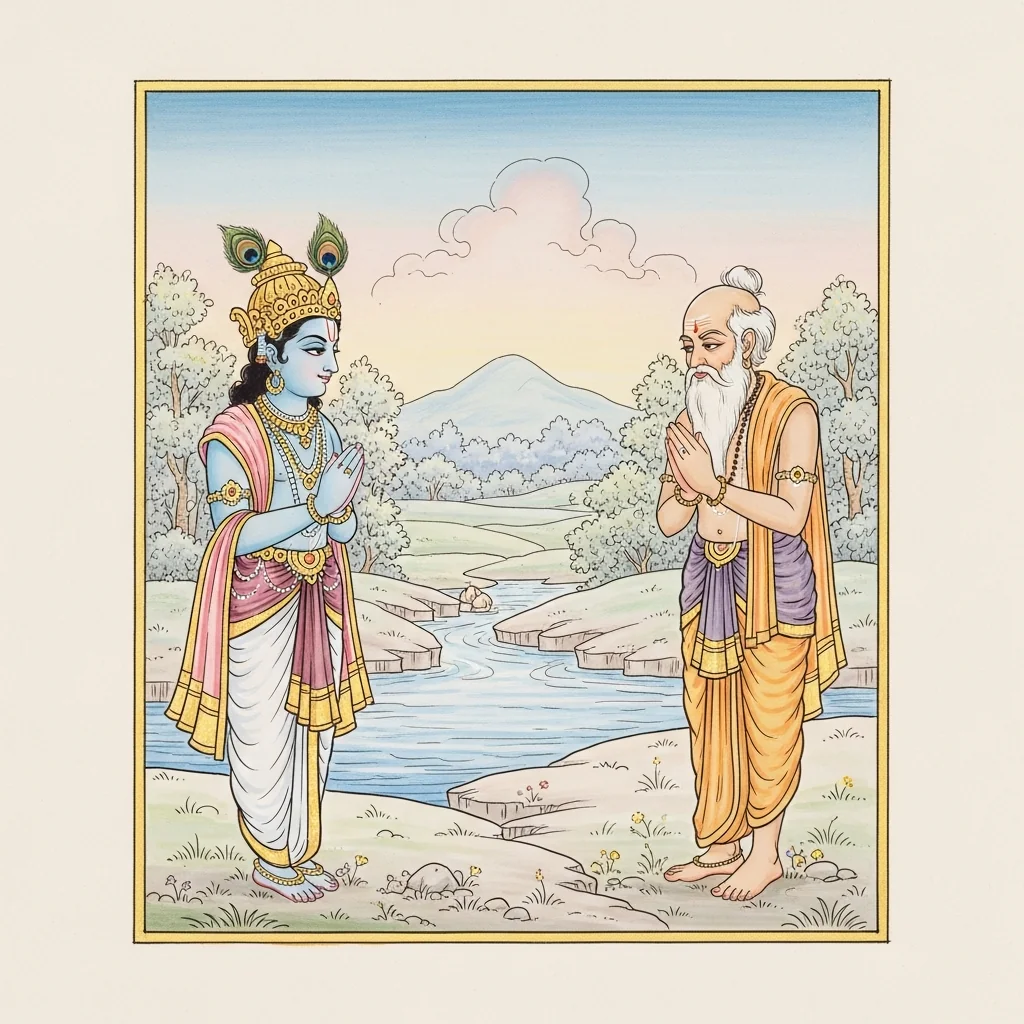
Adhyaya 4
Chapter 4, narrated by Sūta, unfolds as a layered theological teaching centered on Prahlāda’s instruction about Dvārakā’s sacred economy of merit. It opens with Kṛṣṇa and the sage Durvāsā exchanging boons, thereby establishing the tīrtha called Varadāna (“the place of boons”), whose power is tied to bathing at the Gomati–ocean confluence and worshiping both revered figures. The discourse then becomes a practical-ethical guide to pilgrimage: merely forming the intention to go to Dvārakā is meritorious; every step toward the city is equated with the fruits of great sacrifices; and serving pilgrims with shelter, kind speech, food, conveyances, footwear, water-vessels, and care for their feet is praised as exalted devotional service. By contrast, obstructing pilgrims is condemned with clearly stated harmful consequences. Expanding into doctrine, it frames Kali-yuga’s decline through Bṛhaspati’s teaching to Indra and culminates in the claim that Dvārakā is a kalidoṣa-vivarjita refuge, untouched by Kali’s faults. It highlights key tīrthas—especially Cakratīrtha, Gomati snāna, and Rukmiṇī-hrada—declaring that even incidental contact grants liberation and uplifts one’s lineage. The chapter concludes with threshold etiquette and preparatory acts such as honoring Gaṇeśa, formal prostrations, and reverential entry, presenting Dvārakā pilgrimage as a synthesis of devotion, social ethics, and ritual precision.
Shlokas
Verse 1
श्रीप्रह्लाद उवाच । एवं संपूजितस्तेन हरिणा ब्राह्मणोत्तमः । उवाच परिसन्तुष्टो वरं ब्रूहीति केशवम्
Prahlāda said: Thus honored and duly worshipped by Hari, that foremost of brāhmaṇas, fully satisfied, said to Keśava, “Speak—choose a boon.”
Verse 2
श्रीकृष्ण उवाच । यदि तुष्टोऽसि भगवन्यदि देयो वरो मम । स्थातव्यमत्र भवता न त्यक्तव्यं कदाचन
Śrī Kṛṣṇa said: If you are pleased, O Blessed One—and if a boon is to be granted to me—then you must remain here; you must never abandon this place at any time.
Verse 3
दुर्वासा उवाच । यदि तिष्ठाम्यहं कृष्ण तथा त्वमपि केशव । तिष्ठस्व षोडशकलो नित्यं मद्वचनेन हि
Durvāsā said: If I am to remain, O Kṛṣṇa, then you too, O Keśava, must remain—ever present with your sixteenfold fullness—indeed, by my word.
Verse 4
श्रीकृष्ण उवाच । येऽत्र पश्यंति भक्त्या त्वां मां चापि द्विजसत्तम । किं दास्यसि फलं तेषां भाविनां भगवन्वद
Śrī Kṛṣṇa said: O best of the twice-born, those who here behold you with devotion—and also behold me—what fruit will you grant to the pilgrims yet to come? Speak, O Blessed One.
Verse 5
दुर्वासा उवाच । यः स्नात्वा संगमे कृष्ण गोमत्याः सागरस्य च । त्वां मां समर्चति नरः सर्वपापैः समुच्यते
Durvāsā said: O Kṛṣṇa, whoever bathes at the confluence of the Gomati and the ocean, and then worships you and me, is released from all sins.
Verse 6
तथान्यच्छृणु कृष्णात्र स्नात्वा दास्यति यद्धनम् । मम दत्तस्य देवेश प्राप्नुयात्षोडशोत्तरम्
And hear another matter, O Kṛṣṇa: whatever wealth a person gives here after bathing—O Lord of the gods—he attains a return sixteenfold greater than what is given in my name.
Verse 7
श्रीकृष्ण उवाच । यो नरः पूजयित्वा त्वां पूजयिष्यति मामिह । तस्य मुक्तिं प्रदास्यामि या सुरैरपि दुर्ल्लभा
Śrī Kṛṣṇa said: Whoever, after worshipping you, worships me here—unto that person I shall grant liberation (mokṣa), which is difficult to attain even for the gods.
Verse 8
प्रह्लाद उवाच । परस्परं वरौ दत्त्वा कृष्णदुर्वाससौ मुदा । ततः प्रभृति विप्रेन्द्रास्तस्मिन्स्थाने ह्यतिष्ठताम् । वरदानमिति प्रोक्तं तत्तीर्थं सर्वकामदम्
Prahlāda said: Joyfully granting boons to one another, Kṛṣṇa and Durvāsā from that time onward remained at that very spot. That tīrtha came to be known as “Varadāna” (Bestowal of Boons), and it fulfills all desires.
Verse 9
वरदाने नरः स्नातो गोसहस्रफलं लभेत् । विष्णुदुर्वाससोर्यत्र वरदानमभूत्पुरा
Whoever bathes at Varadāna gains merit equal to the gift of a thousand cows; for here, in ancient times, the boon-bestowal of Viṣṇu and the sage Durvāsā took place.
Verse 10
तदाप्रभृति विप्रेन्द्रास्तिष्ठते द्वारकां हरिः । दुर्वाससा गिरा बद्धो न जहाति कदाचन
From that time onward, O best of brāhmaṇas, Hari remains in Dvārakā; bound by Durvāsā’s word, he never abandons it at any time.
Verse 11
यत्र त्रैविक्रमी मूर्तिर्वहते यत्र गोमती । नरा मुक्तिं प्रयास्यंति चक्रतीर्थेन संगताः
Where the sacred presence of Trivikrama abides and where the river Gomatī flows—those who associate with Cakratīrtha there proceed toward liberation.
Verse 12
कलेवरं परित्यक्तं प्रभासे हरिणा यदा । कलाभिः सहितं तेजस्तस्यां मूर्तौ निवेशितम्
When Hari cast off his body at Prabhāsa, his radiant power—together with its divine portions (kalās)—was installed in that sacred form (mūrti).
Verse 13
तस्मात्कलियुगे विप्रा नान्यत्र प्राप्यते हरिः । यदि कार्य्यं हि कृष्णेन तत्र गच्छत मा चिरम्
Therefore, O brāhmaṇas, in the Kali age Hari is not so attainable elsewhere. If you have any sacred purpose to accomplish through Kṛṣṇa, go there—do not delay.
Verse 14
ऋषय ऊचुः । साधु भागवतश्रेष्ठ साधु मार्गप्रदर्शक । यत्त्वया हि परिज्ञातं तन्न जानाति कश्चन
The sages said: “Well spoken, O best among the Bhāgavatas; well spoken, O guide upon the path. What you have truly understood—no one else knows.”
Verse 15
किं फलं गमने तस्यां किं फलं कृष्णदर्शने । कानि तीर्थानि तत्रैव के देवास्तद्वदस्व नः
“What is the merit of going to that place, and what is the merit of beholding Kṛṣṇa there? Which tīrthas are found there, and which deities? Tell us that.”
Verse 16
कस्मिन्मासे तिथौ कस्यां कस्मिन्पर्वणि मानवैः । गन्तव्यं कानि देयानि दानानि दनुजर्षभ
“In which month, on which lunar day, and on which festival occasion should people go? And what gifts and charities are to be given, O best among the Dānavas?”
Verse 17
सूत उवाच । इति पृष्टस्तदा तैस्तु महाभागवतोऽसुरः । कथयामास विप्रेभ्यो भगवद्भक्तिसंयुतः
Sūta said: Thus questioned by them, that Asura—yet a great devotee—full of devotion to the Lord, began to explain to the brāhmaṇas.
Verse 18
प्रह्लाद उवाच । भो भूमिदेवाः शृणुत परं गुह्यं सनातनम् । यत्कस्यचिन्न चाख्यातं तद्वदामि सुविस्तरात्
Prahlāda said: “O gods upon earth (brāhmaṇas), listen to the supreme, secret, and eternal teaching—something not disclosed to just anyone. I shall tell it in full detail.”
Verse 19
यदा मतिं च कुरुते द्वारकागमनं प्रति । तदा नरकनिर्मुक्ता गायन्ति पितरो दिवि
When a person even forms the resolve to journey to Dvārakā, then the ancestors—freed from hell—sing in heaven.
Verse 20
यावत्पदानि कृष्णस्य मार्गे गच्छति मानवः । पदेपदेऽश्वमेधस्य यज्ञस्य लभते फलम्
For as many steps as a person walks upon Kṛṣṇa’s path, at each and every step he gains the fruit of the Aśvamedha sacrifice.
Verse 21
यात्रार्थं देवदेवस्य यः प्रेरयति चापरान् । मानवान्नात्र सन्देहो लभते वैष्णवं पदम्
Whoever encourages other people to undertake the pilgrimage for the Lord of gods—of this there is no doubt—attains the supreme Vaiṣṇava state.
Verse 22
द्वारकां गच्छमानस्य यो ददाति प्रतिश्रयम् । तथैव मधुरां वाचं नन्दते क्रीडते हि सः
Whoever offers lodging to one who is journeying to Dvārakā, and likewise speaks to him with sweet words—he indeed rejoices and delights.
Verse 23
अध्वनि श्रांतदेहस्य वाहनं यः प्रयच्छति । हंसयुक्तेन स नरो विमानेन दिवं व्रजेत्
Whoever provides a conveyance to a traveler whose body is worn out upon the road—such a person goes to heaven in a celestial chariot yoked with swans.
Verse 24
यात्रायां गच्छमानस्य मध्याह्ने क्षुधितस्य च । अन्नं ददाति यो भक्त्या शृणु तस्यापि यद्भवेत्
Whoever, with devotion, gives food to a pilgrim on the journey, hungry at midday—hear what fruit of merit comes to him as well.
Verse 25
गयाश्राद्धेन यत्पुण्यं लभते मानवो भुवि । अन्नदानेन तत्पुण्यं पितॄणां तृप्तिरक्षया
Whatever merit a person gains on earth by performing the Śrāddha at Gayā—that same merit arises from the gift of food, and the satisfaction of the ancestors (Pitṛs) becomes inexhaustible.
Verse 26
उपानहौ तु यो दद्याद्द्वारकां प्रति गच्छताम् । कृष्णप्रसादात्स नरो गजस्कन्धेन गच्छति
Whoever gives footwear to those going toward Dvārakā—by Kṛṣṇa’s grace, that person travels as though mounted upon an elephant’s back.
Verse 27
विघ्नमाचरते यस्तु द्वारकां प्रति गच्छताम् । नरके मज्जते मूढः कल्पमात्रं तु रौरवे
But whoever creates obstacles for those going toward Dvārakā—such a deluded person sinks into hell, in Raurava, for the span of a kalpa.
Verse 28
मार्गस्थितस्य यो धन्यः प्रयच्छति कमण्डलु्म् । प्रपादानसहस्रस्य फलमाप्नोति मानवः
Blessed is the one who gives a kamaṇḍalu, a water-vessel, to a traveler on the road; that person gains the fruit of establishing a thousand prapās, water-resting places.
Verse 29
यात्रायां गच्छमानस्य पादभ्यंगं ददाति यः । पादप्रक्षालनं चैव सर्वान्कामानवाप्नुयात्
Whoever, on pilgrimage, gives a foot-massage to the traveler and also washes the traveler’s feet, attains the fulfillment of all desires.
Verse 30
गाथां शृणोति यो विष्णोर्गीतं च गायतः पथि । दानं ददाति विप्रेन्द्रास्तस्माद्धन्यतरो न हि
O best of brāhmaṇas, none is more blessed than one who, on the road, listens to Viṣṇu’s hymns and to the songs being sung, and who gives charity.
Verse 31
कैलासशिखरावासं श्वेताभ्रमिव निर्मलम् । प्रासादं कृष्णदेवस्य यः पश्यति नरोत्तमः
That best of men who beholds the palace of Lord Kṛṣṇa—like a dwelling upon Kailāsa’s peak, spotless and radiant like a white cloud—truly attains the blessed vision of the Lord’s sacred abode.
Verse 32
दूराद्धेममयं दृष्ट्वा कलशं ध्वजसंयुतम् । वाहनं संपरित्यज्य लुठते धरणीं गतः
Seeing from afar the golden finial (kalaśa) crowned with a flag, he abandons his vehicle and, having come down to the earth, rolls upon the ground in devotion.
Verse 34
पञ्चसूनाकृतं पापं तथाऽधर्मकृतं च यत् । कृमिकीटपतंगाश्च निहताः पथि गच्छता । परान्नं परपानीयमस्पृश्य स्पर्शसंगमम् । तत्सर्वं नाशमाप्नोति भगवत्केतुदर्शनात्
The sin incurred through the “five household-slaughters” (pañca-sūnā), and whatever wrong has been done; the killing of worms, insects, and flying creatures while walking on the road; eating another’s food, drinking another’s water, and contact with what ought not be touched—all of that is destroyed by the mere sight of the Lord’s banner.
Verse 35
पठेन्नामसहस्रं तु स्तवराजमथापि वा । गजेन्द्रमोक्षणं चैव पथि गच्छञ्छनैः शनैः
While walking along the road, slowly step by step, one should recite the Thousand Names, or the King of Hymns, or also the Gajendra-mokṣaṇa—the deliverance of Gajendra.
Verse 36
गायमानो भगवतः प्रादुर्भावाननेकधा । नृत्यद्भिर्हर्षसंयुक्तैर्हृष्यमाणः पुनःपुनः । स्वयं नृत्यन्हर्षयुक्तो भक्तो गच्छेद्धरेः पुरम्
Singing of the Lord’s many manifestations, rejoicing again and again amid devotees who dance in delight, and himself dancing with joy, the devotee attains Hari’s city, the Lord’s divine abode.
Verse 37
विष्णोः क्रीडाकरं स्थानं भुक्तिमुक्तिप्रदायकम् । यस्मिन्दृष्टे कलौ नॄणां मुक्तिरेवोपजायते
This is Viṣṇu’s playful divine seat, bestowing both worldly enjoyment and liberation; upon merely seeing it, even in the Kali age, liberation itself arises for people.
Verse 38
प्रह्लाद उवाच । पूर्वं हि देवराजेन बृहस्पतिरुदारधीः । प्रणम्य परया भक्त्या पृष्टश्च स महामतिः
Prahlāda said: Formerly, Bṛhaspati of noble intellect—the great-minded one—was bowed to with supreme devotion by the king of the gods and then questioned by him.
Verse 39
इन्द्र उवाच । द्वारकायाश्च माहात्म्यं कथयस्व प्रसादतः । चतुर्युगं यथाभागैर्धर्मवृद्धिं जनो लभेत्
Indra said: By your grace, tell the greatness of Dvārakā, and explain the four yugas with their proper divisions, so that people may gain an increase of dharma.
Verse 40
एतच्छ्रुत्वा महेन्द्रस्य वचनं मुनिसत्तमाः । बृहस्पतिरुवाचैनं महेन्द्रं देव संवृतम्
Hearing these words of Mahendra, in the presence of the foremost sages, Bṛhaspati spoke to Mahendra, who was surrounded by the gods.
Verse 41
बृहस्पतिरुवाच । कृतं त्रेता द्वापरं च कलिश्च सुरसत्तम । चतुर्युगमिदं प्रोक्तं तत्त्वतो मुनिसत्तमैः
Bṛhaspati said: O best among the gods, Kṛta, Tretā, Dvāpara, and Kali—this set of four yugas has been explained in truth by the foremost sages.
Verse 42
कृते धर्मश्चतुष्पादो वेदादिफलमेव च । तीर्थं दानं तपो विद्या ध्यानमायुररोगता
In the Kṛta Yuga, dharma stands firm on all four feet, and the fruits of the Vedas and related sacred disciplines are fully attained. Pilgrimage, charity, austerity, sacred learning, meditation, long life, and freedom from disease—these flourish in that age.
Verse 43
पादहीनं सर्वमेतद्युगं त्रेताभिधं प्रभो । पादद्वयं द्वापरे तु सर्वस्यैतस्य वासव
O Lord, in the yuga called Tretā, all these merits are diminished by one foot. And in Dvāpara, O Vāsava, only two feet remain of them all.
Verse 44
पादेनैकेन तत्सर्वं विभागे प्रथमे कलौ । ऊर्ध्वं विनाशः सर्वस्य भविष्यति न संशयः
In the first division of Kali, all of that remains only by a single foot. Thereafter, the destruction of everything will come—of this there is no doubt.
Verse 45
मन्त्रास्तीर्थानि यज्ञाश्च तपो दैवादिकं तथा । प्रगच्छंति समुच्छेदं वेदाः शास्त्राणि चैव हि
Mantras, sacred fords, sacrifices, austerities, and even divine ordinances—all of these move toward obliteration; and indeed the Vedas and the śāstras too suffer rupture and disorder.
Verse 46
म्लेच्छप्रायाश्च भूपाला भविष्यन्त्यमराधिप । लोकः करिष्यते निन्दां साधूनां व्रतचारिणाम्
O lord of the immortals, kings will become for the most part mleccha-like; and people will take to reviling the righteous—those who keep vows and live by holy conduct.
Verse 47
प्रह्लाद उवाच । श्रुत्वा बृहस्पतेर्वाक्यमेतत्तीर्थस्य भो द्विजाः । प्रकंपिताः सुराः सर्वे म्लेच्छ संसर्गजाद्भयात्
Prahlāda said: O twice-born sages, having heard Bṛhaspati’s words concerning this sacred ford, all the gods trembled from fear born of association with the mlecchas.
Verse 48
बृहस्पतिं सुरगुरुं पप्रच्छुर्विनयान्विताः । म्लेच्छसंसर्गजो दोषो गंगयापि न पूयते
With humility they questioned Bṛhaspati, the preceptor of the gods: “The fault born of association with the mlecchas is not purified even by the Gaṅgā.”
Verse 49
कथयस्व प्रसादेन स्थानं कलिविवर्जितम् । यत्र गत्वा निवत्स्यामो यास्यामो निर्वृतिं पराम्
Out of grace, tell us of a place untouched by Kali—where, having gone, we may dwell and attain the highest peace and contentment.
Verse 50
येन दुःखविनिर्मुक्ता भविष्यामो गतव्यथाः । कृपया सुमुखो भूत्वा ब्रूहि तीर्थं हिताय नः
By what may we be released from sorrow and become free of distress? Out of compassion, with a gracious countenance, tell us of the tīrtha for our welfare.
Verse 51
प्रह्लाद उवाच । एतच्छ्रुत्वा सुरेन्द्रस्य वाक्यमंगिरसां वरः । चिरं ध्यात्वा जगादेदं वाक्यं देवपुरोहितः
Prahlāda said: Hearing this request of Surendra, the best of the Aṅgirases—Bṛhaspati, the priest of the gods—pondered for a long time and then spoke these words.
Verse 52
बृहस्पतिरुवाच । पञ्चक्रोशप्रमाणं हि तीर्थं तीर्थवरोत्तमम् । द्वारकानाम विख्यातं कलिदोषविवर्जितम्
Bṛhaspati said: Truly, the sacred region measured as five krośas is the most excellent among tīrthas—famed as Dvārakā, and free from the faults of the Kali age.
Verse 53
विष्णुना निर्मितं स्थानं लोकस्य गतिदायकम् । मुक्तिदं कलिकाले तु ज्ञानहीनजनस्य च
This place was fashioned by Viṣṇu, granting the world the true path and refuge; and in the Kali age it bestows liberation—even upon people lacking spiritual knowledge.
Verse 54
ऊषरं कर्मणां क्षेत्रं पुण्यं पापविनाशनम् । न प्ररोहंति पापानि पुनर्नष्टानि तत्र वै
That holy field is like barren ground for sinful deeds—an auspicious realm that destroys sin. Sins, once eradicated there, do not sprout again.
Verse 55
तिस्रः कोटयोऽर्धकोटी च तीर्थानीह महीतले
On this earth there are three crores and another half-crore of sacred tīrthas.
Verse 56
एवं तीर्थयुता तत्र द्वारका मुक्तिदायका । सेवनीया प्रयत्नेन प्राप्य मानुष्यमुत्तमम्
Thus, filled with tīrthas, Dvārakā grants liberation. Having attained this excellent human birth, one should diligently resort to and serve it through pilgrimage and devotion.
Verse 57
प्रह्लाद उवाच । बृहस्पतेर्वचः श्रुत्वा शतक्रतुरथाऽब्रवीत् । वाचस्पते मम इहि द्वारवत्या महोदयम् । गमने किं फलं प्रोक्तं कृष्णदेवस्य दर्शने
Prahlāda said: Hearing Bṛhaspati’s words, Śatakratu (Indra) then spoke: “O Vācaspati, Lord of Speech, tell me the great glory of Dvāravatī. What phala, spiritual fruit, is declared for going there and for beholding Lord Kṛṣṇa?”
Verse 58
अन्यानि तत्र तीर्थानि मुख्यानि वद मे गुरो । यथाभिषेके गोमत्याः फलं यदपि संगमे
“O Guru, tell me also the other principal tīrthas there—along with the phala, the merit obtained by bathing (snāna/abhiṣeka) at the confluence of the Gomatī.”
Verse 59
बृहस्पतिरुवाच । श्रूयतां तात वक्ष्यामि माहात्म्यं द्वारकोद्भवम् । मनुष्यरूपो भगवान्यत्र क्रीडति केशवः
Bṛhaspati said: “Listen, dear one; I shall declare the greatness arising from Dvārakā—where the Blessed Lord Keśava, taking a human form, sports and dwells in divine play.”
Verse 60
नारायणः स ईशानो ध्येयश्चादौ जगन्मयः । स एव देवतामुख्यः पुरीं द्वारवतीं स्थितः
He is Nārāyaṇa—the sovereign Lord—worthy of contemplation from the very beginning, pervading the universe. That very foremost of deities abides in the city of Dvāravatī.
Verse 61
एकैकस्मिन्पदे दत्ते पुरीं द्वारवतीं प्रति । पुण्यं क्रतुसहस्रेण कलौ भवति देहिनाम्
For embodied beings in the Kali age, with each single step taken toward the city of Dvāravatī, merit arises equal to a thousand sacrificial rites (kratus).
Verse 62
कलौ कृष्णपुरीं रम्यां ये गच्छंति नरोत्तमाः । कुलकोटिशतैर्युक्तास्ते गच्छन्ति हरेः पदम्
In the Kali age, those best of men who go to the lovely Kṛṣṇapurī (Dvārakā), together with hundreds of millions of their family-line, attain the abode of Hari.
Verse 63
ये ध्यायंति मनोवृत्त्या गमनं द्वारकां प्रति । तेषां विलीयते पापं पूर्वजन्मायुतैः कृतम्
Even those who, with inner intent, merely contemplate the journey toward Dvārakā—of them the sins accumulated over tens of thousands of former births dissolve away.
Verse 64
कृष्णस्य दर्शने बुद्धिर्जायते यस्य देहिनः । वक्त्रावलोकनात्तस्य पापं याति सहस्रधा
For that embodied being in whom wisdom awakens upon beholding Kṛṣṇa—by the very sight of his face, sin is shattered into a thousand pieces and departs.
Verse 65
ये गता द्वारकायां च ये मृताः कृष्णसन्निधौ । न तेषां पुनरावृत्तिर्यावदाभूतसंप्लवम्
Those who have gone to Dvārakā, and those who die in the very presence of Śrī Kṛṣṇa—there is no return for them to rebirth until the cosmic deluge, when beings are dissolved in pralaya.
Verse 66
सुलभा मथुरा काशी ह्यवन्ती च तथा सुराः । अयोध्या सुलभा लोके दुर्लभा द्वारका कलौ
Mathurā and Kāśī are easy to reach; so too are Avantī and the abodes of the gods; Ayodhyā also is accessible in the world—yet in the Kali age, Dvārakā is difficult to obtain and to reach.
Verse 67
गत्वा कृष्णपुरीं रम्यां षण्मासात्कृष्णसंनिधौ । जीवन्मुक्तास्तु ते ज्ञेयाः सत्यमेतत्सुरोत्तम
Having gone to the lovely Kṛṣṇapurī and remaining in Śrī Kṛṣṇa’s presence for six months, they should be known as liberated while living (jīvanmukta)—this is truly so, O best of the gods.
Verse 68
कृष्णक्रीडाकरं स्थानं वाञ्छन्ति मनसा प्रिये । तेषां हृदि स्थितं पापं क्षालयेत्प्रेतनायकः
O beloved, those who long in their minds for the place that is Śrī Kṛṣṇa’s playground—the sin lodged in their hearts is washed away, even by Yama, Lord of the departed.
Verse 69
अत्युग्राण्यपि पापानि तावत्तिष्ठन्ति विग्रहे । यावन्न गच्छति नरः कलौ द्वारवतीं प्रति
Even exceedingly terrible sins remain in a person’s body only so long as—during the Kali age—he has not yet set out toward Dvāravatī (Dvārakā).
Verse 70
पुण्यसंख्या च तीर्थानां ब्रह्मणा विहिता पुरा । दानाध्ययन संज्ञानां मुक्त्वा द्वारवतीं कलौ
In former times Brahmā ordained the measure of merit belonging to the tīrthas; yet in the Kali age, apart from Dvāravatī, the merits of charity, sacred study, and other known religious acts are, by comparison, diminished.
Verse 71
चक्रतीर्थे तु यो गच्छेत्प्रसंगेनापि मानवः । कुलैकविंशतियुतः स गच्छेत्परमं पदम्
Even a man who goes to Cakratīrtha merely by chance attains the supreme state, together with twenty-one generations of his family line.
Verse 72
लोभेनाऽप्यपराधेन दम्भेन कपटेन वा । चक्रतीर्थं च यो गच्छेन्न पुनर्विशते भवम्
Even if one goes to Cakratīrtha driven by greed, stained by wrongdoing, or moved by hypocrisy and deceit, that person does not enter worldly becoming (bhava) again and is not reborn.
Verse 73
प्रयागे ह्यस्थिपातेन यत्फलं परिकीर्तितम् । तदेव शतसाहस्रं चक्रतीर्थास्थिपातनात्
Whatever merit is proclaimed from consigning bones at Prayāga, that very merit becomes a hundred-thousandfold through the consigning of bones at Cakratīrtha.
Verse 74
पृथिव्यां चैव तत्तीर्थं परमं परिकीर्तितम् । चक्रतीर्थमिति ख्यातं ब्रह्महत्याविनाशनम्
On the earth, that tīrtha is proclaimed supreme—known as Cakratīrtha—destroyer of the sin of brahma-hatyā, the gravest killing.
Verse 75
ये ये कुले भविष्यंति तत्पूर्वं मानवाः क्षितौ । सर्वे विष्णुपुरं यांति चक्रतीर्थास्थिपातनात्
All those on earth who were born earlier in that lineage—and all who will be born in it—through the consigning of bones at Cakratīrtha, all go to Viṣṇu’s abode.
Verse 76
किं जातैर्बहुभिः पुत्रैर्गणनापूरकात्मकैः । वरमेको भवेत्पुत्रश्चक्रतीर्थं तु यो व्रजेत्
What use are many sons who merely fill the count? Better is a single son—one who would go to Cakratīrtha.
Verse 77
तपसा किं प्रतप्तेन दानेनाध्ययनेन किम् । सर्वावस्थोऽपि मुच्येत गतः कृष्णपुरीं यदि
What need is there of arduous austerity? What need of gifts or scriptural study? In whatever condition one may be, one is liberated—if one has gone to Kṛṣṇa’s city (Dvārakā).
Verse 78
कलिकाल कृतैर्दोषैरत्युग्रैरपि मानवः । कलौ कृष्णमुखं दृष्ट्वा लिप्यते न कदाचन
Even though a person may be afflicted by the terribly fierce faults produced by the age of Kali, in Kali-yuga, upon beholding Kṛṣṇa’s face, one is never tainted.
Verse 79
दानं चाध्ययनं शौचं कारणं न हि पुत्रक । हीनवर्णोऽपि पापात्मा गतः कृष्णपुरीं यदि
O son, charity, study, and purity are not the deciding cause here. Even one of low standing, even a sinful person—if they have gone to Kṛṣṇa’s city—finds deliverance.
Verse 80
वाराणस्यां कुरुक्षेत्रे नर्मदायां च यत्फलम् । तत्फलं निमिषार्धेन द्वारवत्यां दिनेदिने
Whatever merit is gained at Vārāṇasī, at Kurukṣetra, and at the Narmadā— that same merit is obtained in Dvāravatī day after day, in but half a moment.
Verse 81
धन्यानामपि धन्यास्ते देवानामपि देवताः । कृष्णोपरि मतिर्येषां हीयते न कदाचन
Blessed indeed are those—blessed even among the blessed, divine even among the gods—whose mind fixed upon Kṛṣṇa never diminishes at any time.
Verse 82
श्रवणद्वादशीयोगे गोमत्युदधिसंगमे । स्नात्वा कृष्णसुतं दृष्ट्वा लिप्यते नैव स क्वचित्
When the auspicious conjunction of Śravaṇa (nakṣatra) and Dvādaśī occurs, at the confluence of the Gomati and the ocean—having bathed there and beheld the son of Kṛṣṇa—one is not tainted (by sin) anywhere at all.
Verse 83
यस्य कस्यापि मासस्य द्वादशी प्राप्य मानवः । कृष्णक्रीडापुरीं दृष्ट्वा मुक्तः संसारगह्वरात्
On any month’s Dvādaśī, a person—having reached it and beheld the city where Kṛṣṇa sports (Dvārakā)—is freed from the deep ravine of worldly bondage (saṃsāra).
Verse 84
येषां कृष्णालये प्राणा गताः सुरपते कलौ । स्वर्गान्न तेषामावृत्तिः कल्पकोटिशतैरपि
O Lord of the gods, in the Kali age, for those whose life-breath departs in Kṛṣṇa’s abode, there is no return even from heaven—not even after hundreds of crores of kalpas.
Verse 85
विज्ञेया मानुषा वत्स गर्भस्थास्ते महीतले । द्वारवत्यां न यैर्देवो दृष्टः कंसनिषूदनः
O dear one, know that those who have not beheld in Dvāravatī (Dvārakā) the God who slew Kaṃsa are as though still in the womb upon this earth, not yet truly born.
Verse 86
दुर्लभो द्वारकावासो दुर्लभं कृष्णदर्शनम् । दुर्लभं गोमतीस्नानं दुर्लभो रुक्मिणीपतिः
Rare indeed is dwelling in Dvārakā; rare is the darśana of Kṛṣṇa. Rare is bathing in the Gomati; rare is the Lord, the spouse of Rukmiṇī.
Verse 87
तपः परं कृतयुगे त्रेतायां ज्ञानमुच्यते । द्वापरे तु परो यज्ञः कलौ केशवकीर्तनम्
In the Kṛta Yuga, austerity (tapas) is said to be supreme; in the Tretā, knowledge (jñāna) is declared supreme. In the Dvāpara, sacrifice (yajña) is supreme; but in the Kali Yuga, the supreme practice is praising and chanting Keśava.
Verse 88
हेमभारसहस्रैस्तु दत्तैर्यत्फलमाप्यते । दृष्ट्वा तत्कोटि गुणितं हरेः सर्वप्रदं मुखम्
Whatever merit is gained by giving thousands of loads of gold—by merely beholding Hari’s all-bestowing face, that merit is multiplied ten million-fold.
Verse 89
द्वारकायां च यद्दत्तं शंखोद्धारे तथैव च । पिंडारके महातीर्थे दत्तं चैवाक्षयं भवेत्
Whatever is given in charity in Dvārakā, likewise at Śaṅkhoddhāra, and whatever is given at Piṇḍāraka—the great tīrtha—becomes imperishable, of unfailing merit (akṣaya).
Verse 90
गोमहिष्यादि यद्दत्तं सुवर्णवसनानि च । वृषो भूमिग्रहो रूप्यं कन्यादानं तथैव च
Gifts such as cows and buffaloes, gold and garments; a bull, a grant of land, silver, and likewise the gifting of a maiden in marriage—
Verse 91
यच्चान्यदपि देवेन्द्र त्रिषु स्थानेषु यच्छति । तन्मुक्तिकारकं प्रोक्तं पितॄणामात्मनस्तथा
And whatever else, O Indra, one gives in those three places—this is declared to be a cause of liberation, for one’s ancestors and for oneself as well.
Verse 92
ऊषरं हि यतो लोके क्षेत्रमेतत्प्रकीर्तितम् । अतो मुक्तिकरं सर्वं दानं चोक्तं महर्षिभिः
Because this sacred region is renowned in the world as ‘Ūṣara’, the great seers have declared that every act of charity performed here becomes a cause of liberation.
Verse 93
यत्किंचित्कुरुते तत्र दानं क्रीडावगाहनम् । तदनन्तफलं प्राह भगवान्मधुसूदनः
Whatever one does there—whether charity, playful sport, or even entering the waters for a dip—Lord Madhusūdana has declared it to yield endless fruit.
Verse 94
प्रेतत्वं नैव तस्यास्ति न याम्या नारकी व्यथा । येन द्वारवतीं गत्वा कृतं कृष्णाऽवलोकनम्
For one who goes to Dvāravatī and beholds Kṛṣṇa, there is no state of becoming a preta, nor the torments of Yama’s realm, nor the pain of hell.
Verse 95
वारिमात्रेण गोमत्यां पिण्डदाने कृते कलौ । पितॄणां जायते तृप्तिर्यावदाभूतसंप्लवम्
In the Kali age, if piṇḍa-offerings are made at the Gomati even with water alone, the ancestors attain satisfaction that endures until the end of cosmic dissolution.
Verse 96
नित्यं कृष्णपुरीं रम्यां ये स्मरन्ति गृहस्थिताः । नमस्याः सर्वलोकानां देवानां च सुरोत्तम
Householders who daily remember the lovely city of Kṛṣṇa are worthy of reverence by all worlds—and even by the gods, O best of the suras.
Verse 97
ब्रह्मज्ञानं गयाश्राद्धं मरणं गोग्रहेषु च । वासः पुंसां द्वारकायां मुक्तिरेषा चतुर्विधा
Liberation is spoken of as fourfold: through knowledge of Brahman; through the śrāddha at Gayā; through dying among cowsheds, in the shelter of cows; and through dwelling in Dvārakā.
Verse 98
ब्रह्मज्ञानेन मुच्यन्ते प्रयागे मरणेन वा । अथवा स्नानमात्रेण गोमत्यां कृष्णसंनिधौ
One is liberated by knowledge of Brahman, or by dying at Prayāga; or else, merely by bathing in the Gomati in the very presence of Kṛṣṇa.
Verse 99
कृतार्थः कृतपुण्योऽहं ब्रवीत्येवं महोदधिः । पवित्रितं च मद्गात्रं गोमतीवारिसंप्लवात्
Thus speaks the great ocean: “I am fulfilled; I am endowed with merit. For my very body has been purified by the flood of the Gomati’s waters.”
Verse 100
अत्युग्राण्यपि पापानि तावत्तिष्ठंति विग्रहे । यावत्स्नानं न गोमत्यां वारिणा पापहारिणा
Even the most dreadful sins remain lodged in the body only so long as one has not bathed in the Gomati, whose waters destroy sin.
Verse 101
चक्रतीर्थे नरः स्नात्वा गोमत्यां रुक्मिणीह्रदे । दृष्ट्वा कृष्णमुखं रम्यं कुलानां तारयेच्छतम्
After bathing at Cakratīrtha—on the Gomati, in Rukmiṇī’s lake—if a person beholds the lovely face of Kṛṣṇa, he may deliver a hundred generations of his lineage.
Verse 102
कृष्णं च ये द्वारवतीं मनुष्याः स्मरंति नित्यं हरिभक्तियुक्ताः । विधूतपापाः किल संभवांते गच्छंति लोकं परमं मुरारेः
Those who, endowed with devotion to Hari, constantly remember Śrī Kṛṣṇa and the holy city of Dvāravatī—having their sins washed away—indeed, at life’s end attain the supreme abode of Murāri (Kṛṣṇa).
Verse 103
अधौतपादः प्रथमं नमस्कुर्याद्गणेश्वरम् । सर्वविघ्रविनाशश्च जायते नात्र संशयः
Even with unwashed feet, one should first bow to Gaṇeśvara; then the destruction of all obstacles surely arises—of this there is no doubt.
Verse 104
नीलोत्पलदलश्यामं कृष्णं देवकिनन्दनम् । दण्डवत्प्रणमेत्प्रीत्या प्रणमेदग्रजं पुनः
With loving joy, one should prostrate fully (daṇḍavat) before Kṛṣṇa—dark like the petal of a blue lotus, the beloved son of Devakī—and then bow again to his elder brother.
Verse 105
बाल्ये च यत्कृतं पापं कौमारे यौवने तथा । दर्शनात्कृष्णदेवस्य तन्नश्येन्नात्र संशयः
Whatever sin was committed in childhood, in boyhood, and likewise in youth—by merely beholding Lord Kṛṣṇa, it perishes; of this there is no doubt.
Verse 106
वाण्याऽथ मनसा यच्च कर्मणा समुपार्जितम् । पापं जन्मसहस्रेण तन्नश्येन्नात्र संशयः
Sins accumulated by speech, by mind, and by actions—even across a thousand births—are destroyed; of this there is no doubt.
Verse 107
हेमभारसहस्रैस्तु दत्तैर्यत्फलमाप्यते । तत्फलं कोटिगुणितं कृष्णवक्त्रावलोकनात्
The fruit obtained by giving thousands of loads of gold becomes multiplied a crore-fold by beholding the face of Kṛṣṇa.
Verse 108
नमस्कृत्य च देवेशं पुण्डरीकाक्षमच्युतम् । दुर्वाससं महेशानं द्वारकापरिरक्षकम्
Having bowed to the Lord of gods—Puṇḍarīkākṣa, the unfailing Acyuta—and to Durvāsā, the great lord (Maheśāna), the protector of Dvārakā…
Verse 109
प्रणम्य परया भक्त्या वैनतेयसमन्वितम् ।ऽ । द्वारमागत्य च पुनः स्वर्गद्वारोपमं शुभम्
Having bowed with supreme devotion to the Lord accompanied by Vainateya (Garuḍa), one then comes again to the auspicious gateway—like the very gate of heaven.
Verse 110
विश्रम्य च मुहूर्त्तार्द्धं सुहृद्भिर्बान्धवैर्वृतः । तत्राश्रितान्समाहूय ब्राह्मणान्मन्त्रकोविदान् । पूजाद्रव्यं समानीय ततस्तीर्थं व्रजेद्बुधः
Resting for half a muhūrta, surrounded by friends and kinsmen, the wise should summon the resident brāhmaṇas learned and skilled in mantras; having gathered the requisites for worship, he should then proceed to the sacred tīrtha.