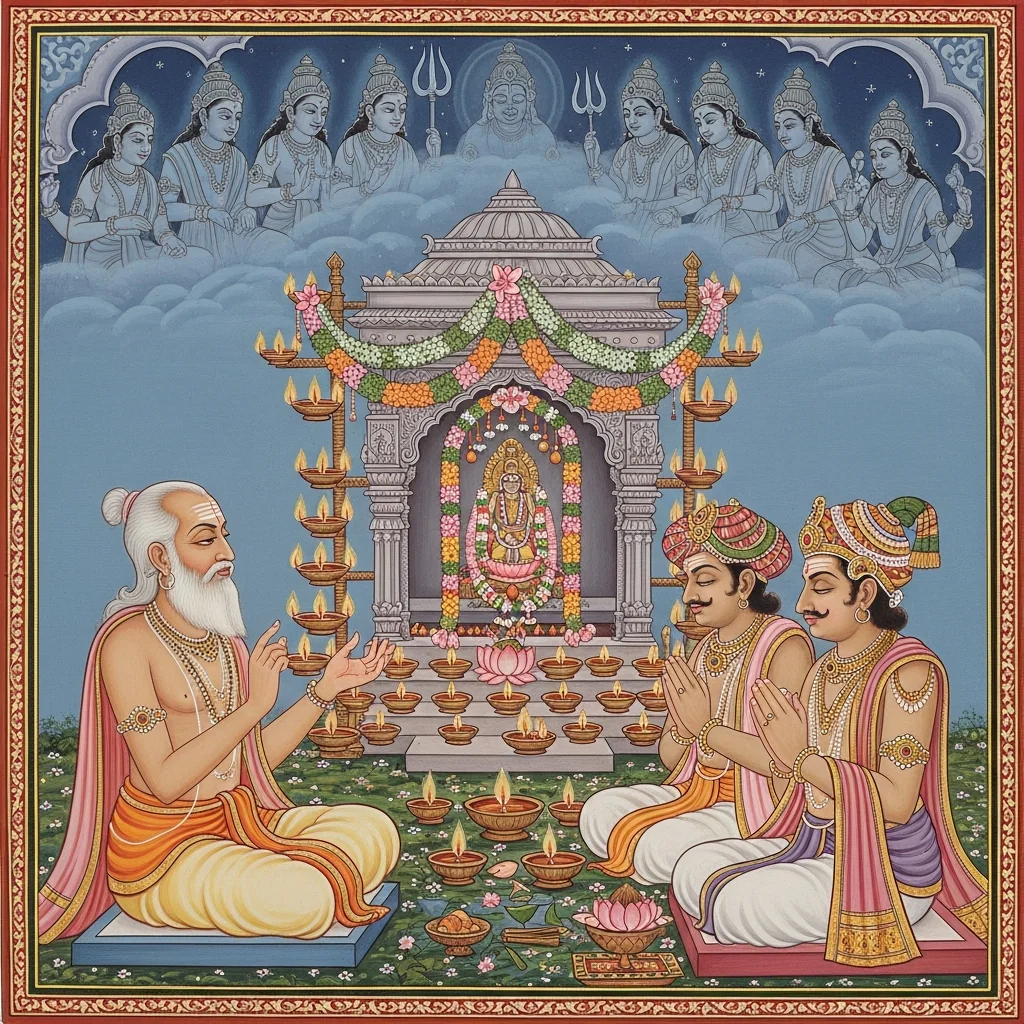
Adhyaya 28
This adhyāya unfolds as a didactic dialogue in which Mārkaṇḍeya teaches the theological and ethical power of hari-jāgaraṇa—keeping a night vigil for Viṣṇu/Kṛṣṇa—especially in connection with Ekādaśī and Dvādaśī observance. The merit of the vigil is declared independent of flawless ritual purity or prior preparation: even the unbathed, the impure, and the socially marginalized are said to be purified and to attain elevated post-mortem states through participation. A strong phalaśruti repeatedly compares the vigil’s fruit to great sacrifices such as the aśvamedha, to tīrtha practices (like drinking at Puṣkara), to visits to river confluences, and to vast gifts, insisting that the vigil surpasses them all. It is also framed as a remedial discipline that can erase severe moral taints (grave sins are listed), while communal devotion—singing, dancing, vīṇā music, and kathā-kīrtana—is affirmed as a legitimate way to stay awake. Cosmic convergence is emphasized: gods, rivers, and sacred waters are said to assemble at the vigil, and those who do not perform it are warned of adverse outcomes. The chapter’s lesson is an ethics of accessible devotion for Kali-yuga: steadfast wakefulness, remembrance of Garuḍadhvaja, and restraint (not eating on Ekādaśī) are presented as a concise, high-yield path.
Shlokas
Verse 1
मार्कण्डेय उवाच । कृत्वा जागरणं विष्णोर्यथान्यायं नरेश्वर । पितॄन्यच्छति पुण्यं च ततः किं कुरुते यमः
Mārkaṇḍeya said: “O lord of men, having duly performed the night-vigil for Viṣṇu, one bestows merit upon the forefathers. Then what power can Yama exercise against such a person?”
Verse 2
भुक्तो वा यदि वाऽभुक्तः स्वच्छो वाऽस्वच्छ एव वा । विमुक्तिः कथिता तत्र हरिजागरणान्नृणाम्
Whether one has eaten or not, whether clean or unclean—there, liberation is declared for people through keeping vigil for Hari (Viṣṇu).
Verse 3
अस्नातो वा नरः स्नातो जागरे समुपस्थिते । सर्वतीर्थाप्लुतो ज्ञेयस्तं दृष्ट्वा दिवमाव्रजेत्
Whether a man has bathed or not, once the vigil has arrived, he should be understood as one who has bathed in all sacred fords; seeing him, one attains heaven.
Verse 4
श्वपचा जागरं कृत्वा पदं निर्वाणमागताः । किं पुनर्वर्णसंभूताः सदाचारपरास्तथा
Even those born among the despised (such as dog-cookers), having kept the vigil, have reached the state of nirvāṇa; how much more, then, those born within the social orders who are devoted to good conduct.
Verse 5
युवतीनादमाकर्ण्य यथा निद्रा न जायते । जागरे चैवमेव स्यात्तत्कथानां च कीर्तने
Just as, on hearing the voices of young women, sleep does not arise—so too in the sacred vigil, drowsiness is dispelled by chanting and recounting His holy narratives.
Verse 6
ब्रह्महत्या सुरापानं स्तेयं गुर्वंगनागमः । उत्कल्लनं मनःपापं शोधयेद्विष्णु जागरः
Brahmin-slaying, drinking liquor, theft, approaching the wife of one’s teacher, violent transgression, and sins of the mind—Viṣṇu’s vigil purifies them.
Verse 7
विमुक्तिः कामुकस्योक्ता किं पुनर्वीक्षतां हरिम्
Liberation is said to come even to the lust-driven; how much more, then, to those who behold Hari.
Verse 8
वाचिकं मानसं पापं करणैर्यदुपार्जितम् । अन्यैर्निमिषमात्रेण व्यपोहति न संशयः
Sins of speech and sins of the mind, accumulated through one’s faculties—by this observance they are removed in a mere instant; of this there is no doubt.
Verse 9
गोष्ठ्यां समागता ये तु तेषां पापं कुतः स्मृतम् । मातृपूजा गयाश्राद्धं सुतीर्थगमनं तथा । जागरस्य नृणां राजन्समानि कवयो विदुः
As for those who have assembled in the sacred gathering—how could sin be spoken of for them? Mother-worship, the śrāddha at Gayā, and going to excellent tīrthas—poets know these to be equal to the vigil for men, O King.
Verse 10
जननीपूजनं भूप ह्यश्वमेधायुतैः समम् । पूर्णं वर्षशतं भूप कुशाग्रेणोद्धृतं जलम्
O King, worship of one’s mother is equal to ten thousand Aśvamedha sacrifices. And likewise, O King, water lifted with the tip of kuśa-grass for a full hundred years is praised as a great act of merit.
Verse 11
पिबन्पात्रे द्विजः सम्यक्तीर्थे पुष्करसंज्ञिते । जागरस्यैव चैतानि कलां नार्हंति षोडशीम्
Even if a twice-born man drinks properly from a vessel at the tīrtha called Puṣkara, those merits do not equal even a sixteenth part of the merit of the vigil alone.
Verse 12
कृत्वा कांचनसंपूर्णां वसुधां वसुधाधिप । दत्त्वा यत्फलमाप्नोति तत्फलं हरिजागरे
O lord of the earth, the very merit gained by fashioning the whole earth into gold and giving it away in charity—that same merit is obtained by keeping vigil for Hari (Harijāgaraṇa).
Verse 14
निकृंतनं कर्मणश्च ह्यात्मना दुष्कृतं कृतम् । व्यपोहति न संदेहो येन जागरणं कृतम् । संक्षेपतः प्रवक्ष्यामि पुनरेव महीपते । जागरे पद्मनाभस्य यत्फलं कवयो विदुः
There is no doubt: one who performs the vigil cuts off and removes the evil deeds done by oneself. O King, I shall again state briefly the fruit of keeping vigil for Padmanābha, as the sages have known it.
Verse 15
रवेर्बिंबमिदं भित्त्वा स योगी हरिजागरे । प्रयाति परमं स्थानं योगिगम्यं निरंजनम् । सांख्ययोगैः सुदुःखेन प्राप्यते यत्पदं हरेः
That yogin, by the vigil for Hari, breaks through this disc of the sun and attains the supreme abode—reachable by yogins, stainless—namely that station of Hari which is otherwise attained only with great hardship through Sāṅkhya and Yoga.
Verse 16
नद्यो नदा यथा यांति सागरे संस्थितिं क्रमात् । एवं जागरणात्सर्वे तत्पदे यांति संस्थितिम्
Just as rivers and streams, in due course, reach their resting place in the ocean, so too, through the sacred vigil, all attain their established abode in that Supreme State.
Verse 17
मेरुमंदरमानानि कृत्वा पापानि वा नरः । हरिजागरणे तानि व्यपोहति न संशयः
Even if a person has committed sins as vast as Meru and Mandara, by the vigil for Hari he removes them—there is no doubt.
Verse 18
राज्यं स्वर्गं तथा मोक्षं यच्चान्यदीप्सितं नृणाम् । ददाति भगवान्कृष्णः स्वगीतैर्जागरे स्थितः
Kingship, heaven, liberation, and whatever else people desire—Bhagavān Kṛṣṇa grants all that to those who remain in the vigil, singing His own hymns.
Verse 19
जागरेणैव पापानां श्वपचानां महीपते । तत्पदं कविभिः प्रोक्तं किं पुनस्तु द्विजन्मनाम्
O king, by vigil alone even sinful outcastes (śvapacas) are said by sages to attain that Supreme State—how much more, then, those who are twice-born.
Verse 20
जपध्यानविहीनस्य गायकस्यापि भूपते । कर्मभ्रष्टस्य च प्रोक्तो मोक्षस्तु हरिजागरे
O king, even for a singer who is devoid of japa and meditation, and even for one who has fallen from prescribed duties, liberation is declared to arise through the vigil for Hari.
Verse 21
तन्नास्ति त्रिषु लोकेषु पुण्यं पुण्यवतां नृणाम् । यत्तु साधयते भूप जागरे संव्यवस्थितः
O king, in the three worlds there is no merit—however meritorious people may be—equal to what one accomplishes by remaining firmly established in the sacred vigil.
Verse 22
त्वया पुनरिदं कार्य्यं स्मर्त्तव्यो गरुडध्वजः । एकादश्यां न भोक्तव्यं कर्तव्यं जागरं सदा
Therefore you must do this: remember the Lord whose banner is Garuḍa; on Ekādaśī one should not eat, and one should always perform the sacred vigil.
Verse 23
जागरे वर्त्तमानस्य श्वपचस्य गतिर्भवेत् । किंपुनर्वर्णजातीनां वैष्णवानां महीपते
O king, even a dog-cooker (one of the lowest-born), if he remains wakeful in the sacred vigil, attains a blessed destiny—how much more, then, do the Vaiṣṇavas of the recognized social orders, O lord of the earth.
Verse 24
ये तु जागरणे निद्रां न यांति नृपपुंगव । न तेषां जननी याति खेदं गर्भावधारणात्
O best of kings, those who do not go to sleep during the sacred vigil—their mother does not suffer distress for having borne them in her womb.
Verse 25
तस्माज्जागरणं कार्य्यं मातुर्जठरवर्जिभिः । भीतेर्मोक्षपरैर्मर्त्यैः सुखचेष्टाबहिष्कृतैः
Therefore, the night-vigil should be performed by mortals who long to be freed from returning to the mother’s womb, who fear saṃsāra, who are intent on mokṣa, and who have cast aside indulgence in comfort.
Verse 26
यस्तु जागरणं रात्रौ कुर्याद्भक्तिसमन्वितः । निमिषेनिमिषे राजन्नश्वमेधफलं लभेत्
But whoever keeps the night vigil with devotion, O king, gains at every moment—moment by moment—the fruit of an Aśvamedha sacrifice.
Verse 27
शयनो त्थापनाभ्यां च समं पुण्यमुदाहृतम् । विशेषो नास्ति भूपाल विष्णुना कथितं पुरा
The merit is declared equal in both—whether one lies down or rises up; there is no distinction, O king, as Viṣṇu explained in ancient times.
Verse 28
ब्राह्मणाः क्षत्रिया वैश्याः स्थिताः शूद्राश्च जागरे । पक्षिणः कृमिकीटाश्च ह्यनेके चैव जंतवः । ते गताः परमं स्थानं योगिगम्यं निरंजनम्
Brāhmaṇas, Kṣatriyas, Vaiśyas, and Śūdras who remained in the vigil—and even birds, worms, insects, and many other creatures—attained the supreme abode, stainless and reachable by yogins.
Verse 29
यानि कानि च पापानि ब्रह्महत्यासमानि च । कृष्णजागरणे तानि क्षयं यांति न संशयः
Whatever sins there may be—even those equal to brahma-hatya—at Kṛṣṇa’s vigil they are destroyed; of this there is no doubt.
Verse 30
एकतः क्रतवः सर्वे सर्वतीर्थसमन्विताः । एकतो देवदेवस्य जागरः कृष्णवल्लभः । न समं ह्यधिकः प्रोक्तः कविभिः कृष्णजागरः
On one side are all sacrifices together with all sacred fords; on the other side is the vigil of the God of gods, beloved of Kṛṣṇa. The poets declare that Kṛṣṇa’s vigil is not merely equal—it is superior.
Verse 31
सूर्यशक्रादयो देवा ब्रह्मरुद्रादयो गणाः । नित्यमेव समायांति जागरे कृष्णवल्लभे
Sūrya, Śakra, and the other gods, and the hosts led by Brahmā and Rudra, indeed come every day to that night-vigil beloved of Kṛṣṇa.
Verse 32
गंगा सरस्वती रेवा यमुना च शतह्रदा । चंद्रभागा वितस्ता च नद्यः सर्वाश्च तत्र वै
There indeed are Gaṅgā, Sarasvatī, Revā, Yamunā, and Śatahradā; also Candrabhāgā and Vitastā—indeed all the rivers are present there.
Verse 33
सरांसि च ह्रदाश्चैव समुद्राः कृत्स्नशो नृप । एकादश्यां नृपश्रेष्ठ गच्छंति हरिजागरे
O king, best among rulers: on Ekādaśī, all lakes, ponds, and even the oceans in their entirety proceed to the night-vigil of Hari.
Verse 34
स्पृहणीयास्तु देवेभ्यो ये नराः कृष्णजागरे । नृत्यं गीतं प्रकुर्वंति वीणावाद्यं तथैव च
Those people who, in Kṛṣṇa’s night-vigil, perform dancing and singing—and likewise the playing of the vīṇā—are indeed envied even by the gods.
Verse 35
भक्त्या वाऽप्यथवाऽभक्त्या शुचिर्वाप्यथवाऽशुचिः । कृत्वा जागरणं विष्णोर्मुच्यते पापकोटिभिः
Whether done with devotion or without devotion—whether one is pure or impure—by performing Viṣṇu’s night-vigil one is freed from crores of sins.
Verse 36
पादयोः पांसुकणिका यावत्तिष्ठंति भूतले । तावद्वर्षसहस्राणि जागरी वसते दिवि
So long as the dust-particles from the feet remain upon the earth, for that many thousands of years the keeper of the vigil dwells in heaven.
Verse 37
तस्माद्गृहं प्रगन्तव्यं जागरे माधवस्य च । कलौ मलविनाशाय द्वादशद्वादशीषु च
Therefore one should go to the Lord’s temple for Mādhava’s night-vigil; and in the Kali age, for the destruction of impurity, especially on the twelfth day and on Dvādaśī.
Verse 38
सुबहून्यपि पापानि कृत्वा जागरणं हरेः । निर्द्दहेन्मेरुतुल्यानि युगकोटिशतान्यपि
Even after committing very many sins, by performing Hari’s night-vigil one burns them up—sins as massive as Mount Meru—even those accumulated over hundreds of crores of ages.
Verse 39
उन्मीलिनी महीपाल यैः कृता प्रीतिसंयुतैः । कलौ जागरणोपेता फलं वक्ष्यामि तच्छृणु
O protector of the earth, listen: I shall describe the fruit of the Unmīlinī observance when, in the Kali age, it is performed together with the night-vigil and with heartfelt joy.
Verse 40
स्थितौ युगसहस्रं तु पादेनैकेन भूतले । काश्यां च जाह्नवीतीरे तत्फलं लभते नरः
A person obtains that same fruit which is gained by standing on the earth on one foot for a thousand yugas—(as by austerity) in Kāśī and on the bank of the Jāhnavī (Gaṅgā).
Verse 41
भवेद्युगसहस्रं च विनाऽहारेण यत्फलम् । उन्मीलिनीं समासाद्य फलं जागरणे हरेः
The merit that would arise from remaining without food for a thousand yugas—upon undertaking the Unmīlinī—becomes the merit of keeping vigil for Hari.
Verse 42
दुष्प्राप्यं वैष्णवं स्थानं मखकोटिशतैः कृतैः । हेलया प्राप्यते नूनं द्वादश्यां जागरे कृते
The Vaiṣṇava abode, hard to attain even by performing hundreds of crores of sacrifices, is surely reached—even with little effort—when one keeps the night-vigil on Dvādaśī.
Verse 43
न कुर्वंति व्रतं विष्णोर्जागरेण समन्वितम् । परस्वं पारदार्यं च पापं तान्प्रति गच्छति
Those who do not undertake Viṣṇu’s vow together with a night-long vigil—upon them the sins of coveting another’s wealth and violating another’s spouse come to cling.
Verse 44
एकेनैवोपवासेन भावहीनास्तु मानवाः । निर्द्दग्धाऽखिलपापास्ते प्रयांति स्वर्गकाननम्
Even by a single fast alone, human beings—though lacking deep devotional feeling—have all their sins burned away, and they go to the heavenly groves.
Verse 45
यत्र भागवतं शास्त्रं यत्र जागरणं हरेः । शालिग्रामशिला यत्र तत्र गच्छेद्धरिः स्वयम्
Where the Bhāgavata scripture is revered, where Hari’s night-vigil is observed, and where the Śāligrāma stone is present—there Hari Himself comes in person.
Verse 46
न पुर्य्यः पावनाः सप्त कलौ वेदवचो नहि । यादृशं वासरं विष्णोः पावनं जागरान्वितम्
In the Kali age, the Vedic word does not proclaim that even the seven sacred cities purify as does Viṣṇu’s day, made holy by the keeping of vigil.
Verse 47
संप्राप्ते वासरे विष्णोर्ये न कुर्वंति जागरम् । मज्जंति नरके घोरे नरानार्य्यो न संशयः
When Viṣṇu’s sacred day arrives, those who do not keep the vigil sink into a dreadful hell—people base in conduct, without doubt.