Adhyaya 10
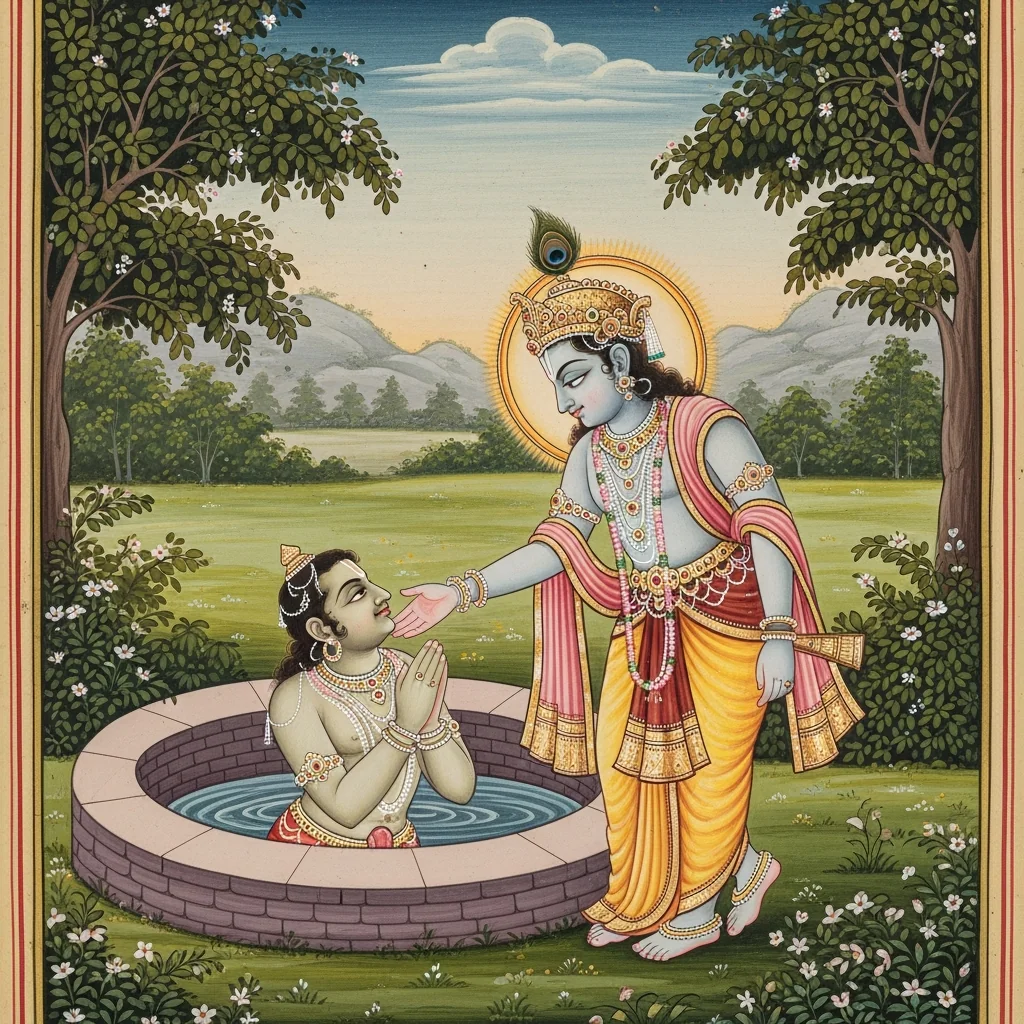
The chapter presents a tīrtha-legend in dialogue. Prahlāda extols the sacred pilgrimage spot called Kṛkalāsa/Nṛga-tīrtha and recounts King Nṛga’s life: a powerful, dharma-minded ruler who daily gifted cows to brahmins with proper honor-rites. Trouble arises when a cow given to the sage Jaimini escapes and is later re-gifted to another brahmin, Somaśarman; when the king fails to respond promptly to the dispute, the offended brahmins curse him to become a kṛkalāsa (lizard). After death, Yama offers Nṛga a choice about the order of experiencing karmic results; for this minor fault he endures many years in a lizard body. Near the end of Dvāpara, Kṛṣṇa (Devakī’s son) appears; Yadu princes find the immovable lizard in a water-body, and Kṛṣṇa’s touch releases Nṛga, who praises the Lord. Granted a boon, Nṛga asks that the pit/well be famed by his name and that devotees who bathe there and perform ancestor rites attain Viṣṇuloka. The chapter closes with ritual guidance: offer arghya with flowers and sandal, bathe using clay, perform tarpaṇa for ancestors/deities/humans, and conduct śrāddha with feeding and dakṣiṇā. It especially commends gifting a decorated cow with calf and a bed with accessories, along with ongoing charity to local needy people—promising wide tīrtha-fruits and successful journeys.
Shlokas
Verse 1
प्रह्लाद उवाच । ततो गच्छेद्द्विजश्रेष्ठास्तीर्थं पापप्रणाशनम् । कृकलासमिति ख्यातं नृगतीर्थमनुत्तमम्
Prahlāda said: “Then, O best of Brāhmaṇas, one should go to the sin-destroying sacred ford, renowned as ‘Kṛkalāsa’, the unsurpassed Nṛga Tīrtha.”
Verse 2
नृगो यत्र महीपालः कृकलासवपुर्धरः । कृष्णेन सह संगत्य संप्राप परमां गतिम्
There, King Nṛga—bearing the body of a lizard—met with Kṛṣṇa and, through that encounter, attained the highest state.
Verse 3
ऋषय ऊचुः । नृगो नाम नृपः कोऽयं कथं कृष्णेन संगतः । कर्मणा कृकलासत्वं केन तद्वद विस्तरात्
The sages said: “Who is this king named Nṛga, and how did he come into contact with Kṛṣṇa? By what deed did he attain the state of a lizard? Tell us that in detail.”
Verse 4
प्रह्लाद उवाच । नृगो नाम नृपो विप्राः सार्वभौमो बलान्वितः । बुद्धिमान्धृतिमान्दक्षः श्रीमान्सर्वगुणान्वितः
Prahlāda said: “O brāhmaṇas, there was a king named Nṛga—an emperor endowed with strength, intelligent, steadfast, capable, prosperous, and possessed of every virtue.”
Verse 5
अनेकशतसाहस्रा भूमिपा अपि तद्वशाः । हस्त्यश्वरथसंघैश्च पत्तिभिर्बहुभिर्वृतः
Hundreds of thousands of other kings too were under his sway; and he was surrounded by great hosts of elephants, horses, chariots, and many foot-soldiers.
Verse 6
सैन्यं च तस्य नृपतेः कोशं चैवाक्षयं तथा । स नित्यं गुरुभक्तश्च देवताराधने रतः
That king possessed an army, and likewise an inexhaustible treasury. He was ever devoted to his teachers and was engaged in the worship of the deities.
Verse 7
महा दानानि विप्रेन्द्रा ददात्यनुदिनं नृपः । शश्वत्स गोसहस्रं तु ददाति नृपसत्तमः
O best of brāhmaṇas, that king gave great gifts every day. Indeed, that excellent ruler continually donated a thousand cows.
Verse 8
प्रक्षाल्य चरणौ भक्त्या ह्युपविश्यासने शुभे । परिधाप्य शुभे क्षौमे सुगन्धेनोपलिप्य च
Washing (the brāhmaṇa’s) feet with devotion, he would seat him upon an auspicious seat; he would clothe him in fine, auspicious linen and anoint him with fragrance.
Verse 9
संपूज्य पुष्पमालाभि धूपेन च सुगन्धिना । ददौ दक्षिणया सार्द्धं प्रतिविप्राय गां तदा । तांबूलसहितां भक्त्या विष्णुर्मे प्रीयतामिति
Having duly honored (the brāhmaṇas) with garlands of flowers and fragrant incense, he then gave each brāhmaṇa a cow together with a priestly fee. With devotion, he also offered betel, saying, “May Viṣṇu be pleased with me.”
Verse 10
एवं प्रददतस्तस्य यजतश्च तथा मखैः । ययौ कालो द्विजश्रेष्ठा भोगांश्चैवानुभुञ्जतः
O best of brāhmaṇas, as he thus continued giving and performing sacrifices, time passed on—while he also enjoyed his rightful pleasures.
Verse 11
एकदा तु द्विजश्रेष्ठं जैमिनिं संशितव्रतम् । श्रद्धया तं च नृपतिः प्रतिग्रहपराङ्मुखम् । उवाच वाक्यं नृपतिः कृतांजलिपुटः स्थितः
Once, the king approached the foremost brāhmaṇa Jaimini, steadfast in his vows. Seeing him averse to accepting gifts, the king stood with folded hands and addressed him with reverence.
Verse 12
मामुद्धर महाभाग कृपां कुरु तपोनिधे । गृहाण गां मया दत्तां दयां कृत्वा ममोपरि
“Raise me up by your grace, O noble one; show compassion, O treasure-house of austerity. Please accept this cow I offer, in mercy toward me.”
Verse 13
तच्छ्रुत्वा वचनं तस्य अनिच्छन्नपि गौरवात् । नृपस्य चाब्रवीद्विप्र एवमस्त्विति लज्जितः
Hearing the king’s words, the brāhmaṇa—though unwilling—out of respect for the ruler, replied in shame, “So be it.”
Verse 14
अवनिज्य ततः पादौ शिरसा धारयज्जलम् । सुवर्णशृंगसहितां रौप्यखुरविभूषिताम्
Then, having washed his feet and bearing that water upon his head, the king presented a cow adorned with golden horns and ornamented with silver hooves.
Verse 15
रत्नपुच्छां कांस्यदोहां सितवस्त्रावगुंठिताम् । समभ्यर्च्य च विप्रेन्द्रं ददौ दक्षिणयान्विताम्
With a jeweled tail, a bronze milking-vessel, and veiled in white cloth—having duly honored the foremost brāhmaṇa—he gave the cow along with a proper dakṣiṇā (priestly fee).
Verse 16
आसीमान्तमनुव्रज्य हृष्टो राजा बभूव ह । तरुणीं हंसवर्णां च हंसीनामेति विश्रुताम्
Escorting the brāhmaṇa up to the boundary, the king became filled with joy. And the cow was young, swan-hued, renowned by the name “Haṃsī”.
Verse 17
गां गृह्य स्वगृहं प्राप्तो दाम्ना बद्धां सवत्सकाम् । स तस्यै यवसं चार्द्रं ददौ ब्राह्मणसत्तमः
Taking the cow, the excellent brāhmaṇa reached his own home; she was tethered with a rope and had her calf with her. Then he gave her fresh, moist fodder-grass.
Verse 18
सुतृप्ता यवसेनैव मध्याह्ने तृषितां तदा । गृहीत्वा निर्ययौ विप्रो दामबद्धां जलाशयम्
Satisfied with the fodder alone, at midday she became thirsty. Then the brāhmaṇa took her—still tied with the rope—and went out to a water-reservoir.
Verse 19
मार्गे गजाश्वसंबाधे त्रस्ता सा उष्ट्रदर्शनात् । हस्तादाच्छिद्य सा धेनुर्ब्राह्मणस्य ययौ तदा
On the road, crowded with elephants and horses, she was frightened at the sight of a camel. Breaking free from the brāhmaṇa’s hand, that cow ran off at once.
Verse 20
विचिन्वन्सकलामुर्वीं नापश्यत्तां द्विजर्षभः । सा ययौ विद्रुता धेनुस्तन्महद्राजगोधनम्
Searching the entire land, the best of the twice-born did not see her. That cow, fleeing, went far away—she who was the king’s great wealth in cattle.
Verse 21
द्वितीयेऽह्नि पुनर्विप्रमाहूय नृपसत्तमः । संपूज्य विधिवद्भक्त्या वस्त्रालंकारभूषणैः
On the second day, the best of kings again summoned the brāhmaṇa and, with devotion and according to the prescribed rite, honored him with garments, ornaments, and adornments.
Verse 22
विधिवद्गां ददौ तां च स नृपः सोमशर्मणे । गृहीत्वा राजभवनान्निर्ययौ गां द्विजर्षभः
That king then duly gave that cow to Somaśarman. Taking the cow, the excellent brāhmaṇa went out from the royal palace.
Verse 23
आशंसमानो राजानं धर्मज्ञमिति कोविदम् । स च विप्रो विचिन्वानः सर्वतो गां सुदुःखितः
Hoping for the protection of the king—skilled and renowned as a knower of dharma—that brāhmaṇa searched everywhere for the cow, overwhelmed with sorrow.
Verse 24
ददर्श पथि गच्छन्तीं पृष्ठतः सोमशर्मणः । दृष्ट्वा तां गां च स मुनिर्जैमिनिस्तमभाषत
He saw on the road the cow going along behind Somaśarman; seeing that cow, the sage Jaimini addressed him.
Verse 25
मम गां चापि हृत्वा त्वं नयसे दस्युवत्कथम् । स तस्य वचनं श्रुत्वा विस्मयं दस्युकीर्त्तनात्
“How can you take away my cow and lead her off like a thief?” Hearing those words, he was astonished at being spoken of as a robber.
Verse 26
राजतो हि मया लब्धां गां नयामि स्वमन्दिरम् । गोहर्त्तेति च मां कस्माद्ब्रवीषि द्विजसत्तम
“I received this cow from the king, and I am taking her to my own home. Why do you call me a cow-stealer, O best of the twice-born?”
Verse 27
ब्राह्मण उवाच । मयापि राजतो लब्धा ममेयं गौर्न संशयः । कथं नयसि विप्र त्वं मयि जीवति मन्दिरम्
The brāhmaṇa said: “I too received her from the king—this cow is mine, without doubt. How can you, O brāhmaṇa, take her to your house while I am still alive?”
Verse 28
सोऽब्रवीदद्य मे लब्धा कथं मां वदसे मृषा । सोऽब्रवीद्ध्यो मया लब्धा बलान्नेतुं त्वमिच्छसि
One said, “Today I obtained her—how can you speak falsely about me?” The other said, “It was yesterday that I obtained her; you wish to take her away by force.”
Verse 29
ममेयमिति संक्रुद्धः सोमशर्माऽब्रवीद्वचः । प्रज्वलत्क्रोधरक्ताक्षो ममेयमिति सोऽपरः
Enraged, Somaśarman declared, “She is mine!” The other too, his eyes reddened by blazing anger, cried, “She is mine!”
Verse 30
विवदतौ तथा विप्रौ राजद्वारमुपागतौ । कुर्वाणौ कलहं घोरं त्यक्तुकामौ स्वजीवितम्
Thus disputing, the two brāhmaṇas came to the king’s gate, raising a terrible quarrel, as though ready to cast away their very lives.
Verse 31
संक्रुद्धौ ब्राह्मणौ दृष्ट्वा शपन्तौ तौ परस्परम् । राज्ञे निवेदयामास द्वास्थं प्रणयपूर्वकम्
Seeing the two enraged brāhmaṇas cursing one another, the gatekeeper courteously reported the matter to the king.
Verse 32
अवज्ञाय तदा विप्रौ विवदन्तौ रुषान्वितौ । कामव्याकुलचेतस्को न बहिर्निःसृतो नृपः
But then the king did not come out to them—those two brāhmaṇas who were quarreling in wrath—for his mind was disturbed and distracted by desire.
Verse 33
एवं विवदमानौ तौ त्रिरात्रं समुपस्थितौ । अवज्ञातौ नृपेणाथ राजानं प्रति च क्रुधा
Thus the two brāhmaṇas, continuing their dispute, remained present for three nights. But being disregarded by the king, they became angry toward him.
Verse 34
ऊचतुः कुपितो वाक्यं सामर्षौ नृपतिं प्रति । अवमन्यसे नौ यस्मात्त्वं न निर्गच्छसि मन्दिरात्
Angered and resentful, they spoke harshly to the king: “You slight us, for you do not even come out from the palace.”
Verse 35
शास्ता भवान्प्रजानां हि न न्यायेन नियोक्ष्यति । भविष्यति भवांस्तस्मात्कृकलासो न संशयः
“Though you are the chastiser and governor of the people, you do not administer them according to justice. Therefore you shall become a lizard—of this there is no doubt.”
Verse 36
एवं शप्त्वा तदा विप्रावन्यस्मै गां प्रदाय तौ । क्षुधितौ खेदसंयुक्तौ स्वगृहं गन्तुमुद्यतौ
Having thus pronounced the curse, those two brāhmaṇas then gave the cow to another recipient. Hungry and wearied, they set out to return to their own home.
Verse 37
प्रस्थितौ तौ नृगो द्वार आगत्य समुपस्थितः । दंडवत्प्रणिपत्याऽशु कृतांजलिरभाषत
As they were departing, King Nṛga came to the doorway and approached them. Quickly prostrating himself like a staff and joining his palms, he spoke.
Verse 38
अमोघवचना यूयं तत्तथा न तदन्यथा । ममोपरि कृपां कृत्वा शापांत उपदिश्यताम्
“Your words are unfailing; it shall be exactly so and not otherwise. Have compassion on me and instruct me as to the ending of this curse.”
Verse 39
तस्य तद्वचनं श्रुत्वा ऊचतुर्वचनं नृपम् । द्वापरस्य युगस्यान्तं भगवान्देवकीसुतः
Hearing his words, the two spoke to the king: “At the end of the Dvāpara Age, the Blessed Lord—the son of Devakī—(will appear…).”
Verse 40
वसुदेवगृहे राजन्हरिराविर्भविष्यति । तस्य संस्पर्शनादेव शापमुक्तिर्भविष्यति
“O king, Hari will manifest in the house of Vasudeva. By merely touching him, liberation from the curse will come about.”
Verse 41
इत्युक्त्वा तौ तदा विप्रौ प्रयातौ स्वनिवेशनम् । राजा बहुविधान्भोगान्भुक्त्वा दत्त्वा च भूरिशः
Having spoken thus, the two brāhmaṇas then departed to their own dwelling. The king, having enjoyed many kinds of royal pleasures and having given abundantly in charity, continued his life.
Verse 42
इष्ट्वा च विविधैर्यज्ञैः कालधर्ममुपेयिवान् । ततः स गतवान्विप्रा धर्मराजनिवेशनम्
And having performed various sacrifices, he reached the law of time—his appointed death. Then, O brāhmaṇas, he went to the abode of Dharmarāja (Yama).
Verse 43
सत्कृत्योक्तो यमेनाथ स्वागतेन नृपोत्तमः । प्रथमं सुकृतं राजन्नथवा दुष्कृतं त्वया । भोक्तव्यमिति मे ब्रूहि तत्ते संपाद्यते मया
Honoured and welcomed by Yama, the best of kings was addressed: “O king, tell me—what shall you experience first: the fruit of your merit or the fruit of your sin? Speak to me; it shall be arranged for you by me.”
Verse 44
नृग उवाच । यद्यस्ति दुष्कृतं किंचित्प्रथमं प्रतिपादय । अनुज्ञातो यमेनैवं कृकलासो भवेति वै । ततो वर्षसहस्राणि कृकलासत्वमाप्तवान्
Nṛga said: “If there is any sin at all, let that be brought forward first.” Thus permitted by Yama—“Become a lizard indeed”—he then attained lizardhood for thousands of years.
Verse 45
एकस्मिन्दिवसे विप्राः सर्वे यदुकुमारकाः । वनं जग्मुर्मृगान्हन्तुं सर्वे कृष्णसमन्विताः
On a certain day, O brāhmaṇas, all the Yadu princes went to the forest to hunt deer, all accompanied by Kṛṣṇa.
Verse 46
तृषार्द्दिताश्च मध्याह्ने विचिन्वंतो जलं ह्रदे । सत्वं च सुमहत्तत्र कृकलासं च संस्थितम्
At midday, tormented by thirst, as they searched for water at a lake, they beheld there a very great creature, standing like a lizard (kṛkalāsa).
Verse 47
चक्रुश्चोद्धरणे तस्य यत्नं यदुकुमारकाः । आकृष्यमाणः स तदा गुरुत्वान्न चचाल ह
The Yadu princes strove to lift him out; yet though he was pulled at that time, he did not move, for he was exceedingly heavy.
Verse 48
यदा न शेकुस्ते सर्व आचख्युः कृष्णरामयोः । ददर्श तं तदा कृष्णो नृगं मत्वा हसन्निव
When they all could not move him, they reported it to Kṛṣṇa and Rāma. Then Kṛṣṇa looked upon him and, recognizing him as Nṛga, seemed to smile.
Verse 49
चिक्षेप वामहस्तेन लीलयैव जगत्पतिः । स संस्पृष्टो भगवता विमुक्तः शापबंधनात्
With his left hand, the Lord of the world cast him out as if in play. Touched by the Blessed Lord, he was freed from the bondage of the curse.
Verse 50
त्यक्त्वा कलेवरं राजा दिव्यमाल्यानुलेपनः । कृतांजलिरुवाचेदं भक्त्या परमया युतः
Casting off his body, the king—adorned with heavenly garlands and unguents—spoke these words with folded hands, endowed with supreme devotion.
Verse 51
नमस्ते जगदाधार सर्गस्थित्यंतकारिणे । सहस्रशिरसे तुभ्यं ब्रह्मणेऽनंतशक्तये
Salutations to You, the Support of the universe, the One who brings about creation, preservation, and dissolution. Salutations to You of a thousand heads—to Brahman, of endless power.
Verse 52
एवं संस्तुवतः प्राह भगवान्देवकीसुतः । ददामि ते वरं तुष्टो यत्ते मनसि वर्त्तते
As he praised Him thus, the Blessed Lord, Devakī’s son, spoke: “Pleased, I grant you a boon—whatever abides in your mind (whatever you desire).”
Verse 53
याहि पुण्यकृतांल्लोकान्दर्शनात्स्पर्शनाच्च मे । एवमुक्तः स देवेन संप्रहृष्टतनूरुहः
“Go to the worlds attained by the doers of merit, through the very sight of Me and through My touch.” Thus addressed by the Lord, he became thrilled with joy, his hairs standing on end.
Verse 54
उवाच यदि तुष्टोऽसि यदि देयो वरो मम । गर्त्तेयं मम नाम्ना तु ख्यातिं गच्छतु केशव
He said: “If You are pleased—if a boon may be granted to me—then, O Keśava, let this pit (well) become renowned by my name.”
Verse 55
यः स्नात्वा परया भक्त्या पितॄन्संतर्पयिष्यति । त्वत्प्रसादेन गोविंद विष्णुलोकं स गच्छतु
“Whoever bathes here and, with supreme devotion, offers satisfaction to the ancestors—by Your grace, O Govinda, may he go to the world of Viṣṇu.”
Verse 56
एवमुक्त्वा स भगवान्पुनर्द्वारावतीमगात्
Having spoken thus, the Blessed Lord returned again to Dvārāvatī (Dvārakā).
Verse 57
स च राजा विमानेन दिव्यमाल्यानुलेपनः । जगाम भवनं विष्णोर्विबुधैरनुसंस्तुतः
And that king, borne in a celestial chariot and adorned with divine garlands and unguents, went to the abode of Viṣṇu, praised along the way by the gods.
Verse 58
प्रह्लाद उवाच । तदाप्रभृति विप्रेंद्राः स कूपो नृगसंज्ञया । वरदानाच्च कृष्णस्य पावनः सर्वदेहिनाम्
Prahlāda said: “From that time onward, O best of brāhmaṇas, that well became known by the name ‘Nṛga’; and by the boon granted by Kṛṣṇa, it became a purifier for all embodied beings.”
Verse 59
तत्र गत्वा द्विजश्रेष्ठा ह्यर्घ्यं दद्याद्यथाविधि । फलपुष्पाक्षतैर्युक्तं चंदनेन च भूसुराः
Having gone there, O best of the twice-born, one should offer arghya according to rule—together with fruits, flowers, unbroken grains of rice, and sandal paste, O brāhmaṇas.
Verse 60
नमस्ते विश्वरूपाय विष्णवे परमात्मने । अर्घ्यं गृहाण देवेश कूपेऽस्मिन्नृगसंज्ञके
“Homage to You, O Viṣṇu of the universal form, the Supreme Self. O Lord of the gods, accept this arghya in this well known as Nṛga.”
Verse 61
ततः स्नायाद्द्विजश्रेष्ठा मृदमालिप्य पाणिना । संतर्पयेत्पितॄन्देवान्मनुष्यांश्च यथाक्रमात्
Then, O best of the twice-born, one should bathe, rubbing clay upon the body with the hand; and in due order one should offer tarpaṇa to satisfy the Pitṛs (ancestors), the gods, and also human beings.
Verse 62
ततः श्राद्धं प्रकुर्वीत पितॄणां श्रद्धयान्वितः । विप्रेभ्यो भोजनं दद्याद्दक्षिणां च स्वशक्तितः
After that, with faith, one should perform śrāddha for the Pitṛs; one should feed the brāhmaṇas and also give dakṣiṇā according to one’s capacity.
Verse 63
विशेषतः प्रदातव्या सवत्सा गौः स्वलंकृता । शय्या सोपस्करां दद्याद्विष्णुर्मे प्रीयतामिति
Above all, one should donate a well-adorned cow together with her calf. One should also give a bed furnished with its proper accessories, with the prayer: “May Viṣṇu be pleased with me.”
Verse 64
दीनांधकृपणानां च सदा तत्तीरवासिनाम् । दद्याद्दानं स्वशक्त्या च वित्त शाठ्यविवर्जितः
And one should always give charity—according to one’s ability—to the poor, the blind, and the destitute who dwell on those sacred riverbanks, free from deceitfulness regarding wealth.
Verse 65
स्नानमात्रेण विप्रेन्द्रा लभेद्गोदानजं फलम् । पितृणां श्राद्धदानेन वियोनिं न च गच्छति
O best of brāhmaṇas, by bathing alone one obtains the fruit that arises from donating a cow. And by offering śrāddha-gifts to the Pitṛs, one does not fall into an inauspicious womb.
Verse 66
कृकलासे कृतं श्राद्धं येनैव तर्पणं तथा । स गच्छेद्विष्णुलोकं तु पितृभिः सहितो नरः
He who performs śrāddha at Kṛkalāsa and likewise offers tarpaṇa there, goes to Viṣṇu’s world together with his ancestors.
Verse 67
तथा मनोरथावाप्तिर्यात्रा च सफला भवेत् । सर्वतीर्थफलावाप्तिं लभते नात्र संशयः
Thus one’s cherished aims are attained and the pilgrimage becomes fruitful. One gains the results of all tīrthas—of this there is no doubt.