Adhyaya 24
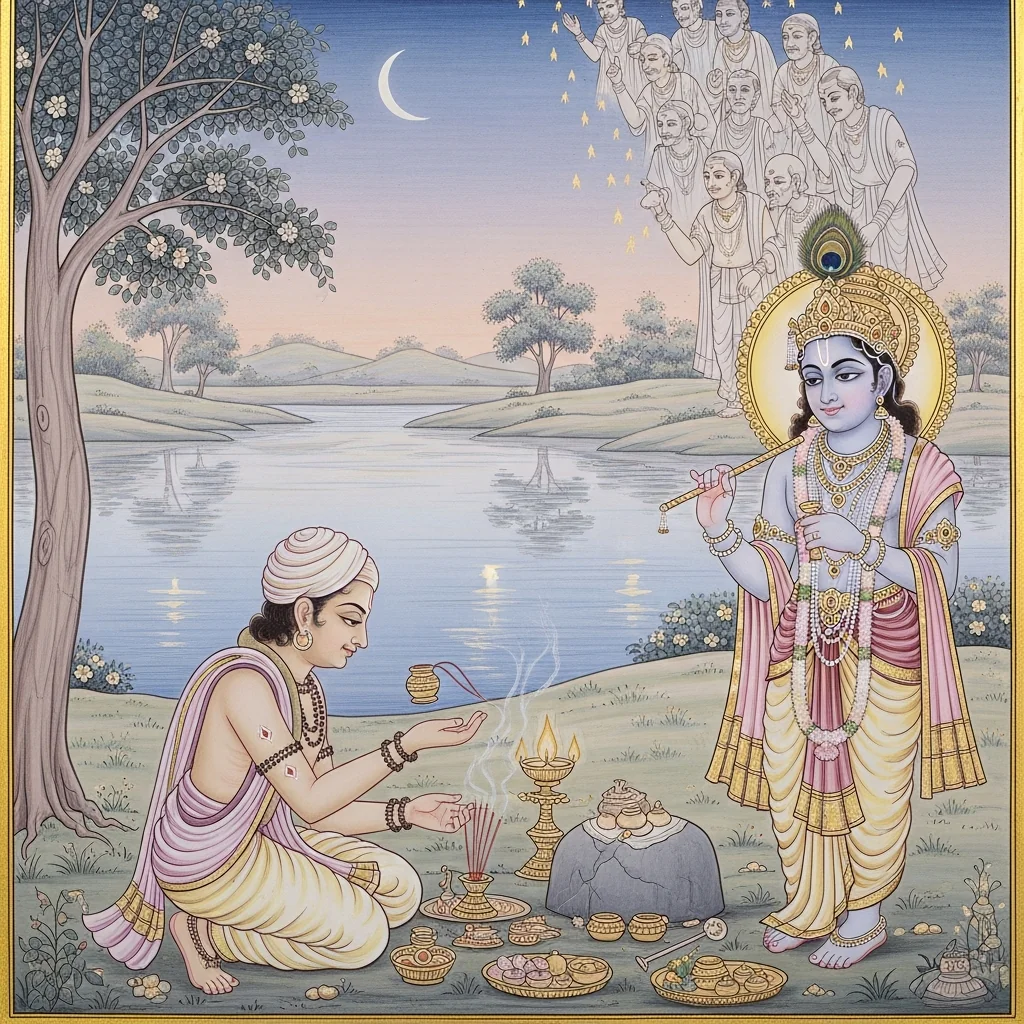
Mārkaṇḍeya recounts how the brāhmaṇa Candraśarmā reaches Dvārakā, a siddha- and deva-served sacred city famed as a mokṣa-bestowing abode, where sins are said to perish upon entry and mere sight. He extols the spiritual sufficiency of Dvārakā-darśana, implying that other tīrtha pursuits become secondary. Candraśarmā then performs rites on the Gomati’s bank: snāna, pitṛ-tarpaṇa, collecting and worshiping cakrāṅkita śilās from Cakratīrtha with the Puruṣasūkta, followed by Śiva-pūjā and formal piṇḍa-udaka offerings with the customary upacāras—vilepana, vastra, puṣpa, dhūpa, dīpa, naivedya, nīrājana, pradakṣiṇa, and namaskāra. Keeping nocturnal vigil (jāgaraṇa), he prays to Kṛṣṇa to remove the fault of daśamī-vedha that mars dvādaśī observance and to free his ancestors from preta-status; Kṛṣṇa affirms the power of bhakti and reveals the ancestors liberated and ascending. The pitṛs warn of the peril of a faulty (sasalya) dvādaśī—especially daśamī-vedha—as destructive to merit and devotion, urging careful calendrical safeguarding of the vow. Kṛṣṇa further declares that a single properly aligned trispr̥śā fast in Vaiśākha, joined with Dvārakā-darśana, can complete neglected observances, and he foretells Candraśarmā’s death in Vaiśākha at a trispr̥śā Wednesday conjunction. The chapter ends with Mārkaṇḍeya’s phala: hearing, reading, or writing and spreading this Dvārakā-māhātmya yields the promised merit.
Shlokas
Verse 1
श्रीमार्कंडेय उवाच । पितॄणां प्रेतरूपाणां कृत्वा वाक्यं महीपते । चंद्रशर्मा द्विजश्रेष्ठो द्वारकां समुपागतः
Śrī Mārkaṇḍeya said: O king, having fulfilled the command of his forefathers who appeared in the form of pretas, the excellent brāhmaṇa Candraśarmā arrived at Dvārakā.
Verse 2
रुक्मिणीसहितः कृष्णो यत्र तिष्ठति चान्वहम् । यत्र तिष्ठंति तीर्थानि तत्र यातो द्विजोत्तमः
The foremost brāhmaṇa went to the place where Kṛṣṇa dwells each day with Rukmiṇī—where the tīrthas, the holy fords, themselves abide.
Verse 3
यत्र तिष्ठंति यज्ञाश्च यत्र तिष्ठंति देवताः । यत्र तिष्ठंति ऋषयो मुनयो योगवित्तमाः
That is the place where the sacrifices (yajñas) themselves abide, where the gods dwell, and where the ṛṣis and sages—foremost among knowers of Yoga—remain established.
Verse 4
या पुरी सिद्धगंधर्वैः सेव्यते किंनरैर्नरेः । अप्सरोगणयक्षैश्च द्वारका सर्वकामदा
That city, honored and frequented by Siddhas and Gandharvas, by Kiṃnaras and noble men, and by hosts of Apsarases and Yakṣas—such is Dvārakā, the fulfiller of all desires.
Verse 5
स्वर्गारोहणनिश्रेणी वहते यत्र गोमती । सा पुरी मोक्षदा नृणां दृष्टा विप्रवरेण हि
Where the Gomātī flows like a stairway for ascending to heaven—indeed, that city, once beheld by the foremost of brāhmaṇas, grants liberation (mokṣa) to men.
Verse 6
यस्याः सीमां प्रविष्टस्य ब्रह्महत्यादिपातकम् । नश्यते दर्शनादेव तां पुरीं को न सेवते
For one who enters even the boundary of that city, grievous sins—beginning with brahma-hatyā—are destroyed by mere sight alone; who, then, would not seek and honor such a city?
Verse 7
गत्वा कृष्णपुरीं दृष्ट्वा गोमतीं चैव सागरम् । मन्ये कृतार्थमात्मानं जीवितं यौवनं धनम्
Having gone to Kṛṣṇa’s city and having seen the Gomātī and the ocean as well, I deem myself fulfilled—my life, my youth, and my wealth have found their true purpose.
Verse 8
दृष्ट्वा कृष्णपुरीं रम्यां कृष्णस्य मुखपंकजम् । धन्योऽहं कृत्यकृत्योहं सभाग्योऽहं धरातले
Having seen lovely Kṛṣṇa’s city, and Kṛṣṇa’s lotus-like face, I am blessed; my duties are accomplished; I am fortunate upon this earth.
Verse 9
दृष्ट्वा कृष्णमुखं रम्यं रुक्मिणीं द्वारकां पुरीम् । तीर्थकोटिसहस्रैस्तु सेवितैः किं प्रयोजनम्
Having beheld the beautiful face of Kṛṣṇa, Rukmiṇī, and the city of Dvārakā—what purpose would be served by visiting millions and thousands of other tīrthas?
Verse 10
पुण्यैर्लक्षसहस्रैस्तु प्राप्ता द्वारवती शुभा । शुक्ला वैशाखमासे तु संप्राप्ता मधुसूदनी
Only through merits accumulated by hundreds of thousands is auspicious Dvāravatī attained; and in the bright fortnight of the month of Vaiśākha, the holy time called Madhusūdanī is obtained.
Verse 11
द्वादशी त्रिस्पृशानाम पापकोटिशतापहा । धन्याः सर्वे मनुष्यास्ते वैशाखे मधुसूदनी
The Dvādaśī called Trispṛśā destroys hundreds of crores of sins. Truly blessed are all those who obtain it in Vaiśākha, in the Madhusūdana observance.
Verse 12
संप्राप्ता त्रिस्पृशा यैस्तु बुधवारेण संयुता । न यज्ञैस्तु न वेदैस्तु न तीर्थैः कोटिसेवितैः । प्राप्यते तत्फलं नैव द्वारकायां यथा नृणाम्
For those who obtain Trispṛśā (Dvādaśī) conjoined with Wednesday, that fruit is not gained by sacrifices, nor by Vedic study, nor even by visiting crores of tīrthas—it is the very fruit that men obtain in Dvārakā.
Verse 13
एवमुक्त्वा द्विजश्रेष्ठो गोमतीतीरमाश्रितः । उपस्पृश्य यथान्यायं शास्त्रदृष्टेन कर्मणा
Having spoken thus, the best of the twice-born went to the bank of the Gomati and, according to proper rule, performed the prescribed purificatory act (ācamana and the like) as enjoined in the śāstras.
Verse 14
कृत्वा स्नानं यथोक्तं तु संतर्प्य पितृदेवताः । चक्रतीर्थात्समादाय शिलांश्चक्रांकिताञ्छुभान् । पूजिताः पुरुषसूक्तेन यथोक्तविधिना नृप
After bathing as prescribed and duly satisfying the ancestral deities, he took auspicious stones marked with the Discus from Cakratīrtha, and worshipped them with the Puruṣasūkta according to the stated rite, O King.
Verse 15
शिवपूजा कृता पश्चात्संस्मृत्य पितृभाषितम् । दत्त्वा पिंडोदकं सम्यक्पितॄणां विधिपूर्वकम्
After performing worship of Śiva, recalling what the forefathers had instructed, he properly offered piṇḍa and water to the Pitṛs in accordance with the rite.
Verse 16
विलेपनं च वस्त्राणि पुष्पाणि धूपदीपको । नैवेद्यानि मनोज्ञानि कंदमूलफलानि च
He offered unguents and garments, flowers, incense and lamps; and also naivedya—pleasing food-offerings of roots, tubers, and fruits as well.
Verse 17
तांबूलं च सकर्पूरं कृत्वा नीराजनादिकम् । प्रदक्षिणां नमस्कारं स्तुतिपूर्वं पुनःपुनः
He offered tāmbūla (betel) with camphor, performed nīrājana (ārati) and the like, and again and again circumambulated and bowed—each act accompanied by hymns of praise.
Verse 18
क्षमापयित्वा देवेशं चक्रे जागरणं ततः । यामत्रये व्यतीते तु चंद्रशर्मा ह्युवाच ह
Having sought forgiveness from the Lord of gods, he then kept vigil (jāgaraṇa). And when three watches of the night had passed, Candraśarmā spoke.
Verse 19
आतुरस्य च दीनस्य शृणु कृष्ण वचो मम । संसारभयसंत्रस्तं मां त्वमुद्धर केशव
Hear my words, O Kṛṣṇa—for I am afflicted and helpless. O Keśava, lift me up and save me, shaken by fear of saṃsāra, worldly existence.
Verse 20
त्वत्पादांबुज भक्तानां न दुःखं पापिनामपि । किं पुनः पापहीनानां द्वादशीसेविनां नृणाम्
For those devoted to Your lotus feet there is no suffering—even if they are sinners; how much more, then, for sinless people who faithfully observe Dvādaśī.
Verse 21
दशमीवेधजं पापं कथितं मम पूर्वजैः । दुष्कृतं नाशमायातु त्वत्प्रसादाज्जनार्द्दन
My forefathers have spoken of the sin born of “Daśamī-vedha” (the taint of the tenth day’s encroachment). By Your grace, O Janārdana, may that wrongdoing be destroyed.
Verse 22
सविद्धं त्वद्दिनं कृष्ण यत्कृतं जागरं हरे । तत्पापं विलयं यातु यथालवणमंभसि
O Kṛṣṇa, O Hari—if the vigil (jāgara) I kept on Your sacred day was tainted by overlap, may that sin dissolve away, like salt in water.
Verse 23
सविद्धं वासरं यस्मा त्कृतं मम पितामहैः । प्रेतत्वं तेन संप्राप्तं महादुःखप्रसाधकम्
Because my grandfathers once observed a sacred day improperly, they fell into the state of a preta—an affliction that brings about immense suffering.
Verse 24
यथा प्रेतत्वनिर्मुक्ता मम पूर्वपितामहाः । मुक्तिं प्रयांति देवेश तथा कुरु जगत्पते
O Lord of the gods, O Master of the world—grant it so that my earlier forefathers, freed from the preta-state, may attain liberation (mokṣa).
Verse 25
पुनरेव यदुश्रेष्ठ प्रसादं कर्तुमर्हसि । अविद्यामोहितेनापि न कृतं तव पूजनम्
O best of the Yadus, be gracious once again. Deluded by ignorance, I did not perform Your worship.
Verse 26
मया पापेन देवेश शिवभक्तिः समाश्रिता । तव भक्तिः कृता नैव न कृतं तव वासरम्
O Lord of the gods, sinful as I am, I took refuge in devotion to Śiva; yet I did not foster devotion to You, nor did I observe Your sacred day.
Verse 27
न दृष्टा द्वारका कृष्ण न स्नातो गोमतीजले । न दृष्टं पादपद्मं च त्वदीयं मोक्षदा यकम्
O Kṛṣṇa, I have not beheld Dvārakā; I have not bathed in the waters of the Gomati; nor have I seen Your lotus-feet, bestowers of liberation.
Verse 28
न कृता द्वारकायात्रा दृष्ट्वा सोमेश्वरं प्रभुम् । विफलं सुकृतं जातं यन्मया समुपार्जितम्
I did not undertake the pilgrimage to Dvārakā to behold Lord Someśvara; thus the merit I have amassed has become fruitless.
Verse 29
मत्पूर्वजैस्तु कथितं सर्वमेव सुरेश्वर । तत्पुण्यं मा वृथा यातु प्रसादात्तव केशव
O Lord of the gods—O Keśava—my forefathers have indeed spoken of all this. By Your grace, let that merit not go in vain.
Verse 30
दृष्टं तु तव वक्त्रं च दुर्ल्लभं भुवनत्रये । तन्नास्ति देवकीपुत्र पुराणेषु श्रुतं मया
Yet I have seen Your face, so rare in the three worlds. O son of Devakī, I have heard in the Purāṇas that such a vision is scarcely attainable.
Verse 31
सापराधास्तु ये केचिच्छिशुपालादयः स्मृताः । त्वत्करेण हताः कोपान्मुक्तिं प्राप्ता महीवराः
Even those remembered as offenders—such as Śiśupāla and others—when slain by Your hand in wrath, attained liberation, O great Lord.
Verse 32
अद्यप्रभृति कर्त्तव्यं पूजनं प्रत्यहं च तत् । पलार्धेनापि विद्धं स्याद्भोक्तव्यं वासरे तव
From today onward, that worship should be performed every day; and even if the fast is ‘defective’ by as little as half a pala, one should eat only on Your sacred day, according to the rule of that observance.
Verse 33
त्वत्प्रिया च मया कार्य्या द्वादशी व्रतसंयुता । भक्तिर्भागवतानां च कार्य्या प्राणैर्द्धनैरपि
I shall observe what is dear to You—especially the sacred Dvādaśī vow—and I shall cultivate devotion to the Lord’s devotees (Bhāgavatas), honoring them even at the cost of my life and wealth.
Verse 34
नित्यं नामसहस्रं तु पठनीयं तव प्रियम् । पूजा तु तुलसीपत्रैर्मया कार्या सदैव हि
Daily I shall recite the thousand names that are dear to You, and I shall ever worship You with tulasī leaves.
Verse 35
तुलसीकाष्ठसंभूता माला धार्य्या सदा मया । नृत्यं गीतं च कर्त्तव्यं संप्राप्ते जागरे तव
I shall always wear a rosary made from tulasī wood; and when Your night-vigil (jāgara) is observed, I shall engage in devotional singing and dancing.
Verse 36
द्वारकायां प्रकर्त्तव्यं प्रत्यहं गमनं मया । त्वत्कथाश्रवणार्थं च नित्यं पुस्तकवाचनम्
I shall go to Dvārakā each day, and to hear the sacred tales of Your deeds I shall daily read the holy scriptures.
Verse 37
नित्यं पादोदकं मूर्ध्ना मया धार्यं सुभक्तितः । नैवेद्यभक्षणं चैव करिष्यामि सुभक्तितः
With sincere devotion I shall daily place upon my head the water that has washed Your feet (pādodaka), and with that same devotion I shall partake of the consecrated offering (naivedya).
Verse 38
निर्माल्यं शिरसा धार्य्यं त्वदीयं सादरं मया । तव दत्त्वा यदिष्टं तु भक्षणीयं सदा मया
With reverence I shall place upon my head Your nirmālya—the garlands and flowers offered to You. And whatever is dear to You, once offered to You, I shall always partake of as Your sanctified gift.
Verse 39
तथा तथा प्रकर्त्तव्यं येन तुष्टिर्भवेत्तव । तथ्यमेतन्मया कृष्ण तवाग्रे परिकीर्तितम्
In every way I shall act so that You may be pleased. This truth, O Kṛṣṇa, I have declared openly before You.
Verse 40
श्रीकृष्ण उवाच । साधुसाधु महाभाग चन्द्रशर्मन्द्विजोत्तम । आगमिष्यंति मल्लोके त्वया सह पितामहाः
Śrī Kṛṣṇa said: “Well done, well done! O fortunate Candraśarman, best of brāhmaṇas—your forefathers will come to My realm along with you.”
Verse 41
पश्य प्रेतत्वनिर्मुक्ता मत्प्रसादाद्द्विजोत्तम । आकाशे गरुडारूढास्तव पूर्वपितामहाः
Behold, O best of brāhmaṇas—by My grace your former forefathers have been freed from the state of preta; in the sky they are mounted upon Garuḍa.
Verse 42
पितामहा ऊचुः । त्वत्प्रसादाद्वयं पुत्र मुक्तिं प्राप्ता न संशयः । प्रेतयोनेर्विनिर्मुक्ताः कृष्णवक्त्रावलोकनात्
The forefathers said: “By your favor, dear son, we have attained liberation—there is no doubt. By beholding Kṛṣṇa’s face we have been freed from the preta state.”
Verse 43
धन्यास्ते मानुषे लोके पुत्रपौत्रप्रपौत्रकाः । दृष्ट्वा श्रीसोमनाथं तु कृष्णं पश्यंति द्वारकाम्
Blessed indeed in the human world are those who, together with their sons, grandsons, and great-grandsons, behold Śrī Somanātha and then behold Kṛṣṇa in Dvārakā.
Verse 44
धन्या च विधवा नारी कृष्णयात्रां करोति या । उद्धरिष्यति लोकेऽस्मिन्कुलानां निरयाच्छतम्
Blessed too is that widow who undertakes the pilgrimage to Kṛṣṇa; in this very world she will deliver a hundred lineages of her family from hell.
Verse 45
श्वपचोऽपि करोत्येवं यात्रां च हरिशांकरीम् । स याति परमां मुक्तिं पितृभिः परिवारितः
Even a śvapaca (one of the lowest-born) who thus undertakes the pilgrimage of Hari and Śaṅkara attains supreme liberation, accompanied by his forefathers.
Verse 46
यः पुनस्तीर्थसंन्यासं कृत्वा तिष्ठति तत्र वै । विष्णुलोकान्निवृत्तिर्न कल्पकोटिशतैरपि
Moreover, whoever, having taken renunciation at that sacred place, abides there—there is no return for him from Viṣṇu’s world, even after hundreds of crores of kalpas.
Verse 47
वंचितास्ते न सन्देहो दृष्ट्वा सोमेश्वरं प्रभुम् । दृष्टं कृष्णमुखं नैव न स्नाता गोमतीजले
Deceived indeed—there is no doubt—are those who, though they have seen Lord Someśvara, have not beheld Kṛṣṇa’s face and have not bathed in the waters of the Gomatī.
Verse 48
किं जलैर्बहुभिः पुण्यैस्तीर्थकोटिसमुद्भवैः । दृष्ट्वा सोमेश्वरं यस्तु द्वारकां नैव गच्छति । धिक्कुर्वंति च तं पापं पितरो दिवि संस्थिताः
What use are many ‘holy waters’ arising from crores of tīrthas? For the one who, after seeing Someśvara, does not go to Dvārakā—him, that sinful man, the Pitṛs abiding in heaven revile.
Verse 49
दृष्ट्वा सोमेश्वरं देवं कृष्णं दृष्ट्वा पुनः शिवम् । सौपर्णे कथितं पुण्यं यात्राशतसमुद्भवम्
Having seen the god Someśvara, having seen Kṛṣṇa, and again having seen Śiva—this merit, born of a hundred pilgrimages, is spoken of in the Sauparṇa (Garuda-related) teaching.
Verse 50
दृष्ट्वा सोमेश्वरं देवं कृष्णं नैव प्रपश्यति । मोहाद्व्यर्थगतं तस्य सर्वं संसारकर्म वै
Having seen the god Someśvara, if one does not truly behold Kṛṣṇa, then out of delusion all his worldly striving becomes fruitless indeed.
Verse 51
आगत्य यः प्रभासे च कृष्णं पश्यति वै नरः । प्रभासायुतसंख्यं तु फलमाप्नोति यत्नतः
Whoever comes to Prabhāsa and beholds Kṛṣṇa attains, through earnest striving, a reward measured in tens of thousands of Prabhāsa-merits.
Verse 52
यस्मात्सर्वाणि तीर्थानि सर्वे देवास्तथा मखाः । द्वारकायां समायांति त्रिकालं कृष्णसंनिधौ
For all tīrthas, all the gods, and even the sacrificial rites (makhās) gather in Dvārakā three times each day, in the very presence of Kṛṣṇa.
Verse 53
तीर्थैर्नानाविधैः पुत्र तत्स्थानैः किं प्रयोजनम् । फलं समस्ततीर्थानां दृष्ट्वा द्वारवतीं लभेत्
O son, what need is there for many kinds of pilgrimage-fords and their various sites? By merely beholding Dvāravatī (Dvārakā), one gains the merit that is the fruit of all tīrthas.
Verse 54
हते कंसे जरासन्धे नरके च निपातिते । उत्तारिते भुवो भारे कृष्णो देवकिनंदनः । चक्रे द्वारवतीं रम्यां सन्निधौ सागरस्य च
When Kaṃsa and Jarāsandha had been slain, Naraka cast down, and the burden of the earth relieved, Kṛṣṇa—the joy of Devakī—founded the lovely city of Dvāravatī beside the ocean.
Verse 55
स्थितः प्रीतमनाः कृष्णो लप्स्यते कामिनीसुखम्
Abiding there with a delighted mind, Kṛṣṇa enjoys the bliss of love—the happiness of union with his beloveds.
Verse 56
ब्रह्माग्निवायुसूर्याश्च वासवाद्या दिवौकसः । मर्त्त्या विप्राश्च राजानः पातालात्पन्नगेश्वराः
Brahmā, Agni, Vāyu, and Sūrya; Indra and the other dwellers of heaven; mortals—brāhmaṇas and kings; and from Pātāla, the lords of the serpents—all gather there.
Verse 57
नद्यो नदाश्च शैलाश्च वनान्युपवनानि च । पुरग्रामा ह्यरण्यानि सागराश्च सरांसि च
Rivers and streams, mountains, forests and groves; cities and villages, wildernesses; oceans and lakes—all, as it were, are present there.
Verse 58
यक्षाश्चासुरगंधर्वाः सिद्धा विद्याधरास्तथा । रम्भाद्यप्सरसश्चैव प्रह्लादाद्या दितेः सुताः । रक्षा विभीषणाद्याश्च धनदो रक्ष नायकः
Yakṣas, asuras, and gandharvas; siddhas and vidyādharas; apsarases such as Rambhā; the sons of Diti beginning with Prahlāda; rākṣasas such as Vibhīṣaṇa; and Dhanada (Kubera), lord of the yakṣas—all are found there.
Verse 59
ऋषयो मुनयः सिद्धाः सनकाद्याश्च योगिनः । ग्रहा ऋक्षाणि योगाश्च ध्रुवः परमवैष्णवः
Ṛṣis and munis, siddhas, and yogins such as Sanaka and the others; the planets, the constellations, and the cosmic yogas; and Dhruva, the supreme Vaiṣṇava—all are present there.
Verse 60
यत्किंचित्त्रिषु लोकेषु तिष्ठते स्थाणुजंगमम् । श्रीकृष्णसन्निधौ नित्यं प्रत्यहं तिष्ठते सदा
Whatever exists in the three worlds—whether unmoving or moving—abides forever in the presence of Śrī Kṛṣṇa, day after day, continually.
Verse 61
न त्यजंति पुरीं पुण्यां द्वारकां कृष्णसेविताम् । सा त्वया सेविता पुत्र सांप्रतं कृष्णदर्शनात् । पिशाचयोनिनिर्मुक्ता यास्यामः परमां गतिम्
They do not forsake the holy city of Dvārakā, served by Kṛṣṇa. You too, my son, have now worshiped it; and by Kṛṣṇa’s darśana we have been freed from birth as a piśāca, and we shall go to the highest state.
Verse 62
द्वादशीवेधजंपापं द्वारकायाः प्रभावतः । नष्टं पुत्र न सन्देहः संप्राप्ताः परमं पदम्
By the very power of Dvārakā, the sin arising from “Dvādaśī-vedha” has been destroyed. O son, there is no doubt: we have attained the supreme abode.
Verse 63
द्वादशीवेधसम्भूतं यत्त्वया पापमर्जितम् । कृष्णस्य दर्शनात्क्षीणं न जह्यं द्वादशीव्रतम्
Whatever sin you incurred due to the vedha that taints Dvādaśī has been exhausted by the very sight of Kṛṣṇa. Therefore, do not abandon the observance of the Dvādaśī vow.
Verse 64
रक्षणीयं प्रयत्नेन वेधो दशमिसम्भवः । नो चेत्पुत्र न संदेहः प्रेतयोनिमवाप्स्यसि
With great effort one must guard against the vedha—an overlapping taint that arises from Daśamī. Otherwise, my son, there is no doubt: you will fall into the state of a preta.
Verse 65
त्रैलोक्य संभवं पापं तेषां भवति भूतले । सशल्यं ये प्रकुर्वंति वासरं कृष्णसंज्ञकम्
For those who observe, with fault (saśalya), the day that bears Kṛṣṇa’s name, the sin born of the three worlds comes upon them here on earth.
Verse 66
प्रायश्चित्तं न तस्यास्ति सशल्यं वासरं हरेः । ये कुर्वंति न ते यांति मन्वतरशतैर्दिवम्
For that there is no expiation—when Hari’s sacred day is observed with a fault. Those who do so do not reach heaven, even after hundreds of manvantaras.
Verse 67
प्रेतत्वं दुःसहं पुत्र दुःसहा यमयातना । तस्मात्पुत्र न कर्त्तव्यं सशल्यं द्वादशीव्रतम्
The state of being a preta is unbearable, my son, and Yama’s punishments are unbearable. Therefore, my son, the Dvādaśī vow must not be performed with defect.
Verse 68
कारयंति हि ये त्वज्ञाः कूटयुक्ताश्च हेतुकाः । प्रेतयोनिं प्रयास्यंति पितृभिः सह सर्वतः
Indeed, those ignorant people—cunning and arguing pretexts—who cause such faulty observances to be done will go to the preta state, along with their ancestors, in every way.
Verse 69
द्वादशी दशमीविद्धा संतानप्रविनाशिनी । ध्वंसिनी पूर्वपुण्यानां कृष्णभक्तिविनाशिनी
Dvādaśī, when pierced and tainted by Daśamī, destroys progeny; it ruins one’s former merits and destroys devotion to Kṛṣṇa.
Verse 70
स्वस्ति तेऽस्तु गमिष्यामः प्रसादाद्रुक्मिणीपतेः । प्राप्तं विष्णुपदं पुत्र अपुनर्भवसंज्ञकम्
May auspiciousness be yours; we shall depart by the grace of Rukmiṇī’s Lord. You have attained, my son, Viṣṇu’s abode—Viṣṇupada—known as freedom from rebirth.
Verse 71
श्रीकृष्ण उवाच । चंद्रशर्मन्प्रसन्नोऽहं तव भक्त्या द्विजोत्तम । शैवभावप्रपन्नोऽपि यस्त्वं जातोऽसि वैष्णवः
Śrī Kṛṣṇa said: O Candraśarman, best of brāhmaṇas, I am pleased by your devotion; though inclined to a Śaiva disposition, you have become a Vaiṣṇava.
Verse 72
नवसप्ततिवर्षाणि न कृतं वासरे मम । संपूर्णं मत्प्रसादेन तव जातं न संशयः
For seventy-nine years you did not perform the observance on My sacred day. Yet by My grace it has become complete for you—there is no doubt.
Verse 73
एकेनैवोपवासेन त्रिस्पृशासंभवेन हि । द्वारकायाः प्रसादेन मद्दृष्ट्यालोकनेन हि
Indeed, by a single fast—especially one connected with the auspicious Trispṛśā observance—by the grace of Dvārakā and by the very act of beholding Me, one gains spiritual merit.
Verse 74
अविद्यामोहितेनैव शिवभक्त्या ममार्चनम् । न कृतं मत्प्रसादेन कृतं चैव भविष्यति
Deluded by ignorance, you did not worship Me through your devotion to Śiva; yet by My grace, that worship—though not done before—will indeed be accomplished.
Verse 75
वैशाखे यैरहं दृष्टो द्वारकायां द्विजोत्तम । त्रिस्पृशावासरे चैव वंजुलीवासरे तथा
O best of brāhmaṇas, those who behold Me in Dvārakā during the month of Vaiśākha—on the day of Trispṛśā and likewise on the day of Vaṃjulī—are specially blessed.
Verse 76
उन्मीलिनीदिने प्राप्ते प्राप्ते वा पक्षवर्द्धिनी । नैतेषां चापराधोऽस्ति यद्यपि ब्रह्मघातकाः
When the sacred day called Unmīlinī arrives, or when Pakṣavarddhinī arrives, these people incur no offense—even if they would otherwise be guilty of brahmin-slaying.
Verse 77
जन्मप्रभृति पुण्यस्य प्रकृतस्यापि भूसुर । मत्पुरीदर्शनेनापि फलभागी भवेन्नरः
O Brahmin, even the merit a person has accumulated since birth bears fruit for him simply by the darśana of My city.
Verse 78
दृष्ट्वा समस्ततीर्थानि प्रभासादीनि भूतले । मत्पुरीदर्शनेनैव पृष्ट्वाऽपीह भवेत्फलम्
Even after seeing all the tīrthas on earth—Prabhāsa and the rest—the fruit here is attained through the darśana of My city alone, even if one merely inquires about it.
Verse 79
माहात्म्यं द्वारकायास्तु मद्दिने यत्र तत्र वा । पठेन्मम पुरीं पुण्यां लभते मत्प्रसादतः
Whoever recites the Māhātmya of Dvārakā—on My sacred day or on any day, wherever he may be—obtains that holy city by My grace.
Verse 80
मत्पुरीं वसतां पुण्यं त्रिकालं मम दर्शनात् । तत्फलं समवाप्नोति यस्त्विदं पठते कलौ
In the Kali age, whoever recites this attains that very fruit—the merit gained by those who dwell in My city and behold Me at the three times of day.
Verse 81
कलौ काशी च मथुरा ह्यवंती च द्विजोत्तम । अयोध्या च तथा माया कांची चैव च मत्पुरी
O best of Brāhmaṇas, in the Kali age, Kāśī, Mathurā, Avanti, Ayodhyā, Māyā (Haridvāra), Kāñcī, and also My city are the foremost sacred tīrthas.
Verse 82
शालिग्रामभवं चैव बदरी च तथोत्तमा । कुरुक्षेत्रं भृगुक्षेत्रं पुष्करं शुभसंज्ञकम्
Śāligrāma, and the most excellent Badarī as well; Kurukṣetra, Bhṛgukṣetra, and Puṣkara, famed as auspicious—these all are eminent tīrthas.
Verse 83
प्रयागं च प्रभासं च क्षेत्रं वै हाटकेश्वरम् । गंगाद्वारं शौकरं च गंगासागरसंगमम्
Prayāga and Prabhāsa; the sacred kṣetra of Hāṭakeśvara; Gaṅgādvāra (Haridvāra), Śaukara, and the confluence where the Gaṅgā meets the ocean—these are all renowned holy places.
Verse 84
नैमिषं दण्डकारण्यं तथा वृन्दावनं द्विज । सैंधवं चार्बुदाख्यं च सर्वाण्यायतनानि च
O Brāhmaṇa, Naimiṣa, the Daṇḍaka forest, and Vṛndāvana; Saiṃdhava and the place called Arbuda (Mount Ābū)—indeed, all holy abodes are encompassed in this sacred reckoning.
Verse 85
वनानि मागधादीनि पुष्कराणि द्विजोत्तम । शैलराजादयः शैला हिमाद्रिप्रमुखा हि ये
O best of Brāhmaṇas, the forests beginning with those of Magadha, the sacred Puṣkaras, and the great mountains—Śailarāja and the ranges headed by Himādri (the Himalaya)—all are included among the famed sanctities invoked.
Verse 86
गंगादयश्च सरितो भूतले संति यानि वै । तीर्थानि त्रिषु कालेषु समानि द्वारकापुरः
Whatever rivers exist upon the earth—beginning with the Gaṅgā—and whatever tīrthas there are: in the three times (past, present, and future) they are equal in merit, when measured against the sanctity of the city of Dvārakā.
Verse 87
कलिना कलितं सर्वं वर्जयित्वा तु मत्पुरीम् । विप्र वर्षशते प्राप्ते मत्पुर्यां मम दर्शने
In the age of Kali, all things are overpowered by Kali—save my own city. O Brāhmaṇa, when a hundred years have passed, in my city, at the time of my darśana (your blessed audience with me)…
Verse 88
तव मृत्युर्महीदेव मत्प्रसादाद्भविष्यति । त्रिस्पृशावासरे प्राप्ते वैशाखे शुक्लपक्षतः
O lord of the earth, by my grace your death shall come to pass. When the Trispṛśā day arrives, in the bright fortnight of Vaiśākha…
Verse 89
संगमे बुधवारस्य दिवा भूमौ ममाग्रतः । दशमं द्वारमासाद्य तव प्राणस्य निर्गमम् । भविष्यति न संदेहो मत्प्रसादेन भूसुर
At the auspicious juncture, on a Wednesday, by day, upon the ground before me—having reached the “tenth gate,” the departure of your life-breath (prāṇa) will occur. Of this there is no doubt, O Brāhmaṇa, by my grace.
Verse 90
स्वस्थानं गच्छ विप्रेंद्र सर्वान्कामानवाप्स्यसि । मद्भक्तानां युगांतेऽपि विनाशो नोपपद्यते
Go now to your own place, O best of Brāhmaṇas; you shall obtain all that you desire. Even at the end of a yuga, the destruction of my devotees does not come to be.
Verse 91
मद्भक्तिं वहतां पुंसामिह लोके परेऽपि वा । नाशुभं विद्यते किंचित्कुलकोटिं नयेद्दिवम्
For men who bear devotion to me—whether in this world or in the next—there is no inauspiciousness whatsoever; that devotion can lead even ten million of one’s lineage to heaven.
Verse 92
मार्कण्डेय उवाच । ततो वर्षशते प्राप्ते गत्वा द्वारवतीं पुरीम् । प्राणान्कृष्णोपदेशेन त्यक्त्वा मोक्षं जगाम ह
Mārkaṇḍeya said: Then, when the hundred years were completed, he went to the city of Dvāravatī; and, by Kṛṣṇa’s instruction, relinquishing his life-breath, he indeed attained liberation.
Verse 93
इन्द्रद्युम्न तदाख्यातं माहात्म्यं द्वारकाभवम् । पुनरेव् प्रवक्ष्यामि यत्ते मनसि वर्त्तते
O Indradyumna, that sacred greatness of Dvārakā has been explained. Yet I shall declare it again—whatever still abides in your mind.
Verse 94
शृण्वतां पठतां चैव माहा त्म्यं द्वारकाभवम् । सर्वं फलमवाप्नोति कृष्णेन कथितं च यत्
Whoever listens to, or recites, this Dvārakā-māhātmya attains every fruit—those very rewards that were spoken by Kṛṣṇa.
Verse 95
विस्तारयंति लोकेऽस्मिंल्लिखितं यस्य वेश्मनि । प्रत्यक्षं द्वारकापुण्यं प्राप्यते कृष्णसंभवम्
In this world, for one in whose house this (māhātmya) is written down and spread, the merit of Dvārakā becomes directly attainable—born of Kṛṣṇa and granted through Kṛṣṇa.