Adhyaya 11
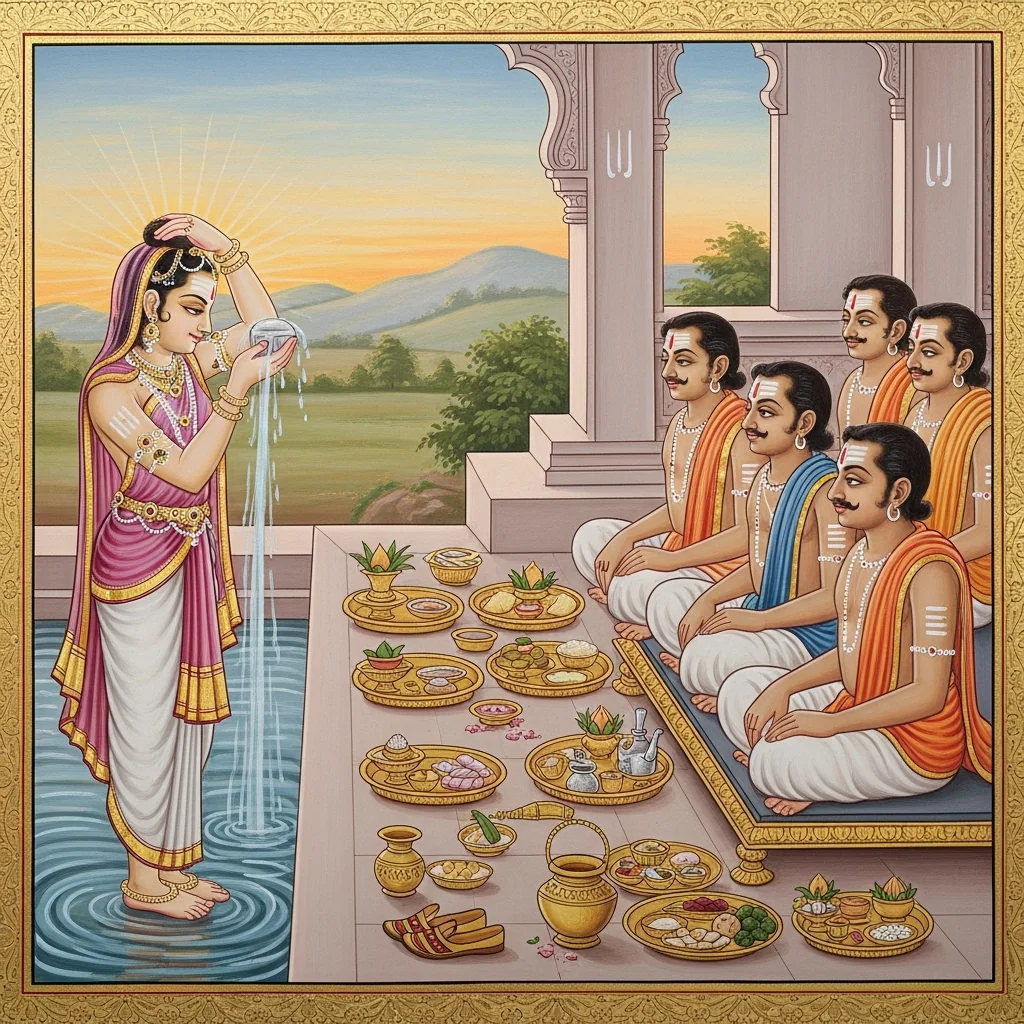
Chapter 11 records Prahlāda’s guidance to learned brāhmaṇas on approaching the tīrtha called “Viṣṇupadodbhava,” a sacred water-source said to arise from Viṣṇu’s footprint and revered in the Gaṅgā/Vaiṣṇavī tradition. Merely beholding this tīrtha is declared to yield the merit of Gaṅgā-snāna. Prahlāda sets out the rite in order: remember its origin and praise it as a destroyer of sin through recollection and recitation; offer arghya with formal salutations to the river as a goddess; perform disciplined snāna facing east, applying tīrtha-soil; and then do tarpaṇa for devas, pitṛs, and humans with tila and akṣata. He further enjoins inviting brāhmaṇas and performing śrāddha with proper dakṣiṇā (gold/silver), along with charity to the poor and afflicted, and practical gifts such as footwear, a water-pot, and salted curd-rice with greens and cumin, plus ritual clothing offerings linked with Rukmiṇī—ending with the devotional resolve to please Viṣṇu. The phalaśruti proclaims that the performer becomes kṛtakṛtya, the ancestors gain lasting satisfaction like Gayā-śrāddha and attain a Vaiṣṇava realm, the devotee receives prosperity and divine favor, and even hearing the chapter is said to free one from sins.
Shlokas
Verse 1
प्रह्लाद उवाच । ततो गच्छेद्द्विजश्रेष्ठास्तीर्थं विष्णुपदोद्भवम् । यस्य दर्शनमात्रेण गंगास्नानफलं लभेत्
Prahlāda said: Then, O best of Brāhmaṇas, one should go to the tīrtha that has arisen from Viṣṇu’s foot. By its mere sight one gains the fruit of bathing in the Gaṅgā.
Verse 2
यस्योत्पत्तिर्मया पूर्वं कथिता द्विजसत्तमाः । यस्य संस्मरणादेव कीर्तनात्पापनाशनम्
O best of Brāhmaṇas, whose origin I have previously described—of that tīrtha, merely remembering it and praising it aloud destroys sin.
Verse 3
हरिणा या समानीता रुक्मिण्यर्थे महात्मना । यस्या गण्डूषमात्रेण हयमेधफलं लभेत्
That sacred water which the great-souled Hari brought for Rukmiṇī’s sake—by merely sipping a mouthful of it, one obtains the fruit of the Aśvamedha sacrifice.
Verse 4
विष्णोः पादप्रसूताया वैष्णवीति च विश्रुता । तत्र गत्वा महाभाग गृहीत्वाऽर्घ्यं विधानतः
She is renowned as “Vaiṣṇavī,” born from Viṣṇu’s foot. O fortunate one, having gone there, one should offer arghya (a reverential water-offering) according to the proper rule.
Verse 5
नमस्ये त्वां भगवति विष्णुपादतलोद्भवे । गृहाणार्घ्यमिदं देवि गंगे त्वं हरिणा सह
I bow to you, O Blessed Goddess, who has arisen from the sole of Viṣṇu’s foot. O Goddess Gaṅgā, accept this arghya—together with Hari.
Verse 6
इत्युच्चार्य द्विजश्रेष्ठा मृदमालभ्य पाणिना । प्राङ्मुखः संयतो भूत्वा स्नानं कुर्यादतन्द्रितः
Having thus recited, O best of the twice-born, taking purifying earth in the hand, facing east and self-restrained, one should perform the ritual bath attentively and without negligence.
Verse 7
देवान्पितॄन्मनुष्यांश्च तर्पितव्यं तिलाक्षतैः । उपहृत्योपहारांश्च ह्याहूय ब्राह्मणांस्ततः
With sesame and grains of rice, one should offer tarpaṇa—satisfying libations—to the gods, the ancestors, and also to human beings; then, bringing offerings, one should invite brāhmaṇas thereafter.
Verse 8
श्रद्धया परया युक्तः श्राद्धं कुर्याद्विचक्षणः । यथोक्तां दक्षिणां दद्यात्सुवर्णं रजतं तथा
Endowed with supreme faith, the discerning person should perform śrāddha; and he should give the stipulated dakṣiṇā—gold and likewise silver—as prescribed.
Verse 9
दीनान्ध कृपणानाञ्च दानं देयं स्वशक्तितः । विशेषतः प्रदातव्यं सुवर्णं द्विजसत्तमाः
Charity should be given, according to one’s capacity, to the poor, the blind, and the destitute; and, O best among the twice-born, gold should especially be given.
Verse 10
उपानहौ ततो देये जलकुम्भं द्विजातये । दध्योदनं सलवणं शाकजीरकसंयुतम्
Then one should give footwear and a water-pot to a twice-born; and offer rice mixed with curd, with salt, together with vegetables and cumin.
Verse 11
रक्तवस्त्रैः कंचुकीभी रुक्मिणीं परिधापयेत् । विप्रपत्नीश्च विप्रांश्च विष्णुर्मेप्रीयतामिति
He should have Rukmiṇī dressed in red garments and bodices; and honor the brāhmaṇas’ wives and the brāhmaṇas with the prayer, “May Viṣṇu be pleased with me.”
Verse 12
एवं कृते द्विज श्रेष्ठाः कृतकृत्यो भवेन्नरः । पितॄणामक्षया तृप्तिर्गयाश्राद्धेन वै यथा
When this is done, O best of the twice-born, a man becomes one who has fulfilled his duty; and the ancestors gain inexhaustible satisfaction—just as they do through the famed śrāddha performed at Gayā.
Verse 13
वैष्णवं लोकमायान्ति पितरस्त्रिकुलोद्भवाः । जीवते स श्रियायुक्तः पुत्रपौत्रसमन्वितः
The ancestors—arising from the three lines of the family—attain the world of Viṣṇu; and the performer lives endowed with prosperity, accompanied by sons and grandsons.
Verse 14
प्रीतः सदा भवेत्तस्य रुक्मिण्या सह केशवः । यच्छते वाञ्छितान्सर्वानैहिकामुष्मिकान्प्रभुः
Keśava, together with Rukmiṇī, is ever pleased with him; and that Lord bestows all desired boons—both worldly and otherworldly.
Verse 15
एतन्माहात्म्यमतुलं विष्णुपादोद्भवं तथा । यः शृणोति हरौ भक्त्या सर्वपापैः स मुच्यते
This incomparable greatness—born from the very feet of Viṣṇu—whoever listens to it with devotion to Hari is released from all sins.
Verse 16
श्रुत्वाऽध्यायमिमं पुण्यं सर्वपापैः प्रमुच्यते
Whoever listens to this sacred chapter is freed from all sins, for it is full of purifying merit.