अध्याय १७ — देवपलायनं, विष्णोः प्रतियुद्धं, जलंधरक्रोधः (Devas’ Rout, Viṣṇu’s Counterattack, and Jalandhara’s Wrath)
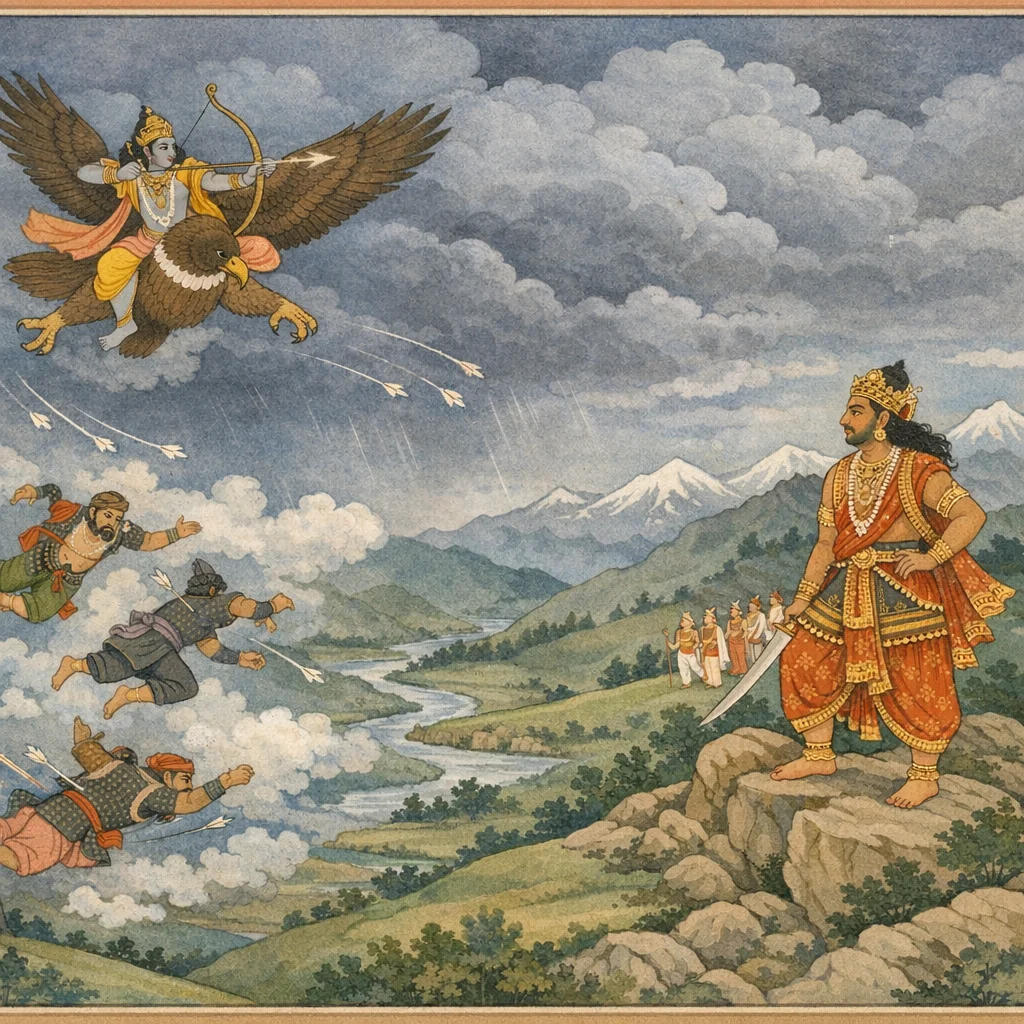
Adhyāya 17, as narrated by Sanatkumāra, describes a sudden reversal in battle: mighty daityas strike the devas with weapons such as the śūla, paraśu, and paṭṭiśa, leaving the gods wounded and panic-driven so that they flee the field. Seeing their retreat, Hṛṣīkeśa (Viṣṇu) swiftly arrives upon Garuḍa to rejoin the fight. Bearing conch, sword, mace, and the Śārṅga bow, Viṣṇu displays disciplined martial wrath; the thunder of Śārṅga resounds through the three worlds. His arrows behead multitudes of diti-ja warriors, while Sudarśana blazes in his hand as a protective emblem for devotees. The daityas are battered and scattered by the wing-winds of Garuḍa, whirled like storm-clouds. Beholding his troops in distress, the great asura Jalandhara—dreaded by the host of devas—erupts in anger. A heroic ally then rushes forward to fight beside Hari, turning the chapter toward a focused confrontation between daitya leadership and the divine counterforce, setting the stage for the next developments of the war.
Shlokas
Verse 1
सनत्कुमार उवाच । अथ दैत्या महावीर्याश्शूलैः परशुपट्टिशैः । निजघ्नुस्सर्वदेवांश्च भयव्याकुलमानसान्
Sanatkumāra said: Then the mighty Daityas, wielding tridents, axes, and spears, struck down the hosts of the gods, whose minds were shaken and distressed with fear.
Verse 2
दैत्यायुधैः समाविद्धदेहा देवास्सवासवाः । रणाद्विदुद्रुवुस्सर्वे भयव्याकुलमानसाः
Their bodies pierced by the Daityas’ weapons, the gods—together with Indra—fell into utter confusion; their minds shaken by fear, they fled from the battlefield.
Verse 3
पलायनपरान्दृष्ट्वा हृषीकेशस्सुरानथ । विष्णुर्वै गरुडारूढो योद्धुमभ्याययौ द्रुतम्
Seeing the gods bent on flight, Hṛṣīkeśa—Viṣṇu, lord and protector of the devas—mounted Garuḍa and swiftly advanced to engage in battle.
Verse 5
शंखखड्गगदाशार्ङ्गधारी क्रोधसमन्वितः । कठोरास्त्रो महावीरस्सर्वयुद्धविशारदः
Bearing the conch, sword, mace, and the Śārṅga bow, he was filled with wrath. Armed with formidable weapons, he was a great hero, skilled in every kind of warfare.
Verse 6
धनुषं शार्ङ्गनामानं विस्फूर्य्य विननाद ह । तस्य नादेन त्रैलोक्यं पूरितं महता मुने
He twanged the bow named Śārṅga and let out a mighty roar; O sage, by that thunderous sound the entire three worlds were filled.
Verse 7
शार्ङ्गनिस्सृतबाणैश्च दितिजानां शिरांसि वै । चकर्त्त भगवान् विष्णुः कोटिशो रुट् समाकुलः
Then Lord Viṣṇu—his mind agitated with wrath—released arrows from the Śārṅga bow and, indeed, severed the heads of the Diti-born demons, in millions.
Verse 8
अथारुणानुजजवपक्षवातप्रपीडिताः । वात्याधिवर्त्तिता दैत्या बभ्रमुः खे यथा घनाः
Then the Daityas, battered by the wind stirred up by the swift flight and wing-beats of Aruṇa’s younger brother, were whirled about by the gale—like clouds tossed in the sky.
Verse 9
ततो जलंधरो दृष्ट्वा दैत्यान्वात्याप्रपीडितान् । चुक्रोधाति महादैत्यो देववृन्दभयंकरः
Then Jalandhara, seeing the Daityas tormented by the violent windstorm, blazed up with intense anger—he, the mighty demon who was a terror to the hosts of the gods.
Verse 10
मर्द्दयंतं च तं दृष्ट्वा दैत्यान् प्रस्फुरिताधरः । योद्धुमभ्याययौ वीरो वेगेन हरिणा सह
Seeing him crushing the Daityas, the heroic one—his lips quivering with wrath—rushed forward at speed to fight, together with Hari (Viṣṇu).
Verse 11
स चकार महानादं देवासुरभयंकरम् । दैत्यानामधिपः कर्णा विदीर्णाः श्रवणात्ततः
Then he let out a mighty roar, terrifying to both the Devas and the Asuras. At its very sound, the ears of the Daitya-lords were torn apart.
Verse 12
भयंङ्करेण दैत्यस्य नादेन पूरितं तदा । जलंधरस्य महता चकम्पे सकलं जगत्
Then the entire world was filled with the demon’s terrifying roar; by the mighty clamour of Jalandhara, all the worlds trembled.
Verse 13
ततस्समभवद्युद्धं विष्णुदैत्येन्द्रयोर्महत् । आकाशं कुर्वतोर्बाणैस्तदा निरवकाशवत्
Then a mighty battle arose between Viṣṇu and the lord of the Daityas. With their volleys of arrows they filled the sky so completely that it seemed to leave no space at all.
Verse 14
तयोश्च तेन युद्धेन परस्परमभून्मुने । देवासुरर्षिसिद्धानां भीकरेणातिविस्मयः
O sage, as those two fought one another in that battle, the gods, the asuras, the seers, and the siddhas were struck with overwhelming astonishment at its terrifying intensity.
Verse 15
विष्णुर्दैत्यस्य बाणौघैर्ध्वजं छत्रं धनुश्शरान् । चिच्छेद तं च हृदये बाणेनैकेन ताडयन्
Vishnu, with volleys of arrows, cut down the demon’s banner and parasol and shattered his bow and arrows; then, striking him, he pierced the demon’s heart with a single arrow.
Verse 16
ततो दैत्यस्समुत्पत्य गदापाणिस्त्वरान्वितः । आहत्य गरुडं मूर्ध्नि पातयामास भूतले
Then the demon sprang up at once, mace in hand and driven by haste; striking Garuḍa upon the head, he caused him to fall down upon the earth.
Verse 17
इति श्रीशिवमहापुराणे द्वितीयायां रुद्रसंहितायां पञ्चमे युद्धखण्डे जलंधरोपाख्याने विष्णुजलंधरयुद्धवर्णनं नाम सप्तदशोऽध्यायः
Thus, in the Śrī Śiva Mahāpurāṇa—within the Second section, the Rudra-saṃhitā, in the Fifth, the Yuddha-khaṇḍa, in the episode of Jalandhara—ends the Seventeenth Chapter, called “The Description of the Battle between Viṣṇu and Jalandhara.”
Verse 18
विष्णुर्गदां च खड्गेन चिच्छेद प्रहसन्निव । तं विव्याध शरैस्तीक्ष्णैश्शार्ङ्गं विस्फूर्य दैत्यहा
Smiling as though in sport, Viṣṇu severed the mace with his sword. Then the demon-slayer, whirling the Śārṅga bow, pierced him with sharp arrows.
Verse 19
विष्णुर्जलंधरं दैत्यं भयदेन शरेण ह । क्रोधाविष्टोऽतितीक्ष्णेन जघानाशु सुरारिहा
Then Viṣṇu—overcome by wrath—swiftly struck the demon Jalandhara, the enemy of the gods, with an exceedingly sharp arrow that inspired fear.
Verse 20
आगतं तस्य तं बाणं दृष्ट्वा दैत्यो महाबलः । छित्त्वा बाणेन विष्णुं च जघान हृदये द्रुतम्
Seeing that arrow coming toward him, the mighty Daitya at once cut it down with his own shaft and swiftly struck Viṣṇu in the heart. From the Śaiva Siddhānta standpoint, this episode underscores that all cosmic powers on the battlefield stand subordinate to Śiva’s higher ordaining will—so that even Viṣṇu’s prowess is shown as contingent, and the drama of conflict serves the unfolding of Śiva’s supreme governance (Pati) over all beings and forces.
Verse 21
केशवोऽपि महाबाहुं विक्षिप्तमसुरेण तम् । शरं तिलप्रमाणेन च्छित्त्वा वीरो ननाद ह
Keśava too—seeing that mighty-armed weapon hurled by the asura—cut that arrow into pieces as small as sesame seeds; then the heroic one let out a triumphant roar.
Verse 22
पुनर्बाण समाधत्त धनुषि क्रोधवेपितः । महाबलोऽथ बाणेन चिच्छेद स शिलीमुखम्
Trembling with wrath, the mighty warrior again set another arrow upon his bow; then, with his own arrow, he struck and severed that sharp-pointed shaft.
Verse 23
वासुदेवः पुनर्बाणं नाशाय विबुधद्विषः । क्रोधेनाधत्त धनुषि सिंहवद्विननाद ह
Then Vāsudeva, intent on destroying that foe of the gods, in wrath set another arrow upon his bow and roared like a lion.
Verse 24
जलंधरोऽथ दैत्येन्द्रः कोपच्छिन्नाधरो बली । शरेण श्वेन शार्ङ्गाख्यं धनुश्चिच्छेद वैष्णवम्
Then Jalandhara, the mighty lord of the Daityas—his lower lip split by rage—shot an arrow and severed the famed Vaiṣṇava bow called Śārṅga.
Verse 25
पुनर्बाणैस्सुतीक्ष्णैश्च जघान मधुसूदनम् । उग्रवीर्यो महावीरो देवानां भयकारकः
Again, with exceedingly sharp arrows, that fierce and mighty hero struck Madhusūdana (Viṣṇu), becoming a cause of fear to the gods.
Verse 26
स च्छिन्नधन्वा भगवान्केशवो लोकरक्ष कः । जलंधरस्य नाशाय चिक्षेप स्वगदां पराम्
Then Bhagavān Keśava, protector of the worlds, though his bow had been cut down, hurled his supreme mace, intent on destroying Jalandhara.
Verse 27
सा गदा हरिणा क्षिप्ता ज्वलज्ज्वलनसन्निभा । अमोघगतिका शीघ्रं तस्य देहे ललाग ह
That mace, hurled by Hari (Vishnu), blazed like a tongue of fire; unfailing in its course, it swiftly struck and clung fast to his body.
Verse 28
तया हतो महादैत्यो न चचालापि किंचन । जलंधरो मदोन्मत्तः पुष्पमालाहतो यथा
Though struck by it, the mighty demon did not stir in the least. Jalandhara, drunk with pride, was as one smitten by a garland of flowers—unshaken, deeming it no true blow.
Verse 29
ततो जलंधरः क्रोधी देवत्रासकरोऽक्षिपत् । त्रिशूलमनलाकारं हरये रणदुर्म्मदः
Then Jalandhara—wrathful, a terror to the gods, and maddened by battle-pride—hurled at Hari a trident shaped like blazing fire.
Verse 30
अथ विष्णुस्तत्त्रिशूलं चिच्छेद तरसा द्रुतम् । नंदकाख्येन खड्गेन स्मृत्वा शिवपदाम्बुजम्
Then Viṣṇu, swiftly and with great force, severed that trident using the sword famed as Nandaka—while inwardly remembering the lotus-feet of Lord Śiva.
Verse 31
छिन्ने त्रिशूले दैत्येन्द्र उत्प्लुत्य सहसा द्रुतम् । आगत्य हृदये विष्णुं जघान दृढमुष्टिना
When the demon-king’s trident was shattered, he suddenly sprang up at once and rushed forward; coming close, he struck Viṣṇu upon the chest with a hard, clenched fist.
Verse 32
सोपि विष्णुर्महावीरोऽविगणय्य च तद्व्यथाम । जलंधरं च हृदये जघान दृढमुष्टिना
Then that great hero Viṣṇu too—disregarding the pain he had received—struck Jalandhara in the region of the heart with a firm, clenched fist.
Verse 33
ततस्तौ बाहुयुद्धेन युयुधाते महाबलौ । बाहुभिर्मुष्टिभिश्चैव जानुभिर्नादयन्महीम्
Then those two mighty ones fought in close combat. With their arms, clenched fists, and even their knees, they struck so powerfully that the earth resounded.
Verse 34
एवं हि सुचिरं युद्धं कृत्वा तेनासुरेण वै । विस्मितोऽभून्मुनिश्रेष्ठ हृदि ग्लानिमवाप ह
Thus, after waging battle for a long time with that asura, he became astonished, O best of sages, and a weariness arose within his heart.
Verse 35
अथ प्रसन्नो भगवान्मायी मायाविदां वरः । उवाच दैत्यराजानं मेघगंभीरया गिरा
Then the Blessed Lord—master of māyā, foremost among those who wield illusion—being pleased, spoke to the king of the Daityas in a voice deep as thunderclouds.
Verse 36
विष्णुरुवाच । भोभो दैत्यवरश्रेष्ठ धन्यस्त्वं रणदुर्मदः । महायुधवरैर्यत्त्वं न भीतो हि महाप्रभुः
Viṣṇu said: “Ho! Ho! O best of the Daityas, truly you are blessed, O you intoxicated with battle. Though confronted by excellent and mighty weapons, O great lord, you are indeed not afraid.”
Verse 37
एभिरेवायुधैरुग्रैर्दैत्या हि बहवो हताः । महाजौ दुर्मदा वीराश्छिन्नदेहा मृतिं गताः
By those very fierce weapons, many Daityas were slain. In that great battle, the arrogant heroes—their bodies cut apart—went to their death.
Verse 38
युद्धेन ते महादैत्य प्रसन्नोऽस्मि महान्भवान् । न दृष्टस्त्वत्समो वीरस्त्रैलोक्ये सचराचरे
O great Daitya, I (Rudra/Śiva) am pleased with you for this battle. Truly you are mighty. In all the three worlds—among beings that move and those that do not—I have not seen a hero equal to you.
Verse 39
वरं वरय दैत्येन्द्र प्रीतोऽस्मि तव विक्रमात् । अदेयमपि ते दद्मि यत्ते मनसि वर्तते
“Choose a boon, O lord of the Daityas. I (Rudra/Śiva) am pleased by your valor. Even what is ordinarily not to be granted, I shall give you—whatever abides in your mind as your desire.”
Verse 40
सनत्कुमार उवाच । इत्याकर्ण्य वचस्तस्य विष्णोर्मायाविनो हरेः । प्रत्युवाच महाबुद्धिर्दैत्यराजो जलंधरः
Sanatkumāra said: Having thus heard the words of Viṣṇu—Hari, the wielder of māyā—Jalandhara, the demon-king of great intellect, replied in return.
Verse 41
जलंधर उवाच । यदि भावुक तुष्टोऽसि वरमे तन्ददस्व मे । मद्भगिन्या मया सार्धं मद्गेहे सगणो वस
Jalandhara said: “If you, O noble one, are pleased, then grant me this boon: along with my sister and with me, dwell in my house together with your attendants.”
Verse 42
सनत्कुमार उवाच । तदाकर्ण्य वचस्तस्य महादैत्यस्य खिन्नधीः । तथास्त्विति च देवेशो जगाद भगवान् हरिः
Sanatkumāra said: Hearing the words of that mighty Daitya, Bhagavān Hari, Lord of the gods, his mind burdened with concern, replied, “So be it.”
Verse 43
उवास स ततो विष्णुस्सर्वदेवगणैस्सह । जलंधरं नाम पुरमागत्य रमया सह
Thereafter Viṣṇu, accompanied by all the hosts of gods, came to the city named Jalandhara and stayed there together with Ramā (Lakṣmī).
Verse 44
अथो जलंधरो दैत्यस्स्वभगिन्या च विष्णुना । उवास स्वालयं प्राप्तो हर्षाकुलितमानसः
Thereafter Jalandhara, the Daitya, accompanied by his own sister and by Viṣṇu, reached his own abode and dwelt there, his mind overwhelmed with joy.
Verse 45
जलंधरोऽथ देवानामधिकारेषु दानवान् । स्थापयित्वा सहर्षस्सन्पुनरागान्महीतलम्
Then Jalandhara, having installed the Dānavas in the very offices and jurisdictions of the gods, rejoicing, returned again to the earth.
Verse 46
देवगंधर्वसिद्धेषु यत्किंचिद्रत्नसंचि तम् । तदात्मवशगं कृत्वाऽतिष्ठत्सागरनंदनः
Whatever treasure-gems were found among the Devas, Gandharvas, and Siddhas—having brought all that wealth under his own control, the son of the Ocean stood firm in his power.
Verse 47
पातालभवने दैत्यं निशुंभं सुमहाबलम् । स्थापयित्वा स शेषादीनानय द्भूतलं बली
Placing the mighty demon Niśumbha in a dwelling of Pātāla, that powerful one then brought Śeṣa and the others up to the surface of the earth.
Verse 48
देवगंधर्वसिद्धौघान् सर्पराक्षसमानुषान् । स्वपुरे नागरान्कृत्वा शशास भुवनत्रयम्
Having made hosts of Devas, Gandharvas, and Siddhas—along with Nāgas, Rākṣasas, and human beings—citizens of his own city, he ruled the three worlds.
Verse 49
एवं जलंधरः कृत्वा देवान्स्ववशवर्तिनः । धर्मेण पालयामास प्रजाः पुत्रानिवौरसान्
Thus Jalandhara, having brought the Devas under his own control, ruled his subjects in accordance with dharma—protecting and governing the people as though they were his own legitimate sons.
Verse 50
न कश्चिद्व्याधितो नैव दुःखितो न कृशस्तथा । न दीनो दृश्यते तस्मिन्धर्माद्राज्यं प्रशासति
In that realm, no one was seen afflicted by disease, nor sorrowful, nor emaciated; none appeared poor or wretched—because the king governed his kingdom in accordance with dharma.
Frequently Asked Questions
A battlefield turn in which the devas are wounded and flee, followed by Viṣṇu’s rapid arrival on Garuḍa to counterattack the daityas, culminating in Jalandhara’s wrath upon seeing his forces shaken.
The episode contrasts destabilizing fear and injury with restored order through decisive divine agency; it also implies that even deva-power is contingent and must be re-aligned with higher cosmic order, a recurring Śaiva Purāṇic theme.
Viṣṇu’s martial form with Śārṅga (whose sound fills the three worlds), the Sudarśana Cakra as a radiant protective emblem, and Garuḍa’s wing-winds as a force that disperses hostile armies.