नारदमोहवर्णनम् — Description of Nārada’s Delusion
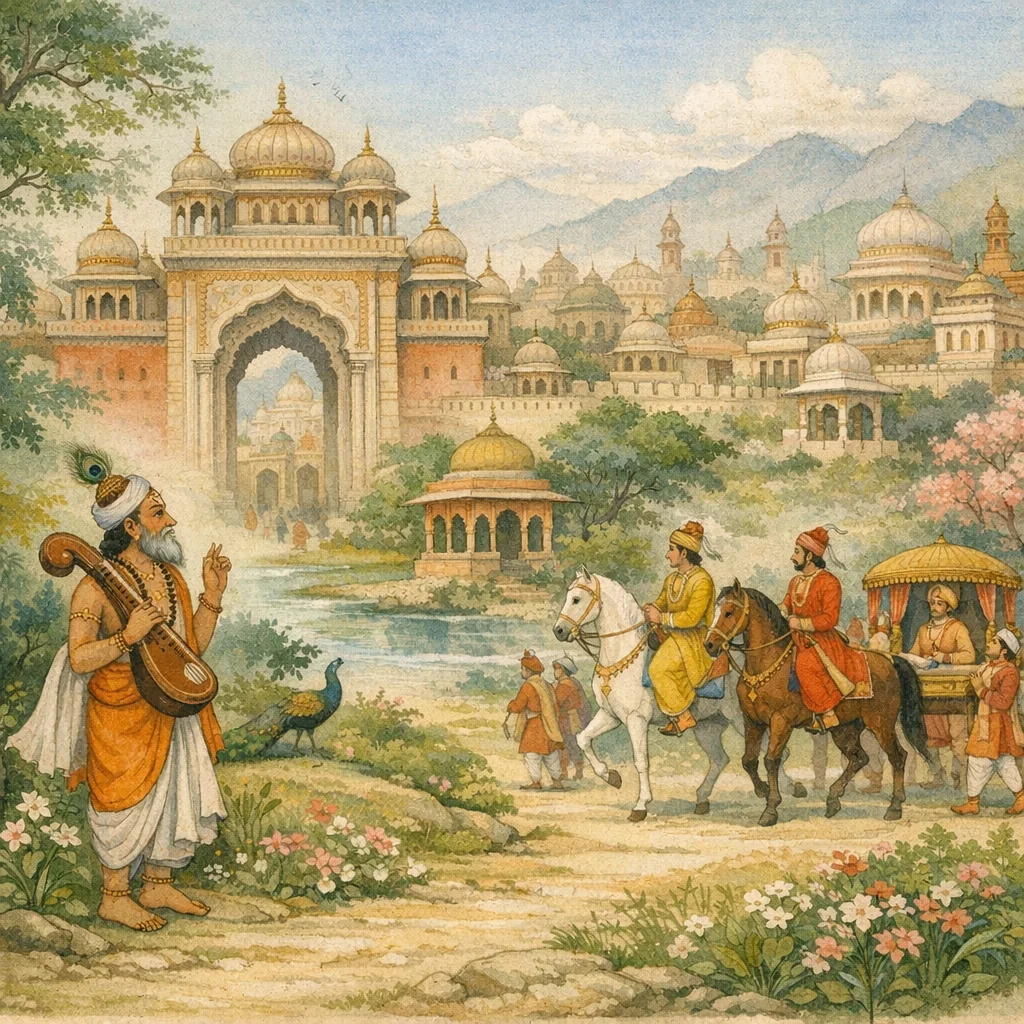
Adhyāya 3 begins in dialogue: the ṛṣis respectfully ask what happened after Viṣṇu departed and where Nārada went. In the purāṇic relay (Vyāsa introducing Sūta’s reply), a Shaiva cause is given: by Śiva’s will, Viṣṇu, master of māyā, swiftly projects a wondrous illusion. On the sages’ path appears a vast, enchanting city, surpassing ordinary worlds in beauty and variety, filled with men and women and ordered as a complete realm according to the caturvarṇa. There rules King Śīlanidhi, wealthy and powerful, holding a grand festival for his daughter’s svayaṃvara. Princes arrive from every direction in splendid attire, eager to win the bride. Seeing this marvel, Nārada is captivated and falls into moha; driven by curiosity and rising desire, he approaches the king’s gate, setting up the coming lesson on māyā’s attraction and the divine disciplining of pride.
Shlokas
Verse 1
ऋषय ऊचुः । सूतसूत महाभाग व्यासशिष्य नमोऽस्तु ते । अद्भुतेयं कथा तात वर्णिता कृपया हि नः
The sages said: “O noble Sūta, disciple of Vyāsa—salutations to you. Dear one, you have compassionately narrated this wondrous account to us; for our sake, please continue and explain it further.”
Verse 2
मुनौ गते हरिस्तात किं चकार ततः परम् । नारदोपि गतः कुत्र तन्मे व्याख्यातुमर्हसि
Venerable sir, when the sage had departed, what did Hari do thereafter? And where did Nārada also go? Pray explain this to me.
Verse 3
इति श्रीशिव महापुराणे द्वितीयायां रुद्रसंहितायां प्रथमखंडे सृष्ट्युपाख्याने नारदमोहवर्णनं नाम तृतीयोऽध्यायः
Thus, in the Śrī Śiva Mahāpurāṇa—within the Second Rudrasaṃhitā, in the First Khaṇḍa of the Creation narrative—ends the Third Chapter called “The Description of Nārada’s Delusion.”
Verse 4
सूत उवाच । मुनौ यदृच्छया विष्णुर्गते तस्मिन्हि नारदे । शिवेच्छया चकाराशु माया मायाविशारदः
Sūta said: When Nārada had thus departed, by mere chance, to the sage Viṣṇu (Brahmā), Viṣṇu—skilled in the workings of māyā—swiftly fashioned an illusion, in accordance with Śiva’s will.
Verse 5
मुनिमार्गस्य मध्ये तु विरेचे नगरं महत् । शतयोजनविस्तारमद्भुतं सुमनोहरम्
In the midst of the sages’ sacred path there shone a great city named Vireca—marvelous and exceedingly charming—spreading across a hundred yojanas.
Verse 6
स्वलोकादधिकं रम्यं नानावस्तुविराजितम् । नरनारीविहाराढ्यं चतुर्वर्णाकुलं परम्
It was more delightful than Brahmā’s own world, splendid with many kinds of wondrous things—abounding in the graceful movements of men and women—and exalted as a supreme realm filled with the four social orders.
Verse 7
तत्र राजा शीलनिर्धिर्नामैश्वर्यसमन्वितः । सुतास्वयम्वरोद्युक्तो महोत्सवसमन्वितः
There dwelt a king named Śīlanirdhi, endowed with prosperity and royal might; he was preparing his daughter’s svayaṃvara, and the occasion was graced with a grand festival.
Verse 8
चतुर्दिग्भ्यः समायातैस्संयुतं नृपनन्दतैः । नानावेषैस्सुशोभैश्च तत्कन्यावरणोत्सुकैः
From the four quarters came princes—the sons of kings—gathered together, radiant in diverse attire, eager to win the maiden’s hand.
Verse 9
एतादृशम्पुरं दृष्ट्वा मोहम्प्राप्तोऽथ नारदः । कौतुकी तन्नृपद्वारं जगाम मदनेधितः
Beholding such a wondrous city, Nārada fell into bewilderment; stirred by curiosity—and further inflamed by desire—he went to the king’s gate.
Verse 10
आगतं मुनिवर्यं तं दृष्ट्वा शीलनिधिर्नृपः । उपवेश्यार्चयांचक्रे रत्नसिंहासने वरे
Seeing the eminent sage arrive, King Śīlanirdhi—an embodiment of noble conduct—seated him upon an excellent jeweled throne and honored him with due, worshipful reverence.
Verse 11
अथ राजा स्वतनयां नामतश्श्रीमतीं वराम् । समानीय नारदस्य पादयोस्समपातयत्
Then the king brought his own daughter—an excellent maiden named Śrīmatī—and had her bow down at the feet of Nārada.
Verse 12
तत्कन्यां प्रेक्ष्य स मुनिर्नारदः प्राह विस्मितः । केयं राजन्महाभागा कन्या सुरसुतोपमा
Seeing that young maiden, the sage Nārada spoke in amazement: “O King, who is this most fortunate girl, resembling the daughter of the gods?”
Verse 13
तस्य तद्वचनं श्रुत्वा राजा प्राह कृतांजलिः । दुहितेयं मम मुने श्रीमती नाम नामतः
Hearing his words, the king, with palms joined in reverence, spoke: “O sage, this is my daughter; by name she is called Śrīmatī.”
Verse 14
प्रदानसमयं प्राप्ता वरमन्वेषती शुभम् । सा स्वयंवरसंप्राप्ता सर्वलक्षणलक्षिता
When the time came to give her in marriage, she sought an auspicious bridegroom. Endowed with every noble mark and excellence, she came to the svayaṃvara, to choose her husband for herself.
Verse 15
अस्या भाग्यं वद मुने सर्वं जातकमादरात् । कीदृशं तनयेयं मे वरमाप्स्यति तद्वद
“O sage, tell me with care her entire destiny and the full account of her horoscope. What kind of husband will this daughter of mine attain? Please speak and tell me.”
Verse 16
इत्युक्तो मुनिशार्दूलस्तामिच्छुः कामविह्वलः । समाभाष्य स राजानं नारदो वाक्यमब्रवीत्
Thus addressed, Nārada—the tiger among sages—yearning for her and shaken by desire, spoke to the king after courteously conversing with him.
Verse 17
सुतेयं तव भूपाल सर्वलक्षणलक्षिता । महाभाग्यवती धन्या लक्ष्मीरिव गुणालया
O king, this daughter of yours is adorned with every auspicious mark. She is exceedingly fortunate and blessed—like Lakṣmī herself, a very abode of noble qualities.
Verse 18
सर्वेश्वरोऽजितो वीरो गिरीशसदृशो विभुः । अस्याः पतिर्ध्रुवं भावी कामजित्सुरसत्तमः
He is the Lord of all, unconquered and heroic, all-pervading and like Girīśa (Śiva) Himself. He will certainly become her husband—one who has conquered desire, the foremost among the gods.
Verse 19
इत्युक्त्वा नृपमामंत्र्य ययौ यादृच्छिको मुनिः । बभूव कामविवशश्शिवमाया विमोहितः
Having spoken thus, the sage Yādṛcchika took leave of the king and departed. Then, overpowered by desire, he became deluded by Śiva’s Māyā.
Verse 20
चित्ते विचिन्त्य स मुनिराप्नुयां कथमेनकाम् । स्वयंवरे नृपालानामेकं मां वृणुयात्कथम्
Pondering within his heart, the sage thought: “How shall I ever obtain this maiden I desire? In the svayaṃvara, amid many kings, how would she choose me alone?”
Verse 21
सौन्दर्यं सर्वनारीणां प्रियं भवति सर्वथा । तद्दृष्ट्वैव प्रसन्ना सा स्ववशा नात्र संशयः
Beauty is, in every way, dear to all women. At its mere sight she rejoices and comes under its sway—of this there is no doubt.
Verse 22
विधायेत्थं विष्णुरूपं ग्रहीतुं मुनिसत्तमः । विष्णुलोकं जगामाशु नारदः स्मरविह्वलः
Having thus resolved to assume the form of Viṣṇu, the foremost of sages—Nārada—swiftly went to Viṣṇu’s abode, his mind agitated by love-longing. From the Śaiva standpoint, even such exalted beings move under the sway of māyā’s impulses until the grace of Pati (Śiva) steadies the heart.
Verse 23
प्रणिपत्य हृषीकेशं वाक्यमेतदुवाच ह । रहसि त्वां प्रवक्ष्यामि स्ववृत्तान्तमशेषतः
Having bowed down to Hṛṣīkeśa (the Lord of the senses), he spoke these words: “In private, I shall tell you completely—without omission—my entire account.”
Verse 24
तथेत्युक्ते तथा भूते शिवेच्छा कार्यकर्त हि । ब्रूहीत्युक्तवति श्रीशे मुनिराह च केशवम्
When he said, “So be it,” and it came to pass accordingly, it was truly Śiva’s will that accomplished the work. Then, when Śrīśa (Viṣṇu, Lord of Lakṣmī) said, “Speak,” the sage addressed Keśava (Viṣṇu).
Verse 25
नारद उवाच । त्वदीयो भूपतिः शीलनिधिस्स वृषतत्परः । तस्य कन्या विशालाक्षी श्रीमतीवरवर्णिनी
Nārada said: “Your king is a treasure-house of noble conduct, ever devoted to dharma. He has a daughter—large-eyed, auspicious and illustrious, of excellent complexion.”
Verse 26
जगन्मोहिन्यभिख्याता त्रैलोक्येप्यति सुन्दरी । परिणेतुमहं विष्णो तामिच्छाम्यद्य मा चिरम्
O Viṣṇu, she is famed as the Enchantress of the worlds, exceedingly beautiful even in the three realms. I desire to marry her today, without delay.
Verse 27
स्वयंवरं चकरासौ भूपतिस्तनयेच्छया । चतुर्दिग्भ्यः समायाता राजपुत्रास्सहस्रशः
“Wishing to fulfill his daughter’s desire, that king arranged a svayaṃvara. From the four directions, thousands of princes arrived there.”
Verse 28
यदि दास्यसि रूपं मे तदा तां प्राप्नुयां ध्रुवम् । त्वद्रूपं सा विना कंठे जयमालां न धास्यति
“If you will grant me your form, then I shall surely attain her. Without your form, she will not place the victory-garland upon my neck.”
Verse 29
स्वरूपं देहि मे नाथ सेवकोऽहं प्रियस्तव । वृणुयान्मां यथा सा वै श्रीमती क्षितिपात्मजा
“O Lord, reveal to me Your true form. I am Your servant and dear to You. Grant that I may be accepted—just as that illustrious daughter of the Earth, Śrīmatī, accepted her chosen one.”
Verse 30
सुत उवाच वचः श्रुत्वा मुनेरित्थं विहस्य मधुसूदनः । शांकरीं प्रभुतां बुद्ध्वा प्रत्युवाच दयापरः
Sūta said: Hearing the sage’s words spoken thus, Madhusūdana (Viṣṇu) smiled. Realizing the supreme lordship of Śaṅkarī, the Śakti of Śiva, the compassionate one replied in return.
Verse 31
विष्णुरुवाच । स्वेष्टदेशं मुने गच्छ करिष्यामि हितं तव । भिषग्वरो यथार्त्तस्य यतः प्रियतरोऽसि मे
Viṣṇu said: “O sage, go to the place you desire. I shall do what is beneficial for you, for you are very dear to me—just as the foremost physician is dear to one who is afflicted.”
Verse 32
इत्युक्त्वा मुनये तस्मै ददौ विष्णुर्मुखं हरे । स्वरूपमनुगृह्यास्य तिरोधानं जगाम सः
Having spoken thus to that sage, Viṣṇu granted Hari his own divine face. Then, graciously bestowing his true form upon him, he withdrew from sight and departed.
Verse 33
एवमुक्तो मुनिर्हृष्टः स्वरूपं प्राप्य वै हरेः । मेने कृतार्थमात्मानं तद्यत्नं न बुबोध सः
Thus addressed, the sage rejoiced; having indeed attained the form of Hari, he considered himself fully accomplished. He did not understand the deeper intent behind that endeavour.
Verse 34
अथ तत्र गतः शीघ्रन्नारदो मुनिसत्तमः । चक्रे स्वयम्वरं यत्र राजपुत्रैस्समाकुलम्
Then the great sage Nārada quickly went there, to the place crowded with princes; and there he arranged a svayaṃvara (a ceremonial self-choice of a husband).
Verse 35
स्वयम्वरसभा दिव्या राजपुत्रसमावृता । शुशुभेऽतीव विप्रेन्द्रा यथा शक्रस भा परा
O best of brāhmaṇas, that divine hall of svayaṃvara, surrounded by princes, shone exceedingly—splendid like the exalted assembly-hall of Indra.
Verse 36
तस्यां नृपसभायां वै नारदः समुपाविशत् । स्थित्वा तत्र विचिन्त्येति प्रीतियुक्तेन चेतसा
In that royal assembly, Nārada indeed took his seat. Remaining there, he reflected within himself, his mind filled with gladness and affectionate devotion.
Verse 37
मां वरिष्यति नान्यं सा विष्णुरूपधरन्ध्रुवम् । आननस्य कुरूपत्वं न वेद मुनिसत्तमः
“She will choose me in marriage—surely no one else—though I bear the form of Viṣṇu. O best of sages, she does not know the ugliness of my face.”
Verse 38
पूर्वरूपं मुनिं सर्वे ददृशुऽस्तत्र मानवाः । तद्भेदं बुबुधुस्ते न राजपुत्रादयो द्विजाः
There, all the people saw the sage in his former appearance; yet they did not recognize the change in him—nor did the twice-born, beginning with the princes, understand the difference.
Verse 39
तत्र रुद्रगणौ द्वौ तद्रक्षणार्थं समागतौ । विप्ररूपधरौ गूढौ तत्रेदं जज्ञतुः परम्
There, two attendants of Rudra arrived for the purpose of protecting it. Concealed and assuming the form of brāhmaṇas, those two came to know that supreme matter there.
Verse 40
मूढ मत्वा मुनिं तौ तन्निकटं जग्मतुर्गणौ । कुरुतस्तत्प्रहासं वै भाषमाणौ परस्परम्
Thinking the sage a fool, the two attendants went up close; speaking among themselves, they openly mocked him and laughed at him.
Verse 41
पश्य नारद रूपं हि विष्णोरिव महोत्तमम् । मुखं तु वानरस्येव विकटं च भयंकरम्
“Behold, O Nārada—this form is supremely exalted, like that of Viṣṇu; yet its face is like that of a monkey—grotesque and terrifying.”
Verse 42
इच्छत्ययं नृपसुता वृथैव स्मरमोहितः । इत्युक्त्वा सच्छलं वाक्यमुपहासं प्रचक्रतुः
“This king’s daughter desires him—yet it is surely in vain, for he is deluded by Kāma.” Saying this, the two of them spoke deceitful words and proceeded to mock him.
Verse 43
न शुश्राव यथार्थं तु तद्वाक्यं स्मरविह्वलः । पर्यैक्षच्छ्रीमतीं तां वै तल्लिप्सुर्मोहितो मुनिः
Overwhelmed by the agitation of desire, the sage did not truly grasp the meaning of her words. Deluded and intent on possessing her, he kept looking upon that illustrious lady again and again.
Verse 44
एतस्मिन्नंतरे भूपकन्या चांतःपुरात्तु सा । स्त्रीभिस्समावृता तत्राजगाम वरवर्णिनी
Meanwhile, the king’s daughter, fair and radiant, came forth from the palace’s inner chambers, surrounded by her women attendants, and arrived there.
Verse 45
मालां हिरण्मयीं रम्यामादाय शुभ क्षणा । तत्र स्वयम्बरे रेजे स्थिता मध्ये रमेव सा
At that auspicious moment she took up a lovely golden garland. Standing in the midst of the svayaṃvara assembly, she shone there brilliantly—like Lakṣmī herself.
Verse 46
बभ्राम सा सभां सर्वां मालामादाय सुव्रता । वरमन्वेषती तत्र स्वात्माभीष्टं नृपात्मजा
With the garland in her hand, the virtuous princess wandered through the entire assembly, searching there for the bridegroom truly desired by her own heart.
Verse 47
वानरास्यं विष्णुतनुं मुनिं दृष्ट्वा चुकोप सा । दृष्टिं निवार्य च ततः प्रस्थिता प्रीतमानसा
Seeing the muni whose face was like a monkey’s and whose body resembled Viṣṇu, she was seized with anger. Then, restraining her gaze, she departed from there, her mind restored to calm.
Verse 48
न दृष्ट्वा स्ववरं तत्र त्रस्तासीन्मनसेप्सितम् । अंतस्सभास्थिता कस्मिन्नर्पयामास न स्रजम्
Not seeing there the bridegroom of her own choice—him whom her heart desired—she became afraid. Standing within the assembly hall, she could not place the garland upon anyone.
Verse 49
एतस्मिन्नंतरे विष्णुराजगाम नृपाकृतिः । न दृष्टः कैश्चिदपरैः केवलं सा ददर्श हि
Meanwhile, Viṣṇu arrived there, assuming the form of a king. He was not seen by anyone else—indeed, only she beheld him.
Verse 50
अथ सा तं समालोक्य प्रसन्नवदनाम्बुजा । अर्पयामास तत्कण्ठे तां मालां वरवर्णिनी
Then she looked upon him, her lotus-like face radiant with joy; and that most excellent, fair-complexioned lady placed the garland upon his neck.
Verse 51
तामादाय ततो विष्णू राजरूपधरः प्रभुः । अंतर्धानमगात्सद्यस्स्वस्थानं प्रययौ किल
Then Lord Viṣṇu—assuming the form of a king—took her with him. Instantly becoming invisible, he indeed departed and went to his own abode.
Verse 52
सर्वे राजकुमाराश्च निराशाः श्रीमतीम्प्रति । मुनिस्तु विह्वलोऽतीव बभूव मदनातुरः
All the princes became despondent regarding Śrīmatī. But the sage, utterly overwhelmed, was tormented by Kāma—the fever of desire.
Verse 53
तदा तावूचतुस्सद्यो नारदं स्वरविह्वलम् । विप्ररूपधरौ रुद्रगणौ ज्ञानविशारदौ
Then those two Rudra-gaṇas—skilled in spiritual knowledge and assuming the form of Brahmin sages—at once addressed Nārada, whose voice was trembling with emotion.
Verse 54
गणावूचतुः । हे नारदमुने त्वं हि वृथा मदनमोहितः । तल्लिप्सुस्स्वमुखं पश्य वानरस्येव गर्हितम्
The Gaṇas said: “O sage Nārada, you are vainly deluded by Kāma, the god of desire. If you seek her, then look at your own face—contemptible like that of a monkey.”
Verse 55
सूत उवाच । इत्याकर्ण्य तयोर्वाक्यं नारदो विस्मितोऽभवत् । मुखं ददर्श मुकुरे शिवमायाविमोहितः
Sūta said: Hearing the words spoken by those two, Nārada became astonished. Bewildered by Śiva’s māyā, he looked into a mirror and saw his own face.
Verse 56
स्वमुखं वानरस्येव दृष्ट्वा चुक्रोध सत्वरम् । शापन्ददौ तयोस्तत्र गणयोर्मोहितो मुनिः
Seeing his own face as if it were that of a monkey, the sage at once became enraged. Deluded on that spot by those two gaṇas, he then pronounced a curse upon them.
Verse 57
युवां ममोपहासं वै चक्रतुर्ब्राह्मणस्य हि । भवेतां राक्षसौ विप्रवीर्यजौ वै तदाकृती
“You two indeed mocked me, a brāhmaṇa. Therefore, may you become rākṣasas—born from the power (austerity) of a brāhmaṇa—and assume that very form.”
Verse 58
श्रुत्वा हरगणावित्थं स्वशापं ज्ञानिसत्तमौ । न किंचिदूचतुस्तौ हि मुनिमाज्ञाय मोहितम्
Hearing from Śiva’s attendants about their own curse, those two foremost among the wise said nothing at all, understanding that the sage had been deluded (by a higher power).
Verse 59
स्वस्थानं जग्मतुर्विप्रा उदासीनौ शिवस्तुतिम् । चक्रतुर्मन्यमानौ वै शिवेच्छां सकलां सदा
Those Brahmin sages returned to their own abode, remaining detached; and they performed hymns in praise of Śiva, ever considering that everything, in its entirety, proceeds only by Śiva’s will.
Frequently Asked Questions
Nārada encounters an astonishing, magically manifested city and royal svayaṃvara setting; captivated by it, he enters a state of moha—an episode initiated through Śiva’s will and executed via māyā.
It dramatizes how even an exalted sage can be drawn into desire and fascination when māyā operates; the narrative functions as a corrective lesson, showing moha as a divinely permitted veil that ultimately redirects the aspirant toward higher discernment.
Māyā as a world-forming power (creating a full city, social order, and festival) and Śivecchā as the superior directive principle behind the event; Viṣṇu appears as māyāviśārada, the adept instrument through whom the illusion is produced.