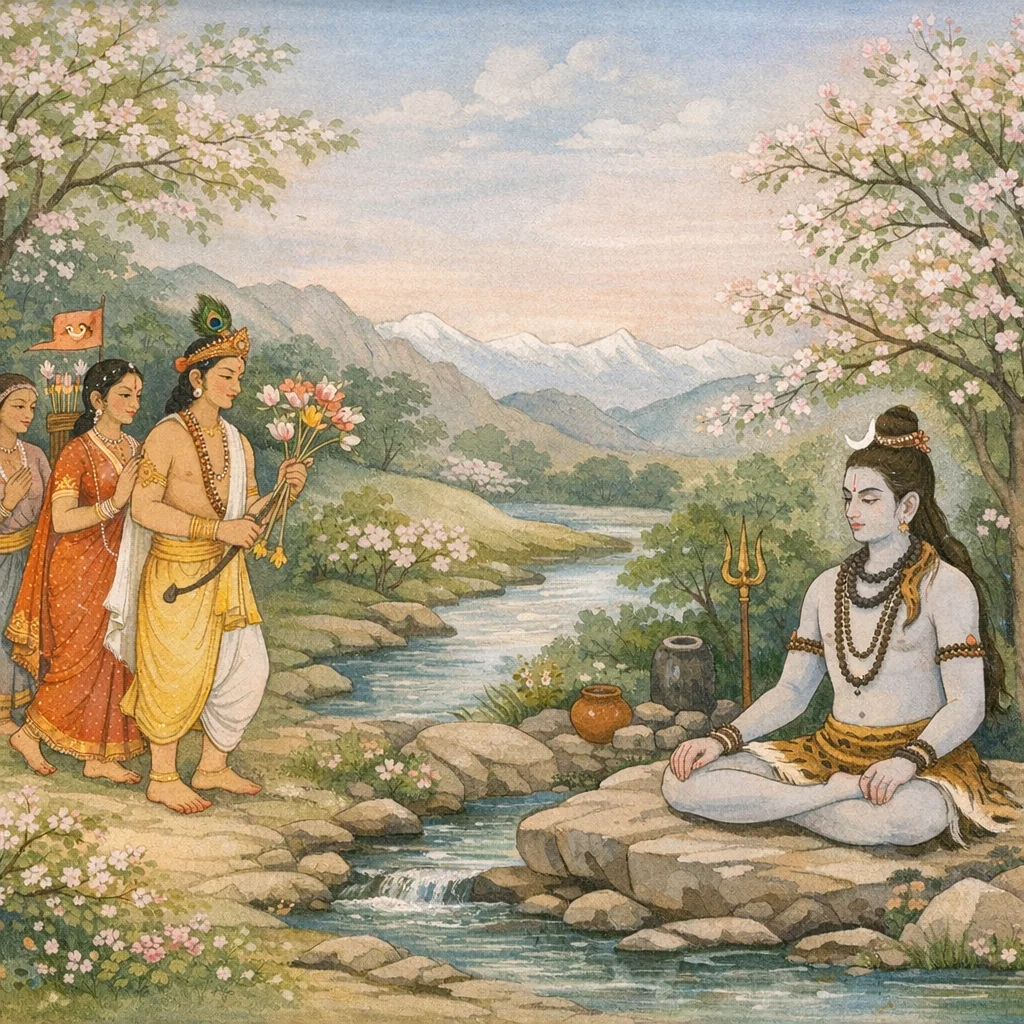
कामप्रभावः (कामा॑स्य प्रभाववर्णनम्) — The Power of Kāma and the (Ineffective) Attempt to Delude Śiva
Adhyāya 9 is framed as Brahmā’s report to a great sage about a striking episode after Manmatha (Kāma) goes with his attendants to Śiva’s abode. Kāma, the mohakāraka (maker of delusion), expands his innate influence; at the same time Vasanta (Spring) manifests its seasonal power—trees bloom all at once—signaling a cosmic intensification of desire and aesthetic charm. Accompanied by Rati, Kāma employs many stratagems to bring beings under his sway, achieving wide success over ordinary jīvas, yet explicitly failing to affect Śiva (together with Gaṇeśa). The narrative then turns to defeat: Kāma’s efforts are declared niṣphala (fruitless) against Śiva, so he withdraws, returns to Brahmā, and humbly confesses. Kāma’s speech states the doctrine: Śiva, being yogaparāyaṇa (steadfast in yoga), is not susceptible to enchantment; neither Kāma nor any other power can delude him. Thus the chapter teaches the inviolability of Śiva’s yogic consciousness and the limits of kāma/moha as cosmological forces.
Shlokas
Verse 1
ब्रह्मोवाच । तस्मिन् गते सानुचरे शिवस्थानं च मन्मथे । चरित्रमभवच्चित्रं तच्छृणुष्व मुनीश्वर
Brahmā said: When he (Kāma/Manmatha) went—together with his attendants—to Śiva’s abode, a wondrous course of events unfolded there. Listen, O lord among sages.
Verse 2
गत्वा तत्र महावीरो मन्मथो मोहकारकः । स्वप्रभावं ततानाशु मोहयामास प्राणिनः
Having gone there, the mighty hero Manmatha (Kāma), the maker of delusion, swiftly spread his own influence and caused living beings to fall into infatuation and confusion.
Verse 3
वसंतोपि प्रभावं स्वं चकार हरमोहनम् । सर्वे वृक्षा एकदैव प्रफुल्ला अभवन्मुने
Even Spring displayed its own power in a manner enchanting to Hara (Śiva). O sage, all the trees at once burst into full bloom.
Verse 4
विविधान्कृतवान्यत्नान् रत्या सह मनोभवः । जीवास्सर्वे वशं यातास्सगणेशश्शिवो न हि
Manobhava (Kāma), together with Rati, employed many kinds of efforts; all living beings came under his sway—yet Śiva, even along with Gaṇeśa, did not at all come under his control.
Verse 5
समधोर्मदनस्यासन्प्रयासा निप्फला मुने । जगाम स मम स्थानं निवृत्त्य विमदस्तदा
O sage, the efforts of Madana (Kāma), who strove against me, became fruitless. Then, withdrawing, he went to his own abode, his pride subdued.
Verse 6
कृत्वा प्रणामं विधये मह्यं गद्गदया गिरा । उवाच मदनो मां चोदासीनो विमदो मुने
O sage, then Madana (Kāma), having bowed to the Ordainer (Brahmā) and also to me, spoke in a choked voice—standing aside, free from pride.
Verse 7
काम उवाच । ब्रह्मन् शंभुर्मोहनीयो न वै योगपरायणः । न शक्तिर्मम नान्यस्य तस्य शंभोर्हि मोहने
Kāma said: “O Brahmā, Śambhu cannot be deluded, for he is wholly devoted to Yoga. Neither I nor anyone else has the power to bewilder that Śambhu.”
Verse 8
समित्रेण मया ब्रह्मन्नुपाया विविधाः कृताः । रत्या सहाखिलास्ते च निष्फला अभवञ्च्छिवे
O Brahman, together with my friend I tried many different means; yet all of them—though done with Rati’s help—proved fruitless in the matter of Śiva.
Verse 9
शृणु ब्रह्मन्यथाऽस्माभिः कृतां हि हरमोहने । प्रयासा विविधास्तात गदतस्तान्मुने मम
O Brahman, listen to what we undertook to bewilder (test) Hara (Lord Śiva). Dear one, O sage—hear from me as I recount the many and varied efforts we made.
Verse 10
यदा समाधिमाश्रित्य स्थितश्शंभुर्नियंत्रितः । तदा सुगंधिवातेन शीतलेनातिवेगिना
When Śambhu, perfectly self‑restrained, remained established in samādhi, then a cool wind, sweet with fragrance, began to blow with great force.
Verse 11
उद्वीजयामि रुद्रं स्म नित्यं मोहनकारिणा । प्रयत्नतो महादेवं समाधिस्थं त्रिलोचनम्
“I continually strive to rouse Rudra—Mahādeva, the three‑eyed Lord—who abides in samādhi, by earnest effort and by acts that draw and enchant the mind.”
Verse 12
स्वसायकांस्तथा पंच समादाय शरासनम् । तस्याभितो भ्रमंतस्तु मोहयंस्तद्ग णानहम्
Taking up my own five arrows and my bow, I began circling around him, bewildering his gaṇas, his attendants, on every side.
Verse 13
मम प्रवेशमात्रेण सुवश्यास्सर्वजंतवः । अभवद्विकृतो नैव शंकरस्सगणः प्रभुः
“By my mere entrance, all creatures became completely subdued; yet Śaṅkara, the sovereign Lord, together with His gaṇas, was not disturbed or altered in the least.”
Verse 14
यदा हिमवतः प्रस्थं स गतः प्रमथाधिपः । तत्रागतस्तदैवाहं सरतिस्समधुर्विधे
When that lord of the Pramathas went to the mountain-slope of Himavān, I too arrived there at that very time, O gentle one, together with my companions.
Verse 15
यदा मेरुं गतो रुद्रो यदा वा नागकेशरम् । कैलासं वा यदा यातस्तत्राहं गतवांस्तदा
Whenever Rudra went to Mount Meru, or to Nāgakeśara, or whenever He journeyed to Kailāsa—at that very time I too went there, following Him.
Verse 16
यदा त्यक्तसमाधिस्तु हरस्तस्थौ कदाचन । तदा तस्य पुरश्चक्रयुगं रचितवानहम्
When Hara (Śiva) once rose from His samādhi and stood still, then I fashioned before Him a pair of discus-weapons (cakras).
Verse 17
तच्च भ्रूयुगलं ब्रह्मन् हावभावयुतं मुहुः । नानाभावानकार्षीच्च दांपत्यक्रममुत्तमम्
O Brahman, that pair of brows again and again displayed graceful, love-born expressions; and it manifested many moods, revealing the most excellent course of wedded harmony.
Verse 18
नीलकंठं महादेवं सगणं तत्पुरःस्थिताः । अकार्षुमोहितं भावं मृगाश्च पक्षिणस्तथा
Standing before Nīlakaṇṭha Mahādeva—Śiva, attended by His gaṇas—the deer and the birds too were drawn into an enchanted, deluded state of mind.
Verse 19
मयूरमिथुनं तत्राकार्षीद्भावं रसोत्सुकम् । विविधां गतिमाश्रित्य पार्श्वे तस्य पुरस्तथा
There, the pair of peacocks became stirred with amorous feeling, eager for delight; assuming many graceful movements, they sported by his side and also in front of him.
Verse 20
नालभद्विवरं तस्मिन् कदाचिदपि मच्छरः । सत्यं ब्रवीमि लोकेश मम शक्तिर्न मोहने
My enemy never found even the slightest opening in me at any time. I speak the truth, O Lord of the worlds: my Śakti is not meant for delusion.
Verse 21
मधुरप्यकरोत्कर्म युक्तं यत्तस्य मोहने । तच्छृणुष्व महाभाग सत्यं सत्यं वदाम्यहम्
Even though it appeared gentle and pleasing, he performed an act skillfully devised to delude him. Listen to that, O noble one—for I speak the truth, the truth alone.
Verse 22
चंपकान्केशरान्वालान्कारणान्पाटलांस्तथा । नागकेशरपुन्नागान्किंशुकान्केतकान्करान्
“(One should offer) campaka blossoms, saffron-like flowers, vāla flowers, kāraṇa flowers, and pāṭalā blossoms; likewise nāgakeśara, punnāga, kiṃśuka, ketaka, and clusters of fresh flowers as sacred offerings.”
Verse 23
मागंधिमल्लिकापर्णभरान्कुरवकांस्तथा । उत्फुल्लयति तत्र स्म यत्र तिष्ठति वै हरः
Wherever Hara (Lord Śiva) stands, there the heavy foliage of sweet-scented jasmine and the kuravaka blossoms at once, as though awakened into full bloom by His sanctifying presence.
Verse 24
सरांस्युत्फुल्लपद्मानि वीजयन् मलयानिलैः । यत्नात्सुगंधीन्यकरोदतीव गिरिशाश्रमे
Fanning the lotus-filled lakes with the cool breezes of Malaya, he carefully made them richly fragrant, thereby enhancing the sanctity and serenity of Girīśa (Śiva)’s hermitage.
Verse 25
लतास्सर्वास्सुमनसो दधुरंकुरसंचयान् । वृक्षांकं चिरभावेन वेष्टयंति स्म तत्र च
There, all the creepers, as though joyful and kindly disposed, put forth clusters of fresh sprouts; and with long, lingering affection they wrapped themselves around the trunks of the trees.
Verse 26
तान्वृक्षांश्च सुपुष्पौघान् तैः सुगंधिसमीरणैः । दृष्ट्वा कामवशं याता मुनयोपि परे किमु
Seeing those trees laden with masses of beautiful blossoms, and the breezes fragrant with their perfume, even the exalted sages were drawn under the sway of desire; how much more, then, would others be so affected?
Verse 27
एवं सत्यपि शंभोर्न दृष्टं मोहस्य कारणम् । भावमात्रमकार्षीन्नो कोपो मय्यपि शंकरः
Even so, in Śambhu no cause of delusion was seen. He displayed only an outward demeanor; Śaṅkara, too, bore no anger toward me.
Verse 28
इति सर्वमहं दृष्ट्वा ज्ञात्वा तस्य च भावनाम् । विमुखोहं शंभुमोहान्नियतं ते वदाम्यहम्
“Thus, having seen everything and having understood his inner intention as well, I have turned away—surely—out of delusion regarding Śambhu. This I tell you as the truth.”
Verse 29
तस्य त्यक्तसमाधेस्तु क्षणं नो दृष्टिगोचरे । शक्नुयामो वयं स्थातुं तं रुद्रं को विमोहयेत्
Even for a moment, once he has set aside his samādhi, he does not come within the range of our sight. How could we possibly stand before that Rudra—who could ever delude Him?
Verse 30
ज्वलदग्निप्रकाशाक्षं जट्टाराशिकरालिनम् । शृंगिणं वीक्ष्य कस्स्थातुं ब्रह्मन् शक्नोति तत्पुरः
O Brahmā, after beholding that horned Lord—whose eyes blaze with the radiance of flaming fire, and whose dreadful mass of matted jaṭā locks is terrifying—who could possibly stand before Him?
Verse 31
ब्रह्मोवाच । मनो भववचश्चेत्थं श्रुत्वाहं चतुराननः । विवक्षुरपि नावोचं चिंताविष्टोऽभवं तदा
Brahmā said: “O Bhava (Śiva), having heard your words in this manner, I—the four-faced one—though wishing to speak, did not speak. Then I was overwhelmed, absorbed in anxious contemplation.”
Verse 32
मोहनेहं समर्थो न हरस्येति मनोभवः । वचः श्रुत्वा महादुःखान्निरश्वसमहं मुने
O sage, when I heard Manobhava’s words—“I am not capable here of deluding Hara (Śiva)”—I was plunged into great sorrow and became utterly despondent.
Verse 33
निश्श्वासमारुता मे हि नाना रूपमहाबलः । जाता गता लोलजिह्वा लोलाश्चातिभयंकराः
“Indeed, the winds that issue forth from My breath—of many forms and of tremendous power—have arisen and moved about. With flickering tongues and restless motion, they are exceedingly terrifying.”
Verse 34
अवादयंत ते सर्वे नानावाद्यानसंख्यकान् । पटहादिगणास्तांस्तान् विकरालान्महारवान्
Then all of them began to play countless kinds of musical instruments—great companies of kettledrums such as the paṭaha and the like—each sending forth a fearsome, thunderous roar.
Verse 35
अथ ते मम निश्श्वाससंभवाश्च महागणाः । मारयच्छेदयेत्यूचुर्ब्रह्मणो मे पुरः स्थिताः
Then those mighty Gaṇas—born of My very breath—stood before Me in Brahmā’s presence and cried, “Command us: shall we slay, shall we cut down?”
Verse 36
तेषां तु वदतां तत्र मारयच्छेदयेति माम् । वचः श्रुत्वा विधिं कामः प्रवक्तुमुपचक्रमे
There, as they were speaking, their words were: “Kill him; cut him down!” Hearing those utterances and grasping their intent, Kāma began to speak out his plan.
Verse 37
मुनेऽथ मां समाभाष्य तान् दृष्ट्वा मदनो गणान् । उवाच वारयन् ब्रह्मन्गणानामग्रतः स्मरः
O sage, then Kāma (Smara), after addressing me and seeing those gaṇas, spoke out—restraining them—standing in front of the gaṇas, O Brahmin.
Verse 38
काम उवाच । हे ब्रह्मन् हे प्रजानाथ सर्वसृष्टिप्रवर्तक । उत्पन्नाः क इमे वीरा विकराला भयंकराः
Kāma said: “O Brahman, O Lord of creatures, O initiator of all creation—who are these heroes that have arisen, so monstrous in form and terrifying?”
Verse 39
किं कर्मैते करिष्यंति कुत्र स्थास्यंति वा विधे । किन्नामधेया एते तद्वद तत्र नियोजय
“O Ordainer (Brahmā), what duties will these beings perform, and where indeed will they dwell? What are their names? Tell me that, and assign them to their proper stations.”
Verse 40
नियोज्य तान्निजे कृत्ये स्थानं दत्त्वा च नाम च । मामाज्ञापय देवेश कृपां कृत्वा यथोचिताम्
“After appointing them to their respective duties, and granting them their proper stations and names, O Lord of the gods, command me as well—showing fitting compassion.”
Verse 41
ब्रह्मोवाच । इति तद्वाक्यमाकर्ण्य मुनेऽहं लोककारकः । तमवोचं ह मदनं तेषां कर्मादिकं दिशन्
Brahmā said: “O sage, having thus heard those words, I—the creator and arranger of the worlds—then spoke to Madana (Kāma), instructing him regarding their duties and the course of action to be undertaken.”
Verse 42
ब्रह्मोवाच । एत उत्पन्नमात्रा हि मारयेत्यवदन् वचः । मुहुर्मुहुरतोमीषां नाम मारेति जायताम्
Brahmā said: “No sooner were they born than they repeatedly cried, ‘Kill!’ Therefore their name came to be ‘Māra’—the killers—again and again.”
Verse 43
सदैव विघ्नं जंतूनां करिष्यन्ति गणा इमे । विना निजार्चनं काम नाना कामरतात्मनाम्
These gaṇas will always create obstacles for living beings absorbed in many desires and pleasures, when—out of craving—they pursue their aims without first performing their own due worship.
Verse 44
तवानुगमने कर्म मुख्यमेषां मनोभव । सहायिनो भविष्यंति सदा तव न संशयः
O Manobhava (Kāma), their foremost duty is to follow your lead; they will always remain your helpers—of this there is no doubt.
Verse 45
यत्रयत्र भवान् याता स्वकर्मार्थं यदा यदा । गंता स तत्रतत्रैते सहायार्थं तदातदा
“Wherever you go, and whenever you go for the sake of your own duty, these (attendants) will also go there and there—at those very times—so as to assist you.”
Verse 46
चित्तभ्रांतिं करिष्यंति त्वदस्त्रवशवर्तिनाम् । ज्ञानिनां ज्ञानमार्गं च विघ्नयिष्यंति सर्वथा
“Those who are brought under the sway of Your divine weapon will have their minds thrown into delusion; and they will, in every way, obstruct the path of knowledge of the true knowers.”
Verse 47
ब्रह्मोवाच । इत्याकर्ण्य वचो मे हि सरतिस्समहानुगः । किंचित्प्रसन्नवदनो बभूव मुनिसत्तम
Brahmā said: “Thus hearing my words, that one—accompanied by his charioteer and attendants—became somewhat serene in countenance, O best of sages.”
Verse 48
श्रुत्वा तेपि गणास्सर्वे मदनं मां च सर्वतः । परिवार्य्य यथाकामं तस्थुस्तत्र निजाकृतिम्
Hearing this, all those gaṇas too—having surrounded Madana and me on every side—stood there as they pleased, each remaining in his own proper form.
Verse 49
अथ ब्रह्मा स्मरं प्रीत्याऽगदन्मे कुरु शासनम् । एभिस्सहैव गच्छ त्वं पुनश्च हरमोहने
Then Brahmā, pleased, addressed Kāma (Smara): “Carry out my command. Go once again together with these attendants, and there, in the task of deluding Hara (Śiva), proceed.”
Verse 50
मन आधाय यवाद्धि कुरु मारगणैस्सह । मोहो भवेद्यथा शंभोर्दारग्रहणहेतवे
“Steady your mind, and together with the hosts of Māra, bring about delusion—so that Śambhu (Śiva) may fall into bewilderment, for the very purpose of taking a wife.”
Verse 51
इत्याकर्ण्य वचः कामः प्रोवाच वचनं पुनः । देवर्षे गौरवं मत्वा प्रणम्य विनयेन माम्
Having thus heard those words, Kāma spoke again. Recognizing the venerable status of the divine sage, he bowed to me with humility and addressed me respectfully.
Verse 52
काम उवाच । मया सम्यक् कृतं कर्म मोहने तस्य यत्नतः । तन्मोहो नाभवत्तात न भविष्यति नाधुना
Kāma said: “With full effort I have properly performed my task of deluding him. Yet, dear one, that delusion did not arise in him—nor will it arise, not now and not in the future.”
Verse 53
तव वाग्गौरवं मत्वा दृष्ट्वा मारगणानपि । गमिष्यामि पुनस्तत्र सदारोहं त्वदाज्ञया
Recognizing the weight and authority of your words, and having even seen those fearsome hosts, I shall return again to that place—together with my retinue—by your command.
Verse 54
मनो निश्चितमेतद्धि तन्मोहो न भविष्यति । भस्म कुर्यान्न मे देहमिति शंकास्ति मे विधे
My mind is firmly resolved on this; therefore that delusion will not arise again. Yet one doubt troubles me, O Brahmā: “Will he reduce my body to ashes?”
Verse 55
इत्युक्त्वा समधुः कामस्सरतिस्सभयस्तदा । ययौ मारगणैः सार्द्धं शिवस्थानं मुनीश्वर
Having said this, Kāma—together with Madhu and Sarati—then became afraid. O lord of sages, he went along with the hosts of Māra to Śiva’s abode.
Verse 56
पूर्ववत् स्वप्रभावं च चक्रे मनसिजस्तदा । बहूपायं स हि मधुर्विविधां बुद्धिमावहन्
Then Manasija (Kāma) again displayed his innate power as before. Madhu, sweetly devising many stratagems, brought forth diverse plans of persuasion.
Verse 57
उपायं स चकाराति तत्र मारगणोऽपि च । मोहोभवन्न वै शंभोरपि कश्चित्परात्मनः
Thereupon he devised a stratagem, and even the hosts of Māra gathered there; yet no delusion at all arose in Śambhu—who is the Supreme Self—for none can bewilder Him.
Verse 58
निवृत्त्य पुनरायातो मम स्थानं स्मरस्तदा । आसीन्मारगणोऽगर्वोऽहर्षो मेपि पुरस्थितः
Having withdrawn, Smara (Kāma) then returned again, remembering my abode. Yet the troop of Māra stood there—without arrogance and without elation—remaining stationed at my very gate.
Verse 59
कामः प्रोवाच मां तात प्रणम्य च निरुत्सवः । स्थित्वा मम पुरोऽगर्वो मारैश्च मधुना तदा
Then Kāma, despondent and without any festivity, bowed to me and spoke: standing before me without pride, together with the Maruts and with Madhu at that time.
Verse 60
कृतं पूर्वादधिकतः कर्म तन्मोहने विधे । नाभवत्तस्य मोहोपि कश्चिद्ध्यानरतात्मनः
O Creator (Brahmā), a stronger act than before was performed to delude him; yet no delusion at all arose in that soul who was absorbed in meditation.
Verse 61
न दग्धा मे तनुश्चैव तत्र तेन दयालुना । कारणं पूर्वपुण्यं च निर्विकारी स वै प्रभुः
My body was not burned there by that compassionate One. The cause is my merit from former lives; for He is indeed the Lord, changeless and untouched by modification.
Verse 62
चेद्वरस्ते हरो भार्यां गृह्णीयादिति पद्मज । परोपायं कुरु तदा विगर्व इति मे मतिः
O Padmaja (Brahmā), if this boon be granted—that Hara (Śiva) should take your wife—then at that very moment devise another means to avert it. Such, indeed, is my well-considered view.
Verse 63
ब्रह्मोवाच । इत्युक्त्वा सपरीवारो ययौ कामस्स्वमाश्रमम् । प्रणम्य मां स्मरन् शंभुं गर्वदं दीनवत्सलम्
Brahmā said: Having spoken thus, Kāma, the god of desire, together with his attendants, departed for his own hermitage. Bowing to me and remembering Śambhu—He who shatters pride and is compassionate to the meek—he went on his way.
Frequently Asked Questions
Kāma (Manmatha), aided by Rati and amplified by Vasanta’s springtime power, attempts multiple methods to enchant beings and to delude Śiva at Śiva’s abode, but fails; he then returns to Brahmā and admits Śiva cannot be mohanīya due to yogic steadfastness.
The episode encodes a hierarchy of forces: kāma/moha can dominate conditioned beings, but cannot penetrate yogic sovereignty. Śiva exemplifies consciousness established in yoga, where sensory-aesthetic stimuli do not compel action—an allegory for liberation through inner mastery.
Vasanta’s sudden universal blossoming and Kāma’s wide-ranging influence over prāṇins/jīvas illustrate desire’s expansive reach; the explicit exception—Śiva (and Gaṇeśa)—marks the boundary where yogic transcendence nullifies enchantment.