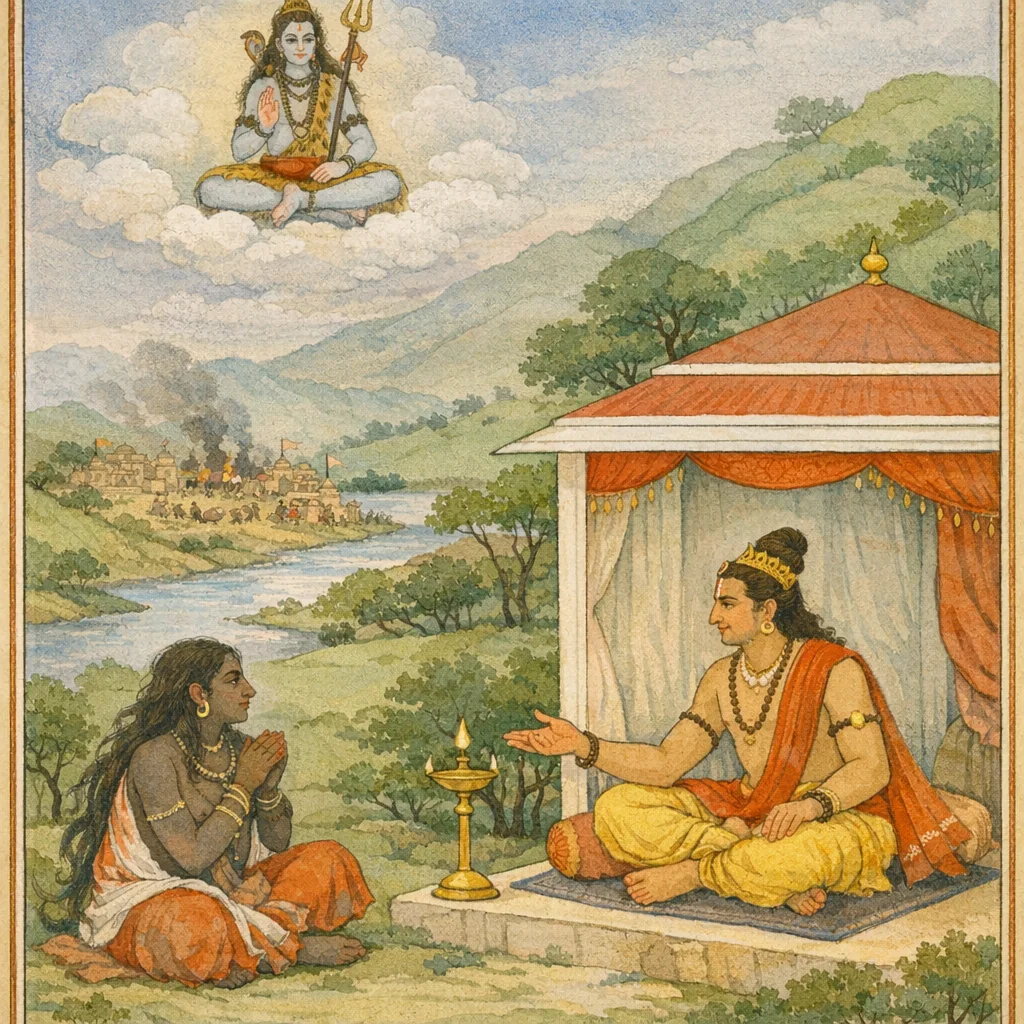
Bhaimaśaṅkara-māhātmya: Śiva’s Descent in Kāmarūpa and the Rise of Bhīma
This adhyāya, narrated by Sūta as the Bhaimaśaṅkara māhātmya, declares the śravaṇa-phala: mere hearing bestows desired attainments. Set in Kāmarūpa, it tells of Śaṅkara (Śiva) descending for the welfare of the world, revealing avatāra as compassionate intervention. The antagonist is Bhīma, a mighty rākṣasa who afflicts all and destroys dharma, born of Kumbhakarṇa and Karkaṭī and dwelling in the Sahya mountains. The young Bhīma questions his mother about his father; Karkaṭī names Kumbhakarṇa, Rāvaṇa’s brother, and recounts his death at Rāma’s hands. Implicitly, the chapter links adharmic power and inherited violence to Śiva’s stabilizing presence at a kṣetra, intertwining place-theology, moral causality, and salvific hearing.
Shlokas
Verse 1
सूत उवाच । अतः परं प्रवक्ष्यामि माहात्म्यं भैमशंकरम् । यस्य श्रवणमात्रेण सर्वाभीष्टं लभेन्नरः
Sūta said: “Now, next, I shall proclaim the sacred glory of Bhīmaśaṅkara. By merely hearing it, a person attains all that is truly desired.”
Verse 2
कामरूपाभिधे देशे शंकरो लोककाम्यया । अवतीर्णः स्वयं साक्षात्कल्याणसुखभाजनम्
In the land called Kāmarūpa, Śaṅkara Himself—out of compassion for the world’s welfare and cherished aspirations—manifested directly, becoming the very abode of auspiciousness and bliss.
Verse 3
यदर्थमवतीर्णोसौ शंकरो लोकशंकरः । शृणुतादरतस्तच्च कथयामि मुनीश्वराः
For what purpose Śaṅkara—who bestows auspiciousness upon the worlds—has descended, listen with reverent attentiveness; I shall narrate it to you, O lordly sages.
Verse 4
भीमोनाम महोवीर्यो राक्षसोऽभूत्पुरा द्विजाः । दुःखदस्सर्वभूतानां धर्मध्वंसकरस्सदा
O brāhmaṇas, in former times there was a mighty and valiant rākṣasa named Bhīma, who ever brought suffering upon all beings and was always a destroyer of dharma.
Verse 5
कुंभकर्णात्समुत्पन्नः कर्कट्यां सुमहाबलः । सह्ये च पर्वते सोऽपि मात्रा वासं चकार ह
Born of Kumbhakarṇa through Karkaṭī, he was exceedingly mighty. He too made his dwelling with his mother on Mount Sahya.
Verse 6
कुंभकर्णे च रामेण हते लोकभयंकरे । राक्षसी पुत्रसंयुक्ता सह्येऽतिष्ठत्स्वयं तदा
When Kumbhakarṇa—the terror of the worlds—had been slain by Rāma, the rākṣasī, accompanied by her son, then of her own accord went and stayed in the Sahya mountains.
Verse 7
स बाल एकदा भीमः कर्कटीं मातरं द्विजाः । पप्रच्छ च खलो लोकदुःखदो भीमविक्रमः
O brāhmaṇas, once, while still a boy, the fierce Bhīma—cruel, a bringer of suffering to the world, and mighty in prowess—questioned his mother Karkaṭī.
Verse 8
भीम उवाच । मातर्मे कः पिता कुत्र कथं वैकाकिनी स्थिता । ज्ञातुमिच्छामि तत्सर्वं यथार्थं त्वं वदाधुना
Bhīma said: “Mother, who is my father, and where is he? And how have you, O Vaikākinī, come to be in this condition? I wish to know all of it exactly as it truly is—tell me now.”
Verse 9
सूत उवाच । एवं पृष्टा तदा तेन पुत्रेण राक्षसी च सा । उवाच पुत्रं सा दुष्टा श्रूयतां कथयाम्यहम्
Sūta said: Thus questioned then by her son, that rākṣasī—being wicked—addressed her son: “Listen; I shall tell (it) to you.”
Verse 10
कर्कट्युवाच । पिता ते कुम्भकर्णश्च रावणानुज एव च । रामेण मारितस्सोयं भ्रात्रा सह महाबलः
Karkaṭī said: “Your father—Kumbhakarṇa, the mighty younger brother of Rāvaṇa—has been slain by Rāma, together with his brother.”
Verse 11
अत्रागतः कदाचिद्वै कुम्भकर्णस्य राक्षसः । मद्भोगं कृतवांस्तात प्रसह्य बलवान्पुरा
“Once, a mighty rākṣasa—Kumbhakarṇa—came here. Long ago, dear one, he violently seized and enjoyed me by force.”
Verse 12
लंकां स गतवान्मां च त्यक्त्वात्रैव महाबलः । मया न दृष्ट्वा सा लंका ह्यत्रैव निवसाम्यहम्
That mighty one went to Laṅkā, leaving me here behind. Since I have not beheld that Laṅkā, I remain dwelling in this very place.
Verse 13
पिता मे कर्कटो नाम माता मे पुष्कसी मता । भर्ता मम विराधो हि रामेण निहतः पुरा
“My father was named Karkaṭa; my mother was known as Puṣkasī. My husband indeed was Virādha—formerly slain by Rāma.”
Verse 14
पित्रोः पार्श्वे स्थिता चाहं निहते स्वामिनि प्रिये । पितरौ मे मृतौ चात्र ऋषिणा भस्मसात्कृतौ
Beloved lady, I stood beside my parents when my husband was slain. Here my own parents too died, and a sage (ṛṣi) reduced them to ashes.
Verse 15
भक्षणार्थं गतौ तत्र कुद्धेन सुमहात्मना । सुतीक्ष्णेन सुतपसाऽगस्त्यशिष्येण वै तदा
Then, at that place, the two who had gone there to devour were confronted by the great-souled Sutīkṣṇa—Agastya’s disciple—who, through severe austerities, had become fiercely wrathful.
Verse 16
साऽहमेकाकिनी जाता दुःखिता पर्वते पुरा । निवसामि स्म दुःखार्ता निरालंबा निराश्रया
I became all alone, afflicted with sorrow, long ago upon the mountain. Distressed by grief, I lived there without any support—without refuge or shelter.
Verse 17
ततस्त्वं च समुत्पन्नो महाबलपराक्रमः । अवलंब्य पुनस्त्वां च कालक्षेपं करोम्यहम्
Then you were manifested—mighty in strength and heroic in prowess. And now, taking support of you again, I shall pass the time and carry on my purpose.
Verse 19
सूत उवाच । इति श्रुत्वा वचस्तस्या भीमो भीमपराक्रमः । कुद्धश्च चिंतयामास किं करोमि हरिं प्रति
Sūta said: Hearing her words, Bhīma—of dreadful valor—became enraged and began to ponder, “What shall I do against Hari (Viṣṇu)?”
Verse 20
इति श्रीशिवमहापुराणे चतुर्थ्यां कोटिरुद्रसंहितायां भीमेश्वरज्योतिर्लिगमाहात्म्ये भीमासुरकृतोपद्रववर्णनं नाम विंशोऽध्यायः
Thus, in the Śrī Śiva Mahāpurāṇa—within the Fourth, the Koṭirudra-saṃhitā—during the account of the greatness of the Bhīmeśvara Jyotirliṅga, the twentieth chapter concludes, entitled “The description of the afflictions caused by the asura Bhīma.”
Verse 21
तत्पुत्रोहं भवेयं चेद्धरिं तं पीडयाम्यहम् । इति कृत्वा मतिं भीमस्तपस्तप्तुं महद्ययौ
“If I can become his son, I will afflict that Hari (Viṣṇu).” Having formed this dreadful resolve, Bhīma set out to undertake intense austerities.
Verse 22
ब्रह्माणां च समुद्दिश्य वर्षाणां च सहस्रकम् । मनसा ध्यानमाश्रित्य तपश्चक्रे महत्तदा
Then, setting his aim upon a span of a thousand divine years and steadying his mind in concentrated contemplation, he undertook great austerities at that time.
Verse 23
ऊर्ध्वबाहुश्चैकपादस्सूर्य्ये दृष्टिं दधत्पुरा । संस्थितस्स बभूवाथ भीमो राक्षसपुत्रकः
Formerly, that fearsome son of a rākṣasa stood in a severe vow of austerity—arms raised aloft, balanced upon one foot, and his gaze fixed upon Sūrya, the Sun.
Verse 24
शिरसस्तस्य संजातं तेजः परमदारुणम् । तेन दग्धास्तदा देवा ब्रह्माणं शरणं ययुः
From his head there arose a radiance—tejas exceedingly fierce and dreadful. Scorched by that blazing power, the gods then went to Brahmā, seeking refuge.
Verse 25
प्रणम्य वेधसं भक्त्या तुष्टुवुर्विविधैः स्तवैः । दुःखं निवेदयांचकुर्ब्रह्मणे ते सवासवाः
Bowing with devotion to Vedhas, the Creator Brahmā, they praised him with hymns of many kinds; and those gods, together with Indra, laid their distress before Brahmā.
Verse 26
देवा ऊचुः । ब्रह्मन्वै रक्षसस्तेजो लोकान्पीडितुमुद्यतम् । यत्प्रार्थ्यते च दुष्टेन तत्त्वं देहि वरं विधे
The gods said: “O Brahmā, truly the rākṣasa’s power has risen, intent on tormenting the worlds. Whatever boon that wicked one seeks—O Vidhe, Creator—grant it in accord with the true principle of dharma, so that the worlds may be protected.”
Verse 27
नोचेदद्य वयं दग्धास्तीव्रतत्तेजसा पुनः । यास्यामस्संक्षयं सर्वे तस्मात्तं देहि प्रार्थितम्
If not, then today we shall be burned again by that fierce tejas, and all of us will meet destruction. Therefore, grant what is being entreated of you.
Verse 28
सूत उवाच । इति तेषां वचश्श्रुत्वा ब्रह्मा लोकपितामहः । जगाम च वरं दातुं वचनं चेदमब्रवीत्
Sūta said: Hearing those words, Brahmā—the grandsire of the worlds—went forth to grant them a boon, and then spoke these words.
Verse 29
ब्रह्मोवाच । प्रसन्नोऽस्मि वरं ब्रूहि यत्ते मनसि वर्तते । इति श्रुत्वा विधेर्वाक्यमब्रवीद्राक्षसो हि सः
Brahmā said: “I am pleased. Speak—declare the boon that abides in your mind.” Hearing these words of the Ordainer (Brahmā), that rākṣasa then replied.
Verse 30
भीम उवाच । यदि प्रसन्नो देवेश यदि देयो वर स्त्वया । अतुलं च बलं मेऽद्य देहि त्वं कमलासन
Bhīma said: “O Lord of the gods, if You are pleased, and if a boon is to be granted by You, then today grant me incomparable strength, O Lotus-seated One.”
Verse 31
सूत उवाच । इत्युक्त्वा तु नमश्चक्रे ब्रह्मणे स हि राक्षसः । ब्रह्मा चापि तदा तस्मै वरं दत्त्वा गृहं ययौ
Sūta said: Having spoken thus, that rākṣasa bowed in reverence to Brahmā. Then Brahmā too, granting him a boon, departed for his own abode.
Verse 32
राक्षसो गृहमागत्य ब्रह्माप्तातिबलस्तदा । मातरं प्रणिपत्याशु स भीमः प्राह गर्ववान्
Then that fearsome rākṣasa returned home, endowed with extraordinary strength as though granted by Brahmā. He quickly bowed down to his mother, and, swollen with pride, spoke.
Verse 33
भीम उवाच । पश्य मातर्बलं मेऽद्य करोमि प्रलयं महत् । देवानां शक्रमुख्यानां हरेर्वै तत्सहायिनः
Bhīma said: “Behold, Mother, my power today. I shall cause a great devastation—of the gods led by Śakra (Indra), and even of Hari (Viṣṇu) together with his allies.”
Verse 34
सूत उवाच । इत्युक्त्वा प्रथमं भीमो जिग्ये देवान्सवासवान् । स्थानान्निस्सारयामास स्वात्स्वात्तान्भीमविक्रमः
Sūta said: Having spoken thus, Bhīma first conquered the gods along with Indra; and that mighty one of dreadful prowess drove them out from their respective abodes.
Verse 35
ततो जिग्ये हरिं युद्धे प्रार्थितं निर्जरैरपि । ततो जेतुं रसां दैत्यः प्रारंभं कृतवान्मुदा
Thereafter the Daitya defeated Hari in battle, even though the Devas had invoked and implored him. Then, rejoicing, that demon began his campaign to conquer the earth.
Verse 36
पुरा सुदक्षिणां तत्र कामरूपेश्वरं प्रभुम् । जेतुं गतस्ततस्तेन युद्धमासीद्भयंकरम्
Formerly, in the land of Sudakṣiṇā, a challenger set forth to conquer the Lord Kāmarūpeśvara. Therefore, a dreadful and fearsome battle arose with Him.
Verse 37
भीमोऽथ तं महाराजं प्रभावाद्ब्रह्मणोऽसुरः । जिग्ये वरप्रभावेण महावीरं शिवाश्रयम्
Then Bhīma, the asura empowered by Brahmā’s might, overcame that great king—though he was a mighty hero and a devotee who had taken refuge in Śiva—by the force of the boon.
Verse 38
स हि जित्वा ततस्तं च कामरूपेश्वरं प्रभुम् । बबंध ताडयामास भीमो भीमपराक्रमः
Having conquered that Lord of Kāmarūpa, Bhīma—of dreadful prowess—bound him and struck him.
Verse 39
गृहीतं तस्य सर्वस्वं राज्यं सोपस्करं द्विजाः । तेन भीमेन दुष्टेन शिवदासस्य भूपतेः
O brāhmaṇas, that wicked Bhīma seized the entire wealth of King Śivadāsa—his kingdom along with all its appurtenances and resources.
Verse 40
राजा चापि सुधर्मिष्ठः प्रियधर्मो हरप्रियः । गृहीतो निगडैस्तेन ह्येकांते स्थापितश्च सः
That king too—most steadfast in dharma, a lover of righteousness and dear to Hara (Śiva)—was seized by him in fetters and confined in a secluded place.
Verse 41
तत्र तेन तदा कृत्वा पार्थिवीं मूर्तिमुत्तमाम् । भजनं च शिवस्यैव प्रारब्धी प्रियकाम्यया
There, at that time, he fashioned an excellent earthen image (pārthiva-mūrti) and, desiring what was dear to him, he began devoted worship of Lord Śiva alone.
Verse 42
गंगायास्तवनं तेन बहुधा च तदा कृतम् । मानसं स्नानकर्मादि कृत्वा शंकरपूजनम्
Then he offered manifold hymns of praise to the Goddess Gaṅgā. Performing the mental rite of bathing and the other inner purificatory acts, he then worshipped Śaṅkara (Lord Śiva).
Verse 43
पार्थिवेन विधानेन चकार नृपसत्तमः । तद्ध्यानं च यथा स्याद्वै कृत्वा च विधिपूर्वकम्
The best of kings performed the worship according to the earthen (Pārthiva) rite; and, having duly followed the prescribed procedure, he also carried out the proper meditation appropriate to that worship.
Verse 44
प्रणिपातैस्तथा स्तोत्रैर्मुद्रासन पुरस्सरम् । कृत्वा हि सकलं तच्च स भेजे शंकरं मुदा
Having performed full prostrations and hymns—preceded by the prescribed hand-gestures and yogic postures—and having thus completed all those acts of worship, he joyfully took refuge in Śaṅkara.
Verse 45
पंचाक्षरमयीं विद्यां जजाप प्रणवान्विताम् । नान्यत्कार्यं स वै कर्तुं लब्धवानन्तरं तदा
He then began to repeat the sacred vidyā of the five syllables, joined with the praṇava “Oṁ.” At that very time, he found no other duty to perform—only japa remained for him.
Verse 46
तत्पत्नी च तदा साध्वी दक्षिणा नाम विश्रुता । निधानं पार्थिवं प्रीत्या चकार नृपवल्लभा
At that time, his wife—the virtuous lady renowned as Dakṣiṇā, beloved of the king—lovingly arranged a royal treasure-store, a noble deposit of wealth.
Verse 47
दंपती त्वेकभावेन शंकरं भक्तशंकरम् । भेजाते तत्र तौ नित्यं शिवाराधनतत्परौ
United in one-hearted devotion, the husband and wife continually resorted to Śaṅkara—ever gracious to His devotees—and there they remained always intent on the worship of Lord Śiva.
Verse 48
राक्षसो यज्ञकर्मादि वरदर्प विमोहितः । लोपयामास तत्सर्वं मह्यं वै दीयतामिति
The rākṣasa, deluded by the arrogance born of boons, caused all the sacrificial rites and allied religious acts to disappear, declaring, “Indeed, let all of that be given to me!”
Verse 49
बहुसैन्यसमायुक्तो राक्षसानां दुरात्मनाम । चकार वसुधां सर्वां स्ववशे चर्षिसत्तमाः
O best of sages, accompanied by a vast host of wicked rākṣasas, he brought the entire earth under his control and subjugated it to his own will.
Verse 50
वेदधर्मं शास्त्रधर्मं स्मृतिधर्मं पुराणजम् । लोपयित्वा च तत्सर्वं बुभुजे स्वयमूर्जितः
Having obscured the dharma taught in the Vedas, the śāstras, the smṛtis, and the Purāṇas, he—empowered by his own might—appropriated it all for himself.
Verse 51
देवाश्च पीडितास्तेन सशक्रा ऋषयस्तथा । अत्यन्तं दुःखमापन्ना लोकान्निस्सारिता द्विजाः
Tormented by him, the gods—along with Indra—and the sages as well fell into extreme distress; and the twice-born were driven out from their worlds.
Verse 52
ते ततो विकलास्सर्वे सवासवसुरर्षयः । ब्रह्मविष्णू पुरोधाय शंकरं शरणं ययुः
Then all of them—distressed and shaken, along with Indra, the Devas, and the sages—placing Brahmā and Viṣṇu at their forefront, went to Śaṅkara seeking refuge.
Verse 53
स्तुत्वा स्तोत्रैरनेकैश्च शंकरं लोक शंकरम् । प्रसन्नं कृतवंतस्ते महाकोश्यास्तटे शुभे
Having praised Śaṅkara—the benefactor of the worlds—with many hymns, they gladdened Him and made Him gracious upon the auspicious bank of the great Kośī river.
Verse 54
कृत्वा च पार्थिवीं मूर्तिं पूजयित्वा विधानतः । तुष्टुवुर्विविधैः स्तोत्रैर्नमस्कारादिभिः क्रमात्
Having fashioned an earthen image (pārthiva-mūrti) and worshipped it according to the prescribed rite, they then praised (Lord Śiva) in due order with various hymns, beginning with reverent salutations and other acts of devotion.
Verse 55
एवं स्तुतस्तदा शंभुर्देवानां स्तवनादिभिः । सुप्रसन्नतरो भूत्वा तान्सुरानिदमब्रवीत्
Thus praised at that time by the devas through hymns and other acts of adoration, Śambhu (Lord Śiva), becoming even more graciously pleased, spoke these words to those gods.
Verse 56
शिव उवाच । हे हरे हे विधे देवा ऋषयश्चाखिला अहम् । प्रसन्नोस्मि वरं ब्रूत किं कार्यं करवाणि वः
Śiva said: “O Hari (Viṣṇu), O Vidhi (Brahmā), O gods and all the sages—I am pleased. Speak the boon you desire. What service shall I accomplish for you?”
Verse 57
सूत उवाच । इत्युक्ते च तदा तेन शिवेन वचने द्विजाः । सुप्रणम्य करौ बद्ध्वा देवः ऊचुश्शिवं तदा
Sūta said: When Lord Śiva had spoken thus, the twice-born ones bowed deeply, joined their hands in reverence, and then addressed Śiva.
Verse 58
देवा ऊचुः । सर्वं जानासि देवेश सर्वेषां मनसि स्थितम् । अन्तर्यामी च सर्वस्य नाज्ञातं विद्यते तव
The Devas said: “O Lord of the gods, You know everything. You abide within the minds of all beings, and as the Antaryāmin, the Inner Ruler of all, nothing at all remains unknown to You.”
Verse 59
तथापि श्रूयतां नाथ स्वदुःखं ब्रूमहे वयम् । त्वदाज्ञया महादेव कृपादृष्ट्या विलोकय
Even so, O Lord, please listen: we shall speak of our own sorrow. O Mahādeva, by Your command, look upon us with a compassionate gaze.
Verse 60
राक्षसः कर्कटीपुत्रः कुंभकर्णोद्भवो बली । पीडयत्यनिशं देवान्ब्रह्मदत्तवरोर्जितः
A mighty rākṣasa—born of Karkaṭī and descended from Kumbhakarṇa—empowered by a boon granted by Brahmā, relentlessly afflicted the devas.
Verse 61
तमिमं जहि भीमाह्वं राक्षसं दुःखदायकम् । कृपां कुरु महेशान विलंबं न कुरु प्रभो
“Slay this demon called Bhīma, the giver of suffering. Show compassion, O Maheśāna; O Lord, do not delay.”
Verse 62
सूत उवाच । इत्युक्तस्तु सुरैस्सर्वैश्शंभुवें भक्तवत्सलः । वधं तस्य करिष्यामीत्युक्त्वा देवांस्ततोऽब्रवीत्
Sūta said: Thus addressed by all the gods, Śambhu—ever affectionate to His devotees—declared, “I shall bring about his destruction,” and then spoke further to the devas.
Verse 63
शंभुरुवाच । कामरूपेश्वरो राजा मदीयो भक्त उत्तमः । तस्मै ब्रूतेति वै देवाः कार्य्यं शीघ्रं भविष्यति
Śambhu (Lord Śiva) said: “The king, the Lord of Kāmarūpa, is My excellent devotee. Tell him this, O gods; the intended work will be accomplished swiftly.”
Verse 64
सुदक्षिण महाराज काम रूपेश्वर प्रभो । मद्भक्तस्त्वं विशेषेण कुरु मद्भजनं रतेः
O King Sudakṣiṇa, O Lord Kāmarūpeśvara! You are especially My devotee—therefore, with loving delight, engage in My worship with exclusive devotion.
Verse 65
दैत्यं भीमाह्वयं दुष्टं ब्रह्मप्राप्तवरोर्जितम् । हनिष्यामि न संदेहस्त्वत्तिरस्कारकारिणम्
“I shall surely slay that wicked Daitya named Bhīma—strengthened by the boon he obtained from Brahmā—there is no doubt, for he is one who has shown contempt toward you.”
Verse 66
सूत उवाच । अथ ते निर्जरास्सर्वे तत्र गत्वा मुदान्विताः । तस्मै महानृपायोचुर्यदुक्तं शंभुना च तत्
Sūta said: Then all those deathless divine beings went there, filled with joy, and they told that great king exactly what Śambhu (Lord Śiva) had spoken.
Verse 67
तमित्युक्त्वा च वै देवा आनंदं परमं गताः । महर्षयश्च ते सर्वे ययुश्शीप्रं निजाश्रमान्
Having said, “So be it,” the gods attained supreme joy; and all those great sages quickly departed to their own hermitages.
Frequently Asked Questions
It establishes the Bhaimaśaṅkara māhātmya’s premise: Shiva descends in Kāmarūpa for world-welfare while an adharmic rākṣasa, Bhīma, arises as a dharma-destroying force—creating the moral and cosmic conditions that necessitate Shiva’s intervention.
By foregrounding śravaṇa-phala, the text treats narrative as a ritual instrument: hearing is not mere information but a sanctioned soteriological act that connects the listener to the kṣetra’s sanctity and to Shiva’s grace, compressing pilgrimage/ritual merit into an accessible auditory discipline.
Bhaimaśaṅkara is highlighted as the kṣetra-linked designation of Śaṅkara, important because it binds Shiva’s universal transcendence to a specific salvific locale and episode—making Shiva-tattva operational through place, name, and māhātmya-driven practice.