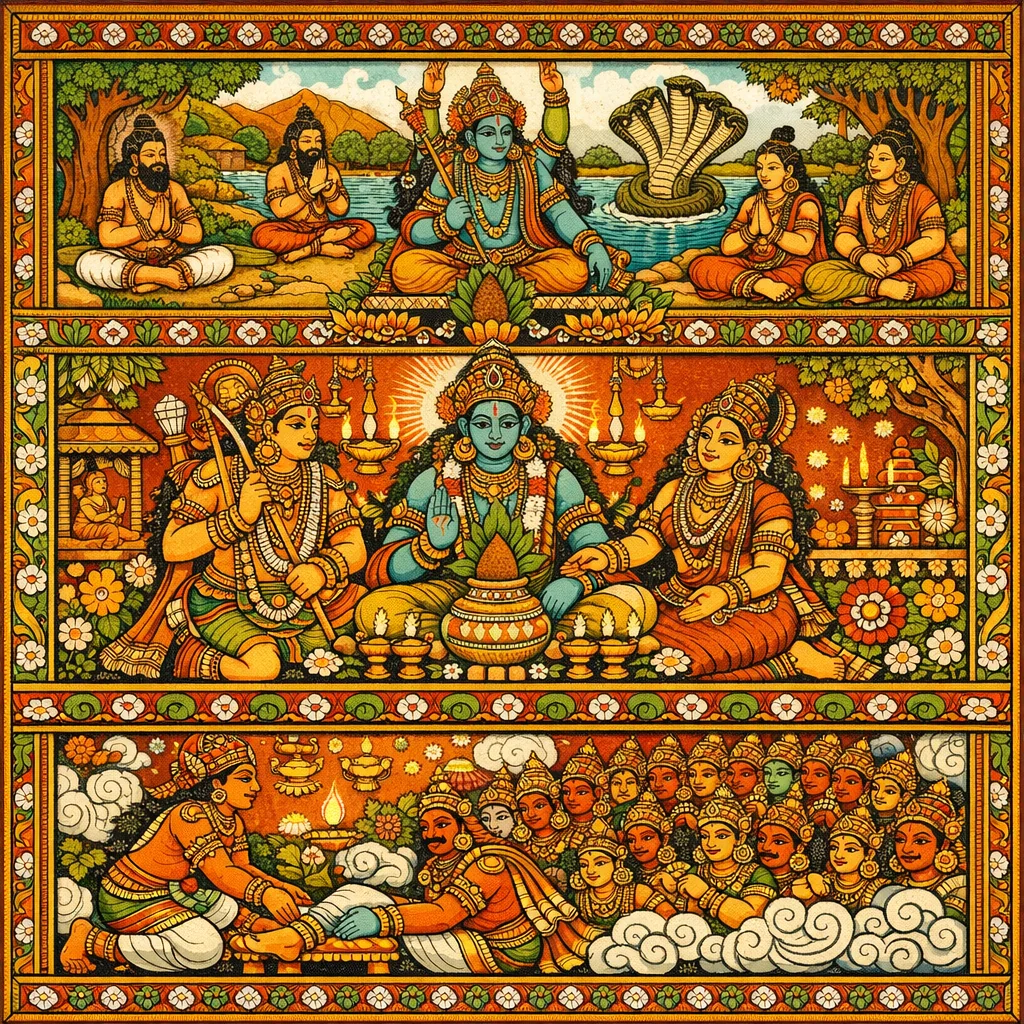
Adhyaya 7: The Madana-Dvādaśī Vow and the Birth of the Maruts (Diti, Indra, and Deva–Asura Reconciliation)
मदनद्वादशीव्रतं मरुत्प्रसवकथा च
Speaker: ऋषयः (Sages), सूत (Sūta), वसिष्ठादयः (Vasiṣṭha and other sages), कश्यप (Kaśyapa), इन्द्र (Indra / Pākaśāsana)
The sages ask Sūta to explain how the Maruts were born from Diti and why they became friends of the gods. Sūta recounts Diti’s austerities and her question to Vasiṣṭha about a vow that removes grief and grants auspicious progeny. The sages prescribe the Madana-Dvādaśī vrata, and Sūta details its requisites, the worship order (Kāma–Keśava), fasting, dāna, homa, and ethical restraints. By the vow’s power Kaśyapa grants Diti a boon and arranges a Putrīyā-iṣṭi through Āpastamba, leading to conception. Kaśyapa then commands strict garbha-niyamas; Indra, fearing a future Indra-slayer, serves Diti seeking a lapse. Near the end of a hundred years Diti breaks purity rules; Indra enters and splits the embryo, but by Hari’s power they multiply into forty-nine. Indra recognizes the vrata’s force, names them Maruts from “mā ruda,” grants them yajña-bhāga, seeks Diti’s forgiveness, and brings her with her sons to heaven—thus explaining their alliance with the Devas.
Key Concepts
Shlokas in Adhyaya 7
Verse 1
*ऋषय ऊचुः दितेः पुत्राः कथं जाता मरुतो देववल्लभाः देवैर्जग्मुश्च सापत्नैः कस्मात्ते सख्यमुत्तमम् //
The sages said: “How were the Maruts—sons of Diti—born, though beloved of the gods? And why did they go together with the Devas, even though they were rivals? From what cause did that excellent friendship arise?”
Verse 2
*सूत उवाच पुरा देवासुरे युद्धे हृतेषु हरिणा सुरैः पुत्रपौत्रेषु शोकार्ता गत्वा भूलोकमुत्तमम् //
Sūta said: Long ago, when the war between the gods and the demons had taken place, and the Suras—by Hari’s power—were struck down, losing their sons and grandsons, they, afflicted with grief, went to the excellent world of mortals, the earth.
Verse 3
स्यमन्तपञ्चके क्षेत्रे सरस्वत्यास्तटे शुभे भर्तुर् आराधनपरा तप उग्रं चचार ह //
In the holy region of Syamantapañcaka, upon the auspicious bank of the Sarasvatī, she—devoted to the worship of her husband—undertook and practiced fierce austerities (tapas).
Verse 4
तदा दितिर् दैत्यमाता ऋषिरूपेण सुव्रता फलाहारा तपस् तेपे कृच्छ्रं चान्द्रायणादिकम् //
Then Diti—the mother of the Daityas—steadfast in her vows, assumed the manner of a sage. Living on fruits, she performed austerities, observing severe disciplines such as the Kṛcchra penance and rites like the Cāndrāyaṇa.
Verse 5
यावद्वर्षशतं साग्रं जराशोकसमाकुला ततः सा तपसा तप्ता वसिष्ठादीनपृच्छत //
For a little more than a hundred years she remained, afflicted by old age and sorrow. Then, tempered by austerity, she approached Vasiṣṭha and the other sages and questioned them.
Verse 6
कथयन्तु भवन्तो मे पुत्रशोकविनाशनम् व्रतं सौभाग्यफलदम् इहलोके परत्र च //
Pray tell me, revered ones, of a vow (vrata) that destroys the sorrow of losing a son and bestows the fruit of good fortune—both in this world and in the world beyond.
Verse 7
ऊचुर् वसिष्ठप्रमुखा मदनद्वादशीव्रतम् यस्याः प्रभावादभवत् सुतशोकविवर्जिता //
Vasiṣṭha and the other sages said: “(She observed) the Madana-Dvādaśī vow; by the power of that vow, she became free from the grief caused by the loss of her son.”
Verse 8
*ऋषय ऊचुः श्रोतुमिच्छामहे सूत मदनद्वादशीव्रतम् सुतानेकोनपञ्चाशद् येन लेभे दितिः पुनः //
The sages said: “O Sūta, we wish to hear of the Madana-Dvādaśī vow, by which Diti again obtained forty-nine sons.”
Verse 9
*सूत उवाच यद्वसिष्ठादिभिः पूर्वं दितेः कथितमुत्तमम् विस्तरेण तदेवेदं मत्सकाशान्निबोधत //
Sūta said: “That excellent account which Vasiṣṭha and the other sages formerly explained to Diti—now learn that very same teaching here, in full detail, in the presence of Matsya.”
Verse 10
चैत्रे मासि सिते पक्षे द्वादश्यां नियतव्रतः स्थापयेदव्रणं कुम्भं सिततण्डुलपूरितम् //
In the month of Caitra, on the twelfth lunar day of the bright fortnight, one disciplined in the vowed observance should set up an unblemished ritual pot (kumbha), filled with white rice-grains.
Verse 11
नानाफलयुतं तद्वद् इक्षुदण्डसमन्वितम् सितवस्त्रयुगच्छन्नं सितचन्दनचर्चितम् //
Likewise, it should be furnished with various fruits and accompanied by sugarcane stalks, covered with a pair of white cloths, and anointed with white sandal paste.
Verse 12
नानाभक्ष्यसमोपेतं सहिरण्यं तु शक्तितः ताम्रपात्रं गुडोपेतं तस्योपरि निवेशयेत् //
One should prepare an offering furnished with various foods, and—according to one’s capacity—also with gold; then one should place a copper vessel containing jaggery (guda) upon it.
Verse 13
तस्मादुपरि कामं तु कदलीदलसंस्थितम् कुर्याच्छर्करयोपेतां रतिं तस्य च वामतः //
Above that, one should place Kāma, the god of desire, seated upon a banana leaf; and to his left one should install Rati, adorned with ornaments.
Verse 14
गन्धं धूपं ततो दद्याद् गीतं वाद्यं च कारयेत् तदभावे कथां कुर्यात् कामकेशवयोर्नरः //
Then one should offer fragrance and incense, and have singing and instrumental music performed. If these are not available, a man should instead recite (or arrange the telling of) the sacred narrative of Kāma and Keśava.
Verse 15
कामनाम्ना हरेरर्चां स्नापयेद्गन्धवारिणा शुक्लपुष्पाक्षततिलैर् अर्चयेन्मधुसूदनम् //
For the fulfillment of desired aims, one should bathe the image of Lord Hari with scented water, and worship Madhusūdana with white flowers, unbroken rice-grains (akṣata), and sesame seeds.
Verse 16
कामाय पादौ सम्पूज्य जङ्घे सौभाग्यदाय च ऊरू स्मरायेति पुनर् मन्मथायेति वै कटिम् //
Having duly worshipped the feet with the mantra “(salutation) to Kāma,” one should worship the shanks with “(salutation) to the giver of good fortune.” The thighs are to be worshipped with “(salutation) to Smara,” and again the hips/waist with “(salutation) to Manmatha.”
Verse 17
स्वच्छोदरायेत्युदरम् अनङ्गायेत्युरो हरेः मुखं पद्ममुखायेति बाहू पञ्चशराय वै //
One should designate Hari’s belly with the epithet “Svaccodara” (the One of pure abdomen), His chest with “Anaṅga” (the bodiless Lord), His face with “Padmamukha” (lotus-faced), and His arms with “Pañcaśara” (He who bears the five arrows).
Verse 18
नमः सर्वात्मने मौलिम् अर्चयेदिति केशवम् ततः प्रभाते तं कुम्भं ब्राह्मणाय निवेदयेत् //
Saying, “Homage to the All-Self,” one should worship Keśava with a crown or head-ornament. Then, at daybreak, one should present that consecrated water-pot (kumbha) to a brāhmaṇa.
Verse 19
ब्राह्मणान्भोजयेद्भक्त्या स्वयं च लवणादृते भुक्त्या तु दक्षिणां दद्याद् इमं मन्त्रमुदीरयेत् //
One should feed the brāhmaṇas with devotion, and oneself should eat without salt. After the meal, one should give the dakṣiṇā (priestly fee) and then recite this mantra.
Verse 20
प्रीयताम् अत्र भगवान् कामरूपी जनार्दनः हृदये सर्वभूतानां य आनन्दो ऽभिधीयते //
May the Blessed Lord Janārdana—who assumes forms at will—be pleased here; He who is spoken of as the bliss (ānanda) within the hearts of all beings.
Verse 21
अनेन विधिना सर्वं मासि मासि व्रतं चरेत् उपवासी त्रयोदश्याम् अर्चयेद्विष्णुमव्ययम् //
Following this prescribed method, one should observe the vow month after month; fasting on Trayodaśī, the thirteenth lunar day, one should worship Viṣṇu, the imperishable.
Verse 22
फलमेकं च संप्राश्य द्वादश्यां भूतले स्वपेत् ततस्त्रयोदशे मासि धृतधेनुसमन्विताम् //
Having eaten a single fruit, on Dvādaśī, the twelfth lunar day, one should sleep upon the ground. Then, on the Trayodaśī observance of that month, one should make the prescribed gift together with a cow duly prepared and ritually appointed.
Verse 23
शय्यां दद्यादनङ्गाय सर्वोपस्करसंयुताम् काञ्चनं कामदेवं च शुक्लां गां च पयस्विनीम् //
One should offer to Ananga (Kāma) a bed furnished with all its accessories, together with a golden image of Kāmadeva, and also a white cow that yields milk.
Verse 24
वासोभिर् द्विजदाम्पत्यं पूज्यं शक्त्या विभूषणैः शय्यागन्धादिकं दद्यात् प्रीयताम् इत्युदीरयेत् //
One should honor a Brahmin couple with garments and, according to one’s means, with ornaments. One should also give a bed, perfumes, and the like, saying, “May you be pleased.”
Verse 25
होमः शुक्लतिलैः कार्यः कामनामानि कीर्तयेत् गव्येन हविषा तद्वत् पायसेन च धर्मवित् //
A fire-offering should be performed with white sesame seeds, while reciting the names of the desired aims. In the same manner, the knower of dharma may offer oblations prepared from cow’s produce, and likewise with pāyasa (rice cooked in milk).
Verse 26
विप्रेभ्यो भोजनं दद्याद् वित्तशाठ्यं विवर्जयेत् इक्षुदण्डानथो दद्यात् पुष्पमालाश् च शक्तितः //
One should offer food to the Brahmins and avoid deceit or stinginess in matters of wealth. One should also give sugarcane-stalks and flower garlands, according to one’s capacity.
Verse 27
यः कुर्याद् विधिनानेन मदनद्वादशीमिमाम् स सर्वपापनिर्मुक्तः प्राप्नोति हरिसाम्यताम् //
Whoever duly performs this Madana Dvādaśī observance according to the prescribed rite is freed from all sins and attains likeness—nearness in divine status—to Hari (Viṣṇu).
Verse 28
इहलोके वरान् पुत्रान् सौभाग्यफलम् अश्नुते यः स्मरः संस्मृतो विष्णुर् आनन्दात्मा महेश्वरः //
In this very world one gains excellent sons and the fruits of good fortune—when that divine power, remembered as Smara and recollected as Viṣṇu, is (also) Mahādeva, Mahēśvara whose very nature is bliss (ānanda).
Verse 29
सुखार्थी कामरूपेण स्मरेदङ्गजमीश्वरम् एतच्छ्रुत्वा चकारासौ दितिः सर्वमशेषतः //
Seeking pleasure, she invoked the Lord of Love (Kāma), visualizing him in the form she desired; and having heard this instruction, Diti carried out everything in full, without omission.
Verse 30
कश्यपो व्रतमाहात्म्याद् आगत्य परया मुदा चकार कर्कशां भूयो रूपयौवनशालिनीम् //
Kaśyapa, arriving through the greatness of the sacred vow (vrata) and filled with supreme joy, made the harsh woman once again endowed with beauty and youthful charm.
Verse 31
वरैर् आछन्दयामास सा तु वव्रे ततो वरम् पुत्रं शक्रवधार्थाय समर्थममितौजसम् //
Pleased by the boons that were offered, she then chose this boon: a son—capable and of immeasurable prowess—intended for the slaying of Śakra (Indra).
Verse 32
वरयामि महात्मानं सर्वामरनिषूदनम् उवाच कश्यपो वाक्यम् इन्द्रहन्तारम् ऊर्जितम् //
Kaśyapa spoke these forceful words: “I choose that great-souled one—the slayer of all the gods—mighty, the powerful Indra-slayer.”
Verse 33
प्रदास्याम्यहमेवेह किं त्व् एतत् क्रियतां शुभे आपस्तम्बः करोत्विष्टिं पुत्रीयामद्य सुव्रते //
“I myself will grant it here. But, O auspicious lady, let this be done: let Āpastamba perform today the Putrīyā‑iṣṭi—the sacrifice for obtaining a son—O you of excellent vows.”
Verse 34
विधास्यामि ततो गर्भम् इन्द्रशत्रुनिषूदनम् आपस्तम्बस्ततश्चक्रे पुत्रेष्टिं द्रविणाधिकाम् //
“Then I shall bring about a conception—one who will become the slayer of Indra’s enemy.” Thereupon Āpastamba performed the Putreṣṭi sacrifice, rich in wealth and offerings.
Verse 35
इन्द्रशत्रुर् भवस्वेति जुहाव च सविस्तरम् देवा मुमुदिरे दैत्या विमुखाः स्युश्च दानवाः //
He poured the oblation in full due form, uttering, “Become the slayer of Indra!” The gods rejoiced, while the Daityas and the Dānavas became dispirited and turned away.
Verse 36
दित्यां गर्भम् अथाधत्त कश्यपः प्राह तां पुनः त्वया यत्नो विधातव्यो ह्य् अस्मिन्गर्भे वरानने //
Then Kashyapa implanted a conception in Diti, and again addressed her: “O fair-faced one, you must exercise great care and discipline regarding this pregnancy.”
Verse 37
संवत्सरशतं त्व् एकम् अस्मिन्न् एव तपोवने संख्यायां नैव भोक्तव्यं गर्भिण्या वरवर्णिनि //
“For a full hundred years, in this very forest of austerity, O fair-complexioned lady, a pregnant woman should not take food in a measured (counted, rationed) manner.”
Verse 38
न स्थातव्यं न गन्तव्यं वृक्षमूलेषु सर्वदा नोपस्करेषूपविशेन् मुसलोलूखलादिषु //
One should never stand or loiter at the base of trees; nor should one sit upon household implements such as pestles, mortars, and the like.
Verse 39
जले च नावगाहेत शून्यागारं च वर्जयेत् वल्मीकायां न तिष्ठेत न चोद्विग्नमना भवेत् //
One should not bathe by immersing oneself in water in improper or unsafe places; one should avoid an empty, deserted house; one should not stand upon an anthill; and one should not remain with an agitated, anxious mind.
Verse 40
विलिखेन्न नखैर्भूमिं नाङ्गारेण न भस्मना न शयालुः सदा तिष्ठेद् व्यायामं च विवर्जयेत् //
One should not scratch or mark the ground with the nails, nor with burning embers, nor with ashes. One should not be habitually prone to lying down; rather, one should remain steadily upright and avoid excessive physical exertion.
Verse 41
न तुषाङ्गारभस्मास्थिकपालेषु समाविशेत् वर्जयेत्कलहं लोकैर् गात्रभङ्गं तथैव च //
One should not step into or come into contact with chaff, live embers, ashes, bones, or skulls. Likewise, one should avoid quarrelling with people and avoid bodily injury or mutilation.
Verse 42
न मुक्तकेशा तिष्ठेत नाशुचिः स्यात्कदाचन न शयीतोत्तरशिरा न चापरशिराः क्वचित् //
One should not stand with the hair left loose, and one should never remain in a state of impurity. One should not lie down with the head toward the north, nor ever with the head toward the west.
Verse 43
न वस्त्रहीना नोद्विग्ना न चार्द्रचरणा सती नामङ्गल्यां वदेद्वाचं न च हास्याधिका भवेत् //
A virtuous woman should not be without proper clothing, nor remain agitated; she should not go about with wet feet. She should not utter inauspicious words, and she should not indulge in excessive laughter.
Verse 44
कुर्यात्तु गुरुशुश्रूषां नित्यं माङ्गल्यतत्परा सर्वौषधीभिः कोष्णेन वारिणा स्नानमाचरेत् //
One should always render attentive service to one’s guru, devoted continually to auspicious conduct; and one should perform bathing with lukewarm water infused with all wholesome medicinal herbs.
Verse 45
कृतरक्षा सुभूषा च वास्तुपूजनतत्परा तिष्ठेत्प्रसन्नवदना भर्तुः प्रियहिते रता //
Having performed the protective rites and being well-adorned, intent on the worship of Vāstu—the dwelling and its presiding principle—she should remain with a serene face, devoted to what is pleasing and beneficial to her husband.
Verse 46
दानशीला तृतीयायां पार्वण्यं नक्तमाचरेत् इतिवृत्ता भवेन्नारी विशेषेण तु गर्भिणी //
On the third lunar day (tṛtīyā), a woman devoted to charity should observe the parvan rite by eating only at night (naktabhojana). Thus a woman becomes well-conducted in her vows—especially if she is pregnant.
Verse 47
यस्तु तस्या भवेत्पुत्रः शीलायुर्वृद्धिसंयुतः अन्यथा गर्भपतनम् अवाप्नोति न संशयः //
But the son who is born to her will be endowed with good conduct, longevity, and increasing prosperity; otherwise, miscarriage (loss of the embryo) is incurred—of this there is no doubt.
Verse 48
तस्मात्त्वमनया वृत्त्या गर्भे ऽस्मिन्यत्नमाचर स्वस्त्यस्तु ते गमिष्यामि तथेत्युक्तस्तया पुनः //
Therefore, you should strive by this very discipline within this womb-like enclosure. May auspiciousness be yours; I shall depart. Addressed again by her in this manner, he replied, “So be it.”
Verse 49
पश्यतां सर्वभूतानां तत्रैवान्तरधीयत ततः सा कश्यपोक्तेन विधिना समतिष्ठत //
As all beings looked on, she vanished right there; thereafter, in accordance with the procedure taught by Kaśyapa, the rite was duly completed and firmly established.
Verse 50
अथ भीतस्तथेन्द्रो ऽपि दितेः पार्श्वमुपागमत् विहाय देवसदनं तच्छुश्रूषुरवस्थितः //
Then Indra too, being afraid, approached Diti’s side; abandoning the abode of the gods, he remained there, intent on attending upon her.
Verse 51
दितेश्छिद्रान्तरप्रेप्सुर् अभवत्पाकशासनः विनीतो ऽभवद् अव्यग्रः प्रशान्तवदनो बहिः //
Seeking an opening—a vulnerable lapse—in Diti, Pākaśāsana (Indra) became outwardly humble: unhurried, undistracted, and with a calm face in appearance.
Verse 52
अजानन्किल तत्कार्यम् आत्मनः शुभमाचरन् ततो वर्षशतान्ते सा न्यूने तु दिवसैस् त्रिभिः //
Indeed, though not understanding the full consequence of that deed, he performed what was auspicious for himself; and then, at the end of a hundred years—short by only three days—that event came to pass.
Verse 53
मेने कृतार्थमात्मानं प्रीत्या विस्मितमानसा अकृत्वा पादयोः शौचं प्रसुप्ता मुक्तमूर्धजा //
Her mind amazed and filled with joy, she deemed herself wholly fulfilled; yet, without performing the cleansing at the feet, she fell asleep, her hair loosened.
Verse 54
निद्राभरसमाक्रान्ता दिवापरशिराः क्वचित् ततस्तदन्तरं लब्ध्वा प्रविष्टस्तु शचीपतिः //
Overcome by the heaviness of sleep, and at times resting her head even in the daytime, she grew inattentive; then Śacī’s lord (Indra), finding that interval of opportunity, entered.
Verse 55
वज्रेण सप्तधा चक्रे तं गर्भं त्रिदशाधिपः ततः सप्तैव ते जाताः कुमाराः सूर्यवर्चसः //
The Lord of the Thirty (Indra) split that embryo into seven parts with his thunderbolt (vajra); from it, seven radiant sons were born—boys blazing with the splendour of the sun.
Verse 56
रुदन्तः सप्त ते बाला निषिद्धा गिरिदारिणा भूयो ऽपि रुदतश्चैतान् एकैकं सप्तधा हरिः //
Those seven children cried aloud and were restrained by Giridārī, the Mountain-bearer. Yet, as they cried again, Hari caused each one of them to become sevenfold.
Verse 57
चिछेद वृत्रहन्ता वै पुनस्तदुदरे स्थितः एवमेकोनपञ्चाशद् भूत्वा ते रुरुदुर्भृशम् //
Then Vṛtrahantā, the slayer of Vṛtra (Indra), cut him again; yet he remained lodged within that belly. Thus becoming forty-nine in number, they wailed aloud in great distress.
Verse 58
इन्द्रो निवारयामास मां रोदिष्ट पुनः पुनः ततः स चिन्तयामास किमेतदिति वृत्रहा //
Indra repeatedly sought to restrain me, saying, “Do not weep again and again.” Then Vṛtrahā (Indra, the slayer of Vṛtra) reflected, “What indeed is this matter?”
Verse 59
धर्मस्य कस्य माहात्म्यात् पुनः संजीवितास्त्वमी विदित्वा ध्यानयोगेन मदनद्वादशीफलम् //
“By the greatness of which dharma were you restored to life again? And having understood it through the discipline of meditative yoga, tell me the fruit of observing Madana-Dvādaśī.”
Verse 60
नूनम् एतत् परिणतम् अधुना कृष्णपूजनात् वज्रेणापि हताः सन्तो न विनाशम् अवाप्नुयुः //
Surely this has now come to pass because of the worship of Kṛṣṇa: even if struck down by Indra’s vajra (thunderbolt), the righteous would not meet with utter ruin.
Verse 61
एको ऽप्यनेकतामाप यस्मादुदरगो ऽप्यलम् अवध्या नूनमेते वै तस्माद्देवा भवन्त्विति //
Since even a single serpent can assume many forms at will, these beings are surely not to be slain. Therefore, let them indeed become gods.
Verse 62
यस्मान्मा रुदतेत्युक्ता रुदन्तो गर्भसंस्थिताः मरुतो नाम ते नाम्ना भवन्तु मखभागिनः //
Because, while still in the womb and crying, they were addressed with the words, “Do not weep,” let them therefore be known by the name “Maruts,” and let them become rightful sharers in the sacrificial offerings (makha).
Verse 63
ततः प्रसाद्य देवेशः क्षमस्वेति दितिं पुनः अर्थशास्त्रं समास्थाय मयैतद् दुष्कृतं कृतम् //
Then, having pacified the Lord of the gods, he again said to Diti, “Forgive me.” Grounded in the principles of Arthaśāstra (statecraft), he confessed, “This evil deed has been done by me.”
Verse 64
कृत्वा मरुद्गणं देवैः समानममराधिपः दितिं विमानमारोप्य ससुतामनयद्दिवम् //
After making the host of Maruts equal in status to the gods, the lord of the immortals (Indra) placed Diti—together with her sons—upon a celestial chariot (vimāna) and brought her to heaven.
Verse 65
यज्ञभागभुजो जाता मरुतस्ते ततो द्विजाः न जग्मुरैक्यमसुरैर् अतस्ते सुरवल्लभाः //
Those Maruts were born as enjoyers of their allotted share in the sacrifice; therefore, O twice-born ones, they did not enter into alliance with the Asuras—hence they became dear to the gods.
Frequently Asked Questions
The chapter’s core instruction is the Madana-Dvādaśī vrata: a disciplined monthly observance centered on Keśava (Viṣṇu) and Kāma, including precise ritual setup (kumbha, offerings, installation of Kāma and Rati), worship with specific epithets/mantras, fasting and salt-avoidance, dāna (bed, gold image, white cow), homa, and ethical restraints. The narrative demonstrates that such dharma-backed worship transforms destiny—removing grief, granting progeny, protecting the righteous even against Indra’s vajra, and culminating in spiritual proximity to Hari (harisāmya).
This adhyāya is primarily Genealogy and Dharma. Genealogy appears in the origin-story of the Maruts (Diti’s forty-nine sons) and their integration into the Deva order as yajña-shareholders. Dharma appears as vrata-vidhi (Madana-Dvādaśī), dāna and homa protocols, and garbha-dharma rules for pregnancy conduct and purity. Vāstu is not a main architectural topic here, but the text briefly gestures to ‘vāstu-pūjana’ as part of auspicious household conduct during pregnancy.