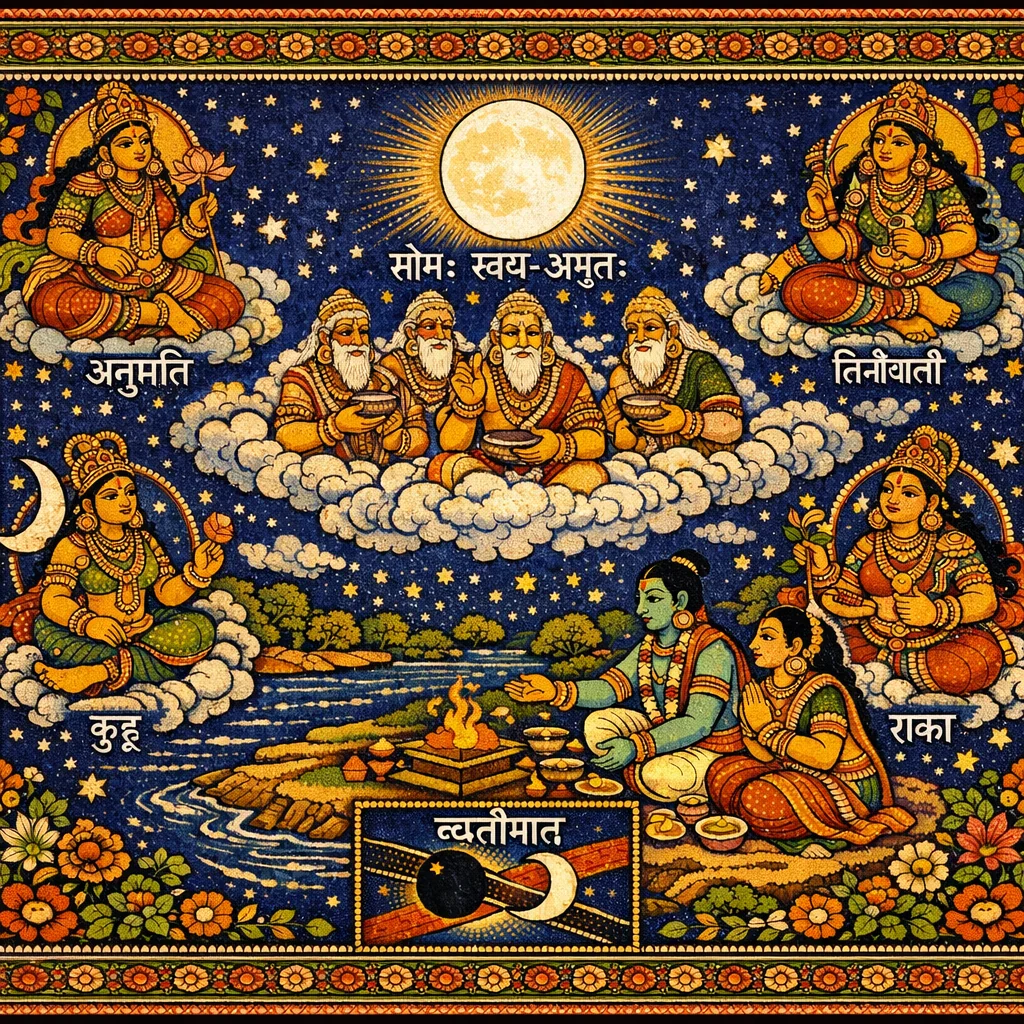
Adhyaya 141: Soma, the Pitṛs, and the Science of Śrāddha: Why Purūravas Ascends on Amāvāsyā + Parva-Sandhi Time Rules
सौम्यपितृमहत्त्वं, श्राद्धतर्पणप्रभावः, पर्वसन्धिकाल-निर्णयः
Speaker: ऋषयः (Sages), सूत (Sūta), मत्स्य (Lord Matsya), वैवस्वत मनु (Vaivasvata Manu), मधुसूदन (Madhusūdana)
The sages ask Sūta how Purūravas (Aila) repeatedly ascends to heaven at every new moon, and how his Pitṛ-tarpaṇa becomes effective. Sūta says this was earlier asked by Vaivasvata Manu to Madhusūdana, and Matsya gives the teaching: Soma is the source of amṛta and svadhā, by which tarpaṇa is fulfilled; Purūravas worships Soma and the Pitṛs each month, especially at the Kuhū/Amāvāsyā junction. Matsya then explains lunar “physiology”—the waxing and waning kalās—through the Sun’s ray and the suṣumnā channel, and defines ritual time-joints (parva-sandhi) in lava and muhūrta measures, including special cases like vyatīpāta. The discourse expands to the taxonomy of Pitṛs, their links to seasons and five-year cycles, and concludes with the doctrine that śrāddha truly reaches the departed, contrasting blessed Pitṛ destinations with preta torment and lower rebirths.
Key Concepts
Shlokas in Adhyaya 141
Verse 1
*ऋषय ऊचुः कथं गच्छत्यमावास्यां मासि मासि दिवं नृपः ऐलः पुरूरवाः सूत तर्पयेत कथं पितॄन् एतदिच्छामहे श्रोतुं प्रभावं तस्य धीमतः //
The sages said: “How is it that on every Amāvāsyā (new-moon day), month after month, the king Purūravas, son of Ilā, goes to heaven? And, O Sūta, how does he perform the tarpaṇa (libations) for the Pitṛs, the Ancestors? We wish to hear of the extraordinary power and efficacy of that wise one.”
Verse 2
*सूत उवाच एतदेव तु पप्रच्छ मनुः स मधुसूदनम् सूर्यपुत्राय चोवाच यथा तन्मे निबोधत //
Sūta said: “This very matter Vaivasvata Manu asked of Madhusūdana; and he said to the son of the Sun, ‘Understand from me how it was.’”
Verse 3
*मत्स्य उवाच तस्य चाहं प्रवक्ष्यामि प्रभावं विस्तरेण तु ऐलस्य दिवि संयोगं सोमेन सह धीमता //
Matsya said: “Now I shall describe in detail his greatness—how Aila came to be united in heaven with the wise Soma (the Moon).”
Verse 4
सोमाच्चैवामृतप्राप्तिः पितॄणां तर्पणं तथा सौम्या बर्हिषदः काव्या अग्निष्वात्तास्तथैव च //
From Soma indeed comes the obtaining of amṛta (ambrosia); and likewise the tarpaṇa, the libation offered to the Pitṛs, the Ancestors. The Saumya Pitṛs, the Barhiṣads, the Kāvyas, and likewise the Agniṣvāttas are to be understood in this connection.
Verse 5
यदा चन्द्रश्च सूर्यश्च नक्षत्राणां समागतौ अमावास्यां निवसत एकस्मिन्नथ मण्डले //
When the Moon and the Sun come together in relation to the nakṣatras (lunar mansions), then on the night of Amāvāsyā (new moon) they are said to dwell within a single sphere, that is, in the same celestial circle.
Verse 6
तदा स गच्छति द्रष्टुं दिवाकरनिशाकरौ अमावास्याममावास्यां मातामहपितामहौ //
Then he goes to behold the Sun and the Moon; and on the day of Amāvāsyā (the New Moon), he reverently beholds—i.e., pays homage to—the maternal grandfather and the paternal grandfather.
Verse 7
अभिवाद्य तु तौ तत्र कालापेक्षः स तिष्ठति प्रचस्कन्द ततः सोमम् अर्चयित्वा परिश्रमात् //
Having respectfully saluted those two there, he remained standing, awaiting the proper time. Then, wearied by his exertion, he hastened forward and thereafter worshipped Soma.
Verse 8
ऐलः पुरूरवा विद्वान् मासि श्राद्धचिकीर्षया ततः स दिवि सोमं वै ह्य् उपतस्थे पितॄनपि //
Aila Purūravas, the wise, wishing to perform the monthly śrāddha, then in the heavenly realm duly worshipped Soma—and also honoured the Pitṛs, the ancestral Fathers.
Verse 9
द्विलवं कुहूमात्रं च तावुभौ तु निधाय सः सिनीवालीप्रमाणाल्पकुहूमात्रव्रतोदये //
Placing (as an offering/measure) two lavas and also a measure corresponding to Kuhū—having deposited both—he should commence the observance at the proper rise of the vow, taking Sinīvālī as the standard and Kuhū in a smaller measure.
Verse 10
कुहूमात्रं पित्रुद्देशं ज्ञात्वा कुहूमुपासाते तमुपास्य ततः सोमं कलापेक्षी प्रतीक्षते //
Knowing that the rite intended for the Fathers (Pitṛs) is confined to the tithi called Kuhū, one should observe and honour Kuhū. Having observed it, one then waits for Soma (the Moon), looking for the proper kalā, the lunar digit.
Verse 11
स्वधामृतं तु सोमाद्वै वसंस्तेषां च तृप्तये दशभिः पञ्चभिश्चैव स्वधामृतपरिस्रवैः कृष्णपक्षभुजां प्रीतिर् द्रुह्यते परमांशुभिः //
The nectar called Svadhā indeed arises from Soma and is their sustenance, bringing satisfaction to the Pitṛs. By the flowing streams of this Svadhā-nectar—five and ten in number—the delight of those who partake during the dark fortnight is nourished by the supreme rays (of Soma).
Verse 12
सद्यो ऽभिक्षरता तेन सौम्येन मधुना च सः निवापेष्वथ दत्तेषु पित्र्येण विधिना तु वै //
And immediately he sprinkled (them) with that gentle honey; and when the nivāpa-offerings had been placed, he did so according to the ancestral (pitṛ) rite indeed.
Verse 13
स्वधामृतेन सौम्येन तर्पयामास वै पितॄन् सौम्या बर्हिषदः काव्या अग्निष्वात्तास्तथैव च //
With the Soma-like libation called svadhā-amṛta, he indeed satisfied (offered tarpaṇa to) the Pitṛs—namely, the gentle Barhiṣads, the Kāvyas, and likewise the Agniṣvāttas as well.
Verse 14
ऋतुरग्निः स्मृतो विप्रैर् ऋतुं संवत्सरं विदुः जज्ञिरे ऋतवस्तस्माद् ऋतुभ्यो ह्यार्तवा अभवन् //
The learned Brahmins remember Ṛtu as a form of Agni; and they know that Ṛtu is the ordering principle of the year. From that, the seasons (ṛtavaḥ) were born; and from the seasons, indeed, the seasonal rites and observances (ārtavāḥ) came into being.
Verse 15
पितर ऋतवो ऽर्धमासा विज्ञेया ऋतुसूनवः पितामहास्तु ऋतवो ह्य् अमावास्याब्दसूनवः प्रपितामहाः स्मृता देवाः पञ्चाब्दा ब्रह्मणः सुताः //
Know that the Pitṛs are identified with the seasons and the half-months (ardhamāsa), as offspring of the seasons. The grandfathers, too, are said to be the seasons, being born of the new-moon day (amāvāsyā) and the year. And the great-grandfathers are remembered as deities of the five-year cycle (pañcābda), as sons of Brahmā.
Verse 16
सौम्या बर्हिषदः काव्या अग्निष्वात्ता इति त्रिधा गृहस्था ये तु यज्वानो हविर्यज्ञार्तवाश्च ये स्मृता बर्हिषदस्ते वै पुराणे निश्चयं गताः //
The Pitṛs are described in three divisions—Saumya, Barhiṣad, Kāvya, and Agniṣvātta. Those who are householders (gṛhastha), who perform sacrifice (yajvāna), and who are remembered as offering havis and seasonal rites—these, in the Purāṇa, are determined with certainty to be the Barhiṣads.
Verse 17
गृहमेधिनश्च यज्वानो ह्य् अग्निष्वात्तार्तवाः स्मृताः अष्टकापतयः काव्याः पञ्चाब्दांस्तु निबोधत //
Householders who have performed sacrifices are remembered as the Agniṣvātta Pitṛs—also called Ārtavas. Know further: the Kāvya Pitṛs are the lords of the Aṣṭakā rites, and their period is five years.
Verse 18
तेषु संवत्सरो ह्यग्निः सूर्यस्तु परिवत्सरः सोमस् त्विड्वत्सरश् चैव वायुश्चैवानुवत्सरः //
Among these (five divisions of the year-cycle), the Saṃvatsara is Agni (Fire); the Parivatsara is the Sun; the Iḍvatsara is Soma (the Moon); and the Anuvatsara is Vāyu (Wind).
Verse 19
रुद्रस्तु वत्सरस्तेषां पञ्चाब्दा ये युगात्मकाः कालेनाधिष्ठितस्तेषु चन्द्रमाः स्रवते सुधाम् //
Among those divisions of time, Rudra is spoken of as the “year”; and the five years, which are of the nature of a yuga, are presided over by Kāla (Time) itself. Within those cycles, the Moon (Candra) continually distils the nectar (sudhā).
Verse 20
एते स्मृता देवकृत्याः सोमपाश्चोष्मपाश्च ये तांस्तेन तर्पयामास यावदासीत्पुरूरवाः //
These are remembered as the “divine functionaries” (devakṛtya)—the Somapās and the Ūṣmapās; and Purūravas, for as long as he lived, continually satisfied them through that rite of offering (tarpana).
Verse 21
यस्मात्प्रसूयते सोमो मासि मासि विशेषतः ततः स्वधाभृतं तद्वै पितॄणां सोमपायिनाम् एतत्तदमृतं सोमम् अवाप मधु चैव हि //
Because Soma is generated anew—month after month, in a special manner—from that (Soma) arises the Svadhā-bearing portion that truly belongs to the Pitṛs, the ancestors who drink Soma. Indeed, it is that Soma, immortal in nature (amṛta), which is obtained; and it is also called “madhu,” the sweet, honey-like essence.
Verse 22
ततः पीतसुधं सोमं सूर्यो ऽसावेकरश्मिना आप्यायते सुषुम्नेन सोमं तु सोमपायिनम् //
Thereupon, the Sun—by a single ray—nourishes and replenishes the Moon, who has drunk the nectar; and by way of Suṣumnā he sustains Soma, the drinker of Soma.
Verse 23
निःशेषा वै कलाः पूर्वा युगपद् व्यापयन् पुरा सुषुम्नाप्यायमानस्य भागं भागमहःक्रमात् //
Formerly, all the kalās (time-units/energetic portions) without remainder pervaded simultaneously; but as Suṣumnā becomes nourished and expands, they are taken up portion by portion, in the successive order of the day (ahaḥ-krama).
Verse 24
कलाः क्षीयन्ति कृष्णास्ताः शुक्ला ह्याप्याययन्ति च एवं सा सूर्यवीर्येण चन्द्रस्याप्यायिता तनुः //
During the dark fortnight (kṛṣṇa-pakṣa) those kalās diminish, while in the bright fortnight (śukla-pakṣa) they increase. Thus the Moon’s body is replenished and made to wax by the Sun’s potency (vīrya).
Verse 25
पौर्णमास्यां स दृश्येत शुक्लः सम्पूर्णमण्डलः एवमाप्यायितः सोमः शुक्लपक्षे ऽप्यहःक्रमात् देवैः पीतसुधं सोमं पुरा पश्चात्पिबेद्रविः //
On the full-moon night he (Soma, the Moon) is seen as bright and white, with a perfectly complete orb. Thus nourished day by day throughout the bright fortnight in the order of the days (ahaḥ-krama), Soma—whose ambrosial essence was formerly drunk by the gods—is afterwards drunk by Ravi (the Sun).
Verse 26
पीतं पञ्चदशाहं तु रश्मिनैकेन भास्करः आप्याययत्सुषुम्नेन भागं भागमहःक्रमात् //
For fifteen days, the Sun, drawing in the essence by a single ray, then nourishes it through the Suṣumnā channel—portion by portion, in the sequence of days.
Verse 27
सुषुम्नाप्यायमानस्य शुक्ला वर्धन्ति वै कलाः तस्माद्ध्रसन्ति वै कृष्णाः शुक्ला ह्याप्याययन्ति च //
When the Suṣumnā is being nourished and filled, the bright lunar digits (kalās) truly increase. Therefore the dark fortnight diminishes, for the bright fortnight indeed brings nourishment and increase.
Verse 28
एवमाप्यायते सोमः क्षयिते च पुनः पुनः समृद्धिरेवं सोमस्य पक्षयोः शुक्लकृष्णयोः //
Thus Soma (the Moon) becomes replenished again and again after having waned; in this very way does the Moon’s increase and decrease occur through its two fortnights—the bright (waxing) and the dark (waning).
Verse 29
इत्येष पितृमान्सोमः स्मृतस्तद्वसुधात्मकः कान्तः पञ्चदशैः सार्धं सुधाभृतपरिस्रवैः //
Thus is Soma (the Moon) remembered as “Pitṛmān”—the one connected with the Fathers (Pitṛs); he is of the nature of nourishment and the Earth’s sustaining essence, the lovely one, together with the fifteen lunar digits, flowing forth with streams that bear nectar.
Verse 30
अतः परं प्रवक्ष्यामि पर्वणां संधयश्च याः यथा ग्रथ्नन्ति पर्वाणि आवृत्तादिक्षुवेणुवत् //
Now, further, I shall explain the joints and junctions of the structural segments (parvan)—how these segments are to be fastened together, like the linked nodes of a bamboo or sugarcane stalk as it turns and continues in successive sections.
Verse 31
तथाब्दमासाः पक्षाश्च शुक्लाः कृष्णास्तु वै स्मृताः पौर्णमास्यास्तु यो भेदो ग्रन्थयः संधयस्तथा //
Thus are the divisions of time remembered: years and months, and also the two fortnights (pakṣa), the bright (śukla, waxing) and the dark (kṛṣṇa, waning). The distinction connected with the full-moon observance (pūrṇamāsī) is likewise to be understood as the “knots” and “junctions,” the calendrical joints that mark transitions.
Verse 32
अर्धमासस्य पर्वाणि द्वितीयाप्रभृतीनि च अग्न्याधानक्रिया यस्मान् नीयन्ते पर्वसंधिषु //
The observance-days (parva) of the half-month—beginning from the second lunar day (dvitīyā)—are so called because the rites of establishing the sacred fires (agnyādhāna) are performed at the junctions (sandhi) of those parva-days.
Verse 33
तस्मात्तु पर्वणो ह्यादौ प्रतिपद्यादिसंधिषु सायाह्ने अनुमत्याश्च द्वौ लवौ काल उच्यते लवौ द्वावेव राकायाः कालो ज्ञेयो ऽपराह्णिकः //
Therefore, at the beginning of a parvan (festival-junction)—at junctions such as Pratipadā and the like—the parvan-time is said to be two lavas in the evening; and likewise, for Rākā (the full-moon night), the time should be known as two lavas in the afternoon (aparāhṇa).
Verse 34
प्रकृतिः कृष्णपक्षस्य काले ऽतीते ऽपराह्णिके सायाह्ने प्रतिपद्येष स कालः पौर्णमासिकः //
When the natural (proper) time of the dark fortnight (kṛṣṇa-pakṣa) has passed—i.e., when the afternoon (aparāhṇa) has elapsed—and Pratipad (the first lunar day) occurs in the evening, that time is to be classified as belonging to the Paurṇamāsika (full-moon-based) reckoning.
Verse 35
व्यतीपाते स्थिते सूर्ये लेखादूर्ध्वं युगान्तरम् युगान्तरोदिते चैव चन्द्रे लेखोपरि स्थिते //
When, at the time of vyatīpāta, the Sun is positioned, the point called yugāntara lies above the drawn line (lekhā). And likewise, when the Moon rises at yugāntara, it is situated above the line.
Verse 36
पूर्णमासव्यतीपातौ यदा पश्येत्परस्परम् तौ तु वै प्रतिपद्यावत् तस्मिन्काले व्यवस्थितौ //
When the Full-Moon day (Paurṇamāsī) and the Vyatīpāta conjunction are seen to coincide with one another, one should observe both rites in the prescribed order; for at that time those two observances stand conjointly in operation.
Verse 37
तत्कालं सूर्यमुद्दिश्य दृष्ट्वा संख्यातुमर्हसि स चैव सत्क्रियाकालः षष्ठः कालो ऽभिधीयते //
At that very time, looking toward the Sun, you should reckon that moment; it is indeed the proper time for auspicious rites, declared to be the sixth division of time (kāla).
Verse 38
पूर्णेन्दुः पूर्णपक्षे तु रात्रिसंधिषु पूर्णिमा तस्मादाप्यायते नक्तं पौर्णमास्यां निशाकरः //
In the bright fortnight (śukla-pakṣa), the night of Pūrṇimā is the junction of the night; therefore, on Paurṇamāsī, the Moon—lord of the night—waxing by night, becomes full.
Verse 39
यदान्योन्यवतीं पाते पूर्णिमां प्रेक्षते दिवा चन्द्रादित्यो ऽपराह्णे तु पूर्णत्वात्पूर्णिमा स्मृता //
When, in the daytime, the Moon and the Sun are seen facing one another in opposition, then—if this occurs in the afternoon (aparāhṇa)—because the lunar digit (kalā) has become full, that day is remembered as Pūrṇimā, the Full-Moon day.
Verse 40
यस्मात्तामनुमन्यन्ते पितरो दैवतैः सह तस्मादनुमतिर्नाम पूर्णत्वात्पूर्णिमा स्मृता //
Because the Pitṛs (ancestors), together with the gods, grant their assent to that tithi, it is therefore called Anumati; and because it is the state of fullness, it is remembered as Pūrṇimā (the Full Moon).
Verse 41
अत्यर्थं राजते यस्मात् पौर्णमास्यां निशाकरः रञ्जनाच्चैव चन्द्रस्य राकेति कवयो विदुः //
Because on the full-moon night (Paurṇamāsī) the Moon—the maker of night—shines exceedingly; and because the Moon delights by its pleasing radiance, poets therefore know that night as “Rākā.”
Verse 42
अमा वसेतामृक्षे तु यदा चन्द्रदिवाकरौ एका पञ्चदशी रात्रिर् अमावास्या ततः स्मृता //
When the Moon and the Sun are together in the same lunar mansion (nakṣatra), that single fifteenth night is remembered as Amāvāsyā, the new-moon night.
Verse 43
उद्दिश्य ताममावास्यां यदा दर्शं समागतौ अन्योन्यं चन्द्रसूर्यौ तु दर्शनाद्दर्श उच्यते //
When, on that Amāvāsyā night, the Moon and the Sun come together in conjunction, as though facing one another, it is called “darśa,” because it is the ‘meeting/appearance’ (darśana) of the two luminaries.
Verse 44
द्वौ द्वौ लवावमावास्यां स कालः पर्वसंधिषु द्व्यक्षरः कुहूमात्रश्च पर्वकालस्तु स स्मृतः //
On the Amāvāsyā day, at the junctions of the parva (parva-sandhi), the time is constituted by two and two lavas. That parva-time is traditionally understood as consisting of two akṣaras and extending only for the measure called kuhū.
Verse 45
दृष्टचन्द्रा त्वमावास्या मध्याह्नप्रभृतीह वै दिवा तदूर्ध्वं रात्र्यां तु सूर्ये प्राप्ते तु चन्द्रमाः सूर्येण सहसोद्गच्छेत् ततः प्रातस्तनात्तु वै //
That Amāvāsyā day is called “dṛṣṭa-candrā” (“moon-seen”): from midday onward, in the daytime itself, and thereafter at night—when the Sun reaches its time (of setting), the Moon rises suddenly together with the Sun; and then it is seen again at dawn.
Verse 46
समागम्य लवौ द्वौ तु मध्याह्नान्निपतन्रविः प्रतिपच्छुक्लपक्षस्य चन्द्रमाः सूर्यमण्डलात् //
When two lava-units of time converge and midday is reached, the Sun begins to decline; and on Pratipad (the first lunar day) of the bright fortnight, the Moon is seen departing from the Sun’s orb, that is, emerging from conjunction.
Verse 47
निर्मुच्यमानयोर्मध्ये तयोर्मण्डलयोस्तु वै स तदान्वाहुतेः कालो दर्शस्य च वषट्क्रियाः एतदृतुमुखं ज्ञेयम् अमावास्यां तु पार्वणम् //
In the interval when the two luminary discs are, as it were, disengaging from one another, that very time is declared the proper moment for the anvāhuta offering and for the vaṣaṭ-invocations of the Darśa rite. This is to be known as the “opening of the season” (ṛtu-mukha); and the Parva observance is to be performed on Amāvāsyā, the new-moon day.
Verse 48
दिवा पर्व त्वमावास्यां क्षीणेन्दौ धवले तु वै तस्माद्दिवा त्वमावास्यां गृह्यते यो दिवाकरः //
The Parva (sacred junction-day) of Amāvāsyā is to be observed in the daytime, when the Moon has waned away, even if the sky appears bright. Therefore, on Amāvāsyā the Parva is to be taken as occurring by day, marked by the presence of the Sun.
Verse 49
कुहेति कोकिलेनोक्तं यस्मात्कालात्समाप्यते तत्कालसंज्ञिता ह्येषा अमावास्या कुहूः स्मृता //
It is called “Kuhū,” as spoken by the cuckoo (kokila), because at that time the lunar period comes to completion; therefore this new-moon day (amāvāsyā) is indeed designated by that time-name and is remembered as Kuhū.
Verse 50
सिनीवालीप्रमाणं तु क्षीणशेषो निशाकरः अमावास्या विशत्यर्कं सिनीवाली तदा स्मृता //
When the Moon remains only as a waning remnant—measured by the Sinīvālī measure—and on the new-moon day it approaches, entering into conjunction with, the Sun, that time is remembered as Sinīvālī.
Verse 51
अनुमतिश्च राका च सिनीवाली कुहूस्तथा एतासां द्विलवः कालः कुहूमात्रा कुहूः स्मृता //
Anumati, Rākā, Sinīvālī, and Kuhū—these lunar phases are thus described. The time-span connected with them is two lavas; and Kuhū is traditionally reckoned as the measure called “kuhū-mātrā”.
Verse 52
इत्येष पर्वसंधीनां कालो वै द्विलवः स्मृतः पर्वणां तुल्यकालस्तु तुल्याहुतिवषट्क्रियाः //
Thus, the time-span of the junctions (sandhi) between the ritual parvas is traditionally understood to be two lavas; and when the parvas have equal duration, the oblations (āhuti) and the vaṣaṭ-acclamations in the rite are to be performed in equal measure as well.
Verse 53
चन्द्रभूर्यव्यतीपाते समे वै पूर्णिमे उभे प्रतिपत्प्रतिपन्नस्तु पर्वकालो द्विमात्रकः //
When the lunar and solar motions are in equal measure at the Vyatīpāta (astronomical junction), and on both full-moon observances, the parva-period is to be understood as extending for two muhūrtas, from the moment the Pratipad (first lunar day) has begun.
Verse 54
कालः कुहूसिनीवाल्योः समुद्धो द्विलवः स्मृतः अर्कनिर्मण्डले सोमे पर्वकालः कलाः स्मृताः //
Between the lunar phases called Kuhū and Sinīvālī, the interval known as a kāla is said to comprise two lavas. And when the Moon is within the Sun’s surrounding orb (the solar halo), that period is known as the parva-time; it is measured in kalās.
Verse 55
यस्माद् आपूर्यते सोमः पञ्चदश्यां तु पूर्णिमा दशभिः पञ्चभिश्चैव कलाभिर्दिवसक्रमात् //
Because Soma (the Moon) becomes filled up, the fifteenth lunar day is called the Full Moon (Pūrṇimā); day by day, in due sequence, it is completed by fifteen kalās (lunar digits).
Verse 56
तस्मात्पञ्चदशे सोमे कला वै नास्ति षोडशी तस्मात्सोमस्य विप्रोक्तः पञ्चदश्यां मया क्षयः //
Therefore, on the fifteenth tithi for Soma (the Moon), the sixteenth kalā is indeed not present. Hence, O Brahmin, I have explained that the Moon’s waning (kṣaya) occurs on the fifteenth tithi.
Verse 57
इत्येते पितरो देवाः सोमपाः सोमवर्धनाः आर्तवा ऋतवो ऽथाब्दा देवास्तान्भावयन्ति हि //
Thus these Pitṛs are indeed divine—drinkers of Soma and increasers of Soma. They are bound to the seasons and the yearly cycle; and the gods, in truth, sustain and foster them.
Verse 58
अतः परं प्रवक्ष्यामि पितॄञ्छ्राद्धभुजस्तु ये तेषां गतिं च सत्तत्वं प्राप्तिं श्राद्धस्य चैव हि //
Now, next, I shall explain the Pitṛs who partake of the śrāddha-offering—along with their course (after death), their true condition, and how the śrāddha indeed reaches them.
Verse 59
न मृतानां गतिः शक्या ज्ञातुं वा पुनरागतिः तपसा हि प्रसिद्धेन किं पुनर्मांसचक्षुषा //
The course of those who have died—and whether they return again—cannot be known. Even by one renowned for austerity (tapas) it is hard to ascertain; how much more so by the mere fleshly eye?
Verse 60
अत्र देवान्पितॄंश्चैते पितरो लौकिकाः स्मृताः तेषां ते धर्मसामर्थ्यात् स्मृताः सायुज्यगा द्विजैः //
Here, these are remembered as the worldly Pitṛs—ancestors among the gods and among the manes. By the power of their dharma, the learned twice-born declare that they attain sāyujya (union or close communion) with the divine.
Verse 61
यदि वाश्रमधर्मेण प्रज्ञानेषु व्यवस्थितान् अन्ये चात्र प्रसीदन्ति श्रद्धायुक्तेषु कर्मसु //
If, by observing the duties of one’s āśrama, people become firmly established in right understanding—and if others here too are thereby pleased—then one should undertake actions performed with faith (śraddhā).
Verse 62
ब्रह्मचर्येण तपसा यज्ञेन प्रजया भुवि श्राद्धेन विद्यया चैव चान्नदानेन सप्तधा //
On earth, (well-being and merit are attained) in seven ways: through brahmacarya (celibate discipline), tapas (austerity), yajña (sacrificial worship), progeny, the śrāddha rite for the ancestors, sacred learning (vidyā), and the gift of food.
Verse 63
कर्मस्वेतेषु ये सक्ता वर्तन्त्य् आ देहपातनात् देवैस्ते पितृभिः सार्धम् ऊष्मपैः सोमपैस्तथा स्वर्गता दिवि मोदन्ते पितृमन्त उपासते //
Those who remain devoted to these prescribed rites and duties, continuing in them until the falling of the body (death), go to heaven; there, together with the gods and the Pitṛs—and with the classes known as the Ūṣmapas and the Somapas—they rejoice in the celestial realm and worship the Pitṛs endowed with power.
Verse 64
प्रजावतां प्रसिद्धैषा उक्ता श्राद्धकृतां च वै तेषां निवापे दत्तं हि तत्कुलीनैस्तु बान्धवैः //
This practice is well known among those who have descendants and is indeed taught for performers of śrāddha; for them, the nivāpa offering is truly to be given by relatives belonging to that very family line.
Verse 65
मासश्राद्धं हि भुञ्जानास् तेऽत्येते सोमलौकिकाः एते मनुष्याः पितरो मासश्राद्धभुजस्तु वै //
Those who partake of the monthly Śrāddha offerings surpass (the status of) the Soma-world (Soma-loka). Indeed, these Pitṛs—though described in human terms—are truly the enjoyers of the monthly Śrāddha.
Verse 66
तेभ्यो ऽपरे तु ये त्वन्ये संकीर्णाः कर्मयोनिषु भ्रष्टाश्चाश्रमधर्मेषु स्वधास्वाहाविवर्जिताः //
But others, distinct from them, are those who have become intermixed among occupational lineages (karmayoni); they have fallen away from the duties of the āśramas and are devoid of the sacred invocations “svadhā” and “svāhā” (that is, they neglect rites for the ancestors and offerings to the gods).
Verse 67
भिन्ने देहे दुरापन्नाः प्रेतभूता यमक्षये स्वकर्माण्यनुशोचन्तो यातनास्थानमागताः //
When the body is broken (by death), those who have fallen into a wretched state become pretas in Yama’s domain; grieving over their own deeds, they arrive at the place of torment.
Verse 68
दीर्घाश्चैवातिशुष्काश्च श्मश्रुलाश्च विवाससः क्षुत्पिपासाभिभूतास्ते विद्रवन्ति त्वितस्ततः //
They become long-limbed and extremely emaciated, bearded and without clothing; tormented by hunger and thirst, they run about in panic—here and there.
Verse 69
सरित्सरस्तडागानि पुष्करिण्यश्च सर्वशः परान्नान्यभिकाङ्क्षन्तः काल्यमाना इतस्ततः //
Rivers, lakes, ponds, and lotus-tanks were everywhere; and, being urged on from place to place, they sought no other refuge than these.
Verse 70
स्थानेषु पात्यमाना ये यातनास्थेषु तेषु वै शाल्मल्यां वैतरण्यां च कुम्भीपाकेद्धवालुके //
Those who are cast down into such places of torment are made to suffer there indeed—among hells such as Śālmalyā, Vaitaraṇī, Kumbhīpāka, and the burning sands.
Verse 71
असिपत्त्रवने चैव पात्यमानाः स्वकर्मभिः तत्रस्थानां तु तेषां वै दुःखितानाम् अशायिनाम् //
And in the forest of sword-like leaves (Asipattravana) they are cast down by their own deeds; and for those who remain there—anguished and unable to lie down—there is indeed only suffering.
Verse 72
तेषां लोकान्तरस्थानां बान्धवैर्नामगोत्रतः भूमावसव्यं दर्भेषु दत्ताः पिण्डास्त्रयस्तु वै प्राप्तांस्तु तर्पयन्त्येव प्रेतस्थानेष्वधिष्ठितान् //
For those who have gone to another realm, their kinsmen—invoking their name and gotra (lineage)—should place three piṇḍa-offerings on the ground upon darbha grass, keeping them to the left (asavya). Having been offered, these piṇḍas indeed satisfy those who abide in the state and stations of the preta (the departed).
Verse 73
अप्राप्ता यातनास्थानं प्रभ्रष्टा ये च पञ्चधा पश्चाद्ये स्थावरान्ते वै भूतानीके स्वकर्मभिः //
Those who do not reach the places of torment, and those who have fallen away into the fivefold lower condition—afterwards, by their own actions, they enter the host of beings ending in the immobile forms (plants and the like).
Verse 74
नानारूपासु जातीनां तिर्यग्योनिषु मूर्तिषु यदाहारा भवन्त्येते तासु तास्विह योनिषु //
Among the many kinds of species, in the embodied forms born in animal wombs (tiryagyoni), these beings become such as their food; in each and every womb here, they take on the diet belonging to that particular birth.
Verse 75
तस्मिंस् तस्मिंस् तदाहारे श्राद्धं दत्तं तु प्रीणयेत् काले न्यायागतं पात्रे विधिना प्रतिपादितम् प्राप्नुवन्त्यन्नमादत्तं यत्र यत्रावतिष्ठते //
Therefore, a Śrāddha offering given at that very meal (and on each such occasion) truly brings satisfaction—when it is performed at the proper time, bestowed upon a duly qualified recipient who has come in a rightful manner, and presented according to the prescribed rite. The ancestors obtain and accept that food wherever they may be abiding.
Verse 76
यथा गोषु प्रनष्टासु वत्सो विन्दति मातरम् तथा श्राद्धेषु दृष्टान्तो मन्त्रः प्रापयते तु तम् //
Just as, when the cows are lost or scattered, a calf finds its own mother, so in the śrāddha rites the mantra—supported by an illustrative example—truly reaches and delivers that offering to the intended recipient, the ancestor.
Verse 77
एवं ह्यविकलं श्राद्धं श्रद्धादत्तं मनुर्ब्रवीत् सनत्कुमारः प्रोवाच पश्यन्दिव्येन चक्षुषा //
“Thus,” said Manu, “a śrāddha performed without defect and given with faith is truly efficacious.” Sanatkumāra proclaimed this as one who sees with divine vision.
Verse 78
गतागतज्ञः प्रेतानां प्राप्तिं श्राद्धस्य चैव हि कृष्णपक्षस्त्वहस्तेषां शुक्लः स्वप्नाय शर्वरी //
The knower of the departed spirits’ coming and going understands indeed how the śrāddha offering reaches them. For those beings, the dark fortnight (kṛṣṇa-pakṣa) is their “day,” while the bright fortnight (śukla-pakṣa) is their “night,” meant for dreaming.
Verse 79
इत्येते पितरो देवा देवाश्च पितरश्च वै अन्योन्यपितरो ह्येते देवाश्च पितरो दिवि //
Thus, these Pitṛs (Ancestors) are also the Gods, and the Gods indeed are also the Pitṛs. They are mutually each other’s progenitors; and in heaven the Gods themselves are the Pitṛs.
Verse 80
एते तु पितरो देवा मनुष्याः पितरश्च ये पिता पितामहश्चैव तथैव प्रपितामहः //
These indeed are the Pitṛs: both the divine Pitṛs and those among humans who are called “ancestors”—the father, the grandfather, and likewise the great-grandfather.
Verse 81
इत्येष विषयः प्रोक्तः पितॄणां सोमपायिनाम् एतत्पितृमहत्त्वं हि पुराणे निश्चयं गतम् //
Thus has this subject been explained—concerning the Soma-drinking Pitṛs. Indeed, this greatness of the ancestors stands firmly established in the Purāṇa as a settled conclusion.
Verse 82
इत्येष सोमसूर्याभ्याम् ऐलस्य च समागमः अवाप्तिं श्रद्धया चैव पितॄणां चैव तर्पणम् //
Thus is described the meeting of the Lunar and Solar lines through Aila; and likewise, the attainment of due spiritual fruit through Śrāddha performed with faith, and through the libations (tarpaṇa) offered to the ancestors.
Verse 83
पर्वणां चैव यः कालो यातनास्थानमेव च समासात्कीर्तितस्तुभ्यं सर्ग एष सनातनः //
The proper times for the sacred observances (parvans) and the very abodes of punishment have been briefly declared to you; this is the eternal account of creation (sarga).
Verse 84
वैरूप्यं येन तत्सर्वं कथितं त्वेकदेशिकम् अशक्यं परिसंख्यातुं श्रद्धेयं भूतिमिच्छता //
Those variations of form by which all this has been described are only partial and by way of a sample; they cannot be fully enumerated. One who seeks prosperity should accept this teaching with faith.
Verse 85
स्वायम्भुवस्य देवस्य एष सर्गो मयेरितः विस्तरेणानुपूर्व्याच्च भूयः किं कथयामि वः //
Thus I have expounded to you, in full and in proper sequence, the creation (sarga) of the divine Svāyambhuva. What more shall I narrate to you now?
Frequently Asked Questions
It teaches that Śrāddha and Pitṛ-tarpaṇa derive their power from Soma’s svadhā-amṛta and must be performed with correct tithi/parva timing—especially at Amāvāsyā (Kuhū/Sinīvālī junction). Purūravas’ repeated heavenly ascent is explained through his monthly, properly timed worship of Soma and satisfaction of the Pitṛ classes.
Primarily Dharma and ritual science: Śrāddha, tarpaṇa, parva-sandhi timing, lunar astronomy (kalās, waxing/waning), and Pitṛ taxonomy. Genealogical concern appears via the three ancestral levels (father, grandfather, great-grandfather). Vastu/temple architecture is not a focus in this adhyāya.
They are named junction-phases around new-moon and full-moon used for ritual timing: Anumati and Rākā relate to fullness/paurṇamāsī, while Sinīvālī and Kuhū relate to the waning remnant and completion at amāvāsyā. Their junction-span is defined as two lavas, and Kuhū is treated as the key measure for Pitṛ-intended rites.
It states that when Śrāddha is given at the proper time, to a qualified recipient, and according to rule, the Pitṛs receive it “wherever they abide.” The text uses the analogy: just as a calf finds its own mother among scattered cows, the mantra-guided rite reaches the intended ancestor.
Parva-sandhi (the junction of observance-days) is repeatedly defined as a span of two lavas. The chapter also discusses cases where parva-periods extend (e.g., under vyatīpāta and certain full-moon reckonings) and explains how offerings/vaṣaṭ acts should match the parva’s measured duration.