Adhyaya 208
Adhyāya 208: Aṅgirasī-kanyāḥ (Enumeration of Aṅgiras’ daughters and attribute-names)
Upa-parva: Mārkaṇḍeya-samvāda (Genealogical and Deity-Name Discourse within Āraṇyaka-parva)
Mārkaṇḍeya continues an archival-genealogical narration, referencing Brahmā’s third son and identifying his wife as Apavasutā, then turning to the progeny framework. The chapter proceeds as an enumerative catalog of named feminine figures associated with Aṅgiras: Bhānumatī is presented as foremost in beauty; Rāgā is characterized through the notion of attachment (rāga) arising in beings; Sinīvālī is linked to subtlety/thinness and to being termed ‘seen/unseen’ by embodied beings; Haviṣmatī is described via radiance and sacrificial offering imagery; Mahāmatī is noted in the context of great rites and luminosity; and Kuhū/Ekānaṃśā is associated with the public’s exclamation and a distinctive epithet. The passage is primarily taxonomic rather than plot-driving, encoding attributes, ritual resonances, and mnemonic structure for lineage and cosmological indexing within the epic’s didactic frame.
Chapter Arc: कौशिक (तपोधन ब्राह्मण) अपने ‘स्वधर्म की सूक्ष्म गति’ पर गहन चिन्तन करता है—धर्म का मार्ग जितना उज्ज्वल दिखता है, उतना ही सूक्ष्म और फिसलनभरा भी। → वह सुनता है कि मिथिला में एक ‘कृतात्मा, धर्मवित्’ व्याध रहता है जो कर्म-फल, शिष्टाचार और धर्म के रहस्यों को जानता है; ब्राह्मण-तपस्वी के लिए एक कसाई से धर्म पूछना भीतर-ही-भीतर अहं और वर्ण-गौरव की परीक्षा बन जाता है। → धर्म का सार उद्घाटित होता है: ‘अहिंसा’ और ‘सत्य’ सर्वोपरि हैं—अहिंसा परमो धर्मः, और वह सत्य में प्रतिष्ठित है; साथ ही यह भी कि शास्त्रविहित कर्मों का मूल्य तभी है जब वे पाप-प्रवृत्ति, द्रोह और असत्य से रहित हों। → व्याध-धर्म का प्रतिपादन करता है कि श्रेष्ठ पुरुष तीन पदों को थामते हैं—द्रोह न करना, दान देना, और सदा सत्य बोलना; तथा अनसूया, क्षमा, शान्ति, संतोष, प्रियवादिता, काम-क्रोध-त्याग और शिष्टाचार-सेवन जैसे गुण ही ‘सतां मार्ग’ हैं। → कौशिक के भीतर यह प्रश्न शेष रह जाता है कि तप, जप, यज्ञ जैसे कर्मों का गर्व यदि अहिंसा-सत्य से विहीन हो, तो क्या वह धर्म कहलाएगा—और क्या वह स्वयं इस कसौटी पर खरा उतरता है?
Shlokas
Verse 1
(दाक्षिणात्य अधिक पाठका $ “लोक मिलाकर कुल ४८ ३ “लोक हैं) हू... #&+7 (9) #ध्िजी आल सप्ताधिकदद्विशततमो< ध्याय: कौशिकका धर्मव्याधके पास जाना, थधर्मव्याथके द्वारा पतिव्रतासे प्रेषित जान लेनेपर कौशिकको आश्चर्य होना, धर्मव्याथके द्वारा वर्णधर्मका वर्णन, जनकराज्यकी प्रशंसा और शिष्टाचारका वर्णन मार्कण्डेय उवाच चिन्तयित्वा तदाक्षर्य स्त्रिया प्रोक्तमशेषत: । विनिन्दन् स स्वमात्मानमागस्कृत इवाबभौ,मार्कण्डेयजी कहते हैं--युधिष्ठि!! उस पतिव्रता देवीकी कही हुई सारी बातोंपर विचार करके कौशिक ब्राह्मणको बड़ा आश्चर्य हुआ। वह अपने-आपको धिक्कारता हुआ अपराधी-सा जान पड़ने लगा
Mārkaṇḍeya said: Having reflected fully on the astonishing words spoken by the woman, the brāhmaṇa Kauśika was filled with wonder. Condemning himself, he appeared as though he were guilty of an offense.
Verse 2
चिन्तयान: स्वधर्मस्य सूक्ष्मां गतिमथाब्रवीत् । श्रद्धधानेन वै भाव्यं गच्छामि मिथिलामहम्,फिर अपने धर्मकी सूक्ष्म गतिपर विचार करके वह मन-ही-मन बोला--“मुझे (उस सतीके कथनपर) श्रद्धा और विश्वास करना चाहिये; अतः मैं अवश्य मिथिला जाऊँगा
Reflecting on the subtle course of his own dharma, he then spoke to himself: “One ought to act with faith and trust; therefore I shall indeed go to Mithilā.”
Verse 3
कृतात्मा धर्मवित् तस्यां व्याधो निवसते किल । त॑ गच्छाम्यहमद्यैव धर्म प्रष्ठूं तपोधनम्,“कहते हैं, वहाँ एक पुण्यात्मा धर्मज्ञ व्याध निवास करता है। मैं उस तपोधन व्याधसे धर्मकी बात पूछनेके लिये आज ही उसके पास जाऊँगा'
Markandeya said: “It is said that in that very place there lives a hunter—self-controlled and well-versed in dharma. I shall go to him this very day to ask that ascetic-treasured man about dharma.”
Verse 4
इति संचित्य मनसा श्रद्दधानः स्त्रिया वच: । बलाकाप्रत्ययेनासौ धर्म्यैश्व वचनै: शुभै:
Thus, having pondered it in his mind and placing trust in the woman’s words, he—convinced by the example of the heron—was instructed with auspicious counsel, righteous and in accord with dharma.
Verse 5
अतिक्रामन्तरण्यानि ग्रामांक्ष नगराणि च,वह अनेकानेक जंगलों, गाँवों तथा नगरोंको पार करता हुआ राजा जनकके द्वारा सुरक्षित, धर्मकी मर्यादासे व्याप्त तथा यज्ञसम्बन्धी उत्सवोंसे सुशोभित सुन्दर मिथिलापुरीमें जा पहुँचा
Mārkaṇḍeya said: Passing beyond forests, villages, and cities, he journeyed on and at last reached the beautiful city of Mithilā—protected by King Janaka, pervaded by the bounds of dharma, and adorned with sacrificial festivities—where righteousness was upheld and public life was ordered by sacred duty.
Verse 6
ततो जगाम मिथिलां जनकेन सुरक्षिताम् | धर्मसेतुसमाकीर्णा यज्ञोत्सववर्ती शुभाम्,वह अनेकानेक जंगलों, गाँवों तथा नगरोंको पार करता हुआ राजा जनकके द्वारा सुरक्षित, धर्मकी मर्यादासे व्याप्त तथा यज्ञसम्बन्धी उत्सवोंसे सुशोभित सुन्दर मिथिलापुरीमें जा पहुँचा
Then he went to Mithilā, protected by King Janaka—a blessed city, filled with the embankments of dharma and graced by sacrificial festivals.
Verse 7
गोपुराट्टालकवतीं हर्म्यप्राकारशो भनाम् । प्रविश्य नगरीं रम्यां विमानैर्बहुभिर्युताम्
Mārkaṇḍeya said: Entering that delightful city—adorned with lofty gateways and watchtowers, beautified by mansions and ramparts, and filled with many vimānas—I beheld its splendid grandeur.
Verse 8
पण्यैश्व बहुभियुक्तां सुविभक्तमहापथाम् । अश्व रथैस्तथा नागैयोचधैश्व बहुभिय्युताम्
Mārkaṇḍeya said: “It was well supplied with abundant merchandise, and its great roads were properly laid out and well divided. It was also thronged with horses and chariots, with elephants, and with many warriors.”
Verse 9
हृष्टपुष्टजनाकीर्णा नित्योत्सवसमाकुलाम् | सो<पश्यद् बहुवृत्तान्तां ब्राह्मण: समतिक्रमन्
Mārkaṇḍeya said: As that brāhmaṇa went on his way, he beheld a city thronged with cheerful, well-nourished folk, ever restless with unceasing festivities, and filled with many scenes and happenings—an outward prosperity that calls one to ponder the unseen causes of fortune and the duties of dharma that uphold it.
Verse 10
बहुत-से गोपुर, अट्टालिकाएँ, महल और चहारदीवारियाँ उस नगरकी शोभा बढ़ा रही थीं। वह रमणीय पुरी बहुत-से विमानोंसे युक्त थी तथा बहुत-सी दुकानें उस पुरीका सौन्दर्य बढ़ाती थीं। सुन्दर ढंगसे बनायी हुई बड़ी-बड़ी सड़कें शोभा पा रही थीं। बहुसंख्यक घोड़े, रथ, हाथी और सैनिकोंसे संयुक्त मिथिलापुरी हृष्ट-पुष्ट मनुष्योंसे भरी हुई थी। वहाँ नित्य नाना प्रकारके उत्सव होते रहते थे और अनेक प्रकारकी घटनाएँ घटित होती थीं। ब्राह्मणने उस पुरीमें प्रवेश करके सब ओर घूम-घामकर उसे अच्छी तरह देखा ।। धर्मव्याधमपृच्छच्च स चास्य कथितो द्विजै: । अपश्यत् तत्र गत्वा त॑ सूनामध्ये व्यवस्थितम्,वहाँ उसने लोगोंसे धर्मव्याधका पता पूछा और ब्राह्मणोंने उसे उसका स्थान बता दिया। कौशिकने वहाँ जाकर देखा कि तपस्वी धर्मव्याध कसाईखानेमें बैठकर सूअर, भैंसे आदि पशुओंका मांस बेच रहा है। वहाँ ग्राहकोंकी भीड़ लगी हुई थी, इसलिये कौशिक एकान्तमें जाकर खड़ा हो गया
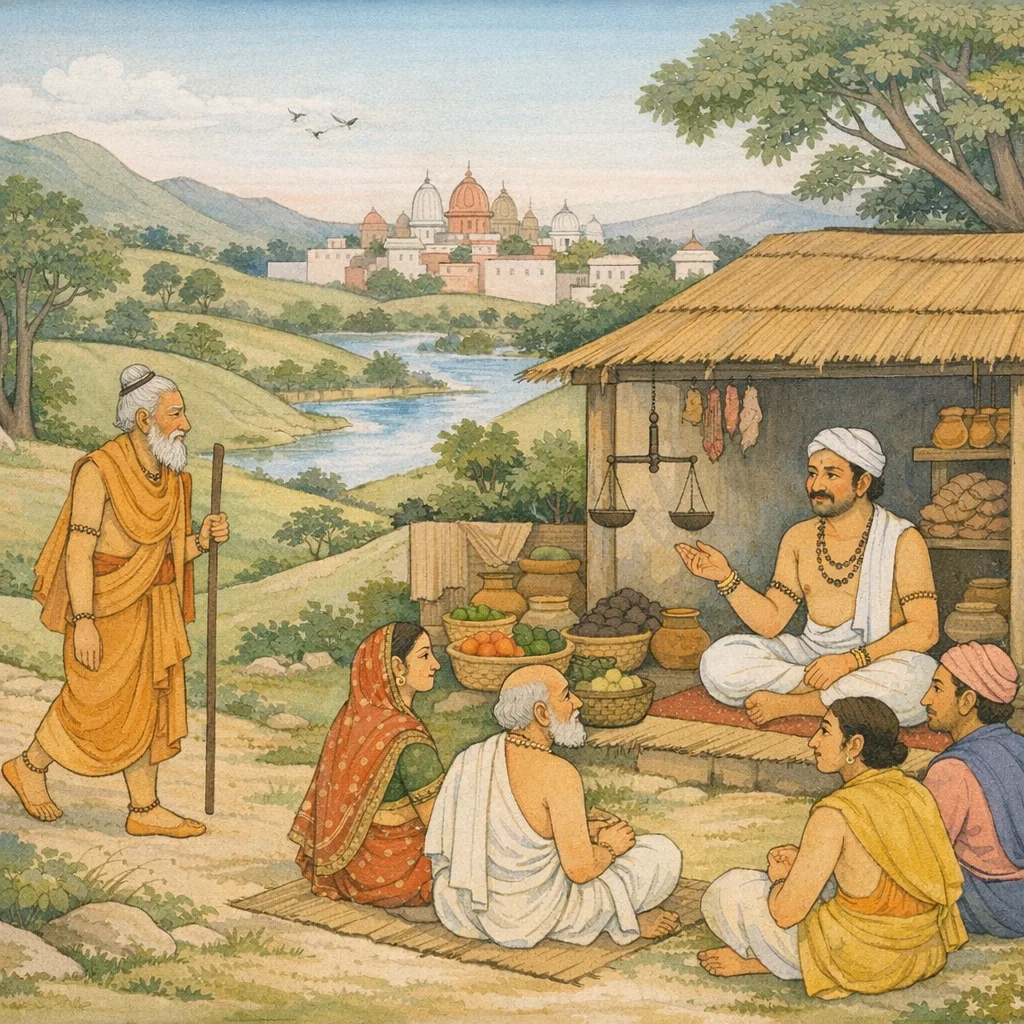
Mārkaṇḍeya said: “That city’s splendor was enhanced by many gateways, lofty towers, palaces, and encircling walls. The delightful capital was furnished with many vimānas, like aerial mansions, and adorned with numerous shops. Broad, well-laid roads shone with beauty. Mithilā, filled with sturdy, cheerful people, was crowded with horses, chariots, elephants, and soldiers. Festivals of many kinds were held there daily, and all manner of events continually occurred. The brāhmaṇa entered the city, wandered about on every side, and examined it well. Then he asked for the ‘Dharma-vyādha’; and the brāhmaṇas told him where he was. Going there, he saw him seated in the midst of a slaughterhouse, selling the flesh of boars, buffaloes, and other animals. Because customers thronged the place, Kauśika stood aside in a secluded spot.”
Verse 11
मार्गमाहिषमांसानि विक्रीणन्तं तपस्विनम् । आकुलत्वाच्च क्रेतृणामेकान्ते संस्थितो द्विज:,वहाँ उसने लोगोंसे धर्मव्याधका पता पूछा और ब्राह्मणोंने उसे उसका स्थान बता दिया। कौशिकने वहाँ जाकर देखा कि तपस्वी धर्मव्याध कसाईखानेमें बैठकर सूअर, भैंसे आदि पशुओंका मांस बेच रहा है। वहाँ ग्राहकोंकी भीड़ लगी हुई थी, इसलिये कौशिक एकान्तमें जाकर खड़ा हो गया
Mārkaṇḍeya said: He saw the ascetic selling the flesh of boars and buffaloes. And because the customers were crowding about in confusion, the brāhmaṇa stood apart in a secluded spot. The scene underscores a central Mahābhārata tension: outward occupation may appear impure, yet dharma is to be judged by conduct, intention, and right understanding rather than by mere social appearance.
Verse 12
स तु ज्ञात्वा द्विजं प्राप्त सहसा सम्भ्रमोत्थित: । आजगाम यतो विप्र: स्थित एकान्तदर्शने,ब्राह्यमणगको आया हुआ जानकर व्याध सहसा शीघ्रतापूर्वक उठ खड़ा हुआ और उस स्थानपर आ गया जहाँ ब्राह्मण एकान्त स्थानमें खड़ा था
Mārkaṇḍeya said: Recognizing that a brāhmaṇa had arrived, the hunter rose at once in respectful haste and went to the spot where the brāhmaṇa was standing apart, intent on a secluded, undisturbed meeting. The scene underscores promptness, humility, and proper regard for a guest—especially one worthy of honor.
Verse 13
व्याध उवाच अभिवादनये त्वां भगवन् स्वागतं ते द्विजोत्तम । अहं व्याधो हि भद्रं ते किं करोमि प्रशाधि माम्,व्याध बोला--भगवन्! मैं आपके चरणोंमें प्रणाम करता हूँ। द्विजश्रेष्ठल आपका स्वागत है। मैं ही वह व्याध हूँ (जिसकी खोजमें आपने यहाँतक आनेका कष्ट किया है)। आपका भला हो, आज्ञा दीजिये, मैं क्या सेवा करूँ?
The hunter said: “Revered sir, I bow to you. Welcome to you, best of the twice-born. I am indeed that hunter (whom you have come seeking). May good be yours—command me: what service shall I do?”
Verse 14
एकपत्न्या यदुक्तो5सि गच्छ त्वं मिथिलामिति । जानाम्येतदहं सर्व यदर्थ त्वमिहागत:,उस पतिव्रता देवीने जो आपसे यह कहकर भेजा है कि “तुम मिथिलापुरीको जाओ।!' वह सब मैं जानता हूँ। आप जिस उद्देश्यसे यहाँ पधारे हैं, वह भी मुझे मालूम है
The hunter said: “I know all that. I know that the chaste wife sent you with the words, ‘Go to Mithilā.’ And I also know the purpose for which you have come here.”
Verse 15
श्रुत्वा च तस्य तद् वाक््यं स विप्रो भूशविस्मित: । द्वितीयमिदमाश्षर्यमित्यचिन्तयत द्विजि:,व्याधकी वह बात सुनकर ब्राह्मणको बड़ा विस्मय हुआ। वह मन-ही-मन सोचने लगा --“यह दूसरा आश्चर्य दृष्टिगोचर हुआ है”
Hearing those words of his, the Brahmin was exceedingly astonished. Within himself he reflected, “This is a second marvel that has come before my eyes.”
Verse 16
अदेशस्थं हि ते स्थानमिति व्याधो<ब्रवीदिदम् । गृहं गच्छाव भगवन् यदि ते रोचतेडनघ,इसके बाद व्याधने कहा--“भगवन्! यह स्थान आपके ठहरनेयोग्य नहीं है। अनघ! यदि आपकी रुचि हो तो हम दोनों हमारे घरपर चलें”
The hunter said, “This place is not suitable for you to stay in. O venerable one, O blameless sage—if it pleases you, let us both go to my home.”
Verse 17
मार्कण्डेय उवाच बाढमित्येव तं विप्रो हृष्टो वचनमत्रवीत् । अग्रतस्तु द्विजं कृत्वा स जगाम गृहं प्रति,मार्कण्डेयजी कहते हैं--युधिष्ठिर! यह सुनकर ब्राह्मणको बड़ा हर्ष हुआ। उसने व्याधसे कहा--“बहुत अच्छा, ऐसा ही करो।” तब व्याध ब्राह्मगको आगे करके घरकी ओर चला
Mārkaṇḍeya said: Hearing this, the Brahmin was filled with joy and said to the hunter, “Very well—so be it.” Then the hunter placed the Brahmin in front and went on toward his home.
Verse 18
प्रविश्य च गृहं रम्यमासनेनाभिपूजित: । अर्घ्येण च स वै तेन व्याधेन द्विजसत्तम:,व्याधका घर बहुत सुन्दर था। वहाँ पहुँचकर उस व्याधने ब्राह्मणको बैठनेके लिये आसन दिया और अर्घ्य देकर उस श्रेष्ठ ब्राह्मणकी आदरसहित पूजा की
Entering the lovely house, the best of Brahmins was respectfully honored with a seat; and that hunter, offering him arghya, worshipped him with due reverence.
Verse 19
ततः: सुखोपविष्टस्तं व्याधं वचनमत्रवीत् | कर्मतद् वै न सदृशं॑ भवत: प्रतिभाति मे । अनुतप्ये भृशं तात तव घोरेण कर्मणा,सुखपूर्वक बैठ जानेपर ब्राह्मणने व्याधसे कहा--“तात! यह मांस बेचनेका काम निश्चय ही तुम्हारे योग्य नहीं है। मुझे तो तुम्हारे इस घोर कर्मसे बहुत संताप हो रहा है”
Then, having seated himself comfortably, the brāhmaṇa addressed the hunter: “Dear one, this trade of selling meat truly does not seem fitting for you. I am deeply pained by your dreadful occupation.”
Verse 20
व्याध उवाच कुलोचितमिदं कर्म पितृपैतामहं परम् । वर्तमानस्य मे धर्मे स्वे मन््युं मा कृथा द्विज,व्याध बोला--ब्रह्मन! यह काम मेरे बाप-दादोंके समयसे होता चला आ रहा है। मेरे कुलके लिये जो उचित है वही धंधा मैंने भी अपनाया है। मैं अपने धर्मका ही पालन कर रहा हूँ; अत: आप मुझपर क्रोध न करें
The hunter said, “This work is proper to my lineage, handed down from my father and grandfather as a long-established tradition. I am living within my own dharma and following the duty that falls to me; therefore, O brahmin, do not be angry with me.”
Verse 21
विधात्रा विहितं पूर्व कर्म स्वमनुपालयन् । प्रयत्नाच्च गुरू वृद्धौ शुश्रूषे5हं द्विजोत्तम,द्विजश्रेष्ठ) विधाताने इस कुलमें जन्म देकर मेरे लिये जो कार्य प्रस्तुत किया है, उसका पालन करता हुआ मैं अपने बूढ़े माता-पिताकी बड़े यत्नसे सेवा करता रहता हूँ
“The work assigned to me by the Creator—my own duty shaped by prior deeds—I continue to uphold. And with earnest effort, O best of twice-born, I serve my aged elders (my parents).”
Verse 22
सत्यं वदे नाभ्यसूये यथाशक्ति ददामि च । देवतातिथि भृत्यानामवशिष्टेन वर्तये,सत्य बोलता हूँ। किसीकी निनन्दा नहीं करता और अपनी शक्तिके अनुसार दान भी करता हूँ। देवताओं, अतिथियों और भरण-पोषणके योग्य कुटुम्बीजनों तथा सेवकोंको भोजन देकर जो बचता है उसीसे शरीरका निर्वाह करता हूँ
The hunter said: “I speak the truth and do not indulge in fault-finding. I give in charity according to my capacity. After first offering food to the gods, to guests, and to those dependent on me—my household and servants—I sustain myself only on what remains.”
Verse 23
न कुत्सयाम्यहं किंचिन्न गहें बलवत्तरम् । कृतमन्वेति कर्तरिं पुरा कर्म द्विजोत्तम,द्विजश्रेष्ठ! किसीके दोषोंकी चर्चा नहीं करता और अपनेसे बलिष्ठ पुरुषकी निन्दा नहीं करता, क्योंकि पहलेके किये हुए शुभाशुभ कर्मोंका परिणाम स्वयं कर्ताको ही भोगना पड़ता है
The hunter said: “I do not disparage anyone, nor do I censure one who is stronger. For deeds done in the past—whether good or evil—inevitably follow their doer, O best of the twice-born; the agent himself must bear their fruit.”
Verse 24
कृषिगोरक्ष्यवाणिज्यमिह लोकस्य जीवनम् । दण्डनीतिस्त्रयी विद्या तेन लोको भवत्युत,कृषि, गोरक्षा, वाणिज्य, दण्डनीति और त्रयीविद्या--ऋक्, यजु, सामके अनुसार यज्ञादिका अनुष्ठान करना और कराना ये लोगोंकी जीविकाके साधन हैं। इनसे ही लौकिक और पारलौकिक उन्नति सम्भव होती है
In this world, agriculture, the tending of cattle, and trade are the livelihood of the people. So too are Daṇḍanīti—the polity of rule and punishment—and the threefold sacred knowledge: the Ṛk, Yajus, and Sāma Vedas, by which sacrifices and rites are performed and caused to be performed. Through these alone are worldly and otherworldly prosperity made possible.
Verse 25
कर्म शूद्रे कृषिर्वैंश्ये संग्राम: क्षत्रिये स्मृत: । ब्रह्मचर्य तपो मन्त्रा: सत्यं च ब्राह्मणे सदा,शूद्रका कर्तव्य है सेवा-कर्म, वैश्यका कार्य है खेती और युद्ध करना क्षत्रियका कर्म माना गया है। ब्रह्मचर्य, तपस्या, मन्त्र-जप, वेदाध्ययन तथा सत्यईभाषण--ये सदा ब्राह्मणके पालन करनेयोग्य धर्म हैं
Service and labor are prescribed as the work of the Śūdra; agriculture (and trade) are the livelihood of the Vaiśya; and battle is remembered as the duty of the Kṣatriya. For the Brāhmaṇa, however, the constant disciplines are brahmacarya, austerity, sacred recitation (and Vedic study), and truthfulness.
Verse 26
राजा प्रशास्ति धर्मेण स्वकर्मनिरता: प्रजा: । विकर्माणश्च ये केचित् तान् युनक्ति स्वकर्मसु,राजा अपने-अपने वर्णाश्रमोचित कर्ममें लगी हुई प्रजाका धर्मपूर्वक शासन करता है और जो कोई अपने कर्मोंसे गिरकर विपरीत दिशामें जा रहे हों उन्हें पुनः अपने कर्तव्यके पालनमें लगाता है
The king governs his subjects in accordance with dharma, keeping the people steadfast in their proper duties. And if any among them fall into wrongful conduct (vikarma), he restrains and redirects them, re-establishing them in their own rightful work and obligations.
Verse 27
भेतव्यं हि सदा राज्ञ: प्रजानामधिपा हि ते । वारयन्ति विकर्मस्थं तृपा मृगमिवेषुभि:
One should always stand in awe of the king, for he is indeed the lord and protector of the people. Those who persist in wrongdoing are restrained by him—just as hunters check a deer with their arrows.
Verse 28
इसलिये राजाओंसे सदा डरते रहना चाहिये; क्योंकि वे प्रजाके स्वामी हैं। जो लोग धर्मके विपरीत कार्य करते हैं, उन्हें राजा दण्डद्वारा उसी प्रकार पापसे रोकते हैं, जैसे बाणोंद्वारा वे हिंसक पशुओंको हिंसासे रोकते हैं ।। जनकस्येह विप्रषषे विकर्मस्थो न विद्यते । स्वकर्मनिरता वर्णा्षृत्वारो5पि द्विजोत्तम,ब्रह्मर्ष] यह राजा जनकका नगर है, यहाँ कोई भी ऐसा नहीं है जो वर्ण-धर्मके विरुद्ध आचरण करे। द्विजश्रेष्ठ) यहाँ चारों वर्गोके लोग अपना-अपना कर्म करते हैं
Therefore one should always remain wary of kings, for they are the lords and guardians of the people. Those who act contrary to dharma are restrained by the king through punishment, just as arrows check violent beasts from doing harm. This is the city of King Janaka, O seer among brāhmaṇas: here no one is found engaged in unlawful conduct; all four social orders, O best of the twice-born, are devoted to their own proper duties.
Verse 29
स एष जनको राजा दुर्वत्तमपि चेत् सुतम् । दण्ड्यं दण्डे निक्षिपति तथा न ग्लाति धार्मिकम्,ये राजा जनक दुराचारीको, वह अपना पुत्र ही क्यों न हो, दण्डनीय मानकर दण्ड देते ही हैं तथा किसी भी धर्मात्माको कष्ट नहीं पहुँचने देते हैं
This very King Janaka—if even his own son were to behave wickedly—would deem him punishable and subject him to due punishment. In the same way, he does not allow any righteous person to be harmed, for he upholds justice without partiality.
Verse 30
सुयुक्तचारो नृपति: सर्व धर्मेण पश्यति | श्रीक्ष राज्यं च दण्डश्ष क्षत्रियाणां द्विजोत्तम,विप्रवर! राजा जनकने सब ओर गुप्तचर लगा रखे हैं, अतः उनके द्वारा वे धर्मानुसार सबपर दृष्टि रखते हैं। सम्पत्तिका उपार्जन, राज्यकी रक्षा तथा अपराधियोंको दण्ड देना--ये क्षत्रियोंके कर्तव्य हैं
The hunter said: “A king, having well-arranged intelligence and surveillance, observes everything in accordance with dharma. Prosperity, the protection of the kingdom, and the administration of punishment—these, O best of the twice-born, are the proper duties of kṣatriyas.”
Verse 31
राजानो हि स्वधर्मेण श्रियमिच्छन्ति भूयसीम् । सर्वेषामेव वर्णानां त्राता राजा भवत्युत,राजालोग अपने धर्मका पालन करते हुए ही प्रचुर सम्पत्ति पानेकी इच्छा रखते हैं और राजा सभी वर्णोंका रक्षक होता है
Kings, by adhering to their own dharma, seek abundant prosperity; indeed, the king becomes the protector of all the social orders. The point is that royal power is ethically justified only when it is exercised as guardianship—upholding order and safeguarding the welfare of every varṇa.
Verse 32
परेण हि हतान् ब्रह्मन् वराहमहिषानहम् । न स्वयं हन्मि विप्र्षे विक्रीणामि सदा त्वहम्,ब्रह्मन! मैं स्वयं किसी जीवकी हिंसा नहीं करता। सदा दूसरोंके मारे हुए सूअर और भैसोंका मांस बेचता हूँ
The hunter said: “O Brahmin, these boars and buffaloes have been killed by others. I do not myself kill living beings, O venerable sage; I only ever sell the meat of animals slain by someone else.”
Verse 33
न भक्षयामि मांसानि ऋतुगामी तथा हाहम् । सदोपवासी च तथा नक्तभोजी सदा द्विज,मैं स्वयं मांस कभी नहीं खाता। ऋतुकाल प्राप्त होनेपर ही पत्नी-समागम करता हूँ। द्विजप्रवर। मैं दिनमें सदा ही उपवास और रातमें भोजन करता हूँ
The hunter said: “I do not eat meat. I approach my wife only when the proper season has come. O best of the twice-born, I fast throughout the day and take my meal only at night.”
Verse 34
अशीलकश्चापि पुरुषो भूत्वा भवति शीलवान् | प्राणिहिंसारतश्चापि भवते धार्मिक: पुन:,शीलसे रहित पुरुष भी कभी शीलवान् हो जाता है। प्राणियोंकी हिंसामें अनुरक्त मनुष्य भी फिर धर्मात्मा हो जाता है
The hunter said: Even a man without good conduct can, in time, become a person of good character. Likewise, even one devoted to harming living beings can again become righteous. The teaching declares moral transformation: past habits do not make virtue impossible when one turns toward dharma.
Verse 35
व्यभिचाराक्नरेन्द्राणां धर्म: संकीर्यते महान् | अधर्मो वर्धते चापि संकीर्यन्ते ततः प्रजा:,राजाओंके व्यभिचार-दोषसे धर्म अत्यन्त संकीर्ण हो जाता है और अधर्म बढ़ जाता है, इससे प्रजामें वर्णसंकरता आ जाती है
The Hunter said: “When kings fall into the fault of sexual misconduct, even the great order of dharma becomes confused and mixed. Adharma then grows stronger, and as a result the people themselves become socially mixed and disordered.”
Verse 36
भेरुण्डा वामना: कुब्जा: स्थूलशीर्षास्तथैव च । क्लीबाश्चान्धाश्न बधिरा जायन्ते5त्युच्चलोचना:,उस दशामें भयंकर आकृतिवाले, बौने, कुबड़े, मोटे मस्तकवाले, नपुंसक, अंधे, बहरे और अधिक ऊँचे नेत्रोंवाले मनुष्य उत्पन्न होते हैं
The hunter said: “In such a condition, people are born with frightening forms—dwarfed, hunchbacked, with oversized heads; also impotent, blind, deaf, and with excessively prominent eyes.” The statement serves as a moral warning: when conduct violates dharma, its consequences are said to appear as painful and limiting conditions in future births.
Verse 37
पार्थिवानामथधर्मत्वात् प्रजानाम भव: सदा | स एष राजा जनक: प्रजा धर्मेण पश्यति,राजाओंके अधर्मपरायण होनेसे प्रजाकी सदा अवनति होती है। हमारे ये राजा जनक समस्त प्रजाको धर्मपूर्ण दृष्टिसे ही देखते हैं
When kings turn away from dharma, the condition of their subjects inevitably declines. But this king Janaka looks upon all his people through the lens of righteousness—governing with a moral vision that safeguards their welfare.
Verse 38
अनुगृह्नत् प्रजा: सर्वा स्वधर्मनिरता: सदा । (पात्येव राजा जनक: पितृवज्जनसत्तम ।) ये चैव मां प्रशंसन्ति ये च निन्दन्ति मानवा:,सर्वान् सुपरिणीतेन कर्मणा तोषयाम्यहम् । नरश्रेष्ठ] राजा जनक सदा स्वथधर्ममें तत्पर रहनेवाली सम्पूर्ण प्रजापर अनुग्रह रखते हुए उसका पिताकी भाँति सदा पालन करते हैं। जो लोग मेरी प्रशंसा करते हैं और जो निन्दा करते हैं, उन सबको अपने सद्व्यवहारसे संतुष्ट रखता हूँ
‘Ever showing favor to all his subjects—who are always devoted to their own duties—King Janaka, best of men, protects them like a father. Likewise, whether people praise me or blame me, I keep them all content through conduct that is well-governed and rightly carried out.’
Verse 39
ये जीवन्ति स्वधर्मेण संयुञ्जन्ति च पार्थिवा:
Those kings who live in accordance with their own ordained duty, and who also engage (themselves and others) in the proper exercise of that duty…
Verse 40
न किंचिदुपजीवन्ति दान्ता उत्थानशीलिन: । जो राजा अपने धर्मका पालन करते हुए जीवन-निर्वाह करते हैं, धर्ममें ही संयुक्त रहते हैं, किसी दूसरेकी कोई वस्तु अपने उपयोगमें नहीं लाते तथा सदा अपनी इन्द्रियोंपर संयम रखते हैं, वे ही उन्नतिशील होते हैं ।। ३९ ई ।। शक््त्यान्नदानं सततं तितिक्षा धर्मनित्यता,अपनी शक्तिके अनुसार सदा दूसरोंको अन्न देना, दूसरोंके अपराध तथा शीत-उष्ण आदि द्वन्दोंको सहन करना, सदा धर्ममें दृढ़तापूर्वक लगे रहना तथा सम्पूर्ण प्राणियोंमें सभी पूजनीय पुरुषोंका यथायोग्य पूजन करना--ये मनुष्योंके सदगुण पुरुषमें स्वार्थत्यागके बिना नहीं रह पाते हैं
The hunter-sage said: Those who are self-restrained and ever striving upward do not sustain themselves by taking what belongs to others. Giving food continually according to one’s capacity, enduring hardships and others’ offenses, remaining steadfastly devoted to dharma, and honoring worthy persons among all beings as is proper—such virtues in a human being cannot abide without the renunciation of selfishness.
Verse 41
यथाहं प्रति पूजा च सर्वभूतेषु वै सदा । त्यागान्नान्यत्र मर्त्यानां गणास्तिष्ठन्ति पूरुषे,अपनी शक्तिके अनुसार सदा दूसरोंको अन्न देना, दूसरोंके अपराध तथा शीत-उष्ण आदि द्वन्दोंको सहन करना, सदा धर्ममें दृढ़तापूर्वक लगे रहना तथा सम्पूर्ण प्राणियोंमें सभी पूजनीय पुरुषोंका यथायोग्य पूजन करना--ये मनुष्योंके सदगुण पुरुषमें स्वार्थत्यागके बिना नहीं रह पाते हैं
The hunter said: “As for the reverence shown toward me, and the constant honoring of all living beings—such clusters of virtues do not abide in a human being anywhere without self-renunciation. Only through giving up self-interest can one sustain generosity according to one’s capacity, endure others’ faults and the oppositions of cold and heat, remain steadfastly established in dharma, and offer fitting respect to all who are worthy among creatures.”
Verse 42
मृषा वाद परिहरेत् कुर्यात् प्रियमयाचित: । न च कामाज्न संरम्भान्न द्वेषाद् धर्ममुत्सूजेत्,झूठ बोलना छोड़ दे, बिना कहे ही दूसरोंका प्रिय करे, काम, क्रोध तथा द्वेषसे भी कभी धर्मका परित्याग न करे
The hunter said: “One should give up false speech. Without even being asked, one should do what is pleasing and beneficial to others. And one should never abandon dharma—whether driven by desire, by rash anger and agitation, or by hatred.”
Verse 43
प्रिये नातिभुशं हृष्येदप्रिये न च संज्वरेत् । न मुहोदर्थकृच्छेषु न च धर्म परित्यजेत्,प्रिय वस्तुकी प्राप्ति होनेपर हर्षसे फ़ूल न उठे, अपने मनके विपरीत कोई बात हो जाय तो दुःख न माने-चिन्तित न हो, अर्थसंकट आ जाय तो भी मोहके वशीभूत हो घबराये नहीं और किसीभी अवस्थामें अपना धर्म न छोड़े
The hunter said: “When something pleasing occurs, one should not exult excessively; when something displeasing happens, one should not burn with distress. In times of financial hardship one should not fall into delusion or panic, and in no condition should one abandon one’s dharma.”
Verse 44
कर्म चेक्किंचिदन्यत् स्यादितरज्न तदाचरेत् । यत् कल्याणमभिध्यायेत् तत्रात्मानं नियोजयेत्,यदि भूलसे कभी कोई निन्दित कर्म बन जाय तो फिर दुबारा वैसा काम न करे। अपने मन और बुद्धिसे विचार करनेपर जो कल्याणकारी प्रतीत हो, उसी कार्यमें अपनेको लगावे
If there is some other deed that ought to be done, then do that. And if ever an act becomes blameworthy, do not do the like again. Whatever, upon reflection with mind and understanding, appears to be for the good—set yourself to that work.
Verse 45
न पापे प्रतिपाप: स्यात् साधुरेव सदा भवेत् | आत्मनैव हतः पापो य: पापं कर्तुमिच्छति,यदि कोई अपने साथ बुरा बर्ताव करे तो स्वयं भी बदलेमें उसके साथ बुराई न करे। सबके साथ सदा सद्व्यवहार ही करे। जो पापी दूसरोंका अहित करना चाहता है वह स्वयं ही नष्ट हो जाता है
Do not answer sin with counter-sin; let the good remain ever virtuous. Whoever longs to do wrong and harm others is, in truth, destroyed by his own evil intent and deed.
Verse 46
कर्म चैतदसाधूनां वृजिनानामसाधुवत् | न धर्मोउस्तीति मन्वाना: शुचीनवहसन्ति ये,यह (दूसरोंका अहित करना) तो दुराचारीकी भाँति दुर्व्यसनोंमें आसक्त हुए पापी पुरुषोंका ही कार्य है। “धर्म कोई चीज नहीं है” ऐसा मानकर जो शुद्ध आचार-विचारवाले श्रेष्ठ पुरुषोंकी हँसी उड़ाते हैं, वे धर्मपर अश्रद्धा रखनेवाले मनुष्य निश्चय ही नष्ट हो जाते हैं। पापी मनुष्य लुहारकी बड़ी धौंकनीके समान सदा ऊपरसे फूले दिखायी देते हैं (परंतु वास्तवमें सारहीन होते हैं)
The hunter said: Such conduct belongs only to the wicked—sinful men sunk in ruinous habits, who behave like the unrighteous. Those who think, “There is no such thing as dharma,” and who mock people of pure conduct, stray through disbelief in righteousness and surely come to ruin.
Verse 47
अश्रद्दधाना धर्मस्य ते नश्यन्ति न संशय: । महादृतिरिवाध्मात: पापो भवति नित्यदा,यह (दूसरोंका अहित करना) तो दुराचारीकी भाँति दुर्व्यसनोंमें आसक्त हुए पापी पुरुषोंका ही कार्य है। “धर्म कोई चीज नहीं है” ऐसा मानकर जो शुद्ध आचार-विचारवाले श्रेष्ठ पुरुषोंकी हँसी उड़ाते हैं, वे धर्मपर अश्रद्धा रखनेवाले मनुष्य निश्चय ही नष्ट हो जाते हैं। पापी मनुष्य लुहारकी बड़ी धौंकनीके समान सदा ऊपरसे फूले दिखायी देते हैं (परंतु वास्तवमें सारहीन होते हैं)
Those who have no faith in dharma surely perish—there is no doubt. A sinful man is always like a great blacksmith’s bellows: swollen and puffed up on the outside, yet empty of true substance within. Harming others is the work of the wicked, addicted to ruinous habits; and those who declare, “There is no such thing as dharma,” and mock the pure conduct and thought of the noble, inevitably come to destruction.
Verse 48
(साधु: सन्नतिमानेव सर्वत्र द्विजसत्तम ।) मूढानामवलिप्तानामसारं भावितं भवेत् । दर्शयत्यन्तरात्मा तं दिवा रूपमिवांशुमान्,द्विजश्रेष्ठ! उत्तम पुरुष सर्वत्र विनयशील ही होता है। अहंकारी मूढ़ मनुष्योंकी सोची हुई प्रत्येक बात निःसार होती है। जैसे सूर्य दिनके रूपको प्रकट कर देता है, उसी प्रकार मूर्खोकी अन्तरात्मा ही उनके यथार्थ स्वरूपका दर्शन करा देती है
O best of brāhmaṇas, a truly good person is humble everywhere. But whatever the deluded and arrogant imagine and plan turns out to be hollow. Just as the sun reveals forms in the daytime, so a fool’s own inner self exposes his real nature.
Verse 49
न लोके राजते मूर्ख: केवलात्मप्रशंसया । अपि चेह श्रिया हीन:ः कृतविद्यः प्रकाशते,मूर्ख मनुष्य केवल अपनी प्रशंसाके बलसे जगत्-में प्रतिष्ठा नहीं पाता है, विद्वान् पुरुष कान्तिहीन हो तो भी संसारमें उसकी ख्माति बढ़ जाती है
The fool does not gain esteem in the world merely by self-praise. But a truly learned man shines forth here even if he lacks outward prosperity; his reputation grows by the force of his knowledge and conduct, not by display.
Verse 50
अब्रुवन् कस्यचिचन्निन्दामात्मपूजामवर्णयन् । न कश्चिद् गुणसम्पन्न: प्रकाशो भुवि दृश्यते,किसी दूसरेकी निन््दा न करे, अपनी मान-प्रतिष्ठाकी प्रशंसा न करे, कोई भी गुणवान् पुरुष पर निन्दा और आत्मप्रशंसाका त्याग किये बिना इस भूमण्डलमें सम्मानित हुआ हो, यह नहीं देखा जाता है
The hunter said: “One should not speak ill of anyone, nor advertise one’s own honor and importance. For it is not seen in this world that any truly virtuous person becomes widely esteemed while still clinging to slander of others and self-praise.”
Verse 51
विकर्मणा तप्यमान: पापाद विपरिमुच्यते । न तत् कुर्या पुनरिति द्वितीयात् परिमुच्यते,जो मनुष्य पापकर्म बन जानेपर सच्चे हृदयसे पश्चात्ताप करता है, वह उस पापसे छूट जाता है तथा “फिर कभी ऐसा कर्म नहीं करूँगा” ऐसा दृढ़ निश्चय कर लेनेपर वह भविष्यमें होनेवाले दूसरे पापसे भी बच जाता है
The hunter said: “A person who is tormented by remorse after committing a wrongful act becomes released from that sin. And when he forms the firm resolve, ‘I will not do that again,’ he is freed even from the second sin—meaning the future sin that would arise from repeating the same wrongdoing.”
Verse 52
कर्मणा येन तेनेह पापाद् द्विजवरोत्तम । एवं श्रुतिरियं ब्रह्मन् धर्मेषु प्रतिदृश्यते,विप्रवर! शास्त्रविहित (जप, तप, यज्ञ, दान आदि) किसी भी कर्मका निष्कामभावसे आचरण करनेपर पापसे छुटकारा मिल सकता है। ब्रह्मन! धर्मके विषयमें ऐसी श्रुति देखी जाती है
The hunter said: “O best of Brahmins, by whatever prescribed action one performs here—when done in the right spirit—one can be freed from sin. O Brahman, such a teaching is found in the śruti with regard to dharma.”
Verse 53
पापान्यबुद्धवेह पुरा कृतानि प्राग् धर्मशीलो5पि विहन्ति पश्चात् । धर्मो राजन् नुदते पूरुषाणां यत् कुर्वते पापमिह प्रमादात्,पहलेका धर्मशील पुरुष भी यदि अनजानमें यहाँ कोई पाप कर बैठे तो वह पीछे (निष्काम पुण्यकर्मद्वारा) उस पापको नष्ट कर देता है। राजन! मनुष्योंका धर्म ही यहाँ प्रमादवश किये हुए उनके पापोंको दूर कर देता है
Sins committed earlier here through ignorance are later destroyed even by a person who is otherwise devoted to dharma. O King, it is dharma itself that drives away a man’s sins when, through heedlessness, he commits wrongdoing in this world—by the force of subsequent righteous conduct and inner rectitude.
Verse 54
पापं कृत्वा हि मन्येत नाहमस्मीति पूरुष: । तं तु देवा: प्रपश्यन्ति स्वस्यैवान्तरपूरुष:,जो मनुष्य पाप करके भी यह मानता है कि “मैं पापी नहीं हूँ।/ वह भूल करता है; क्योंकि देवता उसे और उसके पापको देखते हैं तथा उसीके भीतर बैठा हुआ परमात्मा भी देखता ही है
The hunter said: “A man may commit sin and then imagine, ‘I am not a sinner.’ But he is mistaken. The gods behold him and his deed, and the indwelling Lord—seated within as the inner Person—also sees everything.”
Verse 55
चिकीर्षेदेव कल्याणं श्रद्धधानोडनसूयक: । वसनस्येव छिद्राणि साधूनां विवृणोति यः,(अपश्यन्नात्मनो दोषान् स पाप: प्रेत्य नश्यति ।।) श्रद्धालु मनुष्य दूसरोंके दोष देखना छोड़कर सदा सबके हितकी ही इच्छा करे। जो पापी अपने दोषोंकी ओरसे आँखें बंद करके सदा दूसरे श्रेष्ठ पुरुषोंके दोषोंको ही कपड़ेके छेदोंकी भाँति अधिकाधिक प्रकट करता और बढ़ाता है, वह मृत्युके पश्चात् नष्ट हो जाता है --परलोकमें उसे कोई सुख नहीं मिलता है
The hunter said: “Let a person, full of faith and free from malice, seek only what is good and beneficial. But one who, like pointing out holes in a garment, keeps exposing and enlarging the faults of virtuous people—while failing to see his own faults—such a sinful man perishes after death; in the next world he finds no happiness.”
Verse 56
पापं चेत् पुरुष: कृत्वा कल्याणमभिपद्यते । मुच्यते सर्वपापेभ्यो महाभ्रेणेव चन्द्रमा:,यदि मनुष्य पाप करके भी कल्याणकारी कर्ममें लग जाता है, तो वह महामेघसे मुत्ह हुए चन्द्रमाकी भाँति सब पापोंसे मुक्त हो जाता है
The hunter said: “If a man, even after committing sin, turns himself toward what is wholesome and righteous, he is released from all sins—like the moon freed from the covering of a great cloud.”
Verse 57
यथा<5<दित्य: समुद्यन् वै तमः: पूर्व व्यपोहति । एवं कल्याणमातिष्ठन् सर्वपापै: प्रमुच्यते,जैसे सूर्य उदय होनेपर पहलेके अन्धकारको नष्ट कर देते हैं, उसी प्रकार कल्याणकारी शुभ कर्मका निष्कामभावसे अनुष्ठान करनेवाला पुरुष सब पापोंसे छुटकारा पा जाता है
Just as the sun, on rising, first drives away the darkness, so too a person who steadfastly undertakes what is wholesome and auspicious—performing good action in a spirit free from selfish motive—is released from all sins.
Verse 58
पापानां विद्धयधिष्ठानं लोभमेव द्विजोत्तम । लुब्धा: पापं व्यवस्यन्ति नरा नातिबहुश्रुता:,विप्रवर! लोभको ही पापोंका घर समझो। जिन्होंने अधिकतर शास्त्रोंका श्रवण नहीं किया है, वे लोभी मनुष्य ही पाप करनेका विचार रखते हैं
Know, O best of twice-born, that greed itself is the very seat and foundation of sins. Men who are greedy—especially those not well-trained by much hearing of sacred teaching—set their minds on wrongdoing and resolve upon sinful acts.
Verse 59
अधर्मा धर्मरूपेण तृणै: कूपा इवावृता: । तेषां दम: पवित्राणि प्रलापा धर्मसंश्रिता: । सर्व हि विद्यते तेषु शिष्टाचार: सुदुर्लभ:,तिनकेसे ढके हुए कुओंकी भाँति धर्मकी आड़में कितने ही अधर्म चल रहे हैं। धर्मात्माके वेशमें रहनेवाले इन अधार्मिक मनुष्योंमें इन्द्रिय-संयम, पवित्रता और धर्मसम्बन्धी चर्चा आदि सभी गुण तो होते हैं, परंतु उनमें शिष्टाचार (श्रेष्ठ पुरुषोंका-सा आचार-व्यवहार) अत्यन्त दुर्लभ है
The hunter said: “Just as wells may be hidden under grass, so too many acts of unrighteousness lie concealed beneath the outward appearance of righteousness. In such people—who wear the guise of the virtuous—one may indeed find self-restraint, displays of purity, and even talk that leans upon dharma; yet true cultured conduct, the refined behavior of the truly noble, is exceedingly rare among them.”
Verse 60
मार्कण्डेय उवाच सतु विप्रो महाप्राज्ञो धर्मव्याधमपृच्छत । शिष्टाचारं कथमहं विद्यामिति नरोत्तम,मार्कण्डेयजी कहते हैं--युधिष्ठिर! तदनन्तर परम बुद्धिमान् कौशिकने धर्मव्याथसे पूछा--“नरश्रेष्ठ! मुझे शिष्टाचारका ज्ञान कैसे हो?
Mārkaṇḍeya said: Then that highly wise brāhmaṇa questioned the Dharma-vyādha: “O best of men, how may I come to know the conduct of the cultured and the righteous (śiṣṭācāra)?”
Verse 61
एतदिच्छामि भद्र ते श्रोतुं धर्मभूतां वर । त्वत्तो महामते व्याध तद् ब्रवीहि यथातथम्,“धर्मात्माओंमें श्रेष्ठ महामते व्याध! तुम्हारा भला हो, मैं ये सब बातें तुमसे सुनना चाहता हूँ। अतः यथार्थ रूपसे इनका वर्णन करो”
Markandeya said: “Blessings upon you. O best among the righteous, O wise hunter—this is what I wish to hear from you. Therefore, tell it to me exactly as it truly is.”
Verse 62
व्याध उवाच यज्ञो दानं॑ तपो वेदा: सत्यं च द्विजसत्तम | पज्चैतानि पवित्राणि शिष्टाचारेषु सर्वदा,व्याधने कहा--द्विजश्रेष्ठ! यज्ञ, दान, तपस्या, वेदोंका स्वाध्याय और सत्यभाषण--ये पाँच पवित्र वस्तुएँ शिष्ट पुरुषोंके आचार-व्यवहारमें सदा देखी गयी हैं
The Hunter said: “O best of the twice-born, sacrifice, charitable giving, austerity, study of the Vedas, and truthfulness—these five are held to be purifying. They are always seen embodied in the conduct and daily practice of the cultured and disciplined.”
Verse 63
कामक्रोधौ वशे कृत्वा दम्भं लोभमनार्जवम् | धर्ममित्येव संतुष्टास्ते शिष्टा: शिष्टसम्मता:,जो काम, क्रोध, लोभ, दम्भ और कुटिलताको वशमें करके केवल धर्मको ही अपनाकर संतुष्ट रहते हैं, वे शिष्ट कहलाते हैं और उन्हींका शिष्ट पुरुष आदर करते हैं
The hunter said: “Those who bring desire and anger under control, and likewise subdue hypocrisy, greed, and crookedness, and who remain content with nothing but dharma—such people are called ‘the cultured’ (śiṣṭa). It is they whom other cultivated persons approve and honor.”
Verse 64
न तेषां विद्यते3वृत्तं यज्ञस्वाध्यायशीलिनाम् । आचारपालनं चैव द्वितीयं शिष्टलक्षणम्,वे निरन्तर यज्ञ और स्वाध्यायमें लगे रहते हैं। उनमें स्वेच्छाचार नहीं होता। सदाचारका पालन शिष्ट पुरुषोंका दूसरा लक्षण है
Among those who are steadfast in sacrifice and in the study of sacred knowledge, there is no room for self-willed, wayward conduct. The observance of right practice—faithfully keeping to proper behavior—is the second defining mark of the truly cultured and disciplined.
Verse 65
गुरुशुश्रूषणं सत्यमक्रोधो दानमेव च । एतच्चतुष्टयं ब्रह्मन् शिष्टाचारेषु नित्यदा,ब्रह्मन! शिष्टाचारी पुरुषोंमें गुरुकी सेवा, सत्य-भाषण, क्रोधका अभाव तथा दान-ये चार सदगुण सदा रहते हैं
The hunter said: “Reverent service to one’s teacher, truthfulness, freedom from anger, and generosity—these four virtues, O Brahmin, are found constantly in those who live by the conduct of the cultured and disciplined.”
Verse 66
शिष्टाचारे मन: कृत्वा प्रतिष्ठाप्पय च सर्वश: । यामयं लभते वृत्ति सा न शक््या हाुतो5न्यथा,मनुष्य शिष्ट पुरुषोंके उपर्युक्त आचारमें मनको सब प्रकारसे स्थापित करके जिस उत्तम स्थितिको प्राप्त करता है उसकी उपलब्धि और किसी प्रकारसे नहीं हो सकती
The hunter said: “When a person fixes the mind wholly upon the conduct of the cultured and disciplined (the śiṣṭas) and establishes it there in every way, the noble way of living and inner steadiness that he attains cannot be gained by any other means.”
Verse 67
वेदस्योपनिषत् सत्यं सत्यस्योपनिषद् दम: । दमस्योपनिषत् त्याग: शिष्टाचारेषु नित्यदा,वेदका सार है सत्य, सत्यका सार है इन्द्रिय-संयम और इन्द्रिय-सयंमका सार है त्याग। यह त्याग शिष्ट पुरुषोंके आचारमें सदा विद्यमान रहता है
The hunter-teacher declares a chain of inner essences: the heart of the Veda is truth; the heart of truth is self-control; and the heart of self-control is renunciation. Such renunciation, he says, is always present in the conduct of the truly cultured and disciplined—those who live by dharma in daily life rather than merely speaking of it.
Verse 68
ये तु धर्मानसूयन्ते बुद्धिमोहान्विता नरा: । अपथा गच्छतां तेषामनुयाता च पीड्यते,जो मनुष्य बुद्धिमोहसे युक्त होकर धर्ममें दोष देखते हैं वे स्वयं तो कुमार्गगामी होते ही हैं, उनके पीछे चलनेवाला मनुष्य भी कष्ट पाता है
But those men who, deluded in their understanding, find fault with dharma—such people themselves stray onto a wrong path; and even the one who follows after them is afflicted and comes to grief. The hunter warns that contempt for righteousness misleads not only the critic but also anyone who takes such a person as a guide.
Verse 69
ये तु शिष्टा: सुनियता: श्रुतित्यागपरायणा: । धर्मपन्थानमारूढा: सत्यधर्मपरायणा:,जो शिष्ट हैं वे सदा ही नियमित जीवन व्यतीत करते हैं, वेदोंके स्वाध्यायमें तत्पर और त्यागी होते हैं। धर्मके मार्गपर ही चलते हैं और सत्यधर्मको ही अपना परम आश्रय मानते हैं
But those who are truly cultured and disciplined live under steady self-restraint. They are devoted to the study of the Veda and inclined toward renunciation. Having mounted the path of dharma, they take truthful righteousness as their highest refuge and guiding commitment.
Verse 70
नियच्छन्ति परां बुद्धिं शिष्टाचारान्विता जना: । उपाध्यायमते युक्ता: स्थित्या धर्मार्थदर्शिन:
People who are grounded in the conduct of the cultured restrain and steady their higher understanding. Aligned with the counsel of their teachers, they remain disciplined in their way of life and thereby discern what is truly dharma and what is truly beneficial.
Verse 71
शिष्टाचारपरायण मनुष्य अपनी उत्तम बुद्धिको भी संयममें रखते हैं, गुरुके सिद्धान्तके अनुसार चलते हैं और मर्यादामें स्थित होकर धर्म और अर्थपर दृष्टि रखते हैं ।। नास्तिकान् भिजन्नमर्यादान् क्रूरान् पापमतौ स्थितान् | त्यज तान् ज्ञानमश्रित्य धार्मिकानुपसेव्य च,इसलिये तुम नास्तिक, धर्मकी मर्यादा भंग करनेवाले, क्रूर तथा पापपूर्ण विचार रखनेवाले पुरुषोंका साथ छोड़ दो और ज्ञानका आश्रय लेकर धर्मात्मा पुरुषोंकी सेवामें रहो
The hunter said: “Abandon those who are atheistic, who break the bounds of proper conduct, who are cruel, and whose minds are fixed on sinful intentions. Instead, take refuge in true discernment and remain in the company and service of righteous people. Those who are devoted to proper conduct restrain even their own keen intellect, follow the teachings of their elders and teachers, and, staying within due limits, keep both dharma and practical welfare in view.”
Verse 72
कामलोभग्रहाकीर्णा पड्चेन्द्रियजलां नदीम् । नावं धृतिमयीं कृत्वा जन्मदुर्गाणि संतर,यह शरीर एक नदी है। पाँच इन्द्रियाँ इसमें जल हैं। काम और लोभरूपी मगर इसके भीतर भरे पड़े हैं। जन्म और मृत्युके दुर्गम प्रदेशमें यह नदी बह रही है। तुम धैर्यकी नावपर बैठो और इसके दुर्गम स्थानों--जन्म आदि क्लेशोंको पार कर जाओ
The hunter said: “This body is like a river whose waters are the five senses, and within it swarm the crocodiles of desire and greed. It flows through the hard-to-cross terrain of repeated birth (and its sufferings). Therefore, fashion a boat out of steadfastness and cross beyond these perilous stretches—those afflictions beginning with birth.”
Verse 73
क्रमेण संचितो धर्मो बुद्धियोगमयो महान् | शिष्टाचारे भवेत् साधू राग: शूक्लेव वाससि,जैसे कोई भी रंग सफेद कपड़ेपर ही अच्छी तरह खिलता है, उसी प्रकार शिष्टाचारका पालन करनेवाले पुरुषमें ही क्रमशः संचित किया हुआ बुद्धियोगमय महान् धर्म भलीभाँति प्रकाशित होता है
Just as any color comes into full bloom upon white cloth, so too, in a person who upholds proper conduct, the great dharma—accumulated step by step and suffused with the yoga of discernment—shines forth clearly.
Verse 74
अहिंसा सत्यवचनं सर्वभूतहितं परम् । अहिंसा परमो धर्म: स च सत्ये प्रतिष्ठित: । सत्ये कृत्वा प्रतिष्ठां तु प्रवर्तन्ते प्रवृत्तय:,अहिंसा और सत्यभाषण--ये समस्त प्राणियोंके लिये अत्यन्त हितकर हैं। अहिंसा सबसे महान् धर्म है, परंतु वह सत्यमें ही प्रतिष्ठित है। सत्यके ही आधारपर श्रेष्ठ पुरुषोंके सभी कार्य आरम्भ होते हैं
The hunter said: Non-violence and truthful speech are supremely beneficial to all living beings. Non-violence is the highest dharma, yet it stands firmly only upon truth. When truth is made the foundation, the worthy set their undertakings in motion and their actions proceed on a stable course.
Verse 75
सत्यमेव गरीयस्तु शिष्टाचारनिषेवितम् । आचारक्न सतां धर्म: संतश्षाचारलक्षणा:,अतः शिष्ट पुरुषोंके आचारमें गृहीत सत्य ही सबसे अधिक गौरवकी वस्तु है। सदाचार ही श्रेष्ठ पुरुषोंका धर्म है। सदाचारसे ही संतोंकी पहचान होती है
Truth—when embraced and practiced in accordance with the conduct of the well-bred and disciplined—is the highest value. Right conduct itself is the dharma of the good; and it is by such conduct that saints and truly noble people are recognized.
Verse 76
यो यथाप्रकृतिर्जन्तुः स स्वां प्रकृतिम श्षुते । पापात्मा क्रोधकामादीन् दोषानाप्रोत्यनात्मवान्,जिस जीवकी जैसी प्रकृति होती है, वह अपनी प्रकृतिका ही अनुसरण करता है। अपने मनको वशमें न रखनेवाला पापात्मा पुरुष ही काम, क्रोध आदि दोषोंको प्राप्त होता है
‘A creature acts in accordance with its own innate disposition; it inevitably follows its nature. It is the sinful person—one who lacks self-mastery—who falls into faults such as desire and anger.’
Verse 77
आरम्भोन्याययुक्तो य: स हि धर्म इति स्मृत: । अनाचारस्त्वधर्मेति एतच्छिष्टानुशासनम्,“जो आरम्भ न्याययुक्त हो, वही धर्म कहा गया है। इसके विपरीत जो अनाचार है, वह अधर्म है'--ऐसा शिष्ट पुरुषोंका कथन है
The hunter said: “That undertaking whose very beginning is aligned with justice is remembered as dharma. But conduct that departs from right practice is adharma—this is the instruction handed down by the cultured and disciplined.”
Verse 78
अक्कुद्धयन्तो5नसूयन्तो निरहड्कारमत्सरा: । ऋजव: शमसम्पना: शिष्टाचारा भवन्ति ते,जिनमें क्रोधका अभाव है, जो दूसरोंके दोष नहीं देखते, जिनमें अहंकार और ईर्ष्याका अभाव है, जो सरल तथा मनोनिग्रहसे सम्पन्न हैं, वे शिष्टाचारी कहलाते हैं
The hunter said: Those who are free from anger, who do not indulge in fault-finding or malice toward others, who are devoid of ego and envy, who are straightforward in conduct and endowed with self-restraint—such people are recognized as truly cultured and well-behaved. In this teaching, refinement is defined not by birth or status but by inner discipline and ethical disposition.
Verse 79
त्रैविद्यवृद्धा: शुचयो वृत्तवन्तो मनस्विन: । गुरुशुश्रूषवो दान्ता: शिष्टाचारा भवन्त्युत,'जो तीनों वेदोंके विद्वानोंमें श्रेष्ठ, पवित्र, सदाचारी, मनस्वी, गुरुसेवक और जितेन्द्रिय हैं, वे शिष्टाचारी कहे जाते हैं
The hunter said: Those who are foremost among the knowers of the three Vedas—pure in conduct, steadfast in right living, strong-minded, devoted to serving their teacher, and self-controlled—are indeed called people of refined and exemplary conduct.
Verse 80
तेषामहीनसत्त्वानां दुष्कराचारकर्मणाम् | स्वै: कर्मभि: सत्कृतानां घोरत्वं सम्प्रणश्यति,जो सत्त्वगुणसे सम्पन्न हैं, जिनके आचार और कर्म पापियोंके लिये कठिन हैं तथा जो संसारमें अपने सत्कमोके द्वारा सत्कृत हैं, उनके हिंसा आदि दोष स्वतः नष्ट हो जाते हैं
For those whose sattva is undiminished—whose conduct and deeds are hard for the sinful to emulate, and who are honored in the world by their own good works—harshness and faults such as violence fade away of themselves.
Verse 81
त॑ सदाचारमाश्चर्य पुराणं शाश्वतं ध्रुवम् । धर्म धर्मेण पश्यन्त: स्वर्ग यान्ति मनीषिण:,जिसका श्रेष्ठ पुरुषोंने पालन किया है, जो अनादि, सनातन और नित्य है, उस धर्मको धर्मदृष्टिसे ही देखनेवाले मनीषी पुरुष स्वर्गलोकमें जाते हैं
That wondrous code of right conduct—ancient, everlasting, and unshakable—when the wise behold dharma through the lens of dharma itself, they attain heaven.
Verse 82
आस्तिका मानहीनाश्च द्विजातिजनपूजका: । श्रुतवृत्तोपसम्पन्ना: सन्त: स्वर्गनिवासिन:,जो आस्तिक, अहंकारशून्य, ब्राह्मणोंका समादर करनेवाले, विद्वान् और सदाचारसे सम्पन्न हैं, वे श्रेष्ठ पुरुष स्वर्गमें निवास करते हैं
The hunter said: Those who are faithful, free from pride, who honor the twice-born and revere the community of the learned, and who are endowed with learning and right conduct—such good and noble people dwell in heaven.
Verse 83
धारणं चापि विद्यानां तीर्थानामवगाहनम्
The hunter-sage said: “Steadfast retention and practice of learning, and the reverent bathing or immersion in sacred fords (tīrthas) as acts of purification—these too are to be undertaken.”
Verse 84
सर्वभूतदयावन्तो अहिंसानिरता: सदा
They are compassionate toward all living beings and are always devoted to non-violence.
Verse 85
शुभानामशुभानां च कर्मणां फलसंचये
In the accumulation of the fruits of actions—both auspicious and inauspicious—
Verse 86
न्यायोपेता गुणोपेता: सर्वलोकहितैषिण:
Endowed with justice and integrity, possessed of noble qualities, and intent on the welfare of all people—such persons embody the standard by which right conduct is recognized.
Verse 87
दातार: संविभक्तारो दीनानुग्रहकारिण:,जो सबको दान देनेवाले, अपने कुट॒म्बीजनोंमें प्रत्येक वस्तुको समानरूपसे बाँटकर उसका उपयोग करनेवाले, दीनजनोंपर कृपाभाव बनाये रखनेवाले, शास्त्रज्ञानके धनी, सबके लिये समादरणीय, तपस्वी और समस्त प्राणियोंके प्रति दयालु हैं, वे श्रेष्ठ पुरुषोंद्वारा सम्मानित शिष्ट कहे गये हैं
The hunter said: “Those who give generously, who share what they have by distributing it fairly among their own household, who maintain compassion toward the poor, who are rich in scriptural understanding, worthy of respect to all, disciplined in austerity, and kind to every living being—such people are honored by the best of men and are called ‘the cultured and righteous’.”
Verse 88
सर्वपूज्या: श्रुतधनास्तथैव च तपस्विन: । सर्वभूतदयावन्तस्ते शिष्टा: शिष्टसम्मता:,जो सबको दान देनेवाले, अपने कुट॒म्बीजनोंमें प्रत्येक वस्तुको समानरूपसे बाँटकर उसका उपयोग करनेवाले, दीनजनोंपर कृपाभाव बनाये रखनेवाले, शास्त्रज्ञानके धनी, सबके लिये समादरणीय, तपस्वी और समस्त प्राणियोंके प्रति दयालु हैं, वे श्रेष्ठ पुरुषोंद्वारा सम्मानित शिष्ट कहे गये हैं
The hunter said: “Those who are worthy of reverence by all, rich in sacred learning, and likewise devoted to austerity; who are compassionate toward all beings—such people are called ‘śiṣṭa’ (the cultured and exemplary), and they are acknowledged as such by the truly cultured.”
Verse 89
दानशिष्टा: सुखॉल्लोकानाप्रुवन्तीह च श्रियम् । पीडया च कतलत्रत्रस्य भृत्यानां च समाहिता:,जो दानसे अवशिष्ट वस्तुका उपयोग करनेवाले हैं, वे श्रेष्ठ पुरुष इस लोकमें सम्पत्ति और परलोकमें सुखमय लोक प्राप्त करते हैं। शिष्ट पुरुषोंक पास जब उत्तम पुरुष कुछ माँगनेके लिये पधारते हैं, उस समय वे अपनी स्त्री तथा कुट॒म्बी जनोंको कष्ट देकर सभी मनोयोगपूर्वक अपनी शक्तिसे अधिक दान देते हैं। न्यायपूर्वक लोकयात्राका निर्वाह कैसे हो? धर्मकी रक्षा और आत्माका कल्याण किस प्रकार हो? इन्हीं बातोंकी ओर उनकी दृष्टि रहती है
The hunter said: “Those who live on what remains after giving attain prosperity in this world and happy realms hereafter. Even when it strains their household and dependents, the truly disciplined remain intent on giving—offering, with full attention, even beyond their apparent means. Their gaze stays fixed on sustaining life’s journey by justice, protecting dharma, and securing the welfare of the self.”
Verse 90
अतिशतक्त्या प्रयच्छन्ति सन्त: सद्धि: समागता: । लोकयात्रां च पश्यन्तो धर्ममात्महितानि च,जो दानसे अवशिष्ट वस्तुका उपयोग करनेवाले हैं, वे श्रेष्ठ पुरुष इस लोकमें सम्पत्ति और परलोकमें सुखमय लोक प्राप्त करते हैं। शिष्ट पुरुषोंक पास जब उत्तम पुरुष कुछ माँगनेके लिये पधारते हैं, उस समय वे अपनी स्त्री तथा कुट॒म्बी जनोंको कष्ट देकर सभी मनोयोगपूर्वक अपनी शक्तिसे अधिक दान देते हैं। न्यायपूर्वक लोकयात्राका निर्वाह कैसे हो? धर्मकी रक्षा और आत्माका कल्याण किस प्रकार हो? इन्हीं बातोंकी ओर उनकी दृष्टि रहती है
The good, when approached by worthy people, give even beyond their means. Keeping in view the proper maintenance of worldly life, the safeguarding of dharma, and what leads to their own spiritual welfare, they offer gifts with full attention and resolve.
Verse 91
एवं सन््तो वर्तमानास्त्वेधन्ते शाश्वती: समा: । अहिंसा सत्यवचनमानृशंस्यमथार्जवम्
Thus, those who live and conduct themselves as true and virtuous people continue to flourish through everlasting years. Non-violence, truthful speech, compassion (freedom from cruelty), and straightforward integrity—these are the qualities by which such a life is sustained and made prosperous.
Verse 92
अद्रोहो नाभिमानश्र ह्वीस्तितिक्षा दम: शम: । धीमन्तो धृतिमन्तश्न॒ भूतानामनुकम्पका:
The hunter said: “Non-hostility, freedom from pride, modesty, forbearance, self-restraint, and inner calm—those who are truly wise and steadfast are compassionate toward all living beings.”
Verse 93
अकामद्वेषसंयुक्तास्ते सन्तो लोकसाक्षिण: | ऐसा बर्ताव करनेवाले संत पुरुष अनन्त कालतक उन्नतिकी ओर अग्रसर होते रहते हैं। जो अहिंसा, सत्यभाषण, कोमलता, सरलता, अद्रोह, अहंकारका त्याग, लज्जा, क्षमा, शम, दम--इन गुणोंसे युक्त बुद्धिमान, धैर्यवान् समस्त प्राणियोंपर अनुग्रह करनेवाले तथा राग- द्वेषसे रहित हैं, वे संत सम्पूर्ण लोकोंके लिये प्रमाणभूत हैं ।। त्रीण्येव तु पदान्याहु: सतां व्रतमनुत्तमम्
The hunter said: “Those holy ones who are free from desire and hatred stand as witnesses for the world. Ever moving toward higher good for an endless time, they embody the standard by which people may judge what is right. Indeed, the wise declare that the unsurpassed vow of the virtuous is summed up in just three steps (principles).”
Verse 94
सर्वत्र च दयावन्त: सन्त: करुणवेदिन:,जो सर्वत्र दया करते हैं, जिनके हृदयमें करुणाकी अनुभूति होती है, वे श्रेष्ठ पुरुष इस लोकमें अत्यन्त संतुष्ट रहकर धर्मके उत्तम पथपर चलते हैं। जिन्होंने धर्मको अपनाये रखनेका दृढ़ निश्चय कर लिया है, वे ही महात्मा सदाचारी हैं
The hunter said: “Those who are compassionate everywhere—good people who truly feel the pain of others—live in this world with deep contentment and proceed on the excellent path of dharma. Only those who have formed a firm resolve to uphold dharma are the great-souled and truly virtuous.”
Verse 95
गच्छन्तीह सुसंतुष्टा धर्मपन्थानमुत्तमम् । शिष्टाचारा महात्मानो येषां धर्म: सुनिश्चित:,जो सर्वत्र दया करते हैं, जिनके हृदयमें करुणाकी अनुभूति होती है, वे श्रेष्ठ पुरुष इस लोकमें अत्यन्त संतुष्ट रहकर धर्मके उत्तम पथपर चलते हैं। जिन्होंने धर्मको अपनाये रखनेका दृढ़ निश्चय कर लिया है, वे ही महात्मा सदाचारी हैं
Those great-souled people who are disciplined in conduct and firmly resolved in dharma move through this world with deep contentment, walking the highest path of righteousness. Compassionate toward all beings, they are the truly noble—steadfast in their commitment to uphold dharma.
Verse 96
अनसूया क्षमा शान्ति: संतोष: प्रियवादिता । कामक्रोधपरित्याग: शिष्टाचारनिषेवणम्
The hunter said: “Freedom from envy, forgiveness, inner peace, contentment, and speaking kindly; renouncing lust and anger; and the steady practice of refined, disciplined conduct—these are the qualities to be cultivated.”
Verse 97
शिष्टाचारं निषेवन्ते नित्यं धर्ममनुव्रता:
The steadfast followers of dharma continually practice the conduct of the cultured and disciplined—making right behavior their constant way of life.
Verse 98
प्रज्ञाप्रासादमारुह मुच्यन्ते महतो भयात् | प्रेक्षन्तो लोकवृत्तानि विविधानि द्विजोत्तम
O best of Brahmins, those who ascend the lofty palace of wisdom are freed from great fear. From that height they behold the many and varied ways of the world—seeing human conduct clearly, without being shaken by it.
Verse 99
अतिपुण्यानि पापानि तानि द्विजवरोत्तम | द्विजश्रेष्ठ! जो धर्मात्मा पुरुष सदा शिष्टाचारका सेवन करते हैं और प्रज्ञारूपी प्रासादपर आरूढ़ हो भाँति-भाँतिके लोकचरित्रोंका निरीक्षण तथा अत्यन्त पुण्य एवं पापकर्मोंकी समीक्षा करते हैं, वे महान् भयसे मुक्त हो जाते हैं || ९७-९८ $ ।। एतत् ते सर्वमाख्यातं यथाप्रज्ञं यथाश्रुतम् । शिष्टाचारगुणं ब्रह्मन् पुरस्कृत्य द्विजर्षभ,ब्रह्मन्! विप्रवर! इस प्रकार शिष्टाचारके गुणोंके सम्बन्धमें मैंने जैसा जाना और सुना है, वह सब आपसे कह सुनाया है
The hunter said: “O best of Brahmins, there are deeds of surpassing merit and deeds of sin. But that man of righteous spirit who constantly follows the conduct of the cultured—who, seated as it were upon a palace of discernment, observes the varied ways of the world and carefully reviews what actions are truly virtuous and what are truly blameworthy—becomes free from great fear. Thus, O Brahmin, O foremost of the twice-born, I have told you everything, as far as my understanding and as I have heard it, placing in the forefront the excellence of proper conduct (śiṣṭācāra).”
Verse 206
इस प्रकार श्रीमहाभारत वनपर्वके अन्तर्गत मार्कण्डेययमास्यापर्वमें पतिव्रतोपाख्यानविषयक दो सौ छठाँ अध्याय पूरा हुआ
Thus ends the two hundred and sixth chapter in the Vana Parva of the Śrī Mahābhārata, within the Markandeya-samāsya section, dealing with the narrative of the devoted wife (pativratā). This closing colophon signals the completion of a teaching episode that upholds steadfast marital fidelity and dharmic conduct as a moral ideal.
Verse 207
इति श्रीमहाभारते वनपर्वणि मार्कण्डेयसमास्यापर्वणि ब्राह्मणव्याधसंवादे सप्ताधिकद्धिशततमो< ध्याय:,इस प्रकार श्रीमहाभारत वनपर्वके अन्तर्गत मार्कण्डेययमास्यापर्वमें ब्राह्मणव्याधसंवादविषयक दो सौ सातवाँ अध्याय पूरा हुआ
Thus, in the Śrī Mahābhārata, within the Vana Parva—under the Markandeya-related sub-section—ends the two-hundred-and-seventh chapter of the dialogue between the Brahmin and the hunter. This closing colophon signals the completion of the episode’s teaching on dharma as conveyed through their conversation.
Verse 436
सम्प्रतस्थे स मिथिलां कौतूहलसमन्वित: । मन-ही-मन ऐसा निश्चय करके वह कौतूहलवश मिथिलापुरीकी ओर चल दिया। पतिव्रता स्त्री बगुली पक्षीवाली घटना स्वयं जान गयी थी और उसने धर्मानुकूल शुभ वचनोंद्वारा उपदेश दिया था, इन कारणोंसे उसकी बातोंपर कौशिक ब्राह्मणकी बड़ी श्रद्धा हो गयी थी
Markandeya said: Then he set out for Mithilā, moved by curiosity. Having resolved inwardly, he proceeded toward the city. Since the devoted wife had already understood the episode involving the heron-like bird and had instructed him with auspicious words in accordance with dharma, the brāhmaṇa Kauśika developed deep faith in her counsel.
Verse 826
वेदोक्त: परमो धर्मो धर्मशास्त्रेषु चापर: । शिष्टाचारश्न शिष्टानां त्रिविधं धर्मलक्षणम् | जिसका वेदोंमें वर्णन है, वह धर्मका पहला लक्षण है। धर्मशास्त्रोंमें जिसका प्रतिपादन किया गया है, वह धर्मका दूसरा लक्षण है और शिष्टाचार धर्मका तीसरा लक्षण है। इस प्रकार शिष्ट पुरुषोंने धर्मके तीन लक्षण स्वीकार किये हैं
The hunter said: “That dharma which is taught in the Veda is the highest mark of righteousness. That which is set forth in the Dharmaśāstras is another mark. And the established conduct of the cultured and disciplined (the śiṣṭas) is a third. Thus, the wise recognize three defining signs by which dharma is known and upheld.”
Verse 833
क्षमा सत्यार्जवं शौचं सतामाचारदर्शनम् | सब विद्याओंका अध्ययन, सब तीथोंमें स्नान, क्षमा, सत्य, सरलता और शौच (पवित्रता)--ये श्रेष्ठ पुरुषोंके आचारको लक्षित करानेवाले हैं
The hunter said: “Forbearance, truthfulness, straightforwardness, and purity—these are the marks by which the conduct of the virtuous is recognized. Indeed, the study of all branches of knowledge and bathing at all sacred fords, along with forgiveness, truth, simplicity, and cleanliness—these are the signs that reveal the way of life of truly excellent people.”
Verse 843
परुषं च न भाषन्ते सदा सन््तो द्विजप्रिया: । जो समस्त प्राणियोंपर दया करते, सदा अहिंसा-धर्मके पालनमें तत्पर रहते और कभी किसीसे कटु वचन नहीं बोलते, ऐसे संत सदा समस्त द्विजोंके प्रिय होते हैं
The virtuous, ever dear to the twice-born, do not speak harshly. Those who show compassion to all living beings, remain devoted to the discipline of non-violence, and never utter bitter words are consistently beloved of the learned and the righteous.
Verse 863
सन्त: स्वर्गजित:ः शुक्ला: संनिविष्ट श्च सत्पथे । जो न्यायपरायण, सदगुणसम्पन्न, सब लोगोंका हित चाहनेवाले, हिंसारहित और सन्मार्गपर चलनेवाले हैं, वे श्रेष्ठ पुरुष स्वर्गलोकपर विजय पाते हैं
The righteous—pure in conduct and firmly established on the true path—are the ones who conquer heaven. Those devoted to justice, endowed with good qualities, wishing the welfare of all beings, free from violence, and steadfast in the noble way: such excellent persons attain victory in the heavenly world.
Verse 933
न चैव द्रह्मेद् दद्याच्च सत्यं चैव सदा वदेत् । श्रेष्ठ पुरुष तीन ही पद बताते हैं--किसीसे द्रोह न करे, दान करे और सदा सत्य ही बोले। यह श्रेष्ठ पुरुषोंका सर्वोत्तम व्रत है
The hunter said: “One should never commit treachery against anyone; one should give in charity; and one should always speak the truth. These three are the steps taught by the best of men—non-betrayal, generosity, and truthfulness. This is held to be the highest vow of the noble.”
Verse 966
कर्म च श्रुतसम्पन्नं सतां मार्गमनुत्तमम् | दोषदृष्टिका अभाव, क्षमा, शान्ति, संतोष, प्रियभाषण और काम-क्रोधका त्याग, शिष्टाचारका सेवन और शास्त्रके अनुकूल कर्म करना--यह श्रेष्ठ पुरुषोंका अति उत्तम मार्ग है
The hunter said: “To act rightly and to be enriched by sacred learning—this is the unsurpassed path of the good. Freedom from fault-finding, forgiveness, inner peace, contentment, gentle and pleasing speech, and the renunciation of desire and anger; the practice of refined conduct and acting in accordance with the śāstras—this is the highest path followed by noble persons.”
Verse 8536
विपाकमभिजानन्ति ते शिष्टा: शिष्टसम्मता: । जो शुभ और अशुभ कर्मोके फलसंचयसे सम्बन्ध रखनेवाले परिणामको जानते हैं, वे शिष्ट कहे गये है और शिष्ट पुरुषोंमें उनका समादर होता है
The hunter said: “Those who truly understand the vipāka—the ripening of actions, how auspicious and inauspicious deeds accumulate and yield their results—are called śiṣṭa, the cultured. Such people are honored and accepted among the cultured themselves, for their insight guides conduct in accordance with dharma.”
Frequently Asked Questions
To preserve and transmit a structured mnemonic map in which lineage and named figures are indexed by defining qualities, enabling readers to connect cosmology, ritual vocabulary, and genealogical memory.
Each figure is introduced with a distinguishing semantic cue—beauty, attachment, subtle visibility, sacrificial radiance, greatness in rites, or a marked epithet—so the name operates as an attribute-label rather than merely an identifier.
In the provided passage, no explicit phalaśruti is stated; the meta-function is implicit in the rishi’s cataloging style, which frames knowledge as preservation of order and meaning through enumerative record.