Adhyaya 174
Kailāsa-darśana, Badarī-vāsa, and Sarasvatī–Dvaitavana Transition (कैलासदर्शन–बदरीवास–सरस्वतीद्वैतवनगमनम्)
Upa-parva: Tīrtha-yātrā and Himalayan Sojourn (Kailāsa–Badarī–Sarasvatī itinerary episode)
Vaiśaṃpāyana describes the Pāṇḍavas departing a pleasant mountain residence and regaining resolve upon seeing Kailāsa, depicted as a luminous, Kubera-associated peak marked by waterfalls, forests, caves, and varied terrain. After enduring difficult travel they reach an exemplary āśrama of King Vṛṣaparvan, receive formal hospitality, and recount their wanderings. They stay one night in the meritorious hermitage and proceed to expansive Badarī, residing near Nārāyaṇa’s locale and observing the Kubera-linked Nalini lake frequented by divine and perfected beings. The brothers then return by the same route, enjoy a month in Badarī within the Kirāta ruler Subāhu’s domain, traverse northern regions (including references to Cīna, Tukhāra, Darada, and Kuninda territories), and are welcomed by Subāhu with attendants and provisions. After another night they depart toward a Yāmuna-associated mountain, establish residence near Viśākhayūpa, and spend a year in a great forest rich in wildlife and hunting activity. An episode of peril is noted: Bhīma encounters a powerful, hunger-driven serpent in a mountain cave, and Yudhiṣṭhira is described as the one who frees him when he is constricted (imagery likened to a crocodile’s grasp). As the twelfth year of forest life approaches, they move from the Caitraratha-like forest region toward Marudhanva, then to Sarasvatī, ultimately choosing Dvaitavana as a residence; ascetics practicing austerity and riverbank flora are catalogued, and the Sarasvatī landscape is praised as enchanting and conducive to contented wandering.
Chapter Arc: अर्जुन अपने वृतान्त का सूत्र पकड़ता है—हिरण्यपुर का दिव्य वैभव, रत्न-वृक्षों और मधुर पक्षियों से गूँजता नगर, और उसके भीतर छिपी दानवी सत्ता का संकेत। → रत्नमय, चार-द्वारों वाला दुर्गम नगर (हिरण्यपुर) पौलोमों और कालकेयों से भरा है; अर्जुन को देवकार्य सिद्ध करने हेतु उस ‘अमर-वर्जित’ ख-पुर में प्रवेश कर दानव-समूहों और उनके मायावी, बहुरूपी प्राकट्यों का सामना करना पड़ता है। → अर्जुन के समक्ष रौद्र/पाशुपत-सम्बद्ध दिव्य अस्त्र-प्रभाव का उग्र दृश्य उभरता है—त्रिशिर, त्रिमुख, षड्भुज, दीप्त पुरुष-रूप और मांस-मेद-वसा-अस्थि से संयुक्त अनेक भयावह रूप; इसी उन्मत्त संग्राम में अर्जुन पौलोमों, कालकेयों और निवातकवच दानवों का संहार कर नगर की शक्ति-रीढ़ तोड़ देता है। → दानव-नगर शुष्क वन-सा उजड़ा, शोभाहीन और शोकाकुल हो जाता है; अर्जुन अपने कृतकार्य से हर्षित होकर मातलि के साथ रणभूमि से लौटता है और देवराज इन्द्र के भवन की ओर प्रस्थान करता है—देवकार्य पूर्ण। → इन्द्र द्वारा अर्जुन के अभिनन्दन और आगे के दिव्य संवाद/पुरस्कार की भूमिका बनती है।
Shlokas
Verse 1
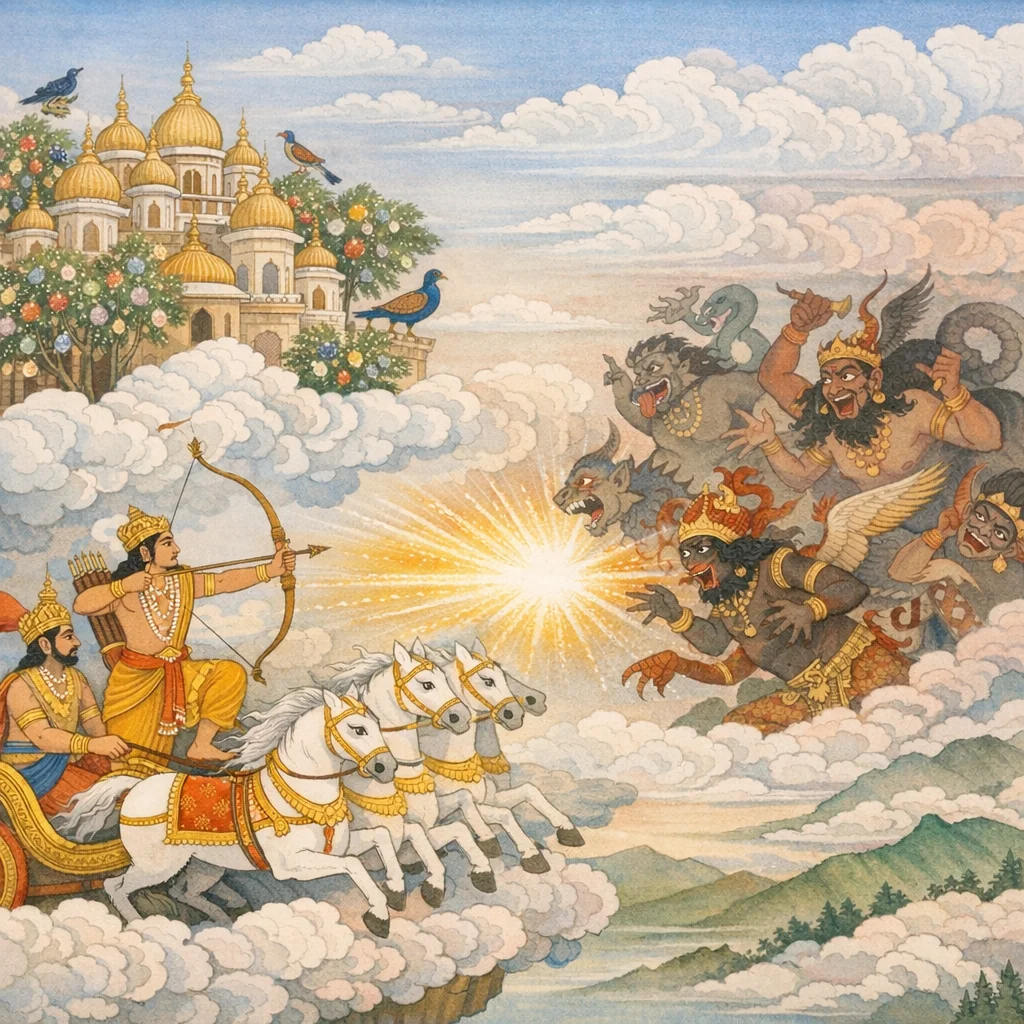
अर रत (0) है ० त्रिसप्तत्यांधिकशततमोब< ध्याय: अर्जुनद्वारा हिरण्यपुरवासी पौलोम तथा कालकेयोंका वध और इन्द्रद्वारा अर्जुनका अभिनन्दन अजुन उवाच निवर्तमानेन मया महदू दृष्टं ततो5परम् पुरं कामचरं दिव्यं पावकार्कसमप्रभम्,अर्जुन बोले--राजन्! तत्पश्चात् लौटते समय मार्ममें मैंने एक दूसरा दिव्य एवं विशाल नगर देखा, जो अग्नि और सूर्यके समान प्रकाशित हो रहा था। वह अपने निवासियोंकी इच्छाके अनुसार सर्वत्र आ-जा सकता था
Arjuna said: “O King, as I was returning, I saw something even more remarkable than what had preceded—a vast, celestial city that could move at will, shining with a radiance like fire and the sun. It seemed to go wherever its inhabitants desired.”
Verse 2
रत्नद्रुममयैश्षित्रै: सुस्वरैश्व पतत्त्रिभि: पौलोमै: कालकज्जैश्न नित्यहृष्टे रधिष्ठितम्,विचित्र र॒त्नमय वृक्ष और मधुर स्वरमें बोलनेवाले पक्षी उस नगरकी शोभा बढ़ाते थे। पौलोम और कालकज्ज नामक दानव सदा प्रसन्नतापूर्वक वहाँ निवास करते थे
Arjuna said: “That city was adorned with wondrous jewel-like trees and with birds of sweet song. There, the demons named Pauloma and Kālakañja dwelt continually in a state of delight.”
Verse 3
गोपुराट्टालकोपेतं चतुर्द्धारं दुरासदम् सर्वरत्नमयं दिव्यमद्भुतोपमदर्शनम्,उस नगरमें ऊँचे-ऊँचे गोपुरोंसहित सुन्दर अट्ठटालिकायें सुशोभित थीं। उसमें चारों दिशाओंमें एक-एक करके चार फाटक लगे थे। शत्रुओंके लिये उस नगरमें प्रवेश पाना अत्यन्त कठिन था। सब प्रकारके रत्नोंसे निर्मित वह दिव्य नगर अद्भुत दिखायी देता था
Arjuna said: “That city was adorned with lofty gateway-towers and beautiful multi-storied mansions. It had four gates, one in each direction, and was exceedingly hard for enemies to enter. Fashioned as if from every kind of jewel, it appeared radiant and wondrous—its very sight comparable to a marvel.”
Verse 4
ट्रुमै: पुष्पफलोपेतै: सर्वरत्नमयैर्वृतम् तथा पतनत्र्त्रिभिर्दिव्यैरुपेतं सुमनोहरै:,फल और फूलोंसे भरे हुए सर्वरत्नमय वृक्ष नगरको सब ओरसे घेरे हुए थे तथा वह नगर दिव्य एवं अत्यन्त मनोहर पक्षियोंसे युक्त था
Arjuna said: “The city was encircled on every side by trees laden with flowers and fruits, trees that seemed fashioned of every kind of jewel; and it was further adorned with divine, exceedingly charming birds.”
Verse 5
असुरैर्नित्यमुदितै: शूलर्टिमुसलायुधै: चापमुद्गरहस्तैश्व स्रग्विभि: सर्वतो वृतम्,सदा प्रसन्न रहनेवाले बहुत-से असुर गलेमें सुन्दर माला धारण किये और हाथोंमें शूल, ऋष्टि, मुसल, धनुष तथा मुद्गर आदि अस्त्र-शस्त्र लिये सब ओरसे घेरकर उस नगरकी रक्षा करते थे
Arjuna said: “That city was surrounded on every side by ever-exultant Asuras—garlanded and fully armed—bearing spears, javelins, clubs, bows, and maces in their hands, constantly guarding it.”
Verse 6
तदहं प्रेक्ष्य दैत्यानां पुरमद्भुतदर्शनम् अपृच्छे मातलिं राजन् किमिदं वर्तते5द्भुतम्,राजन! दैत्योंके उस अद्भुत दिखायी देनेवाले नगरको देखकर मैंने मातलिसे पूछा --'सारथे! यह कौन-सा अद्भुत नगर है?”
Seeing that wondrous city of the Daityas, I asked Mātali, ‘O king, what is this extraordinary sight that is appearing here?’
Verse 7
मातलिरुवाच पुलोमा नाम दैतेयी कालका च महासुरी दिव्यं वर्षमहस्रं ते चेरतु: परमं तप:,मातलिने कहा--पार्थ! दैत्यकुलकी कन्या पुलोमा तथा महान् असुरवंशकी कन्या कालका--उन दोनोंने एक हजार दिव्य वर्षोतक बड़ी भारी तपस्या की। तदनन्तर तपस्या पूर्ण होनेपर भगवान् ब्रह्माजीने उन दोनोंको वर दिया। उन्होंने यही वर माँगा कि “हमारे पुत्रोंका दुःख दूर हो जाय”
Mātali said: “There was a Daitya woman named Pulomā, and also Kālākā, a mighty Asurī. Those two undertook the highest austerity for a thousand divine years.”
Verse 8
तपसोडन््ते ततस्ताभ्यां स्वयम्भूरदद् वरम् अगृल्लीतां वरं ते तु सुतानामल्पदुःखताम्,मातलिने कहा--पार्थ! दैत्यकुलकी कन्या पुलोमा तथा महान् असुरवंशकी कन्या कालका--उन दोनोंने एक हजार दिव्य वर्षोतक बड़ी भारी तपस्या की। तदनन्तर तपस्या पूर्ण होनेपर भगवान् ब्रह्माजीने उन दोनोंको वर दिया। उन्होंने यही वर माँगा कि “हमारे पुत्रोंका दुःख दूर हो जाय”
Arjuna said: “When their austerities had reached completion, the Self-born Lord Brahmā granted those two a boon. They, however, chose this boon: that their sons might suffer only little sorrow—indeed, that their sons’ distress be removed.”
Verse 9
अवध्यतां च राजेन्द्र सुरराक्षसपन्नगै: पुरं सुरमणीयं च खचरं सुमहाप्रभम्,राजेन्द्र! उन दोनोंने यह भी प्रार्थना की कि “हमारे पुत्र देवता, राक्षस तथा नागोंके लिये भी अवध्य हों। इनके रहनेके लिये एक सुन्दर नगर होना चाहिये, जो अपने महान प्रभा- पुज्जसे जगमगा रहा हो। वह नगर विमानकी भाँति आकाशमें विचरनेवाला होना चाहिये, उसमें सब प्रकारके रत्नोंका संचय रहना चाहिये, देवता, महर्षि, यक्ष, गन्धर्व, नाग, असुर तथा राक्षस कोई भी उसका विध्वंस न कर सके। वह नगर समस्त मनोवाजञ्छित गुणोंसे सम्पन्न, शोकशून्य तथा रोग आदिसे रहित होना चाहिये।” भरतश्रेष्ठ! ब्रह्माजीने कालकेयोंके लिये वैसे ही नगरका निर्माण किया था। यह वही आकाशचारी दिव्य नगर है, जो सर्वत्र विचरता है। इसमें देवताओंका प्रवेश नहीं है। वीरवर! इसमें पौलोम और कालकंज नामक दानव ही निवास करते हैं
Arjuna said: “O king, they further sought a boon that their sons should be invulnerable even to gods, rākṣasas, and nāgas, and that they should possess a supremely beautiful city—radiant with great splendor—moving through the sky like a celestial craft. It was to be filled with every kind of jewel, incapable of being destroyed by any being—devas, great seers, yakṣas, gandharvas, nāgas, asuras, or rākṣasas—endowed with all desired excellences, free from sorrow, and untouched by disease. O best of the Bharatas, Brahmā fashioned such a city for the Kālakeyas. This is that very divine, sky-roaming city that ranges everywhere; the gods have no entry into it, and the daityas named Pauloma and Kālakāñja dwell there.”
Verse 10
सर्वरत्नै: समुदितं दुर्धर्षममरैरपि महर्षियक्षगन्धर्वपन्नगासुरराक्षसै:,राजेन्द्र! उन दोनोंने यह भी प्रार्थना की कि “हमारे पुत्र देवता, राक्षस तथा नागोंके लिये भी अवध्य हों। इनके रहनेके लिये एक सुन्दर नगर होना चाहिये, जो अपने महान प्रभा- पुज्जसे जगमगा रहा हो। वह नगर विमानकी भाँति आकाशमें विचरनेवाला होना चाहिये, उसमें सब प्रकारके रत्नोंका संचय रहना चाहिये, देवता, महर्षि, यक्ष, गन्धर्व, नाग, असुर तथा राक्षस कोई भी उसका विध्वंस न कर सके। वह नगर समस्त मनोवाजञ्छित गुणोंसे सम्पन्न, शोकशून्य तथा रोग आदिसे रहित होना चाहिये।” भरतश्रेष्ठ! ब्रह्माजीने कालकेयोंके लिये वैसे ही नगरका निर्माण किया था। यह वही आकाशचारी दिव्य नगर है, जो सर्वत्र विचरता है। इसमें देवताओंका प्रवेश नहीं है। वीरवर! इसमें पौलोम और कालकंज नामक दानव ही निवास करते हैं
Arjuna said: “O king, they asked for a city heaped with every kind of jewel—unassailable even by the gods, and impossible to destroy by great seers, Yakṣas, Gandharvas, Nāgas, Asuras, and Rākṣasas. They prayed that their sons should be invulnerable even to gods, demons, and serpents, and that they should possess a splendid city, blazing with great radiance, moving through the sky like a vimāna, filled with all treasures, endowed with every desired excellence, free from sorrow and disease. For the Kālakeyas, Brahmā fashioned just such a city—this very divine, sky-roaming city that wanders everywhere, into which the gods have no entry; and in it dwell the Dānavas named Pauloma and Kālakāñja.”
Verse 11
सर्वकामगुणोपेतं वीतशोकमनामयम् ब्रह्मणा भरतश्रेष्ठ कालकेयकृते कृतम्,राजेन्द्र! उन दोनोंने यह भी प्रार्थना की कि “हमारे पुत्र देवता, राक्षस तथा नागोंके लिये भी अवध्य हों। इनके रहनेके लिये एक सुन्दर नगर होना चाहिये, जो अपने महान प्रभा- पुज्जसे जगमगा रहा हो। वह नगर विमानकी भाँति आकाशमें विचरनेवाला होना चाहिये, उसमें सब प्रकारके रत्नोंका संचय रहना चाहिये, देवता, महर्षि, यक्ष, गन्धर्व, नाग, असुर तथा राक्षस कोई भी उसका विध्वंस न कर सके। वह नगर समस्त मनोवाजञ्छित गुणोंसे सम्पन्न, शोकशून्य तथा रोग आदिसे रहित होना चाहिये।” भरतश्रेष्ठ! ब्रह्माजीने कालकेयोंके लिये वैसे ही नगरका निर्माण किया था। यह वही आकाशचारी दिव्य नगर है, जो सर्वत्र विचरता है। इसमें देवताओंका प्रवेश नहीं है। वीरवर! इसमें पौलोम और कालकंज नामक दानव ही निवास करते हैं
Arjuna said: “O best of the Bharatas, Brahmā fashioned for the Kālkeyas a city endowed with every desirable excellence—free from sorrow and untouched by disease. It was created to fulfill their petition for an inviolable refuge, a radiant aerial stronghold beyond the reach of gods, sages, yakṣas, gandharvas, nāgas, asuras, and rākṣasas. This is that divine, sky-moving city that roams everywhere; the gods have no entry there, and it is inhabited by the demons Pauloma and Kālakāñja.”
Verse 12
तदेतत् खपुरं दिव्यं चरत्यमरवर्जितम् पौलोमाध्युषितं वीर कालकज्जैश्व दानवै:,राजेन्द्र! उन दोनोंने यह भी प्रार्थना की कि “हमारे पुत्र देवता, राक्षस तथा नागोंके लिये भी अवध्य हों। इनके रहनेके लिये एक सुन्दर नगर होना चाहिये, जो अपने महान प्रभा- पुज्जसे जगमगा रहा हो। वह नगर विमानकी भाँति आकाशमें विचरनेवाला होना चाहिये, उसमें सब प्रकारके रत्नोंका संचय रहना चाहिये, देवता, महर्षि, यक्ष, गन्धर्व, नाग, असुर तथा राक्षस कोई भी उसका विध्वंस न कर सके। वह नगर समस्त मनोवाजञ्छित गुणोंसे सम्पन्न, शोकशून्य तथा रोग आदिसे रहित होना चाहिये।” भरतश्रेष्ठ! ब्रह्माजीने कालकेयोंके लिये वैसे ही नगरका निर्माण किया था। यह वही आकाशचारी दिव्य नगर है, जो सर्वत्र विचरता है। इसमें देवताओंका प्रवेश नहीं है। वीरवर! इसमें पौलोम और कालकंज नामक दानव ही निवास करते हैं
Arjuna said: “This is that wondrous celestial ‘sky-city’ which moves through the air and is barred to the gods. O hero, it is inhabited by the Pauloma demons and also by the Dānavas called the Kālakajas.”
Verse 13
हिरण्यपुरमित्येवं ख्यायते नगरं महत् रक्षितं कालकेयैश्न पौलोमैश्न महासुरै:,यह विशाल नगर हिरण्यपुरके नामसे विख्यात है। कालकेय तथा पौलोम नामक महान् असुर इसकी रक्षा करते हैं
Arjuna said: “There is a great city renowned by the name Hiraṇyapura. It is guarded by the mighty Asuras known as the Kālakeyas and the Paulomas.”
Verse 14
त एते मुदिता राजन्नवध्या: सर्वदैवतै: निवसन्त्यत्र राजेन्द्र गतोद्वेगा निरुत्सुका:,राजन! ये वे ही दानव हैं, जो सम्पूर्ण देवताओंसे अवध्य रहकर उद्वेग तथा उत्कण्ठासे रहित हो यहाँ प्रसन्नतापूर्वक निवास करते हैं
Arjuna said: “O King, these very Dānavas dwell here in gladness. They are invulnerable to all the gods, and, O lord of kings, they live here free from agitation and without anxious longing.”
Verse 15
मानुषान्मृत्युरेतेषां निर्दिष्टो ब्रह्मणा पुरा एतानपि रणे पार्थ कालकज्जान् दुरासदान् वज्ास्त्रेण नयस्वाशु विनाशं सुमहाबलान्,पूर्वकालमें ब्रह्माजीने मनुष्यके हाथसे इनकी मृत्यु निश्चित की थी। कुन्तीकुमार! ये कालकंज और पौलोम अत्यन्त बलवान तथा दुर्धर्ष हैं। तुम युद्धमें वज्रास्त्रके द्वारा इनका भी शीघ्र ही संहार कर डालो
Arjuna said: “Long ago Brahmā ordained that these beings would meet their death at the hands of a human. Therefore, O Pārtha, even these formidable, hard-to-approach Kālakaja warriors—mighty in strength—must be swiftly brought to destruction in battle by the Vajra-weapon. Thus what is fated is fulfilled through disciplined action in the protection of dharma.”
Verse 16
अजुन उवाच सुरासुरैरवध्यं तदहं ज्ञात्वा विशाम्पते अब्र॒ुवं मातलिं हृष्टो याहेतत् पुरमज्जसा,अर्जुन बोले--राजन्! उस हिरण्यपुरको देवताओं और असुरोंके लिये अवध्य जानकर मैंने मातलिसे प्रसन्नतापूर्वक कहा--'आप यथाशीघ्र इस नगरमें अपना रथ ले चलिये'
Arjuna said: “O lord of the people (King)! Knowing that this city, Hiraṇyapura, was invulnerable to both gods and demons, I spoke to Mātali with delight: ‘Drive the chariot swiftly into this city at once.’”
Verse 17
त्रिदशेशद्विषो यावत् क्षयमस्त्रैर्नयाम्यहम् न कथज्वचिद्धि मे पापा न वध्या ये सुरद्विष:,“जिससे देवराजके द्रोहियोंको मैं अपने अस्त्रोंद्वारा नष्ट कर डालूँ। जो देवताओंसे द्वेष रखते हैं, उन पापियोंको मैं किसी प्रकार मारे बिना नहीं छोड़ सकता”
Arjuna said: “I will, with my weapons, drive the enemies of the Lord of the gods to their destruction. Those sinners who bear hatred toward the gods I cannot leave unpunished in any way; I cannot let them go without slaying them.”
Verse 18
उवाह मां ततः शीघ्र हिरण्यपुरमन्तिकात् रथेन तेन दिव्येन हरियुक्तेन मातलि:,मेरे ऐसा कहनेपर मातलिने घोड़ोंसे युक्त उस दिव्य रथके द्वारा मुझे शीघ्र ही हिरण्यपुरके निकट पहुँचा दिया
At my request, Mātali swiftly carried me in that celestial chariot drawn by horses, bringing me near the city of Hiraṇyapura.
Verse 19
ते मामालक्ष्य दैतेया विचित्रा भरणाम्बरा: समुत्पेतुर्महावेगा रथानास्थाय दंशिता:,मुझे देखते ही विचित्र वस्त्राभूषणोंसे विभूषित वे दैत्य कवच पहनकर अपने रथोंपर जा बैठे और बड़े वेगसे मेरे ऊपर टूट पड़े
Arjuna said: “The Daityas, adorned with variegated ornaments and garments, caught sight of me. Armoured and mounted upon their chariots, they sprang forward with great speed and rushed to attack me.”
Verse 20
ततो नालीकनाराचैर्भल्लै: शक्त्यृष्टितोमरै: प्रत्यघ्नन् दानवेन्द्रा मां क्रुद्धास्तीव्रपराक्रमा:,तत्पश्चात् क्रोधमें भरे हुए उन प्रचण्ड पराक्रमी दानवेन्द्रोंने नालीक, नाराच, भल्ल, शक्ति, ऋष्टि तथा तोमर आदि अस्त्रोंद्वारा मुझे मारना आरम्भ किया
Then those lordly Dānavas, their fury aroused and their might fierce, began striking at me from all sides with nālīka arrows, nārācas, bhallas, and with weapons such as the śakti, ṛṣṭi, and tomara.
Verse 21
तदहं शरवर्षेण महता प्रत्यवारयम् शस्त्रवर्ष महद् राजन् विद्याबलमुपाश्रित:,राजन्! उस समय मैंने विद्या-बलका आश्रय लेकर महती बाण-वर्षके द्वारा उनके अस्त्र-शस्त्रोंकी भारी बौछारको रोका और युद्ध-भूमिमें रथके विभिन्न पैंतरे बदलकर विचरते हुए उन सबको मोहमें डाल दिया। वे ऐसे किंकर्तव्यविमूढ हो रहे थे कि आपसमें ही लड़कर एक-दूसरे दानवोंको धराशायी करने लगे
Then, O King, relying on the strength of my martial knowledge, I checked their great shower of weapons with a mighty rain of arrows. Moving across the battlefield with varied chariot-manoeuvres, I cast them into confusion; so bewildered were they about what to do that they began fighting among themselves and struck down their own demon allies.
Verse 22
व्यामोहयं च तान् सर्वान् रथमार्गैश्चरन् रणे तेडन्योन्यमभिसम्मूढा: पातयन्ति सम दानवान्,राजन्! उस समय मैंने विद्या-बलका आश्रय लेकर महती बाण-वर्षके द्वारा उनके अस्त्र-शस्त्रोंकी भारी बौछारको रोका और युद्ध-भूमिमें रथके विभिन्न पैंतरे बदलकर विचरते हुए उन सबको मोहमें डाल दिया। वे ऐसे किंकर्तव्यविमूढ हो रहे थे कि आपसमें ही लड़कर एक-दूसरे दानवोंको धराशायी करने लगे
Arjuna said: “O King, moving about the battlefield by varying the courses of my chariot, I threw all of them into confusion. Bewildered and unable to discern their proper course, they began striking one another, and thus those Dānavas fell—brought down by their own mutual combat. In that moment, relying on the strength of my martial knowledge, I checked the heavy shower of their weapons with a great rain of arrows.”
Verse 23
तेषामेवं विमूढानामन्योन्यमभिधावताम् शिरांसि विशियेर्दीप्तैन्यहनं शतसड्घश:
Arjuna said: “As those men, thus deluded, rushed at one another in confusion, I struck down their heads—again and again, in hundreds and in groups—with my blazing, superior weapons.”
Verse 24
इस प्रकार मूढ़चित्त हो आपसमें ही एक-दूसरेपर धावा करनेवाले उन दानवोंके सौ-सौ मस्तकोंको मैं अपने प्रज्वलित बाणोंद्वारा काट-काटकर गिराने लगा ।। ते वध्यमाना दैतेया: पुरमास्थाय तत् पुनः खमुत्पेतु: सनगरा मायामास्थाय दानवीम्,वे दैत्य जब इस प्रकार मारे जाने लगे, तब पुनः अपने उस नगरमें ही घुस गये और दानवी मायाका सहारा ले नगर सहित आकाशमें ऊँचे उड़ गये
Arjuna said: Seeing those Dānava warriors, their minds deluded, rushing at one another in mutual assault, I began to cut down and cast to the ground their heads by the hundreds with my blazing arrows. But as the Daiteyas were thus being slain, they withdrew again into their city; then, resorting to demonic illusion, they rose up into the sky together with the entire city.
Verse 25
ततो<हं शरवर्षेण महता कुरुनन्दन मार्गमावृत्य दैत्यानां गतिं चैषामवारयम्,कुरुनन्दन! तब मैं बाणोंकी भारी बौछार करके दैत्योंका मार्ग रोक लिया और उनकी गति कुण्ठित कर दी
Then, O joy of the Kurus, I covered the way with a great shower of arrows and checked the Daityas—blocking their advance and breaking the momentum of their movement.
Verse 26
तत् पुरं खचरं दिव्यं कामगं सूर्यसप्रभम् दैतेयैर्वरदानेन धार्यते सम यथासुखम्,सूर्यके समान प्रकाशित होनेवाला दैत्योंका वह आकाशचारी दिव्य नगर उनकी इच्छाके अनुसार चलनेवाला था और दैत्यलोग वरदानके प्रभावसे उसे सुखपूर्वक आकाशमें धारण करते थे
Arjuna said: “That celestial city, moving through the sky, wondrous and radiant like the sun, could go wherever its occupants wished. By the power of a boon, the Daityas were able to bear and sustain it in the heavens with ease and comfort.”
Verse 27
अन्तर्भूमौ निपतति पुनरूर्ध्व॑ प्रतिष्ठते पुनस्तिर्यक् प्रयात्याशु पुनरप्सु निमज्जति,वह दिव्य पुर कभी पृथ्वीपर अथवा पातालमें चला जाता, कभी ऊपर उड़ जाता, कभी तिरछी दिशाओंमें चलता और कभी शीघ्र ही जलमें डूब जाता था
Arjuna said: “That wondrous, divine being would at one moment plunge into the earth, at another rise upward again; sometimes it would swiftly move in slanting directions, and sometimes it would quickly sink into the waters.”
Verse 28
अमरावतिसंकाशं तत् पुरं कामगं महत् अहमस्त्रैरबहुविधै: प्रत्यगृह्लं परंतप,परंतप! इच्छानुसार विचरनेवाला वह विशाल नगर अमरावतीके ही तुल्य था; परंतु मैंने नाना प्रकारके अस्त्रों द्वारा उसे सब ओरसे रोक लिया
Arjuna said: “That great city, moving at will, shone like Amarāvatī itself. Yet, O scorcher of foes, I hemmed it in on every side by deploying many kinds of weapons—checking its freedom of movement and bringing it under control.”
Verse 29
ततो<हं शरजालेन दिव्यास्त्रनुदितेन च व्यगृह्नं सह दैतेयैस्तत् पुरं पुरुषर्षभ,नरश्रेष्ठ! फिर दिव्यास्त्रोंसे अभिमन्त्रित बाणसमूहोंकी वृष्टि करते हुए मैंने दैत्योंसहित उस नगरको क्षत-विक्षत करना आरम्भ किया
Then, O bull among men, I unleashed a net of arrows—empowered by divine weapons—and, together with the Daityas, began to batter and tear that city apart.
Verse 30
विक्षतं चायसैर्बाणर्म-्प्रयुक्तैरजिद्वागै: महीमभ्यपतदू राजन् प्रभग्नं पुरमासुरम्,राजन! मेरे चलाये हुए लोहनिर्मित बाण सीधे लक्ष्यतक पहुँचनेवाले थे। उनसे क्षतिग्रस्त हुआ वह दैत्य-नगर तहस-नहस होकर पृथ्वीपर गिर पड़ा
Arjuna said: “O King, the iron arrows I discharged—swift and unerring in their course—struck the target and tore it apart. Thus the Asura-city, shattered and ruined, fell down upon the earth.”
Verse 31
ते वध्यमाना मद्वाणैर्वज़वेगैरयस्मयै: पर्यभ्रमन्त वै राजन्नसुरा: कालचोदिता:,महाराज! लोहेके बने हुए मेरे बाणोंका वेग वज्ञ़के समान था। उनकी मार खाकर वे कालप्रेरित असुर चारों ओर चक्कर काटने लगते थे
Arjuna said: “O King, struck by my iron arrows—swift as Indra’s thunderbolt—the Asuras, driven onward by Time itself, reeled and whirled about on every side.”
Verse 32
ततो मातलिरारुह्म[ पुरस्तान्निपतन्निव महीमवातरत क्षिप्रं रथेनादित्यवर्चसा,तदनन्तर मातलि आकाशमें ऊँचे चढ़कर सूर्यके समान तेजस्वी रथद्वारा उन राक्षसोंके सामने गिरते हुए-से शीघ्र ही पृथ्वीपर उतरे
Then Mātali, mounting up into the sky, descended swiftly to the earth in his sun-bright chariot, as though falling straight down before the foes.
Verse 33
ततो रथसहस्राणि षष्टिस्तेषाममर्षिणाम् युयुत्सूनां मया सार्थ पर्यवर्तन्त भारत तान्यहं निशितैर्बाणिव्यधरमं गार्ध्रराजितै:,भरतनन्दन! उस समय युद्धकी इच्छासे अमर्षमें भरे हुए उन दानवोंके साठ हजार रथ मेरे साथ लड़नेके लिये डट गये। यह देख मैंने गृद्धपंखसे सुशोभित तीखे बाणोंद्वारा उन सबको घायल करना आरम्भ किया
Then, O Bhārata, sixty thousand chariots of those wrath-filled beings, eager to fight, wheeled about and formed up against me. Seeing this, O delight of the Bharatas, I began to wound them all with sharp arrows, splendidly adorned with vulture-feathers.
Verse 34
ते युद्धे सन्न्यवर्तन्त समुद्रस्थ यथोर्मय: नेमे शक्या मानुषेण युद्धेनेति प्रचिन्त्य तत्
Arjuna said: “In the midst of battle they turned back, like waves that rise within the ocean and then subside. Reflecting on that, it became clear: ‘These cannot be overcome by a merely human mode of fighting.’”
Verse 35
ततस्तानि सहस्राणि रथिनां चित्रयोधिनाम्
Then those thousands of chariot-warriors—fighters of varied and striking prowess—came into view, revealing the vast scale of the host and the many forms of skill and resolve gathered for the coming conflict.
Verse 36
अस्त्राणि मम दिव्यानि प्रत्यघध्नन् शनकैरिव परंतु विचित्र युद्ध करनेवाले वे सहस्रों रथारूढ़ दानव धीरे-धीरे मेरे दिव्यास्त्रोंका भी निवारण करने लगे ।। रथमार्गान् विचित्रांस्ते विचरन्तो महाबला:
Arjuna said: “My celestial weapons were being countered, as though little by little. Yet those thousands of chariot-mounted Dānavas—skilled in strange and varied modes of fighting—began, gradually, to obstruct even my divine missiles. Moving about with great strength along intricate chariot-paths and maneuvers, they kept shifting their courses in battle.”
Verse 37
विचित्रमुकुटापीडा विचित्रकवचध्वजा:
Arjuna said: “They are adorned with wondrous crowns and diadems, and they bear variegated armor and banners.”
Verse 38
अहं तु शरवर्षैस्तानस्त्रप्रचुदितै रणे
Arjuna said: “But I, in the midst of battle, will assail them with showers of arrows, driven forth by my weapons.”
Verse 39
तैः पीड्यमानो बहुभि: कृतास्त्रै: कुशलैर्युधि
Arjuna said: “Pressed hard by many—skilled in battle and armed with prepared weapons—I was being sorely harassed in the fight.”
Verse 40
ततो&हं देवदेवाय रुद्राय प्रयतो रणे
Then, in the midst of battle, I—composed and disciplined—turned in reverent address to Rudra, the God of gods, seeking his favor and guidance amid the demands of righteous combat.
Verse 41
(प्रयत: प्रणतो भूत्वा नमस्कृत्य महात्मने ।) स्वस्ति भूतेभ्य इत्युक्त्वा महास्त्रं समचोदयम् तब मैंने एकाग्रचित्त हो मस्तक झुकाकर देवाधिदेव महात्मा रुद्रको प्रणाम किया और “समस्त भूतोंका कल्याण हो” ऐसा कहकर उनके महान् पाशुपतास्त्रका प्रयोग किया ।। ४० ई | यत् तद् रौद्रमिति ख्यातं सर्वामित्रविनाशनम्,उसीको “रौद्रास्त्र” भी कहते हैं। वह समस्त शत्रुओंका विनाश करनेवाला है। वह महान् एवं दिव्य पाशुपतास्त्र सम्पूर्ण विश्वके लिये वन्दनीय है। उसका प्रयोग करते ही मुझे एक दिव्य पुरुषका दर्शन हुआ, जिनके तीन मस्तक, तीन मुख, नौ नेत्र तथा छः: भुजाएँ थीं। उनका स्वरूप बड़ा तेजस्वी था। उनके मस्तकके बाल सूर्यके समान प्रज्वलित हो रहे थे
After bowing in reverence and offering salutations to the great Lord, Arjuna uttered, “May there be well-being for all beings,” and then set in motion the mighty weapon. The act is framed not as personal vengeance but as a solemn, restrained deployment of divine force, preceded by humility and a universal benediction—an ethical reminder that even in war, power must be invoked with reverence and concern for the welfare of all.
Verse 42
(महत् पाशुपतं दिव्यं सर्वतोकनमस्कृतम् ।) ततो<पश्यं त्रिशिरसं पुरुषं नवलोचनम् त्रिमुखं षपड्भुजं दीप्तमर्कज्वलनमूर्थजम्,उसीको “रौद्रास्त्र” भी कहते हैं। वह समस्त शत्रुओंका विनाश करनेवाला है। वह महान् एवं दिव्य पाशुपतास्त्र सम्पूर्ण विश्वके लिये वन्दनीय है। उसका प्रयोग करते ही मुझे एक दिव्य पुरुषका दर्शन हुआ, जिनके तीन मस्तक, तीन मुख, नौ नेत्र तथा छः: भुजाएँ थीं। उनका स्वरूप बड़ा तेजस्वी था। उनके मस्तकके बाल सूर्यके समान प्रज्वलित हो रहे थे
Arjuna said: “Then I beheld a wondrous, divine Person—three-headed, three-faced, nine-eyed, and six-armed—radiant with blazing splendor, whose hair flared like the sun. This was in connection with the great, heavenly Pāśupata weapon, revered by the whole world, a power spoken of as ‘Raudra’ and capable of destroying all enemies.”
Verse 43
लेलिहानैर्महानागै: कृतचीरममित्रहन् (भक्तानुकम्पिनं देवं नागयज्ञोपवीतिनम् ।) विभीस्ततस्तदस्त्र॑ तु घोरं रौद्रं सनातनम्,शत्रुदमन नरेश! लपलपाती जीभवाले बड़े-बड़े नाग उन दिव्य पुरुषके लिये चीर (वस्त्र) बने हुए थे। भक्तोंपर अनुग्रह करनेवाले उन महादेवजीने सर्पोंका ही यज्ञोपवीत धारण कर रखा था। उनके दर्शनसे मेरा सारा भय जाता रहा। भरतश्रेष्ठ! फिर तो मैंने उस भयंकर एवं सनातन पाशुपतास्त्रको गाण्डीव धनुषपर संयोजित करके अमित तेजस्वी त्रिनेत्रधारी भगवान् शंकरको नमस्कार किया और उन दाननवेन्द्रोंके विनाशके लिये उनपर चला दिया। उस अस्त्रके छूटते ही उससे सहस्रों रूप प्रकट हो गये
Arjuna said: “O slayer of foes! Great serpents, their tongues flickering, served as the very garments of that divine Lord; and out of compassion for devotees, the God wore serpents themselves as his sacred thread. At the sight of him, all my fear fell away. Then, O king who subdues enemies, I set upon the Gāṇḍīva bow that dreadful, Rudra-born, eternal weapon—the Pāśupata—and, bowing to the immensely radiant, three-eyed Lord Śaṅkara, I released it for the destruction of those lordly Dānavas. The moment it was discharged, it manifested in thousands of forms.”
Verse 44
दृष्टवा गाण्डीवसंयोगमानीय भरतर्षभ नमस्कृत्वा त्रिनेत्राय शर्वायामिततेजसे,शत्रुदमन नरेश! लपलपाती जीभवाले बड़े-बड़े नाग उन दिव्य पुरुषके लिये चीर (वस्त्र) बने हुए थे। भक्तोंपर अनुग्रह करनेवाले उन महादेवजीने सर्पोंका ही यज्ञोपवीत धारण कर रखा था। उनके दर्शनसे मेरा सारा भय जाता रहा। भरतश्रेष्ठ! फिर तो मैंने उस भयंकर एवं सनातन पाशुपतास्त्रको गाण्डीव धनुषपर संयोजित करके अमित तेजस्वी त्रिनेत्रधारी भगवान् शंकरको नमस्कार किया और उन दाननवेन्द्रोंके विनाशके लिये उनपर चला दिया। उस अस्त्रके छूटते ही उससे सहस्रों रूप प्रकट हो गये
Arjuna said: “O bull among the Bharatas, after bringing the Gāṇḍīva and fitting it for use, I bowed to the three-eyed Śarva, whose splendor is immeasurable. O king, the great serpents with flickering tongues served as the divine Lord’s garments, and that Mahādeva—ever compassionate to his devotees—wore a serpent itself as his sacred thread. At the sight of him, all my fear vanished. Then, O best of the Bharatas, I set upon the Gāṇḍīva that dreadful and eternal Pāśupata weapon; having saluted the three-eyed, radiant Lord Śaṅkara, I released it against those chiefs of the Dānavas for their destruction. The moment the weapon was discharged, it manifested in thousands of forms.”
Verse 45
मुक्तवान् दानवेन्द्राणां पपाभावाय भारत मुक्तमात्रे ततस्तस्मिन् रूपाण्यासन् सहस्रश:,शत्रुदमन नरेश! लपलपाती जीभवाले बड़े-बड़े नाग उन दिव्य पुरुषके लिये चीर (वस्त्र) बने हुए थे। भक्तोंपर अनुग्रह करनेवाले उन महादेवजीने सर्पोंका ही यज्ञोपवीत धारण कर रखा था। उनके दर्शनसे मेरा सारा भय जाता रहा। भरतश्रेष्ठ! फिर तो मैंने उस भयंकर एवं सनातन पाशुपतास्त्रको गाण्डीव धनुषपर संयोजित करके अमित तेजस्वी त्रिनेत्रधारी भगवान् शंकरको नमस्कार किया और उन दाननवेन्द्रोंके विनाशके लिये उनपर चला दिया। उस अस्त्रके छूटते ही उससे सहस्रों रूप प्रकट हो गये
Arjuna said: “O Bhārata, I released it to destroy the wickedness of the lords of the Dānavas. And the instant that weapon was discharged, it manifested in thousands of forms.”
Verse 46
मृगाणामथ सिंहानां व्याप्राणां च विशाम्पते ऋक्षाणां महिषाणां च पन्नगानां तथा गवाम्
Arjuna said: “O lord of the people, (I speak) of deer, and of lions, and of tigers; of bears and buffaloes as well; and likewise of serpents and of cattle.”
Verse 47
शरभाणां गजानां च वानराणां च सड्घश: ऋषभाणां वराहाणां मार्जाराणां तथैव च
Arjuna said: “In clustered multitudes there were śarabhas, elephants, and troops of monkeys; likewise there were bulls, boars, and also cats.”
Verse 48
शालावृकाण्णा प्रेतानां भुरुण्डानां च सर्वशः गृध्राणां गरुडानां च चमराणां तथैव च
Arjuna said: “(I see) everywhere jackals, hosts of spirits of the dead, and bhuruṇḍas; likewise vultures and garuḍas, and also chamaras.”
Verse 49
देवानां च ऋषीणां च गन्धर्वाणां च सर्वशः पिशाचानां सयक्षाणां तथैव च सुरद्धिषाम्
Arjuna said: “Of the gods and the seers, and of the Gandharvas in every way; of the Piśācas together with the Yakṣas, and likewise of those who preside over the hosts of the gods.”
Verse 50
गुहाकानां च संग्रामे नै#तानं तथैव च झषाणां गजवकक्त्राणामुलूकानां तथैव च
Arjuna said: “In battle, among the guhākas as well—and likewise among these—among the fishes, among those with elephant-like faces, and likewise among the owls as well.”
Verse 51
मीनवाजिसरूपाणां नानाशस्त्रासिपाणिनाम् तथैव यातुधानानां गदामुद्गरधारिणाम्
Arjuna said: “(I beheld) beings in the forms of fish and horses, their hands bearing many kinds of weapons and swords; and likewise rākṣasa-like yātudhānas, wielding maces and heavy clubs.”
Verse 52
महाराज! मृग, सिंह, व्याप्र, रीछ, भैंस, नाग, गौ, शरभ, हाथी, वानर, बैल, सूअर, बिलाव, भेड़िये, प्रेत, मुरुण्ड, गिद्ध, गरुड, चमरी गाय, देवता, ऋषि, गन्धर्व, पिशाच, यक्ष, देवद्रोही राक्षस, गुह्मक, निशाचर, मत्स्य, गजमुख, उल्लू, मीन तथा अभश्व-जैसे रूपवाले नाना प्रकारके जीवोंका प्रादुर्भाव हुआ। उन सबके हाथमें भाँति-भाँतिके अस्त्र-शस्त्र एवं खड्ग थे। इसी प्रकार गदा और मुद्गर धारण किये बहुत-से यातुधान भी प्रकट हुए ।। ४६ “५३९ || एतैश्वान्यैश्व बहुभि्नानारूपधरैस्तथा सर्वमासीज्जगद् व्याप्तं तस्मिन्नस्त्रे विसर्जिते,इन सबके साथ दूसरे भी बहुत-से जीवोंका प्राकट्य हुआ, जिन्होंने नाना प्रकारके रूप धारण कर रखे थे। उन सबके द्वारा यह सारा जगत् व्याप्त-सा हो गया था। पाशुपतास्त्रका प्रयोग होते ही कोई तीन मस्तक, कोई चार दाढ़ें, कोई चार मुख और कोई चार भुजावाले अनेक रूपधारी प्राणी प्रकट हुए, जो मांस, मेदा, वसा और हलड्ियोंसे संयुक्त थे
Arjuna said: “O great king! At the discharge of that weapon, countless beings of many kinds came forth—taking the forms of deer, lions, tigers, bears, buffaloes, serpents, cattle, śarabhas, elephants, monkeys, bulls, boars, cats, wolves, ghosts, muruṇḍas, vultures, Garuḍas, yak-tailed cattle, gods, seers, Gandharvas, Piśācas, Yakṣas, god-hating Rākṣasas, Guhyakas, night-roamers, fish, elephant-faced creatures, owls, and fish again, and even horse-like shapes. In the hands of all of them were various weapons—arms, missiles, and swords; and many Yātudhānas appeared as well, bearing clubs and mallets. Along with these and many other shape-shifting forms, the whole world seemed filled and overrun the moment that weapon was released. The scene conveys the terrifying, world-pervading force of divine weaponry and implicitly warns that such power, once invoked, overwhelms all boundaries and must be governed by restraint and dharma.”
Verse 53
त्रिशिरोभिश्नतुर्दष्टै क्षतुरास्यै श्चतुर्भुजै: अनेकरूपसंयुक्तैर्मांसमेदोवसास्थिभि:,इन सबके साथ दूसरे भी बहुत-से जीवोंका प्राकट्य हुआ, जिन्होंने नाना प्रकारके रूप धारण कर रखे थे। उन सबके द्वारा यह सारा जगत् व्याप्त-सा हो गया था। पाशुपतास्त्रका प्रयोग होते ही कोई तीन मस्तक, कोई चार दाढ़ें, कोई चार मुख और कोई चार भुजावाले अनेक रूपधारी प्राणी प्रकट हुए, जो मांस, मेदा, वसा और हलड्ियोंसे संयुक्त थे
Arjuna said: “At the very moment the Pāśupata weapon was set in motion, countless beings of terrifying and varied forms manifested—some with three heads, some with four fangs, some with four mouths, and some with four arms—bodies compounded of flesh, fat, sinew, and bone. With their emergence, the whole world seemed as though pervaded and overwhelmed.”
Verse 54
अभीक्षणं वध्यमानास्ते दानवा नाशमागता: अर्कज्वलनतेजोभिव॑ज्राशनिसमप्रभै:,उन सबके द्वारा गहरी मार पड़नेसे वे सारे दानव नष्ट हो गये। भारत! उस समय सूर्य और अग्निके समान तेजस्वी तथा वज्ञ और अशनिके समान प्रकाशित होनेवाले शत्रुविनाशक लोहमय बाणोंद्वारा भी मैंने दो ही घड़ीमें सम्पूर्ण दानवोंका संहार कर डाला
Arjuna said: “As they were struck again and again, those Dānavas were brought to destruction. With iron arrows that blazed with the radiance of the sun and fire, and that flashed like the thunderbolt and the lightning, I swiftly annihilated the host of foes.”
Verse 55
अद्रिसारमयैश्चान्यैर्बाणैरपि निबर्हणै: न्यहनं दानवानू् सर्वान् मुहूर्तेनेव भारत,उन सबके द्वारा गहरी मार पड़नेसे वे सारे दानव नष्ट हो गये। भारत! उस समय सूर्य और अग्निके समान तेजस्वी तथा वज्ञ और अशनिके समान प्रकाशित होनेवाले शत्रुविनाशक लोहमय बाणोंद्वारा भी मैंने दो ही घड़ीमें सम्पूर्ण दानवोंका संहार कर डाला
Arjuna said: “With other arrows too—hard as the essence of mountains and crushing in their impact—I struck down all those Dānavas in but a single moment, O Bhārata. And with iron arrows, enemy-destroying, blazing like the sun and fire and flashing like the thunderbolt and lightning, I brought about the complete slaughter of the Dānavas within a very short time.”
Verse 56
गाण्डीवास्त्रप्रणुन्नांस्तान् गतासून् नभसक्ष्युतान् दृष्टवाहं प्राणमं भूयस्त्रिपुरघ्नाय वेधसे,गाण्डीव धनुषसे छूटे हुए अस्त्रोंद्वारा क्षत-विक्षत हो समस्त दानव प्राण त्यागकर आकाशसे पृथ्वीपर गिर पड़े हैं। यह देखकर मैंने पुनः त्रिपुरनाशक भगवान् शंकरको प्रणाम किया
Arjuna said: “Seeing those (demons), struck and driven by the missiles released from the Gāṇḍīva, now lifeless and fallen from the sky, I once again bowed in reverence to the Creator—Śaṅkara, the destroyer of Tripura.”
Verse 57
तथा रौद्रास्त्रनिष्पिष्टान् दिव्याभरणभूषितान् निशम्य परमं हर्षमगमद् देवसारथि:,दिव्य आभूषणोंसे विभूषित दानव पाशुपतास्त्रसे पिस गये हैं, यह देखकर देवसारथि मातलिको बड़ा हर्ष हुआ
Hearing that those demon-warriors—adorned with celestial ornaments—had been crushed by the Rudra-weapon, the charioteer of the gods was filled with supreme joy.
Verse 58
तदसहां कृतं कर्म देवैरपि दुरासदम् दृष्टवा मां पूजयामास मातलि: शक्रसारथि:,जो कार्य देवताओंके लिये भी दुष्कर और असहा था, वह मेरेद्वारा पूरा हुआ देख इन्द्रसारथि मातलिने मेरा बड़ा सम्मान किया
Arjuna said: “Seeing that I had accomplished that deed—so arduous and seemingly unbearable, and difficult even for the gods—Mātali, the charioteer of Śakra (Indra), honored me with great respect.”
Verse 59
उवाच वचन चेदं प्रीयमाण: कृताञ्जलि: सुरासुरैरसहां हि कर्म यत् साधितं त्वया,और अत्यन्त प्रसन्न हो हाथ जोड़कर कहा--'अर्जुन! आज तुमने वह कार्य कर दिखाया है जो देवताओं और असुरोंके लिये भी असाध्य था
With hands joined in reverence and his heart filled with joy, he spoke these pleasing words: “Arjuna, today you have accomplished a deed so formidable that it would be beyond the power even of the gods and the asuras.”
Verse 60
न होतत् संयुगे कर्तुमपि शक्तः सुरेश्वर: (ध्रुवं धनंजय प्रीतस्त्वयि शक्र: पुरार्दन ।) सुरासुरैरवध्यं हि पुरमेतत् खगं महत्
“Even the lord of the gods would not be able to accomplish that in battle. Surely, O Dhanañjaya, Śakra is pleased with you, O Pūrārdana. For this great flying city is indeed invulnerable to both gods and demons.”
Verse 61
विध्वस्ते खपुरे तस्मिन् दानवेषु हतेषु च,उस आकाशवर्ती नगरका विध्वंस और दानवोंका संहार हो जानेपर वहाँकी सारी स्त्रियाँ विलाप करती हुई नगरसे बाहर निकल आयीं। उनके केश बिखरे हुए थे। वे दुःख और व्यथामें डूबी हुई कुररीकी भाँति करुण-क्रन्दन करती थीं
Arjuna said: “When that aerial city had been shattered and the Dānavas slain, all the women there, wailing, came out of the city. Their hair was dishevelled; overwhelmed by grief and anguish, they raised a pitiful cry like the lament of a kurarī-bird.”
Verse 62
विनदन्त्यः स्त्रिय: सर्वा निष्पेतुर्नगराद् बहि: प्रकीर्णकेश्यो व्यथिता: कुरर्य इव दुखिता:,उस आकाशवर्ती नगरका विध्वंस और दानवोंका संहार हो जानेपर वहाँकी सारी स्त्रियाँ विलाप करती हुई नगरसे बाहर निकल आयीं। उनके केश बिखरे हुए थे। वे दुःख और व्यथामें डूबी हुई कुररीकी भाँति करुण-क्रन्दन करती थीं
After the devastation of the city and the destruction of the demons, all the women of that place, wailing aloud, rushed out beyond the city limits. With their hair dishevelled and their hearts shaken by grief, they cried piteously like kurarī-birds.
Verse 63
पेतुः पुत्रान् पितृन् भ्रातूनू शोचमाना महीतले रुदत्यो दीनकण्ठ्यस्तु निनदन्त्यो हतेश्वरा:
Bereft of their protectors, the women fell upon the earth, lamenting for their sons, fathers, and brothers. With voices choked by grief they wept aloud, raising a wailing cry in their helplessness after their lords had been slain.
Verse 64
उरांसि परिनिध्नन्त्यो विस्नस्तस्रग्विभूषणा: अपने पुत्र, पिता और भाइयोंके लिये शोक करती हुई वे सब-की-सब पृथ्वीपर गिर पड़ीं। जिनके पति मारे गये थे, वे अनाथ अबलाएँ दीनतापूर्ण कष्टसे रोती-चिल्लाती हुई छाती पीट रही थीं। उनके हार और आभूषण इधर-उधर गिर पड़े थे ।। ६३ $ ।। तच्छोकयुक्तमश्रीकं दुःखदैन्यसमाहतम्,शुष्कवृक्षमिवारण्यमदृश्यम भवत् पुरम् दानवोंका वह नगर शोकमग्न हो अपनी सारी शोभा खो चुका था। वहाँ दुःख और दीनता व्याप्त हो रही थी। अपने प्रभुओंके मारे जानेसे वह दानव-नगर निष्प्रभ और अशोभनीय हो गया था। गन्धर्व-नगरकी भाँति उसका अस्तित्व अयथार्थ जान पड़ता था। जिसका हाथी मर गया हो, उस सरोवर और जहाँके वृक्ष सूख गये हों, उस वनके समान वह नगर अदर्शनीय हो गया था
Arjuna said: “Beating their breasts, their garlands and ornaments fallen into disarray, the women—grieving for sons, fathers, and brothers—collapsed upon the earth. Those whose husbands had been slain, now helpless and unprotected, wailed in misery and struck their chests as their necklaces and adornments scattered. That city of the Dānavas, overwhelmed by grief, lost all its splendor; it was crushed by sorrow and destitution. With its lords slain it became dim and unbeautiful, seeming almost unreal like a city of the Gandharvas, and as unfit to behold as a forest of dried trees.”
Verse 65
न बभौ दानवपुरं हतत्विट्कं हतेश्वरम् गन्धर्वनगराकारं हतनागमिव हृदम्
Arjuna said: “That city of the Dānavas no longer shone—its splendor destroyed and its lord slain. It looked like a Gandharva-city, a mere illusion; like a lake after its great serpent has been killed, it lay emptied of its former awe and vitality.”
Verse 66
मां तु संहृष्टमनसं क्षिप्रं मातलिरानयत्
Arjuna said: “As for me—my mind uplifted and delighted—Mātali quickly brought me away.”
Verse 67
हिरण्यपुरमुत्सूज्य निहत्य च महासुरान्
Arjuna said: “Having abandoned Hiraṇyapura, and having slain the mighty asuras…”
Verse 68
मम कर्म च देवेन्द्र मातलिरविस्तरेण तत्
Arjuna said: “O lord of the gods, and O Mātali—please relate that matter to me in full detail, along with what I must do.”
Verse 69
सर्व विश्रावयामास यथाभूतं महाद्ुते महाद्युते! मातलिने मेरा सारा कार्य, जो कुछ जैसे हुआ था, देवराज इन्द्रसे विस्तारपूर्वक कह सुनाया ।। हिरण्यपुरघातं च मायानां च निवारणम्,हिरण्यपुरका विध्वंस, दानवी मायाका निवारण तथा महाबलवान् निवातकवचोंका युद्धमें वध सुनकर मरुत् आदि देवताओंसहित भगवान् सहस्नलोचन इन्द्र अत्यन्त प्रसन्न हो मुझे साधुवाद देने लगे और मुझे प्रेम पूर्वक हृदयसे लगाकर मुसकराते हुए मेरा मस्तक सूँघा। तत्पश्चात् देवराजने बार-बार मुझे सान्त्वना देते हुए देवताओंके साथ यह मधुर वचन कहा--'पार्थ! तुमने युद्धमें वह कार्य किया है, जो देवताओं और असुरोंके लिये भी असम्भव है
Arjuna said: “O radiant one, O supremely radiant one! I reported everything exactly as it happened. To Mātali I related the whole undertaking in detail, and he in turn conveyed it fully to Indra, the king of the gods. When Indra heard of the destruction of Hiraṇyapura, the thwarting of the demons’ magical stratagems, and the slaying in battle of the mighty Nivātakavacas, he—together with the Maruts and the other gods—was filled with joy. Praising me with words of approval, he embraced me affectionately, smiled, and, in a gesture of intimate blessing, smelled my head. Then the lord of the gods repeatedly comforted me and, with the assembled deities, spoke these sweet words: ‘Pārtha, in war you have accomplished a deed that is impossible even for gods and asuras.’”
Verse 70
निवातकवचानां च वधं संख्ये महौजसाम् 85 त्वा भगवान् _प्रीतः सहस्राक्ष: पुरंदर:,हिरण्यपुरका विध्वंस, दानवी मायाका निवारण तथा महाबलवान् निवातकवचोंका युद्धमें वध सुनकर मरुत् आदि देवताओंसहित भगवान् सहस्नलोचन इन्द्र अत्यन्त प्रसन्न हो मुझे साधुवाद देने लगे और मुझे प्रेम पूर्वक हृदयसे लगाकर मुसकराते हुए मेरा मस्तक सूँघा। तत्पश्चात् देवराजने बार-बार मुझे सान्त्वना देते हुए देवताओंके साथ यह मधुर वचन कहा--'पार्थ! तुमने युद्धमें वह कार्य किया है, जो देवताओं और असुरोंके लिये भी असम्भव है
Arjuna said: “When the mighty Nivātakavacas were slain in battle, the thousand-eyed Lord Indra (Purandara), delighted, praised me. With the Maruts and other gods he embraced me affectionately, smiling, and inhaled the scent of my head in approval. Then the king of the gods repeatedly consoled me and spoke these sweet words: ‘Pārtha, in war you have accomplished a deed that is impossible even for gods and asuras.’”
Verse 71
: सहित: श्रीमान् साधु साध्वित्यथाब्रवीत् (परिष्वज्य च मां प्रेम्णा मूर्ध्नि चाप्राय सस्मितम् ।) ततो मां देवराजो वै समाश्वास्य पुन: पुन:,हिरण्यपुरका विध्वंस, दानवी मायाका निवारण तथा महाबलवान् निवातकवचोंका युद्धमें वध सुनकर मरुत् आदि देवताओंसहित भगवान् सहस्नलोचन इन्द्र अत्यन्त प्रसन्न हो मुझे साधुवाद देने लगे और मुझे प्रेम पूर्वक हृदयसे लगाकर मुसकराते हुए मेरा मस्तक सूँघा। तत्पश्चात् देवराजने बार-बार मुझे सान्त्वना देते हुए देवताओंके साथ यह मधुर वचन कहा--'पार्थ! तुमने युद्धमें वह कार्य किया है, जो देवताओं और असुरोंके लिये भी असम्भव है
Then the glorious lord of the gods, accompanied by the other deities, exclaimed, “Well done! Well done!” Embracing me with affection, smiling, he gently smelled my head in a gesture of intimate approval. After that, the king of the gods repeatedly comforted and reassured me, speaking sweet words—praising the deed I had accomplished in battle as something beyond even the reach of gods and demons. The passage highlights how extraordinary valor, when aligned with a righteous cause and performed with steadiness, is honored not merely as strength but as dharmic excellence worthy of blessing and reassurance.
Verse 72
अब्रवीद् विबुधै: सार्थमिदं स मधुरं वच: अतिदेवासुरं कर्म कृतमेव त्वया रणे,हिरण्यपुरका विध्वंस, दानवी मायाका निवारण तथा महाबलवान् निवातकवचोंका युद्धमें वध सुनकर मरुत् आदि देवताओंसहित भगवान् सहस्नलोचन इन्द्र अत्यन्त प्रसन्न हो मुझे साधुवाद देने लगे और मुझे प्रेम पूर्वक हृदयसे लगाकर मुसकराते हुए मेरा मस्तक सूँघा। तत्पश्चात् देवराजने बार-बार मुझे सान्त्वना देते हुए देवताओंके साथ यह मधुर वचन कहा--'पार्थ! तुमने युद्धमें वह कार्य किया है, जो देवताओं और असुरोंके लिये भी असम्भव है
Arjuna said: Then Indra, the thousand-eyed lord, together with the Maruts and the other gods, delighted at heart, spoke these sweet words. Having heard of the destruction of Hiraṇyapura, the thwarting of the Dānavas’ sorcery, and the slaying in battle of the mighty Nivātakavacas, he praised me, embraced me with affection, smiling, and touched my head in a gesture of intimate approval. Thereafter the king of the gods, consoling and reassuring me again and again in the presence of the gods, said: “Pārtha, in war you have accomplished a deed that is beyond even gods and asuras.”
Verse 73
गुर्वर्थश्ष कृत: पार्थ महाशत्रून् घ्नता मम एवमेव सदा भाव्यं स्थिरेणाजी धनंजय,“आज तुमने मेरे महान् शत्रुओंका संहार करके गुरुदक्षिणा चुका दी है। धनंजय! इसी प्रकार तुम्हें सदा युद्धभूमिमें अविचल रहना चाहिये और मोहशून्य होकर अस्त्रोंका प्रयोग करना चाहिये। देवता, दानव तथा राक्षस कोई भी युद्धमें तुम्हारा सामना नहीं कर सकता
‘O Pārtha, by slaying my formidable enemies you have fulfilled what was due to the teacher. Let it always be thus for you, Dhanañjaya: stand unwavering on the battlefield, free from delusion, and employ your weapons with clear resolve. No god, demon, or rākṣasa can withstand you in war.’
Verse 74
असम्मूढेन चास्त्राणां कर्तव्यं प्रतिपादनम् अविषटह्गो रणे हि त्वं देवदानवराक्षसै:,“आज तुमने मेरे महान् शत्रुओंका संहार करके गुरुदक्षिणा चुका दी है। धनंजय! इसी प्रकार तुम्हें सदा युद्धभूमिमें अविचल रहना चाहिये और मोहशून्य होकर अस्त्रोंका प्रयोग करना चाहिये। देवता, दानव तथा राक्षस कोई भी युद्धमें तुम्हारा सामना नहीं कर सकता
“You must employ your weapons with a clear, undeluded mind and with proper application. For in battle you are unshakable—no god, demon, or rākṣasa can truly stand against you.”
Verse 75
सयक्षासुरगन्धर्वै: सपक्षिगणपत्नगै: वसुधां चापि कौन्तेय त्वदूबाहुबलनिर्जिताम् पालयिष्यति धर्मात्मा कुन्तीपुत्रो युधिष्ठिर:,'यक्ष, असुर, गन्धर्व, पक्षी तथा नाग भी तुम्हारे सामने नहीं टिक सकते। कुन्तीकुमार! धर्मात्मा कुन्तीपुत्र युधिष्ठिर तुम्हारे बाहुबलसे जीती हुई पृथ्वीका पालन करेंगे
Arjuna said: “O son of Kuntī, even Yakṣas, Asuras, Gandharvas, the hosts of birds, and the serpent-races cannot stand against you. The righteous Yudhiṣṭhira, Kuntī’s son, will govern and protect this earth—won by the strength of your arms—upholding dharma rather than mere conquest.”
Verse 172
इस प्रकार श्रीमह्ा भारत वनपर्वके अन्तर्गत निवातकवचयुद्धपर्वमें निवातकवचयुद्धाविषयक एक सौ बहत्तरवाँ अध्याय पूरा हुआ
Thus ends the one hundred and seventy-second chapter of the Nivātakavaca Battle section, within the Vana Parva of the Śrī Mahābhārata, dealing with the battle against the Nivātakavacas. (This is a colophon marking the completion of the chapter, not a spoken verse.)
Verse 173
इति श्रीमहाभारते वनपर्वणि निवातकवचयुद्धपर्वणि हिरण्यपुरदैत्यवधे त्रिसप्तत्यधिकशततमो<ध्याय:
Thus ends the one-hundred-and-seventy-fourth chapter of the Vana Parva of the Śrī Mahābhārata, within the section on the battle with the Nivātakavacas, describing the slaying of the demons of Hiraṇyapura. (This is a colophon marking the close of the chapter rather than a spoken verse.)
Verse 343
ततो&हमानुपूर्व्येण दिव्यान्यस्त्राण्ययोजयम् परंतु वे दानव युद्धके लिये इस प्रकार मेरी ओर चढ़े आ रहे थे, मानो समुद्रकी लहरें उठ रही हों। तब मैंने यह सोचकर कि मानवोचित युद्धके द्वारा इनपर विजय नहीं पायी जा सकती, क्रमशः दिव्यास्त्रोंका प्रयोग आरम्भ किया
Then, in due order, I set the divine weapons in motion. Yet those Dānavas surged toward me for battle as though the ocean’s waves were rising. Seeing that they could not be overcome by merely human warfare, I began, one after another, to employ the celestial astras.
Verse 363
प्रत्यदृश्यन्त संग्रामे शतशो5थ सहस््रशः वे महान् बलवान तो थे ही, रथके विचित्र पैंतरे बदलकर रणभूमिमें विचर रहे थे। उस युद्धके मैदानमें उनके सौ-सौ और हजार-हजारके झुंड दिखायी देते थे
In the thick of battle they appeared in hundreds and in thousands. Mighty and powerful, they ranged across the field of war, shifting their chariots through intricate maneuvers. There, on that battlefield, their companies—by the hundreds and by the thousands—could be seen.
Verse 373
विचित्राभरणाश्रैव नन्दयन्तीव मे मनः उनके मस्तकोंपर विचित्र मुकुट और पगड़ी देखी जाती थी। उनके कवच और ध्वज भी विचित्र ही थे। वे अद्भुत आभूषणोंसे विभूषित हो मेरे लिये मनोरंजनकी-सी वस्तु बन गये थे
Arjuna said: “Adorned with wondrous ornaments, they seemed to delight my mind. Upon their heads were seen curious crowns and turbans; their cuirasses and banners too were of unusual kinds. Thus, decked in extraordinary finery, they appeared to me almost as objects of spectacle—captivating to behold, even amid the serious undertone of martial display.”
Verse 386
नाशबवनुवं॑ पीडयितु ते तु मां प्रत्यपीडयन् उस युद्धमें दिव्यास्त्रों द्वारा अभिमन्त्रित बाणोंकी वर्षा करके भी मैं उन्हें पीड़ित न कर सका; परंतु वे मुझे बहुत पीड़ा देने लगे
Arjuna said: “I am unable to afflict them. Even in that battle, though I rained down volleys of arrows empowered by divine weapons and consecrated by mantras, I could not subdue them; instead, they have begun to torment me severely.”
Verse 396
व्यथितो5स्मि महायुद्धे भयं चागान्महन्मम वे अस्त्रोंके ज्ञाता तथा युद्धकुशल थे, उनकी संख्या भी बहुत थी। उस महान संग्राममें उन दानवोंसे पीड़ित होनेपर मेरे मनमें महान् भय समा गया
Arjuna said: “In this great battle I am shaken; a great fear has come upon me. Though the opposing warriors were skilled in weapons and trained in the arts of war, and though they were many in number, when I found myself afflicted by those fierce adversaries in that vast conflict, my mind became filled with dread.”
Verse 603
त्वया विमथितं वीर स्ववीर्यतपसो बलात् 'साक्षात् देवराज इन्द्र भी युद्धमें यह सब कार्य करनेकी शक्ति नहीं रखते हैं। हिरण्यपुरका विनाश करनेवाले वीरवर धनंजय! निश्चय ही देवराज इन्द्र आज तुम्हारे ऊपर बहुत प्रसन्न होंगे। वीर! तुमने अपने पराक्रम और तपस्याके बलसे इस आकाशचारी विशाल नगरको तहस-नहस कर डाला, जिसे सम्पूर्ण देवता और असुर मिलकर भी नष्ट नहीं कर सकते थे”
Arjuna said: “O hero, by the force of your own valor and austerity you have shattered this city. Even Indra himself, the king of the gods, would not have the power to accomplish all this in battle. O foremost of warriors, Dhanañjaya, destroyer of Hiraṇyapura—Indra is surely greatly pleased with you today. By your prowess and the strength born of your tapas you have laid waste this vast, sky-moving city, which even all the gods and the asuras together could not have destroyed.”
Verse 653
शुष्कवृक्षमिवारण्यमदृश्यम भवत् पुरम् दानवोंका वह नगर शोकमग्न हो अपनी सारी शोभा खो चुका था। वहाँ दुःख और दीनता व्याप्त हो रही थी। अपने प्रभुओंके मारे जानेसे वह दानव-नगर निष्प्रभ और अशोभनीय हो गया था। गन्धर्व-नगरकी भाँति उसका अस्तित्व अयथार्थ जान पड़ता था। जिसका हाथी मर गया हो, उस सरोवर और जहाँके वृक्ष सूख गये हों, उस वनके समान वह नगर अदर्शनीय हो गया था
Arjuna said: “That city had become as unlovely as a forest of withered trees. The Daitya city, sunk in grief after the fall of its lords, had lost all splendor and seemed unreal—like a Gandharva-city. Bereft of its protectors, it appeared desolate and unfit to behold, like a lake whose elephant has died and a woodland whose trees have dried up.”
Verse 663
देवराजस्य भवनं कृतकर्माणमाहवात् मेरे मनमें तो हर्ष और उत्साह भरा हुआ था। मैंने देवताओंका कार्य पूरा कर दिया था। अतः मातलि उस रणभूमिसे मुझे शीघ्र ही देवराज इन्द्रके भवनमें ले आये
Arjuna said: “After accomplishing the task in battle, I was filled with joy and renewed courage. I had fulfilled the work entrusted by the gods; therefore Mātali quickly brought me from that battlefield to the palace of Indra, the king of the gods.”
Verse 676
निवातकवचांश्वैव ततो5हं शक्रमागमम् इस प्रकार मैं निवातकवच नामक महादानवोंको (तथा पौलोम और कालकेयोंको) मारकर तथा उजड़े हुए हिरण्यपुरको उसी अवस्थामें छोड़कर वहाँसे इन्द्रके पास आया
Arjuna said: “Having slain the mighty Dānavas known as the Nivātakavacas (along with the Paulomas and the Kālakeyas), and leaving the devastated city of Hiraṇyapura as it was, I then went from there to Śakra (Indra).”
Frequently Asked Questions
The tension lies in balancing survival-oriented movement (seeking safe lodging, resources, and protection) with ascetic discipline and non-disruptive conduct—maintaining royal responsibility and restraint while living as forest-dwellers.
Sacred geography functions as moral infrastructure: disciplined travel, respectful reciprocity with hosts, and contemplative residence transform exile from mere deprivation into an organized practice of endurance, memory, and dharmic continuity.
No explicit phalaśruti formula is presented in the provided verses; the chapter’s meta-function is archival and orienting—linking locations, hosts, and trials to the broader exile chronology and the ethical maturation of the protagonists.