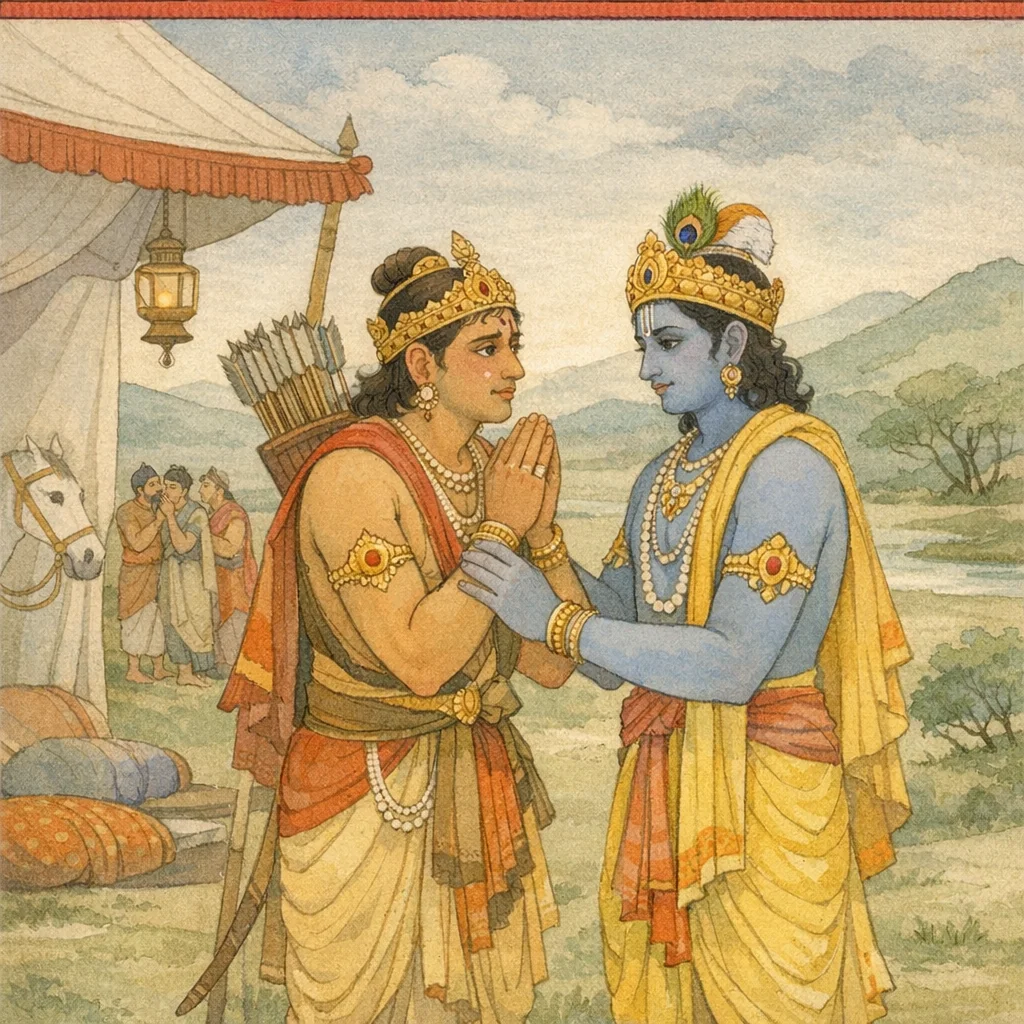
Adhyaya 72
धृष्टद्युम्नस्य द्रोणरथारोহণं सात्यकेः प्रतिरक्षणं च | Dhrishtadyumna Boards Droṇa’s Chariot; Sātyaki’s Counter-Protection
Upa-parva: Droṇa–Dhṛṣṭadyumna-saṃyoga (Strategic Engagement of Droṇa and Dhṛṣṭadyumna)
Saṃjaya reports that as the battle intensifies, the Pāṇḍavas press Kaurava forces that have become divided, while key leaders engage opposing champions (Bhīma checks Jalasandha; Yudhiṣṭhira confronts Kṛtavarman). The narrative then concentrates on Droṇa and Dhṛṣṭadyumna: both unleash dense volleys, producing severe battlefield disarray and vivid descriptions of debris, casualties, and scavenging animals—an archival portrayal of the war’s dehumanizing environment rather than celebratory spectacle. Dhṛṣṭadyumna, seeking a difficult objective, abandons the bow for sword-and-shield and penetrates Droṇa’s chariot space, disrupting the yoke and striking at the horses and fittings. Droṇa finds no opening at close quarters, then reasserts distance-control with precise archery, damaging Dhṛṣṭadyumna’s weapon, horses, and standards, and releases a lethal arrow. Sātyaki intervenes by severing the incoming missile and counter-wounding Droṇa, enabling Pāñcāla forces to extract Dhṛṣṭadyumna and re-stabilize their line. The chapter’s thematic lesson is the interplay of initiative, countermeasure, and protective alliance under conditions where dharma is strained by necessity and speed.
Chapter Arc: संशप्तकों के साथ घोर संग्राम के बाद, कपिध्वज अर्जुन दिव्यास्त्रों से शत्रु-व्रात का संहार कर शिबिर की ओर लौटता है—पर विजय-रथ पर बैठा हुआ भी उसका कंठ आँसुओं से भर उठता है, क्योंकि मन में एक अनकहा अनिष्ट काँप रहा है। → मार्ग में और शिबिर में संकेत मिलते जाते हैं कि आज का दिन केवल रण-जय का नहीं, किसी प्रिय के विनाश का भी है। अर्जुन का हृदय आशंकित है; वह गोविन्द से व्याकुल होकर कहता है कि स्वजनों को व्यग्र देखकर उसकी शंका दूर नहीं होती। तभी अभिमन्यु के विषय में प्रश्न उठता है—इन्द्र के पौत्र, सुकुमार, महाधनुर्धर, सदा प्रिय—वह युद्ध में कैसे मारा गया? → अभिमन्यु-वध का समाचार अर्जुन पर वज्र की तरह गिरता है। शोक तुरंत क्रोध में बदलता है; अधर्म के इस कृत्य पर धिक्कार उठता है। युयुत्सु कौरवों को ललकारकर कहता है कि जब अर्जुन पर वश न चला तो तुमने बालक को घेरकर मारा—यह धर्म नहीं। अर्जुन के भीतर प्रतिशोध की ज्वाला धधकती है और वह अधर्मियों को शीघ्र फल मिलने की घोषणा-सी करता है। → शिबिर में भाई, मित्र और सहायक—सब अर्जुन के शोक से दीन हो उठते हैं; उसे संभालने, धैर्य देने और युद्ध-नीति को फिर से बाँधने का प्रयत्न करते हैं। कृष्ण अर्जुन के साथ हैं—उसके आँसू, उसकी प्रतिज्ञा-गंधी वाणी और उसके भीतर उठते धर्म-क्रोध को दिशा देने के लिए। → अभिमन्यु-वध के प्रतिशोध हेतु अर्जुन का संकल्प अगले दिन के युद्ध को और भी प्रचण्ड बनाने वाला है—किस पर गिरेगा यह वज्र, और कौन-सा अधर्मी शीघ्र फल पाएगा?
Shlokas
Verse 1
अकाल (प्रतिज्ञापर्व) द्विसप्ततितमो< ध्याय: अभिमन्युकी मृत्युके कारण अर्जुनका विषाद और क्रोध (धृतराष्ट्र वाच अथ संशप्तकै: सार्ध युध्यमाने धनंजये । अभिमनयौ हते चापि बाले बलवतां वरे ।। महर्षिसत्तमे याते युधिष्ठिरपुरोगमा: । पाण्डवा: किमथाकार्षु: शोकेन हतचेतस: ।। कथं संशप्तकेभ्यो वा निवृत्तो वानरध्वज: । केन वा कथित: तस्य प्रशान्त: सुतपावक: ।। एतन्मे शंस तत्त्वेन सर्वमेवेह संजय ।) धृतराष्ट्रने पूछा--संजय! जब अर्जुन संशप्तकोंके साथ युद्ध कर रहे थे, जब बलवानोंमें श्रेष्ठ बालक अभिमन्यु मारा गया और जब महर्षियोंमें श्रेष्ठ व्यास (युधिष्ठिरको सान्त्वना देकर) चले गये, तब शोकसे व्याकुल चित्तवाले युधिष्ठिर और अन्य पाण्डवोंने क्या किया? कपिध्वज अर्जुन संशप्तकोंकी ओरसे कैसे लौटे तथा किसने उनसे कहा कि तुम्हारा अग्निके समान तेजस्वी पुत्र सदाके लिये शान्त हो गया। इन सब बातोंको तुम यथार्थरूपसे मुझे बताओ। संजय उवाच तस्मिन्नहनि निर्वत्ति घोरे प्राणभृतां क्षये । आदित्येउस्तं गते श्रीमान् संध्याकाल उपस्थिते,संजय बोले--भरतश्रेष्ठ! प्राणधारियोंका संहार करनेवाले उस भयंकर दिनके बीत जानेपर जब सूर्यदेव अस्ताचलको चले गये और संध्याकाल उपस्थित हुआ, उस समय समस्त सैनिक जब शिविरमें विश्रामके लिये चल दिये, तब विजयशील श्रीमान् कपिध्वज अर्जुन अपने दिव्यास्त्रोंद्रारा संशप्तकसमूहोंका वध करके अपने उस विजयी रथपर बैठे हुए शिविरकी ओर चले। चलते-चलते ही वे अश्रुगदुगदकण्ठ हो भगवान् गोविन्दसे इस प्रकार बोले---
Sanjaya said: When that dreadful day—marked by the destruction of living beings—had come to an end, and when the sun had set and the hour of twilight had arrived, the course of events turned from open slaughter toward the grim reckoning that follows battle’s close.
Verse 2
व्यपयातेषु वासाय सर्वेषु भरतर्षभ । हत्वा संशप्तकव्रातान् दिव्यैरस्त्रै: कपिध्वज:,संजय बोले--भरतश्रेष्ठ! प्राणधारियोंका संहार करनेवाले उस भयंकर दिनके बीत जानेपर जब सूर्यदेव अस्ताचलको चले गये और संध्याकाल उपस्थित हुआ, उस समय समस्त सैनिक जब शिविरमें विश्रामके लिये चल दिये, तब विजयशील श्रीमान् कपिध्वज अर्जुन अपने दिव्यास्त्रोंद्रारा संशप्तकसमूहोंका वध करके अपने उस विजयी रथपर बैठे हुए शिविरकी ओर चले। चलते-चलते ही वे अश्रुगदुगदकण्ठ हो भगवान् गोविन्दसे इस प्रकार बोले---
Sañjaya said: “O bull among the Bharatas, when the day of slaughter had passed and evening rest was at hand, and all the troops had turned toward their camps to retire, Arjuna—he whose banner bears the monkey—having destroyed the massed Saṁśaptakas with celestial weapons, proceeded toward the camp seated upon his victorious chariot.”
Verse 3
प्रायात् स शिबिरं जिष्णुर्जैत्रमास्थाय तं रथम् । गच्छन्नेव च गोविन्द साश्रुकण्ठो5भ्यभाषत,संजय बोले--भरतश्रेष्ठ! प्राणधारियोंका संहार करनेवाले उस भयंकर दिनके बीत जानेपर जब सूर्यदेव अस्ताचलको चले गये और संध्याकाल उपस्थित हुआ, उस समय समस्त सैनिक जब शिविरमें विश्रामके लिये चल दिये, तब विजयशील श्रीमान् कपिध्वज अर्जुन अपने दिव्यास्त्रोंद्रारा संशप्तकसमूहोंका वध करके अपने उस विजयी रथपर बैठे हुए शिविरकी ओर चले। चलते-चलते ही वे अश्रुगदुगदकण्ठ हो भगवान् गोविन्दसे इस प्रकार बोले---
Sañjaya said: Arjuna, the unconquered victor, mounted that triumph-bearing chariot and set out for the camp. Even as he was moving on, his throat choked with tears, he addressed Govinda.
Verse 4
कि नु मे हृदयं त्रसस््तं वाक् च सज्जति केशव । स्पन्दन्ति चाप्यनिष्टानि गात्र॑ं सीदति चाप्युत,“केशव! न जाने क्यों आज मेरा हृदय धड़क रहा है, वाणी लड़खड़ा रही है, अनिष्ट- सूचक बायें अंग फड़क रहे हैं और शरीर शिथिल होता जा रहा है
Sañjaya said: “Keśava, why is my heart trembling and my speech faltering? Ominous signs throb within my limbs, and my body too is sinking into weakness.”
Verse 5
अनिष्ट चैव मे श्लिष्टं हृदयान्नापसर्पति । भुवि ये दिक्षु चात्युग्रा उत्पातास्त्रासयन्ति माम्,“मेरे हृदयमें अनिष्टकी चिन्ता घुसी हुई है, जो किसी प्रकार वहाँसे निकलती ही नहीं है। पृथ्वीपर तथा सम्पूर्ण दिशाओंमें होनेवाले भयंकर उत्पात मुझे डरा रहे हैं
Sañjaya said: “A foreboding of calamity has fastened itself to my heart and will not withdraw. The terrifying portents appearing on the earth and throughout all the directions are filling me with dread.”
Verse 6
बहुप्रकारा दृश्यन्ते सर्व एवाघशंसिन: । अपि स्वस्ति भवेद् राज्ञ: सामात्यस्य गुरोर्मम,“ये उत्पात अनेक प्रकारके दिखायी देते हैं और सब-के-सब भारी अमंगलकी सूचना दे रहे हैं। क्या मेरे पूज्य भ्राता राजा युधिष्ठिर अपने मन्त्रियोंसहित सकुशल होंगे?”
Sañjaya said: “Portents of many kinds are being seen—each and every one foretelling grave misfortune. Might there yet be well-being for the king, together with his ministers—my revered elder, Yudhiṣṭhira?”
Verse 7
वायुदेव उवाच व्यक्त शिवं तव भ्रातु: सामात्यस्य भविष्यति । मा शुच: किज्चिदेवान्यत् तत्रानिष्टं भविष्यति,भगवान् श्रीकृष्ण बोले--अर्जुन] शोक न करो। मुझे स्पष्ट जान पड़ता है कि मन्त्रियोंसहित तुम्हारे भाईका कल्याण ही होगा। इस अपशकुनके अनुसार कोई दूसरा ही अनिष्ट हुआ होगा
The Wind-god said: “I see clearly that your brother—together with his ministers—will come to welfare. Grieve for nothing; by this ill-omen, it is some other calamity that has occurred there.”
Verse 8
संजय उवाच ततः संध्यामुपास्यैव वीरो वीरावसादने । कथयन्तौ रणे वृत्तं प्रयाता रथमास्थितौ,संजय कहते हैं--राजन्! तदनन्तर वे दोनों वीर उस वीरसंहारक रणभूमिमें संध्या- वन्दन करके पुन: रथपर बैठकर युद्ध॒सम्बन्धी बातें करते हुए आगे बढ़े
Sañjaya said: Then, having duly performed the twilight worship upon that battlefield which brings down heroes, the two heroes mounted their chariot again and moved on, conversing about what had occurred in the fight.
Verse 9
ततः स्वशिबिरं प्राप्तौ हतानन्दं हतत्विषम् । वासुदेवोर<्'्जुनश्वैव कृत्वा कर्म सुदुष्करम्,फिर श्रीकृष्ण और अर्जुन जो अत्यन्त दुष्कर कर्म करके आ रहे थे, अपने शिविरके निकट आ पहुँचे। उस समय वह शिविर आनन्दशून्य और श्रीहीन दिखायी देता था
Sañjaya said: Then Vāsudeva (Kṛṣṇa) and Arjuna, having accomplished a deed exceedingly difficult to perform, came back near their own camp. At that time the camp appeared bereft of joy and stripped of its former splendor.
Verse 10
ध्वस्ताकारं समालक्ष्य शिबिरं परवीरहा । बीभत्सुरब्रवीत् कृष्णमस्वस्थहृदयस्तत:,अपनी छावनीको विध्वस्त हुई-सी देखकर शत्रुवीरोंका संहार करनेवाले अर्जुनका हृदय चिन्तित हो उठा। अतः वे भगवान् श्रीकृष्णसे इस प्रकार बोले--
Sañjaya said: Seeing the camp in ruins, Arjuna—slayer of enemy heroes—became inwardly unsettled. With a heart troubled by anxiety, he then spoke to Kṛṣṇa.
Verse 11
नदन्ति नाद्य तूर्याणि मड़ल्यानि जनार्दन | मिश्रा दुन्दुभिनिर्घोषै: शड्खाश्चाडम्बरै: सह,“जनार्दन! आज इस शिविरमें मांगलिक बाजे नहीं बज रहे हैं। दुन्दुभिनाद तथा तुरहीके शब्दोंके साथ मिली हुई शंखध्वनि भी नहीं सुनायी देती है
Arjuna said: “O Janārdana, today in this camp the auspicious instruments are not sounding. Nor is the conch-blast heard—mingled with the booming of kettledrums and the calls of trumpets—together with festive fanfare.”
Verse 12
वीणा नैवाद्य वाद्यन्ते शम्पातालस्वनै: सह । मड़ल्यानि च गीतानि न गायन्ति पठन्ति च
Sañjaya said: “Now the vīṇās are not being played, nor do the festive instruments sound together with their resonant tones. Even the customary songs and recitations are not sung or chanted.”
Verse 13
योधाश्चापि हि मां दृष्टवा निवर्तन्ते हधोमुखा:,“मेरे सैनिक मुझे देखकर नीचे मुख किये लौट जाते हैं। पहलेकी भाँति अभिवादन करके मुझसे युद्धका समाचार नहीं बता रहे हैं। माधव! क्या आज मेरे भाई सकुशल होंगे?”
Sañjaya said: “Even the warriors, on seeing me, turn back with faces cast down. Unlike before, they do not salute and report to me the tidings of the battle. O Mādhava—will my brothers be safe today?”
Verse 14
कर्माणि च यथापूर्व कृत्वा नाभिवदन्ति माम् । अपि स्वस्ति भवेदद्य भ्रातृभ्यो मम माधव,“मेरे सैनिक मुझे देखकर नीचे मुख किये लौट जाते हैं। पहलेकी भाँति अभिवादन करके मुझसे युद्धका समाचार नहीं बता रहे हैं। माधव! क्या आज मेरे भाई सकुशल होंगे?”
Sañjaya said: “Having performed their duties as before, they do not salute me. Seeing me, my soldiers turn back with downcast faces and do not report the news of the battle as they used to. O Mādhava—will my brothers be safe today?”
Verse 15
न हि शुद्ध्यति मे भावो दृष्टवा स्वजनमाकुलम् । अपि पाज्चालराजस्य विराटस्य च मानद
Sañjaya said: “My mind does not become calm or clear when I see my own kinsmen thrown into turmoil—nor does it find peace when I behold the Pāñcāla king and Virāṭa as well, O bestower of honor.”
Verse 16
न च मामद्य सौभद्र: प्रह्ष्टो ग्रातृभि: सह । रणादायान्तुमुचितं प्रत्युद्याति हसन्निव,“आज प्रतिदिनकी भाँति सुभद्राकुमार अभिमन्यु अपने भाइयोंके साथ हर्षमें भरकर हँसता हुआ-सा युद्धसे लौटते हुए मेरी उचित अगवानी करने नहीं आ रहा है (इसका क्या कारण है?)'
Sañjaya said: “And today, the son of Subhadrā—usually delighted and accompanied by his brothers—does not come forth, as is proper, to greet me on his return from battle, as though smiling. What could be the reason?”
Verse 17
संजय उवाच एवं संकथयन्तौ तौ प्रविष्टोी शिबिरं स््वकम् । ददृशाते भृशास्वस्थान् पाण्डवान् नष्टचेतस:,संजय कहते हैं--राजन्! इस प्रकार बातें करते हुए उन दोनोंने शिविरमें पहुँचकर देखा कि पाण्डव अत्यन्त व्याकुल और हतोत्साह हो रहे हैं
Sañjaya said: “O King, while those two were thus conversing, they entered their own camp and saw the Pāṇḍavas in a grievously unsettled state—their minds shaken and their resolve broken.”
Verse 18
दृष्टवा क्षातृश्व पुत्रांक्ष विमना वानरध्वज: । अपश्यंश्वैव सौभद्रमिदं वचनमत्रवीत्,भाइयों तथा पुत्रोंको इस अवस्थामें देख और सुभद्राकुमार अभिमन्युको वहाँ न पाकर कपिध्वज अर्जुनका मन अत्यन्त उदास हो गया तथा वे इस प्रकार बोले--
Sañjaya said: Seeing the brothers and sons in such a condition, the monkey-bannered Arjuna became deeply distressed; and, not seeing Saubhadra (Abhimanyu) there, he spoke these words.
Verse 19
मुखवर्णोडप्रसन्नो व: सर्वेषामेव लक्ष्यते । न चाभिमन्युं पश्यामि न च मां प्रतिनन्दथ,“आज आप सभी लोगोंके मुखकी कान्ति अप्रसन्न दिखायी दे रही है, इधर मैं अभिमन्युको नहीं देख पाता हूँ और आपलोग भी मुझसे प्रसन्नतापूर्वक वार्तालाप नहीं कर रहे हैं
“The colour and expression of all your faces appear troubled and joyless. And I do not see Abhimanyu here; nor do you speak to me with the warmth of welcome.”
Verse 20
मया श्रुतश्न द्रोणेन चक्रव्यूहो विनिर्मित: । न च वस्तस्य भेत्तास्ति विना सौभद्रमर्भकम्,“मैंने सुना है कि आचार्य द्रोणने चक्रव्यूहककी रचना की थी। आपलोगोंमेंसे बालक अभिमन्युके सिवा दूसरा कोई उस व्यूहका भेदन नहीं कर सकता था
“I have heard that Ācārya Droṇa devised the formidable ‘Cakra’ battle-formation. And among you, none was capable of breaking into that array—except the young Abhimanyu, son of Subhadrā.”
Verse 21
न चोपदिष्टस्तस्यासीन्मयानीकाद् विनिर्गम: । कच्चिन्न बालो युष्माभि: परानीकं प्रवेशित:,'परंतु मैंने उसे उस व्यूहसे निकलनेका ढंग अभी नहीं बताया था। कहीं ऐसा तो नहीं हुआ कि आपलोगोंने उस बालकको शत्रुके व्यूहमें भेज दिया हो?
“And I had not instructed him in the method of exiting from that battle-array. Tell me—has that boy been made, by you, to enter the enemy’s formation?”
Verse 22
भित्त्वानीकं महेष्वास: परेषां बहुशो युधि | कच्चिन्न निहत: संख्ये सौभद्र: परवीरहा,शत्रुवीरोंका संहार करनेवाला महाधनुर्धर सुभद्राकुमार अभिमन्यु युद्धमें शत्रुओंके उस व्यूहका अनेकों बार भेदन करके अन्तमें वहीं मारा तो नहीं गया?
Sanjaya said: “Having again and again broken through the enemy’s battle-array amid the clash of arms, has Abhimanyu—Subhadrā’s son, the mighty archer, slayer of hostile heroes—been slain at last in the thick of the fight?”
Verse 23
लोहिताक्ष॑ महाबाहुं जात॑ सिंहमिवाद्रिषु । उपेन्द्रसदृशं ब्रूत कथमायोधने हत:,'पर्वतोंमें उत्पन्न हुए सिंहके समान लाल नेत्रोंवाले, श्रीकृष्णतुल्य पराक्रमी महाबाहु अभिमन्युके विषयमें आपलोग बतावें। वह युद्धमें किस प्रकार मारा गया?
Sanjaya said: “Tell me how Abhimanyu—red-eyed, mighty-armed, and valiant like Upendra (Vishnu), like a lion born among the mountains—was slain in the battle. By what manner did such a hero meet his end?”
Verse 24
सुकुमारं महेष्वासं वासवस्यात्मजात्मजम् | सदा मम प्रियं ब्रूत कथमायोधने हतः,“इन्द्रके पौत्र तथा मुझे सदा प्रिय लगनेवाले सुकुमार शरीर महाधनुर्धर अभिमन्युके विषयमें बताइये। वह युद्धमें कैसे मारा गया?
Sanjaya said: “Tell me about that tender youth, the great archer—Vāsava’s grandson—who was ever dear to me. How was he slain in the battle?”
Verse 25
सुभद्राया: प्रियं पुत्र द्रौपद्या: केशवस्य च । अम्बायाश्ष प्रियं नित्यं कोडवधीत् कालमोहित:,“सुभद्रा और द्रौपदीके प्यारे पुत्र अभिमन्युको, जो श्रीकृष्ण और माता कुन्तीका सदा दुलारा रहा है, किसने कालसे मोहित होकर मारा है?
Sanjaya said: “Who, deluded by the power of Time, has slain that beloved son of Subhadrā—dear also to Draupadī and to Keśava—who was ever cherished by his mother (Kuntī)?”
Verse 26
सदृशो वृष्णिवीरस्य केशवस्य महात्मन: । विक्रमश्रुतमाहात्म्यै: कथमायोधने हत:,*वृष्णिकुलके वीर महात्मा केशवके समान पराक्रमी, शास्त्रज्ष और महत्त्वशाली अभिमन्यु युद्धमें किस प्रकार मारा गया है?
Sanjaya said: “How was Abhimanyu—whose prowess, fame, and greatness were comparable to that of the heroic Vṛṣṇi champion, the great-souled Keśava—slain in battle?”
Verse 27
वार्ष्णेयीदयितं शूरं मया सततलालितम् । यदि पुत्र न पश्यामि यास्यामि यमसादनम्,“सुभद्राके प्राणप्यारे शूरवीर पुत्रको, जिसको मैंने सदा लाड़-प्यार किया है, यदि नहीं देखूँगा तो मैं भी यमलोक चला जाऊँगा
Sañjaya said: “If I do not behold that heroic son—dear to Vārṣṇeyī (Subhadrā)—whom I have continually cherished and raised with affection, then, my child, I too shall go to the abode of Yama.”
Verse 28
मृदुकुज्चितकेशान्तं बालं बालमृगेक्षणम् | मत्तद्विरदविक्रान्ते शालपोतमिवोद्गतम्,यदि पुत्र न पश्यामि यास्यामि यमसादनम् । “जिसके केशप्रान्त कोमल और घुँघराले थे, दोनों नेत्र मृगछौनेके समान चंचल थे, जिसका पराक्रम मतवाले हाथीके समान और शरीर नूतन शालवृक्षके समान ऊँचा था, जो मुसकराकर बातें करता था, जिसका मन शान्त था, जो सदा गुरुजनोंकी आज्ञाका पालन करता था, बाल्यावस्थामें भी जिसके पराक्रमकी कोई तुलना नहीं थी, जो सदा प्रिय वचन बोलता और किसीसे ईर्ष्या-द्वेष नहीं रखता था, जिसमें महान् उत्साह भरा था, जिसकी भुजाएँ बड़ी-बड़ी और दोनों नेत्र विकसित कमलके समान सुन्दर एवं विशाल थे, जो भक्तजनोंपर दया करता, इन्द्रियोंको वशमें रखता और नीच पुरुषोंका साथ कभी नहीं करता था, जो कृतज्ञ, ज्ञानवान्, अस्त्र-विद्यामें पारंगत, युद्धसे मुँह न मोड़नेवाला, युद्धका अभिनन्दन करनेवाला तथा सदा शत्रुओंका भय बढ़ानेवाला था, जो स्वजनोंके प्रिय और हितमें तत्पर तथा अपने पितृकुलकी विजय चाहनेवाला था, संग्राममें जिसे कभी घबराहट नहीं होती थी और जो शत्रुपर पहले प्रहार नहीं करता था, अपने उस पुत्र बालक अभिमन्युको यदि नहीं देखूँगा तो मैं भी यमलोककी राह लूँगा
Sañjaya said: “If I do not see my son—whose hair-ends were soft and gently curled; who was still a boy, with eyes restless and bright like a fawn’s; whose stride and prowess were like those of an intoxicated elephant; who rose up like a young śāla sapling—then I too shall go to the abode of Yama.”
Verse 29
स्मिताभिभाषिणं शान्तं गुरुवाक्यकरं सदा | बाल्ये5प्यतुलकर्माणं प्रियवाक्यममत्सरम्
Sañjaya said: He was gentle, speaking with a quiet smile; calm by nature; ever obedient to the word of his teachers. Even in childhood his deeds were unmatched. His speech was pleasing, and he was free from envy.
Verse 30
महोत्साहं महाबाहुं दीर्घधाजीवलोचनम् । भक्तानुकम्पिनं दान्तं न च नीचानुसारिणम्
Sañjaya said: “He was of great resolve, mighty-armed, and long-bannered, with eyes full of life. Compassionate toward the devoted and self-controlled, he would never stoop to follow the ways of the base.”
Verse 31
कृतज्ञं ज्ञानसम्पन्नं कृतास्त्रमनिवर्तिनम् | युद्धाभिनन्दिनं नित्यं द्विषतां भयवर्धनम्
Sañjaya said: He was grateful and wise, fully trained in the use of weapons, and one who never turned back. Ever delighting in battle, he became a constant increaser of fear among his enemies.
Verse 32
स्वेषां प्रियहिते युक्त पितृणां जयगृद्धिनम् । न च पूर्व प्रह्तारिं संग्रामे नष्टसम्भ्रमम्
Sañjaya said: “He was devoted to securing what was dear and beneficial to his own side, eager for victory for the sake of his elders; and in battle he was no mere first striker—he fought without losing composure, unshaken by confusion.”
Verse 33
रथेषु गण्यमानेषु गणितं त॑ं महारथम्
Sañjaya said: “When the chariots were being counted and assessed, he was reckoned among them as a mahāratha—one of the foremost chariot-warriors.”
Verse 34
मयाध्यर्धगुणं संख्ये तरुणं बाहुशालिनम् । प्रद्युम्नस्य प्रियं नित्यं केशवस्य ममैव च
Sañjaya said: “In battle there was that youthful, strong-armed warrior—valued by me as more than half my own worth—who was ever dear to Pradyumna, and dear to Keśava as well, and to me too.”
Verse 35
यदि पुत्र न पश्यामि यास्यामि यमसादनम् । '“रथियोंकी गणना होते समय जो महारथी गिना गया था, जिसे युद्धमें मेरी अपेक्षा ड्यौढ़ा समझा जाता था तथा अपनी भुजाओंसे सुशोभित होनेवाला जो तरुण वीर प्रद्यम्नको, श्रीकृष्णको और मुझे भी सदैव प्रिय था, उस पुत्रको यदि मैं नहीं देखूँगा तो यमराजके लोकमें चला जाऊँगा ।। ३३-३४ ई ।। सुनसं सुललाटान्तं स्वक्षिभ्रृद्शनच्छदम्
Sañjaya said: “If I do not behold my son, I shall go to the abode of Yama (death).” The line conveys a father’s anguish amid the moral devastation of war, where attachment to one’s child overwhelms endurance and makes death itself seem preferable to continued life without him.
Verse 36
तन्त्रीस्वनसुखं रम्यं पुंस्कोकिलसमध्वनिम्
Sañjaya said: “(It was) charming and delightful to the ear—sweet like the sound of a lute-string, and resonant like the call of a male cuckoo.”
Verse 37
रूप॑ चाप्रतिमं तस्य त्रिदशैश्षापि दुर्लभम्
Sañjaya said: His form was incomparable—so rare that even the gods could scarcely obtain or behold such a manifestation.
Verse 38
अपश्यतो हि वीरस्य का शान्तिहदयस्य मे । “उसके रूपकी कहीं तुलना नहीं थी। देवताओंके लिये भी वैसा रूप दुर्लभ है। यदि वीर अभिमन्युके उस रूपको नहीं देख पाता हूँ तो मेरे हृदयको क्या शान्ति मिलेगी? ।। ३७ न ! अभिवादनदक्ष॑ तं पितृणां वचने रतम्
Sañjaya said: “If I do not behold that heroic one, what peace can there be for my heart?”
Verse 39
सुकुमार: सदा वीरो महाहशयनोचित:
Sañjaya said: “Though delicate in appearance, he was ever a hero—one fit for the great chariot-warrior’s station.”
Verse 40
शयानं समुपासन्ति यं पुरा परमस्त्रिय:
Sañjaya said: “Him whom, in former times, the noblest of women would reverently attend even as he lay at rest—”
Verse 41
यः पुरा बोध्यते सुप्त: सूतमागधवन्दिभि:
Sañjaya said: “He who, in earlier times, used to be awakened from sleep by charioteers, court-bards, and panegyrists.”
Verse 42
बोधयन्त्यद्य त॑ नूनं श्वापदा विकृतैः स्वनै: । “जिसे पहले सो जानेपर सूत, मागध और बन्दीजन जगाया करते थे, उसी अभिमन्युको आज निश्चय ही हिंसक जन्तु अपने भयंकर शब्दोंद्वारा जगाते होंगे ।। ४१३ || छत्रच्छायासमुचितं तस्य तद् वदनं शुभम्
Sañjaya said: “Surely today, wild beasts are awakening him with their harsh, distorted cries—him whom, when he slept before, bards, panegyrists, and court-singers used to rouse.”
Verse 43
हा पुत्रकावितृप्तस्य सतत पुत्रदर्शने
Sañjaya said: “Alas! Though he is never satisfied with seeing his son, he remains continually intent on beholding him.”
Verse 44
सा च संयमनी नूनं सदा सुकृतिनां गति:
Sañjaya said: “And that Saṁyamanī is indeed, always, the destined course for the meritorious.”
Verse 45
स्वभाभि भासिता रम्या त्वयात्यर्थ विराजते । “निश्चय ही वह संयमनी पुरी सदा पुण्यवानोंका आश्रय है; जो आज अपनी प्रभासे प्रकाशित और मनोहारिणी होती हुई भी तुम्हारे द्वारा अत्यन्त उद्भधासित हो उठी होगी ।। ४४ कल | नूनं वैवस्वतश्न त्वां वरुणश्व प्रियातिथिम्
Sañjaya said: “That lovely city, already radiant with its own splendor, shines all the more because of you. Indeed, Saṁyamanī is ever a refuge for the meritorious; though it is naturally luminous and enchanting, today it will blaze with exceptional brilliance through your presence.”
Verse 46
एवं विलप्य बहुधा भिन्नपोतो वणिग् यथा
Sañjaya said: Having lamented in many ways—like a merchant whose ship has been shattered—he gave voice to grief born of sudden ruin, as one who sees all support and hope broken in the midst of calamity.
Verse 47
कच्चित्स कदन कृत्वा परेषां कुरुनन्दन
Sañjaya said: “O delight of the Kurus, has he indeed wrought a great slaughter among the enemy?”
Verse 48
स नून॑ बहुभियत्तिर्युध्यमानो नरर्षभै:
Sañjaya said: “Surely, as he strives in battle, he is now fighting against many bull-like heroes among men.”
Verse 49
पीड्यमान: शरैस्ती&णै: कर्णद्रोणकृपादिभि:
Sañjaya said: He was being sorely afflicted by sharp arrows shot by Karṇa, Droṇa, Kṛpa, and the other foremost warriors.
Verse 50
नानालिज्ैः सुधौताग्रैर्मम पुत्रो5ल्पचेतन: । इह मे स्यात् परित्राणं पितेति स पुनः पुन:
Sañjaya said: “My son, of little discernment, again and again cried out, ‘Father, may there be protection for me here!’—even as weapons with many sharpened, well-polished points were being brought to bear.”
Verse 51
इत्येवं विलपन् मन्ये नृशंसैर्भुवि पातित: । “जब कर्ण, द्रोण और कृपाचार्य आदिने चमकते हुए अग्रभागवाले नाना प्रकारके तीखे बाणोंद्वारा मेरे पुत्रको पीड़ित किया होगा और उसकी चेतना मन्द होने लगी होगी, उस समय अभिमन्युने बारंबार विलाप करते हुए यह कहा होगा कि यदि यहाँ मेरे पिताजी होते तो मेरे प्राणोंकी रक्षा हो जाती। मैं समझता हूँ, उसी अवस्थामें उन निर्दयी शत्रुओंने उसे पृथ्वीपर मार गिराया होगा ।। ४९-५० # ।। अथवा मत्प्रसूत: स स्वस्रीयो माधवस्य च
Sañjaya said: “Thus, lamenting again and again, I think he was struck down to the ground by those pitiless men. When Karṇa, Droṇa, Kṛpa and others had tormented my son with many kinds of sharp arrows with gleaming points, and when his awareness began to fade, Abhimanyu would repeatedly cry out that if his father were here, his life would be saved. In that very condition, I believe, the ruthless enemies felled him upon the earth.”
Verse 52
वज्सारमयं नूनं हृदयं सुदृढे मम
Sañjaya said: “Surely my heart must be made of adamantine essence—so firmly hardened is it—since I continue to endure and recount these dreadful events of the war.”
Verse 53
कथं बाले महेष्वासा नृशंसा मर्मभेदिन:
Sañjaya said: “How could those great archers—so pitiless, striking at vital points—act thus against a mere child?”
Verse 54
स्वस्रीये वासुदेवस्य मम पुत्रेडक्षिपन् शरान् उन क्रूरकर्मा महान् धनुर्धरोंने श्रीकृष्णके भानजे और मेरे बालक पुत्रपर मर्मभेदी बाणोंका प्रहार कैसे किया? ।। ५३ ह ।। यो मां नित्यमदीनात्मा प्रत्युद्गम्याभिनन्दति
Sañjaya said: “He who, with an unbroken and unhumiliated spirit, always comes forward to meet me and greets me with respect…”
Verse 55
नूनं स पातितः शेते धरण्यां रुधिरोक्षित:
Sañjaya said: “Surely he has been struck down and now lies upon the earth, drenched in blood—an image of war’s grim certainty, where valor and fate culminate in a fallen body and the moral weight of violence becomes unmistakable.”
Verse 56
सुभद्रामनुशोचामि या पुत्रमपलायिनम्
Sañjaya said: “I grieve for Subhadrā—she whose son did not flee.”
Verse 57
सुभद्रा वक्ष्यते कि मामभिमन्युमपश्यती
Sañjaya said: “What will Subhadrā say to me, when she does not see Abhimanyu?”
Verse 58
वज्सारमयं नूनं हृदयं यन्न यास्यति
Sañjaya said: “Surely the heart is made of adamantine essence—since it does not break or depart even under such crushing sorrow.”
Verse 59
दृप्तानां धार्तराष्ट्राणां सिंहनादो मया श्रुतः
Sañjaya said: “I heard the lion-like roar of the proud sons of Dhṛtarāṣṭra.”
Verse 60
अशवनुवन्तो बीभत्सुं बाल॑ हत्वा महारथा:
Sañjaya said: “Having slain the boy Bībhatsu, the great chariot-warriors cried out for their horses.”
Verse 61
कि मोदध्वमधर्मज्ञा: पाण्डवं दृश्यतां बलम् | 'युयुत्सु कह रहा था, धर्मको न जाननेवाले महारथी कौरवो! अर्जुनपर जब तुम्हारा वश न चला, तब तुम एक बालककी हत्या करके क्यों आनन्द मना रहे हो? कल पाण्डवोंका बल देखना ।। ६० ह ।। कि तयोरविप्रियं कृत्वा केशवार्जुनयोर्मुधे
Sañjaya said: “Why do you rejoice, you who are ignorant of dharma? Let the might of the Pāṇḍavas be seen. And what could you possibly do in battle that would not be displeasing to Keśava and Arjuna?”
Verse 62
आगमिष्यति व: क्षिप्रं फलं पापस्य कर्मण:
Sañjaya said: “Swiftly, the fruit of this sinful deed will come upon you.”
Verse 63
इति तान् परिभाषन वै वैश्यापुत्रो महामति:
Sañjaya said: Having thus addressed them, the wise son of a Vaiśya spoke on—his words marking a pointed reply within the charged moral atmosphere of war.
Verse 64
अपायाच्छस्त्रमुत्सूज्य कोपदुःखसमन्वित: । *राजा धृतराष्ट्रकी वैश्यजातीय पत्नीका परम बुद्धिमान् पुत्र युयुत्सु कोप और दुःखसे युक्त हो कौरवोंसे उपर्युक्त बातें कहकर शस्त्र त्यागककर चला आया है' ।। किमर्थमेतन्नाख्यातं त्वया कृष्ण रणे मम
Sañjaya said: “Yuyutsu—the exceedingly intelligent son of King Dhṛtarāṣṭra by his wife of Vaiśya birth—overcome with anger and grief, spoke those words to the Kauravas and then, casting aside his weapon, withdrew and came away. Why, O Kṛṣṇa, did you not tell me this in the midst of the battle?”
Verse 65
अधाक्षं तानहं क्रूरांस्तदा सर्वान् महारथान् | “श्रीकृष्ण! आपने रणक्षेत्रमें ही यह बात मुझसे क्यों नहीं बता दी? मैं उसी समय उन समस्त क़ूर महारथियोंको जलाकर भस्म कर डालता” || ६४ $ || संजय उवाच पुत्रशोकार्दितं पार्थ ध्यायन्तं साश्रुलोचनम्,संजय कहते हैं--महाराज! इस प्रकार अर्जुनको पुत्रशोकसे पीड़ित और उसीका चिन्तन करते हुए नेत्रोंसे आँसू बहाते देख भगवान् श्रीकृष्णने उन्हें पकड़कर सँभाला। वे पुत्रवियोगके कारण होनेवाली गहरी मनोव्यथामें डूबे हुए थे और तीव्र शोक उन्हें संतप्त कर रहा था। भगवान् बोले--'मित्र! ऐसे व्याकूुल न होओ
Sañjaya said: O King, seeing Pārtha (Arjuna) afflicted by grief for his son—absorbed in brooding over him and with tear-filled eyes—Śrī Kṛṣṇa took hold of him and steadied him. Overwhelmed by the deep inner anguish born of separation from his child, Arjuna was being scorched by intense sorrow; and the Lord addressed him as a friend, urging him not to be so distraught.
Verse 66
निगृहा वासुदेवस्तं पुत्राधिभिरभिप्लुतम् । मैवमित्यब्रवीत् कृष्णस्तीव्रशोकसमन्वितम्,संजय कहते हैं--महाराज! इस प्रकार अर्जुनको पुत्रशोकसे पीड़ित और उसीका चिन्तन करते हुए नेत्रोंसे आँसू बहाते देख भगवान् श्रीकृष्णने उन्हें पकड़कर सँभाला। वे पुत्रवियोगके कारण होनेवाली गहरी मनोव्यथामें डूबे हुए थे और तीव्र शोक उन्हें संतप्त कर रहा था। भगवान् बोले--'मित्र! ऐसे व्याकूुल न होओ
Sañjaya said: Seeing Arjuna overwhelmed by grief for his son—his mind flooded by that sorrow and his eyes streaming with tears—Vāsudeva Kṛṣṇa took hold of him and steadied him. Arjuna, sunk in the deep anguish born of separation, was burning with intense lamentation. Kṛṣṇa spoke to restrain him: “Friend, do not be so distraught.”
Verse 67
सर्वेषामेष वै पन्था: शूराणामनिवर्तिनाम् । क्षत्रियाणां विशेषेण येषां युद्धेन जीविका,'युद्धमें पीठ न दिखानेवाले सभी शूरवीरोंका यही मार्ग है। विशेषतः उन क्षत्रियोंको, जिनकी युद्धसे जीविका चलती है, इस मार्गसे जाना ही पड़ता है
Sañjaya said: “This indeed is the path for all valiant men who do not turn back—above all for kṣatriyas, whose livelihood and very station are sustained by warfare. For them, to proceed by this way is unavoidable.”
Verse 68
एषा वै युध्यमानानां शूराणामनिवर्तिनाम् । विहिता सर्वशास्त्रज्जैगतिर्मतिमतां वर,“बुद्धिमानोंमें श्रेष्ठ वीर! जो युद्धसे कभी पीछे नहीं हटते हैं, उन युद्धपरायण शूरवीरोंके लिये सम्पूर्ण शास्त्रज्ञोंने यही गति निश्चित की है
Sañjaya said: “This indeed is the ordained destiny for heroic warriors who stand firm in battle and never turn back. All who know the śāstras have determined this as the proper course—O best among the wise.”
Verse 69
ध्र॒ुवं हि युद्धे मरणं शूराणामनिवर्तिनाम् । गत: पुण्यकृतां लोकानभिमन्युर्न संशय:,'पीछे पैर न हटानेवाले शूरवीरोंका युद्धमें मरण अवश्यम्भावी है। अभिमन्यु पुण्यात्मा पुरुषोंके लोकमें गया है, इसमें संशय नहीं है
Sañjaya said: “For heroes who do not turn back, death in battle is indeed certain. Abhimanyu has gone to the worlds attained by the doers of merit—of this there is no doubt.”
Verse 70
एतच्च सर्ववीराणां काड्क्षितं भरतर्षभ | संग्रामेडभिमुखो मृत्यु प्राप्तुयादिति मानद,“दूसरोंको मान देनेवाले भरतश्रेष्ठ! संग्राममें सम्मुख युद्ध करते हुए वीरको मृत्युकी प्राप्ति हो, यही सम्पूर्ण शूरवीरोंका अभीष्ट मनोरथ हुआ करता है
Sanjaya said: “O bull among the Bharatas, O giver of honor, this is what all true warriors long for: that in battle one should meet death while facing the foe—engaged in open, forward combat.”
Verse 71
इस प्रकार श्रीमहाभारत द्रोणपर्वके अन्तर्गत अभिमन्युवधपर्वमें षोडशराजकीयोपाख्यानविषयक इकह त्तरवाँ अध्याय पूरा हुआ,सच वीरान् रणे हत्वा राजपुत्रान् महाबलान् | वीरैराकाड्ृक्षितं मृत्युं सम्प्राप्तोडभिमुखं रणे “अभिमन्युने रणक्षेत्रमें महाबली वीर राजकुमारोंका वध करके वीर पुरुषोंद्वारा अभिलपफित संग्राममें सम्मुख मृत्यु प्राप्त की है
Thus ends the seventy-first chapter, concerning the episode of the sixteen princes, within the Abhimanyu-slaying section of the Droṇa Parva of the Śrī Mahābhārata. Having slain in battle mighty princes—true heroes—Abhimanyu met, face to face on the battlefield, the death that warriors themselves desire: a direct and valorous end in combat.
Verse 72
मा शुचः पुरुषव्याप्र पूर्वरेष सनातन: । धर्मकृद्धि: कृतो धर्म: क्षत्रियाणां रणे क्षय:,'पुरुषसिंह! शोक न करो। प्राचीन धर्मशास्त्रकारोंने संग्राममें वध होना क्षत्रियोंका सनातनधर्म नियत किया है इति श्रीमहाभारते द्रोणपर्वणि प्रतिज्ञापर्वणि अर्जुनकोपे द्विसप्ततितमो<ध्याय: ।। ७२ || इस प्रकार श्रीमह्ाभारत द्रोणपर्वके अन्तर्गत प्रतिज्ञापर्वमें अजुनकोपविषयक बहत्तरवाँ अध्याय पूरा हुआ
Sañjaya said: “Do not grieve, O tiger among men. This is an ancient and eternal ordinance established by the makers of dharma: for kṣatriyas, to meet death in battle is their appointed duty.”
Verse 73
इमे ते भ्रातर: सर्वे दीना भरतसत्तम । त्वयि शोकसमादविष्टे नृपाश्व सुह्दस्तव,“भरतश्रेष्ठ! तुम्हारे शोकाकुल हो जानेसे ये तुम्हारे सभी भाई, नरेशगण तथा सुहृद् दीन हो रहे हैं
Sañjaya said: “O best of the Bharatas, when you are seized by grief, all these your brothers, the kings, and your well-wishers become dejected. Your sorrow spreads through the circle of kin and allies, weakening their resolve and burdening the common cause.”
Verse 74
एतांश्व वचसा साम्ना समाश्वासय मानद । विदितं वेदितव्यं ते न शोक॑ कर्तुमहसि,“मानद! इन सबको अपने शान्तिपूर्ण वचनसे आश्वासन दो। तुम्हें जाननेयोग्य तत्त्वका ज्ञान हो चुका है। अतः तुम्हें शोक नहीं करना चाहिये”
Sañjaya said: “O noble one, reassure all these with calm, conciliatory words. What ought to be known has already become known to you; therefore you should not give way to grief.”
Verse 75
एवमाश्वासित: पार्थ: कृष्णेनादभुतकर्मणा । ततोअब्रवीत् तदा भ्रातृन् सर्वान् पार्थ: सगद्गदान्,अदभुत कर्म करनेवाले श्रीकृष्णके इस प्रकार समझाने-बुझानेपर अर्जुन उस समय वहाँ गदगद कण्ठवाले अपने सब भाइयोंसे बोले--
Sañjaya said: Thus reassured by Kṛṣṇa, whose deeds are wondrous, Arjuna (Pārtha) then addressed all his brothers. His voice, choked with emotion, he spoke to them—his renewed steadiness arising from Kṛṣṇa’s counsel amid the moral strain of war.
Verse 76
स दीर्घबाहु: पृथ्वंसो दीर्घधजीवलोचन: । अभिमन्युर्यथावृत्त: श्रोतुमिच्छाम्यहं तथा,“मोटे कंधों, बड़ी भुजाओं तथा कमलसदृश विशाल नेत्रोंवाला अभिमन्यु संग्राममें जिस प्रकार लड़ा था, वह सब वृत्तान्त मैं सुनना चाहता हूँ
Sañjaya said: “I wish to hear, in full and exactly as it happened, how Abhimanyu—broad-shouldered, long-armed, and lotus-eyed—fought in the battle.”
Verse 77
सनागस्यन्दनहयान द्रक्ष्यध्वं निहतान् मया । संग्रामे सानुबन्धांस्तान् मम पुत्रस्य वैरिण:,“कल आपलोग देखेंगे कि मेरे पुत्रके वैरी अपने हाथी, रथ, घोड़े और सगे- सम्बन्धियोंसहित युद्धमें मेरे द्वारा मार डाले गये
Sañjaya said: “Tomorrow you will see the enemies of my son—together with their elephants, chariots, and horses, and along with their own followers and kinsmen—lying slain by me on the battlefield.”
Verse 78
कथं च व: कृतास्त्राणां सर्वेषां शस्त्रपाणिनाम् । सौभद्रो निधनं गच्छेद् वज्जिणापि समागत:,“आप सब लोग अस्त्रविद्याके पण्डित और हाथमें हथियार लिये हुए थे। सुभद्राकुमार अभिमन्यु साक्षात् वज्रधारी इन्द्रसे भी युद्ध करता हो तो भी आपके सामने कैसे मारा जा सकता था?
“How could it be that you all—masters of weapon-lore, weapons in hand—allowed Saubhadra Abhimanyu, who could have fought even Indra the wielder of the Vajra, to be slain before you?”
Verse 79
यद्येवमहमज्ञास्यमशक्तान् रक्षणे मम । पुत्रस्य पाण्डुपञ्चालान् मया गुप्तो भवेत् तत:,“यदि मैं ऐसा जानता कि पाण्डव और पांचाल मेरे पुत्रकी रक्षा करनेमें असमर्थ हैं तो मैं स्वयं उसकी रक्षा करता
Sañjaya said: “Had I only known this—that the Pāṇḍavas and the Pāñcālas were incapable of protecting my son—then from that moment I myself would have kept him guarded.”
Verse 80
कथं च वो रथस्थानां शरवर्षाणि मुज्चताम् । नीतो>भिमन्युर्निधनं कदर्थीकृत्य व: परैः,“आपलोग रथपर बैठे हुए बाणोंकी वर्षा कर रहे थे तो भी शत्रुओंने आपकी अवहेलना करके कैसे अभिमन्युको मार डाला?
Sañjaya said: “Even as you stood firm upon your chariots, showering volleys of arrows, how did the enemy nonetheless disregard you and, after humiliating Abhimanyu, lead him to his death?”
Verse 81
अहो व: पौरुषं नास्ति न च वो<5स्ति पराक्रम: । यत्राभिमन्यु: समरे पश्यतां वो निपातित:,“अहो! आपलोगोंमें पुरुषार्थ नहीं है और पराक्रम भी नहीं है; क्योंकि समरभूमिमें आपलोगोंके देखते-देखते अभिमन्यु मार डाला गया
Sañjaya said: “Alas, there is no manly resolve in you, nor any true valor—since, while you all stood watching on the battlefield, Abhimanyu was struck down.”
Verse 82
आत्मानमेव गर्हैयं यदहं वै सुदुर्बलान् । युष्मानाज्ञाय निर्यातों भीरूनकृतनिश्चयान्,“मैं अपनी ही निन््दा करूँगा; क्योंकि आपलोगोंको अत्यन्त दुर्बल, डरपोक और सुदृढ़ निश्चयसे रहित जानकर भी मैं (अभिमन्युको आपलोगोंके भरोसे छोड़कर) अन्यत्र चला गया
Sañjaya said: “I will condemn myself alone, for though I knew you to be utterly weak—timid and lacking firm resolve—I still departed elsewhere, leaving Abhimanyu to rely upon you.”
Verse 83
आहोस्विद् भूषणार्थाय वर्म शस्त्रायुधानि व: । वाचस्तु वक्तुं संसत्सु मम पुत्रमरक्षताम्
Sañjaya said: “Were your coats of mail and weapons meant only for ornament? For your words—your ability to speak in the assemblies—did not protect my son.”
Verse 84
“अथवा आपलोगोंके ये कवच और अस्त्र-शस्त्र क्या शरीरका आभूषण बनानेके लिये हैं? मेरे पुत्रकी रक्षा न करके वीरोंकी सभामें केवल बातें बनानेके लिये हैं?” ।। एवमुक्त्वा ततो वाक्यं तिष्ठ॑श्नापवरासिमान् । न स्माशक्यत बीभत्सु: केनचित्प्रसमीक्षितुम्,ऐसा कहकर फिर अर्जुन धनुष और श्रेष्ठ तलवार लेकर खड़े हो गये। उस समय कोई उनकी ओर आँख उठाकर देख भी न सका
Sañjaya said: “Or are your coats of mail and your weapons meant only to decorate your bodies? Are they for merely making speeches in the assembly of heroes, instead of protecting my son?” Having spoken thus, Arjuna (Bibhatsu) then stood up, taking up his bow and a splendid sword; at that moment no one could even raise his eyes to look at him.
Verse 85
तमन्तकमिव क्रुद्ध॑ निःश्वसन्तं मुहुर्मुहुः । पुत्रशोकाभिसंतप्तमश्रुपूर्णमुखं तदा,वे यमराजके समान कुपित हो बारंबार लंबी साँसें छोड़ रहे थे। उस समय पुत्रशोकसे संतप्त हुए अर्जुनके मुखयर आँसुओंकी धारा बह रही थी
Sañjaya said: At that time he, inflamed with wrath like Antaka (Death) himself, kept heaving deep breaths again and again. Tormented by grief for his son, his face was filled with tears—his sorrow and fury mingling in the midst of war.
Verse 86
न भाषितुं शक्नुवन्ति द्रष्ट॑ वा सुहृदो &र्जुनम् । अन्यत्र वासुदेवाद्वा ज्येष्ठाद्वा पाण्डुनन्दनात्,उस अवस्थामें वसुदेवनन्दन भगवान् श्रीकृष्ण अथवा ज्येष्ठ पाण्डुनन्दन युधिष्ठिरको छोड़कर दूसरे सगे-सम्बन्धी न तो उनसे कुछ बोल सकते थे और न तो देखनेका ही साहस करते थे
Sañjaya said: Arjuna’s own well-wishers could neither find words to speak to him nor even muster the courage to look at him—except for Vāsudeva (Śrī Kṛṣṇa) and the eldest son of Pāṇḍu (Yudhiṣṭhira).
Verse 87
सर्वास्ववस्थासु हितावर्जुनस्य मनोनुगौ । बहुमानात् प्रियत्वाच्च तावेनं वक्तुमर्हत:,श्रीकृष्ण और युधिष्ठिर सभी अवस्थाओंमें अर्जुनके हितैषी और उनके मनके अनुकूल चलनेवाले थे; क्योंकि अर्जुनके प्रति उनका बड़ा आदर और प्रेम था। अतः वे ही दोनों इनसे उस समय कुछ कहनेका अधिकार रखते थे
Sañjaya said: In every circumstance, those two—Śrī Kṛṣṇa and King Yudhiṣṭhira—were devoted to Arjuna’s welfare and acted in harmony with his mind. Because of their deep respect and affection for him, they alone were truly entitled, at that moment, to speak to him and counsel him.
Verse 88
ततस्तं पुत्रशोकेन भूशं पीडितमानसम् | राजीवलोचनं क्रुद्धं राजा वचनमत्रवीत्,तदनन्तर मन-ही-मन पुत्रशोकसे अत्यन्त पीड़ित हुए क्रोधभरे कमलनयन अर्जुनसे राजा युधिष्ठिरने इस प्रकार कहा--
Sañjaya said: Then King Yudhiṣṭhira addressed Arjuna—lotus-eyed and inflamed with anger—whose mind was grievously tormented by sorrow for his son.
Verse 123
स्तुतियुक्तानि रम्याणि ममानीकेषु बन्दिन: । “ढाक और करतारकी ध्वनिके साथ आज वीणा भी नहीं बज रही है। मेरी सेनाओंमें वन्दीजन न तो मंगलगीत गा रहे हैं और न स्तुतियुक्त मनोहर श्लोकोंका ही पाठ करते हैं
Sañjaya said: “Within my formations, the bards are no longer reciting delightful verses filled with praise. The customary auspicious songs and celebratory recitations that once upheld morale and proclaimed honor have fallen silent—an ominous sign that the spirit of the army is breaking under the weight of the war’s reversals.”
Verse 326
यदि पुत्र न पश्यामि यास्यामि यमसादनम् । “जिसके केशप्रान्त कोमल और घुँघराले थे, दोनों नेत्र मृगछौनेके समान चंचल थे, जिसका पराक्रम मतवाले हाथीके समान और शरीर नूतन शालवृक्षके समान ऊँचा था, जो मुसकराकर बातें करता था, जिसका मन शान्त था, जो सदा गुरुजनोंकी आज्ञाका पालन करता था, बाल्यावस्थामें भी जिसके पराक्रमकी कोई तुलना नहीं थी, जो सदा प्रिय वचन बोलता और किसीसे ईर्ष्या-द्वेष नहीं रखता था, जिसमें महान् उत्साह भरा था, जिसकी भुजाएँ बड़ी-बड़ी और दोनों नेत्र विकसित कमलके समान सुन्दर एवं विशाल थे, जो भक्तजनोंपर दया करता, इन्द्रियोंको वशमें रखता और नीच पुरुषोंका साथ कभी नहीं करता था, जो कृतज्ञ, ज्ञानवान्, अस्त्र-विद्यामें पारंगत, युद्धसे मुँह न मोड़नेवाला, युद्धका अभिनन्दन करनेवाला तथा सदा शत्रुओंका भय बढ़ानेवाला था, जो स्वजनोंके प्रिय और हितमें तत्पर तथा अपने पितृकुलकी विजय चाहनेवाला था, संग्राममें जिसे कभी घबराहट नहीं होती थी और जो शत्रुपर पहले प्रहार नहीं करता था, अपने उस पुत्र बालक अभिमन्युको यदि नहीं देखूँगा तो मैं भी यमलोककी राह लूँगा
Sañjaya said: “If I do not behold my son, I shall go to the abode of Yama—the realm of death.” In the lament around these words, the speaker recalls the son’s gentle beauty and disciplined conduct: soft curling hair, eyes quick as a fawn’s; valor like a maddened elephant, a tall body like a young śāla tree; speech with a smile, a tranquil mind, obedience to elders and teachers; unmatched prowess even in boyhood; sweet words without envy or hate; great zeal, mighty arms, wide lotus-like eyes; compassion for the devout, mastery of the senses, no company with the base; gratitude, learning, and mastery of weapons; never turning from battle, welcoming the fight and increasing the enemy’s fear; beloved of kin and intent on their good, seeking victory for his father’s line; unshaken in war, yet not striking first. If he cannot see that young son Abhimanyu, he says, he too will take the road to Yamaloka.
Verse 353
अपश्यतस्तद्वदनं का शान्तिहदयस्य मे । “जिसकी नासिका, ललाटपटप्रान्त, नेत्र, भौंह तथा ओषछ्ठ--ये सभी परम सुन्दर थे, अभिमन्युके उस मुखको न देखनेपर मेरे हृदयमें क्या शान्ति होगी?
Sañjaya said: “If I do not behold that face, what peace can there be for my heart? His nose, the line of his brow, his eyes, his eyebrows, and his lips—each supremely beautiful—if I do not see Abhimanyu’s face, how could my heart ever be at rest?”
Verse 366
अशृण्वतः स्वनं तस्य का शान्ति्दयस्य मे । “अभिमन्युका स्वर वीणाकी ध्वनिके समान सुखद, मनोहर तथा कोयलकी काकलीके तुल्य मधुर था। उसे न सुननेपर मेरे हृदयको क्या शान्ति मिलेगी?
Sanjaya said: “If I do not hear his voice, what peace can my heart ever find? Abhimanyu’s sound was pleasing and enchanting—like the resonance of a vīṇā, sweet as the cuckoo’s call; without hearing it, my heart cannot be stilled.”
Verse 383
नाद्याहं यदि पश्यामि का शान्तिहदयस्य मे । “प्रणाम करनेमें कुशल और पितृवर्गकी आज्ञाका पालन करनेमें तत्पर अभिमन्युको यदि आज मैं नहीं देखता हूँ तो मेरे हृदयको कया शान्ति मिलेगी?
Sanjaya said: “If today I do not behold him, what peace can there be for my heart? If I do not see Abhimanyu—skilled in offering salutations and eager to obey the commands of his elders and his father’s line—how can my heart be at rest?”
Verse 393
भूमावनाथवच्छेते नूनं नाथवतां वर: । “जो सदा बहुमूल्य शय्यापर सोनेके योग्य और सुकुमार था, वह सनाथशिरोमणि वीर अभिमन्यु आज निश्चय ही अनाथकी भाँति पृथ्वीपर सो रहा है
Sanjaya said: “Surely today Abhimanyu—the tender hero fit to sleep upon a costly couch—lies on the bare earth like one without a guardian.”
Verse 403
तमद्य विप्रविद्धाड़मुपासन्त्यशिवा: शिवा: । “आजसे पहले सोते समय परम सुन्दरी स्त्रियाँ जिसकी उपासना करती थीं, अपने क्षत-विक्षत अंगोंसे पृथ्वीपर पड़े हुए उस अभिमन्युके पास आज अमंगलजनक शब्द करनेवाली सियारिनें बैठी होंगी
Sanjaya said: “Today, around him—his body torn and mangled by weapons as it lies upon the earth—those she-jackals, ominous in their cries, will gather; he whom, before this day, auspicious and exquisitely beautiful women would attend with reverence.”
Verse 426
नूनमद्य रजोध्वस्तं रणरेणु: करिष्यति । “उसका वह सुन्दर मुख सदा छत्रकी छायामें रहने योग्य था; परंतु आज युद्धभूमिमें उड़ती हुई धूल उसे आच्छादित कर देगी
Sanjaya said: “Surely today the dust of battle will cover him in grime. That face, so fitting to remain always beneath the shade of a royal parasol, will now be veiled by the swirling war-dust on the battlefield.”
Verse 436
भाग्यहीनस्य कालेन यथा मे नीयसे बलात् । हा पुत्र! मैं बड़ा भाग्यहीन हूँ। निरन्तर तुम्हें देखते रहनेपर भी मुझे तृप्ति नहीं होती थी, तो भी काल आज बलपूर्वक तुम्हें मुझसे छीनकर लिये जा रहा है
Sañjaya said: “Alas, my son! How fate and Time drag you away from me by force, as though I were utterly bereft of fortune. Even when I could look upon you without pause, my heart was never satisfied; and yet today Time, with irresistible power, tears you from me and carries you off.”
Verse 453
शतक्रतुर्धनेशश्व प्राप्तमर्चन्त्यभीरुकम् । “अवश्य ही आज वैवस्वत यम, वरुण, इन्द्र और कुबेर वहाँ तुम-जैसे निर्भय वीरको अपने प्रिय अतिथिके रूपमें पाकर तुम्हारा बड़ा आदर-सत्कार करते होंगे”
Sañjaya said: “Surely, even today, Yama the son of Vivasvat, Varuṇa, Indra, and Kubera—having received a fearless hero like you as a beloved guest in their realm—must be honoring and welcoming you with great respect.”
Verse 463
दुःखेन महता<5<विष्टो युधिष्ठिरमपृच्छत । इस प्रकार बारंबार विलाप करके टूटे हुए जहाजवाले व्यापारीकी भाँति महान् दुःखसे व्याप्त हो अर्जुनने युधिष्ठिरसे इस प्रकार पूछा--
Sañjaya said: Overwhelmed by intense sorrow, he questioned Yudhiṣṭhira. Like a merchant whose ship has been shattered, he lamented again and again; and, consumed by grief, Arjuna spoke to Yudhiṣṭhira in this manner.
Verse 473
स्वर्गतो$भिमुख: संख्ये युध्यमानो नरभै: | “कुरुनन्दन! क्या उन श्रेष्ठ वीरोंके साथ युद्ध करता हुआ अभिमन्यु रणभूमिमें शत्रुओंका संहार करके सम्मुख मारा जाकर स्वर्गलोकमें गया है?
Sañjaya said: “Did Abhimanyu, facing heaven as his destined goal, fight in the thick of battle against those bull-like heroes, slaughtering his foes on the field, and then—struck down while still confronting them—attain the heavenly world?”
Verse 483
असहाय: सहायार्थी मामनुध्यातवान् ध्रुवम् | “अवश्य ही बहुत-से श्रेष्ठ एवं सावधानीके साथ प्रयत्नपूर्वक युद्ध करनेवाले योद्धाओंके साथ अकेले लड़ते हुए अभिमन्युने सहायताकी इच्छासे मेरा बारंबार स्मरण किया होगा
Sañjaya said: Left without support and longing for help, Abhimanyu must surely have kept thinking of me again and again. Fighting alone against many eminent warriors who were battling with careful, deliberate effort, he would naturally remember me in the hope of assistance.
Verse 513
सुभद्रायां च सम्भूतो न चैवं वक्तुमहति । अथवा वह मेरा पुत्र, श्रीकृष्णका भानजा था, सुभद्राकी कोखसे उत्पन्न हुआ था; इसलिये ऐसी दीनतापूर्ण बात नहीं कह सकता था
Sañjaya said: “Born of Subhadrā, he was not one who could speak in such a pitiable, self-abasing manner. Indeed, being my son, Kṛṣṇa’s nephew, and sprung from Subhadrā’s womb, he could not have uttered words of such dejection.”
Verse 523
अपश्यतो दीर्घबाहुं रक्ताक्ष॑ यन्न दीर्यते । “निश्चय ही मेरा यह हृदय अत्यन्त सुदृढ़ एवं वज़्सारका बना हुआ है, तभी तो लाल नेत्रोंवाले महाबाहु अभिमन्युको न देखनेपर भी यह फट नहीं जाता है
Sañjaya said: “It is surely because my heart has become exceedingly firm—hard as diamond—that it does not split apart, even though I do not behold Abhimanyu, that long-armed hero with blood-red eyes. Such is the weight of what has happened on this battlefield that mere absence from sight should have shattered me, yet this heart endures.”
Verse 543
उपायान्तं रिपून् हत्वा सोड्द्य मां कि न पश्यति । “जब मैं शत्रुओंको मारकर शिविरको लौटता था, उस समय जो प्रतिदिन प्रसन्नचित्त हो आगे बढ़कर मेरा अभिनन्दन करता था, वह अभिमन्यु आज मुझे क्यों नहीं देख रहा है?
Sañjaya said: “After slaying the foes and returning to the camp, he who used to come forward each day with a joyful heart to greet me—why does that Abhimanyu not look upon me today?”
Verse 553
शोभयन् _मेदिनीं गात्रैरादित्य इव पातित: । “निश्चय ही शत्रुओंने उसे मार गिराया है और वह खूनसे लथपथ होकर धरतीपर पड़ा सो रहा है एवं आकाशसे नीचे गिराये हुए सूर्यकी भाँति वह अपने अंगोंसे इस भूमिकी शोभा बढ़ा रहा है
Sañjaya said: “Lying fallen like the sun cast down from the sky, he adorns the earth with his limbs. Surely the enemies have struck him down; drenched in blood, he lies upon the ground as though asleep.”
Verse 563
रणे विनिहतं श्रुत्वा शोकार्ता वै विनड्क्ष्यति । “मुझे बारंबार सुभद्राके लिये शोक हो रहा है, जो युद्धसे मुँह न मोड़नेवाले अपने वीर पुत्रको रणभूमिमें मारा गया सुनकर शोकसे आतुर हो प्राण त्याग देगी
Sañjaya said: “On hearing that her heroic son—one who never turned away from battle—has been slain on the field, Subhadrā, overwhelmed by grief, will surely waste away and may even give up her life.”
Verse 573
द्रौपदी चैव दुःखातें ते च वक्ष्यामि कि नन््वहम् । अभिमन्युको न देखकर सुभद्रा मुझे क्या कहेगी? द्रौपदी भी मुझसे किस प्रकार वार्तालाप करेगी? इन दोनों दुःखकातर देवियोंको मैं क्या जवाब दूँगा?
Sañjaya said: “And what shall I say to those two queens, Draupadī and Subhadrā, when they are overwhelmed with grief? If Abhimanyu is not to be seen, what will Subhadrā say to me? And how will Draupadī even speak with me? What answer can I possibly give to these two noble ladies, stricken by sorrow?”
Verse 583
सहस्रधा वधू दृष्टवा रुदतीं शोककर्शिताम् | “निश्चय ही मेरा हृदय वज़्सारका बना हुआ है, जो शोकसे कातर हुई बहू उत्तराको रोती देखकर सहखसों टुकड़ोंमें विदीर्ण नहीं हो जाता?
Sañjaya said: “Surely my heart must have become hard as adamant; for when I behold the young bride Uttarā, worn down by grief and weeping, it does not shatter into a thousand pieces.”
Verse 613
सिंहवन्नदथ प्रीता: शोककाल उपस्थिते । 'रणक्षेत्रमें श्रीकृष्ण और अर्जुनका अपराध करके तुम्हारे लिये शोकका अवसर उपस्थित है, ऐसे समयमें तुमलोग प्रसन्न होकर सिंहनाद कैसे कर रहे हो?
Sañjaya said: “You roar like lions in delight even though a time for grief has arrived. Having committed an offense against Śrī Kṛṣṇa and Arjuna on the battlefield, you have brought upon yourself an occasion for sorrow—how, at such a moment, can you exult and raise a lion-like shout?”
Verse 623
अधर्मो हि कृतस्तीव्र: कथं स्यादफलश्रिरम् । “तुम्हारे पापकर्मका फल तुम्हें शीघ्र ही प्राप्त होगा। तुमलोगोंने घोर पाप किया है। उसका फल मिलनेमें अधिक विलम्ब कैसे हो सकता है?
Sañjaya said: “A grievous act of adharma has indeed been committed—how could it possibly remain without its due consequence? The fruit of your sinful deed will come to you swiftly; you have done a terrible wrong, so how could there be much delay in its result?”
Verse 1536
सर्वेषां चैव योधानां सामग्रयं स्यान्ममाच्युत । “आज इन स्वजनोंको व्याकुल देखकर मेरे हृदयकी आशंका नहीं दूर होती है। दूसरोंको मान देनेवाले अच्युत श्रीकृष्ण! राजा द्रुपद, विराट तथा मेरे अन्य सब योद्धाओंका समुदाय तो सकुशल होगा न?
Sañjaya said: “O Acyuta, may the entire host of our warriors remain intact and safe. Seeing these kinsmen thrown into distress, the anxiety in my heart does not subside. O Kṛṣṇa, who honors others, will King Drupada, Virāṭa, and all my other warriors surely be well?”
Verse 5936
युयुत्सुश्नापि कृष्णेन श्रुतो वीरानुपालभन् | “मैंने घमंडमें भरे हुए धृतराष्ट्रपुत्रोंका सिंहनाद सुना है और श्रीकृष्णने यह भी सुना है कि युयुत्सु उन कौरववीरोंको इस प्रकार उपालम्भ दे रहा था
Sanjaya said: Krishna also heard Yuyutsu as he reproached the warriors. Having heard the lion-like shouts of Dhritarashtra’s sons, swollen with pride, Krishna likewise heard Yuyutsu censuring those Kaurava heroes. In that moment a moral fissure opened within the Kaurava camp: a voice of conscience openly challenging arrogance amid the headlong rush toward ruin.
Frequently Asked Questions
The chapter stages a dharma-sankat between decisive action and ethical restraint: whether high-risk, high-impact tactics against a principal commander are justified when they intensify collateral chaos and accelerate irreversible suffering in a deteriorating moral environment.
Capability must be matched with discernment: valor alone is insufficient without support structures, timing, and proportional action; in complex systems, protection of allies and containment of escalation can be more dharmically sustainable than solitary pursuit of victory.
No explicit phalaśruti is stated here; the chapter functions as narrative evidence within Saṃjaya’s reportage, contributing to the epic’s cumulative reflection on how action under pressure generates enduring moral and political residue.