Adhyaya 161
अजिशीर्षे प्रातःसंध्यायां संग्रामवर्णनम् / Dawn-Transition Battle at Ajiśīrṣa (Chapter 161)
Upa-parva: Ajiśīrṣa-saṃgrāma (Engagement around the Ajiśīrṣa sector) — contextual unit for Adhyāya 161
Saṃjaya reports that with only a third of the night remaining, fighting continues with heightened arousal on both sides. Dawn approaches as Aruṇa reddens the sky, marking a shift in visibility and tempo. With the armies split, Droṇa—fronted by Duryodhana—presses the Somakas, Pāṇḍavas, and Pāñcālas. Observing the division, Kṛṣṇa instructs Arjuna to render the rival force “left-sided” (a tactical reorientation), and Arjuna pivots to flank Droṇa and Karṇa. Bhīma then urges Arjuna toward decisive action framed as kṣatriya obligation and repayment of honor, leading Arjuna to expand pressure by surrounding movement. Duryodhana, Karṇa, and Śakuni shower Arjuna with missiles; Arjuna counters by neutralizing weapons with weapons and striking multiple leaders with controlled volleys. The battlefield becomes obscured by dust, darkness, and sound; recognition collapses, and close-quarters grappling occurs among dismounted charioteers. Droṇa withdraws northward and stands like a smokeless fire; the Pāṇḍava host trembles at his radiance and perceived invincibility. Pāñcālas surge; Virāṭa and Drupada advance, joined by Drupada’s three grandsons and allied Cedis, but Droṇa kills the three grandsons and then brings down Virāṭa and Drupada with precise shots, defeating multiple contingents. Dhṛṣṭadyumna, enraged and publicly bound by oath, advances with his forces; Kaurava leaders protect Droṇa, preventing effective counter-engagement. Bhīma rebukes Dhṛṣṭadyumna for delay, likening Droṇa to a consuming fire, and then forcibly enters Droṇa’s formation; Dhṛṣṭadyumna also closes in, producing a tumult described as unprecedented at sunrise. The chapter ends as the sun quickly reaches evening twilight, underscoring the day’s compressed, relentless violence and disorientation.
Chapter Arc: द्रोणपुत्र अश्वत्थामा क्रोध से धधकता हुआ कर्ण के वध के लिए उठ खड़ा होता है—और यह सब कुरुराज दुर्योधन की आँखों के सामने घटता है। → दुर्योधन और कृपाचार्य उसे रोकते हैं; कृप कर्ण को भी कटु वचन कहकर चेताते हैं कि उसका दर्प अंततः फाल्गुन (अर्जुन) द्वारा नष्ट होगा। इसी बीच पाण्डव-पाञ्चाल पक्ष कर्ण पर दबाव बढ़ाता है, और कौरव-सेना में भीतर-ही-भीतर नेतृत्व व अहं का संघर्ष उभर आता है। → रणभूमि में कर्ण असम्भ्रान्त होकर धनंजय के प्रतिमुख बढ़ता है; दोनों महावीर एक-दूसरे को तीक्ष्ण शर-वर्षा से ढँक देते हैं—अर्जुन कर्ण को, और कर्ण अर्जुन को—मानो दो गजराज आमने-सामने आ खड़े हों। → अश्वत्थामा का आवेग तत्काल टल जाता है, पर युद्ध का केंद्र कर्ण बनाम अर्जुन की ओर खिंच जाता है; कर्ण अपने अस्त्र-प्रहार से रथांगों और ध्वज-छत्र तक को लक्ष्य कर युद्ध को और उग्र बनाता है। → जब दोनों पक्षों के महारथी (अश्वत्थामा, कृप, शल्य आदि) अर्जुन को आते देख सक्रिय होते हैं, तब प्रश्न लटकता है—क्या यह दिन कर्ण-अर्जुन के निर्णायक परिणाम की ओर मुड़ेगा, या किसी नई रणनीति से युद्ध की धारा पलटेगी?
Shlokas
Verse 1
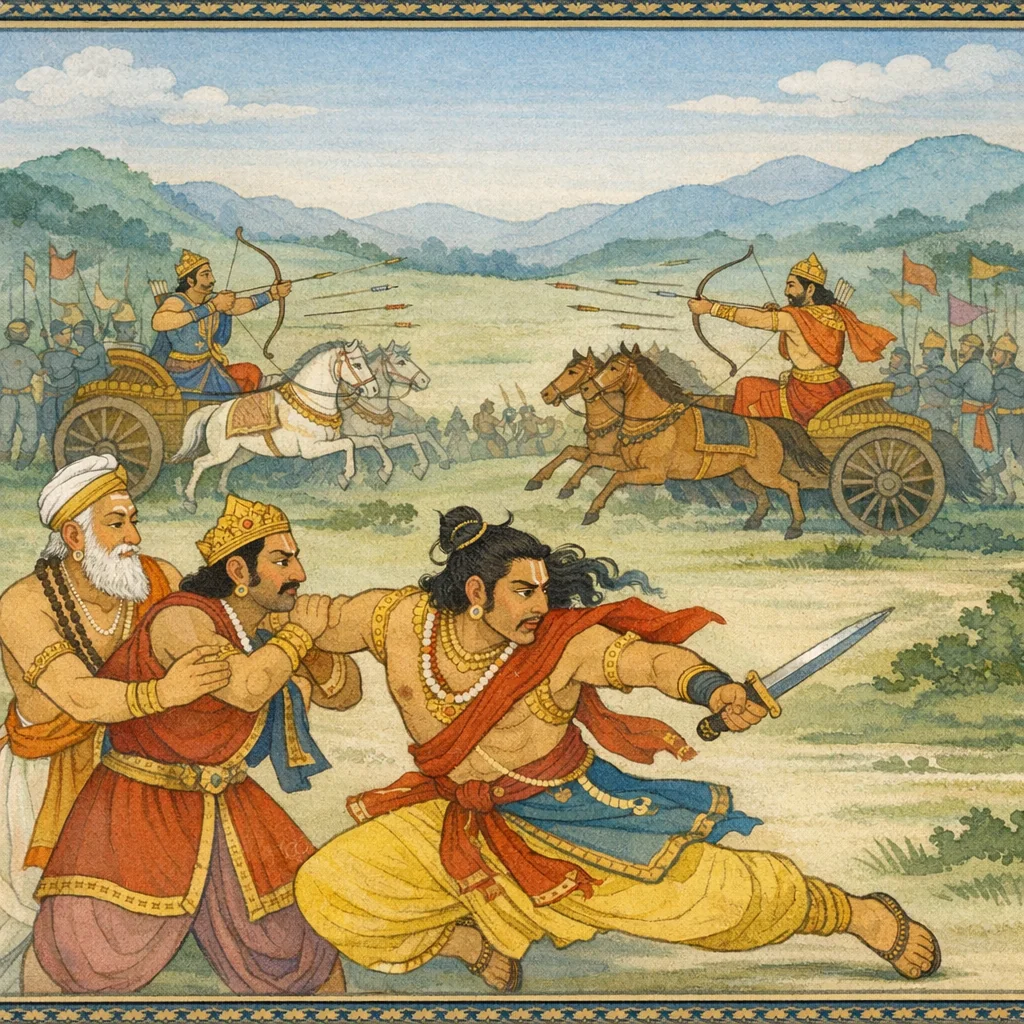
ऑपनआक्रा बछ। लि, एकोनषष्ट्यधिकशततमो< ध्याय: अभश्रत्थामाका कर्णको मारनेके लिये उद्यत होना, दुर्योधनका उसे मनाना, पाण्डवों और पाज्चालोंका कर्णपर आक्रमण, कर्णका पराक्रम, अर्जुनके द्वारा कर्णकी पराजय तथा दुर्योधनका अश्वत्थामासे पांचालोंके वधके लिये अनुरोध संजय उवाच तथा परुषितं दृष्टवा सूतपुत्रेण मातुलम् | खड्गमुद्यम्य वेगेन द्रौणिरभ्यपतद् द्रुतम्,संजय कहते हैं--राजन्! इस प्रकार अपने मामाके प्रति सूतपुत्र कर्णको कटु वचन सुनाते देख अश्वत्थामा बड़े वेगसे तलवार उठाकर तुरंत कर्णपर टूट पड़ा
Sanjaya said: O King, seeing Karṇa—the son of a charioteer—address his maternal uncle with harsh words in this manner, Droṇa’s son Aśvatthāmā, seizing his sword and driven by sudden fury, swiftly rushed to attack Karṇa.
Verse 2
ततः परमसंक्रुद्धः सिंहो मत्तमिव द्विपम् । प्रेक्षत: कुरुराजस्य द्रौणि: कर्ण समभ्ययात्
Sañjaya said: Then, inflamed with extreme wrath, Droṇa’s son (Aśvatthāman) advanced upon Karṇa—like a lion rushing at a maddened elephant—while the Kuru king looked on.
Verse 3
जैसे सिंह मतवाले हाथीपर झपटता है, उसी प्रकार अत्यन्त क्रोधमें भरे हुए द्रोणकुमार अश्व॒ृत्थामाने कुरुराज दुर्योधनके देखते-देखते कर्णपर आक्रमण किया ।। अश्वत्थामोवाच यदर्जुनगुणांस्तथ्यान् कीर्तयानं नराधम । शूरं द्वेषात् सुददुर्बुद्धे त्वं भर्त्समपसि मातुलम्,अश्वत्थामाने कहा--दुर्बुद्धि! नराधम! मेरे मामा सम्पूर्ण जगतके श्रेष्ठ धनुर्धर एवं शूरवीर हैं। ये अर्जुनके सच्चे गुणोंका बखान कर रहे थे, तो भी तू द्वेषवश अपनी शूरताकी डींग हाँकता हुआ और घमण्डमें आकर आज युद्धमें किसीको कुछ न समझता हुआ जो इन्हें फटकार रहा है, उसका क्या कारण है?
Sañjaya said: As a lion springs upon a maddened elephant, so did Droṇa’s son Aśvatthāmā—filled with blazing anger—rush to attack Karṇa, even as the Kuru king Duryodhana looked on. Aśvatthāmā said: “O vile man, O wretch of a mind! Why do you, out of sheer hatred, rebuke my maternal uncle—who is a true hero and the finest of archers—when he is merely proclaiming Arjuna’s genuine virtues? What drives you, in your arrogance, to boast of your own valor and to scold him as though none in this war were worthy of regard?”
Verse 4
विकत्थमान: शौर्येण सर्वलोकथनुर्थरम् । दर्पोत्सेधगृहीतो5द्य न कज्चिद् गणयन् मृथे,अश्वत्थामाने कहा--दुर्बुद्धि! नराधम! मेरे मामा सम्पूर्ण जगतके श्रेष्ठ धनुर्धर एवं शूरवीर हैं। ये अर्जुनके सच्चे गुणोंका बखान कर रहे थे, तो भी तू द्वेषवश अपनी शूरताकी डींग हाँकता हुआ और घमण्डमें आकर आज युद्धमें किसीको कुछ न समझता हुआ जो इन्हें फटकार रहा है, उसका क्या कारण है?
Sañjaya said: “Boasting of his own prowess, and seized today by the swelling pride of arrogance, he scolds in the midst of battle that foremost bowman, renowned throughout all the worlds, counting no one as worthy of regard.”
Verse 5
क्व ते वीर्य क््व चास्त्राणि यच्त्वां निर्जित्य संयुगे । गाण्डीवधन्वा हतवान् प्रेक्षतस्ते जयद्रथम्,जब युद्धस्थलमें गाण्डीवधारी अर्जुनने तुझे परास्त करके तेरे देखते-देखते जयद्रथको मार डाला था, उस समय तेरा पराक्रम कहाँ था? तेरे वे अस्त्र-शस्त्र कहाँ चले गये थे?
“Where was your valor—where were your weapons and astras—when Arjuna, wielder of the Gāṇḍīva, defeated you in battle and slew Jayadratha before your very eyes?”
Verse 6
येन साक्षान्महादेवो योधित: समरे पुरा । तमिच्छसि वृथा जेतुं सूताधम मनोरथै:,सूताधम! जिन्होंने समरांगणमें पहले साक्षात् महादेवजीके साथ युद्ध किया है, उन्हें केवल मनोरथोंद्वारा जीतनेकी तू व्यर्थ इच्छा प्रकट कर रहा है
Sañjaya said: “He who once fought face to face with Mahādeva himself in battle—him you vainly wish to conquer by mere daydreams and empty schemes, O lowest of charioteers.”
Verse 7
यं हि कृष्णेन सहित सर्वशस्त्रभूृतां वरम् । जेतुं न शक्ता: सहिता: सेन्द्रा अपि सुरसुरा:,दुर्बद्धि! सूत! जो सम्पूर्ण शस्त्रधारियोंमें श्रेष्ठ हैं तथा श्रीकृष्णके साथ रहनेपर जिन्हें इन्द्रसहित सम्पूर्ण देवता और असुर भी जीतनेमें समर्थ नहीं हैं, उन्हीं लोकके एकमात्र अपराजित वीर अर्जुनको जीतनेके लिये इन राजाओंसहित तेरी क्या शक्ति है?
Sañjaya said: O foolish-minded charioteer! Even the assembled gods and demons, Indra included, cannot conquer that Arjuna—foremost among all bearers of weapons—when he stands together with Kṛṣṇa. If he is the one warrior in the world who is truly unconquered, what power do you have, even with these kings at your side, to defeat him?
Verse 8
लोकैकवीरमजितमर्जुनं सूत संयुगे । कि पुनस्त्व॑ सुद्दुर्बुद्धे सहैभिरवसुधाधिपै:,दुर्बद्धि! सूत! जो सम्पूर्ण शस्त्रधारियोंमें श्रेष्ठ हैं तथा श्रीकृष्णके साथ रहनेपर जिन्हें इन्द्रसहित सम्पूर्ण देवता और असुर भी जीतनेमें समर्थ नहीं हैं, उन्हीं लोकके एकमात्र अपराजित वीर अर्जुनको जीतनेके लिये इन राजाओंसहित तेरी क्या शक्ति है?
Sañjaya said: “O charioteer, Arjuna is the world’s lone, unconquered champion—invincible in battle. If even the gods with Indra, and the hosts of asuras too, cannot overcome him when he stands with Śrī Kṛṣṇa, then what strength do you—of misguided judgment—have to defeat that foremost bearer of weapons, even with all these kings beside you?”
Verse 9
कर्ण पश्य सुददुर्बुद्धे तिछेदानीं नराधम । एष तेड्द्य शिर: कायादुद्धरामि सुदुर्मते,दुर्बद्धि नराधम! कर्ण! तू देख और खड़ा रह। दुर्मते! मैं अभी तेरा सिर धड़से उतार लेता हूँ
Sañjaya said: “Karṇa, look on and stand your ground, you utterly misguided wretch, lowest of men. This very day, O evil-minded fool, I shall tear your head from your body.”
Verse 10
संजय उवाच तमुद्यतं तु वेगेन राजा दुर्योधन: स्वयम् । न्यवारयन्महातेजा: कृपश्च द्विपदां वर:,संजय कहते हैं--राजन्! इस प्रकार वेगपूर्वक उठे हुए अश्वत्थामाको महातेजस्वी स्वयं राजा दुर्योधन तथा मनुष्योंमें श्रेष्ठ कृपाचार्यने रोका
Sañjaya said: O King, when Aśvatthāmā sprang up in a surge of speed and fury, King Duryodhana himself—together with the mighty Kṛpa, foremost among men—restrained him.
Verse 11
कर्ण उवाच शूरो5यं समरश्लाघी दुर्मतिश्न द्विजाधम: । आसादयतु मद्दीर्य मुज्चेमं कुरुसत्तम,कर्ण बोला--कुरुश्रेष्ठ! यह दुर्बुद्धि एवं नीच ब्राह्मण बड़ा शूरवीर बनता है और युद्धकी श्लाघा रखता है। तुम इसे छोड़ दो। आज यह मेरे पराक्रमका सामना करे
Karna said: “This man is a braggart of battle, a misguided wretch, the lowest of Brahmins. Let him come and face my prowess. Release him, O best of the Kurus.”
Verse 12
अश्वत्थामोवाच तवैतत् क्षम्यतेडस्माभि: सूतात्मज सुदुर्मते । दर्पमुत्सिक्तमेतत् ते फाल्गुनो नाशयिष्यति,अश्वत्थामाने कहा--दुर्बुद्धि सूतपुत्र! हमलोग तेरे इस अपराधको क्षमा करते हैं। तेरे इस बढ़े हुए घमण्डका नाश अर्जुन करेंगे
Ashvatthama said: “O son of a charioteer, of perverse understanding—this offense of yours is forgiven by us. But this swollen pride of yours will be crushed by Phalguna (Arjuna).”
Verse 13
दुर्योधन उवाच अश्वत्थामन् प्रसीदस्व क्षन्तुमहसि मानद । कोप: खलु न कर्तव्य: सूतपुत्रं कथंचन,दुर्योधन बोला--दूसरोंको मान देनेवाले (भाई) अश्वत्थामा! प्रसन्न होओ। तुम्हें क्षमा करना चाहिये। सूतपुत्र कर्णपर तुम्हें किसी प्रकार भी क्रोध करना उचित नहीं है
Duryodhana said: “Aśvatthāman, be appeased; O giver of honor, you ought to forgive. Indeed, you should not, in any way, direct anger toward Karṇa, the son of a charioteer.”
Verse 14
त्वयि कर्णे कृपे द्रोणे मद्रराजेडथ सौबले । महत् कार्य समासक्तं प्रसीद द्विजसत्तम,द्विजश्रेष्ठ! तुमपर, कर्णपर तथा कृपाचार्य, द्रोणाचार्य, मद्रराज शल्य और शकुनिपर महान् कार्यभार रखा गया है; तुम प्रसन्न होओ
Duryodhana said: “Upon you—on Karṇa, on Kṛpa, on Droṇa, on the king of Madra (Śalya), and on Saubala (Śakuni)—a great and urgent responsibility has been placed. Be gracious and act with full resolve, O best of the twice-born.”
Verse 15
एते हाभिमुखा: सर्वे राधेयेन युयुत्सव: । आयान्ति पाण्डवा ब्रद्वान्नाह्नयन्त: समन्तत:,ब्रह्मन! ये सामने राधापुत्र कर्णके साथ युद्धकी अभिलाषा रखकर समस्त पाण्डव- सैनिक सब ओरसे ललकारते आ रहे हैं
Duryodhana said: “All these warriors, facing us, eager to fight with Radheya (Karna), are advancing—the Pāṇḍavas, O Brahmin—challenging from every side.”
Verse 16
संजय उवाच प्रसाद्यमानस्तु ततो राज्ञा द्रौणिमहामना: । प्रससाद महाराज क्रोधवेगसमन्वित:,संजय कहते हैं--महाराज! राजा दुर्योधनके मनानेपर क्रोधके वेगसे युक्त महामना अश्र॒त्थामा शान्त एवं प्रसन्न हो गया
Sañjaya said: “Then, being appeased by the king, the high-souled Aśvatthāmā—though still charged with the surge of anger—became calm and well-disposed, O great king.”
Verse 17
ततः: कृपो<प्युवाचेदमाचार्य: सुमहामना: । सौम्यस्वभावादू राजेन्द्र क्षिप्रमागतमार्दव:,राजेन्द्र! तत्पश्चात् सौम्य स्वभावके कारण शीघ्र ही मृदुता आ जानेसे महामना कृपाचार्य भी शान्त हो गये और इस प्रकार बोले
Then even Kṛpa, the noble-minded preceptor, softened quickly because of his gentle disposition. O best of kings, when mildness returned to him, he grew calm and spoke in this manner—showing how self-control and innate gentleness can restrain anger even amid the pressures of war.
Verse 18
कृप उवाच तवैतत् क्षम्यतेडस्माभि: सूतात्मज सुदुर्मते । दर्पमुत्सिक्तमेतत् ते फाल्गुनो नाशयिष्यति,कृपाचार्यने कहा--दुर्बुद्धि सूतपुत्र! हमलोग तो तेरे इस अपराधको क्षमा कर देते हैं; परंतु अर्जुन तेरे इस बढ़े हुए घमंडका अवश्य नाश करेंगे
Kripa said: “O son of a charioteer, O misguided one—this offense of yours is forgiven by us. Yet Arjuna will surely shatter this swollen arrogance of yours.”
Verse 19
संजय उवाच ततस्ते पाण्डवा राजन् पज्चालाश्व यशस्विन: । आजम्मु: सहिता: कर्ण तर्जयन्त: समन्ततः,संजय कहते हैं--राजन्! तदनन्तर वे यशस्वी पाण्डव और पांचाल एक साथ होकर गर्जन-तर्जन करते हुए चारों ओरसे कर्णपर चढ़ आये
Sañjaya said: “O King, thereafter the illustrious Pāṇḍavas and the Pāñcālas, united together, advanced upon Karṇa from all sides, roaring and hurling challenges.”
Verse 20
कर्णोडपि रथियनां श्रेष्ठ श्नापमुद्यम्य वीर्यवान् । कौरवाग्रयै: परिवृत: शक्रो देवगणैरिव
Sañjaya said: Karṇa too—mighty and foremost among chariot-warriors—raised his weapon, surrounded by the leading Kauravas, like Indra encircled by the hosts of gods.
Verse 21
ततः प्रववृते युद्ध कर्णस्य सह पाण्डवै:
Sañjaya said: Thereupon the battle commenced—Karna engaging the Pāṇḍavas—signaling a decisive turn in the war where personal prowess and long-held vows collide with the larger demands of duty and fate.
Verse 22
भीषणं सुमहाराज सिंहनादविराजितम् | महाराज! तदनन्तर कर्णका पाण्डवोंके साथ भीषण युद्ध आरम्भ हुआ, जो सिंहनादसे सुशोभित हो रहा था ।। ततस्ते पाण्डवा राजन् पज्चालाश्न यशस्विन:
Sañjaya said: “O great king, then a dreadful battle began between Karṇa and the Pāṇḍavas—made resplendent by the lion-roars of warriors. Thereupon, O king, the Pāṇḍavas and the illustrious Pāñcālas also advanced and joined the fight.”
Verse 23
अयं कर्ण: कुत: कर्णस्तिष्ठ कर्ण महारणे
Sañjaya said: “Here is Karṇa—where is Karṇa now? Stand firm, O Karṇa, in this great battle!” The cry bears urgency and moral pressure: in war’s crisis a warrior is called to steadiness and accountability, not evasion, for the fate of many hangs upon his resolve.
Verse 24
अन््ये तु दृष्टवा राधेयं क्रोधरक्तेक्षणाउब्रुवन्
Sañjaya said: But others, on seeing Rādheya (Karna), their eyes reddened with anger, spoke out—words born of wrath in the heat of battle, showing how fury can overtake judgment and drive men to harsh speech amid war’s ruin.
Verse 25
हन्यतामयमुत्सिक्त: सूतपुत्रो5ल्पचेतन: । सर्वे: पार्थिवशार्टूलैननिनार्थो5स्ति जीवता
Sañjaya said: “Slay this arrogant, dull-witted son of a charioteer. For all you tiger-like kings, there is no purpose in leaving him alive.”
Verse 26
अत्यन्तवैरी पार्थानां सततं पापपूरुष: । एष मूलमनर्थानां दुर्योधनमते स्थित:
Sañjaya said: “He is the Pāṇḍavas’ implacable enemy, ever a sinful man. He stands as the very root of calamities, fixed in the counsel and mindset of Duryodhana.”
Verse 27
घ्नतैनमिति जल्पन्त: क्षत्रिया: समुपाद्रवन् । महता शरवर्षेण च्छादयन्तो महारथा:
Sañjaya said: Crying, “Kill him!”, the Kṣatriya warriors rushed forward. Those great chariot-fighters then smothered him under a massive downpour of arrows.
Verse 28
वधार्थ सूतपुत्रस्य पाण्डवेयेन चोदिता: । दूसरे लोगोंने राधापुत्र कर्णको देखकर क्रोधसे लाल आँखें करके कहा--“समस्त श्रेष्ठ राजा मिलकर इस घमंडी और मूर्ख सूतपुत्रको मार डालें। इसके जीनेसे कोई लाभ नहीं है। यह पापात्मा पुरुष सदा कुन्तीकुमारोंके साथ अत्यन्त वैर रखता आया है। दुर्योधनकी रायमें रहकर यही सारे अनर्थोकी जड़ बना हुआ है। अतः इसे मार डालो।” ऐसा कहते हुए समस्त क्षत्रिय महारथी पाण्डुपुत्र युधिष्ठिरसे सूतपुत्रके वधके लिये प्रेरित हो बाणोंकी बड़ी भारी वर्षद्वारा उसे आच्छादित करते हुए उसपर टूट पड़े || २४--२७ ह || तांस्तु सर्वास्तथा दृष्टवा धावमानान् महारथान्
Sañjaya said: Urged on by the son of Pāṇḍu, the warriors moved with the intent to kill the charioteer’s son (Karna). In the heat of battle they cast Karna, the son of Rādhā, as the enduring foe of Kuntī’s sons and the root of ruin through his alignment with Duryodhana; thus they pressed Yudhiṣṭhira toward a decisive act, and the kṣatriya mahārathas surged forward, covering Karna with a dense shower of arrows.
Verse 29
दृष्टवा संहारकल्पं तमुद्धूतं सैन्यसागरम्,वारयामास तत् सैन्यं समन्ताद् भरतर्षभ | भरतश्रेष्ठ! प्रलयकालके समान उस सैन्यसागरको उमड़ा हुआ देख संग्राममें पराजित न होनेवाले बलवान, शीघ्रकारी और महान् शक्तिशाली कर्णने आपके पुत्रोंको प्रसन्न करनेकी इच्छासे बाणसमूहकी वर्षा करके सब ओरसे शत्रुओंकी उस सेनाको रोक दिया
Sañjaya said: Seeing that army—like a sea of troops—surging up in a manner fit for universal destruction, Karṇa checked that host on every side, O bull among the Bharatas. With swift, unerring strength and the resolve to gladden your sons, he poured forth volleys of arrows and held back the enemy’s advance.
Verse 30
पिप्रीषुस्तव पुत्राणां संग्रामेष्वपराजित: । सायकौघेन बलवान क्षिप्रकारी महाबल:
Sañjaya said: “Eager to please your sons, unconquered in battles, mighty with a torrent of arrows, swift in action, and of great strength.”
Verse 31
ततस्तु शरवर्षेण पार्थिवास्तमवारयन्,तदनन्तर सैकड़ों और सहस्रों नरेशोंने अपने धनुषोंको कम्पित करते हुए बाणोंकी वर्षसे कर्णकी भी प्रगति रोक दी। जैसे दैत्योंने इन्द्रके साथ संग्राम किया था, उसी प्रकार वे राजालोग राधापुत्र कर्णके साथ युद्ध करने लगे
Sañjaya said: Then the kings checked him with a rain of arrows. After that, hundreds and thousands of rulers, shaking their bows, halted even Karna’s advance by a storm of shafts. As the Daityas once fought against Indra, so those kings engaged in battle with Karna, the son of Radha.
Verse 32
धनूंषि ते विधुन्चाना: शतशो5थ सहस्रश: । अयोधयन्त राधेयं शक्रं दैत्यगणा इव,तदनन्तर सैकड़ों और सहस्रों नरेशोंने अपने धनुषोंको कम्पित करते हुए बाणोंकी वर्षसे कर्णकी भी प्रगति रोक दी। जैसे दैत्योंने इन्द्रके साथ संग्राम किया था, उसी प्रकार वे राजालोग राधापुत्र कर्णके साथ युद्ध करने लगे
Sanjaya said: Then, by the hundreds and by the thousands, those kings, shaking their bows, checked Radheya Karna’s advance with a rain of arrows. Like hosts of Daityas battling Indra, they pressed Karna into fierce combat.
Verse 33
शरवर्ष तु तत् कर्ण: पार्थिव: समुदीरितम् । शरवर्षेण महता समन्ताद् व्यकिरत् प्रभो,प्रभो! राजाओंद्वारा की हुई उस बाण-वर्षाको कर्णने बाणोंकी बड़ी भारी वृष्टि करके सब ओर बिखेर दिया
Sanjaya said: Karna, the king, met that shower of arrows unleashed by the rulers; with an even greater and wider rain of arrows, he scattered it in all directions.
Verse 34
तद् युद्धमभवत् तेषां कृतप्रतिकृतैषिणाम् । यथा देवासुरे युद्धे शक्रस्य सह दानवै:
Sanjaya said: Then a battle arose among them—men intent on repaying deed with counter-deed—like the war between the gods and the asuras, when Śakra fought against the Dānavas.
Verse 35
जैसे देवासुर-संग्राममें दानवोंके साथ इन्द्रका युद्ध हुआ था, उसी प्रकार घात- प्रतिघातकी इच्छावाले राजाओं तथा कर्णका वह युद्ध बड़ा भयंकर हो रहा था ।। तत्राद्भुतमपश्याम सूतपुत्रस्य लाघवम् । यदेनं सर्वतो यत्ता नाप्लुवन्ति परे युधि
Sanjaya said: Just as, in the ancient war between gods and asuras, Indra fought the Dānavas, so too this battle became exceedingly dreadful—kings on every side driven by the desire to strike and counterstrike, and Karna meeting them in relentless combat. There we witnessed something astonishing: the swiftness of the charioteer’s son. Though the enemy pressed him from all directions, they could not overwhelm him in the fight.
Verse 36
वहाँ हमने सूतपुत्र कर्णकी अद्भुत फुर्ती देखी, जिससे सब ओरसे प्रयत्न करनेपर भी शत्रुपक्षीय योद्धा उस युद्धस्थलमें कर्णको काबूमें नहीं कर पा रहे थे ।। निवार्य च शरौघांस्तान् पार्थिवानां महारथ: । युगेष्वीषासु च्छत्रेषु ध्वजेषु च हयेषु च
Sanjaya said: There we witnessed the astonishing swiftness of Karna, son of a sūta; though the enemy strove from every side, they could not bring him under control on that battlefield. The great chariot-warrior Karna checked the dense volleys of arrows shot by the kings, and struck at the yokes and pole-pieces of their chariots, and at their parasols, banners, and horses.
Verse 37
ततस्ते व्याकुली भूता राजान: कर्णपीडिता:
Then those kings, tormented by Karṇa, were thrown into confusion and distress, their composure broken amid the press of battle—showing how unchecked martial prowess can shake even rulers when courage is not steadied by discipline and right counsel.
Verse 38
हयानां वध्यमानानां गजानां रथिनां तथा
Sañjaya said: “As the horses were being cut down, and likewise the elephants and the chariot-warriors as well…,”—he begins to depict the battlefield’s mounting devastation, where the instruments of war and the warriors themselves fall together, underscoring the moral weight and tragic cost of unchecked slaughter.
Verse 39
तत्र तत्राभ्यवेक्षाम संघान् कर्णेन ताडितान् । कर्णके बाणोंकी चोट खाकर मरनेवाले घोड़ों, हाथियों और रथियोंके झुंड-के-झुंड हमने वहाँ देखे थे ।। शिरोभि: पतितै राजन् बाहुभिश्न समन्ततः
Sañjaya said: “There and again there we beheld whole masses of warriors struck down by Karna. In that place we saw, in great clusters, horses, elephants, and chariot-fighters dying from the blows of Karna’s arrows—while all around, O King, the ground was strewn with fallen heads and severed arms.”
Verse 40
हतैश्न हन्यमानैश्व निष्टनद्धिश्ष सर्वश:
Sañjaya said: On every side there were cries and groans—arising alike from those already struck down and from those still being cut down—so that the battlefield resounded with suffering in all directions. The line underscores the moral weight of war: victory is inseparable from the pervasive anguish of the slain and the dying.
Verse 41
बभूवायोधन रौद्रं वैवस्वतपुरोपमम् । कुछ लोग मारे गये थे, कुछ मारे जा रहे थे और कुछ लोग सब ओर पीड़ासे कराह रहे थे। इससे वह युद्धस्थल यमपुरीके समान भयंकर प्रतीत होता था ।। ततो दुर्योधनो राजा दृष्टवा कर्णस्य विक्रमम्
Sañjaya said: The battlefield became a scene of dreadful combat, resembling the city of Vaivasvata (Yama). Some had already been slain, some were being slain, and others, writhing in pain, cried out on every side—so terrifying did that field of war appear, like Yama’s own realm. Then King Duryodhana, seeing Karṇa’s prowess…
Verse 42
युध्यतेड्सौ रणे कर्णो दंशित: सर्वपार्थिवै:,“रणभूमिमें वह कवचधारी कर्ण समस्त राजाओंके साथ अकेला ही युद्ध कर रहा है। देखो, कर्णके बाणोंसे पीड़ित हुई यह पाण्डव-सेना कार्तिकेयके द्वारा नष्ट की हुई असुरवाहिनीके समान भागी जा रही है
Sañjaya said: In the thick of battle, Karṇa, clad in armor, fights on alone though assailed by all the kings. The Pāṇḍava host, tormented by Karṇa’s arrows, is breaking and fleeing, like the Asura army shattered by Kārttikeya (Skanda).
Verse 43
पश्यैतां द्रवर्ती सेनां कर्णसायकपीडिताम् । कार्तिकेयेन विध्यस्तामासुरीं पृततामिव,“रणभूमिमें वह कवचधारी कर्ण समस्त राजाओंके साथ अकेला ही युद्ध कर रहा है। देखो, कर्णके बाणोंसे पीड़ित हुई यह पाण्डव-सेना कार्तिकेयके द्वारा नष्ट की हुई असुरवाहिनीके समान भागी जा रही है
Sañjaya said: “Behold this army in flight, tormented by Karṇa’s arrows. It is scattering like a host of Asuras struck down by Kārttikeya (Skanda).”
Verse 44
दृष्टवैतां निर्जितां सेनां रणे कर्णेन धीमता । अभियात्येष बीभत्सु: सूतपुत्रजिधघांसया,“बुद्धिमान् कर्णके द्वारा रणभूमिमें पराजित हुई इस सेनाको देखकर सूतपुत्रका वध करनेकी इच्छासे ये अर्जुन आगे बढ़े जा रहे हैं
Sañjaya said: Seeing this army defeated in battle by the wise Karṇa, Arjuna (Bībhatsu) now advances, driven by the resolve to slay the charioteer’s son (the Sūta’s son).
Verse 45
तद् यथा प्रेक्षमाणानां सूतपुत्रं महारथम् | न हन्यात् पाण्डव: संख्ये तथा नीतिर्विधीयताम्,“अत: हमलोगोंके देखते-देखते युद्धमें पाण्डुपुत्र अर्जुन-जैसे भी महारथी सूतपुत्रको न मार सकें, वैसी नीतिसे काम लो”
Sañjaya said: “So contrive it that, even while we are watching, the Pāṇḍava in the thick of battle may not be able to slay the great chariot-warrior, the Sūta’s son. Let the strategy be arranged accordingly.”
Verse 46
ततो दौणि: कृप: शल्यो हार्दिक्यश्व महारथ: । प्रत्युद्ययुस्तदा पार्थ सुतपुत्रपरीप्सया
Sañjaya said: Then Droṇa’s son (Aśvatthāman), Kṛpa, Śalya, and the great chariot-warrior Hārdikya set out in counter-advance, O Pārtha, intent on protecting the Sūta’s son.
Verse 47
बीभत्सुरपि राजेन्द्र पड्चालैरभिसंवृत:
Sañjaya said: O king, even Bhībhatsu (Arjuna), though a formidable warrior, was surrounded on all sides by the Pāñcālas.
Verse 48
धृतराष्ट्र रवाच संरब्धं फाल्गुनं दृष्टया कालान्तकयमोपमम्
Dhṛtarāṣṭra said: “Seeing Phālguna (Arjuna) inflamed with wrath, resembling Yama—the bringer of death at the end of time—I am struck with dread.”
Verse 49
कर्णो वैकर्तन: सूत प्रत्यपद्यत् किमुत्तरम् । धृतराष्ट्रने पूछा--सूत! काल, अन्तक और यमके समान क्रोधमें भरे हुए अर्जुनको देखकर वैकर्तन कर्णने उन्हें किस प्रकार उत्तर दिया? (कैसे उनका सामना किया) ।। ४८ ६ || यो हास्पर्धत पार्थेन नित्यमेव महारथ:
Sañjaya said: “O Sūta, what reply did Karṇa, the son of Vikarṭana, make? When Dhṛtarāṣṭra asked, ‘O Sūta, on seeing Arjuna blazing with wrath like Time, Death, and Yama, how did Karṇa answer him; how did he face him?’—tell me. For Karṇa was the great chariot-warrior who had always challenged Pārtha (Arjuna).”
Verse 50
स तु तं सहसा प्राप्तं नित्यमत्यन्तवैरिणम्
Sañjaya said: But he, encountering him suddenly—one who was ever his most implacable enemy—faced that unavoidable confrontation.
Verse 51
कर्णो वैकर्तन: सूत किमुत्तरमपद्यत । संजय! उस समय अपने सदाके अत्यन्त वैरी अर्जुनको सहसा सामने पाकर सूर्यपुत्र कर्णने उन्हें किस प्रकार उत्तर देनेका निश्चय किया? || ५० ई ।। संजय उवाच आयान्तं पाण्डवं दृष्टवा गजं प्रतिगजो यथा
Sañjaya said: Seeing the Pāṇḍava advancing, Karṇa moved to meet him—like one elephant confronting another.
Verse 52
तमापततन्तं वेगेन वैकर्तनमजिह्ागै:
Sañjaya said: As Vaikartana (Karna) rushed forward with great speed, he was met and checked by serpentine missiles—like snakes—hurled in the fury of battle. Thus is it shown that in war even the mightiest are confronted by counter-force and stratagem.
Verse 53
स कर्ण शरजालेन च्छादयामास पाण्डव:
Sañjaya said: The Pāṇḍava then covered Karṇa with a net-like shower of arrows, overwhelming him in the press of battle. The moment underscores the relentless intensity of righteous war, where resolve and skill must be matched by restraint and purpose amid violence.
Verse 54
तस्य तल्लाघवं पार्थो नामृष्पत महाबल:,शत्रुओंको संताप देनेवाले महाबली अर्जुन कर्णकी इस फुर्तीको न सह सके। उन्होंने सूतपुत्र कर्णजो शिलापर तेज किये हुए स्वच्छ अग्रभागवाले तीन सौ बाण मारे
Sañjaya said: Mighty Arjuna could not endure that display of swiftness. A tormentor of foes, he showered the charioteer’s son Karṇa with three hundred arrows—stone-whetted and keen-pointed—meeting speed with disciplined force in the relentless ethics of battlefield response.
Verse 55
तस्मै बाणान् शिलाधौतान प्रसन्नाग्रानजिद्दागान् । प्राहिणोत् सूतपुत्राय त्रिशतं शत्रुतापन:,शत्रुओंको संताप देनेवाले महाबली अर्जुन कर्णकी इस फुर्तीको न सह सके। उन्होंने सूतपुत्र कर्णजो शिलापर तेज किये हुए स्वच्छ अग्रभागवाले तीन सौ बाण मारे
Sañjaya said: Unable to endure that display of speed, the foe-scorching Arjuna sent against Karṇa, the charioteer’s son, three hundred arrows—stone-polished, bright-tipped, and flying straight. The verse underscores the relentless escalation of battle-skill, where prowess and resolve drive warriors to answer force with greater force.
Verse 56
विव्याध चैनं संरब्धो बाणेनैकेन वीर्यवान् । सव्ये भुजाग्रे बलवान् नाराचेन हसन्निव,इसके सिवा कुपित हुए पराक्रमी एवं बलवान् अर्जुनने हँसते हुए-से एक नाराच नामक बाणके द्वारा कर्णकी बायीं भुजाके अग्रभागमें चोट पहुँचायी
Sañjaya said: Enraged, the mighty warrior struck him with a single arrow; then, powerful and unshaken, he pierced the tip of his left arm with a nārāca shaft, as if smiling. In the brutal ethics of battlefield conduct, the verse highlights controlled prowess—displaying superiority without losing composure, even while inflicting harm in a righteous but devastating war.
Verse 57
तस्य विद्धस्य बाणेन कराच्चापं पपात ह । पुनरादाय तच्चापं निमेषार्धान्महाबल:
Sañjaya said: Struck by an arrow, his bow slipped from his hand and fell. Yet that mighty warrior, in less than half a blink, seized the same bow again—revealing the fierce steadiness and trained resolve that drive men onward in the brutal discipline of war.
Verse 58
शरवष्टिं तु तां मुक्तां सूतपुत्रेण भारत
Sañjaya said: O Bhārata, that volley of arrows was released by the charioteer’s son. In the moral atmosphere of the war, the line underscores how decisive acts of violence are traced to individual agency—each discharge of a weapon being a deliberate choice that deepens the burden of responsibility amid chaos.
Verse 59
व्यधमच्छरवर्षेण स्मयन्निव धनंजय: । भारत! सूतपुत्रद्वारा की हुई उस बाण-वर्षाको अर्जुनने मुसकराते हुए-से बाणोंकी वृष्टि करके नष्ट कर दिया ।। तौ परस्परमासाद्य शरवर्षेण पार्थिव
Sañjaya said: O Bhārata, Dhanañjaya (Arjuna), as though smiling, shattered the arrow-storm unleashed by the charioteer’s son (Karna) by pouring forth his own rain of shafts. Thus, meeting each other head-on, the two warriors assailed one another with torrents of arrows—an image of relentless martial resolve where skill and self-control, not mere rage, govern the violence of war.
Verse 60
तदद्भुतं महद् युद्ध कर्णपाण्डवयोर्मुधे
Sañjaya said: “That battle—marvellous and immense—between Karṇa and the Pāṇḍava, in the thick of combat, (then took place).”
Verse 61
क्रुद्धयोर्वासिताहेतोर्वन्ययोर्गजयोरिव । जैसे दो जंगली हाथी किसी हथिनीके लिये क्रोधपूर्वक लड़ रहे हों, उसी प्रकार उस युद्धस्थलमें कर्ण और अर्जुनका वह संग्राम महान् एवं अद्भुत था ।। ततः पार्थों महेष्वासो दृष्टवा कर्णस्य विक्रमम्
Sañjaya said: Like two wild elephants, enraged and driven to battle for the sake of a she-elephant, so too on that battlefield the clash between Karṇa and Arjuna was vast and astonishing. Then Pārtha, the great archer, seeing Karṇa’s prowess…
Verse 62
अश्वांश्व चतुरो भल्लैरनयदू यमसादनम्
Sañjaya said: With sharp arrows (bhallas), he sent the four horses to Yama’s abode—an image of swift, decisive killing amid the relentless ethics of battlefield necessity.
Verse 63
अथीनं छिन्नधन्वानं हताश्वचं हतसारथिम्
Sañjaya said: He was left helpless—his bow cut away, his horses slain, and his charioteer killed—stripped of the supports by which a warrior stands firm in battle.
Verse 64
विव्याध सायकै: पार्थश्चतुर्भि: पाण्डुनन्दन: । धनुष कट जाने और घोड़ों तथा सारथिके मारे जानेपर कर्णको पाण्डुनन्दन अर्जुनने चार बाणोंद्वारा घायल कर दिया ।। ६३ ई || हताश्चात् तु रथात् तूर्णमवप्लुत्य नरर्षभ:
Sañjaya said: Then Pāṇḍu’s son Arjuna, the son of Pṛthā, pierced Karṇa with four arrows. Thereafter, the bull among men, leaping down swiftly from his chariot—(continued).
Verse 65
स नुन्नो$र्जुनबाणौधचैराचित: शल्यको यथा
Sañjaya said: Struck and driven on by Arjuna’s torrents of arrows, he became bristling with shafts—like a porcupine—an image that underscores how relentless martial prowess can overwhelm even a seasoned warrior in the heat of righteous battle.
Verse 66
राधेयं निर्जितं दृष्टवा तावका भरतर्षभ
Sañjaya said: “O bull among the Bharatas, seeing Rādheya (Karna) defeated, your warriors were shaken—an ominous turn in the battle’s moral and strategic balance.”
Verse 67
द्रवतस्तान् समालोक्य राजा दुर्योधनो नूप
Sañjaya said: Seeing those warriors fleeing in disorder, King Duryodhana—O ruler—turned his gaze upon them and reacted accordingly.
Verse 68
निवर्तयामास तदा वाक्यमेतदुवाच ह । नरेश्वर! उन्हें भागते देख राजा दुर्योधनने लौटाया और उस समय उनसे यह बात कही -- ६७३ || अलं द्रुतेन व: शूरास्तिष्ठ ध्वं क्षत्रियर्षभा:,क्षत्रियशिरोमणि शूरवीरो! ठहरो, तुम्हारे भागनेकी कोई आवश्यकता नहीं है। मैं स्वयं अभी अर्जुनका वध करनेके लिये युद्धभूमिमें चलता हूँ। मैं पांचालों और सोमकोंसहित कुन्तीकुमारोंका वध करूँगा
Sañjaya said: Then King Duryodhana checked them as they fled and spoke these words: “Enough of this running, O heroes, bulls among kṣatriyas—stand firm! O crest-jewel of warriors, there is no need for you to retreat in flight. I myself will go onto the battlefield at once to slay Arjuna. I will kill the sons of Kuntī along with the Pañcālas and the Somakas.”
Verse 69
एष पार्थवधायाहं स्वयं गच्छामि संयुगे | अहं पार्थान हनिष्यामि सपञठ्चालान ससोमकान,क्षत्रियशिरोमणि शूरवीरो! ठहरो, तुम्हारे भागनेकी कोई आवश्यकता नहीं है। मैं स्वयं अभी अर्जुनका वध करनेके लिये युद्धभूमिमें चलता हूँ। मैं पांचालों और सोमकोंसहित कुन्तीकुमारोंका वध करूँगा
Sañjaya said: “For the slaying of Arjuna I myself am going to the battlefield. I shall kill the sons of Pṛthā, along with the Pāñcālas and the Somakas.”
Verse 70
अद्य मे युध्यमानस्य सह गाण्डीवधन्चना । द्रक्ष्यन्ति विक्रमं पार्था: कालस्येव युगक्षये,“आज गाण्डीवधारी अर्जुनके साथ युद्ध करते समय कुन्तीके सभी पुत्र प्रलयकालमें कालके समान मेरा पराक्रम देखेंगे
Sañjaya said: “Today, as I fight face to face with Arjuna, the wielder of the Gāṇḍīva, the sons of Kuntī will behold my prowess—like that of Time itself at the dissolution of an age.”
Verse 71
अद्य मद्घाणजालानि विमुक्तानि सहस्रश: । द्रक्ष्यन्ति समरे योधा: शलभानामिवायती:
Sañjaya said: “Today, in the thick of battle, the warriors will behold my nets of destruction released in their thousands—spreading out like swarms of locusts.”
Verse 72
“आज समरांगणमें सहस्रों योद्धा मेरे छोड़े हुए हजारों बाणसमूहोंको शलभोंकी पंक्तियोंके समान देखेंगे ।। अद्य बाणमयं वर्ष सृजतो मम धन्विन: । जीमूतस्येव घर्मान्ते द्रक्ष्यन्ति युधि सैनिका:,'जैसे वर्षाकालमें मेघ जलकी वर्षा करता है, उसी प्रकार धनुष हाथमें लेकर मेरे द्वारा की हुई बाणमयी वर्षाको आज युद्धस्थलमें समस्त सैनिक देखेंगे
Sanjaya said: “Today, on the battlefield, thousands of warriors will behold the thousands of clusters of arrows released by me, like rows of moths. Today the soldiers in the fight will witness my shower made wholly of arrows, as though a rain-cloud, at the end of the hot season, were pouring down its rain.”
Verse 73
जेष्याम्यद्य रणे पार्थ सायकैर्नतपर्वभि: । तिष्ठ ध्वं समरे शूरा भयं त्यजत फाल्गुनात्,“आज रणभूमिमें झुकी हुई गाँठवाले बाणोंद्वारा मैं अर्जुनको जीत लूँगा। शूरवीरो! तुम समरभूमिमें डटे रहो और अर्जुनसे भय छोड़ दो
Sañjaya said: “Today, on the battlefield, I shall defeat Pārtha (Arjuna) with arrows whose joints are bent. Stand firm in the fight, O heroes; cast off your fear of Phālguna (Arjuna).”
Verse 74
न हि मद्वीर्यमासाद्य फाल्गुन: प्रसहिष्यति | यथा वेलां समासाद्य सागरो मकरालय:,'जैसे समुद्र तटभूमितक पहुँचकर शान्त हो जाता है, उसी प्रकार अर्जुन मेरे समीप आकर मेरा पराक्रम नहीं सह सकेंगे”
Sañjaya said: “For, having come face to face with my prowess, Phālguna (Arjuna) will not be able to withstand it. Just as the ocean—home of the makaras—grows calm upon reaching the shoreline, so too will Arjuna, on approaching me, be unable to endure my might.”
Verse 75
इत्युक्त्वा प्रययौ राजा सैन्येन महता वृत: । फाल्गुनं प्रति दुर्धर्ष: क्रोधात् संरक्तलोचन:
Having spoken thus, the king set out, surrounded by a vast army. Unassailable, he advanced toward Phālguna (Arjuna), his eyes reddened with wrath.
Verse 76
ऐसा कहकर दुर्धर्ष राजा दुर्योधनने क्रोधसे लाल आँखें करके विशाल सेनाके साथ अर्जुनपर आक्रमण किया ।। त॑ प्रयान्तं महाबाहुं दृष्टवा शारद्वतस्तदा । अश्वत्थामानमासाद्य वाक्यमेतदुवाच ह,महाबाहु दुर्योधनको अर्जुनके सामने जाते देख शरद्वानके पुत्र कृपाचार्यने उस समय अश्वत्थामाके पास जाकर यह बात कही--
Seeing the mighty-armed Duryodhana advancing at that moment, Śāradvata (Kṛpa) approached Aśvatthāmā and spoke these words.
Verse 77
एष राजा महाबाहुरमर्षी क्रोधमूर्च्छित: । पतज्जवृत्तिमास्थाय फाल्गुनं योद्धुमिच्छति,“यह अमर्षशील महाबाहु राजा दुर्योधन क्रोधसे अपनी सुधबुध खो बैठा है और पतंगोंकी वृत्तिका आश्रय ले अर्जुनके साथ युद्ध करना चाहता है
Sañjaya said: “This king, mighty-armed and intolerant of affront, has been overwhelmed by anger and has lost clear judgment. Taking on the reckless course of a moth rushing into flame, he now wishes to fight Phālguna (Arjuna).”
Verse 78
यावन्न: पश्यमानानां प्राणान् पार्थेन संगतः । न जह्दात् पुरुषव्याप्रस्तावदू वारय कौरवम्,“यह पुरुषसिंह नरेश अर्जुनसे भिड़कर हमारे देखते-देखते जबतक अपने प्राणोंको त्याग न दे, उसके पहले ही तुम जाकर उस कुरुवंशी राजाको रोको
Sañjaya said: “Before that tiger among men—having engaged with Pārtha—casts away his life right before our eyes, go at once and restrain that Kaurava king. Do not let him rush into a fatal encounter.”
Verse 79
यावत् फाल्गुनबाणानां गोचरं नाद्य गच्छति । कौरव: पार्थिवो वीरस्तावद् वारय संयुगे,“यह कौरववंशका वीर भूपाल आज जबतक अर्जुनके बाणोंकी पहुँचके भीतर नहीं जाता है, तभीतक इसे रोक दो
Sañjaya said: “So long as this heroic Kaurava king does not today come within the range of Arjuna’s arrows, hold him back on the battlefield.”
Verse 80
यावत् पार्थशरैघेरिरनिर्मुक्तोरगसंनिभै: । न भस्मीक्रियते राजा तावद् युद्धान्निवार्यताम्,'केंचुलसे छूटे हुए सर्पोके समान अर्जुनके भयंकर बाणोंद्वारा जबतक राजा दुर्योधन भस्म नहीं कर दिया जाता है, तबतक ही उसे युद्धसे रोक दो
Sañjaya said: “So long as the king is not reduced to ashes by Arjuna’s dreadful arrows—like serpents just released from their slough—restrain him from entering the battle.”
Verse 81
अयुक्तमिव पश्यामि तिष्ठस्त्वस्मासु मानद | स्वयं युद्धाय यद् राजा पार्थ यात्यसहायवान्,“मानद! यह मुझे अनुचित-सा दिखायी देता है कि हमलोगोंके रहते हुए स्वयं राजा दुर्योधन बिना किसी सहायकके अर्जुनके साथ युद्धके लिये जाय
Sañjaya said: “O bestower of honor, it seems improper to me that, while we are still present, the king should go by himself—without any support—to fight Arjuna.”
Verse 82
दुर्लभ जीवितं मन्ये कौरव्यस्य किरीटिना । युध्यमानस्य पार्थेन शार्दूलेनेव हस्तिन:,'जैसे सिंहके साथ हाथी युद्ध करे तो उसका जीवित रहना असम्भव हो जाता है, उसी प्रकार किरीटधारी कुन्तीकुमार अर्जुनके साथ युद्धमें प्रवृत्त होनेपर कुरुवंशी दुर्योधनके जीवनको मैं दुर्लभ ही मानता हूँ
Sañjaya said: “I deem the life of the Kuru prince, Duryodhana, hard to preserve. For when he engages in battle with the diademed Pārtha—Arjuna—his survival is as unlikely as that of an elephant fighting a tiger.”
Verse 83
मातुलेनैवमुक्तस्तु द्रौणि: शस्त्रभूतां वर: । दुर्योधनमिदं वाक््यं त्वरित: समभाषत,मामाके ऐसा कहनेपर शस्त्रधारियोंमें श्रेष्ठ द्रोणकुमार अश्वत्थामाने तुरतं ही दुर्योधनके पास जाकर इस प्रकार कहा--
Sañjaya said: Thus addressed by his maternal uncle, Aśvatthāmā—the son of Droṇa, foremost among those who bear arms—hurried to Duryodhana and spoke these words.
Verse 84
मयि जीवति गान्धारे न युद्ध गन्तुमरहसि । मामनादृत्य कौरव्य तव नित्यं हितैषिणम्,“गान्धारीनन्दन! कुरुकुलरत्न! मैं सदा तुम्हारा हित चाहनेवाला हूँ। तुम मेरे जीते-जी मेरा अनादर करके स्वयं युद्धमें न जाओ
Sañjaya said: “So long as I am alive, O son of Gāndhārī, you ought not to go to battle. Do not disregard me, O Kaurava—for I am ever one who seeks your welfare.”
Verse 85
नहि ते सम्भ्रम: कार्य: पार्थस्य विजयं प्रति । अहमावारयिष्यामि पार्थ तिष्ठ सुयोधन,'सुयोधन! अर्जुनपर विजय पानेके सम्बन्धमें तुम्हें किसी प्रकार संदेह नहीं करना चाहिये। तुम खड़े रहो। मैं अर्जुनको रोकूँगा”
Sañjaya said: “Do not let doubt or agitation arise in you regarding victory over Pārtha (Arjuna). Stand firm, Suyodhana; I shall restrain Pārtha.”
Verse 86
दुर्योधन उवाच आचार्य: पाण्डुपुत्रान् वै पुत्रवत् परिरक्षति । त्वमप्युपेक्षां कुरुषे तेषु नित्यं द्विजोत्तम,दुर्योधन बोला--द्विजश्रेष्ठ) हमारे आचार्य तो अपने पुत्रकी भाँति पाण्डवोंकी रक्षा करते हैं और तुम भी सदा उनकी उपेक्षा ही करते हो
Duryodhana said: “O best of Brahmins, our teacher truly protects the sons of Pāṇḍu as if they were his own children. And you too continually show indifference toward them.”
Verse 87
मम वा मन्दभाग्यत्वान्मन्दस्ते विक्रमो युधि । धर्मराजप्रियार्थ वा द्रौपद्या वा न विद्य तत्,अथवा मेरे दुर्भाग्यसे युद्धमें तुम्हारा पराक्रम मन्द पड़ गया है। तुम धर्मराज युधिष्ठछिर अथवा द्रौपदीका प्रिय करनेके लिये ऐसा करते हो, इसका मुझे पता नहीं है
Duryodhana said: “Either through my ill fortune your prowess in battle has grown faint, or you are holding back to please Dharmarāja Yudhiṣṭhira—or Draupadī. I cannot discern which it is.”
Verse 88
धिगस्तु मम लुब्धस्य यत्कृते सर्वबान्धवा: । सुखार्हा: परम॑ दु:खं प्राप्रुवन्त्यपराजिता:,मुझ लोभीको धिक््कार है, जिसके कारण किसीसे पराजित न होनेवाले और सुख भोगनेके योग्य मेरे सभी भाई-बन्धु महान् दुःख उठा रहे हैं
Duryodhana said: “Shame upon me in my greed—for my sake all my kinsmen, who deserve happiness and were thought unconquerable, are now undergoing the deepest suffering.”
Verse 89
को हि शस्त्रविदां मुख्यो महेश्वरसमो युधि । शत्रुं न क्षपयेच्छक्तो यो न स्थाद् गौतमीसुत:,कृपीकुमार अश्व॒त्थामाके सिवा दूसरा कौन ऐसा वीर है, जो श्त्रवेत्ताओंमें प्रधान, महादेवजीके समान पराक्रमी तथा शक्तिशाली होकर भी युद्धमें शत्रुका संहार नहीं करेगा
Duryodhana said: “Who among the masters of weapons—mighty in battle like Maheśvara himself—would refrain from destroying the enemy when he has the power to do so? Such a one is none other than Aśvatthāmā, the son of Kṛpī, born of Gautamī.”
Verse 90
अश्वत्थामन् प्रसीदस्व नाशयैतान् ममाहितान् | तवास्त्रगोचरे शक्ता: स्थातुं देवा न दानवा:,अश्वत्थामन्! प्रसन्न होओ। मेरे इन शत्रुओंका नाश करो। तुम्हारे अस्त्रोंके मार्गमें देवता और दानव भी नहीं ठहर सकते हैं
Duryodhana implores Aśvatthāman: “Be pleased, Aśvatthāman—destroy these enemies of mine. In the range of your weapons, neither gods nor demons can stand their ground.”
Verse 91
पज्चालान् सोमकांश्चैव जहि द्रौणे सहानुगान् । वयं शेषान् हनिष्यामस्त्वयैव परिरक्षिता:,द्रोणकुमार! तुम अनुगामियोंसहित पांचालों और सोमकोंको मार डालो; फिर तुमसे ही सुरक्षित हो हमलोग अपने शेष शत्रुओंका संहार कर डालेंगे
Duryodhana said: “O son of Droṇa, strike down the Pāñcālas and the Somakas, together with all their followers. With you alone guarding us, we shall then destroy the remaining enemies.”
Verse 92
एते हि सोमका विप्र पञ्चालाश्न यशस्विन: । मम सैन्येषु संक्रुद्धा विचरन्ति दवाग्निवत्,विप्रवर! वे यशस्वी पांचाल और सोमक क्रोधमें भरकर दावानलके समान मेरी सेनाओंमें विचर रहे हैं। इन्हींके साथ केकय भी हैं। महाबाहो! नरश्रेष्ठ! वे किरीटधारी अर्जुनसे सुरक्षित हो मेरी सेनाका सर्वनगाश न कर डालें। अतः पहले ही उन्हें रोको
Duryodhana said: “O brāhmaṇa, these renowned Somakas and Pāñcālas, inflamed with wrath, are ranging through my forces like a forest-fire. Their assault is consuming my army without restraint; therefore they must be checked at once.”
Verse 93
तान् वारय महाबाहो केकयांश्व नरोत्तम । पुरा कुर्वन्ति नि:शेषं रक्ष्यमाणा: किरीटिना,विप्रवर! वे यशस्वी पांचाल और सोमक क्रोधमें भरकर दावानलके समान मेरी सेनाओंमें विचर रहे हैं। इन्हींके साथ केकय भी हैं। महाबाहो! नरश्रेष्ठ! वे किरीटधारी अर्जुनसे सुरक्षित हो मेरी सेनाका सर्वनगाश न कर डालें। अतः पहले ही उन्हें रोको
Duryodhana said: “O mighty-armed one, O best of men—hold them back, and the Kekayas as well. If they are not checked at once, then, protected by the diadem-wearing Arjuna, they will utterly annihilate my forces.”
Verse 94
अभश्रृत्थामंस्त्वरायुक्तो याहि शीघ्रमरिंदम । आदी वा यदि वा पश्चात् तवेदं कर्म मारिष,शत्रुओंका दमन करनेवाले माननीय भाई अअश्वत्थामा! तुम शीघ्र ही जाओ। पहले करो या पीछे; यह कार्य तुम्हारे ही वशका है
Duryodhana said: “Aśvatthāman, subduer of foes—act with urgency and go at once. Whether you do it first or later, this task rests in your hands, noble one.”
Verse 95
त्वमुत्पन्नो महाबाहो पञ्चालानां वध प्रति । करिष्यसि जगत् सर्वमपाज्चालं किलोद्यत:,महाबाहो! तुम पांचालोंका वध करनेके लिये ही उत्पन्न हुए हो। यदि तुम तैयार हो जाओ तो निश्चय ही सारे जगत्को पांचालोंसे शून्य कर दोगे
Duryodhana said: “O mighty-armed one, you were born for the very purpose of slaying the Pañcālas. If you but rise in readiness, you will surely make the whole world bereft of the Pañcālas.”
Verse 96
एवं सिद्धा<ब्रुवन् वाचो भविष्यति च तत् तथा । तस्मात्त्वं पुरुषव्याप्र पज्चालाञउ्जहि सानुगान्,पुरुषसिंह! सिद्ध पुरुषोंने तुम्हारे विषयमें ऐसी ही बातें कही हैं। वे उसी रूपमें सत्य होंगी। अत: तुम सेवकोंसहित पांचालोंका वध करो
Duryodhana said: “Thus have the perfected ones spoken words about you, and so indeed it shall come to pass exactly in that manner. Therefore, O tiger among men, O lion among men, slay the Pāñcālas together with their followers and attendants.”
Verse 97
न ते<स्त्रगोचरे शक्ता: स्थातुं देवा: सवासवा: । किमु पार्था: सपाज्चाला: सत्यमेतद् ब्रवीमि ते
Duryodhana said: “Within the range of your weapons, even the gods—Indra included—would be unable to stand their ground. How much less, then, the sons of Pṛthā along with the Pāñcālas? I tell you this as the truth.”
Verse 98
मैं तुमसे यह सच कहता हूँ कि तुम्हारे बाणोंके मार्गमें इन्द्रसहित सम्पूर्ण देवता भी नहीं ठहर सकते; फिर कुन्तीके पुत्रों और पांचालोंकी तो बिसात ही कया है? ।। नत्वां समर्था: संग्रामे पाण्डवा: सह सोमकै: । बलाद् योधयितुं वीर सत्यमेतद् ब्रवीमि ते,वीर! सोमकोंसहित पाण्डव संग्राममें तुम्हारे साथ बलपूर्वक युद्ध करनेमें समर्थ नहीं हैं। यह मैं तुमसे सत्य कहता हूँ
Duryodhana declares to his warrior that he speaks the truth: even the gods, Indra included, could not stand firm in the path of his arrows—so what chance have the sons of Kuntī and the Pāñcālas? He insists that the Pāṇḍavas, even with the Somakas, are not capable of forcing a battle against him. The speech is martial praise meant to harden resolve and project inevitability.
Verse 99
गच्छ गच्छ महाबाहो न न: कालात्ययो भवेत् । इयं हि द्रवते सेना पार्थसायकपीडिता,महाबाहो! जाओ, जाओ। हमारे इस कार्यमें विलम्ब नहीं होना चाहिये। देखो, अर्जुनके बाणोंसे पीड़ित होकर यह सेना भागी जा रही है
Duryodhana said: “Go, go, O mighty-armed one—let there be no delay for us. For look: this army is already breaking and fleeing, tormented by the arrows of Pārtha (Arjuna).”
Verse 100
शक्तो हासि महाबाहो दिव्येन स्वेन तेजसा । निग्रहे पाण्डुपुत्राणां पज्चालानां च मानद,दूसरोंको मान देनेवाले महाबाहु वीर! तुम अपने दिव्य तेजसे पांचालों और पाण्डवोंका निग्रह करनेमें समर्थ हो
Duryodhana said: “O mighty-armed hero, you are indeed capable—by your own divine splendor—of subduing the sons of Pāṇḍu and the Pāñcālas, O giver of honor.”
Verse 159
इति श्रीमहा भारते द्रोणपर्वणि घटोत्कचवधपर्वणि रात्रियुद्धे दुर्योधनवाक्ये एकोनषष्ट्यधिकशततमो<ध्याय:
Thus, in the sacred Mahābhārata, within the Droṇa Parva—specifically in the section on the slaying of Ghaṭotkaca, during the night-battle—these are the words of Duryodhana, concluding the one-hundred-and-sixty-first chapter.
Verse 203
पर्यतिष्ठत तेजस्वी स्वबाहुबलमाश्रित: । रथियोंमें श्रेष्ठ, पराक्रमी एवं तेजस्वी वीर कर्ण भी देवताओंसे घिरे हुए इन्द्रके समान प्रधान कौरववीरोंसे घिरकर अपने बाहुबलका भरोसा करके धनुष उठाकर युद्धके लिये खड़ा हो गया
Sañjaya said: Trusting in the strength of his own arms, the radiant hero stood firm. Karṇa too—foremost among chariot-warriors, mighty and resplendent—surrounded by the leading Kaurava champions, rose for battle with bow in hand, like Indra encircled by the gods.
Verse 226
दृष्टवा कर्ण महाबाहुमुच्चै: शब्दमथानदन् । राजन्! यशस्वी पाण्डव और पांचालोंने महाबाहु कर्णको देखकर उच्चस्वरसे इस प्रकार कहना आस्मभ किया
Sañjaya said: Seeing Karṇa, the mighty-armed hero, the illustrious Pāṇḍavas and the Pañcālas raised their voices loudly. O King, on beholding that great warrior Karṇa, they began to speak out in this manner.
Verse 236
युध्यस्व सहितोस्माभिवर्दुरात्मन् पुरुषाधम । “कहाँ कर्ण है? यह कर्ण है। दुरात्मन् नराधम कर्ण! इस महायुद्धमें खड़ा रह और हमारे साथ युद्ध कर”
Sañjaya said: “Fight with us, O wicked one, lowest among men. ‘Where is Karṇa?’—‘Here is Karṇa.’ O vile, base Karṇa! Stand firm in this great war and fight with us.”
Verse 286
न विव्यथे सूतपुत्रो न च त्रासमगच्छत । उन समस्त महारथियोंको इस प्रकार धावा करते देख सूतपुत्रके मनमें न तो व्यथा हुई और न त्रास ही हुआ
Sañjaya said: Seeing all those great chariot-warriors charging in that manner, the charioteer’s son (Karṇa) neither wavered in spirit nor fell into fear.
Verse 303
वारयामास तत् सैन्यं समन्ताद् भरतर्षभ | भरतश्रेष्ठ! प्रलयकालके समान उस सैन्यसागरको उमड़ा हुआ देख संग्राममें पराजित न होनेवाले बलवान, शीघ्रकारी और महान् शक्तिशाली कर्णने आपके पुत्रोंको प्रसन्न करनेकी इच्छासे बाणसमूहकी वर्षा करके सब ओरसे शत्रुओंकी उस सेनाको रोक दिया
Sañjaya said: O bull among the Bharatas, seeing that enemy host surge like an ocean at the time of dissolution, Karṇa—mighty, swift in action, and famed for being unconquered in battle—wished to gladden your sons. He poured down a rain of arrows and, from every side, checked that advancing army.
Verse 373
बश्रमुस्तत्र तत्रैव गाव: शीतार्दिता इव | तत्पश्चात् कर्णके बाणोंसे पीड़ित और व्याकुल हुए राजालोग सर्दीसे कष्ट पानेवाली गायोंके समान इधर-उधर चक्कर काटने लगे
Sañjaya said: There and then they wandered about like cattle tormented by winter. After that, the kings—pierced by Karṇa’s arrows and driven into distress—reeled and circled in confusion, like cows suffering from the cold, moved only by pain and panic amid the crush of battle.
Verse 393
आस्तीर्णा वसुधा सर्वा शूराणामनिवर्तिनाम् । राजन! युद्धमें पीठ न दिखानेवाले शूरवीरोंके कट-कटकर गिरे हुए मस्तकों और भुजाओंसे वहाँकी सारी भूमि सब ओरसे पट गयी थी
Sañjaya said: O King, the entire earth there was strewn everywhere with the severed heads and arms of heroic warriors who would not turn back—men who would not show their backs in battle. The scene proclaimed both the terrible cost of steadfast valor and the grim, all-consuming nature of war.
Verse 413
अश्वत्थामानमासाद्य वाक्यमेतदुवाच ह । उस समय राजा दुर्योधनने कर्णका पराक्रम देख अश्वत्थामाके पास पहुँचकर यह बात कही--
Sañjaya said: Having approached Aśvatthāmā, he spoke these words. In the midst of the battle, Duryodhana—observing Karṇa’s prowess—went to Aśvatthāmā and addressed him, seeking to shape the course of action through counsel and command.
Verse 473
प्रत्युध्ययौ तदा कर्ण यथा वृत्रं शतक्रतुः । राजेन्द्र! उस समय वृत्रासुरपर चढ़ाई करनेवाले इन्द्रके समान पांचालोंसे घिरे हुए अर्जुनने भी कर्णपर धावा किया
Sañjaya said: Then Karṇa advanced to meet him, just as Śatakratu (Indra) once advanced against Vṛtra. O best of kings, at that moment Arjuna too—surrounded by the Pāñcālas—charged at Karṇa, like Indra pressing his assault upon Vṛtrāsura.
Verse 493
आशंसते च बीभत्सु युद्धे जेतुं सुदारुणम् । महारथी कर्ण सदा ही अर्जुनके साथ स्पर्धा रखता था और युद्धमें अत्यन्त भयंकर अर्जुनको पराजित करनेका विश्वास प्रकट करता था
Sañjaya said: It was said that Bhībhatsu (Arjuna) could be conquered even in that exceedingly dreadful battle. The great chariot-warrior Karṇa, ever maintaining rivalry with Arjuna, repeatedly voiced his confidence that he would defeat Arjuna, fearsome in war.
Verse 513
असम्भ्रान्तो रणे कर्ण: प्रत्युदीयाद् धनंजयम् । संजयने कहा--राजन्! जैसे एक हाथीको आते देख दूसरा हाथी उसका सामना करनेके लिये आगे बढ़े, उसी प्रकार पाण्डुपुत्र धनंजयको आते देख कर्ण बिना किसी घबराहटके युद्धमें उनका सामना करनेके लिये आगे बढ़ा
Sañjaya said: O King, Karṇa, unshaken amid the battle, advanced to meet Dhanañjaya (Arjuna). As one elephant, seeing another approach, moves forward to confront it, so Karṇa—without fear or confusion—went forth to face the son of Pāṇḍu.
Verse 533
ततः कर्ण: सुसंरब्ध: शरैस्त्रिभिरविध्यत । पाए्डुपुत्र अर्जुनने पुन: अपने बाणोंके जालसे कर्णको आच्छादित कर दिया। तब क्रोधमें भरे हुए कर्णने तीन बाणोंसे अर्जुनको बींध डाला
Sañjaya said: Then Karṇa, fiercely enraged, struck Arjuna with three arrows. Arjuna, the son of Pāṇḍu, once again covered Karṇa with a dense net of his own shafts. In response, Karṇa—his anger fully roused—pierced Arjuna with three arrows.
Verse 576
छादयामास बाणौघचै: फाल्गुनं कृतहस्तवत् । उस बाणसे घायल हुए कर्णके हाथसे धनुष छूटकर गिर पड़ा। फिर आधे निमेषमें ही उस महाबली वीरने पुनः वह धनुष लेकर सिद्धहस्त योद्धाकी भाँति बाणसमूहोंकी वर्षा करके अर्जुनको ढक दिया
Sañjaya said: With torrents of arrows he covered Phālguna (Arjuna), as though he were a perfectly trained master of weapons. Though struck by those arrows, Karṇa’s bow slipped from his hand and fell; yet in less than half a moment that mighty warrior seized it again and, like a consummate archer, rained volleys of shafts and screened Arjuna from view.
Verse 593
छादयेतां महेष्वासौ कृतप्रतिकृतैषिणौ । राजन! वे दोनों महाधनुर्धर वीर आघातका प्रतिघात करनेकी इच्छासे परस्पर बाणोंकी वर्षा करके एक-दूसरेको आच्छादित करने लगे
Sañjaya said: O King, those two mighty archers, intent on repaying blow with counterblow, began to cover one another by pouring down showers of arrows.
Verse 613
मुष्टिदेशे धनुस्तस्य चिच्छेद त्वरयान्वित: । तदनन्तर महाधनुर्धर अर्जुनने कर्णका पराक्रम देखकर उसके धनुषको मुट्ठी पकड़नेकी जगहसे शीघ्रतापूर्वक काट दिया
Sañjaya said: With swift precision, Arjuna cut Karṇa’s bow at the very point where it was gripped by the fist. Seeing Karṇa’s formidable prowess, the great archer acted without delay, disabling the weapon at its most effective hold in the heat of battle.
Verse 623
सारथेश्व शिर: कायादहरच्छत्रुतापन: । साथ ही उसके चारों घोड़ोंको चार भल्ल्लोंद्वारा यमलोक पहुँचा दिया। फिर शत्रुसंतापी अर्जुनने उसके सारथिका सिर धड़से अलग कर दिया
Sañjaya said: The foe-scorching warrior cut off the charioteer’s head from his body. At the same time, with four sharp arrows he dispatched the four horses to the realm of Yama. Then Arjuna, tormentor of enemies, severed the charioteer’s head cleanly from the trunk.
Verse 643
आरुरोह रथं तूर्ण कृपस्थ शरपीडित: । जिसके घोड़े मारे गये थे, उस रथसे तुरंत उतरकर बाणपीड़ित कर्ण शीघ्रतापूर्वक कृपाचार्यके रथपर चढ़ गया
Sañjaya said: Struck and pained by arrows, Karṇa—whose own chariot’s horses had been slain—quickly dismounted and swiftly mounted the chariot of Kṛpācārya.
Verse 653
जीवितार्थमभिप्रेप्सु: कृपस्य रथमारुहत् । अर्जुनके बाणसमूहोंसे पीड़ित और व्याप्त होकर वह काँटोंसे भरे हुए साहीके समान जान पड़ता था। अपने प्राण बचानेके लिये कर्ण कृपाचार्यके रथपर जा बैठा था
Sañjaya said: Seeking only to preserve his life, Karṇa mounted Kṛpa’s chariot. Pierced and covered by Arjuna’s dense volleys of arrows, he looked like a porcupine bristling with thorns. To save his breath, Karṇa took his seat upon Kṛpācārya’s chariot.
Verse 666
धनंजयशरैनुन्ना: प्राद्रवन्त दिशो दश । भरतश्रेष्ठ! राधापुत्र कर्णको पराजित हुआ देख आपके सैनिक अर्जुनके बाणोंसे पीड़ित हो दसों दिशाओंमें भाग चले
Sañjaya said: Struck and driven on by Dhananjaya’s arrows, they fled in all ten directions. O best of the Bharatas, seeing Radha’s son Karna defeated, your soldiers—tormented by Arjuna’s shafts—broke ranks and ran everywhere.
Verse 3636
आत्मनामाड्कितान् घोरान् राधेय: प्राहिणोच्छरान् | राजाओंके उन बाणसमूहोंका निवारण करके महारथी राधापुत्र कर्णने उनके रथके जुओं, ईषादण्डों, छत्रों, ध्वजाओं तथा घोड़ोंपर अपने नाम खुदे हुए भयंकर बाणोंका प्रहार किया
Sañjaya said: Then Rādheya (Karna) discharged dreadful arrows inscribed with his own name. Having checked the kings’ volleys, the great chariot-warrior struck their chariots’ yokes and shafts, as well as their parasols, banners, and horses, with those fearsome, name-marked arrows.
Verse 4636
आयान्तं वीक्ष्य कौन्तेयं शक्रं दैत्यचमूमिव । तब दैत्य-सेनापर आक्रमण करनेवाले इन्द्रके समान अर्जुनको कौरव-सेनाकी ओर आते देख अभश्वत्थामा, कृपाचार्य शल्य और महारथी कृतवर्मा सूतपुत्रकी रक्षा करनेकी इच्छासे अर्जुनका सामना करनेके लिये आगे बढ़े
Sañjaya said: Seeing the son of Kuntī (Arjuna) advancing—like Indra charging against the host of the Dānavas—the Kaurava warriors beheld Arjuna, Indra-like in his assault, coming toward their army. Wishing to protect the charioteer’s son (Karna), Aśvatthāmā, Kṛpa, Śalya, and the great chariot-warrior Kṛtavarman moved forward to confront Arjuna.
Verse 5236
छादयामास पार्थोडथ कर्णस्तु विजयं शरै: । वेगसे आते हुए वैकर्तन कर्णको अर्जुनने अपने सीधे जानेवाले बाणोंसे आच्छादित कर दिया और कर्णने भी अर्जुनको अपने बाणोंसे ढक दिया
Sañjaya said: Then Pārtha (Arjuna) covered Karṇa with a shower of straight-flying arrows as he charged in with speed; and Karṇa, in turn, blanketed Arjuna with his own arrows.
Frequently Asked Questions
The tension lies between decisive violence as kṣatriya obligation and the ethical weight of targeting leaders and kin-linked allies; exhortations frame action as honor-debt, while the narrative simultaneously records the human costs and destabilization that follow.
The chapter illustrates that agency operates within constraints—time, visibility, collective panic, and oath-bound duty—so “right action” in crisis requires adaptability and clarity about responsibility, not merely personal valor.
No explicit phalaśruti appears; the meta-commentary is implicit in Saṃjaya’s descriptive framing, emphasizing impermanence of control in conflict and the interpretive importance of recognizing how conditions (dust, noise, fatigue, timing) govern outcomes.