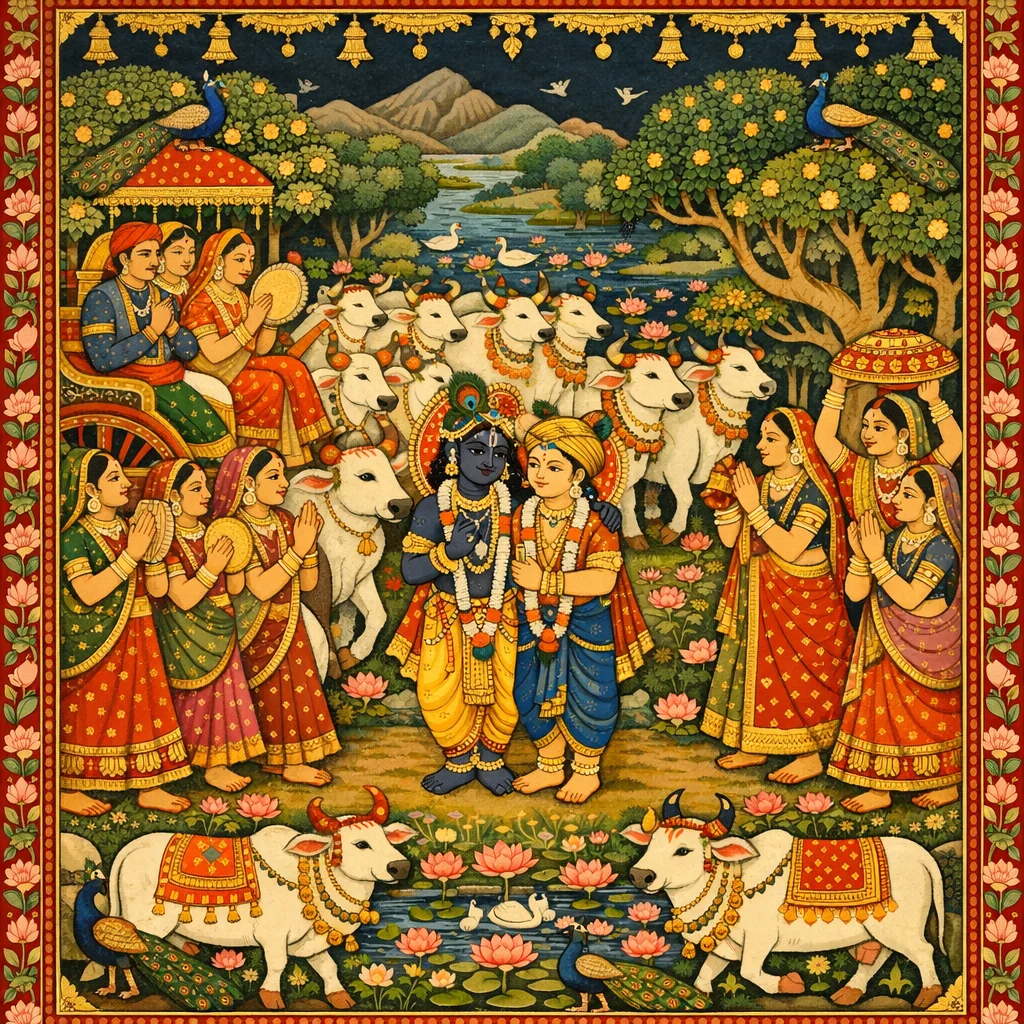
Adhyaya 11
Gokula’s Wonder, Kṛṣṇa’s Bhakta-vaśyatā, the Move to Vṛndāvana, and the Slaying of Vatsāsura and Bakāsura
After the yamala-arjuna trees fall and Nalakūvara and Maṇigrīva are liberated, the cowherds of Gokula rush to the spot in amazement, yet cannot discern the cause. The boys testify that Kṛṣṇa—still tied to the mortar—dragged it between the trees, but Nanda and the elders, overwhelmed by vātsalya, struggle to accept His superhuman agency. Nanda unties Kṛṣṇa, and the narrative turns to Vraja’s daily intimacy: the gopīs coax Him to dance and run errands, revealing bhakta-vaśyatā—Bhagavān willingly “ruled” by love. A fruit-seller is blessed when Kṛṣṇa barters grains and her basket becomes jewels. As dangers persist, Upananda urges a move from Gokula to Vṛndāvana for the children’s safety; the community migrates by carts, singing Kṛṣṇa-kathā. In Vṛndāvana, Kṛṣṇa and Balarāma begin calf-tending and playful sports. Demonic threats return: Kṛṣṇa slays Vatsāsura and then Bakāsura, comes home unharmed, and deepens the elders’ conviction that Garga Muni’s prophecies are manifest, setting the stage for the next, intensifying Vraja conflicts and revelations.
Shlokas
Verse 1
श्रीशुक उवाच गोपा नन्दादय: श्रुत्वा द्रुमयो: पततोरवम् । तत्राजग्मु: कुरुश्रेष्ठ निर्घातभयशङ्किता: ॥ १ ॥
Śukadeva Gosvāmī continued: O Mahārāja Parīkṣit, best of the Kurus, hearing the dreadful crash as the yamala-arjuna trees fell, Nanda and the other cowherd men—fearing a thunderbolt—rushed to that spot.
Verse 2
भूम्यां निपतितौ तत्र ददृशुर्यमलार्जुनौ । बभ्रमुस्तदविज्ञाय लक्ष्यं पतनकारणम् ॥ २ ॥
There they saw the twin yamala-arjuna trees fallen upon the ground, yet they were bewildered, for though the fall was plain to see, its cause could not be traced.
Verse 3
उलूखलं विकर्षन्तं दाम्ना बद्धं च बालकम् । कस्येदं कुत आश्चर्यमुत्पात इति कातरा: ॥ ३ ॥
Kṛṣṇa, the little boy bound by a rope to the ulūkhala, the wooden mortar, was dragging it along. The cowherd men, alarmed and doubtful, wondered: “Whose doing is this, and from where has this astonishing event arisen?”
Verse 4
बाला ऊचुरनेनेति तिर्यग्गतमुलूखलम् । विकर्षता मध्यगेन पुरुषावप्यचक्ष्महि ॥ ४ ॥
The cowherd boys said, “It was Kṛṣṇa who did it. When He went between the two trees, the mortar became lodged crosswise; as He dragged it, both trees fell. Then two handsome men emerged from the trees—we saw it with our own eyes.”
Verse 5
न ते तदुक्तं जगृहुर्न घटेतेति तस्य तत् । बालस्योत्पाटनं तर्वो: केचित्सन्दिग्धचेतस: ॥ ५ ॥
They, led by Nanda, did not accept the boys’ report—“It cannot be so!” For a mere child to uproot such trees seemed too wondrous. Yet some remained doubtful, thinking, “He was foretold to be equal to Nārāyaṇa; perhaps He truly could have done it.”
Verse 6
उलूखलं विकर्षन्तं दाम्ना बद्धं स्वमात्मजम् । विलोक्य नन्द: प्रहसद्वदनो विमुमोच ह ॥ ६ ॥
Seeing his own son bound by rope to the wooden mortar and dragging it along, Nanda Mahārāja smiled and released Kṛṣṇa from His bonds.
Verse 7
गोपीभि: स्तोभितोऽनृत्यद् भगवान्बालवत्क्वचित् । उद्गायति क्वचिन्मुग्धस्तद्वशो दारुयन्त्रवत् ॥ ७ ॥
Urged on by the gopīs with clapping and sweet promises, the Lord would sometimes dance like a little child; though all-powerful Bhagavān, He smiled and moved according to their wish, as if a wooden doll in their hands, and at times sang loudly at their bidding, thus coming fully under their sway.
Verse 8
बिभर्ति क्वचिदाज्ञप्त: पीठकोन्मानपादुकम् । बाहुक्षेपं च कुरुते स्वानां च प्रीतिमावहन् ॥ ८ ॥
Sometimes Yaśodā and the gopīs would order, “Bring this, bring that,” telling Kṛṣṇa to fetch a wooden plank, wooden sandals, or a measuring pot. Obeying, He would try to lift them; at times, as if unable, He merely touched them and stood. To delight His own, He would swing His arms, displaying strength.
Verse 9
दर्शयंस्तद्विदां लोक आत्मनो भृत्यवश्यताम् । व्रजस्योवाह वै हर्षं भगवान् बालचेष्टितै: ॥ ९ ॥
For pure devotees who can fathom His pastimes, Bhagavān Kṛṣṇa revealed how greatly He may be subdued by the love of His servant-bhaktas; thus, by His childhood play, He increased the joy of the Vrajavāsīs.
Verse 10
क्रीणीहि भो: फलानीति श्रुत्वा सत्वरमच्युत: । फलार्थी धान्यमादाय ययौ सर्वफलप्रद: ॥ १० ॥
Once a fruit seller called out, “Buy fruits!” Hearing her, Acyuta Kṛṣṇa at once took a handful of grains and went to barter, as though He desired fruit—though He Himself is the Giver of all fruits.
Verse 11
फलविक्रयिणी तस्य च्युतधान्यकरद्वयम् । फलैरपूरयद् रत्नै: फलभाण्डमपूरि च ॥ ११ ॥
As Kṛṣṇa hurried to the fruit seller, most of the grains slipped from His two hands. Still, she filled His hands with fruits, and at once her fruit basket became filled with jewels and gold.
Verse 12
सरित्तीरगतं कृष्णं भग्नार्जुनमथाह्वयत् । रामं च रोहिणी देवी क्रीडन्तं बालकैर्भृशम् ॥ १२ ॥
After the yamala-arjuna trees were uprooted, Rohiṇīdevī went to the riverbank and called for Kṛṣṇa and Rāma, who were deeply absorbed in play with the other boys.
Verse 13
नोपेयातां यदाहूतौ क्रीडासङ्गेन पुत्रकौ । यशोदां प्रेषयामास रोहिणी पुत्रवत्सलाम् ॥ १३ ॥
So absorbed in play, the two boys—Kṛṣṇa and Balarāma—did not come back when called. Therefore motherly Rohiṇī sent Yaśodā to call Them home.
Verse 14
क्रीडन्तं सा सुतं बालैरतिवेलं सहाग्रजम् । यशोदाजोहवीत्कृष्णं पुत्रस्नेहस्नुतस्तनी ॥ १४ ॥
Though it was very late, Yaśodā saw her son playing with the boys along with His elder brother and called Kṛṣṇa back; in motherly love, milk flowed from her breasts.
Verse 15
कृष्ण कृष्णारविन्दाक्ष तात एहि स्तनं पिब । अलं विहारै: क्षुत्क्षान्त: क्रीडाश्रान्तोऽसि पुत्रक ॥ १५ ॥
Mother Yaśodā said: “Kṛṣṇa, Kṛṣṇa, lotus-eyed one—come, my son, drink from my breast. Enough of playing; you are weary from hunger and tired from so long a game, my child.”
Verse 16
हे रामागच्छ ताताशु सानुज: कुलनन्दन । प्रातरेव कृताहारस्तद् भवान्भोक्तुमर्हति ॥ १६ ॥
“O Rāma, joy of our family, come at once with Your younger brother. You ate in the morning; now it is fitting that You eat again.”
Verse 17
प्रतीक्षतेत्वां दाशार्ह भोक्ष्यमाणो व्रजाधिप: । एह्यावयो: प्रियं धेहि स्वगृहान्यात बालका: ॥ १७ ॥
O Dāśārha, Nanda Mahārāja, the lord of Vraja, is waiting to take his meal and is waiting for You. Dear Balarāma, come back and please us; and all the boys who play with Kṛṣṇa should now go to their own homes.
Verse 18
धूलिधूसरिताङ्गस्त्वं पुत्र मज्जनमावह । जन्मर्क्षं तेऽद्य भवति विप्रेभ्यो देहि गा: शुचि: ॥ १८ ॥
Mother Yaśodā said: My son, by playing all day Your body has become covered with dust and sand; come back, bathe, and become pure. Today is the auspicious conjunction of Your birth star; therefore, in purity, give cows in charity to the brāhmaṇas.
Verse 19
पश्य पश्य वयस्यांस्ते मातृमृष्टान्स्वलङ्कृतान् । त्वं च स्नात: कृताहारो विहरस्व स्वलङ्कृत: ॥ १९ ॥
Just see, just see—Your playmates of Your own age have been cleansed by their mothers and adorned with beautiful ornaments. You too, after bathing, taking Your meal, and being decorated, may again play with Your friends.
Verse 20
इत्थं यशोदा तमशेषशेखरं मत्वा सुतं स्नेहनिबद्धधीर्नृप । हस्ते गृहीत्वा सहराममच्युतं नीत्वा स्ववाटं कृतवत्यथोदयम् ॥ २० ॥
O King, mother Yaśodā, her mind bound by deep affection, regarded Acyuta—the crest of all opulences—as her own son. Taking His hand along with Balarāma, she brought Them into the courtyard and fully performed her duties: bathing, dressing, adorning, and feeding Them.
Verse 21
श्रीशुक उवाच गोपवृद्धा महोत्पाताननुभूय बृहद्वने । नन्दादय: समागम्य व्रजकार्यममन्त्रयन् ॥ २१ ॥
Śrī Śukadeva Gosvāmī continued: Having experienced great disturbances in Bṛhadvana, the elder cowherd men, headed by Nanda Mahārāja, assembled and deliberated what should be done to stop the continual troubles in Vraja.
Verse 22
तत्रोपानन्दनामाह गोपो ज्ञानवयोऽधिक: । देशकालार्थतत्त्वज्ञ: प्रियकृद् रामकृष्णयो: ॥ २२ ॥
In that assembly of the people of Gokula, a cowherd named Upananda—mature in age and wisdom, and skilled in judging place, time, and circumstance—offered this counsel for the welfare of Rāma and Kṛṣṇa.
Verse 23
उत्थातव्यमितोऽस्माभिर्गोकुलस्य हितैषिभि: । आयान्त्यत्र महोत्पाता बालानां नाशहेतव: ॥ २३ ॥
He said: “Dear cowherd friends, seeking Gokula’s welfare we should leave this place, for great calamities keep arising here, bringing destruction upon the children.”
Verse 24
मुक्त: कथञ्चिद्राक्षस्या बालघ्न्या बालको ह्यसौ । हरेरनुग्रहान्नूनमनश्चोपरि नापतत् ॥ २४ ॥
The child Kṛṣṇa, by the mercy of the Lord Hari, was somehow rescued from the hands of the rākṣasī Pūtanā, intent on killing Him; and again by that same grace, the handcart failed to fall upon the child.
Verse 25
चक्रवातेन नीतोऽयं दैत्येन विपदं वियत् । शिलायां पतितस्तत्र परित्रात: सुरेश्वरै: ॥ २५ ॥
Then the demon Tṛṇāvarta, taking the form of a whirlwind, carried the child into the perilous sky to kill Him, but the demon fell upon a stone slab; in that case too, by the mercy of Lord Viṣṇu or His associates, the child was saved.
Verse 26
यन्न म्रियेत द्रुमयोरन्तरं प्राप्य बालक: । असावन्यतमो वापि तदप्यच्युतरक्षणम् ॥ २६ ॥
Even the other day, when the two trees fell, neither Kṛṣṇa nor His playmates died, though the children were near them or even between them; this too should be regarded as the protecting grace of Acyuta.
Verse 27
यावदौत्पातिकोऽरिष्टो व्रजं नाभिभवेदित: । तावद्बालानुपादाय यास्यामोऽन्यत्र सानुगा: ॥ २७ ॥
All these disturbances are surely caused by some unknown asura. Before the ominous Ariṣṭa comes to Vraja to create further turmoil, we should take the boys with us and, along with our companions, go elsewhere.
Verse 28
वनं वृन्दावनं नाम पशव्यं नवकाननम् । गोपगोपीगवां सेव्यं पुण्याद्रितृणवीरुधम् ॥ २८ ॥
Between Nandeśvara and Mahāvana lies a forest called Vṛndāvana, most fit for the herds, filled with fresh groves and gardens. It is a blessed place, dear to the gopas, gopīs, and cows, rich with sacred hills, grasses, plants, and creepers.
Verse 29
तत्तत्राद्यैव यास्याम: शकटान् युङ्त मा चिरम् । गोधनान्यग्रतो यान्तु भवतां यदि रोचते ॥ २९ ॥
Therefore let us go at once, today—there is no need to wait. If you approve, yoke the carts immediately, place the herds in front, and let us set out for that place.
Verse 30
तच्छ्रुत्वैकधियो गोपा: साधु साध्विति वादिन: । व्रजान्स्वान्स्वान्समायुज्य ययू रूढपरिच्छदा: ॥ ३० ॥
Hearing Upananda’s counsel, the cowherd men agreed with one mind, saying, “Well spoken! Well spoken!” They then set their household matters in order, loaded their clothes and belongings onto the carts, and at once set out for Vṛndāvana.
Verse 31
वृद्धान्बालान्स्त्रियो राजन्सर्वोपकरणानि च । अन:स्वारोप्य गोपाला यत्ता आत्तशरासना: ॥ ३१ ॥ गोधनानि पुरस्कृत्य शृङ्गाण्यापूर्य सर्वत: । तूर्यघोषेण महता ययु: सहपुरोहिता: ॥ ३२ ॥
O King! The cowherd men placed the elders, women, children, and all household goods upon the bullock carts, and with careful vigilance took up bows and arrows. Setting the herds in front and filling every direction with the mighty blare of horn-bugles, they set out on their journey, accompanied by their priests.
Verse 32
वृद्धान्बालान्स्त्रियो राजन्सर्वोपकरणानि च । अन:स्वारोप्य गोपाला यत्ता आत्तशरासना: ॥ ३१ ॥ गोधनानि पुरस्कृत्य शृङ्गाण्यापूर्य सर्वत: । तूर्यघोषेण महता ययु: सहपुरोहिता: ॥ ३२ ॥
O King Parīkṣit, placing the old men, women, children, and all household goods upon the bullock carts, and keeping the herds of cows in front, the cowherd men carefully took up their bows and arrows. With the mighty blare of horn-bugles resounding on every side, and accompanied by their priests, they set out on their journey.
Verse 33
गोप्यो रूढरथा नूत्नकुचकुङ्कुमकान्तय: । कृष्णलीला जगु: प्रीत्या निष्ककण्ठ्य: सुवासस: ॥ ३३ ॥
The gopīs, riding upon the bullock carts, were beautifully dressed in fresh garments; their necks were adorned with niṣka ornaments, and their breasts shone with newly applied kuṅkuma. With delighted devotion they began to sing of Śrī Kṛṣṇa’s līlās.
Verse 34
तथा यशोदारोहिण्यावेकं शकटमास्थिते । रेजतु: कृष्णरामाभ्यां तत्कथाश्रवणोत्सुके ॥ ३४ ॥
In the same way, Mother Yaśodā and Rohiṇīdevī, eager to hear narrations of the līlās of Kṛṣṇa and Rāma, mounted a single bullock cart together with Them. In that scene, with Kṛṣṇa and Balarāma, they appeared exceedingly beautiful.
Verse 35
वृन्दावनं सम्प्रविश्य सर्वकालसुखावहम् । तत्र चक्रुर्व्रजावासं शकटैरर्धचन्द्रवत् ॥ ३५ ॥
Thus they entered Vṛndāvana, a place that grants happiness in every season. There they made a temporary settlement for the people of Vraja by arranging their bullock carts in the shape of a half-moon.
Verse 36
वृन्दावनं गोवर्धनं यमुनापुलिनानि च । वीक्ष्यासीदुत्तमा प्रीती राममाधवयोर्नृप ॥ ३६ ॥
O King Parīkṣit, when Rāma and Mādhava (Kṛṣṇa) beheld Vṛndāvana, Govardhana, and the banks of the Yamunā, both of Them were filled with the highest joy.
Verse 37
एवं व्रजौकसां प्रीतिं यच्छन्तौ बालचेष्टितै: । कलवाक्यै: स्वकालेन वत्सपालौ बभूवतु: ॥ ३७ ॥
Thus, by their childlike play and sweet, half-formed speech, Śrī Kṛṣṇa and Balarāma bestowed transcendental delight upon all the people of Vraja; in due course They became fit to tend the calves.
Verse 38
अविदूरे व्रजभुव: सह गोपालदारकै: । चारयामासतुर्वत्सान् नानाक्रीडापरिच्छदौ ॥ ३८ ॥
Not far from their home in Vraja, equipped with many playthings, Kṛṣṇa and Balarāma sported with the cowherd boys and began to tend the young calves.
Verse 39
क्वचिद्वादयतो वेणुं क्षेपणै: क्षिपत: क्वचित् । क्वचित्पादै: किङ्किणीभि: क्वचित्कृत्रिमगोवृषै: ॥ ३९ ॥ वृषायमाणौ नर्दन्तौ युयुधाते परस्परम् । अनुकृत्य रुतैर्जन्तूंश्चेरतु: प्राकृतौ यथा ॥ ४० ॥
Sometimes They played the flute; sometimes They tossed ropes and stones to bring down fruits from the trees, and sometimes only stones. Sometimes, their ankle bells tinkling, They kicked bilva and āmalakī fruits like a ball. Sometimes They wrapped themselves in blankets, imitated cows and bulls, roared like bulls and wrestled with each other; sometimes They mimicked the cries of animals. Thus They sported, just like two ordinary children.
Verse 40
क्वचिद्वादयतो वेणुं क्षेपणै: क्षिपत: क्वचित् । क्वचित्पादै: किङ्किणीभि: क्वचित्कृत्रिमगोवृषै: ॥ ३९ ॥ वृषायमाणौ नर्दन्तौ युयुधाते परस्परम् । अनुकृत्य रुतैर्जन्तूंश्चेरतु: प्राकृतौ यथा ॥ ४० ॥
Sometimes They played the flute; sometimes They tossed ropes and stones to bring down fruits from the trees, and sometimes only stones. Sometimes, their ankle bells tinkling, They kicked bilva and āmalakī fruits like a ball. Sometimes They wrapped themselves in blankets, imitated cows and bulls, roared like bulls and wrestled with each other; sometimes They mimicked the cries of animals. Thus They sported, just like two ordinary children.
Verse 41
कदाचिद् यमुनातीरे वत्सांश्चारयतो: स्वकै: । वयस्यै: कृष्णबलयोर्जिघांसुर्दैत्य आगमत् ॥ ४१ ॥
One day, as Rāma and Kṛṣṇa, with their companions, were tending the calves on the bank of the Yamunā, another demon came there, intent on killing Them.
Verse 42
तं वत्सरूपिणं वीक्ष्य वत्सयूथगतं हरि: । दर्शयन् बलदेवाय शनैर्मुग्ध इवासदत् ॥ ४२ ॥
Seeing the demon disguised as a calf and mingled among the herd, the Lord Hari signaled to Baladeva, “Here is another demon.” Then, as if unaware of its intent, He approached it very slowly, with an air of innocent wonder.
Verse 43
गृहीत्वापरपादाभ्यां सहलाङ्गूलमच्युत: । भ्रामयित्वा कपित्थाग्रे प्राहिणोद्गतजीवितम् । स कपित्थैर्महाकाय: पात्यमानै: पपात ह ॥ ४३ ॥
Then Śrī Kṛṣṇa, the infallible Acyuta, seized the demon by its hind legs and tail, whirled its body with tremendous force until life left it, and hurled it into the top of a kapittha tree. The tree crashed down, and the demon’s now-great body fell with it amid the fruits.
Verse 44
तं वीक्ष्य विस्मिता बाला: शशंसु: साधु साध्विति । देवाश्च परिसन्तुष्टा बभूवु: पुष्पवर्षिण: ॥ ४४ ॥
Seeing the demon’s lifeless body, the cowherd boys marveled and cried, “Sādhu, sādhu—well done!” In the higher worlds the devas were delighted, and they showered flowers upon the Supreme Lord.
Verse 45
तौ वत्सपालकौ भूत्वा सर्वलोकैकपालकौ । सप्रातराशौ गोवत्सांश्चारयन्तौ विचेरतु: ॥ ४५ ॥
After the demon was slain, Kṛṣṇa and Balarāma finished Their morning meal and, still tending the calves, wandered here and there. Though They are the sole protectors of all worlds, They took charge of the calves like simple cowherd boys.
Verse 46
स्वं स्वं वत्सकुलं सर्वे पाययिष्यन्त एकदा । गत्वा जलाशयाभ्याशं पाययित्वा पपुर्जलम् ॥ ४६ ॥
One day all the boys, including Kṛṣṇa and Balarāma, each leading his own group of calves, went to a water reservoir to let them drink. After the calves had drunk, the boys also drank water there.
Verse 47
ते तत्र ददृशुर्बाला महासत्त्वमवस्थितम् । तत्रसुर्वज्रनिर्भिन्नं गिरे: शृङ्गमिव च्युतम् ॥ ४७ ॥
Right by the reservoir, the boys beheld a gigantic living body lying there, like a mountain peak shattered and cast down by the thunderbolt (vajra). Seeing such vastness, they were struck with fear.
Verse 48
स वै बको नाम महानसुरो बकरूपधृक् । आगत्य सहसा कृष्णं तीक्ष्णतुण्डोऽग्रसद् बली ॥ ४८ ॥
That mighty demon was named Bakāsura. Assuming the form of a heron with a razor-sharp beak, he came there and at once swallowed Śrī Kṛṣṇa.
Verse 49
कृष्णं महाबकग्रस्तं दृष्ट्वा रामादयोऽर्भका: । बभूवुरिन्द्रियाणीव विना प्राणं विचेतस: ॥ ४९ ॥
Seeing Kṛṣṇa swallowed by the gigantic heron, Balarāma and the other boys became almost unconscious—like the senses when life-breath has departed.
Verse 50
तं तालुमूलं प्रदहन्तमग्निवद् गोपालसूनुं पितरं जगद्गुरो: । चच्छर्द सद्योऽतिरुषाक्षतं बक- स्तुण्डेन हन्तुं पुनरभ्यपद्यत ॥ ५० ॥
Kṛṣṇa—though playing as the son of a cowherd, yet the father of Brahmā, the guru of the world—became like fire, burning the root of the demon’s throat. Bakāsura at once disgorged Him. Seeing Kṛṣṇa unharmed though swallowed, the demon attacked again, seeking to kill Him with his sharp beak.
Verse 51
तमापतन्तं स निगृह्य तुण्डयो- र्दोर्भ्यां बकं कंससखं सतां पति: । पश्यत्सु बालेषु ददार लीलया मुदावहो वीरणवद् दिवौकसाम् ॥ ५१ ॥
As Bakāsura, Kaṁsa’s friend, rushed in to strike, Kṛṣṇa—the lord of the saintly and leader of the Vaiṣṇavas—seized the demon’s beak in both hands. Before the boys’ very eyes, He effortlessly split him in two, as a child tears a blade of vīraṇa grass. By this slaying, Kṛṣṇa greatly delighted the denizens of heaven.
Verse 52
तदा बकारिं सुरलोकवासिन: समाकिरन् नन्दनमल्लिकादिभि: । समीडिरे चानकशङ्खसंस्तवै- स्तद् वीक्ष्य गोपालसुता विसिस्मिरे ॥ ५२ ॥
At that time, the celestial denizens of the higher planetary system showered mallikā-puṣpa, flowers grown in Nandana-kānana, upon Kṛṣṇa, the enemy of Bakāsura. They also congratulated Him by sounding celestial kettledrums and conchshells and by offering prayers. Seeing this, the cowherd boys were struck with wonder.
Verse 53
मुक्तं बकास्यादुपलभ्य बालका रामादय: प्राणमिवेन्द्रियो गण: । स्थानागतं तं परिरभ्य निर्वृता: प्रणीय वत्सान् व्रजमेत्य तज्जगु: ॥ ५३ ॥
Just as the senses are pacified when consciousness and life return, so when Kṛṣṇa was freed from this danger, all the boys, including Balarāma, thought that their life had been restored. They embraced Kṛṣṇa in good consciousness, and then they collected their own calves and returned to Vrajabhūmi, where they declared the incident loudly.
Verse 54
श्रुत्वा तद्विस्मिता गोपा गोप्यश्चातिप्रियादृता: । प्रेत्यागतमिवोत्सुक्यादैक्षन्त तृषितेक्षणा: ॥ ५४ ॥
When the cowherd men and women heard about the killing of Bakāsura in the forest, they were very much astonished. Upon seeing Kṛṣṇa and hearing the story, they received Kṛṣṇa very eagerly, thinking that Kṛṣṇa and the other boys had returned from the mouth of death. Thus they looked upon Kṛṣṇa and the boys with silent eyes, not wanting to turn their eyes aside now that the boys were safe.
Verse 55
अहो बतास्य बालस्य बहवो मृत्यवोऽभवन् । अप्यासीद् विप्रियं तेषां कृतं पूर्वं यतो भयम् ॥ ५५ ॥
The cowherd men, headed by Nanda Mahārāja, began to contemplate: It is very astonishing that although this boy Kṛṣṇa has many times faced many varied causes of death, by the grace of the Supreme Personality of Godhead it was these causes of fear that were killed, instead of Him.
Verse 56
अथाप्यभिभवन्त्येनं नैव ते घोरदर्शना: । जिघांसयैनमासाद्य नश्यन्त्यग्नौ पतङ्गवत् ॥ ५६ ॥
Although the causes of death, the daityas, were very fierce, they could not kill this boy Kṛṣṇa. Rather, because they came to kill innocent boys, as soon as they approached they themselves were killed, exactly like flies attacking a fire.
Verse 57
अहो ब्रह्मविदां वाचो नासत्या: सन्ति कर्हिचित् । गर्गो यदाह भगवानन्वभावि तथैव तत् ॥ ५७ ॥
How wondrous! The words of those who know Brahman never become untrue. Whatever the venerable Garga Muni foretold, we are now experiencing exactly, in every detail.
Verse 58
इति नन्दादयो गोपा: कृष्णरामकथां मुदा । कुर्वन्तो रममाणाश्च नाविन्दन् भववेदनाम् ॥ ५८ ॥
Thus Nanda and the other cowherd men joyfully spoke of the pastimes of Kṛṣṇa and Balarāma; absorbed in transcendental delight, they did not even notice worldly distress.
Verse 59
एवं विहारै: कौमारै: कौमारं जहतुर्व्रजे । निलायनै: सेतुबन्धैर्मर्कटोत्प्लवनादिभि: ॥ ५९ ॥
In this way Kṛṣṇa and Balarāma spent Their boyhood in Vraja in childish sports—playing hide-and-seek, building a make-believe bridge, and leaping about like monkeys, and the like.
Frequently Asked Questions
The text emphasizes intense vātsalya: parental affection reframes perception. Although the evidence is visible, Nanda and the elders relate to Kṛṣṇa primarily as their dependent child, not as Īśvara. This is central to Vraja theology—Kṛṣṇa’s aiśvarya is covered by yogamāyā so that love remains unimpeded. Their doubt is not ignorance alone; it is a bhakti-privilege where intimacy overrides awe.
Kṛṣṇa approaches with simple grains—an offering of a child with no calculative intent—yet the vendor responds generously, and her basket becomes filled with jewels and gold. In bhakti hermeneutics, the lesson is that Bhagavān reciprocates (ye yathā māṁ prapadyante) disproportionately to the devotee’s sincerity, not the material value of the gift. The episode also models dāna (charity), hospitality, and the sanctification of ordinary exchange through devotion.
Upananda, described as mature in age, knowledge, and practical discernment (deśa-kāla-pātra), advises relocation. His reasoning is dhārmic and protective: repeated lethal disturbances suggest an ongoing demonic campaign targeting Rāma and Kṛṣṇa; therefore, the community should act responsibly (rakṣaṇa-dharma) by moving to a safer, more resource-rich place—Vṛndāvana—without waiting for further calamity.
Vatsāsura infiltrates as a calf among calves—deception within innocence. Kṛṣṇa identifies him, approaches without alarm, seizes him by the hind legs and tail, whirls him, and throws him atop a tree, killing him. The significance is twofold: (1) Bhagavān’s omniscience pierces disguise, protecting the vulnerable; (2) spiritually, anartha often enters subtly within “ordinary” life, and divine guidance (and discernment) is required to expose and remove it.
Bakāsura is linked with Kaṁsa and represents violent disruption of Vraja’s pastoral dharma. His defeat restores cosmic order (devatā-prīti) and demonstrates that Kṛṣṇa’s Vraja-līlā, though intimate and local, has universal implications. The demigods’ flower-shower and drums signify divine approval: the Supreme is acting within human-like play while simultaneously maintaining the moral and cosmic balance.