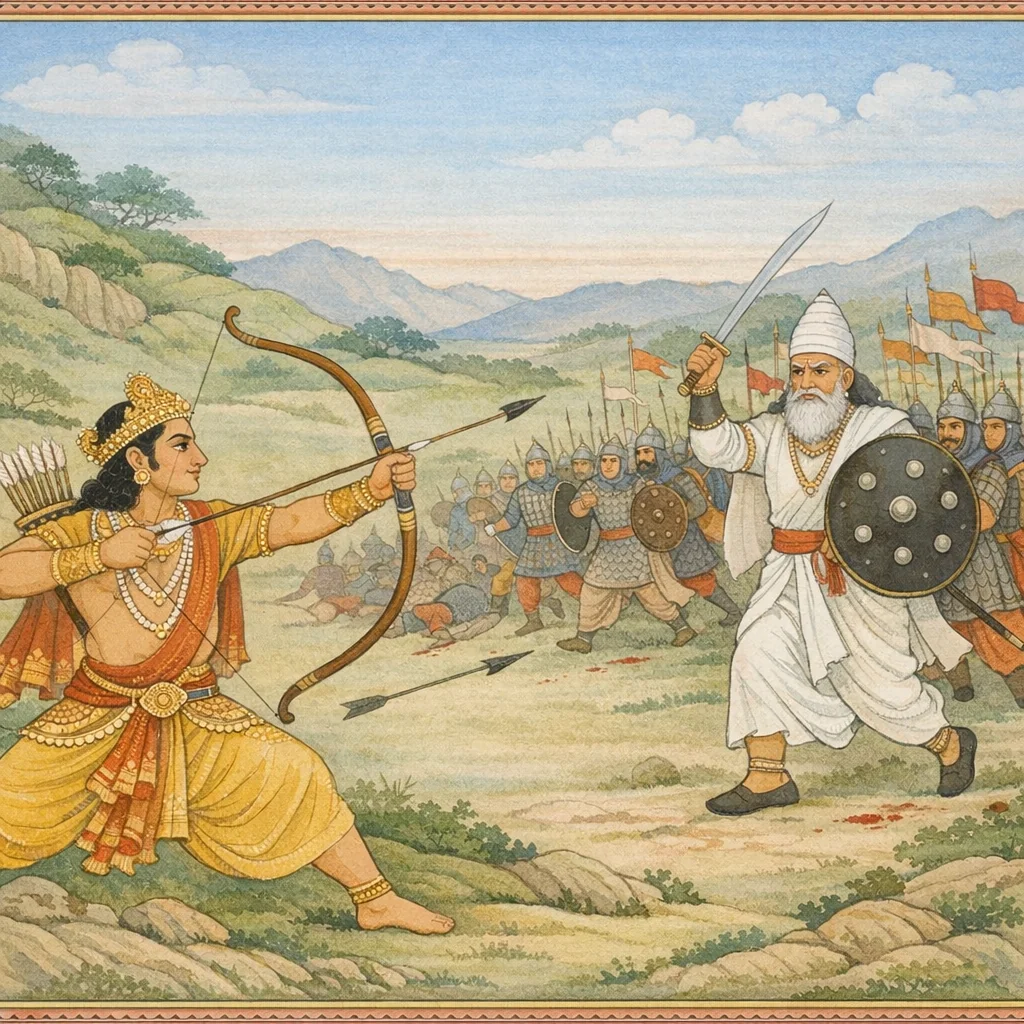
Adhyaya 112
द्रोणपर्व (अध्याय ११२) — कर्णभीमयोर्युद्धम्, दुर्योधनस्य रक्षणादेशः (Droṇa-parva 112: Karṇa–Bhīma Engagement and Duryodhana’s Protective Order)
Upa-parva: Karna–Bhīmasena Saṃgrāma (Engagement Episode) — Droṇa-parva, Adhyāya 112
Saṃjaya reports that Karṇa, hearing the taut bow-sound of Bhīma, reacts with agitation likened to an enraged elephant. After briefly moving out of Bhīma’s missile-range and seeing Dhṛtarāṣṭra’s sons fallen from their chariots, Karṇa returns against the Pāṇḍava with intensified force. A dense exchange of arrows follows: Karṇa’s volleys are described through solar-ray and bird-flight similes, while Bhīma endures and counters, striking Karṇa and reciprocally ‘covering’ him with shafts. Observers—select warriors and celestial witnesses (cāraṇas)—signal approval of Bhīma’s prowess. Hearing the tumult, Duryodhana urgently commands his brothers and allied princes to go to Karṇa’s aid, fearing Bhīma’s arrows may kill him. Seven of Duryodhana’s brothers surround Bhīma with arrow-rain; Bhīma responds with seven carefully aimed missiles, killing them and producing a lion-roar that reaches Yudhiṣṭhira as a morale signal. The narration then turns reflective: Duryodhana recalls earlier counsel and recognizes the ripening ‘fruit’ of prior sabhā insults to Draupadī, presenting ethical causality as integral to the battle’s unfolding.
Chapter Arc: संजय धृतराष्ट्र से कहता है—राजन्, लोमहर्षण संग्राम सुनो: पाण्डव-सेना में युयुधान (सात्यकि) अग्रणी होकर द्रोण की व्यवस्था को हिला देता है, और गुरु स्वयं उसे रोकने को बढ़ते हैं। → युयुधान के प्रहार से कौरव-बल ‘वध्यमान’ दिखता है; द्रोण का क्रोध और कर्तव्य एक साथ जागते हैं। उधर पाण्डव-पक्ष में रणनीति की चर्चा—कौन-कौन सहायक (केशव, बलराम, अनिरुद्ध, प्रद्युम्न) हों, और यदि द्रोण अर्जुन की ओर बढ़े तो भीमसेन आदि उसे रोकने का संकल्प लेते हैं। → द्रोण, ‘सत्यविक्रम’ सात्यकि पर स्वयं धावा बोलता है—गुरु बनाम शिष्य/सखा का तीखा संग्राम; साथ ही युद्ध-नीति का निर्णायक संकेत उभरता है: ‘जहाँ धनंजय है, वहीं जाओ’—अर्जुन-केंद्रित लक्ष्य के लिए सेना को भीतर तक प्रवेश कराने का आदेश। → अध्याय का अंत एक अस्थायी निष्कर्ष देता है—सात्यकि की प्रशंसा और उसके साहस को मान्यता मिलती है, पर द्रोण का प्रतिरोध भी उतना ही दृढ़ है; दोनों पक्ष अपनी-अपनी सहायता-व्यवस्था और रोक-रणनीति तय कर लेते हैं। → द्रोण को रोकने की प्रतिज्ञाएँ और ‘धनंजय के पास पहुँचो’ का निर्देश अगले अध्याय के लिए प्रश्न छोड़ता है—क्या सात्यकि द्रोण को पार कर अर्जुन तक मार्ग बना पाएगा, या गुरु का चक्रव्यूह-सा प्रतिरोध उसे वहीं बाँध देगा?
Shlokas
Verse 1
(दाक्षिणात्य अधिक पाठके ३ श्लोक मिलाकर कुल ४० श्लोक हैं) अपना बछ। आर: 2 दशाधिकशततमो<् ध्याय: द्रोणाचार्य और कं अड काछ 8543 द्ध 2807 सात्यकिकी प्रशंसा करते हुए सहायताके लिये कौरव-सेनामें प्रवेश करनेका आदेश घतयद्र उवाच भारद्वाजं कथं युद्धे युयुधानो न्यवारयत् । संजयाचक्ष्व तत्त्वेन परं कौतूहलं हि मे,धृतराष्ट्रने पूछा--संजय! सात्यकिने युद्धमें द्रोणाचार्यको किस प्रकार रोका? यह यथार्थरूपसे बताओ। इसे सुननेके लिये मेरे मनमें महान् कौतूहल हो रहा है
Dhṛtarāṣṭra said: “How, in the midst of battle, did Yuyudhāna (Sātyaki) check Bhāradvāja’s son (Droṇa)? Tell me the truth of it, Sañjaya—for my curiosity about this is exceedingly great.”
Verse 2
संजय उवाच शृणु राजन महाप्राज्ञ संग्रामं लोमहर्षणम् । द्रोणस्य पाण्डवै: सार्थ युयुधानपुरोगमै:,संजयने कहा--राजन्! महामते! द्रोणाचार्यका सात्यकि आदि पाण्डव-योद्धाओंके साथ जो रोमांचकारी संग्राम हुआ था, उसका वर्णन सुनिये
Sanjaya said: O King, O greatly wise one, listen to the hair-raising account of the battle—how Droṇa fought together with the Pāṇḍavas, with Yuyudhāna (Sātyaki) at their forefront. The narration frames the war not as mere spectacle, but as a grave arena where prowess, duty, and the consequences of chosen loyalties unfold.
Verse 3
वध्यमानं बल दृष्टवा युयुधानेन मारिष | अभ्यद्रवत् स्वयं द्रोण: सात्यकिं सत्यविक्रमम्,माननीय नरेश! द्रोणाचार्यने जब अपनी सेनाको युयुधानके द्वारा पीड़ित होते देखा, तब वे सत्यपराक्रमी सात्यकिपर स्वयं ही टूट पड़े
Sañjaya said: O venerable king, seeing his army being cut down by Yuyudhāna, Droṇa himself rushed forward to confront Sātyaki, whose valor was true to his word. The scene underscores a commander’s duty to protect his forces, even at personal risk, within the harsh ethics of battlefield responsibility.
Verse 4
तमापतन्तं सहसा भारद्वाजं महारथम् | सात्यकि: पज्चविंशत्या क्षुद्रकाणां समार्पयत्,उस समय सहसा आते हुए महारथी द्रोणाचार्यको सात्यकिने पचीस बाण मारे
Sañjaya said: As the great chariot-warrior Droṇa, the son of Bhāradvāja, suddenly charged forward, Sātyaki met him at once by delivering a volley of twenty-five swift arrows—an act of immediate resistance in the press of battle, aimed at checking a formidable elder whose prowess threatened the opposing ranks.
Verse 5
द्रोणो5पि युधि विक्रान्तो युयुधानं समाहित: । अविध्यत् पज्चभिस्तूर्ण हेमपुड्खै: शरै: शितै:,तब पराक्रमी द्रोणाचार्यने भी युद्धस्थलमें एकाग्रचित्त हो तुरंत ही सोनेके पंखवाले पाँच पैने बाणोंद्वारा युयुधानको घायल कर दिया
Sañjaya said: Even Droṇa, advancing boldly in the battle, fixed his mind in concentration and swiftly struck Yuyudhāna with five sharp arrows, their shafts adorned with golden feathers. The scene underscores how disciplined focus and martial skill, when turned toward violence, intensify the destructive efficiency of war—raising the ethical tension between prowess and the human cost on the battlefield.
Verse 6
ते वर्म भित्त्वा सुदृढं द्विषत्पिशितभोजना: । अभ्ययुर्थधरणीं राजन् श्वसन्त इव पन्नगा:,राजन! द्रोणाचार्यके बाण शत्रुओंके मांस खानेवाले थे। वे सात्यकिके सुदृढ़ कवचको छिन्न-भिन्न करके फुफकारते हुए सर्पोंके समान धरतीमें समा गये
Sañjaya said: Having shattered that very strong armour, those enemy-devouring warriors—like flesh-eating beasts—rushed down into the earth, O King, hissing like serpents. The image underscores the ferocity and dehumanizing momentum of battle: once protection is broken, violence surges forward with a predatory, almost elemental force.
Verse 7
दीर्घबाहुरभिक्रुद्धस्तोत्रार्दित इव द्विप: । द्रोणं पजचाशताविषध्यन्नाराचैरग्निसंनिभै:
Sañjaya said: Long-armed and blazing with anger, he was like an elephant tormented by the goad. He assailed Droṇa with fifty barbed arrows, each like fire—an image of wrath unleashed in battle, where prowess and fury press against the bounds of righteous conduct.
Verse 8
तब अंकुशकी मार खाये हुए गजराजके समान अत्यन्त कुपित हुए महाबाहु सात्यकिने अग्निके समान तेजस्वी पचास नाराचोंद्वारा द्रोणाचार्यको वेध दिया ।। भारद्वाजो रणे विद्धो युयुधानेन सत्वरम् । सात्यकिं बहुभिर्बाणैर्यतमानमविध्यत,सात्यकिके द्वारा समरांगणमें घायल हो द्रोणाचार्यने शीघ्र ही बहुत-से बाण मारकर विजयके लिये प्रयत्न करनेवाले सात्यकिको क्षत-विक्षत कर दिया
Sanjaya said: Enraged like a lordly elephant struck by the goad, the mighty-armed Satyaki—blazing like fire—pierced Dronacharya with fifty iron arrows. Then Bharadvaja’s son (Drona), wounded in battle by Yuyudhana, swiftly countered: with many shafts he struck and tore at Satyaki as the latter strove for victory. The passage underscores the grim reciprocity of war—prowess answered by prowess—where even great teachers and noble warriors, driven by duty and wrath, inflict and endure suffering in the name of their chosen cause.
Verse 9
ततः क्रुद्धो महेष्वासो भूय एव महाबल: । सात्वतं पीडयामास शरेणानतपर्वणा,तदनन्तर महाथनुर्धर महाबली द्रोणने पुनः कुपित होकर झुकी हुई गाँठवाले एक बाणद्वारा सात्यकिको गहरी चोट पहुँचायी
Sañjaya said: Then that mighty, great archer, inflamed with anger once again, pressed hard the Sātvata warrior (Sātyaki), striking him with an arrow whose joints were bent—intensifying the violence of the duel and showing how wrath in battle drives men to ever harsher blows.
Verse 10
स वध्यमान: समरे भारद्वाजेन सात्यकि: । नान्वपद्यत कर्तव्यं किज्चिदेव विशाम्पते,प्रजानाथ! समरभूमिमें द्रोणाचार्यके द्वारा क्षत-विक्षत होकर सात्यकिसे कुछ भी करते नहीं बना
Sañjaya said: As Sātyaki was being struck down in the battle by Bhāradvāja (Droṇācārya), he could not find any course of action at all, O lord of the people, O protector of subjects. Wounded and torn on the field by Droṇa, he was left unable to do what ought to be done.
Verse 11
विषण्णवदनश्चापि युयुधानो5भवन्नूप । भारद्वाजं रणे दृष्टवा विसृजन्तं शितान् शरान्
Sañjaya said: O king, Yuyudhāna too became downcast in countenance when, on the battlefield, he saw Bhāradvāja relentlessly releasing sharp arrows. The sight of that fierce, unceasing archery weighed upon him, revealing how even the valiant can be shaken when confronted with overwhelming martial prowess and the grim momentum of war.
Verse 12
नरेश्वर! रणक्षेत्रमें पैने बाणोंकी वर्षा करते हुए द्रोणाचार्यको देखकर युयुधानके मुखपर विषाद छा गया ।। तं तु सम्प्रेक्ष्य ते पुत्रा: सैनिकाश्न विशाम्पते । प्रहष्टमणनसो भूत्वा सिंहवद् व्यनदन् मुहुः,प्रजापालक नरेश! उन्हें उस अवस्थामें देखकर आपके पुत्र और सैनिक प्रसन्नचित्त होकर बारंबार सिंहनाद करने लगे
Sanjaya said: “O king! Seeing Droṇācārya on the battlefield showering sharp arrows, Yuyudhāna’s face was clouded with grief and dejection. But when your sons and their troops beheld him in that state, O lord of men, their minds grew elated; again and again they roared like lions. O protector of the people, they took Droṇa’s fierce display as a sign of advantage, and their exultation reveals how war turns prowess into a moral spectacle—one side’s despair becoming the other side’s triumph.”
Verse 13
त॑ श्रुत्वा निनदं घोरं पीड्यमानं च माधवम् | युधिष्ठिरो5ब्रवीद् राजा सर्वसैन्यानि भारत,भारत! उनकी वह घोर गर्जना सुनकर और सात्यकिको पीड़ित देखकर राजा युधिष्ठिरने अपने समस्त सैनिकोंसे कहा--
Sañjaya said: Hearing that dreadful roar, and seeing Mādhava (Sātyaki) hard-pressed, King Yudhiṣṭhira addressed all the troops, O Bhārata—calling them to act with resolve amid the moral strain of battle, where protecting allies and upholding duty must be balanced against the violence of war.
Verse 14
एष वृष्णिवरो वीर: सात्यकि: सत्यविक्रम: । ग्रस्थते युधि वीरेण भानुमानिव राहुणा
Sañjaya said: “Behold that heroic foremost of the Vṛṣṇis—Sātyaki, whose prowess is unfailing. In the thick of battle he is being seized and overpowered by a mighty warrior, just as the radiant sun is seized by Rāhu.” The image underscores how even the noblest champions can be suddenly eclipsed in war, where fate and force momentarily obscure merit without negating it.
Verse 15
धृष्टद्युम्नं च पाउचाल्यमिदमाह जनाधिप:,इसके बाद राजाने पांचालराजकुमार धृष्टद्युम्नसे इस प्रकार कहा--'ट्रुपदनन्दन! खड़े क्यों हो? तुरंत ही द्रोणाचार्यपर धावा करो। क्या तुम नहीं देखते कि द्रोणकी ओरसे हमलोगोंपर घोर भय उपस्थित हो गया है?
Sanjaya said: Then the king addressed Dhrishtadyumna, the prince of Panchala, in these words: “Son of Drupada, why do you stand still? Rush at once against Acharya Drona. Do you not see that, because of Drona, a dreadful fear has arisen for us?”
Verse 16
अभिद्रव द्रुतं द्रोणं किमु तिष्ठसि पार्षत । न पश्यसि भयं द्रोणाद् घोर॑ न: समुपस्थितम्,इसके बाद राजाने पांचालराजकुमार धृष्टद्युम्नसे इस प्रकार कहा--'ट्रुपदनन्दन! खड़े क्यों हो? तुरंत ही द्रोणाचार्यपर धावा करो। क्या तुम नहीं देखते कि द्रोणकी ओरसे हमलोगोंपर घोर भय उपस्थित हो गया है?
Sañjaya said: “Charge swiftly at Droṇa—why do you stand still, O son of Pṛṣata? Do you not see that a dreadful peril, arising from Droṇa, has come upon us?” The line underscores the moral pressure of battlefield leadership: hesitation in the face of an overwhelming threat is treated as a failure of duty, and decisive action is urged to protect one’s side from imminent harm.
Verse 17
असौ द्रोणो महेष्वासो युयुधानेन संयुगे । क्रीडते सूत्रबद्धेन पक्षिणा बालको यथा,“जैसे कोई बालक डोरमें बँधे हुए पक्षीके साथ खेलता है, उसी प्रकार ये महाधनुर्धर द्रोण युद्धस्थलमें युयुधानके साथ क्रीड़ा करते हैं
Sañjaya said: “That great archer Droṇa, on the battlefield, is sporting with Yuyudhāna as a child plays with a bird tied by a string.” The image underscores a grim imbalance of power: what is mortal combat for one becomes mere play for the other, revealing the cruelty and moral strain of war when mastery turns an opponent into an object of sport.
Verse 18
तत्रैव सर्वे गच्छन्तु भीमसेनपुरोगमा: । त्वयैव सहिता: सर्वे युयुधानरथं प्रति,“अतः तुम्हारे साथ भीमसेन आदि सभी महारथी वहीं युयुधानके रथके समीप जायेँ
Sañjaya said: “Let them all go right there—led by Bhīmasena. Let all of them, together with you, proceed toward the chariot of Yuyudhāna.” The line conveys urgent battlefield coordination: the leader directs a collective movement to protect or reach a key ally, emphasizing disciplined unity amid crisis.
Verse 19
पृष्ठतो$नुगमिष्यामि त्वामहं सहसैनिक: । सात्यकिं मोक्षयस्वाद्य यमर्दंष्टान्तरं गतम्,'फिर मैं भी सम्पूर्ण सैनिकोंके साथ तुम्हारे पीछे-पीछे आऊँगा। इस समय यमराजकी दाढ़ोंमें पहुँचे हुए सात्यकिको छुड़ाओ”
Sañjaya said: “I shall follow behind you, accompanied by the entire host of soldiers. Rescue Sātyaki at once—he has fallen into the very jaws of Yama (Death).”
Verse 20
एवमुक््त्वा ततो राजा सर्वसैन्येन भारत । अभ्यद्रवद् रणे द्रोणं युयुधानस्य कारणात्,“भारत! ऐसा कहकर राजा युधिष्ठिरने उस समय रणक्षेत्रमें युयुधानकी रक्षाके लिये अपनी सारी सेनाके साथ द्रोणाचार्यपर आक्रमण किया
Sañjaya said: “Having spoken thus, O Bhārata, the king then—bringing his entire army—charged in battle against Droṇa, prompted by the need to protect Yuyudhāna. In that moment, Yudhiṣṭhira’s resolve turns from restraint to decisive action, treating the safeguarding of a righteous ally as a duty that outweighs personal hesitation amid the violence of war.”
Verse 21
तत्रारावो महानासीद् द्रोणमेकं॑ युयुत्सताम् । पाण्डवानां च भद्रें ते सृूज्जयानां च सर्वश:,राजन्! आपका भला हो। अकेले द्रोणाचार्यके साथ युद्ध करनेकी इच्छासे आये हुए पाण्डवों और सूंजयोंका वहाँ सब ओर महान् कोलाहल छा गया
Sañjaya said: There arose there a mighty uproar, O king—on every side—among the Pāṇḍavas and the Sṛñjayas, who had come with the resolve to fight Drona alone. The scene conveys the fierce moral tension of war: a single revered teacher stands as the focal point of battle, while the opposing warriors, driven by duty and necessity, surge forward amid thunderous clamor.
Verse 22
ते समेत्य नरव्यात्रा भारद्वाजं महारथम् | अभ्यवर्षन् शरैस्तीक्ष्पै: कड्कबर्हिणवाजितै:,वे मनुष्योंमें व्याप्रके समान पराक्रमी सैनिक महारथी द्रोणाचार्यके पास जाकर कंक और मोरके पंखोंसे युक्त तीखे बाणोंकी वर्षा करने लगे
Sañjaya said: Those tiger-like men, having gathered together, advanced upon Bhāradvāja’s great chariot-warrior (Droṇa) and showered him with sharp arrows, their shafts adorned with the feathers of herons and peacocks. The scene underscores the war’s relentless escalation: many brave fighters unite to overwhelm a single eminent teacher-warrior, revealing both the collective fury of battle and the grim resolve to strike down even the most venerable among opponents.
Verse 23
स्मयन्नेव तु तान् वीरान् द्रोण: प्रत्यग्रहीत् स्वयम् । अतिथीनागतान् यद्धत् सलिलेनासनेन च,राजन्! जैसे घरपर आये हुए अतिथियोंका जल और आसन आदिके द्वारा सत्कार किया जाता है, उसी प्रकार द्रोणाचार्यने स्वयं उन समस्त आक्रमणकारी वीरोंकी मुसकराते हुए ही अगवानी की। जैसे अतिथिसत्कारमें निपुण गृहस्थके घर जाकर अतिथि तृप्त होते हैं, उसी प्रकार धनुर्धर द्रोणाचार्यके बाणोंसे उन सबकी यशथेष्ट तृप्ति की गयी
Sañjaya said: Smiling as he did so, Droṇa himself went forward to receive those heroes—just as a householder welcomes arriving guests with water and a seat, O King. In the same spirit, skilled in the ‘hospitality’ of battle, the great archer satisfied them to their fill with his arrows—granting them the grim reception that war demands.
Verse 24
तर्पितास्ते शरैस्तस्य भारद्वाजस्य धन्विन: । आतियथेयं गृहं प्राप्पय नृपतेडतिथयो यथा,राजन्! जैसे घरपर आये हुए अतिथियोंका जल और आसन आदिके द्वारा सत्कार किया जाता है, उसी प्रकार द्रोणाचार्यने स्वयं उन समस्त आक्रमणकारी वीरोंकी मुसकराते हुए ही अगवानी की। जैसे अतिथिसत्कारमें निपुण गृहस्थके घर जाकर अतिथि तृप्त होते हैं, उसी प्रकार धनुर्धर द्रोणाचार्यके बाणोंसे उन सबकी यशथेष्ट तृप्ति की गयी
Sañjaya said: Those warriors were ‘satisfied’ by the arrows of that bowman Bhāradvāja (Droṇa), just as guests, O king, are satisfied when they reach a house and are honored with hospitality. In ethical irony, the battlefield is cast as a household: Droṇa ‘welcomes’ the attackers not with water and seats, but with shafts—fulfilling the grim code of war while exposing how courtesy-language can mask lethal duty.
Verse 25
भारद्वाजं च ते सर्वे न शेकुः प्रतिवीक्षितुम् । मध्यंदिनमनुप्राप्तं सहस्रांशुमिव प्रभो,प्रभो! जैसे दोपहरके प्रचण्ड मार्तण्डकी ओर देखना कठिन होता है, उसी प्रकार वे समस्त योद्धा भरद्वाजनन्दन द्रोणाचार्यकी ओर देखनेमें भी समर्थ न हो सके
Sañjaya said: All those warriors could not bear to look upon Bhāradvāja’s son (Droṇa). O lord, just as it is hard to gaze at the thousand-rayed sun when midday has arrived, so too were they unable to face him—his splendor and martial force overwhelming their sight and resolve.
Verse 26
तांस्तु सर्वान् महेष्वासान् द्रोण: शस्त्रभृतां वर: । अतापयच्छरब्रातैर्गभस्तिभिरिवांशुमान्,शस्त्रधारियोंमें श्रेष्ठ द्रोणाचार्य उन समस्त महाधनुर्धरोंको अपने बाणसमूहोंद्वारा उसी प्रकार संतप्त करने लगे, जैसे अंशुमाली सूर्य अपनी किरणोंसे जगत्को संताप देते हैं
Sañjaya said: Then Droṇa, the foremost among weapon-bearers, began to scorch all those mighty bowmen with volleys of arrows—just as the radiant sun torments the world with its blazing rays. The verse underscores the impersonal, overwhelming force of martial prowess in war, where skill and duty-driven combat can become as inescapable as natural heat, pressing warriors into the harsh consequences of the battlefield.
Verse 27
वध्यमाना महाराज पाण्डवा: सृञज्जयास्तथा । त्रातारं नाध्यगच्छन्त पड़कमग्ना इव द्विपा:,महाराज! उस समय द्रोणाचार्यकी मार खाते हुए पाण्डव और सूंजय सैनिक कीचड़में फँसे हुए हाथियोंके समान कोई रक्षक न पा सके
Sañjaya said: “O King, as they were being struck down, the Pāṇḍavas and the Sṛñjayas could find no protector—like elephants sunk in mire, unable to gain firm ground or rescue.”
Verse 28
द्रोणस्य च व्यदृश्यन्त विसर्पन्तो महाशरा: । गभस्तय इवार्कस्य प्रतपन्त: समन्ततः
Sañjaya said: And from Droṇa there were seen great arrows spreading out in all directions, scorching everything on every side—like the sun’s rays blazing forth. The image underscores how a single warrior’s prowess can turn the battlefield into a sphere of inescapable heat and peril, where power, when unleashed without restraint, becomes a force that tests the limits of courage and righteousness.
Verse 29
जैसे सूर्यकी किरणें सब ओर ताप प्रदान करती हुई फैल जाती हैं, उसी प्रकार द्रोणाचार्यके विशाल बाण सब ओर फैलते और शत्रुओंको संतप्त करते दिखायी देते थे ।। तस्मिन् द्रोणेन निहता: पञ्चाला: पञ्चविंशति: । महारथा: समाख्याता धृष्टद्युम्नस्य सम्मता:,उस युद्धमें द्रोणाचार्यके द्वारा पांचालोंके पचीस सुप्रसिद्ध महारथी मारे गये जो धृष्टद्युम्नको बहुत ही प्रिय थे
Sañjaya reports that, as the sun’s rays spread in every direction and pour forth heat, so did Droṇa’s vast flights of arrows fan out on all sides, scorching the enemy ranks. In that battle, Droṇa slew twenty-five renowned Pañcāla mahārathas—warriors held in high esteem and especially dear to Dhṛṣṭadyumna—intensifying the moral weight of the slaughter and the grief borne by those who fought for the Pāṇḍava cause.
Verse 30
पाण्डूनां सर्वसैन्येषु पड्चालानां तथैव च । द्रोणं सम ददृशु: शूरं विनिध्नन्तं वरान् वरान्,लोगोंने देखा, पाण्डवों और पांचालोंकी समस्त सेनाओंमें जो मुख्य-मुख्य योद्धा हैं, उन्हें शूरवीर द्रोणाचार्य चुन-चुनकर मार रहे हैं
Sañjaya said: Throughout the entire armies of the Pāṇḍavas and likewise of the Pāñcālas, people saw the heroic Droṇa striking down, one after another, the foremost champions. The scene underscores the grim ethic of battlefield duty: a master of arms, bound to his side’s cause, targets the leading protectors to break the enemy’s strength, even as the slaughter of the best among men deepens the tragedy of the war.
Verse 31
महाराज! सौ केकययोद्धाओंको मारकर शेष सैनिकोंको चारों ओर खदेड़नेके पश्चात् द्रोणाचार्य मुँह बाये हुए यमराजके समान खड़े हो गये
Sañjaya said: O King, after slaying a hundred Kekaya warriors and then driving the remaining troops away in all directions, Droṇācārya stood there—mouth agape—like Yama, the Lord of Death. The scene underscores the terrifying momentum of battle, where martial prowess, once unleashed, becomes an impersonal force that overwhelms ordinary soldiers and tests the moral endurance of all who witness it.
Verse 32
पज्चालान् सृञ्जयान् मत्स्यान् केकयांश्व नराधिप । द्रोणोड5जयन्महाबाहु: शतशोडथ सहसत्रश:,नरेश्वर! महाबाहु द्रोणाचार्यने पांचाल, सृंजय, मत्स्य और केकयोंके सैकड़ों तथा सहस्रों वीरोंको परास्त किया
Sañjaya said: O king of men, the mighty-armed Droṇa overcame the Pāñcālas, the Sṛñjayas, the Matsyas, and the Kekayas—defeating them in hundreds and in thousands. The verse underscores the grim momentum of war: prowess and strategy can crush vast numbers, raising the ethical tension between martial duty and the human cost of victory.
Verse 33
केकयानां शतं हत्वा विद्राव्य च समन्ततः । द्रोणस्तस्थौ महाराज व्यादितास्य इवान्तक:,तेषां समभवच्छब्दो विद्धानां द्रोणसायकै: । वनौकसामिवारण्ये व्याप्तानां धूम्रकेतुना जैसे घोर जंगलमें दावानलसे व्याप्त हुए वनवासी जन्तुओंकी क्रन्दनध्वनि सुनायी पड़ती है, उसी प्रकार द्रोणाचार्यके बाणोंसे घायल हुए उन विपक्षी योद्धाओंका आर्तनाद वहाँ श्रवणगोचर होता था
Sañjaya said: Having slain a hundred of the Kekayas and scattering the rest in every direction, Droṇa stood firm, O King, like Death himself with gaping jaws. From those warriors pierced by Droṇa’s arrows there arose a tumult of cries—like the wailing of forest creatures in a dreadful wilderness when a wildfire, trailing smoke, spreads everywhere. The verse underscores the terrifying momentum of battle, where martial prowess becomes indistinguishable from annihilation, and the moral cost is heard in the wounded voices of the afflicted.
Verse 34
तत्र देवा: सगन्धर्वा: पितरश्नाब्रुवन् नृप । एते द्रवन्ति पठचाला: पाण्डवाक्ष ससैनिका:,नरेश्वरर उस समय वहाँ आकाशमें खड़े हुए देवता, पितर और गन्धर्व कहते थे, ये पांचाल और पाण्डव अपने सैनिकोंके साथ भागे जा रहे हैं
Sañjaya said: “There, O king, the gods—together with the Gandharvas and the Pitṛs—standing in the sky, declared: ‘These Pañcālas and the Pāṇḍavas, along with their troops, are fleeing.’”
Verse 35
त॑ तथा समरे द्रोणं निघ्नन्तं सोमकान् रणे । न चाप्यभिययु: केचिदपरे नैव विव्यधु:,इस प्रकार समरांगणमें सोमकोंका वध करते हुए द्रोणाचार्यके सामने न तो कोई जा सके और न कोई उन्हें चोट ही पहुँचा सके
Sañjaya said: As Droṇa, in that manner, was slaughtering the Somakas on the battlefield, no one could even advance against him; nor could any of the others so much as wound him. The scene underscores the crushing imbalance of power in war, where valor and duty are tested against fear, disarray, and the seeming invincibility of a single commander.
Verse 36
वर्तमाने तथा रौद्रे तस्मिन् वीरवरक्षये । अशृणोत् सहसा पार्थ: पाउ्चजन्यस्य नि:स्वनम्,बड़े-बड़े वीरोंका संहार करनेवाला वह भयंकर संग्राम चल ही रहा था कि सहसा कुन्तीकुमार युधिष्ठिरने पांचजन्यकी ध्वनि सुनी
Sañjaya said: While that dreadful battle—bringing about the destruction of the foremost heroes—was raging on, Pārtha suddenly heard the resounding blast of the conch Pāñcajanya. In the midst of slaughter and confusion, the familiar signal of Kṛṣṇa’s conch cuts through the din, marking a decisive turn of attention and resolve amid the moral weight of war.
Verse 37
पूरितो वासुदेवेन शड्खराट् स्वनते भृशम् | युध्यमानेषु वीरेषु सैन्धवस्याभिरक्षिषु,भगवान् श्रीकृष्णके फूँकनेपर वह शंखराज पांचजन्य बड़े जोरसे अपनी ध्वनिका विस्तार कर रहा था। सिन्धुराज जयद्रथकी रक्षामें नियुक्त हुए वीरगण युद्धमें संलग्न थे। अर्जुनके रथके पास आपके पुत्र और सैनिक गरज रहे थे तथा गाण्डीव धनुषकी टंकार सब ओरसे दब गयी थी
Sañjaya said: Filled by Vāsudeva’s breath, the king of conches roared with tremendous force. The warriors appointed to protect Saindhava (Jayadratha) were locked in combat; near Arjuna’s chariot your son and his troops shouted, and the twang of the Gāṇḍīva was momentarily drowned by the surrounding tumult. The scene underscores how resolve and divine companionship (Kṛṣṇa with Arjuna) manifest as rallying signals amid the moral pressure of battle, where protecting one man becomes the focal point of many lives and choices.
Verse 38
नदत्सु धार्तराष्ट्रेषु विजयस्य रथं प्रति । गाण्डीवस्य च निर्घोषे विप्रणष्टे समनन््तत:ः,भगवान् श्रीकृष्णके फूँकनेपर वह शंखराज पांचजन्य बड़े जोरसे अपनी ध्वनिका विस्तार कर रहा था। सिन्धुराज जयद्रथकी रक्षामें नियुक्त हुए वीरगण युद्धमें संलग्न थे। अर्जुनके रथके पास आपके पुत्र और सैनिक गरज रहे थे तथा गाण्डीव धनुषकी टंकार सब ओरसे दब गयी थी
Sañjaya said: As the sons of Dhṛtarāṣṭra roared toward the chariot of Vijaya (Arjuna), the thunder of the Gāṇḍīva bow was drowned out on every side. At that moment, Bhagavān Śrī Kṛṣṇa blew the king of conches, Pāñcajanya, whose mighty blast spread far and wide—an assertion of resolve and righteous purpose amid the chaos of battle, even as Jayadratha’s appointed protectors remained locked in combat.
Verse 39
कश्मलाभिह्ठतो राजा चिन्तयामास पाण्डव: । न नूनं स्वस्ति पार्थाय यथा नदति शड्खराट्
Sañjaya said: Overcome by bewilderment and distress, the Pāṇḍava king fell into anxious reflection. “Surely all is not well for Pārtha,” he thought, “for the lordly conch does not resound as it should.”
Verse 40
कौरवाश्न यथा हृष्टा विनदन्ति मुहुर्मुहुः । तब पाण्डुपुत्र राजा युधिष्ठिर मोहके वशीभूत होकर इस प्रकार चिन्ता करने लगे --'जिस प्रकार शंखराज पांचजन्यकी ध्वनि हो रही है और जिस तरह कौरव-सैनिक बारंबार हर्षनाद कर रहे हैं, उससे जान पड़ता है, निश्चय ही अर्जुनकी कुशल नहीं है” ।। ३९ कल | एवं स चिन्तयित्वा तु व्याकुलेनान्तरात्मना,ऐसा विचारकर अजातशत्रु कुन्तीकुमार युधिष्ठिरका हृदय व्याकुल हो उठा। वे चाहते थे कि जयद्रथवधका कार्य निर्विष्न पूर्ण हो जाय; अतः बारंबार मोहित हो अश्रुगद्गद वाणीमें शिनिप्रवर सात्यकिको सम्बोधित करके बोले
Sañjaya said: “And as the Kauravas, exultant, keep raising their loud cries again and again, it appears that their confidence has surged—suggesting to the anxious mind of Yudhiṣṭhira that Arjuna’s welfare may be in doubt. In the moral pressure of war, the sound of conches and the enemy’s repeated acclamation becomes an omen-like signal, stirring fear for a righteous aim (the slaying of Jayadratha) and compassion for one’s own.”
Verse 41
अजातशशणत्रु: कौन्तेय: सात्वतं प्रत्यभाषत । बाष्पगद्गदया वाचा मुहामानो मुहुर्मुहु: । कृत्यस्यानन्तरापेक्षी शैनेयं शिनिपुड़वम्,ऐसा विचारकर अजातशत्रु कुन्तीकुमार युधिष्ठिरका हृदय व्याकुल हो उठा। वे चाहते थे कि जयद्रथवधका कार्य निर्विष्न पूर्ण हो जाय; अतः बारंबार मोहित हो अश्रुगद्गद वाणीमें शिनिप्रवर सात्यकिको सम्बोधित करके बोले
Sañjaya said: Ajātaśatru, the son of Kuntī (Yudhiṣṭhira), addressed the Sātvata hero. His voice, choked and trembling with tears, he became repeatedly bewildered again and again. Anxious that the urgent task be carried through without delay, he spoke to Śaineya—Sātyaki, the foremost of the Śinis—seeking swift completion of the deed (the slaying of Jayadratha).
Verse 42
युधिष्ठिर उवाच यः स धर्म: पुरा दृष्ट: सदूभि: शैनेय शाश्वत: । साम्पराये सुद्ृत्कृत्ये तस्य कालोडयमागत:ः,युधिष्ठिरे कहा--शैनेय! साधु पुरुषोंने पूर्वकालमें विपत्तिके समय एक सुहृदके कर्तव्यके विषयमें जिस सनातन धर्मका साक्षात्कार किया है, आज उसीके पालनका अवसर उपस्थित हुआ है
Yudhiṣṭhira said: “O Śaineya, that eternal dharma which the good perceived long ago—concerning what a true friend ought to do in a time of calamity—now has its moment of arising. Today is the time to act upon it.”
Verse 43
सर्वेष्वपि च योधेषु चिन्तयन् शिनिपुड्रव । त्वत्त: सुह्तत्तमं कज्चिन्नाभिजानामि सात्यके,शिनिप्रवर सात्यके! इस दृष्टिसे विचार करनेपर मैं समस्त योद्धाओंमें किसीको भी तुमसे बढ़कर अपना अतिशय सुहृत् नहीं समझ पाता हूँ
Yudhiṣṭhira said: “As I reflect upon all the warriors, O best of the Śinis, Sātyaki, I do not recognize anyone who is a greater well-wisher of mine than you. In this war’s harsh moral testing, your steadfast friendship stands above all.”
Verse 44
यो हि प्रीतमना नित्यं यश्नच नित्यमनुव्रतः । स कार्य साम्पराये तु नियोज्य इति मे मति:,जो सदा प्रसन्नचित्त रहता हो तथा जो नित्य-निरन्तर अपने प्रति अनुराग रखता हो, उसीको संकटकालमें किसी महत्त्वपूर्ण कार्यका सम्पादन करनेके लिये नियुक्त करना चाहिये, ऐसा मेरा मत है
Verse 45
यथा च केशवो नित्यं पाण्डवानां परायणम् | तथा त्वमपि वार्ष्णेय कृष्णतुल्यपराक्रम:,वार्ष्णेय! जैसे भगवान् श्रीकृष्ण सदा पाण्डवोंके परम आश्रय हैं, उसी प्रकार तुम भी हो। तुम्हारा पराक्रम भी श्रीकृष्णके समान ही है
Yudhiṣṭhira said: “Just as Keśava (Śrī Kṛṣṇa) is ever the supreme refuge and final reliance of the Pāṇḍavas, so too are you, O Vārṣṇeya. Your prowess is equal to Kṛṣṇa’s.”
Verse 46
सो<हं भारं समाधास्ये त्वयि तं वोढुम्हसि । अभिप्रायं च मे नित्यं न वृथा कर्तुमहसि,अतः मैं तुमपर जो कार्यभार रख रहा हूँ, उसका तुम्हें निर्वाह करना चाहिये। मेरे मनोरथको सदा सफल बनानेकी ही तुम्हें चेष्टा करनी चाहिये
Yudhiṣṭhira said: “Therefore I place this responsibility upon you; you must bear and carry it through. And you must always strive to ensure that my intention is not rendered futile.”
Verse 47
स व्वं भ्रातुर्वयस्यस्य गुरोरपि च संयुगे । कुरु कृच्छे सहायार्थमर्जुनस्य नरर्षभ,नरश्रेष्ठ! अर्जुन तुम्हारा भाई, मित्र और गुरु है। वह युद्धके मैदानमें संकटमें पड़ा हुआ है। अतः तुम उसकी सहायताके लिये प्रयत्न करो
Yudhiṣṭhira said: “You are his brother, his companion, and in a sense even his revered elder; and now, in the midst of battle, Arjuna has fallen into grave difficulty. Therefore, O bull among men, strive to aid Arjuna in this crisis.”
Verse 48
त्वं हि सत्यव्रतः शूरो मित्राणामभयड्कर: । लोके विख्यायसे वीर कर्मभि: सत्यवागिति,तुम सत्यव्रती, शूरवीर तथा मित्रोंको अभय देनेवाले हो। वीर! तुम अपने कर्माद्वारा संसारमें सत्यवादीके रूपमें विख्यात हो
You are indeed a hero vowed to truth, a brave man who grants fearlessness to your friends. O warrior, by your deeds you are renowned in the world as one whose speech is truthful. (Yudhiṣṭhira appeals to the addressee’s established reputation for truth and protection, invoking ethical consistency amid the pressures of war.)
Verse 49
यो हि शैनेय मित्रार्थे युध्यमानस्त्यजेत् तनुम् । पृथिवीं च द्विजातिभ्यो यो दद्यात् स समो भवेत्,शैनेय! जो मित्रके लिये युद्ध करते हुए शरीरका त्याग करता है तथा जो ब्राह्मणोंको समूची पृथ्वीका दान कर देता है, वे दोनों समान पुण्यके भागी होते हैं
Yudhiṣṭhira said: “O Śaineya, one who, fighting for a friend’s sake, gives up his body, and one who bestows the entire earth as a gift to the twice-born (Brahmins)—these two become equal in merit.”
Verse 50
श्रुताश्ष बहवो5स्माभी राजानो ये दिवं गता: । दत्त्वेमां पृथिवीं कृत्स्नां ब्राह्मणेभ्यो यथाविधि,हमने सुना है कि बहुत-से राजा ब्राह्मणोंको विधिपूर्वक इस समूची पृथ्वीका दान करके स्वर्गलोकमें गये हैं
Yudhiṣṭhira said: “We have heard of many kings who, having duly bestowed this entire earth upon the Brahmins according to prescribed rule, attained heaven. Such accounts are well known—where royal power is relinquished through lawful gift, and merit is sought through dharmic generosity rather than possession.”
Verse 51
एवं त्वामपि धर्मात्मन् प्रयाचे5हं कृताञज्जलि: । पृथिवीदानतुल्यं स्यादधिकं वा फलं विभो,धर्मात्मन्! इसी प्रकार तुमसे भी मैं अर्जुनकी सहायताके लिये हाथ जोड़कर याचना करता हूँ। प्रभो! ऐसा करनेसे तुम्हें पृथ्वीदानके समान अथवा उससे भी अधिक फल प्राप्त होगा
Verse 52
एक एव सदा कृष्णो मित्राणामभयड्करः । रणे संत्यजति प्राणान् द्वितीयस्त्वं च सात्यके,सात्यके! मित्रोंको अभय प्रदान करनेवाले एक तो भगवान् श्रीकृष्ण ही सदा हमारे लिये युद्धमें अपने प्राणोंका परित्याग करनेके लिये उद्यत रहते हैं और दूसरे तुम
Yudhiṣṭhira said: “For us, there is always one—Kṛṣṇa—who grants fearlessness to his friends. In battle he stands ready to give up even his life; and the second such one is you, O Sātyaki—O Sātyaki!”
Verse 53
विक्रान्तस्य च वीरस्य युद्धे प्रार्थथतो यश: । शूर एव सहाय: स्यान्नेतर: प्राकृतो जन:,युद्धमें सुयश पानेकी इच्छा रखकर पराक्रम करनेवाले वीर पुरुषकी सहायता कोई शूरवीर पुरुष ही कर सकता है। दूसरा कोई निम्न कोटिका मनुष्य उसका सहायक नहीं हो सकता
Yudhiṣṭhira said: “For a valiant warrior who advances with prowess, seeking glory in battle, only a truly heroic man can be a helper. No other ordinary, lesser-minded person can serve as his support.”
Verse 54
ईदृशे तु परामर्दे वर्तमानस्य माधव । त्वदन्यो हि रणे गोप्ता विजयस्य न विद्यते,माधव! ऐसे घोर युद्धमें लगे हुए रणक्षेत्रमें अर्जुनका सहायक एवं संरक्षक होनेयोग्य तुम्हारे सिवा दूसरा कोई नहीं है
Yudhiṣṭhira said: “O Mādhava, in such a crushing and dreadful press of battle as this, there is none other but you who can stand in the war as the protector of victory—none other fit to aid and guard Arjuna.”
Verse 55
श्लाघन्नेव हि कर्माणि शतशस्तव पाण्डव: । मम संजनयन् हर्ष पुन: पुनरकीर्तयत्,पाणए्डुपुत्र अर्जुनने तुम्हारे सैकड़ों कार्योंकी प्रशंसा करते और मेरा हर्ष बढ़ाते हुए बारंबार तुम्हारे गुणोंका वर्णन किया था
Yudhiṣṭhira said: “Indeed, the son of Pāṇḍu would repeatedly extol your deeds—hundreds of them—again and again recounting your virtues, and in doing so he continually increased my joy.”
Verse 56
लघुहस्तश्नित्रयोधी तथा लघुपराक्रम: । प्राज्ञ: सर्वास्त्रविच्छूरों मुहुते न च संयुगे,वह कहता था--'सात्यकिके हाथोंमें बड़ी फुर्ती है। वह विचित्र रीतिसे युद्ध करनेवाला और शीतघ्रतापूर्वक पराक्रम दिखानेवाला है। सम्पूर्ण अस्त्रोंका ज्ञाता, विद्वान् एवं शूरवीर सात्यकि युद्धस्थलमें कभी मोहित नहीं होता है
Yudhiṣṭhira said: “Sātyaki is quick-handed; he fights with varied and ingenious tactics, and he displays swift valor. Wise, a knower of every weapon, and truly heroic, he is never bewildered on the battlefield—not even for a moment in the midst of combat.”
Verse 57
महास्कन्धो महोरस्को महाबाहुर्महाहनु: । महाबलो महावीर्य: स महात्मा महारथ:,“उसके कंधे महान, छाती चौड़ी, भुजाएँ बड़ी-बड़ी और ठोढ़ी विशाल एवं हृष्ट-पुष्ट हैं। वह महाबली, महापराक्रमी, महामनस्वी और महारथी है
Yudhiṣṭhira said: “He is broad-shouldered and deep-chested, with mighty arms and a massive jaw. Strong in body and great in valor, he is a high-souled warrior—truly a foremost chariot-fighter.”
Verse 58
शिष्यो मम सखा चैव प्रियो<स्याहं प्रियश्न मे । युयुधान: सहायो मे प्रमथिष्यति कौरवान्,'सात्यकि मेरा शिष्य और सखा है। मैं उसको प्रिय हूँ और वह मुझे। युयुधान मेरा सहायक होकर मेरे विपक्षी कौरवोंका संहार कर डालेगा
Yudhiṣṭhira said: “Sātyaki is my disciple and also my friend. I am dear to him, and he is dear to me. Yuyudhāna, standing as my ally, will crush the Kauravas—those who oppose us.”
Verse 59
अस्मदर्थ च राजेन्द्र संनहोद् यदि केशव: । रामो वाप्यनिरुद्धो वा प्रद्मयुम्नो वा महारथ:,'राजेन्द्र! महाराज! यदि युद्धके श्रेष्ठ मुहानेपर हमारी सहायताके लिये भगवान् श्रीकृष्ण, बलराम, अनिरुद्ध, महारथी प्रद्युम्न, गद, सारण अथवा वृष्णिवंशियोंसहित साम्ब कवच धारण करके तैयार होंगे, तो भी मैं पुरुषसिंह सत्यपराक्रमी शिनिपौत्र सात्यकिको अवश्य ही अपनी सहायताके कार्यमें नियुक्त करूँगा; क्योंकि मेरी दृष्टिमें दूसरा कोई सात्यकिके समान नहीं है”
Yudhiṣṭhira said: “O king of kings! Even if Keśava (Kṛṣṇa) himself were to stand armed and ready for battle on our behalf—or Balarāma, or Aniruddha, or the great chariot-warrior Pradyumna—still, for the work of aiding me I would certainly appoint Sātyaki, the lion among men, the truly valorous grandson of Śini; for in my judgment there is no other equal to Sātyaki.”
Verse 60
गदो वा सारणो वापि साम्बो वा सह वृष्णिभि: | सहायार्थ महाराज संग्रामोत्तममूर्थनि,'राजेन्द्र! महाराज! यदि युद्धके श्रेष्ठ मुहानेपर हमारी सहायताके लिये भगवान् श्रीकृष्ण, बलराम, अनिरुद्ध, महारथी प्रद्युम्न, गद, सारण अथवा वृष्णिवंशियोंसहित साम्ब कवच धारण करके तैयार होंगे, तो भी मैं पुरुषसिंह सत्यपराक्रमी शिनिपौत्र सात्यकिको अवश्य ही अपनी सहायताके कार्यमें नियुक्त करूँगा; क्योंकि मेरी दृष्टिमें दूसरा कोई सात्यकिके समान नहीं है”
Yudhiṣṭhira said: “O great king, even if Gada or Sāraṇa, or Sāmba together with the Vṛṣṇis, were to don their armor and stand ready to aid us at the very forefront of this supreme battle, still I would certainly appoint the lion among men—Sātyaki, the true and proven hero, grandson of Śini—to the task of my support; for in my judgment there is none equal to Sātyaki.”
Verse 61
'राजेन्द्र! महाराज! यदि युद्धके श्रेष्ठ मुहानेपर हमारी सहायताके लिये भगवान् श्रीकृष्ण, बलराम, अनिरुद्ध, महारथी प्रद्युम्न, गद, सारण अथवा वृष्णिवंशियोंसहित साम्ब कवच धारण करके तैयार होंगे, तो भी मैं पुरुषसिंह सत्यपराक्रमी शिनिपौत्र सात्यकिको अवश्य ही अपनी सहायताके कार्यमें नियुक्त करूँगा; क्योंकि मेरी दृष्टिमें दूसरा कोई सात्यकिके समान नहीं है”
Yudhiṣṭhira said: “O lord of kings, O great king! Even if, at the most decisive front of this war, Bhagavān Śrī Kṛṣṇa, Balarāma, Aniruddha, the great chariot-warrior Pradyumna, and also Gada, Sāraṇa—or even Sāmba together with the Vṛṣṇi heroes—were to don armor and stand ready to aid us, still I would certainly appoint Sātyaki, the lion among men, the truly valiant grandson of Śini, to the task of supporting us. For in my judgment there is no one equal to Sātyaki.”
Verse 62
इति द्वैतवने तात मामुवाच धनंजय: । परोक्षे त्वदगुणांस्तथ्यान् कथयन्नार्यसंसदि,तात! इस प्रकार अर्जुनने द्वैतवनमें श्रेष्ठ पुरुषोंकी सभामें तुम्हारे यथार्थ गुणोंका वर्णन करते हुए परोक्षमें मुझसे उपर्युक्त बातें कही थीं
Thus, dear one, in the Dvaitavana forest Dhanañjaya (Arjuna) spoke these words to me—while, in the assembly of noble men, he was truthfully recounting your virtues in your absence. The passage underscores the ethical ideal that genuine praise is offered without ulterior motive, especially when the person praised is not present to hear it.
Verse 63
तथाप्यहं नरव्याप्रं शैनेयं सत्यविक्रमम् । साहाय्ये विनियोक्ष्यामि नास्ति मे5न्यो हि तत्सम:,तस्य त्वमेवं संकल्पं न वृथा कर्तुमरहसि । धनंजयस्य वाष्णेय मम भीमस्य चोभयो: वार्ष्षय! अर्जुनका, मेरा, भीमसेनका तथा दोनों माद्रीकुमारोंका तुम्हारे विषयमें जो वैसा संकल्प है, उसे तुम्हें व्यर्थ नहीं करना चाहिये
Yudhiṣṭhira said: “Even so, O tiger among men, I shall appoint Śaineya—whose valor is proven and true—to aid us; for I have no other equal to him. Therefore, O Vāṣṇeya, you should not allow this resolve to become fruitless—the resolve that Arjuna, I, Bhīma, and both the sons of Mādrī have formed concerning you.”
Verse 64
यच्चापि तीर्थानि चरन्नगच्छं द्वारकां प्रति । तत्राहमपि ते भक्तिमर्जुनं प्रति दृष्टवान्,जब मैं तीर्थोमें विचरता हुआ द्वारकामें गया था, वहाँ भी अर्जुनके प्रति जो तुम्हारा भक्तिभाव है, उसे मैंने प्रत्यक्ष देखा था
Yudhiṣṭhira said: “And when I was wandering among the sacred pilgrimage places and went toward Dvārakā, there too I personally witnessed your devotion and loyal regard directed toward Arjuna.”
Verse 65
न तत् सौहदमन्येषु मया शैनेय लक्षितम् | यथा त्वमस्मान् भजसे वर्तमानानुपप्लवे,शैनेय! इस विनाशकारी संकटमें पड़े हुए हमलोगोंकी तुम जिस प्रकार सेवा एवं सहायता कर रहे हो, वैसा सौहार्द मैंने तुम्हारे सिवा दूसरोंमें नहीं देखा है
Yudhiṣṭhira said: “I have not perceived such friendship in anyone else, O Śaineya, as the way you stand by us and care for us now, when we are caught in this ruinous crisis.”
Verse 66
सो5भिजात्या च भवत्या च सख्यस्याचार्यकस्य च । सौहृदस्य च वीर्यस्य कुलीनत्वस्य माधव,महाबाहु महाधनुर्धर माधव! वही तुम हमलोगोंपर कृपा करनेके लिये ही उत्तम कुलमें जन्म-ग्रहण, अर्जुनके प्रति भक्तिभाव, मैत्री, गुरुभाव, सौहार्द, पराक्रम, कुलीनता और सत्यके अनुरूप कर्म करो
Yudhiṣṭhira said: “O Mādhava, by your noble birth, by your own excellence, by your friendship, by your reverence as a guide, by your goodwill, by your valor, and by your high lineage—act in a manner consistent with truth and these virtues. Let these qualities become the very means by which you show compassion and protection toward us.”
Verse 67
सत्यस्य च महाबाहो अनुकम्पार्थमेव च । अनुरूप महेष्वास कर्म त्वं कर्तुमहसि,महाबाहु महाधनुर्धर माधव! वही तुम हमलोगोंपर कृपा करनेके लिये ही उत्तम कुलमें जन्म-ग्रहण, अर्जुनके प्रति भक्तिभाव, मैत्री, गुरुभाव, सौहार्द, पराक्रम, कुलीनता और सत्यके अनुरूप कर्म करो
Verse 68
सुयोधनो हि सहसा गतो द्रोणेन दंशित: । पूर्वमेवानुयातास्ते कौरवाणां महारथा:,द्रोणाचार्यद्वारा दी गयी कवचधारणासे सुरक्षित हो दुर्योधन सहसा अर्जुनका सामना करनेके लिये गया है। बहुतेरे कौरव महारथियोंने पहलेसे ही उसका पीछा किया था
Yudhiṣṭhira said: “Suyodhana (Duryodhana), suddenly spurred on—emboldened by Droṇa—has gone forth. And those great chariot-warriors of the Kauravas had already set out in advance, following after him.”
Verse 69
सुमहान् निनदश्चैव श्रूयते विजयं प्रति । स शैनेय जवेनाशु गन्तुमरहसि मानद,जहाँ अर्जुन हैं, उस ओर बड़े जोरकी गर्जना सुनायी दे रही है। अतः दूसरोंको मान देनेवाले शैनेय! तुम्हें शीघ्रतापूर्वक बड़े वेगसे वहाँ जाना चाहिये
Yudhiṣṭhira said: “A very great roar is being heard from the direction of victory. Therefore, O Śaineya—honourer of others—you should swiftly go there with speed.”
Verse 70
भीमसेनो वयं चैव संयत्ता: सहसैनिका: । द्रोणमावारयिष्यामो यदि त्वां प्रति यास्यति,भीमसेन और हमलोग अपने सैनिकोंके साथ सब प्रकारसे सावधान हैं। यदि द्रोणाचार्य तुम्हारा पीछा करेंगे तो हम सब लोग उन्हें रोकेंगे
Yudhiṣṭhira said: “Bhīmasena and we ourselves, fully prepared and supported by our troops, will hold Droṇa back. If he turns to pursue you, we shall restrain him.” The statement frames protection of an ally as a duty amid battle, emphasizing coordinated responsibility rather than reckless heroism.
Verse 71
पश्य शैनेय सैन्यानि द्रवमाणानि संयुगे । महान्तं च रणे शब्द दीर्यमाणां च भारतीम्,शैनेय! वह देखो, उधर युद्धस्थलमें सेनाएँ भाग रही हैं। रणक्षेत्रमें महान् कोलाहल हो रहा है और मोरचेबंदी करके खड़ी हुई कौरवी सेनामें दरारें पड़ रही हैं
Yudhiṣṭhira said: “Look, O Śaineya—see how the armies are fleeing in the thick of battle. A tremendous roar rises across the field, and the Bhārata host is being torn apart—its battle-array splitting and breaking under the pressure of war.”
Verse 72
महामारुतवेगेन समुद्रमिव पर्वसु । धार्रराष्ट्रबलं तात विक्षिप्तं सव्यसाचिना,तात! पूर्णिमाके दिन प्रचण्ड वायुके वेगसे विक्षुब्ध हुए समुद्रके समान सव्यसाची अर्जुनके द्वारा पीड़ित हुई दुर्योधनकी सेनामें हलचल मच गयी है
Yudhiṣṭhira said: “Dear brother, driven into turmoil by the mighty rush of wind—like the ocean heaving at the mountain-capes—the army of Dhṛtarāṣṭra’s sons has been thrown into confusion, scattered and shaken by Savyasācin (Arjuna).”
Verse 73
रथैरविपरिधावद्धिममनुष्यैश्व हयैश्व ह । सैन्यं रज:समुद्धूतमेतत् सम्परिवर्तते,इधर-उधर भागते हुए रथों, मनुष्यों और घोड़ोंके द्वारा उड़ी हुई धूलसे आच्छादित हुई यह सारी सेना चक्कर काट रही है
Yudhiṣṭhira said: “Driven into frantic motion by chariots rushing to and fro, by men, and by horses, this entire host—shrouded in dust raised up on all sides—whirls about in confusion.”
Verse 74
संवृतः सिन्धुसौवीरैर्नखरप्रासयोधिभि: । अत्यन्तोपचितै: शूरै: फाल्गुन: परवीरहा,शत्रुवीरोंका संहार करनेवाला अर्जुन, नखर (बघनखे) और प्रासोंद्वारा युद्ध करनेवाले तथा अधिक संख्यामें एकत्र हुए सिन्धु-सौवीर देशके शूरवीर सैनिकोंसे घिर गया है
Yudhiṣṭhira said: Arjuna—Phālguna, the slayer of enemy champions—has been hemmed in by the warriors of Sindhu and Sauvīra, fighters who wage battle with nakhara-weapons and spears, gathered together in overwhelming numbers. The scene underscores the moral pressure of war: even the most righteous and capable hero can be surrounded by massed force, testing resolve, duty, and leadership amid chaos.
Verse 75
नैतद् बलमसंवार्य शक््यो जेतुं जयद्रथः । एते हि सैन्धवस्यार्थे सर्वे संत्यक्तजीविता:,इस सेनाका निवारण किये बिना जयद्रथको जीतना असम्भव है। ये सभी सैनिक सिन्धुराजके लिये अपना जीवन न्यौछावर कर चुके हैं
Yudhiṣṭhira said: “Without first checking this irresistible force, Jayadratha cannot be overcome. For all these warriors, for the sake of the king of Sindhu, have already renounced their lives—resolved to die rather than let him be defeated.”
Verse 76
शरशक्तिध्वजवरं हयनागसमाकुलम् | पश्यैतद् धार्तराष्ट्राणामनीकं सुदुरासदम्,बाण, शक्ति और ध्वजाओंसे सुशोभित तथा घोड़े और हाथियोंसे भरी हुई कौरवोंकी इस दुर्जय सेनाको देखो
Yudhiṣṭhira said: “Behold this Kaurava battle-array—adorned with excellent standards, bristling with arrows and spears, and crowded with horses and elephants. It is a host hard to assail and difficult to overcome.” In this moment, Yudhiṣṭhira draws attention to the formidable power amassed by the sons of Dhṛtarāṣṭra, underscoring the grave ethical weight of the conflict and the daunting cost of confronting such force in war.
Verse 77
शणु दुन्दुभिनिर्घोषं शडखशब्दां श्व पुष्कलान् | सिंहनादरवांश्षैव रथनेमिस्वनांस्तथा,सुनो, डंकोंकी आवाज हो रही है, जोर-जोरसे शंख बज रहे हैं, वीरोंके सिंहनाद तथा रथोंके पहियोंकी घर्घराहटके शब्द सुनायी पड़ रहे हैं
Yudhiṣṭhira said: “Listen—there is the deep booming of kettledrums; conch-blasts are sounding loudly in abundance; the lion-like battle-cries of heroes are rising; and the rumbling, grinding resonance of chariot-wheels is heard as well.” In this moment the battlefield’s sounds announce the irreversible turn toward combat, testing the warriors’ resolve and the king’s commitment to duty amid fear and grief.
Verse 78
नागानां शृणु शब्दं च पत्तीनां च सहस्रश: । सादिनां द्रवतां चैव शूणु कम्पयतां महीम्,हाथियोंके चिग्धाड़नेकी आवाज सुनो। सहस्रों पैदल सिपाहियों तथा पृथ्वीको कम्पित करते हुए दौड़ लगानेवाले घुड़सवारोंके शब्द सुन लो
Yudhiṣṭhira said: “Listen to the sound of the elephants, and to the clamour of thousands of foot-soldiers. Hear too the thunder of the horsemen as they charge, shaking the earth beneath them.”
Verse 79
पुरस्तात् सैन्धवानीकं द्रोणानीकं च पृष्ठत: । बहुत्वाद्धि नरव्याप्र देवेन्द्रमपि पीडयेत्,नरव्याप्र! अर्जुनके सामने सिन्धुराजकी सेना है और पीछे द्रोणाचार्यकी। इसकी संख्या इतनी अधिक है कि यह देवराज इन्द्रको भी पीड़ित कर सकती है
Yudhiṣṭhira said: “In front lies the army of the king of Sindhu, and behind is the army of Droṇa. O tiger among men, by sheer multitude it could harass even Indra, the lord of the gods.”
Verse 80
अपर्यन्ते बले मग्नो जह्मादपि च जीवितम् | तस्मिंश्न निहते युद्धे कथं जीवेत मादृूश:
Yudhiṣṭhira said: “Overwhelmed and sinking in this boundless host, I have even abandoned the hope of life. If he is slain in this battle, how could one like me go on living?”
Verse 81
श्यामो युवा गुडाकेशो दर्शनीयश्व पाण्डव:,निद्राविजयी पाण्डुकुमार अर्जुन श्यामवर्णवाला दर्शनीय तरुण है। वह शीघ्रतापूर्वक अस्त्र चलाता और विचित्र रीतिसे युद्ध करता है। तात! उस महाबाहु वीरने सूर्योदयके समय अकेले ही कौरवी-सेनामें प्रवेश किया था और अब दिन बीतता चला जा रहा है
Yudhiṣṭhira said: “Arjuna, the dark-hued, youthful Guḍākeśa—handsome among the Pāṇḍavas, a conqueror of sleep—moves with swift mastery of weapons and fights with wondrous tactics. Father! At sunrise that mighty-armed hero entered the Kaurava host all alone, and now the day is steadily passing.”
Verse 82
लघ्वस्त्रश्नित्रयोधी च प्रविष्टस्तात भारतीम् । सूर्योदये महाबाहुर्दिवसश्लातिवर्तते,निद्राविजयी पाण्डुकुमार अर्जुन श्यामवर्णवाला दर्शनीय तरुण है। वह शीघ्रतापूर्वक अस्त्र चलाता और विचित्र रीतिसे युद्ध करता है। तात! उस महाबाहु वीरने सूर्योदयके समय अकेले ही कौरवी-सेनामें प्रवेश किया था और अब दिन बीतता चला जा रहा है
Yudhiṣṭhira said: “O dear one, that mighty-armed hero—swift in the discharge of weapons and skilled in varied modes of fighting—entered the Kaurava host at sunrise; and now the day is passing away.” The statement carries an anxious ethical undertone: time is slipping by while Arjuna, acting out of duty, remains deep within the enemy formation, and the speaker measures the urgency of protecting a righteous purpose amid the chaos of war.
Verse 83
तन्न जानामि वार्ष्णेय यदि जीवति वा न वा । कुरूणां चापि तत् सैन्यं सागरप्रतिमं महत्,वार्ष्णेय! पता नहीं, इस समयतक अर्जुन जीवित है या नहीं। महासमरमें जिसके वेगको सहन करना देवताओंके लिये भी असम्भव है, कौरवोंकी वह सेना समुद्रके समान विशाल है, तात! उस कौरवी-सेनामें महाबाहु अर्जुनने अकेले ही प्रवेश किया है
Yudhiṣṭhira said: “O Vārṣṇeya, I do not know whether Arjuna is still alive or not. The army of the Kurus is vast like the ocean; in that great battle its onrush is such that even the gods would find it impossible to withstand. And into that Kaurava host the mighty-armed Arjuna has entered alone.”
Verse 84
एक एव च बीभत्सु: प्रविष्टस्तात भारतीम् । अविषह्ाां महाबाहु: सुरैरपि महाहवे,वार्ष्णेय! पता नहीं, इस समयतक अर्जुन जीवित है या नहीं। महासमरमें जिसके वेगको सहन करना देवताओंके लिये भी असम्भव है, कौरवोंकी वह सेना समुद्रके समान विशाल है, तात! उस कौरवी-सेनामें महाबाहु अर्जुनने अकेले ही प्रवेश किया है
Yudhiṣṭhira said: “O dear one, Bībhatsu (Arjuna) has entered the Kaurava host all alone. In that great battle his might is unbearable—even for the gods. Yet I do not know, O Vārṣṇeya, whether Arjuna is still alive at this moment. The Kaurava army is vast like the ocean; and into that ocean of troops the mighty-armed Arjuna has plunged by himself.”
Verse 85
न हि मे वर्तते बुद्धिरद्य युद्धे कथंचन । दोणो<5पि रभसो युद्धे मम पीडयते बलम्,आज किसी प्रकार मेरी बुद्धि युद्धमें नहीं लग रही है। इधर द्रोणाचार्य भी युद्धस्थलमें बड़े वेगसे आक्रमण करके मेरी सेनाको पीड़ित कर रहे हैं
Yudhiṣṭhira said: “For today, my mind finds no footing in battle at all. And Droṇa too, rushing fiercely in the fight, is pressing hard upon my forces.”
Verse 86
प्रत्यक्ष ते महाबाहो यथासौ चरति द्विज: । युगपच्च समेतानां कार्याणां त्वं विचक्षण:,महाबाहो! विप्रवर द्रोणाचार्य जैसा कार्य कर रहे हैं, वह सब तुम्हारी आँखोंके सामने है। एक ही समय प्राप्त हुए अनेक कार्योमेंसे किसका पालन आवश्यक है, इसका निर्णय करनेमें तुम कुशल हो
Verse 87
महार्थ लघुसंयुक्त कर्तुमहसि मानद । तस्य मे सर्वकार्येषु कार्यमेतन््मतं महत्
O bestower of honor, you ought to frame it in a way that unites great meaning with brevity. For me, in all undertakings, this is the weightiest and most necessary task—this is my firm conviction.
Verse 88
नाहं शोचामि दाशाहं गोप्तारं जगत: पतिम्,कि पुनर्धात॑राष्ट्रस्य बलमेतत् सुदुर्बलम् । तात! मैं दशार्हनन्दन भगवान् श्रीकृष्णके लिये शोक नहीं करता। वे तो सम्पूर्ण जगत्के संरक्षक और स्वामी हैं। युद्धस्थलमें तीनों लोक संघटित होकर आ जायाँ तो भी वे पुरुषसिंह श्रीकृष्ण उन सबको परास्त कर सकते हैं, यह तुमसे सच्ची बात कहता हूँ। फिर दुर्योधनकी इस अत्यन्त दुर्बल सेनाको जीतना उनके लिये कौन बड़ी बात है?
Yudhiṣṭhira said: “I do not grieve for Dāśārha (Śrī Kṛṣṇa), the protector of the world and its sovereign. How much less, then, should I fear this feeble force of Dhṛtarāṣṭra’s sons? For one who upholds the whole cosmos, overcoming such a weak army is no great matter.”
Verse 89
स हि शक्तो रणे तात त्रींललोकानपि संगतान् । विजेतुं पुरुषव्याप्र: सत्यमेतद् ब्रवीमि ते
Yudhiṣṭhira said: “Indeed, dear brother, that tiger among men is capable in battle of conquering even the three worlds, were they to unite together. This is the truth I tell you.”
Verse 90
अर्जुनस्त्वेष वा्ष्णेय पीडितो बहुभिययुधि
Yudhiṣṭhira said: “O Vāṣṇeya, this Arjuna, hard-pressed in the battle by many foes, is being sorely afflicted.”
Verse 91
तस्य त्वं पदवीं गच्छ गच्छेयुस्त्वाद्शा यथा
You should follow in his path—walk the course he has set—so that men of your kind may proceed as they ought. In this appeal, Yudhiṣṭhira urges adherence to a noble exemplar, framing right action as a standard that guides not only the individual but also those who look to such a person for moral direction.
Verse 92
रणे वृष्णिप्रवीराणां द्वावेवातिरथौ स्मृती
Yudhiṣṭhira said: “In the battle, among the foremost heroes of the Vṛṣṇi clan, only two are remembered as true atirathas (supreme chariot-warriors).”
Verse 93
अस्त्रे नारायणसम: संकर्षणसमो बले
Yudhiṣṭhira said: “In the use of weapons he is equal to Nārāyaṇa, and in sheer physical might he is equal to Saṅkarṣaṇa.” By this praise, Yudhiṣṭhira frames the warrior’s prowess in sacred, exemplary terms—measuring martial excellence against divine standards, while implicitly reminding that such power must be governed by dharma amid the moral strain of war.
Verse 94
भीष्मद्रोणावतिक्रम्य सर्वयुद्धविशारदम्
Yudhiṣṭhira said: “Having passed beyond Bhīṣma and Droṇa—masters of every mode of warfare…”
Verse 95
त्वामेव पुरुषव्याप्रं लोके सन्त: प्रचक्षते । इस जगत्में भीष्म और द्रोणके बाद तुझ पुरुषसिंह सात्यकिको ही श्रेष्ठ पुरुष सम्पूर्ण युद्धकलामें निपुण बताते हैं ।। ९४ ई ।। (सदेवासुरगन्धर्वान् सकिन्नरमहोरगान् । योधयेत् स जगत् सर्व विजयेत रिपून् बहुन् ।। इति ब्रुवन्ति लोकेषु जनास्तव गुणान् सदा । समागमेषु जल्पन्ति पृथगेव च सर्वदा ।।) जब अच्छे पुरुषोंका समाज जुटता है, उस समय उसमें आये हुए सब लोग संसारमें तुम्हारे गुणोंको सदा-सर्वदा सबसे विलक्षण ही बतलाते हैं। उनका कहना है कि सात्यकि देवता, असुर, गन्धर्व, किन्नर तथा बड़े-बड़े नागोंसहित बहुसंख्यक शत्रुओंपर विजय पा सकते हैं। सम्पूर्ण जगत्से अकेले ही युद्ध कर सकते हैं। नाशक्यं विद्यते लोके सात्यकेरिति माधव,माधव! लोग कहते हैं कि संसारमें सात्यकिके लिये कोई कार्य असाध्य नहीं है। महाबली वीर! सब लोगोंकी तथा मेरी और अर्जुनकी-दोनों भाइयोंकी तुम्हारे विषयमें बड़ी उत्तम भावना है। अतः मैं तुमसे जो कुछ कहता हूँ, उसका पालन करो। महाबाहो! तुम हमारी पूर्वोक्त धारणाको बदल न देना। समरांगणमें प्यारे प्राणोंका मोह छोड़कर निर्भयके समान विचरो
Yudhiṣṭhira said: “It is you alone whom the good and discerning people of the world proclaim as the foremost among capable men. In the assemblies of the virtuous, your excellence is spoken of as singular—so great that they say you could face even hosts like gods, asuras, gandharvas, kinnaras, and mighty serpents, and still prevail. Thus, O Mādhava, the world declares that for Sātyaki nothing is impossible. Therefore, with the high regard held for you by all—and by me and by Arjuna—do as I ask. Do not fall away from the earlier resolve: casting off attachment to life, move on the battlefield with fearless steadiness.”
Verse 96
तत् त्वां यदभिवक्ष्यामि तत् कुरुष्व महाबल । सम्भावना हि लोकस्य मम पार्थस्य चोभयो:,माधव! लोग कहते हैं कि संसारमें सात्यकिके लिये कोई कार्य असाध्य नहीं है। महाबली वीर! सब लोगोंकी तथा मेरी और अर्जुनकी-दोनों भाइयोंकी तुम्हारे विषयमें बड़ी उत्तम भावना है। अतः मैं तुमसे जो कुछ कहता हूँ, उसका पालन करो। महाबाहो! तुम हमारी पूर्वोक्त धारणाको बदल न देना। समरांगणमें प्यारे प्राणोंका मोह छोड़कर निर्भयके समान विचरो
Yudhiṣṭhira said: “O mighty-armed hero, do exactly what I am about to tell you. For the people hold you in high esteem, and so do I and Pārtha (Arjuna) alike. Therefore, carry out what I say.”
Verse 97
नान्यथा तां महाबाहो सम्प्रकर्तुमिहाहसि । परित्यज्य प्रियान् प्राणान् रणे चर विभीतवत्,माधव! लोग कहते हैं कि संसारमें सात्यकिके लिये कोई कार्य असाध्य नहीं है। महाबली वीर! सब लोगोंकी तथा मेरी और अर्जुनकी-दोनों भाइयोंकी तुम्हारे विषयमें बड़ी उत्तम भावना है। अतः मैं तुमसे जो कुछ कहता हूँ, उसका पालन करो। महाबाहो! तुम हमारी पूर्वोक्त धारणाको बदल न देना। समरांगणमें प्यारे प्राणोंका मोह छोड़कर निर्भयके समान विचरो
Yudhiṣṭhira said: “O mighty-armed one, you ought not to act otherwise in this matter here. Casting aside attachment even to your dear life-breaths, move about in battle as though you knew no fear.” In context, Yudhiṣṭhira urges steadfastness to a chosen course of action and the warrior’s ethic of resolute courage—placing duty and the collective cause above personal survival.
Verse 98
न हि शैनेय दाशार्हा रणे रक्षन्ति जीवितम् । अयुद्धमनवस्थानं संग्रामे च पलायनम्
Yudhiṣṭhira said: “O Śaineya, the Dāśārhas do not preserve their lives in battle by resorting to what is unworthy of a warrior—by refusing to fight, by standing without resolve, or by fleeing from the field. For them, such conduct is not a means of safety but a betrayal of kṣatriya duty.”
Verse 99
भीरूणामसतां मार्गो नैष दाशार्हसेवित: । शैनेय! दशार्हकुलके वीर पुरुष रणक्षेत्रमें अपने प्राण बचानेकी चेष्टा नहीं करते हैं। युद्धसे मुँह मोड़ना, युद्धस्थलमें डटे न रहना और संग्रामभूमिमें पीठ दिखाकर भागना यह कायरों और अधम पुरुषोंका मार्ग है। दशाकुलके वीर पुरुष इससे दूर रहते हैं || ९८ ई ।। तवार्जुनो गुरुस्तात धर्मात्मा शिनिपुज्रव
Yudhiṣṭhira said: “This is the path of cowards and base men; it is not the way followed by the Dāśārhas. O Śaineya, the heroes of the Dāśārha line do not strive to save their lives on the battlefield. To turn one’s face away from war, to fail to stand firm where the fight is joined, and to flee showing one’s back in the field of battle—this is the course of the timid and the ignoble. The valiant of the Dāśārha clan keep far from such conduct.”
Verse 100
कारणद्वयमेतद्धि जानंस्त्वामहमब्रुवम्
Knowing these two reasons, I spoke to you accordingly—my words were not uttered blindly, but with clear awareness of the grounds that compelled this counsel.
Verse 101
वासुदेवमतं चैव मम चैवार्जुनस्य च
Yudhiṣṭhira said: “And indeed, this is the considered view of Vāsudeva, and also of me and of Arjuna.”
Verse 102
एतद् वचनमाज्ञाय मम सत्यपराक्रम
Yudhiṣṭhira said: “Having understood these words of mine, O you whose valor is grounded in truth…”
Verse 103
प्रविश्य च यथान्यायं संगम्य च महारथै: । यथार्हमात्मन: कर्म रणे सात्वत दर्शय,सात्वत! इसमें प्रवेश करके यथायोग्य सब महारथियोंसे मिलकर युद्धमें अपने अनुरूप पराक्रम दिखाओ
Yudhiṣṭhira said: “Enter the fray in the proper manner, and, having duly joined with the great chariot-warriors, display in battle the valor and action that befit your own station and capacity, O Sātvata!”
Verse 109
इस प्रकार श्रीमह्ाभारत द्रोणपर्वके अन्तर्गत जयद्रथवधपर्वमें अलग्बुषवधविषयक एक सौ नवाँ अध्याय पूरा हुआ
Sanjaya said: Thus ends the one hundred and ninth chapter of the Alambusha-slaying episode, within the Jayadratha-slaying section of the Drona Parva of the sacred Mahabharata. This closing colophon marks the completion of a narrated unit in the war account, emphasizing orderly transmission of events and the moral gravity of the battlefield narrative.
Verse 110
इति श्रीमहाभारते द्रोणपर्वणि जयद्रथवधपर्वणि युधिष्ठिरवाक्ये दशाधिकशततमोड<ध्याय:
Thus, in the Śrī Mahābhārata, within the Droṇa Parva, in the section concerning the slaying of Jayadratha, this concludes the one-hundred-and-twelfth chapter, presented in the context of Yudhiṣṭhira’s words.
Verse 146
अभिद्रवत गच्छध्वं सात्यकिर्यत्र युध्यते । 'योद्धाओ! जैसे राहु सूर्यको ग्रस लेता है, उसी प्रकार यह वृष्णिवंशका श्रेष्ठ वीर सत्यपराक्रमी सात्यकि युद्धस्थलमें वीर द्रोणाचार्यके द्वारा कालके गालमें जाना चाहता है। अतः तुमलोग दौड़ी और वहीं जाओ, जहाँ सात्यकि युद्ध करता है”
Sanjaya said: “Rush forth—go at once to the place where Sātyaki is fighting. Like Rāhu seizing the sun, that foremost hero of the Vṛṣṇis, Sātyaki—true in valor—seems intent on plunging into the very jaws of Death at the hands of the mighty Droṇācārya. Therefore run and reach him where the battle rages.”
Verse 803
सर्वथाहमनुप्राप्त: सुकृच्छ त्वयि जीवति । इस अनन्त सैन्यसमुद्रमें डूबकर अर्जुन अपने प्राणोंका भी परित्याग कर देगा। युद्धमें उसके मारे जानेपर मेरे-जैसा मनुष्य कैसे जीवित रह सकता है? युयुधान! तुम्हारे जीते-जी मैं सब प्रकारसे बड़े भारी संकटमें पड़ गया हूँ
Verse 873
अर्जुनस्य परित्राणं कर्तव्यमिति संयुगे । मानद! सबसे महान् प्रयोजनको तुम्हें शीघ्रतापूर्वक सम्पन्न करना चाहिये। मुझे तो सब कार्योमें सबसे महान् कार्य यही जान पड़ता है कि युद्धस्थलमें अर्जुनकी रक्षा की जाय
Yudhiṣṭhira said: “In the midst of battle, Arjuna’s protection must be ensured. O bestower of honor, you must swiftly accomplish what is the greatest necessity. To me, among all duties, the highest task appears to be this alone: that Arjuna be safeguarded on the battlefield.”
Verse 896
कि पुनर्धात॑राष्ट्रस्य बलमेतत् सुदुर्बलम् । तात! मैं दशार्हनन्दन भगवान् श्रीकृष्णके लिये शोक नहीं करता। वे तो सम्पूर्ण जगत्के संरक्षक और स्वामी हैं। युद्धस्थलमें तीनों लोक संघटित होकर आ जायाँ तो भी वे पुरुषसिंह श्रीकृष्ण उन सबको परास्त कर सकते हैं, यह तुमसे सच्ची बात कहता हूँ। फिर दुर्योधनकी इस अत्यन्त दुर्बल सेनाको जीतना उनके लिये कौन बड़ी बात है?
Yudhiṣṭhira said: “Then what of the strength of Dhṛtarāṣṭra’s side—so feeble as it is? Dear one, I do not grieve for Bhagavān Śrī Kṛṣṇa, the delight of the Daśārhas. He is the protector and lord of the entire world. Even if the three worlds were to unite and rush together onto the battlefield, that lion among men, Śrī Kṛṣṇa, could still defeat them all—this I tell you in truth. How, then, could victory over Duryodhana’s exceedingly weak army be any great feat for him?”
Verse 913
तादृशस्येदृशे काले मादृशेनाभिनोदित:ः । अतः तुम मेरे-जैसे मनुष्यसे प्रेरित हो ऐसे संकटके समय अर्जुन-जैसे प्रिय सखाके पथका अनुसरण करो, जैसा कि तुम्हारे-जैसे वीर पुरुष किया करते हैं
Yudhiṣṭhira said: “In such a situation and at such a critical time, you are being urged on by someone like me. Therefore, even if prompted by a person of my kind, in this hour of danger you should follow the course taken by a dear friend like Arjuna—just as men of your heroic stature are wont to do.”
Verse 923
प्रद्मुम्नश्च महाबाहुस्त्वं च सात्वत विश्रुतः । सात्वत! वृष्णिवंशी प्रमुख वीरोंमें रणक्षेत्रके लिये दो ही व्यक्ति अतिरथी माने गये हैं-- एक तो महाबाह प्रद्युम्न और दूसरे सुविख्यात वीर तुम
Yudhiṣṭhira said: “Pradyumna, the mighty-armed, and you as well—renowned among the Sātvatas—O Sātvata, scion of the Vṛṣṇi line: among the foremost heroes, only two are regarded as ‘atirathas’ fit for the battlefield—one is the mighty-armed Pradyumna, and the other is you, the celebrated warrior.”
Verse 933
वीरतायां नरव्यात्र धनंजयसमो हासि । नरव्याप्र! तुम अस्त्रविद्याके ज्ञानमें भगवान् श्रीकृष्णके समान, बलमें बलरामजीके तुल्य और वीरतामें धनंजयके समान हो
Yudhiṣṭhira said: “O tiger among men, in valor you are equal to Dhanañjaya (Arjuna). Indeed, O best of men: in knowledge of the science of weapons you are like the blessed Śrī Kṛṣṇa; in strength you are comparable to Balārāma; and in heroism you match Dhanañjaya. By such praise I recognize your worth and the righteous power you bring to this war.”
Verse 996
वासुदेवो गुरुश्नापि तव पार्थस्य धीमत: । तात! शिनिप्रवर! धर्मात्मा अर्जुन तुम्हारा गुरु है तथा भगवान् श्रीकृष्ण तुम्हारे और बुद्धिमान अर्जुनके भी गुरु हैं
Yudhiṣṭhira said: “Vāsudeva (Śrī Kṛṣṇa) is a revered teacher—indeed, a spiritual guide—both to you and to the wise Pārtha (Arjuna). O dear one, best of the Śini line! The righteous-souled Arjuna is your teacher, and the Blessed Lord Śrī Kṛṣṇa is the teacher of you both.”
Verse 1006
मावमंस्था वचो महां गुरुस्तव गुरोह[हम् । इन दोनों कारणोंको जानकर मैं तुमसे इस कार्यके लिये कह रहा हूँ। तुम मेरी बातकी अवहेलना न करो; क्योंकि मैं तुम्हारे गुरुका भी गुरु हूँ
Yudhiṣṭhira said: “Do not slight my words. I am a great elder—indeed, I am even the preceptor of your preceptor. Knowing these two grounds, I speak to you for the sake of this task. Do not disregard what I say, for my authority stands above even that of your teacher.”
Verse 1013
सत्यमेतन्मयोक्तं ते याहि यत्र धनंजय: । तुम्हारा वहाँ जाना भगवान् श्रीकृष्णको, मुझको तथा अर्जुनको भी प्रिय है। यह मैंने तुमसे सच्ची बात कही है। अत: जहाँ अर्जुन है, वहाँ जाओ
“This is truly what I have told you. Go to where Dhanañjaya (Arjuna) is. Your going there is dear to Bhagavān Śrī Kṛṣṇa, to me, and to Arjuna as well. I have spoken the truth to you; therefore, go to where Arjuna is.”
Verse 1026
प्रविशैतद् बल॑ तात धार्तराष्ट्रस्थ दुर्मते: । सत्यपराक्रमी वत्स! तुम मेरी इस बातको मानकर दुर्बुद्धि दुर्योधनकी इस सेनामें प्रवेश करो
Yudhiṣṭhira said: “Enter this force, dear one—into the army that stands with the Dhārtarāṣṭras, led by the ill-minded. O child of true valor, accept my counsel and go into this host of the misguided Duryodhana.”
Verse 9063
प्रजह्मयात् समरे प्राणांस्तस्माद् विन्दामि कश्मलम् | परंतु वार्ष्णेय! यह अर्जुन तो युद्धस्थलमें बहुसंख्यक सैनिकोंद्वारा पीड़ित होनेपर समरांगणमें अपने प्राणोंका परित्याग कर देगा। इसीलिये मैं शोक और दु:खमें डूबा जा रहा हूँ
Yudhiṣṭhira said: “If he were to lose his life in battle, I would be plunged into despair. But, O Vārṣṇeya (Kṛṣṇa), this Arjuna—when harried on the battlefield by a great multitude of soldiers—will cast away his very life in the arena of war. Therefore I am sinking into grief and sorrow.”
Frequently Asked Questions
The chapter juxtaposes immediate tactical necessity (protecting a key warrior through massed intervention) with the longer ethical ledger of prior wrongdoing, implying that present strategic choices unfold within a moral causality shaped by earlier public humiliation and harsh speech.
Actions and speech-acts operate as durable causal inputs: battlefield outcomes are narrated not only as results of strength and tactics but also as the maturation of earlier intentions and public conduct, reinforcing a karmic model of historical explanation.
No formal phalaśruti is stated; however, the narrative supplies meta-commentary by having Duryodhana recall earlier counsel and interpret the deaths as the ‘fruit’ (phala) of sabhā-era insults, functioning as an internal ethical gloss on events.