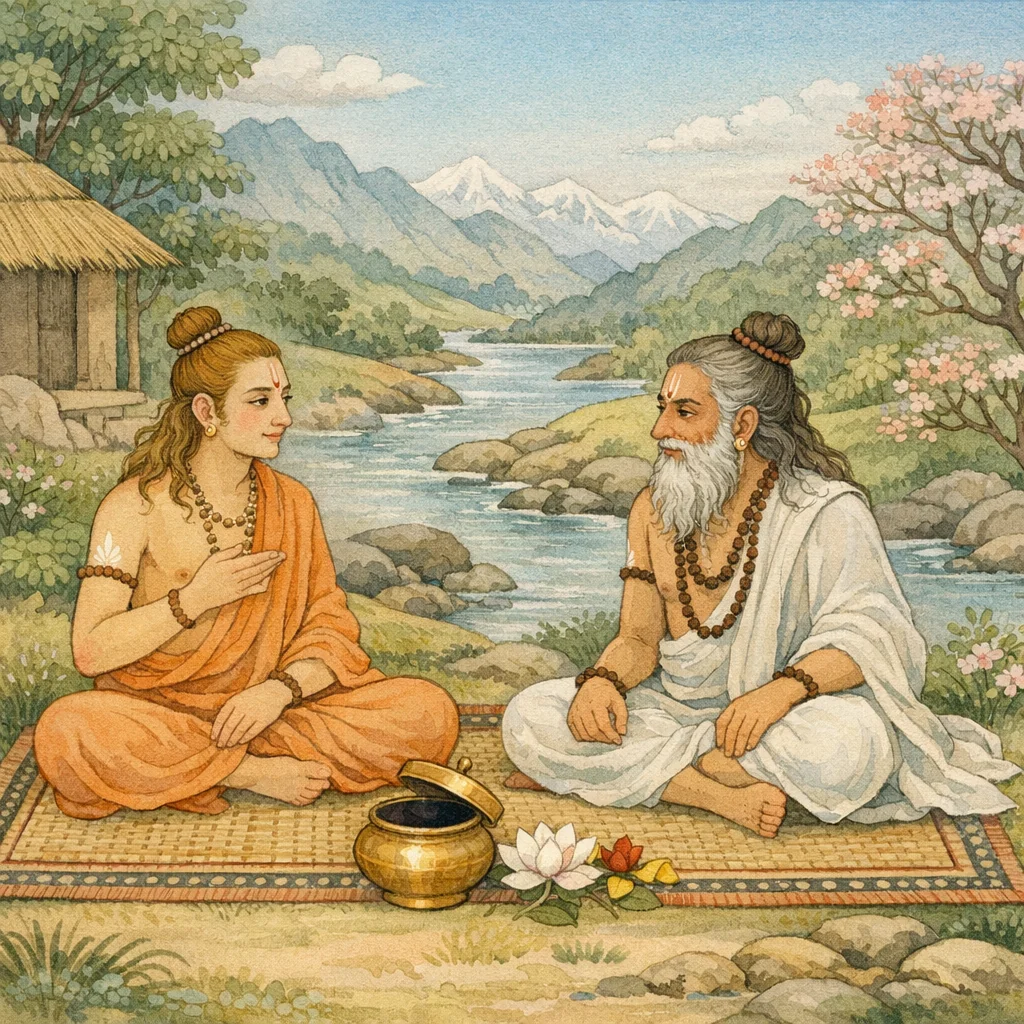
Dehāśucitā-vicāraḥ (Inquiry into the Impurity of the Body)
Adhyāya 23 unfolds as a didactic dialogue in which Sanatkumāra instructs Vyāsa on the body’s inherent impurity (dehāśucitā) and the need for detachment. He explains that the body arises from śukra-śoṇita (semen and blood), remains continually bound to wastes such as feces, urine, and phlegm, and—through analogies like a vessel clean outside yet filled with filth within—shows that external cleansing cannot make the body intrinsically pure. Even highly sanctifying substances and rites are said to lose purity upon contact with the body, underscoring that ritual purity is conditional and instrumental, whereas true ontological purity lies in the self’s orientation toward Śiva-tattva. The esoteric lesson is disciplined realism meant to dismantle dehābhimāna, turning the aspirant toward inner purification, discrimination (viveka), and steady Śaiva sādhanā.
Shlokas
Verse 1
सनत्कुमार उवाच । शृणु व्यास महाबुद्धे देहस्याशुचितां मुने । महत्त्वं च स्वभावस्य समासात्कथयाम्यहम्
Sanatkumāra said: O Vyāsa of great intellect, O sage—listen. I shall briefly explain to you the impurity inherent in the body, and also the profound importance of one’s true nature (svabhāva).
Verse 2
शुक्रशोणितसंयोगाद्देहस्संजायते यतः । नित्यं विण्मूत्रसंपूर्णस्तेनायमशुचिस्स्मृतः
Because the body arises from the union of semen and blood, and because it is perpetually filled with feces and urine, this body is therefore regarded as impure. In Śaiva wisdom, such recognition fosters dispassion and turns the seeker from attachment to the perishable body toward Lord Śiva, the pure Pati who grants liberation.
Verse 3
यथांतर्विष्ठया पूर्णश्शुचिमान्न बहिर्घटः । शोध्यमानो हि देहोऽयं तेनायमशुचिस्ततः
Just as a pot that appears clean on the outside is not truly pure when it is filled within with filth, so too this body—because it must continually be cleansed—is impure by its very nature.
Verse 4
संप्राप्यातिपवित्राणि पंचगव्यहवींषि चा । अशुचित्वं क्षणाद्यांति किमन्यदशुचिस्ततः
On coming into contact with supremely purifying substances—such as pañcagavya and the consecrated oblations (havis)—impurity vanishes in a moment. Then what other impurity can remain thereafter?
Verse 5
हृद्यान्यप्यन्नपानानि यं प्राप्य सुरभीणि च । अशुचित्वं प्रयांत्याशु किमन्यदशुचिस्ततः
Even pleasing foods and drinks, and even fragrant substances, upon coming into contact with him quickly become impure. What further proof is needed, then, that he is impure?
Verse 6
हे जनाः किन्न पश्यंति यन्निर्याति दिनेदिने । स्वदेहात्कश्मलं पूतिस्तदाधारः कथं शुचिः
O people, why do you not see what leaves the body day after day? From one’s own body impurity and foulness continually issue forth—how then can its support, this body, be called truly pure?
Verse 7
देहस्संशोध्यमानोऽपि पंचगव्यकुशांबुभिः । घृष्यमाण इवांगारो निर्मलत्वं न गच्छति
Even if the body is purified with pañcagavya and with water sanctified by kuśa grass, it still does not attain true purity—like a coal that, though rubbed, never becomes spotless.
Verse 8
स्रोतांसि यस्य सततं प्रभवंति गिरेरिव । कफमूत्रपुरीषाद्यैस्स देहश्शुध्यते कथम्
How can this body ever be pure, when its streams flow forth unceasingly like waters from a mountain—issuing as phlegm, urine, feces, and the like?
Verse 9
सर्वाशुचिनिधानस्य शरीरस्य न विद्यते । शुचिरेकः प्रदेशोऽपि विण्मूत्रस्य दृतेरिव
In this body—an abode of every kind of impurity—there is not even a single spot that is truly pure, just as in a skin-bag filled with feces and urine.
Verse 10
सृष्ट्वात्मदेहस्रोतांसि मृत्तोयैः शोध्यते करः । तथाप्यशुचिभांडस्य न विभ्रश्यति किं करः
After creating the bodily channels and openings, a hand may be cleansed with earth and water; yet if it has handled an impure vessel, does the taint not still cling to that hand?
Verse 11
कायस्सुगंधधूपाद्यैर्य न्नेनापि सुसंस्कृतः । न जहाति स्वभावं स श्वपुच्छमिव नामितम्
Even if the body is carefully refined with perfumes, incense, and the like, it does not abandon its inherent nature—just as a dog’s tail, though pressed and straightened, does not stay so. Thus, outer polish cannot replace inner transformation through Shiva-oriented discipline and knowledge.
Verse 12
यथा जात्यैव कृष्णोर्थः शुक्लस्स्यान्न ह्युपायतः । संशोद्ध्यमानापि तथा भवेन्मूर्तिर्न निर्मला
Just as something that is black by its very nature cannot become white by any means, so too a form (mūrti) that is inherently impure does not become truly pure even when repeatedly cleansed.
Verse 13
जिघ्रन्नपि स्वदुर्गंधं पश्यन्नपि स्वकं मलम् । न विरज्येत लोकोऽयं पीडयन्नपि नासिकाम्
Even while smelling one’s own foul stench, and even while seeing one’s own filth—though it torments the very nose—this world does not become dispassionate. Such is the binding power of delusion to the body.
Verse 14
अहो मोहस्य माहात्म्यं येनेदं छादितं जगत् । शीघ्रं पश्यन्स्वकं दोषं कायस्य न विरज्यते
Alas, how powerful is delusion—by it this entire world is veiled. Even when one quickly perceives one’s own fault, one does not at once become dispassionate toward the body.
Verse 15
स्वदेहस्य विगंधेन न विरज्येत यो नरः । विरागकारणं तस्य किमेतदुपदिश्यते
If a man does not grow dispassionate even because of the foul smell and impurity of his own body, then what cause of detachment could this instruction possibly teach him?
Verse 16
सर्वस्यैव जगन्मध्ये देह एवाशुचिर्भवेत् । तन्मलावयवस्पर्शाच्छुचिरप्यशुचिर्भवेत्
In this world, for everyone, the body alone is truly impure. By contact with the body’s filthy parts and secretions, even one who is otherwise pure becomes impure.
Verse 17
गंधलेपापनोदार्थ शौचं देहस्य कीर्तितम् । द्वयस्यापगमाच्छुद्धिश्शुद्धस्पर्शाद्विशुध्यति
Bodily purification (śauca) is taught as that which removes foul odor and smeared impurities. When both are dispelled, purity arises; and by contact with what is pure, one becomes wholly purified.
Verse 18
गंगातोयेन सर्वेण मृद्भारैः पर्वतोपमैः । आमृत्योराचरेच्छौचं भावदुष्टो न शुध्यति
Even if one bathed with all the waters of the Gaṅgā and smeared oneself with heaps of earth like mountains, and even if one performed outward purifications until death—one whose inner disposition is corrupted does not become pure.
Verse 19
तीर्थस्नानैस्तपोभिर्वा दुष्टात्मा नैव शुध्यति । श्वदृतिः क्षालिता तीर्थे किं शुद्धिमधिगच्छति
Neither by bathing at sacred fords (tīrtha) nor by austerities (tapas) does a wicked-minded person become purified at all. If a dog’s hide is washed in a holy place, what true purity does it attain?
Verse 20
अंतर्भावप्रदुष्टस्य विशतोऽपि हुताशनम् । न स्वर्गो नापवर्गश्च देहनिर्दहनं परम्
For one whose inner disposition is corrupted, even entering the sacred fire yields no heaven and no liberation; it brings only the supreme burning—mere destruction of the body.
Verse 21
सर्वेण गांगेन जलेन सम्यङ् मृत्पर्वतेनाप्यथ भावदुष्टः । आजन्मनः स्नानपरो मनुष्यो न शुध्यतीत्येव वयं वदामः
We declare that a person whose inner disposition is corrupted does not become purified—even if he bathes properly with all the waters of the Gaṅgā and with the cleansing earth of sacred mountains, and even if he remains devoted to bathing from birth onward.
Verse 22
प्रज्वाल्य वह्निं घृततैलसिक्तं प्रदक्षिणावर्तशिखं महांतम् । प्रविश्य दग्धस्त्वपि भावदुष्टो न धर्ममाप्नोति फलं न चान्यत
Even if one kindles a great fire, fed with ghee and oil, whose flames curl auspiciously to the right, and even if one enters it and is burned—if one’s inner intention is corrupt, one attains no dharma, and no spiritual fruit whatsoever.
Verse 23
इति श्रीशिवमहापुराणे पञ्चम्यामुमासंहितायां संसारचिकित्सायां देहा शुचित्वबाल्याद्यवस्थादुःखवर्णनं नाम त्रयोविंशोऽध्यायः
Thus, in the Śrī Śiva Mahāpurāṇa, in the Fifth (Book), the Umā Saṃhitā—within the section called “The Remedy for Worldly Existence (Saṃsāra-cikitsā)”—ends the twenty-third chapter, entitled “The description of the sufferings arising from the body—its conditions of purity and impurity—and from childhood and the other stages of life.”
Verse 24
भावशुद्धिः परं शौचं प्रमाणे सर्वकर्मसु । अन्यथाऽऽलिंग्यते कांता भावेन दुहितान्यथा
Purity of intention (inner disposition) is the highest purity; in all actions it alone is the true standard. Otherwise, by a mistaken attitude, one may embrace one’s beloved as though she were a daughter—or a daughter as though she were the beloved.
Verse 25
मनसो भिद्यते वृत्तिरभिन्नेष्वपि वस्तुषु । अन्यथैव सुतं नारी चिन्तयत्यन्यथा पतिम्
Even when the objects are essentially the same, the mind’s mode of cognition becomes divided. Thus a woman thinks of her son in one way, and of her husband in another—because the mind colors each relation differently.
Verse 26
पश्यध्वमस्य भावस्य महाभाग्यमशेषतः । परिष्वक्तोपि यन्नार्य्या भावहीनं न कामयेत्
Behold, in every way, the extraordinary greatness of this bhāva, the inner disposition. Even when embraced, a woman does not desire a man devoid of heartfelt feeling—so essential is true bhāva.
Verse 27
नाद्याद्विविधमन्नाद्यं भक्ष्याणि सुरभीणि च । यदि चिंतां समाधत्ते चित्ते कामादिषु त्रिषु
One should not partake of the two kinds of food, nor of fragrant delicacies and relishable edibles, if one’s mind is set upon thoughts of the three—desire and the like, the inner impurities.
Verse 28
गृह्यते तेन भावेन नरो भावाद्विमुच्यते । भावतश्शुचि शुद्धात्मा स्वर्गं मोक्षं च विंदति
A person is bound by the very bhāva he embraces, and by that bhāva he is also released. By cultivating a pure bhāva, the inner self is cleansed and one attains heaven as well as liberation (mokṣa).
Verse 29
भावेनैकात्मशुद्धात्मा दहञ्जुह्वन्स्तुवन्मृतः । ज्ञानावाप्तेरवाप्याशु लोकान्सुबहुयाजिनाम्
With devotional bhāva, becoming one-pointed and inwardly purified, he performs the sacred acts—burning the offering, making homa oblations, and praising Śiva. Even at death, he swiftly attains the goal of true knowledge and reaches the exalted worlds reserved for those who have performed many sacrifices.
Verse 30
ज्ञानामलांभसा पुंसां सद्वैराग्यमृदा पुनः । अविद्यारागविण्मूत्रलेपगंधविशोधनम्
For embodied beings, the pure water of true knowledge and, again, the cleansing earth of steadfast dispassion wash away the foul stains and stench—ignorance and attachment—like filth and urine clinging to the body.
Verse 31
एवमेतच्छरीरं हि निसर्गादशुचि स्मृतम् । त्वङ्मात्रसारं निःसारं कदलीसारसन्निभम्
Thus, this body is said to be impure by its very nature. It has only skin as its seeming ‘essence’, is truly without real substance, and is comparable to the pith of a banana plant.
Verse 32
ज्ञात्वैवं दोषवद्देहं यः प्राज्ञश्शिथिलो भवेत् । देह भोगोद्भवाद्भावाच्छमचित्तः प्रसन्नधीः
Knowing thus that the body is fraught with faults, the wise one loosens all attachment. Seeing that every mode of feeling arises from bodily enjoyments, he becomes calm in mind and clear in understanding.
Verse 33
सोऽतिक्रामति संसारं जीवन्मुक्तः प्रजायते । संसारं कदलीसारदृढग्राह्यवतिष्ठते
He transcends saṃsāra and becomes a jīvanmukta—liberated while still embodied. For him, the world-process appears graspable yet is without substance, firm only in seeming, like the pith of a banana plant.
Verse 34
एवमेतन्महाकष्टं जन्म दुःखं प्रकीर्तितम् । पुंसामज्ञानदोषेण नानाकार्मवशेन च
Thus is declared the exceedingly grievous suffering called “birth,” arising for embodied beings through the fault of ignorance and through subjection to diverse karmas.
Verse 35
श्लोकार्धेन तु वक्ष्यामि यदुक्तं ग्रन्थकोटिभिः । ममेति परमं दुःखं न ममेति परं सुखम्
In half a verse I shall state what crores of scriptures have declared: the sense of “mine” is the greatest sorrow, while “not mine” is the highest happiness.
Verse 36
बहवोपीह राजानः परं लोक मितो गताः । निर्ममत्वसमेतास्तु बद्धाश्शतसहस्रशः
Here, many kings too have departed to the higher worlds; yet—even though endowed with detachment, free from possessiveness—they remain bound, in hundreds of thousands.
Verse 37
गर्भस्थस्य स्मृतिर्यासीत्सा च तस्य प्रणश्यति । संमूर्छितेन दुःखेन योनियन्त्रनिपीडनात्
Whatever memory the embodied soul had while dwelling in the womb—that too is lost. Overwhelmed by suffering, it is crushed by the constriction of the womb’s mechanism (the birth-channel), and its former recollection perishes.
Verse 38
बाह्येन वायुना वास्य मोहसङ्गेन देहिनः । स्पृष्टमात्रेण घोरेण ज्वरस्समुपजायते
For the embodied being, when the vital breath is disturbed by an external wind and becomes entangled with delusion, then merely by that dreadful contact, fever arises.
Verse 39
तेन ज्वारेण महता सम्मोहश्च प्रजायते । सम्मूढस्य स्मृतिभ्रंशश्शीघ्रं संजायते पुनः
From that intense fever arises delusion; and for one thus bewildered, loss of memory quickly occurs again and again.
Verse 40
स्मृतिभ्रंशात्ततस्तस्य स्मृतिर्न्नोऽपूर्वकर्मणः । रतिः संजायते तूर्णं जन्तोस्तत्रैव जन्मनि
Then, due to the loss of memory, that being’s recollection does not arise regarding deeds performed in former lives. Yet, in that very birth, desire and attachment quickly spring up within the embodied soul.
Verse 41
रक्तो मूढश्च लोकोऽयं न कार्य्ये सम्प्रवर्तते । न चात्मानं विजानाति न परं न च दैवतम्
This world, bound by attachment and delusion, does not rightly set itself to what ought to be done. It knows neither its own Self, nor the Supreme Reality, nor even the Divine.
Verse 42
न शृणोति परं श्रेयस्सति कर्णेऽपि सन्मुने । न पश्यति परं श्रेयस्सति चक्षुषि तत्क्षमे
O noble sage, though one has ears, one does not truly hear of the Supreme Good; and though one has capable eyes, one does not truly see that Supreme Good.
Verse 43
समे पथि शनैर्गच्छन् स्खलतीव पदेपदे । सत्यां बुद्धौ न जानाति बोध्यमानो बुधैरपि
Even while moving slowly on an even path, he stumbles as though at every step; and even when instructed by the wise, he does not recognize the truth, because his understanding is not established in right discernment.
Verse 44
संसारे क्लिश्यते तेन गर्भलोभवशानुगः । गर्भस्मृतेन पापेन समुज्झितमतिः पुमान्
Therefore, in saṃsāra a man suffers, driven by the compulsion of craving for embodiment and birth. By the sin of fixation upon the womb (rebirth), his discernment is cast away, and he becomes deluded.
Verse 45
इत्थं महत्परं दिव्यं शास्त्रमुक्तं शिवेन तु । तपसः कथनार्थाय स्वर्गमोक्षप्रसाधनम्
Thus, this supremely great and divine scripture was spoken by Lord Śiva to expound the discipline of tapas; it is a means that brings about both heaven and liberation (mokṣa).
Verse 46
ये सत्यस्मिच्छिवे ज्ञाने सर्वकामार्थ साधने । न कुर्वन्त्यात्मनः श्रेयस्तदत्र महदद्भुतम्
Even when the true knowledge of Śiva—able to fulfill every rightful desire and human aim—is available, some do not pursue their own highest good; this indeed is a great wonder here.
Verse 47
अव्यक्तेन्द्रियवृत्तित्वाद्बाल्ये दुःखं महत्पुनः । इच्छन्नपि न शक्नोति वक्तुं कर्त्तुं प्रतिक्रियाम्
Because the activities of the senses are still unmanifest in childhood, there is great suffering then as well; even though one wills it, one cannot speak or act in response.
Verse 48
दंतोत्थाने महद्दुःखमल्पेन व्याधिना तथा । बालरोगैश्च विविधै पीडा बालग्रहैरपि
At the time of teething there is great suffering; even slight ailments cause trouble. A child is afflicted by various childhood diseases, and also by the seizing influences known as the bāla-grahas.
Verse 49
क्वचित्क्षुत्तृट्परीतांगः क्वचित्तिष्ठति संरटन् । विण्मूत्रभक्षणाद्यं च मोहाद्बालस्समाचरेत्
At times, with his body tormented by hunger and thirst, he wanders about; at times he stands there, crying out in distress. Deluded by bewilderment, the childish-minded one may even take up vile acts such as eating excrement and urine.
Verse 50
कौमारे कर्णपीडायां मातापित्रोश्च साधनः । अक्षराध्ययनाद्यैश्च नानादुःखं प्रवर्तते
In childhood, when the ears ache from being pierced, when one is disciplined by mother and father, and again through learning letters and other trainings, manifold kinds of suffering arise for the embodied being.
Verse 51
बाल्ये दुःखमतीत्यैव पश्यन्नपि विमूढधीः । न कुर्वीतात्मनः श्रेयस्तदत्र महदद्भुतम्
Even after passing through the sufferings of childhood, though he sees the truth plainly, the deluded-minded person still does not undertake what is truly beneficial for his own Ātman—this indeed is the great wonder here.
Verse 52
प्रवृत्तेन्द्रियवृत्तित्वात्कामरोगप्रपीडनात् । तदप्राप्ते तु सततं कुतस्सौख्यं तु यौवने
Because the senses are ever driven outward, and because one is tormented by the disease of desire (kāma), when the desired object is not attained there is continual agitation—so where, indeed, is happiness in youth?
Verse 53
ईर्ष्यया च महद्दुःखं मोहाद्रक्तस्य तस्य च । नेत्रस्य कुपितस्येव त्यागी दुःखाय केवलम्
Through jealousy (īrṣyā) arises great suffering; and for one whose mind is stained by delusion and attachment, renunciation becomes only pain—like an inflamed, angry eye.
Verse 54
न रात्रौ विंदते निद्रां कामाग्निपरिवेदितः । दिवापि च कुतस्सौख्यमर्थोपार्जनचिंतया
Scorched by the fire of desire (kāma), he finds no sleep at night; and even by day, how could there be happiness, tormented by anxiety over the earning of wealth?
Verse 55
स्त्रीष्वध्यासितचित्तस्य ये पुंसः शुक्रबिन्दवः । ते सुखाय न मन्यन्ते स्वेदजा इव ते तथा
For the man whose mind is fastened upon women, the semen-drops that arise from such infatuation are not held to be the cause of true happiness; in that respect they are like beings born of sweat—base and fleeting.
Verse 56
कृमिभिस्तुद्यमानस्य कुष्ठिनो वानरस्य च । कंडूयनाभितापेन यद्भवेत्स्त्रिषु तद्विदः
The wise know that the same kind of torment—like a leprous monkey being gnawed by worms, afflicted with burning distress and itching—also manifests among women.
Verse 57
यादृशं मन्यते सौख्यं गंडे पूतिविनिर्गमात् । तादृशं स्त्रीषु मन्तव्यं नाधिकं तासु विद्यते
Whatever pleasure one imagines in the discharge of foul matter from a boil, so should the so‑called pleasure in women be understood to be of that very kind; beyond that, there is nothing higher in them as objects of sense‑enjoyment.
Verse 58
विण्मूत्रस्य समुत्सर्गात्सुखं भवति यादृशम् । तादृशं स्त्रीषु विज्ञेयं मूढैः कल्पितमन्यथा
The pleasure that arises from discharging feces and urine—know that the same kind of pleasure is involved in sexual indulgence with women; only the deluded imagine it to be something else.
Verse 59
नारीष्ववस्तुभूतासु सर्वदोषाश्रयासु वा । नाणुमात्रं सुखं तासु कथितं पंचचूडया
Pañcacūḍā declared: “In women—said to be insubstantial and a refuge of every fault—there is not even an atom’s measure of true happiness.”
Verse 60
सम्माननावमानाभ्यां वियोगेनेष्टसंगमात् । यौवनं जरया ग्रस्तं क्व सौख्यमनुपद्रवम्
Struck by honor and dishonor, by separation from the company of the beloved, and with youth itself seized by old age—where in this world is any happiness free from disturbance? Therefore one should seek the unshaken refuge of Lord Śiva, the Pati beyond all change.
Verse 61
वलीपलितखालित्यैश्शिथिलिकृतविग्रहम् । सर्वक्रियास्वशक्तिं च जरया जर्जरीकृतम्
Wrinkled, grey-haired, and bald, the body becomes slackened; and through old age one is rendered broken and powerless in every activity.
Verse 62
स्त्रीपुंसयौवनं हृद्यमन्योऽन्यस्य प्रियं पुरा । तदेव जरयाग्रस्तमनयोरपि न प्रियम्
In former times, the youth of woman and man was pleasing to the heart—each was dear to the other. Yet that very same youth, once seized by old age, becomes unpleasing even to them both.
Verse 63
अपूर्ववत्स्वमात्मानं जरया परिवर्तितम् । यः पश्यन्नपि रज्येत कोऽन्यस्तस्मादचेतनः
Seeing one’s own self altered by old age—no longer as before—if a person still becomes attached, who could be more insentient than that one?
Verse 64
जराभिभूतः पुरुषः पुत्रीपुत्रादिबांधवैः । आसक्तत्वाद्दुराधर्षैर्भृत्यैश्च परिभूयते
When a man is overpowered by old age, he is slighted by his relatives—daughters, sons, grandchildren and the rest; and because of his clinging attachment, he is also humiliated even by servants who were once difficult to oppose.
Verse 65
धर्ममर्थं च कामं वा मोक्षं वातिजरातुरः । अशक्तस्साधितुं तस्माद्युवा धर्मं समाचरेत्
One who is exceedingly aged and afflicted becomes unable to accomplish dharma, artha, kāma, or even mokṣa. Therefore, while still young, one should diligently practice dharma.
Frequently Asked Questions
A sustained argument for dehāśucitā: because the body arises from biological fluids and continually produces waste, it cannot be intrinsically pure; therefore, over-investment in bodily identity and merely external purification is philosophically misplaced.
They function as a hermeneutic device: even the most ritually purifying media become ‘impure’ by bodily contact, indicating that ritual śuddhi is contingent and pragmatic, while the deeper purification required is cognitive and spiritual—viveka leading to detachment and Śiva-oriented consciousness.
No specific iconographic manifestation is foregrounded in the provided verses; the chapter is primarily an ascetical-philosophical instruction that supports Śaiva soteriology by preparing the aspirant for Śiva-tattva realization through vairāgya.