भैरवावतारलीलावर्णनम् (Bhairava-avatāra-līlā-varṇanam) — “Narration of the Divine Play of Bhairava’s Descent”
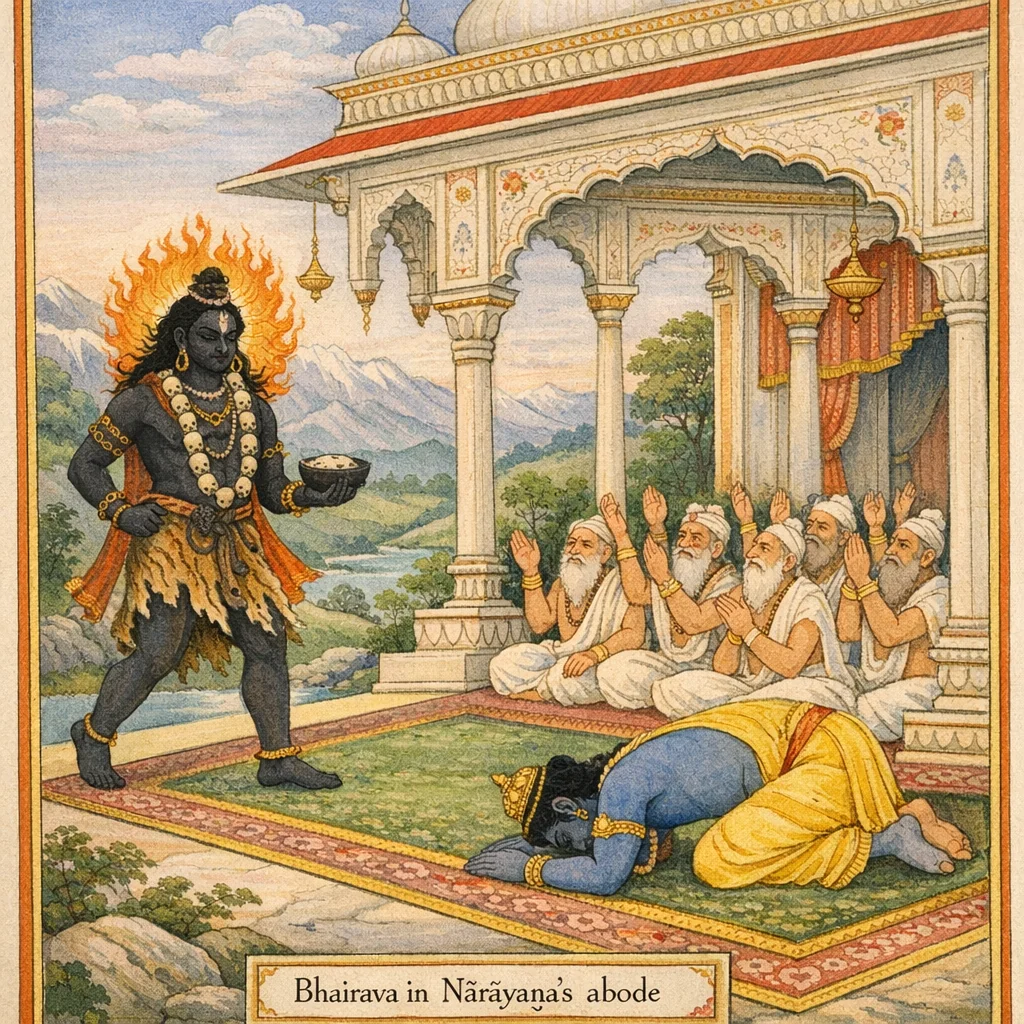
This chapter is framed as Nandīśvara’s instruction to Sanatkumāra, declaring the account a “supreme Bhairavī narrative” that destroys great faults and increases devotion (v.1). Bhairava is then praised as Mahākāla/Kālakālana who, by the command of the “God of gods,” undertakes the Kāpālika vow (v.2), showing that even transgressive forms serve divine ordinance. As Kapālapāṇi and Viśvātmā he roams the three worlds (v.3); even the dreadful brahmahatyā cannot overpower him, and mere circling of pilgrimage sites does not grant liberation (vv.3–4), affirming that Śiva’s mahimā is the decisive purifying power. The scene shifts to Nārāyaṇa’s abode, where Hari, the devas, sages, and divine women offer daṇḍavat prostrations and hymnic praise on Bhairava’s arrival (vv.5–8), recognizing his full, complete form (pūrṇākāra). It culminates in Viṣṇu’s pleased address, recalling Lakṣmī’s emergence from the churning of the ocean (v.9), thereby weaving Vaiṣṇava cosmology into a Śaiva-centered theophany and confirming Bhairava’s supra-sectarian authority in the Purāṇic order.
Shlokas
Verse 1
नन्दीश्वर उवाच । सनत्कुमार सर्वज्ञ भैरवीमपरां कथाम् । शृणु प्रीत्या महादोषसंहर्त्रीम्भक्तिवर्द्धिनीम्
Nandīśvara said: O Sanatkumāra, all-knowing one—listen with loving attention to this supreme account of Bhairavī, which destroys great faults and increases devotion (bhakti) to the Lord.
Verse 2
तत्सान्निध्यं भैरवोऽपि कालोऽभूत्कालकालनः । स देवदेववाक्येन बिभ्रत्कापालिकं व्रतम्
By that very sacred Presence, Bhairava too became Kāla—the slayer of Time itself. And, by the command of the God of gods, he undertook and bore the Kapālika observance (vrata).
Verse 3
कपालपाणिर्विश्वात्मा चचार भुवनत्रयम् । नात्याक्षीच्चापि तं देवं ब्रह्महत्यापि दारुणा
Bearing a skull in His hand, Śiva—the Universal Self—wandered through the three worlds. Yet even the dreadful sin of brahmahatyā, the slaying of a brāhmaṇa, could not truly overpower or subdue that God.
Verse 4
प्रतितीर्थं भ्रमन्वापि विमुक्तो ब्रह्महत्यया । अतः कामारिमहिमा सर्वोपि ह्यवगम्यताम्
Even by wandering to each sacred ford and pilgrimage-place one may be freed from the sin of brahmin-slaying; therefore, let the greatness of Kāmāri—Śiva, the foe of Kāma—be understood by all.
Verse 5
प्रमथैः सेव्यमानोऽपि ह्येकदा विहरन्हरः । कापालिको ययौ स्वैरी नारायणनिकेतनम्
Even while being attended upon by the Pramathas, Hara (Lord Śiva) once, roaming freely in the guise of a Kāpālika ascetic, went to the abode of Nārāyaṇa (Viṣṇu).
Verse 6
अथायान्तं महाकालं त्रिनेत्रं सर्पकुण्डलम् । महादेवांशसम्भूतं पूर्णाकारं च भैरवम्
Then they beheld Mahākāla drawing near—three-eyed, adorned with serpent-earrings—Bhairava, arisen from a portion of Mahādeva, manifest in a complete and fully revealed form.
Verse 7
पपात दण्डवद्भूमौ तं दृष्ट्वा गरुडध्वजः । देवाश्च मुनयश्चैव देवनार्य्यः समन्ततः
On seeing Him, the Lord whose banner bears Garuḍa (Viṣṇu) fell upon the ground like a staff in full prostration; and all around, the gods, the sages, and the celestial ladies likewise bowed in reverence.
Verse 8
अथ विष्णुः प्रणम्यैनं प्रयातः कमलापतिः । शिरस्यञ्जलिमाधाय तुष्टाव विविधैः स्तवः
Then Lord Viṣṇu—consort of Lakṣmī—bowed down to Him. With joined palms placed upon his head in reverence, he proceeded and praised (Śiva) with many kinds of hymns.
Verse 9
इति श्रीशिवमहापुराणे तृतीयायांशत रुद्रसंहितायां भैरवावतारलीलावर्णनं नाम नवमोऽध्यायः
Thus, in the Śrī Śiva Mahāpurāṇa—within the third section, the Śatarudra Saṃhitā—ends the ninth chapter, entitled “The Description of the Divine Play of Bhairava’s Incarnation.”
Verse 10
विष्णुरुवाच । प्रिये पश्याब्जनयने धन्यासि सुभगेऽनघे । धन्योऽहं देवि सुश्रोणि यत्पश्यावो जगत्पतिम्
Viṣṇu said: “Beloved—behold, O lotus‑eyed one. Fortunate are you, O auspicious and sinless lady. Fortunate am I too, O goddess of fair hips, for we have beheld the Lord of the universe.”
Verse 11
अयन्धाता विधाता च लोकानां प्रभुरीश्वरः । अनादिः शरणः शान्तः पुरः षड्विंशसंमितः
He is indeed the Sustainer and the Ordainer of the worlds—their Lord and sovereign Īśvara. Beginningless, the Refuge of all, and ever Peaceful, He abides in the ‘city’ (the body) measured as twenty-six principles.
Verse 12
सर्वज्ञः सर्वयोगीशस्सर्वभूतैकनायकः । सर्वभूतान्तरात्मायं सर्वेषां सर्वदः सदा
He is omniscient; the sovereign Lord of all yogins; the one supreme ruler of all beings. He abides as the inner Self within every creature, and ever remains the constant bestower of all attainments to all.
Verse 13
ये विनिद्रा विनिश्वासाः शान्ता ध्यानपरायणाः । धिया पश्यंति हृदये सोयं पद्मे समीक्षताम्
Those who are free from the dullness of sleep and from restless breath, who are tranquil and wholly devoted to meditation—by purified understanding they behold Him within the heart. Let that very Lord be contemplated in the lotus of the heart.
Verse 14
यं विदुर्व्वेदतत्त्वज्ञा योगिनो यतमानसाः । अरूपो रूपवान्भूत्वा सोऽयमायाति सर्वगः
He whom the knowers of Vedic truth and the steadfast-minded yogins realize—though formless, He assumes a form; thus that all-pervading Lord appears to the devotees and to the world.
Verse 15
अहो विचित्रं देवस्य चेष्टितम्परमेष्ठिनः । यस्याख्यां ब्रुवतो नित्यं न देहः सोऽपि देहभृत्
Ah, how wondrous are the deeds of that Supreme Lord! For one who continually utters His holy name, the bondage of embodiment no longer remains—though he may still appear to bear a body.
Verse 16
तं दृष्ट्वा न पुनर्जन्म लभ्यते मानवैर्भुवि । सोयमायाति भगवांस्त्र्यम्बकश्शशिभूषणः
Having beheld Him, human beings on earth do not obtain rebirth again. Behold—here comes that very Blessed Lord, Tryambaka, adorned with the moon.
Verse 17
पुण्डरीकदलायामे धन्ये मेऽद्य विलोचने । यद्दृश्यते महादेवो ह्याभ्यां लक्ष्मि महेश्वरः
O Lakṣmī, blessed indeed are my eyes today—wide like lotus petals—for with them I behold Mahādeva, Maheśvara Himself.
Verse 18
धिग्धिक्पदन्तु देवानां परं दृष्ट्वा न शंकरम् । लभ्यते यत्र निर्वाणं सर्व दुःखान्तकृत्तु यत्
Shame upon that so‑called “highest state” of the gods, if it is attained without beholding Śaṅkara. For it is in Him that Nirvāṇa is obtained—He who truly brings all suffering to its end.
Verse 19
देवत्वादशुभं किञ्चिद्देवलोके न विद्यते । दृष्ट्वापि सर्वे देवेशं यन्मुक्तिन्न लभामहे
Because of their divine status, nothing in the world of the gods is considered inauspicious. Yet we all, even after beholding the Lord of the gods (Śiva), do not attain liberation—such is our predicament.
Verse 20
एवमुक्त्वा हृषीकेशस्संप्रहृष्टतनूरुहः । प्रणिपत्य महादेवमिदमाह वृषध्वजम्
Having spoken thus, Hṛṣīkeśa (Viṣṇu), his body thrilled with joy, bowed down to Mahādeva and then addressed Vṛṣadhvaja (Śiva, whose banner bears the bull).
Verse 21
विष्णुरुवाच । किमिदन्देवदेवेन सर्वज्ञेन त्वया विभो । क्रियते जगतां धात्रा सर्वपापहराव्यय
Viṣṇu said: “O Lord of gods, O all-knowing Mighty One—why is this being done by You, the Sustainer of the worlds, the imperishable remover of all sins?”
Verse 22
क्रीडेयन्तव देवेश त्रिलोचन महामते । किङ्कारणं विरूपाक्ष चेष्टितन्ते स्मरार्दन
O Lord of the gods—Three-eyed One, great-souled, O Virūpākṣa, destroyer of Kāma—while you were sporting, what was the reason for this deed of yours?
Verse 23
किमर्थं भगवञ्छम्भो भिक्षाञ्चरसि शक्तिप । संशयो मे जगन्नाथ एष त्रैलोक्यराज्यद
“For what purpose, O Blessed Śambhu, do You wander seeking alms, O Lord of Power? A doubt has arisen in me, O Lord of the universe—you are the bestower of sovereignty over the three worlds.”
Verse 24
नन्दीश्वर उवाच । एवमुक्तस्ततः शम्भुर्विष्णुना भैरवो हरः । प्रत्युवाचाद्भुतोतिस्स विष्णुं हि विहसन्प्रभुः
Nandīśvara said: Thus addressed by Viṣṇu, Śambhu—Hara in the awe-inspiring form of Bhairava—smiled and, the sovereign Lord, replied to Viṣṇu with wondrous utterance.
Verse 25
भैरव उवाच । ब्रह्मणस्तु शिरश्छिन्नमंगुल्याग्रनखेन ह । तदघम्प्रतिहन्तुं हि चराम्येतद्व्रतं शुभम्
Bhairava said: “With the nail at the tip of my finger I severed Brahmā’s head. Therefore, to counteract that sin, I now undertake and observe this auspicious vow.”
Verse 26
नन्दीश्वर उवाच । एवमुक्तो महेशेन भैरवेण रमापतिः । स्मृत्वा किंचिन्नतशिराः पुनरेवमजिज्ञपत्
Nandīśvara said: Thus addressed by Maheśa in the form of Bhairava, Viṣṇu—the lord of Ramā—remembered something; then, bowing his head slightly, he again inquired in this manner.
Verse 27
विष्णुरुवाच । यथेच्छसि तथा क्रीड सर्वविघ्नोपनोदक । मायया मां महादेव नाच्छादयितुमर्हसि
Viṣṇu said: “Sport as You wish, O remover of all obstacles. Yet, O Mahādeva, You should not veil me with Your māyā.”
Verse 28
नाभीकमलकोशात्तु कोटिशः कमलासनाः । कल्पे कल्पे पुरा ह्यान्सत्यं योगबलाद्विभो
From the sheath of the navel-lotus arise countless Brahmās—each seated upon a lotus. In every kalpa, O all-pervading Lord, this indeed occurs by the power of Yoga, the divine yogic potency.
Verse 29
त्यज मायामिमान्देव दुस्तरामकृतात्मभिः । ब्रह्मादयो महादेव मायया तव मोहिताः
O Lord, abandon this Māyā—so hard to cross for those who have not mastered themselves. Even Brahmā and the other gods, O Mahādeva, are deluded by Your Māyā.
Verse 30
यथावदनुगच्छामि चेष्टितन्ते शिवापते । तवैवानुग्रहाच्छम्भो सर्वेश्वर सतांगते
O Lord of auspiciousness, O Master Śiva—by Your grace alone, O Śambhu, Supreme Lord and refuge of the virtuous, I am able to follow Your conduct and divine ways as they truly are.
Verse 31
संहारकाले संप्राप्ते सदेवान्निखिलान्मुनीन् । लोकान्वर्णाश्रमवतो हरिष्यसि यदा हर
O Hara, when the time of dissolution arrives, You will withdraw all worlds—together with the gods and all the sages—along with the entire order of varṇa and āśrama, into Yourself.
Verse 32
तदा कृते महादेव पापं ब्रह्मवधादिकम् । पारतन्त्र्यं न ते शम्भो स्वैरं क्रीडत्यतो भवान्
O Mahādeva, when that deed was done, sin arose, beginning with brahma-hatyā (the slaying of a brāhmaṇa). Yet, O Śambhu, there is no bondage or dependence for You; therefore You sport freely, in complete sovereignty.
Verse 33
अर्घीव ब्रह्मणो ह्यस्थ्नां स्रक्कण्ठे तव भासते । तथाद्यनुगता शम्भो ब्रह्महत्या तवानघ
O Śambhu, on Your neck there shines, as it were, a garland made from Brahmā’s bones. And even now, O sinless One, the stigma of brahma-hatyā appears to cling to You—though in essence You remain ever stainless.
Verse 34
कृत्वापि सुमहत्पापं यस्त्वां स्मरति मानवः । आधारं जगतामीश तस्य पापं विलीयते
Even if a person has committed a very great sin, when he remembers You—O Lord, the very support of the worlds—his sin is dissolved and fades away.
Verse 35
यथा तमो न तिष्ठेत सन्निधावंशुमालिनः । तथैव तव यो भक्तः पापन्तस्य व्रजेत्क्षयम्
Just as darkness cannot remain in the presence of the Sun, so too, for the one who is Your devotee, O Śiva, sin is destroyed and comes to an end.
Verse 36
यश्चिन्तयति पुण्यात्मा तव पादाम्बुजद्वयम् । ब्रह्महत्याकृतमपि पापन्तस्य व्रजेत्क्षयम्
That pure-souled devotee who contemplates Your two lotus-feet—even the sin arising from brahmin-slaying (brahmahatyā)—is destroyed for him and comes to an end.
Verse 37
तव नामानुरक्ता वाग्यस्य पुंसो जगत्पते । अप्यद्रिकूटतुलितं नैनस्तमनुबाधते
O Lord of the universe, for the person whose speech is devoted to Your Name, even sin heaped up like a mountain-peak does not afflict him.
Verse 38
परमात्मन्परन्धाम स्वेच्छाभिधृतविग्रह । कुतूहलं तवेशेदं कृपणाधीनतेश्वर
O Supreme Self, O highest abode, O Lord who assumes a form by Your own free will—why, O Īśa, does this curiosity arise in You, as though You depended upon a helpless wretch, O Sovereign Lord?
Verse 39
अद्य धन्योऽस्मि देवेश यत्र पश्यंति योगिनः । पश्यामि तं जगन्मूर्त्ति परमेश्वरमव्ययम्
“Today I am truly blessed, O Lord of the gods, for I behold that very Supreme Lord whom the yogins perceive. I see the Imperishable Parameśvara—the universal-form (jaganmūrti) who pervades all.”
Verse 40
अद्य मे परमो लाभस्त्वद्य मे मंगलं परम् । तं दृष्ट्वामृत तृप्तस्य तृणं स्वर्गापवर्गकम्
Today I have gained the highest gain; today my supreme auspiciousness is fulfilled. For one who has beheld Him and is satisfied as though by nectar, even heaven and liberation appear as mere straw.
Verse 41
इत्थं वदति गोविंदे विमला पद्मया तया । मनोरथवती नाम भिक्षा पात्रे समर्पिता
As Govinda spoke thus, that spotless lady Padmā offered into the alms-bowl a sacred gift of food called “Manorathavatī,” a bestowal that fulfills one’s righteous aspirations.
Verse 42
भिक्षाटनाय देवोऽपि निरगात्परया मुदा । अन्यत्रापि महादेवो भैरवश्चात्तविग्रहः
Then the Lord Himself set out to wander for alms, filled with supreme joy. Elsewhere too, Mahādeva assumed the embodied form of Bhairava.
Verse 43
दृष्ट्वानुयायिनीं तान्तु समाहूय जनार्दनः । संप्रार्थयद्ब्रह्महत्यां विमुंच त्वं त्रिशूलिनम्
Seeing that Brahma-hatyā (the sin of Brahmin-slaying) was following after him, Janārdana called her near and earnestly implored: “Release the Trident-bearing Lord (Śiva); let him be free.”
Verse 44
ब्रह्महत्योवाच । अनेनापि मिषेणाहं संसेव्यामुं वृषध्वजम् । आत्मानम्पावयिष्यामि त्वपुनर्भवदर्शनम्
Brahmahatyā said: “Even by this pretext I shall come into contact with that Bull-bannered Lord (Śiva) and serve Him. By beholding Him—who is the vision that grants freedom from rebirth—I shall purify myself.”
Verse 45
नन्दीश्वर उवाच । सा तत्याज न तत्पार्श्वं व्याहृतापि मुरारिणा । तमूचेऽथ हरिं शंभुः स्मेरास्यो भैरवो वचः
Nandīśvara said: Though addressed by Murāri (Viṣṇu), she did not leave that side. Then Śambhu—Bhagavān Bhairava, smiling—spoke words to Hari.
Verse 46
भैरव उवाच । त्वद्वाक्पीयूषपानेन तृप्तोऽस्मि बहुमानद । स्वभावोऽयं हि साधूनां यत्त्वं वदसि मापते
Bhairava said: “By drinking the nectar of your words, O bestower of great honor, I am satisfied. For this indeed is the very nature of the virtuous—that you speak thus, O Lord.”
Verse 47
वरं वृणीष्व गोविंद वरदोऽस्मि तवानघ । अग्रणीर्मम भक्तानां त्वं हरे निर्विकारवान्
“Choose a boon, O Govinda; I am a bestower of boons to you, O sinless one. O Hari, you are the foremost among my devotees—steadfast and free from all change.”
Verse 48
नो माद्यन्ति तथा भैक्ष्यैर्भिक्षवोऽप्यतिसंस्कृतैः । यथा मानसुधापानैर्ननु भिक्षाटनज्वराः
Even mendicants do not become so intoxicated by alms-food, though it be exquisitely prepared, as they do by drinking the nectar of the mind—indeed, this is the feverish compulsion of wandering for alms.
Verse 49
नन्दीश्वर उवाच । इत्याकर्ण्य वचः शंभो भैरवस्य परात्मनः । सुप्रसन्नतरो भूत्वा समवोचन्महेश्वरम्
Nandīśvara said: Having thus heard the words of Bhairava—the Supreme Self—Śambhu became even more gracious, and then addressed Maheśvara.
Verse 50
विष्णुरुवाच । एष एव वरः श्लाघ्यो यदहं देक्ताधिपम् । पश्यामि त्वान्देवदेव मनोवाणी पथातिगम्
Viṣṇu said: “This boon alone is truly worthy of praise—that I behold You, O God of gods, the Lord of all that is seen, who transcend the paths of mind and speech.”
Verse 51
अदभ्रेयं सुधादृष्टिरनया मे महोत्सवः । अयत्त्ननिधिलाभोयं वीक्षणं हर ते सताम्
This nectar-like glance is truly inexhaustible; by it, a great festival has arisen for me. This is a treasure gained without effort—O Hara, the darśana of You belongs to the virtuous.
Verse 52
अवियोगोऽस्तु मे देव त्वदंघ्रियुगलेन वै । एष एव वरः शंभो नान्यं कश्चिद् वृणे वरम्
O Lord, may there never be any separation for me from Your pair of sacred feet. This alone is the boon I seek, O Śambhu; I choose no other blessing.
Verse 53
श्रीभैरवी उवाच । एवम्भवतु ते तात यत्त्वयोक्तं महामते । सर्वेषामपि देवानां वरदस्त्वं भविष्यसि
Śrī Bhairavī said: “So be it, dear child. O great-minded one, may what you have spoken come to pass. You shall become the bestower of boons even to all the gods.”
Verse 54
नन्दीश्वर उवाच । अनुगृह्येति दैत्यारि केंद्राद्रिभुवनेचरम् । भेजे विमुक्तनगरीं नाम्ना वाराणसीं पुरीम्
Nandīśvara said: “Showing grace,” the Slayer of the asuras came to the holy region of Kendrādri and its sacred sphere, and he entered the city famed as the ‘City of Liberation’—the city named Vārāṇasī.
Verse 56
कपालं ब्राह्मणः सद्यो भैरवस्य करांबुजात् । पपात भुवि तत्तीर्थमभूत्कापालमोचनम्
At once, the Brahmin’s skull-bowl slipped from Bhairava’s lotus-hand and fell upon the earth; and that very spot became a sacred tīrtha called Kāpālamocana, where the (sin of) the skull was released.
Verse 57
कपालं ब्रह्मणो रुद्रस्सर्वेषामेव पश्यताम् । हस्तात्पतन्तमालोक्य ननर्त परया मुदा
As all looked on, Rudra beheld Brahmā’s skull slipping from His hand; and upon seeing it fall, He danced in supreme joy.
Verse 58
विधेः कपालं नामुंचत्करमत्यन्तदुस्सहम् । परस्य भ्रमतः क्वापि तत्काश्यां क्षणतोऽपतत्
Brahmā’s skull would not leave (Śiva’s) hand—an unbearably painful burden. As the Supreme Lord wandered, that skull, in a moment, fell away at Kāśī.
Verse 59
शूलिनो ब्रह्मणो हत्या नापैति स्म च या क्वचित् । सा काश्यां क्षणतो नष्टा तस्मात्सेव्या हि काशिका
Even the sin of Brahmin-slaying that once clung to Śūlin (Lord Śiva) and could not be removed anywhere else is destroyed in a moment in Kāśī. Therefore, Kāśikā (Kāśī) is indeed to be resorted to and served.
Verse 60
कपालमोचनं काश्यां यः स्मरेत्तीर्थमुत्तमम् । इहान्यत्रापि यत्पापं क्षिप्रं तस्य प्रणश्यति
Whoever remembers the supreme sacred ford called Kapālamocana in Kāśī—whatever sin of his, whether committed here or elsewhere, quickly perishes.
Verse 61
आगत्य तीर्थप्रवरे स्नानं कृत्वा विधानतः । तर्पयित्वा पितॄन्देवान्मुच्यते ब्रह्महत्यया
Having come to the most excellent sacred ford and bathed there according to the prescribed rite, and having offered tarpana-libations to the ancestors and the gods, one is freed from the sin of brahmahatyā—the slaying of a Brāhmaṇa.
Verse 62
कपालमोचनं तीर्थं पुरस्कृत्वा तु भैरवः । तत्रैव तस्थौ भक्तानां भक्षयन्नघसन्ततिम्
Then Bhairava, setting foremost the sacred ford called Kapālamocana, remained right there—devouring, as it were, the unbroken succession of sins of his devotees.
Verse 63
कृष्णाष्टम्यान्तु मार्गस्य मासस्य परमेश्वरः । आविर्बभूव सल्लीलो भैरवात्मा सताम्प्रियः
On Aṣṭamī, the eighth lunar day of the dark fortnight (Krishna-pakṣa) in the month of Mārgaśīrṣa, the Supreme Lord manifested Himself—playfully revealing His Bhairava-nature—beloved of the virtuous and devoted.
Verse 64
मार्गशीर्षासिताष्टम्यां कालभैरवसन्निधौ । उपोष्य जागरं कुर्वन्महापापैः प्रमुच्यते
On Aṣṭamī, the eighth lunar day of the dark fortnight in the month of Mārgaśīrṣa, in the presence of Kālabhairava, one who fasts and keeps vigil through the night is freed from great sins.
Verse 65
अन्यत्रापि नरो भक्त्या तद्व्रतं यः करिष्यति । स जागरं महापापैर्मुक्तो यास्यति सद्गतिम्
Even elsewhere, anyone who with devotion undertakes that same vow—the sacred night-long vigil—will be freed from great sins and will attain the good and auspicious state.
Verse 66
अनेकजन्मनियुतैर्यत्कृतं जन्तुभिस्त्वघम् । तत्सर्वं विलयं याति कालभैरवदर्शनात्
Whatever sin embodied beings have committed over thousands of births—all of it is dissolved and destroyed by the mere darśana, the vision of Kālabhairava.
Verse 67
कालभैरवभक्तानां पातकानि करोति यः । स मूढो दुःखितो भूत्वा पुनर्दुर्गतिमाप्नुयात्
Whoever commits sinful acts against the devotees of Kālabhairava—such a deluded person, stricken with sorrow, falls again into an evil course of existence.
Verse 68
विश्वेश्वरेऽपि ये भक्ता नो भक्ताः कालभैरवे । ते लभन्ते महादुःखं काश्यां चैव विशेषतः
Those who are devoted to Viśveśvara yet are not devoted to Kālabhairava obtain great suffering—especially in Kāśī.
Verse 69
वाराणस्यामुषित्वा यो भैरवं न भजेन्नरः । तस्य पापानि वर्द्धन्ते शुक्लपक्षे यथा शशी
A man who dwells in Vārāṇasī yet does not worship Bhairava—his sins increase, just as the moon grows during the bright fortnight.
Verse 70
कालराजं न यः काश्यां प्रतिभूताष्टमीकुजम् । भजेत्तस्य क्षयं पुण्यं कृष्णपक्षे यथा शशी
Whoever does not worship Kālarāja in Kāśī—especially when the Aṣṭamī tithi coincides with Tuesday—his merit diminishes, just as the moon wanes in the dark fortnight.
Verse 71
श्रुत्वाख्यानमिदम्पुण्यम्ब्रह्महत्यापनोदकम् । भैरवोत्पत्तिसंज्ञं च सर्वपापैः प्रमुच्यते
Whoever hears this holy narrative—known as the account of Bhairava’s manifestation, and renowned for removing even the sin of brahma-hatyā—becomes freed from all sins.
Verse 72
बन्धनागारसंस्थोऽपि प्राप्तोऽपि विपदम्पराम् । प्रादुर्भावं भैरवस्य श्रुत्वा मुच्येत सङ्कटात्
Even if one is confined in a prison, or has fallen into the extremity of calamities, merely by hearing of the manifestation of Bhairava one becomes freed from distress.
Verse 95
क्षेत्रे प्रविष्टमात्रेऽथ भैरवे भीषणाकृतौ । हाहेत्युक्त्वा ब्रह्महत्या पातालं चाविशत्तदा
But the moment it entered the sacred kṣetra, it encountered Bhairava in a terrifying form. Crying, “Alas! Alas!”, the sin of brahma-hatyā then plunged down into Pātāla.
Frequently Asked Questions
It narrates Bhairava’s theophany as Mahākāla, his adoption of the Kāpālika vrata by divine command, and his arrival at Nārāyaṇa’s abode where Viṣṇu and the celestial assembly prostrate and praise—arguing that Shiva’s mahimā supersedes ordinary sin-logic and sectarian rank.
The skull-in-hand (Kapālapāṇi) and Kāpālika vow function as controlled transgressive symbols: they encode radical detachment and the conversion of impurity into liberative power when authorized by Shiva, while Mahākāla/Kālakālana signifies time’s transcendence—Shiva as the power that consumes even the consumer (kāla).
Shiva is highlighted primarily as Bhairava in his ‘pūrṇākāra’ (full manifestation) and as Mahākāla/Kālakālana; the chapter’s emphasis is the fierce, protective, and purifying Rudra-form rather than a Gauri-centric manifestation.