Kirātāvatāra, Durvāsā-upākhyāna, and the Logic of Divine Rescue (Kirātākhyam-avatāra; Pāṇḍava-prasaṅga)
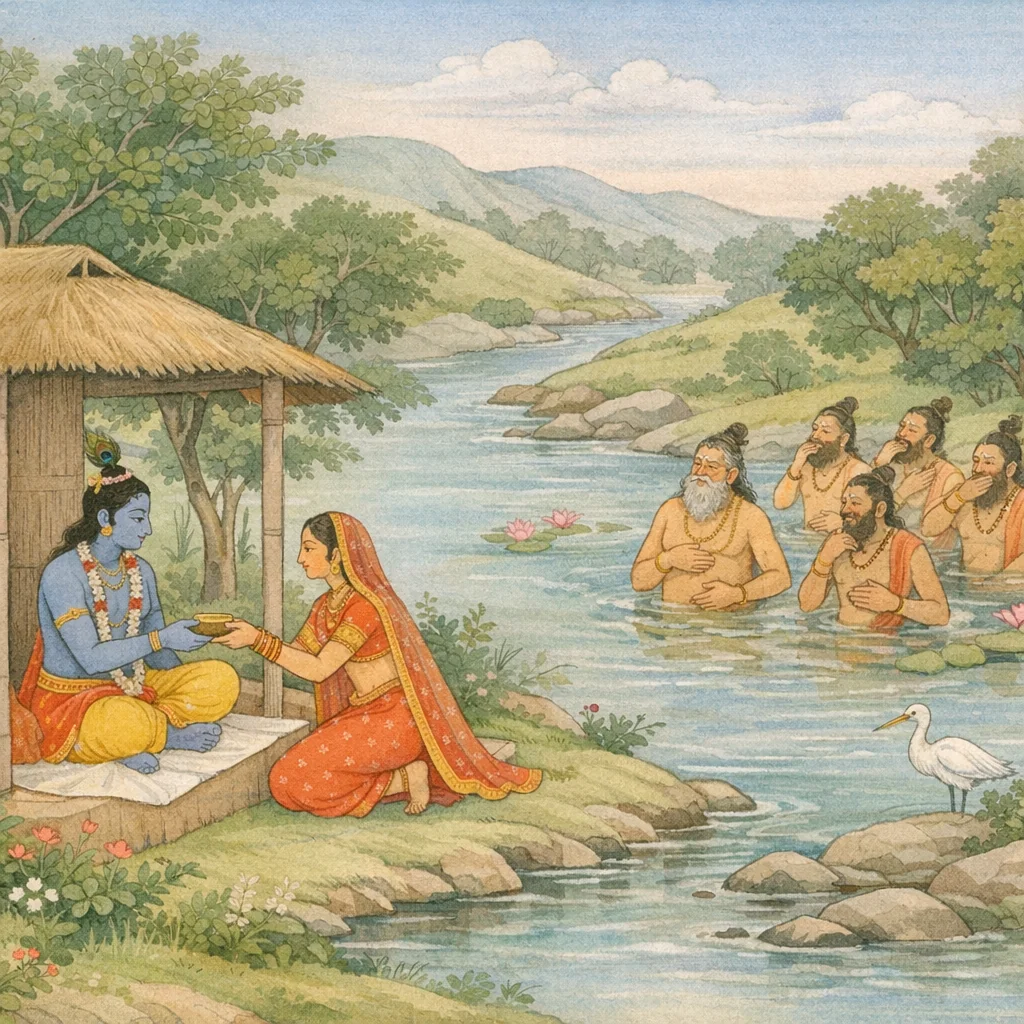
This Adhyāya, cast as Nandīśvara’s instruction, introduces Pinākin Śiva’s Kirāta-avatāra and recalls how he pleased Arjuna by slaying the demon Mūka and granting a boon. It then turns to an Itihāsa episode: the Pāṇḍavas, living with Draupadī in the Dvaita forest and sustained by Sūrya’s gifted vessel, are targeted by Duryodhana, who sends the sage Durvāsā with disciples to engineer a hospitality crisis. After being received, the guests go to bathe, leaving the hosts distressed for lack of food. Draupadī remembers Kṛṣṇa; he arrives at once and, by eating the last remaining morsel of śāka, mystically satisfies Durvāsā and his retinue, averting a curse and rescuing the Pāṇḍavas from danger. The chapter thus teaches a bhakti logic: remembrance summons divine presence, a minimal offering becomes cosmically sufficient when grace operates, and hostile “tests” become proofs of protection for dharma-aligned devotees. It ends with the Pāṇḍavas questioning Kṛṣṇa about rising threats and right action, carrying the narrative from crisis into strategic spiritual counsel.
Shlokas
Verse 1
नन्दीश्वर उवाच । शृणु प्राज्ञ किराताख्यमवतारम्पिनाकिनः । मूकं च हतवान्प्रीतो योऽर्जुनाय वरन्ददौ
Nandīśvara said: “O wise one, listen to the incarnation of the Bearer of the Pināka (Śiva) known as Kirāta. Pleased, he slew Mūka and then granted a boon to Arjuna.”
Verse 2
सुयोधनजितास्ते वै पाण्डवाः प्रवराश्च ते । द्रौपद्या च तया साध्व्या द्वैताख्यं वनमाययुः
Indeed, those excellent Pāṇḍavas—defeated by Suyodhana—went, together with the virtuous Draupadī, to the forest known as Dvaita. Thus even the noble are drawn into hardship by worldly fate; yet for the devotee, exile becomes a sacred field for turning the mind toward Lord Śiva, the liberating Pati beyond all bonds (pāśa).
Verse 3
तत्रैव सूर्य्यदत्तां वै स्थालीं चाश्रित्य ते तदा । कालं च वाहयामासुस्सुखेन किल पाण्डवाः
There itself, then, the Pāṇḍavas took refuge in the cooking vessel (sthālī) given by the Sun, and they passed their time in ease.
Verse 4
छलार्थं प्रेरितस्तेन दुर्वासा मुनिपुङ्गवः । सुयोधनेन विप्रेन्द्र पाण्डवान्तिकमादरात्
O best of Brāhmaṇas, the foremost sage Durvāsā—sent by Suyodhana with the intention of deceit—went respectfully to the Pāṇḍavas’ dwelling.
Verse 5
छात्रैः स्वैर्वायुतैस्सार्द्धं ययाचे तत्र तान्मुदा । भोज्यं चित्तेप्सितं वै स तेभ्यश्चैव समागतः
There, together with his own disciples and attendants, he joyfully requested them; and the food he desired in his mind was also obtained from them.
Verse 6
स्वीकृत्य पाण्डवैस्तैस्तैः स्नानार्थं प्रेषितास्तदा । दुर्वासःप्रमुखाश्चैव मुनयश्च तपस्विनः
Having been duly received by the Pāṇḍavas with fitting honors, those ascetic sages—led by Durvāsā—were then sent by them to bathe.
Verse 7
अथ ते पाण्डवाः सर्वे अन्नाभावान्मुनीश्वर । दुःखिताश्च तदा प्राणांस्त्यक्तुं चित्ते समादधुः
Then all those Pāṇḍavas, O lord among sages, distressed by the lack of food, resolved in their hearts at that time to give up their very lives.
Verse 8
द्रौपद्या च स्मृतः कृष्ण आगतस्तत्क्षणादपि । शाकं च भक्षयित्वा तु तेषां तृप्तिं समादधत्
Remembered by Draupadī, Kṛṣṇa arrived that very instant; and after eating the simple vegetable dish, he brought about the complete satisfaction of them all.
Verse 9
दुर्वासाश्च तदा शिष्यांस्तृप्ताञ्ज्ञात्वा ययौ पुनः । पाण्डवाः कृच्छ्रनिर्मुक्ताः कृष्णस्य कृपया तदा
Then Durvāsā, knowing that his disciples had been fully satisfied, departed again. At that time the Pāṇḍavas were freed from their grievous peril by the grace of Kṛṣṇa.
Verse 10
अथ ते पाण्डवाः कृष्णं पप्रच्छुः किम्भविष्यति । बलवाञ्छत्रुरुत्पन्नः किं कार्य्यन्तद्वद प्रभो
Then the Pāṇḍavas questioned Kṛṣṇa: “What will happen now? A powerful enemy has arisen—what should be done? Tell us, O Lord.”
Verse 11
नन्दीश्वर उवाच । इति पृष्ठस्तदा तैस्तु श्रीकृष्णः पाण्डवैर्मुने । स्मृत्वा शिवपदाम्भोजौ पाण्डवानिदमब्रवीत्
Nandīśvara said: Thus questioned by the Pāṇḍavas at that time, O sage, Śrī Kṛṣṇa—having recalled in his heart the lotus-feet of Lord Śiva—spoke these words to the Pāṇḍavas.
Verse 12
श्रीकृष्ण उवाच । श्रूयतां पाण्डवाः श्रेष्ठाः श्रुत्वा कर्तव्यमेव हि । मद्वृत्तान्तं विशेषेण शिवसेवासमन्वितम्
Śrī Kṛṣṇa said: “Listen, O best of the Pāṇḍavas. Having heard, it must indeed be put into practice. I shall relate my account in particular—an account accompanied by the service and worship of Lord Śiva.”
Verse 13
द्वारकां च मया गत्वा शत्रूणां विजिगीषया । विचार्य्य चोपदेशांश्च उपमन्योर्महात्मनः
Then I went to Dvārakā, intent on conquering the enemies; and, reflecting upon the sacred instructions of the great-souled sage Upamanyu, I proceeded accordingly.
Verse 14
मया ह्याराधितः शम्भुः प्रसन्नः परमेश्वरः । बटुके पर्वतश्रेष्ठे सप्तमासं सुसेवितः
“Indeed, I worshipped Śambhu; the Supreme Lord became pleased. On Baṭuka, the best of mountains, I served Him well for seven months.”
Verse 15
इष्टान्कामानदान्मह्यं विश्वेशश्च स्वयं स्थितः । तत्प्रभावान्मया सर्वसामर्थ्यं लब्धमुत्तमम्
Viśveśa, the Lord of the universe, Himself being present, granted me my cherished desires. By the power of His grace, I attained the highest and complete capability in all respects.
Verse 16
इदानीं सेव्यते देवो भुक्तिमुक्ति फलप्रदः । यूयं सेवत तं शम्भुमपि सर्वसुखावहम्
Now is the time to worship the Deva who bestows the fruits of both worldly enjoyment and liberation. You too should worship that Śambhu, who brings every true happiness.
Verse 17
नन्दीश्वर उवाच । इत्युक्त्वान्तर्दधे कृष्ण आश्वास्याथ च पाण्डवान् । द्वारकामगमच्छीघ्रं स्मरच्छिवपदाम्बुजम्
Nandīśvara said: Having spoken thus, Kṛṣṇa then vanished from their sight. After consoling the Pāṇḍavas, he swiftly went to Dvārakā, all the while remembering the lotus-feet of Lord Śiva.
Verse 18
पाण्डवा अथ भिल्लं च प्रेषयामासुरोजसा । गुणानां च परीक्षार्थं तस्य दुर्योधनस्य च
Then the Pāṇḍavas, with vigorous resolve, sent the Bhilla as a messenger, so that Duryodhana’s qualities and intentions might be tested and ascertained.
Verse 19
सोपि सर्वं च तत्रत्यन्दुर्योधनगुणोदयम् । समीचीनं च तज्ज्ञात्वापुनः प्राप प्रभून्प्रति
He too observed everything there—the manifest rise of Duryodhana’s qualities—and, understanding that it was all proper and fitting, he returned again to his lords.
Verse 20
तदुक्तन्ते निशम्यैवं दुखम्प्रापुर्मुनीश्वर । परस्परं समूचुस्ते पाण्डवा अतिदुःखिताः
O lord among sages, hearing that account to its very end, the Pāṇḍavas were seized by grief; deeply distressed, they spoke among themselves.
Verse 21
किङ्कर्तव्यं क्व गन्तव्यमस्माभिरधुना युधि । समर्था अपि वै सर्वे सत्यपाशेन यन्त्रिताः
“What, then, should we do, and where should we go now in the midst of this battle? Though we are all capable, we have been restrained and bound by the noose of Truth.”
Verse 22
नन्दीश्वर उवाच । एतस्मिन्समये व्यासो भस्मभूषितमस्तकः । रुद्राक्षाभरणश्चायाज्जटाजूटविभूषितः
Nandīśvara said: “At that time, Vyāsa arrived—his head adorned with sacred ash (bhasma), wearing Rudrākṣa ornaments, and beautified with a matted lock of hair (jaṭā-jūṭa).”
Verse 23
पञ्चाक्षरं जपन्मंत्रं शिवप्रेमसमाकुलः । तेजसां च स्वयंराशिस्साक्षाद्धर्म इवापरः
Absorbed in love for Śiva, he ceaselessly repeated the five-syllabled mantra (Namaḥ Śivāya); he became a self-manifest heap of radiance—like Dharma himself made visible in another form.
Verse 24
तन्दृष्ट्वा ते तदा प्रीता उत्थाय पुरतः स्थिताः । दत्त्वासनं तदा तस्मै कुशाजिनसुशोभितम्
Seeing him, they were filled with joy. Rising at once, they stood before him and then offered him a seat—beautifully adorned with sacred kuśa grass and a deerskin.
Verse 25
तत्रोपविष्टं तं व्यासं पूजयन्ति स्म हर्षिताः । स्तुतिं च विविधां कृत्वा धन्याः स्म इति वादिनः
There, seeing Vyāsa seated, they joyfully worshipped him. Having offered many kinds of hymns of praise, they declared, “We are truly blessed.”
Verse 26
तपश्चैव सुसन्तप्तं दानानि विविधानि च । तत्सर्वं सफलं जातं तृप्तास्ते दर्शनात्प्रभो
O Lord, the austerities we have performed with intense fervor, and the many kinds of gifts we have offered—now all have borne fruit. By the mere sight of You, O Prabhu, we are fully satisfied and fulfilled.
Verse 27
दुःखं च दूरतो जातन्दर्शनात्ते पितामह । दुष्टैश्चैव महादुःखं दत्तं नः क्रूरकर्मभिः
O Pitāmaha, at the very sight of You our sorrow has fled far away; yet the wicked, by their cruel deeds, have indeed inflicted great suffering upon us.
Verse 28
श्रीमतान्दर्शने जाते दुःखं चैव गमिष्यति । कदाचिन्न गतं तत्र निश्चयोयं विचारितः
When the darśana of the Blessed Lord (Śiva) is attained, sorrow surely departs. In that state it never fails at any time—this is the conclusion reached after due reflection.
Verse 29
महतामाश्रमे प्राप्ते समर्थे सर्वकर्मणि । यदि दुःखं न गच्छेतु दैवमेवात्र कारणम्
Even after reaching the āśrama of the great ones—where every spiritual act is fully supported—if one’s sorrow still does not depart, then daiva, the ripening of past karma, is the cause here.
Verse 30
निश्चयेनैव गच्छेतु दारिद्यं दुःखकारणम् । महतां च स्वभावोयं कल्पवृक्षसमो मतः
By firm resolve, the poverty that becomes the cause of suffering is surely driven away. Such is the very nature of the great-souled devotees—held to be like the wish-fulfilling Kalpavṛkṣa, ever inclined to remove distress and grant support.
Verse 31
तद्गुणानेव गणयेन्महतो वस्तुमात्रतः । आश्रयस्य वशादेव पुंसो वै जायते प्रभो
O Lord, one should recount only the attributes of the Supreme Reality, insofar as a limited measure can grasp a great object; for the individual soul’s very ‘being’ and ‘becoming’ arise solely according to the power of its support—Śiva, the ultimate refuge.
Verse 32
लघुत्वं च महत्त्वं च नात्र कार्य्या विचारणा । उत्तमानां स्वभावोयं यद्दीनप्रतिपालनम्
Whether one is insignificant or great, no deliberation is needed here: it is the very nature of the noble to protect and uphold the helpless and afflicted.
Verse 33
रंकस्य लक्षणं लोके ह्यतिश्रेयस्करं मतम् । पुरोऽस्य परयत्नो वै सुजनानां च सेवनम्
In this world, the hallmark of one truly humble is held to be supremely beneficial: foremost in such a person are earnest effort and faithful association with the virtuous.
Verse 34
अतः परं च भाग्यं वै दोषश्चैव न दीयताम् । एतस्मात्कारणात्स्वामिंस्त्वयि दृष्टो शुभन्तदा
Therefore, from this point onward, let neither ‘fortune’ nor ‘fault’ be imputed to anyone. For this very reason, O Lord, auspiciousness was then seen to rest in you.
Verse 35
त्वदागमनमात्रेण सन्तुष्टानि मनांसि नः । दिशोपदेशं येनाशु दुःखं नष्टम्भवेच्च नः
By your mere arrival our minds are satisfied. Please grant us direction and guidance, by which our sorrow may quickly be destroyed as well.
Verse 36
नन्दीश्वर उवाच । इत्येतद्वचनं श्रुत्वा पाण्डवानां महामुनिः । प्रसन्नमानसो भूत्वा व्यासश्चैवाब्रवीदिदम्
Nandīśvara said: Having heard these words spoken by the Pāṇḍavas, the great sage Vyāsa—his mind becoming serene and pleased—then spoke as follows.
Verse 37
इति श्रीशिवमहापुराणे तृतीयायां शतरुद्रसंहितायां किरातावतारवर्णनप्रसंगेऽर्जुनाय व्यासोपदेशवर्णनं नाम सप्तत्रिंशोऽध्यायः
Thus, in the revered Shiva Mahāpurāṇa, in the Third Book known as the Śatarudra-saṃhitā, this is the thirty-seventh chapter, entitled “The Account of Vyāsa’s Instruction to Arjuna,” set within the narrative context of Shiva’s Kirāta (hunter) incarnation.
Verse 38
सुजनानां स्वभावोयं प्राणान्तेऽपि सुशोभनः । धर्मं त्यजन्ति नैवात्र सत्यं सफलभाजनम्
This is the innate nature of the noble: even at life’s very end it shines forth in beauty. Here they never forsake dharma, and truth becomes the vessel that bears fruitful results.
Verse 39
अस्माकं चैव यूयं च ते चापि समताङ्गताः । तथापि पक्षपातो वै धर्मिष्ठानां मतो बुधैः
“We, you, and they too have all attained the same standing. Even so, the wise declare that the truly righteous show a deliberate preference—siding with what is dharma.”
Verse 40
धृतराष्ट्रेन दुष्टेन प्रथमं च ह्यचक्षुषा । धर्मस्त्यक्तः स्वयं लोभाद्युष्माकं राज्यमाहृतम्
First, by the wicked Dhṛtarāṣṭra—indeed, by the blind one—dharma was abandoned out of greed, and your rightful kingdom was seized away.
Verse 41
तस्य यूयं च ते चापि पुत्रा एव न संशयः । पितर्य्युपरते बाला अनुकंप्या महात्मनः
“You and they too are indeed his sons—of this there is no doubt. Now that your father has departed, you children are worthy of compassion from that great-souled one.”
Verse 42
पश्चात्पुत्रश्च तेनैव वारितो न कदाचन । अनर्थो नैव जायेत यच्चैवं च कृतन्तदा
Afterwards, even the son—restrained by him alone—would never again act otherwise. Thus no misfortune would arise, for in that manner the matter had then been properly settled.
Verse 43
अतः परं च यज्जातं तज्जातं नान्यथाभवेत् । अयन्दुष्टो भवन्तश्च धर्मिष्ठाः सत्यवादिनः
Henceforth, whatever is born shall indeed be just as it is born—there shall be no deviation from its ordained nature. And you shall not become corrupt; you shall be steadfast in dharma and devoted to truthfulness in speech.
Verse 44
तस्मादन्ते च तस्यैवाशुभं हि भविता धुवम् । यच्चैव वापितं बीजं तत्प्ररोहो भवेदिह
Therefore, in the end, misfortune will certainly befall that very person. For whatever seed one has sown, its sprout surely arises here (in this very life).
Verse 45
तस्माद्दुःखं न कर्तव्यं भवद्भिः सर्वथा ध्रुवम् । भविष्यति शुभं वो हि नात्र कार्य्या विचारणा
Therefore, do not give yourselves over to sorrow in any way—this is certain. Auspiciousness will surely come to you; here there is no need for further doubt or deliberation.
Verse 46
नन्दीश्वर उवाच । इत्युक्त्वा पाण्डवाः सर्वे तेन व्यासेन प्रीणिताः । युधिष्ठिरमुखास्ते च पुनरेवाब्रुवन्वचः
Nandīśvara said: Having spoken thus, all the Pāṇḍavas were gladdened by that sage Vyāsa; and those led by Yudhiṣṭhira once again spoke their words (to him).
Verse 47
पाण्डवा ऊचुः । सत्यमुक्तन्त्वया नाथ दुष्टैर्दुःखं निरंतरम् । दुष्टात्मभिर्वने चापि दीयते हि मुहुर्मुहुः
The Pāṇḍavas said: “O Lord, what you have spoken is true. From the wicked, sorrow comes unceasingly; and even in the forest, those of corrupt nature keep inflicting pain again and again.”
Verse 48
तन्नाशयाशुभम्मेद्य किंचिद्देयं शुभं विभो । कृष्णेन कथितं पूर्वमाराध्यश्शङ्करस्सदा
“To destroy that inauspiciousness, O all-pervading Lord, some pure and auspicious offering should be given. This was formerly taught by Kṛṣṇa—thus Śaṅkara should ever be worshipped.”
Verse 49
प्रमादश्च कृतोऽस्माभिस्तद्वचश्शिथिलीकृतम् । स देवमार्गस्तु पुनरिदानीमुपदिश्यताम्
“We have indeed acted carelessly, and your words have been treated with laxity. Therefore, please instruct us again—now—about that divine path (the way that leads to the Lord).”
Verse 50
नन्दीश्वर उवाच । इत्येतद्वचनं श्रुत्वा व्यासो हर्षसमन्वितः । उवाच पाण्डवान्प्रीत्या स्मृत्वा शिवपदांबुजम्
Nandīśvara said: Having thus heard these words, Vyāsa—filled with joy—recollected the lotus-feet of Lord Śiva and lovingly addressed the Pāṇḍavas.
Verse 51
व्यास उवाच । श्रूयतां वचनं मेद्य पांडवा धर्मबुद्धयः । सत्यमुक्तं तु कृष्णेन मया संसेव्यते शिवः
Vyāsa said: “O Pāṇḍavas of righteous understanding, listen to my words today. What Kṛṣṇa has spoken is indeed true, for I myself continually worship and serve Lord Śiva.”
Verse 52
भवद्भिः सेव्यतां प्रीत्या सुखं स्यादतुलं सदा । सर्वदुःखं भवत्येव शिवाऽसेवात एव हि
Therefore, worship Śiva with loving devotion; then unsurpassed happiness will ever arise. Indeed, all suffering comes only from neglecting the service and worship of Śiva.
Verse 53
नंदीश्वर उवाच । अथ पंचसु तेष्वेव विचार्य्य शिवपूजने । अर्जुनं योग्यमुच्चार्य व्यासो मुनिवरस्तथा
Nandīśvara said: “Then, after deliberating among those five regarding the worship of Śiva, the great sage Vyāsa declared Arjuna to be the fit and worthy one (for that worship).”
Verse 54
तपःस्थानं विचार्य्यैवं ततस्स मुनिसत्तमः । पाण्डवान्धर्मसन्निष्ठान्पुनरेवाब्रवीदिदम्
Having thus reflected upon the proper place for austerity, that foremost of sages then spoke again to the Pāṇḍavas—who were firmly established in dharma—saying these words.
Verse 55
व्यास उवाच । श्रूयताम्पाण्डवास्सर्वे कथयामि हितं सदा । शिवं सर्वं परं दृष्ट्वा परं ब्रह्म सताङ्गतिम्
Vyāsa said: “O Pāṇḍavas, all of you listen. I shall ever speak what is truly beneficial. Having beheld Śiva as the All and as the Supreme, know Him as the Supreme Brahman—the final refuge and ultimate goal of the righteous.”
Verse 56
ब्रह्मादित्रिपरार्द्धान्तं यत्किंचिद्दृश्यते जगत् । तत्सर्वं शिवरूपं च पूज्यन्ध्येयं च तत्पुनः
From Brahmā onward, up to the end of the supreme cosmic span (triparārdha), whatever universe is seen—everything indeed is of the very form of Śiva; therefore that same Reality is to be worshipped and meditated upon as Śiva.
Verse 57
सर्वेषां चैव सेष्योसौ शङ्करस्सर्वदुःखहा । शिवः स्वल्पेन कालेन संप्रसीदति भक्तितः
Indeed, Śaṅkara is the supreme refuge for all and the remover of every sorrow. By devotion alone, Lord Śiva becomes fully gracious within a very short time.
Verse 58
सुप्रसन्नो महेशो हि भक्तेभ्यः सकलप्रदः । भुक्तिं मुक्तिमिहामुत्र यच्छतीति सुनिश्चितम्
When Mahesha is fully pleased, He becomes the bestower of all attainments to His devotees. It is certain that He grants both worldly enjoyment (bhukti) and liberation (mukti)—here in this life and in the hereafter.
Verse 59
तस्मात्सेव्यस्सदा शभ्भुर्भुक्तिमुक्तिफलेप्सुभिः । पुरुषश्शङ्करः साक्षाद्दुष्टहन्ता सतांगतिः
Therefore, Śambhu should always be worshipped by those who seek the fruits of both worldly enjoyment and liberation. For Śaṅkara is truly the Supreme Lord in person—the destroyer of the wicked and the sure refuge and final goal of the righteous.
Verse 60
परन्तु प्रथमं शक्रविद्यां दृढमना जपेत् । क्षत्रियस्य पराख्यस्य चेदमेव समाहितम्
However, first one should, with a firm and focused mind, recite the Śakra-vidyā, Indra’s sacred mantra. This very practice is prescribed here as the settled rule for the renowned Kṣatriya, the royal warrior.
Verse 61
अतोर्जुनश्च प्रथमं शक्रविद्यां जपेद्दृढः । करिष्यति परीक्षाम्प्राक् संतुष्टस्तद्भविष्यति
Therefore Arjuna should first, with firm resolve, repeat the Śakra-vidyā, the mantra taught in connection with Indra. Before he is tested, he will become satisfied and steady—so it shall come to pass.
Verse 62
सुप्रसन्नश्च विघ्नानि संहरिष्यति सर्वदा । पुनश्चैवं शिवस्यैव वरं मन्त्रं प्रदास्यति
Being exceedingly pleased, he will always destroy all obstacles; and then, in this very manner, he will again bestow the excellent mantra of Lord Śiva.
Verse 63
नन्दीश्वर उवाच । इत्युक्त्वार्जुनमाहूयोपेन्द्रविद्यामुपादिशत् । स्नात्वा च प्राङ्मुखो भूत्वा जग्राहार्जुन उग्रधीः
Nandīśvara said: “Having spoken thus, he summoned Arjuna and instructed him in the Upendra-vidyā. Then Arjuna—of fierce resolve—bathed, faced the east, and duly received that sacred knowledge.”
Verse 64
पार्थिवस्य विधानं च तस्मै मुनिवरो ददौ । प्रत्युवाच च तं व्यासो धनंजयमुदारधीः
The foremost sage taught him the proper procedure for the earthen (Pārthiva) worship; and then the noble-minded Vyāsa replied to Dhanañjaya (Arjuna).
Verse 65
व्यास उवाच । इतो गच्छाधुना पार्थ इन्द्रकीले सुशोभने । जाह्नव्याश्च समीपे वै स्थित्वा सम्यक् तपः कुरु
Vyāsa said: “Now depart from here, O son of Pṛthā, to the splendid Indrakīla. There, staying close to the Jāhnavī (Gaṅgā), perform your austerity properly, with full discipline.”
Verse 66
अदृश्या चैव विद्या स्यात्सदा ते हितकारिणी । इत्याशिषन्ददौ तस्मै ततः प्रोवाच तान्मुनिः
“May you possess the knowledge by which you become unseen; may this vidyā ever work for your welfare.” Having thus bestowed his blessing, the sage then spoke further to him.
Verse 67
धर्म्ममास्थाय सर्वं वै तिष्ठन्तु नृपसत्तमाः । सिद्धिः स्यात्सर्वथा श्रेष्ठा नात्र कार्या विचारणा
Let all the best of kings stand firmly established in dharma. Then the highest attainment (siddhi) will surely be gained in every way—there is no need here for doubt or further deliberation.
Verse 68
नन्दीश्वर उवाच । इति दत्त्वाशिषन्तेभ्यः पाण्डवेभ्यो मुनीश्वरः । स्मृत्वा शिवपदाम्भोजं व्यासश्चान्तर्दधे क्षणात्
Nandīśvara said: Thus, having bestowed blessings upon the Pāṇḍavas as they received them, the lord among sages—Vyāsa—remembered Śiva’s lotus-feet and, in an instant, vanished from their sight.
Frequently Asked Questions
It juxtaposes Śiva’s Kirāta manifestation (slaying Mūka and blessing Arjuna) with the Durvāsā episode at the Pāṇḍavas’ forest dwelling, arguing through narrative that divine intervention is activated by devotion and safeguards dharma when adversaries attempt to weaponize ritual obligations like hospitality.
The ‘last morsel’ (śāka) functions as a ritual-symbol of sufficiency through anugraha: when devotion is intact, the smallest remainder becomes plenitude. The bathing interval (snāna) marks the liminal window of karmic testing, where anxiety peaks and remembrance becomes the decisive yogic act.
Śiva is highlighted as Pinākin in the Kirāta (hunter) form—an adaptive manifestation that enters the world to confront adharma (Mūka) and to confer boons upon a qualified devotee (Arjuna).