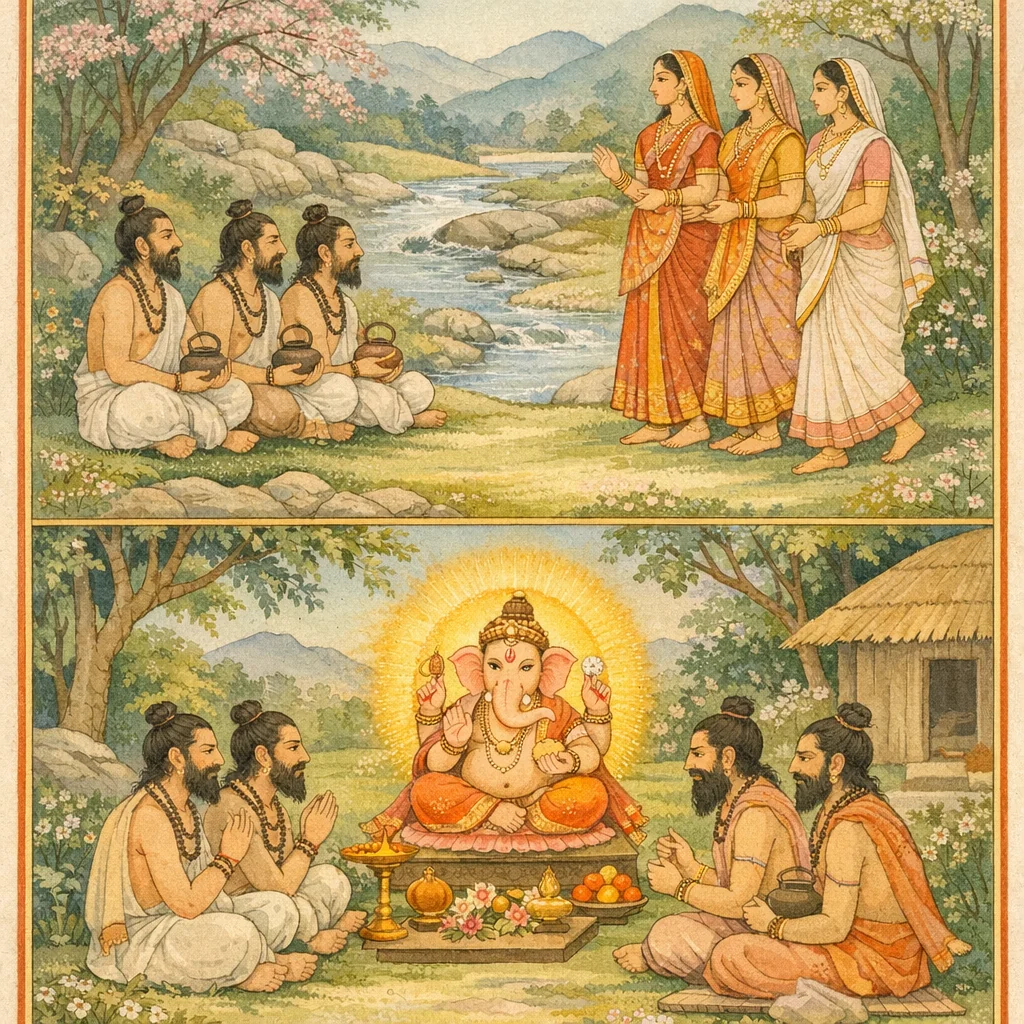
गौतमविघ्नप्रकरणम् (Episode of Obstacles to Gautama; Gaṇeśa’s Appearing Through Misguided Worship)
Narrated by Sūta, this adhyāya presents a brief cause-and-effect episode showing how social suspicion and ritualized emotion can “manufacture obstacles” (vighna) against a righteous ascetic. Gautama’s disciples go with kamaṇḍalus to fetch water, but at the water-source the wives of other ṛṣis claim precedence and rebuke them. When the disciples report back, a tapasvinī (ascetic woman) supplies water to Gautama so he may continue his daily observances. The ṛṣipatnīs, driven by anger and crooked intent, then distort the incident before their husbands, the great sages. Swayed by karmic predispositions (bhāvikarma-vaśa), the sages rage at Gautama and, to create impediments, perform elaborate worship of Gaṇeśa—not for auspiciousness, but for obstruction. Gaṇeśvara appears, pleased and boon-giving, underscoring the lesson that devotional form may be correct while moral intention is perverse, and introducing the teaching on saṅkalpa, the ethical weight of ritual, and the ambiguous use of divine powers in Purāṇic narrative logic.
Shlokas
Verse 1
सूत उवाच । कदाचिद्गौतमेनैव जलार्थं प्रेषिता निजाः । शिष्यास्तत्र गता भक्त्या कमंडलुकरा द्विजाः
Sūta said: Once, Gautama himself sent his own disciples to fetch water. Those twice-born students went there with devotion, carrying their water-pots (kamaṇḍalus) in hand.
Verse 2
शिष्याञ्जलसमीपे तु गतान्दृष्ट्वा न्यषेधयन् । जलार्थमगतांस्तत्र चर्षिपत्न्योप्यनेकशः
Seeing them approaching the water, he restrained them. And there, many wives of the sages as well, who had come in search of water, were also stopped.
Verse 3
ऋषिपत्न्यो वयं पूर्वं ग्रहीष्यामो विदूरतः । पश्चाच्चैव जलं ग्राह्यमित्येवं पर्यभर्त्सयन्
“We are the wives of the sages; we shall take it first, from a distance. Only afterward should the water be taken.” Saying this, they scolded and rebuked (the others).
Verse 4
परावृत्य तदा तैश्च ऋषिपत्न्यै निवेदितम् । सा चापि तान्समादाय समाश्वास्य च तैः स्वयम्
Then, turning back, they reported the matter to the sages’ wife. She, in turn, gathered them to herself and, by her own words, consoled them.
Verse 5
जलं नीत्वा ददौ तस्मै गौतमाय तपस्विनी । नित्यं निर्वाहयामास जलेन ऋषिसत्तमः
Bringing water, the ascetic woman offered it to Gautama. And that best of sages sustained his daily observances continually with that water.
Verse 6
ताश्चैवमृषिपत्न्यस्तु क्रुद्धास्तां पर्यभर्त्सयन् । परावृत्य गतास्सर्वास्तूटजान्कुटिलाशयाः
Thus the wives of the sages, inflamed with anger, harshly rebuked her. Then, turning back, they all departed—those women of the hermitage—bearing crooked intentions in their hearts.
Verse 7
स्वाम्यग्रे विपरीतं च तद्वृत्तं निखिलं ततः । दुष्टाशयाभिः स्त्रीभिश्च ताभिर्वै विनिवेदितम्
Then, in their master’s presence, those women of wicked intent reported the entire incident in a distorted, contrary manner.
Verse 8
अथ तासां वचः श्रुत्वा भाविकर्मवशात्तदा । गौतमाय च संकुद्धाश्चासंस्ते परमर्षयः
Then, having heard their words, and being impelled at that time by the force of destined karma, the great sages grew angry with Gautama and spoke to him in reproach.
Verse 9
विघ्नार्थं गौतमस्यैव नानापूजोपहारकैः । गणेशं पूजयामासुस्संकुद्धास्ते कुबुद्धयः
Intending to raise obstacles for Gautama alone, those ill-minded men, inflamed with anger, began worshipping Gaṇeśa with various acts of pūjā and diverse offerings.
Verse 10
आविर्बभूव च तदा प्रसन्नो हि गणेश्वरः । उवाच वचनं तत्र भक्ताधीनः फलप्रदः
Then Gaṇeśvara, Lord of the Gaṇas, manifested there, truly pleased. Bestower of results and moved by the devotee’s love, he spoke words in that very place.
Verse 11
गणेश उवाच । प्रसन्नोऽस्मि वरं ब्रूत यूयं किं करवाण्यहम् । तदीयं तद्वचः श्रुत्वा ऋषयस्तेऽबुवंस्तदा
Gaṇeśa said: “I am pleased. Speak your boon—what shall I do for you?” Hearing his words, the sages then replied.
Verse 12
ऋषय ऊचुः । त्वया यदि वरो देयो गौतमस्स्वाश्रमाद्बहिः । निष्कास्यं नो ऋषिभिः परिभर्त्स्य तथा कुरु
The sages said: “If you are to grant a boon, then arrange that Gautama be driven out from his own hermitage. Let him be expelled by us sages and be rebuked—do it in that manner.”
Verse 13
सूत उवाच । स एवं प्रार्थितस्तैस्तु विहस्य वचनं पुनः । प्रोवाचेभमुखः प्रीत्या बोधयंस्तान्सतां गतिः
Sūta said: Thus entreated by them, he smiled and again spoke with delight; that noble one—refuge and true path of the virtuous—taught them with affection.
Verse 14
गणेश उवाच । श्रूयतामृषयस्सर्वे युक्तं न क्रियतेऽधुना । अपराधं विना तस्मै क्रुध्यतां हानिरेव च
Gaṇeśa said: “Let all the sages listen. What is proper is not being done now. Though he has committed no offense, anger is being turned upon him—and only harm will come of it.”
Verse 15
उपस्कृतं पुरा यैस्तु तेभ्यो दुःखं हितं न हि । यदा च दीयते दुःखं तदा नाशो भवेदिह
Those who were once honoured and well cared for—bringing them pain is never beneficial. For when suffering is inflicted, destruction surely arises here, in this very world.
Verse 16
ईदृशं च तपः कृत्वा साध्यते फलमुत्तमम् । शुभं फलं स्वयं हित्वा साध्यते नाहितं पुनः
By performing austerity of this kind, the highest fruit is attained. But if one abandons the auspicious fruit by one’s own choice, one again attains what is not beneficial.
Verse 17
सूत उवाच । इत्येवं वचनं श्रुत्वा तस्य ते मुनिसत्तमाः । बुद्धिमोहं तदा प्राप्ता इदमेव वचोऽब्रुवन्
Sūta said: Having thus heard his words, those foremost of sages then fell into a bewilderment of understanding, and they spoke these very words in reply.
Verse 18
ऋषय ऊचुः । कर्तव्यं हि त्वया स्वामिन्निदमेव न चान्यथा । इत्युक्तस्तु तदा देवो गणेशो वाक्यमब्रवीत्
The sages said: “O Lord, this indeed must be done by you—this alone, and not otherwise.” Thus addressed, the divine Gaṇeśa then spoke in reply.
Verse 19
गणेश उवाच । असाधुस्साधुतां चैव साधुश्चासाधुतां तथा । कदाचिदपि नाप्नोति ब्रह्मोक्तमिति निश्चितम्
Gaṇeśa said: “The unrighteous never truly attain saintliness, nor does a saint fall into unrighteousness. This is certain—so it has been declared by Brahmā.”
Verse 20
यदा च भवतां दुःखं जातं चानशनात्पुरा । तदा सुखं प्रदत्तं वै गौतमेन महर्षिणा
When, in earlier times, sorrow arose for you due to fasting and going without food, then indeed the great sage Gautama granted you comfort and relief.
Verse 21
इदानीं वै भवद्भिश्च तस्मै दुःखं प्रदीयते । नेतद्युक्ततमं लोके सर्वथा सुविचार्यताम्
At this moment, by your actions, suffering is being inflicted upon him. This is not at all the most fitting course in this world—reflect on it thoroughly in every way.
Verse 22
स्त्रीबलान्मोहिता यूयं न मे वाक्यं करिष्यथ । एतद्धिततमं तस्य भविष्यति न संशयः
Deluded by the force of a woman, you will not carry out my command. Yet there is no doubt—this will ultimately become the greatest good for him.
Verse 23
पुनश्चायमृषिश्रेष्ठो दास्यते वस्सुखं ध्रुवम् । तारणं न च युक्तं स्याद्वरमन्यं वृणीत वै
Again, this foremost of sages will surely grant you happiness. Yet to carry him across—meaning to free him directly—would not be proper; therefore, indeed choose some other boon.
Verse 24
सूत उवाच । इत्येवं वचनं तेन गणेशेन महात्मना । यद्यप्युक्तमृषिभ्यश्च तदप्येते न मेनिरे
Sūta said: Thus were those words spoken by the great-souled Gaṇeśa. Yet, though they were addressed to the sages, even so they did not accept them.
Verse 25
इति श्रीशिवमहापुराणे चतुर्थ्यां कोटिरुद्रसंहितायां गौतमव्यवस्थावर्णनं नाम पंचविंशोऽध्यायः
Thus ends the twenty-fifth chapter, called “The Description of Gautama’s Ordinance,” in the fourth section of the Śrī Śiva Mahāpurāṇa, within the Koṭirudra Saṃhitā.
Verse 26
गणेश उवाच । भवद्भिः प्रार्थ्यते यच्च करिष्येऽहं तथा खलु । पश्चाद्भावि भवेदेव इत्युक्त्वांतर्दधे पुनः
Ganesha said: “Whatever you have entreated me for, that indeed I shall do. In due course it will surely come to pass.” Having said this, he again disappeared from sight.
Verse 27
गौतमस्स न जानाति मुनीनां वै दुराशयम् । आनन्दमनसा नित्यं पत्न्या कर्म चकार तत्
Gautama did not recognize the truly wicked intention of those sages. Ever joyful at heart, he continued to perform that act of service together with his wife.
Verse 28
तदन्तरे च यज्जातं चरितं वरयोगतः । तद्दुष्टर्षिप्रभावात्तु श्रूयतां तन्मुनीश्वराः
O best of sages, hear now what occurred in the meantime through the power of a boon-born yoga; indeed, it arose from the influence of that wicked rishi.
Verse 29
गौतमस्य च केदारे तत्रासन्व्रीहयो यवाः । गणेशस्तत्र गौर्भूत्वा जगाम किल दुर्बला
In Gautama’s Kedāra field there were rice and barley. There, Gaṇeśa, assuming the form of a cow, indeed wandered about as though weak and feeble.
Verse 30
कंपमाना च सा गत्वा तत्र तद्वरयोगतः । व्रीहीन्संभक्षयामास यवांश्च मुनिसत्तमाः
Trembling, she went there; and by the power of that boon, O best of sages, she began to eat rice grains and also barley.
Verse 31
एतस्मिन्नन्तरे दैवाद्गौतमस्तत्र चागतः । स दयालुस्तृणस्तंम्बैर्वारयामास तां तदा
Meanwhile, by divine providence, Gautama arrived there. Compassionate at heart, he at once restrained her with clumps of grass.
Verse 32
तृणस्तंबेन सा स्पृष्टा पपात पृथिवीतले । मृता च तत्क्षणादेव तदृषेः पश्यतस्तदा
Touched merely by a stalk of grass, she fell upon the earth; and at that very instant she died, while that sage looked on.
Verse 33
ऋषयश्छन्नरूपास्ते ऋषिपत्न्यस्तथाशुभाः । ऊचुस्तत्र तदा सर्वे किं कृतं गौतमेन च
Then those sages—having concealed their true forms—and likewise their wives, driven by inauspicious intent, all spoke there at that time: “What indeed has been done by Gautama?”
Verse 34
गौतमोऽपि तथाहल्यामाहूयासीत्सुविस्मितः । उवाच दुःखतो विप्रा दूयमानेन चेतसा
Then Gautama too, having summoned Ahalyā, stood utterly astonished. With a heart burning in grief, that brāhmaṇa spoke.
Verse 35
गौतम उवाच । किं जातं च कथं देवि कुपितः परमेश्वरः । किं कर्तव्यं क्व गन्तव्यं हत्या च समुपस्थिता
Gautama said: “What has happened, and how, O Goddess, has the Supreme Lord (Parameśvara) become displeased? What should be done now, where should one go, and how has the sin of killing come to stand before us?”
Verse 36
सूत उवाच एतस्मिन्नन्तरे विप्रो गौतमं पर्यभर्त्सयन् । विप्रपत्न्यस्तथाऽहल्यां दुर्वचोभिर्व्यथां ददुः
Sūta said: In the meantime, a certain brāhmaṇa began to rebuke Gautama; and the wives of the brāhmaṇas, likewise, pained Ahalyā with harsh and wounding words.
Verse 37
दुर्बुद्धयश्च तच्छिष्यास्सुतास्तेषां तथैव च । गौतम परिभर्त्स्यैव प्रत्यूचुर्धिग्वचो मुहुः
Those ill-minded men—along with their disciples and likewise their sons—reviled Gautama and repeatedly retorted with contemptuous words.
Verse 38
ऋषय ऊचुः । मुखं न दर्शनीयं ते गम्यतां गम्यतामिति । दृष्ट्वा गोघ्नमुखं सद्यस्सचैलं स्नानमाचरेत्
The sages said: “Your face should not be shown—go away, go away!” Having seen the face of a killer of a cow, one should immediately perform a purificatory bath even with one’s clothes on.
Verse 39
यावदाश्रममध्ये त्वं तावदेव हविर्भुजः । पितरश्च न गृह्णंति ह्यस्मद्दत्तं हि किञ्चन
So long as you remain within the bounds of the āśrama, you are indeed the consumer of the havis, the oblation; and the Pitṛs, the Ancestors, do not accept anything at all that is offered by us.
Verse 40
तस्माद्गच्छान्यतस्त्वं च परिवारसमन्वितः । विलम्बं कुरु नैव त्वं धेनुहन्पापकारक
Therefore, depart from here at once to some other place, along with your attendants. Do not delay—O slayer of a cow, you who bring about sin.
Verse 41
सूत उवाच । इत्युक्त्वा ते च तं सर्वे पाषाणैस्समताडयन् । व्यथां ददुरतीवास्मै त्वहल्यां च दुरुक्तिभिः
Sūta said: Having spoken thus, all of them together struck him with stones. They inflicted severe pain upon him, and they also tormented Ahalyā with harsh and abusive words.
Verse 42
ताडितो भर्त्सितो दुष्टैर्गौतमो गिरमब्रवीत् । इतो गच्छामि मुनयो ह्यन्यत्र निवसाम्यहम्
Struck and bitterly reviled by wicked men, the sage Gautama spoke: “O sages, I depart from this place; indeed, I shall dwell elsewhere.”
Verse 43
इत्युक्त्वा गौतमस्तस्मात्स्थानाच्च निर्गतस्तदा । गत्वा क्रोशं तदा चक्रे ह्याश्रमं तदनुज्ञया
Having said this, Gautama then departed from that place. Going a krośa away, with her permission he then established an āśrama there.
Verse 44
यावच्चैवाभिशापो वै तावत्कार्य्यं न किंचन । न कर्मण्यधिकारोऽस्ति दैवे पित्र्येऽथ वैदिके
So long as the curse remains in force, nothing at all is to be undertaken; one has no entitlement to perform rites for the gods, for the ancestors, or the Vedic duties.
Verse 45
मासार्धं च ततो नीत्वा मुनीन्संप्रार्थयत्तदा । गौतमो मुनिवर्य्यस्स तेन दुःखेन दुखितः
Then, after letting half a month pass, the eminent sage Gautama approached the sages and earnestly implored them—his heart oppressed by that very sorrow.
Verse 46
गौतम उवाच । अनुकंप्यो भवद्भिश्च कथ्यतां क्रियते मया । यथा मदीयं पापं च गच्छत्विति निवेद्यताम्
Gautama said: “Out of compassion, please instruct me—whatever must be done, I shall do it—so that my sin may depart. Please tell me the means.”
Verse 47
सूत उवाच । इत्युक्तास्ते तदा विप्रा नोचुश्चैव परस्परम् । अत्यंतं सेवया पृष्टा मिलिता ह्येकतस्स्थिताः
Sūta said: Thus addressed, those brāhmaṇa sages did not speak among themselves. Having been questioned with great humility and reverent service, they gathered together and stood in one place.
Verse 48
गौतमो दूरतः स्थित्वा नत्वा तानृषिसत्तमान् । पप्रच्छ विनयाविष्टः किं कार्यं हि मयाधुना
Standing at a respectful distance, Gautama bowed to those foremost of sages. Filled with humility, he asked: “What, indeed, should I do now?”
Verse 49
इत्युक्ते मुनिना तेन गौतमेन महात्मना । मिलितास्सकलास्ते वै मुनयो वाक्यमब्रुवन्
When those words were spoken by the great-souled sage Gautama, all the assembled sages gathered together and then spoke their reply.
Verse 50
ऋषय ऊचुः । निष्कृतिं हि विना शुद्धिर्जायते न कदाचन । तस्मात्त्वं देहशुद्ध्यर्थं प्रायश्चित्तं समाचर
The sages said: “Without niṣkṛti (expiation), purity never arises at any time. Therefore, for the purification of your body and embodied condition, duly undertake prāyaścitta, the proper rites of atonement.”
Verse 51
त्रिवारं पृथिवीं सर्वां क्रम पापं प्रकाशयन् । पुनरागत्य चात्रैव चर मासव्रतं तथा
Having circumambulated the whole earth three times—thereby bringing sin to light and dispelling it—one should return here again and, in this very place, duly observe the month-long vow (māsa-vrata) as prescribed.
Verse 52
शतमेकोत्तरं चैव ब्रह्मणोऽस्य गिरेस्तथा । प्रक्रमणं विधायैवं शुद्धिस्ते च भविष्यति
Thus, having performed the circumambulation one hundred and one times—of this mountain and of Brahmā as well—your purification will indeed come to pass.
Verse 53
अथवा त्वं समानीय गंगास्नानं समाचर । पार्थिवानां तथा कोटिं कृत्वा देवं निषेवय
Or else, bring the sacred water of the Gaṅgā and perform a Gaṅgā-bath; and likewise, having made a koṭi (a crore) of earthen liṅgas, worship and serve the Lord (Śiva).
Verse 54
गंगायां च ततः स्नात्वा पुनश्चैव भविष्यति । पुरा दश तथा चैकं गिरेस्त्वं क्रमणं कुरु
Then bathe in the Gaṅgā; thereafter you shall again attain a renewed state. As enjoined from ancient times, circumambulate the mountain ten times and then once more.
Verse 55
शत कुंभैस्तथा स्नात्वा पार्थिवं निष्कृतिर्भवेत् । इति तैर्षिभिः प्रोक्तस्तथेत्योमिति तद्वचः
After bathing as prescribed with a hundred water-pots, the expiation connected with the pārthiva rite of earthen liṅgas is fulfilled. Thus declared those sages; and he assented, saying, “So be it,” and “Om.”
Verse 56
पार्थिवानां तथा पूजां गिरेः प्रक्रमणं तथा । करिष्यामि मुनिश्रेष्ठा आज्ञया श्रीमतामिह
O best of sages, by the command of the venerable ones here, I shall set forth the worship of the Pārthiva (earthen) Liṅga, and also the rite of circumambulating the sacred mountain.
Verse 57
इत्युक्त्वा सर्षिवर्यश्च कृत्वा प्रक्रमणं गिरेः । पूजयामास निर्माय पार्थिवान्मुनिसत्तमः
Having spoken thus, that foremost of sages—together with the other ṛṣis—performed the reverential circumambulation of the mountain. Then the best of munis fashioned Pārthiva forms of earth and worshipped Śiva with devotion.
Verse 58
अहल्या च ततस्साध्वी तच्च सर्वं चकार सा । शिष्याश्च प्रतिशिष्याश्च चक्रुस्सेवां तयोस्तदा
Then the virtuous Ahalyā carried out all that was enjoined. At that time, the disciples and the disciples’ disciples also rendered devoted service to the two of them.
Frequently Asked Questions
A conflict at a water-source leads to false reporting by ṛṣipatnīs, provoking great sages to oppose Gautama; they then worship Gaṇeśa with the explicit aim of generating obstacles (vighna) against him, after which Gaṇeśvara appears as a boon-giver.
Jala and the kamaṇḍalu signify the infrastructure of daily tapas and ritual continuity: when access to ritual necessities is socially contested, the narrative exposes how external purity-acts can be disrupted by internal impurity (anger, envy), making saṅkalpa the decisive factor in spiritual outcomes.
Gaṇeśa (Gaṇeśvara) is highlighted as ‘bhaktādhīna’ (responsive to worship) and ‘phalaprada’ (giver of results), underscoring a theological caution: divine powers respond to devotion in form, but the moral quality of the requested ‘fruit’ reveals the worshipper’s adharmic intention.