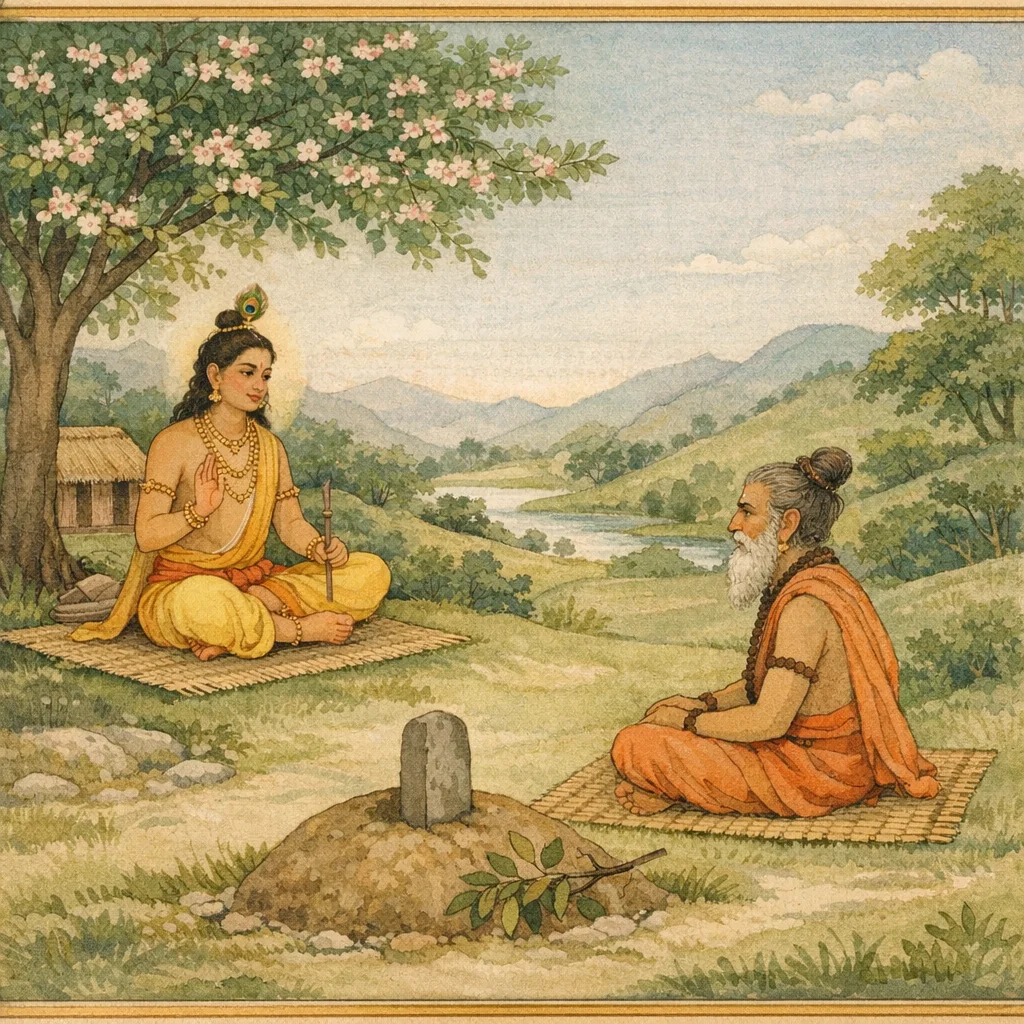
मुक्तयतिदेहसंस्काररहस्यं — The Esoteric Rites for the Bodies of Liberated Ascetics
Adhyāya 21 transmits “guhya/rahasya” teaching on the post-mortem rites (saṃskāra) for liberated ascetics (yati) who are mukta or established in Śiva-bhāva. Vāmadeva asks Kārtikeya/Subrahmaṇya why cremation (dāha-karman) is not prescribed for such renouncers and why burial (khanana) is spoken of instead. Sūta narrates Subrahmaṇya’s reply, revealing an inner doctrine earlier heard from Īśvara and conveyed to Bhṛgu, the Śiva-yogin. The chapter stresses eligibility and restricted transmission: it is not to be taught indiscriminately, but only to a śānta disciple endowed with Śiva-bhakti. It distinguishes levels of yogic attainment—one established in samādhi and Śiva-bhāva may be regarded as “paripūrṇa-śiva,” while the restless aspirant without samādhi is given practical means (upāya). The path begins with Vedānta–Āgama based “tripadārtha-parijñāna,” then proceeds through guru-taught yoga and foundational restraints starting with yama, integrating jñāna, initiation, and disciplined practice within a coherent Śaiva soteriology.
Shlokas
Verse 1
वामदेव उवाच । ये मुक्ता यतयस्तेषां दाहकर्म्म न विद्यते । मृते शरीरे खननं तद्देहस्य श्रुतं मया
Vāmadeva said: “For those ascetic sages who are liberated, no funerary rite of cremation is prescribed. I have heard that, when their body falls in death, that body is to be buried.”
Verse 2
तत्कर्माचक्ष्व सुप्रीत्या कार्तिकेय गुरो मम । त्वत्तोन्यो न हि संवक्ता त्रिषु लोकेषु विद्यते
O Kārtikeya, my revered Guru, please explain that sacred rite to me with great affection; for in the three worlds there exists no other competent expounder equal to you.
Verse 3
पूर्णाहं भावमाश्रित्य ये मुक्ता देहपंजरात् । ये तूपासनमार्गेण देहमुक्ताः परंगतः
Those who, taking refuge in the realization “I am the Whole,” become liberated from the cage of the body—and those who, by the path of devoted worship (upāsanā), become free from embodiment—attain the Supreme state.
Verse 4
तेषां गतिविशेषञ्च भगवञ्छंकरात्मज । वक्तुमर्हसि सुप्रीत्या मां विचार्य्य स्वशिष्यतः
O venerable son of Bhagavān Śaṅkara, with gracious affection, consider me as your own disciple and deign to explain to me their distinct destinations—their states of attainment.
Verse 5
सूत उवाच । मुनिविज्ञप्तिमाकर्ण्य शक्तिपुत्रस्सुरारिहा । प्राहात्यन्तरहस्यं तद्भृगुणा श्रुतमीश्वरात्
Sūta said: Hearing the sages’ request, the son of Śakti—destroyer of the foes of the gods—declared that most secret teaching, just as Bhṛgu had heard it from the Lord Īśvara Himself.
Verse 6
सुब्रह्मण्य उवाच । इदमेव मुने गुह्यं भृगवे शिवयोगिने । उक्तं भगवता साक्षात्सर्वज्ञेन पिनाकिना
Subrahmaṇya said: “O sage, this very secret teaching was spoken directly to Bhṛgu—the yogin devoted to Śiva—by Bhagavān Himself, the all-knowing Pinākin (Śiva, bearer of the bow).”}]}}
Verse 7
वक्ष्ये तदद्य ते ब्रह्मन्न देयं यस्य कस्यचित् । देयं शिष्याय शान्ताय शिवभक्तियुताय वै
O Brahmā, today I shall declare that teaching to you. It is not to be given to just anyone; it is to be imparted only to a disciple who is peaceful, self-controlled, and truly endowed with devotion to Śiva.
Verse 8
समाधिस्थो यतिः कश्चिच्छिवभावेन देहभुक् । अस्ति चेत्स महाधीरः परिपूर्णश्शिवो भवेत्
If there is an ascetic who abides in samādhi and yet sustains the body while established in Śiva-consciousness, then that great steadfast one becomes Śiva Himself in complete fullness.
Verse 9
अधैर्य्यचित्तो यः कश्चित्समाधिं न च विंदति । तदुपायम्प्रवक्ष्यामि सावधानतया शृणु
Whoever, with an unsteady and impatient mind, does not attain samādhi—I shall explain the means for that. Listen with full attentiveness.
Verse 10
त्रिपदार्थपरिज्ञानं वेदान्तागमवाक्यजम् । श्रुत्वा गुरोर्मुखाद्योगमभ्यसेत्स यमादिकम्
Having heard from the Guru’s own mouth the knowledge of the three realities (tripadārtha), drawn from the utterances of Vedānta and the Āgamas, one should then practice Yoga, beginning with the disciplines of yama and the rest, so that the soul may be led toward the Lord (Pati) beyond bondage.
Verse 11
तत्कुर्वन्स यतिस्सम्यक्छिवध्यानपरो भवेत् । नियमेन मुने नित्यं प्रणवासक्तमानसः
Performing that practice, the renunciate becomes rightly established, wholly devoted to meditation on Śiva. O sage, by disciplined observance he should always keep his mind steadily attached to the Praṇava (Oṁ).
Verse 12
देहदौर्बल्यवशतो यद्यधैर्य्यधरो यतिः । अकामश्च शिवं स्मृत्वा स जीर्णां स्वां तनुं त्यजेत्
If an ascetic, due to bodily weakness, becomes overwhelmed by lack of steadiness, then—free from desire—remembering Lord Śiva, he may relinquish his own worn-out body.
Verse 13
सदाशिवानुग्रहतो नंदिना प्रेरिता मुने । आतिवाहिकरूपिण्यो देवताः पञ्च विश्रुताः
O sage, by the grace of Sadāśiva, and urged on by Nandin, five well-renowned deities—taking the form of subtle carriers (ātivāhika)—came forth.
Verse 14
आत्महन्ताकृतिः काचिज्ज्योत्तिःपुंजवपुष्मती । अह्नोऽभिमानिनी काचिच्छुक्लपक्षाभिमानिनी
One divine Power appeared in a form that destroys ego-self, radiant as a mass of light. Another manifested as the presiding intelligence of the day, and yet another as the presiding intelligence of the bright fortnight (śukla-pakṣa).
Verse 15
उत्तरायणरूपा च पंचानुग्रहतत्परा । धूम्रा तमस्विनी रात्रिः कृष्णपक्षाभिमानिनी
She is of the nature of Uttarāyaṇa (the sun’s northward course) and is devoted to the fivefold grace. She is the smoky, darkness-laden Night, identifying herself with the dark fortnight (kṛṣṇa-pakṣa).
Verse 16
दक्षिणायनरूपेति विश्रुताः पञ्च देवताः । तासां वृत्तिं शृणुष्वाद्य वामदेव महामुने
O great sage Vāmadeva, five deities are renowned as the forms presiding over Dakṣiṇāyana (the sun’s southern course). Now listen as I describe their functions and spheres of activity.
Verse 17
ताः पंचदेवता जीवान्कर्मानुष्ठान तत्परान् । गृहीत्वा त्रिदिवं यांति तत्पुण्यवशतो मुने
O sage, those Five Deities, taking hold of the embodied souls devoted to the proper performance of sacred duties, carry them to the heavenly worlds—by the compelling force of that very merit.
Verse 18
भुक्त्वा भोगान्यथोक्तांश्च ते तत्पुण्यक्षये पुनः । मानुषं लोकमासाद्य भजते जन्मपूर्ववत्
After enjoying the pleasures spoken of in the heavenly realms, when that merit is exhausted, they return again; reaching the human world, they take birth once more, just as before.
Verse 19
ताः पुनः पंचधा मार्गं विभज्यारभ्य भूतलम् । अग्न्यादिक्रमतां गृह्यं सदाशिवपदं यतिः
Then, dividing those paths again into five, beginning from the earthly plane, the ascetic proceeds by adopting the successive stages starting with the principle of “fire”, and thus attains the state and abode of Sadāśiva.
Verse 20
निनीय वन्द्यचरणौ देवदेवस्य पृष्ठतः । तिष्ठंत्यनुग्रहाकाराः कर्म्मण्येव प्रयोजिताः
Having led them behind the Lord of gods, whose feet are worthy of all reverence, they remained there in forms of grace, engaged solely in the service that was to be performed.
Verse 21
इति श्रीशिवमहापुराणे षष्ठ्यां कैलाससंहितायां यतीनान्मरणानन्तरदशाहपर्य्यंतकृत्यवर्णनन्नामैकविंशोऽध्यायः
Thus, in the Śrī Śiva Mahāpurāṇa, in the Sixth Book—the Kailāsa Saṃhitā—ends the twenty-first chapter, entitled “Description of the rites to be performed for ascetics from immediately after death up to the tenth day.”
Verse 22
स्वसाम्यं च वपुर्दत्ते गाणपत्येभिषिच्य च । अनुगृह्णाति सर्वेशश्शंकरः सर्वनायकः
Śaṅkara—the Lord of all and the leader of all—bestows upon him a form equal to His own and, consecrating him to the rank of Gaṇapati, graciously favors him.
Verse 23
मृगटंकत्रिशूलाग्र्यवरदानविभूषितम् । त्रिनेत्रं चन्द्रशकलं गंगोल्लासिजटाधरम्
Adorned with the emblem of the deer and the excellent trident, graced with boons bestowed upon devotees; three‑eyed, bearing the crescent moon, and wearing matted locks made radiant by the presence of the Gaṅgā.
Verse 24
अधिष्ठितविमानाग्र्यं सर्वदं सर्वकामदम् । इति शाखाविरक्तश्चेद्रुद्रकन्यासमावृतम्
“The foremost celestial car, presided over by the divine power of Śiva, bestowing everything and granting all desired aims”—thus it is declared. If one becomes detached from the worldly branches of pursuit, one is then encompassed by the Rudra‑maidens (the Śivaśaktis), who draw the soul toward the Lord.
Verse 25
नृत्यगीतमृदंगादिवाद्यघोषमनोहरम् । दिव्याम्बरस्रगालेप भूषणैरपि भूषितम्
It was enchanting with the delightful sounds of dance, song, and instruments such as the mṛdaṅga. It was further adorned with celestial garments, garlands, fragrant unguents, and ornaments.
Verse 26
दिव्यामृतघटैः पूर्णं दिव्यांभःपरिपूरितम् । सूर्यकोटिप्रतीकाशं चंद्रकोटिसुशीतलम्
It was filled with celestial jars of nectar and completely brimming with divine water—radiant like ten million suns, yet cool and soothing like ten million moons.
Verse 27
मनोवेगं सर्वगं च विमानमनुगृह्य च । भुक्तभोगस्य तस्यापि भोगकौतूहलक्षये
And (Śiva), showing grace, granted him a celestial chariot—swift as thought and able to go everywhere. Yet even for one who had already enjoyed pleasures, when the curiosity for further enjoyment came to an end, a turning toward the higher goal arose.
Verse 28
निपात्य शक्तिं तीव्रतरां प्रकृत्या ह्यति दुर्गमाम् । कान्तारं दग्धुकामान्तान्मलयानलसुप्रभाम्
Unleashing, by her very innate nature, a power far more intense, she made that exceedingly impassable wilderness blaze forth—radiant like the fire that rises from the Malaya mountains—intent on burning up the hostile forces to their very end.
Verse 29
अनुगृह्य महामंत्रतात्पर्यम्परमेश्वरः । पूर्णोहं भावनारूपः शंभुर स्मीति निश्चलम्
Having shown grace, the Supreme Lord reveals the inner purport of the great mantra: “I am the All-Complete; my very nature is pure contemplative awareness. I am Śambhu”—thus one should remain unwavering in this certainty.
Verse 30
अनुगृह्य समाधिश्च स्वदास्यस्पन्दरूपिणीः । रव्यादिकर्म्मसामर्थ्यरूपाः सिद्धीरनर्गलाः
Having shown grace, (Śiva bestows) samādhi, and also unobstructed siddhis—manifesting as the spontaneous stirrings of His own servitude (devotional surrender), and as capacities for actions such as those of the Sun and other cosmic powers.
Verse 31
आयुः क्षये पद्मयोनेः पुनरावृत्तिवर्जिताम् । मुक्तिं च परमां तस्मै प्रयच्छति जगद्गुरुः
When the lifespan of Brahmā, the lotus-born, comes to its end, the Jagadguru—Lord Śiva—bestows upon him the supreme liberation, free from return (rebirth).
Verse 32
एतदेव पदं तस्मात्सर्वैश्वर्य्यं समष्टिमत् । मुक्तिघंटापथं चेति वेदांतानां विनिश्चयः
Therefore, that very State alone is the totality of all sovereign powers; it is also the sure path that, like a bell, proclaims liberation (mokṣa)—such is the settled conclusion of the Vedānta.
Verse 33
मुमूर्षोस्तस्य मन्दस्य यतेस्सत्सम्प्रदायिनः । यतयः सानुकूलत्वात्तिष्ठेयुः परित स्तदा
When that dull-minded renunciant was about to die, the true lineage-bearing ascetics, out of compassionate goodwill, should then remain gathered all around him.
Verse 34
ततस्सर्वे च ते तत्र प्रणवादीन्यनुक्रमात् । उपदिश्य च वाक्यानि तात्पर्यं च समाहिताः
Then all of them, being fully composed in mind, instructed there—step by step—beginning with the Praṇava (Oṁ). They also taught the sacred statements along with their intended purport.
Verse 35
वर्णयेयुः स्फुटं प्रीत्या शिवं संस्मारयन्सदा । निर्गुणं परमज्योतिः प्रणम्य विलयावधि
With clear words and loving devotion they should describe Śiva, ever remembering Him. Having bowed to that attributeless Supreme Light, they remain absorbed in reverence until the very end of dissolution.
Verse 36
एतेषां सममेवात्र संस्कारक्रम उच्यते । असंस्कृतशरीराणां दौर्गत्यं नैव जायते
Here, the same orderly sequence of purificatory rites (saṃskāras) is taught for all of these. For those whose bodies are not refined by such consecration, misfortune and spiritual decline do not arise, when they are established in Śiva’s discipline and grace.
Verse 37
संन्यस्य सर्वकर्म्माणि शिवाश्रयपरा यतः । देहं दूषयतस्तेषां राज्ञो राष्ट्रं च नश्यति
When people renounce all worldly duties and take exclusive refuge in Śiva, yet defile their bodies through impure conduct, then because of them both the king and his kingdom come to ruin.
Verse 38
तद्ग्रामवासिनस्तेऽपि भवेयुर्भृशदुःखिनः । तद्दोषपरिहाराय विधानं चैवमुच्यते
Even the inhabitants of that village would become exceedingly afflicted with suffering. Therefore, for the removal (or expiation) of that fault, a prescribed procedure is thus set forth.
Verse 39
स तु नम हरिण्याय चेत्यारभ्य विनम्रधीः । नम आमीवत्केभ्यान्तं तत्काले प्रजपेन्मनुम्
With a humble mind, he should begin the mantra with “namaḥ hariṇyāya …” and, ending with “namaḥ āmīvatkebhyaḥ,” he should recite that mantra at the prescribed time.
Verse 40
ओंमित्यन्ते जपन्देवयजनम्पूरयेत्ततः । ततश्शान्तिर्भवेत्तस्य दोषस्य हि मुनीश्वर
At the conclusion, one should complete the worship of the Deity by repeating “Oṁ.” Then, O lord among sages, that (incidental) fault in the rite becomes pacified, and peace is established.
Verse 41
पुत्रादयो यथा न्यायं कुर्य्युस्संस्कारमुत्तमम् । वच्मि तत्कृपया विप्र सावधानतया शृणु
O Brahmin, listen attentively. Out of compassion I shall explain the excellent rite of sacred observances, by which sons and other kin should duly perform the proper saṃskāras according to the rule.
Verse 42
अभ्यर्च्य स्नाप्य शुद्धोदैरभ्यर्च्य कुसुमादिभिः । श्रीरुद्रचमकाभ्यां च रुद्रसूक्तेन च क्रमात्
Having first worshipped (the Lord) and then bathed (the Liṅga) with pure waters, one should again offer worship with flowers and the like; then, in due sequence, one should recite the Śrī Rudram and the Camaka, and also the Rudra Sūkta—thus completing the worship in proper order.
Verse 43
शंखं च पुरतः स्थाप्य तज्जलेनाभिषिच्य च । पुष्पं निधाय शिरसि प्रणवेन प्रमार्जयेत्
Placing a conch before oneself, one should perform abhiṣeka with the water from it. Then, setting a flower upon the head, one should wipe and purify oneself while reciting the Praṇava, “Oṁ.”
Verse 44
कौपीनादीनि संत्यज्य पुनरन्यानि धारयेत् । भस्मनोद्धूलयेत्तस्य सर्वांगं विधिना ततः
Setting aside the loincloth and the like, one should then don other, fresh garments. Thereafter, according to the prescribed rite, one should dust and anoint the entire body with sacred ash (bhasma).
Verse 45
त्रिपुण्ड्रं च विधानेन तिलकं चन्दनेन च । विरच्य पुष्पैर्मालाभिरलंकुर्य्यात्कलेवरम्
One should apply the Tripuṇḍra in the prescribed manner and place a tilaka with sandal paste. Then, adorning oneself with flowers and garlands, one should beautify the body for the worship of Śiva.
Verse 46
उरः कण्डशिरोबाहुप्रकोष्ठश्रुतिषु क्रमात् । रुद्राक्षमालाभरणैरलंकुर्य्याच्च मंत्रतः
In due order, one should adorn the chest, the neck, the head, the arms, the forearms, and the ears with ornaments and garlands of Rudrākṣa, doing so while reciting the prescribed mantra. Thus the devotee assumes the marks of a Śaiva and becomes fit for worship of the Lord (Pati).
Verse 47
सुधूपितं समुत्थाप्य शिक्योपरि निधाय च । पंचब्रह्ममये रम्ये रथे संस्थापयेत्तनुम्
Having raised up the sacred form well-incensed and placing it upon a carrying-sling, one should install that body—the consecrated form—upon the beautiful chariot fashioned of the Five Brahmans (Pañcabrahma), thus worshipping the Lord in His fivefold manifestation.
Verse 48
ओंमाद्यैः पंचभिर्ब्रह्ममंत्रैस्सद्यादिभिः क्र्मात् । सुगंधकुसुमैर्माल्यैरलंकुर्य्याद्रथं च तम्
Beginning with the sacred ‘Oṁ’, one should, in due order, consecrate with the five Brahma-mantras—such as the Sadyojāta. Then one should adorn that chariot with fragrant flowers and garlands.
Verse 49
नृत्यवाद्यैर्ब्राह्मणानां वेदघोषैश्च सर्वतः । ग्रामम्प्रदक्षिणीकृत्य गच्छे त्प्रेतं तमुद्वहन्
Accompanied on all sides by dance and music, and by Brahmins chanting the Vedas, he should circumambulate the village and then proceed onward, bearing that departed one (the body).
Verse 50
ततस्ते यतिनः सर्वे तथा प्राच्यामथापि वा । उदीच्यम्पुण्यदेशे तु पुण्यवृक्षसमीपतः
Then all those ascetics (yatis), whether in the eastern quarter or elsewhere, gathered in the northern holy region, close to the sacred tree, choosing a sanctified place fit for disciplined worship and contemplation of Śiva.
Verse 51
खनित्वा देवयजनं दण्डमात्रप्रमाणतः । प्रणवव्याहृतिभ्यां च प्रोक्ष्य चास्तीर्य्य च क्रमात्
Having dug the divine altar (the place of worship) to the measure of one daṇḍa, one should sprinkle it with sanctified water while uttering the Praṇava (Oṁ) along with the vyāhṛtis, and then spread the ritual covering upon it in due order.
Verse 52
शमीपत्रश्च कुसुमैरुत्तराग्रं तदूर्ध्वतः । आस्तीर्य दर्भांस्तत्पीठं चैलाजिनकुशोत्तरम्
Spreading śamī leaves and flowers with their tips directed toward the north, and laying sacred darbha grass above them, one should prepare that seat—covered with a cloth, with a deerskin, and with darbha grass on top.
Verse 53
प्रणवेन ब्रह्मभिश्च पञ्चगव्येन तां तनुम् । प्रोक्ष्याभिषिच्य रौद्रेण सूक्तेन प्रणवेन च
With the Praṇava (Oṁ) and the Brahma-mantras, and with the five sacred products of the cow, he should sprinkle and bathe that body; and then, with the Raudra hymn and again with the Praṇava, he should perform the consecratory ablution (abhiṣeka).
Verse 54
शंखतोयेनाभिषिच्य मूर्ध्नि पुष्पं विनिःक्षिपेत् । तद्गतस्यानुकूलोऽसौ शिवस्मरणतत्परः
Having bathed (the devotee or the sacred emblem) with water poured from a conch, one should place a flower upon the crown of the head. For the one whose mind is absorbed in that worship, he becomes favorable and well-disposed—ever intent on the remembrance of Śiva.
Verse 55
ओंमित्यथ समुद्धृत्य स्वस्तिवाचनपूर्वकम् । गर्ते योगासने स्थाप्य प्राङ्मुखं स्याद्यथा तथा
Then, uttering the sacred syllable “Oṁ” aloud and first pronouncing words of auspicious benediction, one should place (the worshipful object/seat) in a prepared pit as a yogic seat (yogāsana), and sit facing the east, as prescribed.
Verse 56
गंधपुष्पैरलंकृत्वा धूपगुग्गुलुना ततः । विष्णो हव्यमिति प्रोच्य रक्षस्वेति वदन्ददेत्
Having adorned the offering with fragrant substances and flowers, and then fumigated it with incense and guggulu, one should present it saying, “O Viṣṇu, this is an oblation (havya),” and uttering, “Protect (me),” give it as the offering.
Verse 57
दण्डं दक्षिणहस्ते तु वामे दद्यात्कमण्डलुम् । प्रजापते न त्वदेतान्यन्यो मंत्रेण सोदकम्
Let the staff (daṇḍa) be held in the right hand, and in the left let the kamaṇḍalu, the water-pot, be placed. O Prajāpati, none other than you may bestow these rites and insignia together with the consecrated water and the mantra.
Verse 58
ब्रह्मजज्ञानम्प्रथममितिमंत्रेण मस्तके । स्पृशञ्जप्त्वा रुद्रसूक्तं भुवोर्मध्ये स्पृशञ्जपेत्
Touching the head, one should recite the mantra beginning with “brahmajajñānaṁ prathamam.” Then, touching the space between the eyebrows, one should recite the Rudra-sūkta.
Verse 59
मानो महान्तमित्यादिचतुर्भिर्मस्तकन्ततः । नालिकेरेण निर्भिद्यादवटं पूरयेत्ततः
Reciting the four mantras beginning with “māno mahāntam…”, one should pierce the coconut at its top and then properly fill the small cavity thus made.
Verse 60
पंचभिर्ब्रह्मभिस्स्पृष्ट्वा जपेत्स्थलमनन्यधीः । यो देवानामुपक्रम्य यः परः स महेश्वरः
Having touched (and thus sanctified) the sacred spot with the five Brahma-mantras, one should perform japa there with an undistracted mind. He who stands beyond the gods and is approached even by the devas—He alone is Mahādeva, Maheśvara.
Verse 61
इति जप्त्वा महादेवं सांबं संसारभेषजम् । सर्वज्ञमपराधीनं सर्वानुग्रहकारकम्
Thus, having recited the mantra/hymn, one should worship Mahādeva—Śiva together with Ambā—who is the remedy for worldly bondage, the all-knowing Lord, independent of any other, and the bestower of grace upon all.
Verse 62
एकारत्निसमुत्सेधमरत्निद्वयविस्तृतम् । मृदा पीठं प्रकल्प्याथ गोपये नोपलेपयेत्
Then, having prepared a pedestal of earth—one cubit in height and two cubits in breadth—one should keep it protected and should not smear or plaster it over.
Verse 63
चतुरस्रं च तन्मध्ये गंधाक्षतसमन्वितेः । सुगंधकुसुमैर्बिल्वैस्तुलस्या च समर्चयेत्
One should prepare a four-sided (square) altar, and in its center—adorned with fragrant sandal paste and unbroken rice (akṣata)—worship Lord Śiva with sweet-smelling flowers, bilva leaves, and also with tulasī.
Verse 64
प्रणवेन ततो दयाद्धूपदीपौ पयोहविः । दत्त्वा प्रदक्षिणीकृत्य नमस्कुर्य्याच्च पंचधा
Then, with the sacred syllable Pranava “Oṁ,” one should offer incense and a lamp, and present an oblation of milk. Having made the offering and performed pradakṣiṇā (circumambulation), one should bow down in prostration five times.
Verse 65
प्रणवं द्वादशावृत्त्वा संजप्य प्रणमेत्ततः । दिग्विदिक्क्रमतो दद्याद्ब्रह्माद्यम्प्रणवेन च
Having repeated the Praṇava (Oṁ) twelve times and duly performed its japa, one should then bow down. Thereafter, proceeding in order through the directions and the intermediate directions, one should make offerings to Brahmā and the other deities, accompanied by the Praṇava.
Verse 66
एवं दशाहपर्य्यंतं विधिस्ते समुदाहृतः । यतीनां मुनिवर्य्याथैकादशाहविधिं शृणु
Thus, the rite extending up to ten days has been fully explained to you. Now, O best of sages, listen to the observance prescribed for ascetics (yatīs) for the eleventh day.
Frequently Asked Questions
The chapter advances a theological argument about differential funerary rites: liberated ascetics established in Śiva-bhāva are not subject to ordinary cremation rites; instead, burial is discussed as appropriate, and the rationale is explained through a guru-lineage disclosure attributed to Śiva and transmitted via Bhṛgu.
The rahasya lies in treating the yogin’s body not as a karmic remainder requiring purificatory fire, but as a locus transformed by samādhi and Śiva-identification; thus the rite (e.g., khanana/burial) becomes a marker of realized status, and the secrecy/eligibility rules encode the Shaiva principle that higher practice is safeguarded by adhikāra.
Rather than a new iconic form of Śiva or Gaurī, the chapter highlights Śiva as the omniscient teacher (Pinākin/Īśvara) and emphasizes the realized state “paripūrṇa-śiva” as an experiential manifestation of Śiva-tattva in the liberated yati.