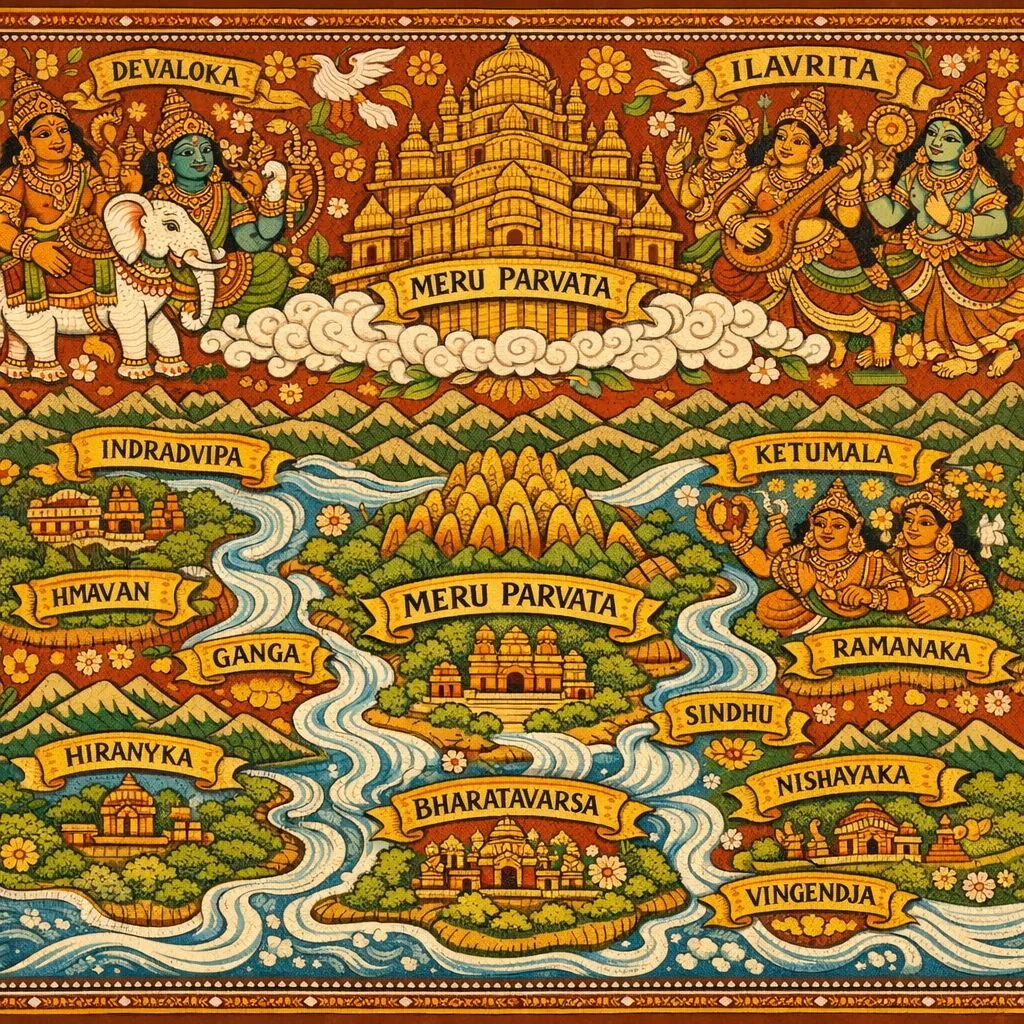
Adhyaya 114: Division of Bhārata-varṣa, its peoples, mountains, rivers, and adjacent varṣas (Kimpuruṣa, Harivarṣa, Ilāvṛta)
भारतवर्षविभाग-वर्णनम्
Speaker: Ṛṣayaḥ (the sages), Sūta (Lomaharṣaṇa’s son; Uttaraśravaṇa), Matsya (framing voice)
The sages ask for a fresh account of Bhārata-varṣa in relation to the fourteen Manus and the creation of progeny. After reflection, the Sūta defines Bhārata as the central realm where the rule of karma (karma-vidhi) is acknowledged and where both heavenly attainment and liberation (mokṣa) are possible. He sets out its nine divisions, boundaries and peoples, explains varṇa duties and āśrama discipline, and links territorial wholeness with the royal title Samrāṭ. He then names Bhārata’s kulaparvata mountain ranges and gives a long catalogue of rivers and tributaries, followed by extensive janapada lists by direction—Madhyadeśa, Udīcya, Prācya, Dakṣiṇāpatha, Aparānta, and the Vindhya hinterlands. As the chapter turns, the sages inquire about Kimpuruṣa-varṣa, Harivarṣa, and Jambūkhaṇḍa; the Sūta describes their traits, lifespans, varṣa-trees and juices, Ilāvṛta’s special conditions, the Sudarśana Jambū tree, Jāmbūnada gold, and the divine beings around Meru, and he signals a later exposition of the yuga cycle.
Key Concepts
Shlokas in Adhyaya 114
Verse 1
*ऋषय ऊचुः यदिदं भारतं वर्षं यस्मिन् स्वायम्भुवादयः चतुर्दशैव मनवः प्रजासर्गं ससर्जिरे //
The sages said: “This land called Bhārata-varṣa—within it, beginning with Svāyambhuva, the fourteen Manus indeed brought forth the creation of progeny, the generations of beings.”
Verse 2
एतद् वेदितुम् इच्छामः सकाशात्तव सुव्रत उत्तरश्रवणं भूयः प्रब्रूहि वदतां वर //
We wish to know this from you, O you of excellent vows. Therefore, explain once again the later account, O best among speakers.
Verse 3
एतच्छ्रुत्वा ऋषीणां तु प्राब्रवील्लौमहर्षणिः पौराणिकस्तदा सूत ऋषीणां भावितात्मनाम् //
Having heard this, Lomaharṣaṇa’s son—the Sūta, the learned narrator of Purāṇic lore—then spoke to those sages whose minds were refined and contemplative.
Verse 4
बुद्ध्या विचार्य बहुधा विमृश्य च पुनः पुनः तेभ्यस्तु कथयामास उत्तरश्रवणं तदा //
Having pondered with his intellect in many ways, and reflecting again and again, Uttaraśravaṇa then proceeded to explain the later account to them.
Verse 5
*सूत उवाच अथाहं वर्णयिष्यामि वर्षे ऽस्मिन्भारते प्रजाः भरणात्प्रजनाच्चैव मनुर्भरत उच्यते //
Sūta said: Now I shall describe the peoples in this land called Bhārata. Because he sustained them and also caused progeny to flourish, the Manu is called “Bharata”.
Verse 6
निरुक्तवचनैश्चैव वर्षं तद्भारतं स्मृतम् यतः स्वर्गश्च मोक्षश्च मध्यमश्चापि हि स्मृतः //
By such authoritative statements and definitions, that region is remembered as Bhārata-varṣa—because it is taught to be the “middle” realm, from which both heavenly attainment and liberation (mokṣa) are possible.
Verse 7
न खल्वन्यत्र मर्त्यानां भूमौ कर्मविधिः स्मृतः भारतस्यास्य वर्षस्य नव भेदान्निबोधत //
Indeed, nowhere else on earth is the ordained rule of action (karma and its rites) for mortals recognized as it is here. Therefore, understand the nine divisions of this Bhārata-varṣa.
Verse 8
इन्द्रद्वीपः कशेरुश्च ताम्रपर्णो गभस्तिमान् नागद्वीपस्तथा सौम्यो गन्धर्वस्त्वथ वारुणः //
“(These are the divisions:) Indradvīpa and Kaśeru; Tāmraparṇa and Gabhastimān; likewise Nāgadvīpa and Saumya; then Gandharva and also Vāruṇa.”
Verse 9
अयं तु नवमस्तेषां द्वीपः सागरसंवृतः योजनानां सहस्रं तु द्वीपो ऽयं दक्षिणोत्तरः //
This, indeed, is the ninth of those dvīpas, encircled by the ocean. This island extends a thousand yojanas in breadth, stretching from south to north.
Verse 10
आयतस्तु कुमारीतो गङ्गायाः प्रवहावधिः तिर्यगूर्ध्वं तु विस्तीर्णः सहस्राणि दशैव तु //
From the region of Kumārī onward extends the limit of the Gaṅgā’s flowing course; and its spread—horizontally and upward—is said to be exactly ten thousand yojanas.
Verse 11
द्वीपो ह्युपनिविष्टो ऽयं म्लेच्छैरन्तेषु सर्वशः यवनाश्च किराताश्च तस्यान्ते पूर्वपश्चिमे //
This island-continent is indeed settled on all sides at its borders by mlecchas (foreign peoples); and the Yavanas and the Kirātas dwell at its eastern and western extremities.
Verse 12
ब्राह्मणाः क्षत्रिया वैश्या मध्ये शूद्राश्च भागशः इज्यायुतवणिज्यादि वर्तयन्तो व्यवस्थिताः //
Brahmins, Kshatriyas, and Vaishyas—and, in due proportion among them, Shudras as well—were duly established in the central region, each carrying on their respective functions such as yajña (ritual service), allied occupations, trade, and related livelihoods.
Verse 13
तेषां स व्यवहारो ऽयं वर्तनं तु परस्परम् धर्मार्थकामसंयुक्तो वर्णानां तु स्वकर्मसु //
This is their proper social conduct—the manner in which they should deal with one another—while each varṇa remains established in its own duties, and while their pursuits are harmonized with dharma, artha, and kāma.
Verse 14
संकल्पपञ्चमानां तु आश्रमाणां यथाविधि इह स्वर्गापवर्गार्थं प्रवृत्तिरिह मानुषे //
But as for the āśramas—reckoned as five by intention and inner resolve—when they are followed here according to proper rule, human endeavor in this very world proceeds for the sake of heaven and for apavarga (liberation).
Verse 15
यस्त्वयं मानवो द्वीपस् तिर्यग्यामः प्रकीर्तितः य एनं जयते कृत्स्नं स सम्राडिति कीर्तितः //
This very ‘Mānava’ continent, famed for its breadth (east–west), is thus proclaimed; whoever conquers it in its entirety is celebrated as a ‘Samrāṭ’ (universal sovereign).
Verse 16
अयं लोकस्तु वै सम्राड् अन्तरिक्षजितां स्मृतः स्वराडसौ स्मृतो लोकः पुनर्वक्ष्यामि विस्तरात् //
O sovereign king, this realm is remembered as ‘Samrāṭ’ among those who have conquered the mid-space (antarikṣa). That world is also known as ‘Svarāṭ’. I shall explain it again in detail.
Verse 17
सप्त चास्मिन्महावर्षे विश्रुताः कुलपर्वताः महेन्द्रो मलयः सह्यः शुक्तिमानृक्षवानपि //
In this great region (Bhārata-varṣa) there are seven renowned ‘kulaparvatas’ (chief mountain ranges): Mahendra, Malaya, Sahya, Śuktimān, and also Ṛkṣavān.
Verse 18
विन्ध्यश्च पारियात्रश्च इत्येते कुलपर्वताः तेषां सहस्रशश्चान्ये पर्वतास्तु समीपतः //
Vindhya and Pāriyātra—these are (counted among) the principal ‘kulaparvatas’ (family-mountains). Near them, moreover, lie thousands of other mountains.
Verse 19
अभिज्ञातास्ततश्चान्ये विपुलाश्चित्रसानवः अन्ये तेभ्यः परिज्ञाता ह्रस्वा ह्रस्वोपजीविनः //
And then there were other peoples as well—well-known and numerous, dwelling on varied ridges and uplands. Others, known from among them, were of short stature, living by modest (small) means.
Verse 20
तैर्विमिश्रा जानपदा आर्या म्लेच्छाश्च सर्वतः पिबन्ति बहुला नद्यो गङ्गा सिन्धुः सरस्वती //
With them, the provinces are intermingled on every side—both Āryas and Mlecchas everywhere. Many rivers flow there, and people drink their waters: the Gaṅgā, the Sindhu, and the Sarasvatī.
Verse 21
शतद्रुश्चन्द्रभागा च यमुना सरयूस्तथा ऐरावती वितस्ता च विशाला देविका कुहूः //
The rivers Śatadru and Candrabhāgā, and likewise Yamunā and Sarayū; also Airāvatī and Vitastā, along with Viśālā, Devikā, and Kuhū—these are to be remembered as sacred rivers.
Verse 22
गोमती धौतपापा च बाहुदा च दृषद्वती कौशिकी तु तृतीया च निश्चला गण्डकी तथा //
Gomatī, Dhautapāpā, Bāhudā, and Dṛṣadvatī; and as the third, Kauśikī; likewise Niścalā and also Gaṇḍakī—these are counted among the sacred rivers.
Verse 23
इक्षुर्लौहितम् इत्येता हिमवत्पार्श्वनिःसृताः वेदस्मृतिर् वेत्रवती वृत्रघ्नी सिन्धुरेव च पर्णाशा नर्मदा चैव कावेरी महती तथा //
‘Ikṣu’ and ‘Lauhita’—these rivers arise from the flanks of the Himalaya; so too are Veda-smṛti, Vetravatī, Vṛtraghnī, and the Sindhu; likewise Parṇāśā, the Narmadā, the Kāverī, and the great river Mahatī.
Verse 24
पारा च धन्वतीरूपा विदुषा वेणुमत्यपि शिप्रा ह्यवन्ती कुन्ती च पारियात्राश्रिताः स्मृताः //
Pārā, and Dhanvatī (known in the form called Dhanvatīrūpā), Viduṣā, and also Veṇumatī—together with Śiprā, Avantī, and Kuntī—are remembered as rivers belonging to (or taking refuge in) the Pāriyātra mountain region.
Verse 25
शोणो महानदश्चैव नन्दना सुकृशा क्षमा मन्दाकिनी दशार्णा च चित्रकूटा तथैव च तमसा पिप्पली श्येनी तथा चित्रोत्पलापि च //
The Śoṇa and the Mahānadā; Nandanā, Sukṛśā, and Kṣamā; Mandākinī and Daśārṇā; likewise Citrakūṭā; Tamasā, Pippalī, Śyenī, and also Citrotpalā—these too are counted among the sacred rivers.
Verse 26
विमला चञ्चला चैव तथा च धूतवाहिनी शुक्तिमन्ती शुनी लज्जा मुकुटा ह्रादिकापि च ऋष्यवन्तप्रसूतास् ता नद्यो ऽमलजलाः शुभाः //
Vimalā, Cañcalā, and likewise Dhūtavāhinī; Śuktimantī, Śunī, Lajjā, Mukuṭā, and also Hrādikā—these rivers, born from Ṛṣyavanta, are auspicious, their waters pure and undefiled.
Verse 27
तापी पयोष्णी निर्विन्ध्या क्षिप्रा च ऋषभा नदी वेणा वैतरणी चैव विश्वमाला कुमुद्वती //
Tāpī, Payoṣṇī, Nirvindhyā, and also Kṣiprā; the river Ṛṣabhā; Veṇā; and likewise Vaitaraṇī; (as well as) Viśvamālā and Kumudvatī—these are the revered rivers.
Verse 28
तोया चैव महागौरी दुर्गमा तु शिला तथा विन्ध्यपादप्रसूतास् ताः सर्वाः शीतजलाः शुभाः //
Likewise, Toyā, Mahāgaurī, Durgamā, and also Śilā—these streams that arise from the foothills of the Vindhya—are all auspicious, having cool waters.
Verse 29
गोदावरी भीमरथी कृष्णवेणी च वञ्जुला तुङ्गभद्रा सुप्रयोगा वाह्या कावेरी चैव तु दक्षिणापथनद्यस्ताः सह्यपादाद्विनिःसृताः //
Godāvarī, Bhīmarathī, Kṛṣṇaveṇī, Vaṅjulā, Tuṅgabhadrā, Suprayogā, Vāhyā, and also Kāverī—these are the rivers of the Southern Path; they all arise from the foothills of the Sahya (Western Ghats).
Verse 30
कृतमाला ताम्रपर्णी पुष्पजा ह्युत्पलावती मलयप्रसूता नद्यस् ताः सर्वाः शीतजलाः शुभाः //
The rivers Kṛtamālā, Tāmraparṇī, Puṣpajā, and Utpalāvatī—arising from the Malaya mountain—are all auspicious, bearing cool and refreshing waters.
Verse 31
त्रिभागा ऋषिकुल्या च इक्षुदा त्रिदिवाचला ताम्रपर्णी तथा मूली शरवा विमला तथा महेन्द्रतनयाः सर्वाः प्रख्याताः शुभगामिनीः //
Tribhāgā, R̥ṣikulyā, Ikṣudā, Tridivācalā, Tāmraparṇī, Mūlī, Śaravā, and Vimalā—these are all renowned rivers said to be the daughters of Mahendra, auspicious in their course and beneficent to those who approach them.
Verse 32
काशिका सुकुमारी च मन्दगा मन्दवाहिनी कृपा च पाशिनी चैव शुक्तिमन्तात्मजास् तु ताः //
Kāśikā, Sukumārī, Mandagā, Mandavāhinī, Kṛpā, and Pāśinī—these indeed are the daughters of Śuktimant.
Verse 33
सर्वाः पुण्यजलाः पुण्याः सर्वगाश्च समुद्रगाः विश्वस्य मातरः सर्वाः सर्वपापहराः शुभाः //
All these rivers are holy waters and are themselves sacred; they range everywhere and flow into the ocean. All of them are the mothers of the world—auspicious, and destroyers of every sin.
Verse 34
तासां नद्युपनद्यश्च शतशो ऽथ सहस्रशः तास्विमे कुरुपाञ्चालाः शाल्वाश्चैव सजाङ्गलाः //
Of those great rivers there are hundreds, even thousands, of rivers and tributaries; along them dwell these peoples—the Kurus and the Pañcālas, the Śālvas, and also the Jāṅgalas (folk of the forest or dry regions).
Verse 35
शूरसेना भद्रकारा बाह्याः सहपटच्चराः मत्स्याः किराताः कुल्याश्च कुन्तलाः काशिकोशलाः //
The Śūrasenas, the Bhadrakāras, the Bāhyas, the Sahapaṭaccaras; the Matsyas, the Kirātas, the Kulyas, the Kuntalas, and the Kāśi–Kośalas—these peoples and regions are thus enumerated.
Verse 36
आवन्ताश्च कलिङ्गाश्च मूकाश्चैवान्धकैः सह मध्यदेशा जनपदाः प्रायशः परिकीर्तिताः //
The Avantas, the Kaliṅgas, the Mūkas, together with the Andhakas—these are, for the most part, the janapadas (territorial peoples) proclaimed as belonging to Madhyadeśa, the “Middle Country”.
Verse 37
सह्यस्यानन्तरे चैते तत्र गोदावरी नदी पृथिव्यामपि कृत्स्नायां स प्रदेशो मनोरमः //
Beyond the Sahya mountains lies this region; there the river Godāvarī flows. Even upon the whole earth, that tract of land is truly delightful.
Verse 38
यत्र गोवर्धनो नाम मन्दरो गन्धमादनः रामप्रियार्थं स्वर्गीया वृक्षा दिव्यास्तथौषधीः //
There lie the mountains named Govardhana, Mandara, and Gandhamādana; and for the delight of Rāma there are heavenly trees and divine medicinal herbs as well.
Verse 39
भरद्वाजेन मुनिना प्रियार्थमवतारिताः ततः पुष्पवरो देशस् तेन जज्ञे मनोरमः //
Brought down by the sage Bharadvāja for a beloved purpose, that delightful region thereafter came to be known as Puṣpavara—“the land of excellent flowers”—charming to behold.
Verse 40
वाह्लीका वाटधानाश्च आभीराः कालतोयकाः पुरंध्राश्चैव शूद्राश्च पल्लवाश् चात्तखण्डिकाः //
The Vāhlīkas, the Vāṭadhānas, the Ābhīras, the Kālatoyakas, the Puraṃdhras, the Śūdras, the Pallavas, and the Āttakhaṇḍikas are likewise enumerated among the peoples and regions.
Verse 41
गान्धारा यवनाश्चैव सिन्धुसौवीरमद्रकाः शका द्रुह्याः पुलिन्दाश्च पारदाहारमूर्तिकाः //
Also (there are) the Gāndhāras and the Yavanas; the Sindhus, the Sauvīras, and the Madrakas; the Śakas, the Druhyas, and the Pulindas; and likewise the Pāradas, the Hāras, and the Mūrtikas.
Verse 42
रामठाः कण्टकाराश्च कैकेया दशनामकाः क्षत्रियोपनिवेश्याश्च वैश्याः शूद्रकुलानि च //
The Rāmaṭhas and the Kaṇṭakāras; the Kaikeyas and those known as the Daśanāmaka; likewise the settlements of Kṣatriyas, as well as the Vaiśyas and the clans of Śūdras.
Verse 43
अत्रयो ऽथ भरद्वाजाः प्रस्थलाः सदसेरकाः लम्पकास् तलगानाश्च सैनिकाः सह जाङ्गलैः एते देशा उदीच्यास्तु प्राच्यान्देशान्निबोधत //
Now, the Atrayas, the Bharadvājas, the Prasthalas, the Sadaserakas, the Lampākas, the Talagānas, and the Sainikas—together with the Jāṅgalas—these are the northern (udīcya) regions. Next, understand the eastern (prācya) countries.
Verse 44
अङ्गा वङ्गा मद्गुरका अन्तर्गिरिबहिर्गिरी ततः प्लवंगमातंगा यमका मल्लवर्णकाः सुह्मोत्तराः प्रविजया मार्गवा गेयमालवाः //
The Angas, the Vangas, and the Madgurakas; those dwelling within the mountains and those outside the mountains; then the Plavaṅgas and Mātaṅgas; the Yamakas; the Mallavarṇakas; the Suhmas and the Uttaras; the Pravijayas; the Mārgavas; and the Geya-Mālavās.
Verse 45
प्राग्ज्योतिषाश्च पुण्ड्राश्च विदेहास्ताम्रलिप्तकाः शाल्वमागधगोनर्दाः प्राच्या जनपदाः स्मृताः //
Prāgjyotiṣa, Puṇḍra, Videha, and the people of Tāmraliptaka—together with the Śālvas, the Māgadhas, and the Gonardas—are remembered as the eastern (Prācya) provinces.
Verse 46
तेषां परे जनपदा दक्षिणापथवासिनः पाण्ड्याश्च केरलाश्चैव चोलाः कुल्यास्तथैव च //
Beyond them are the provinces of the Dakṣiṇāpatha (the southern route/Deccan): the Pāṇḍyas, the Keralas, the Colas, and likewise the Kulyas.
Verse 47
सेतुकाः सूतिकाश्चैव कुपथां वाजिवासिकाः नवराष्ट्रा माहिषिकाः कलिङ्गाश्चैव सर्वशः //
Also mentioned are the Setukas and the Sūtikās; the people of Kupatha and the Vājivāsikas; the Navarāṣṭras, the Māhiṣikas, and likewise the Kaliṅgas—everywhere, in all quarters.
Verse 48
कारूषाश्च सहैषीका आटव्याः शबरास्तथा पुलिन्दा विन्ध्यपुषिका वैदर्भा दण्डकैः सह //
The Kārūṣas, together with the Haiṣīkas; the forest-dwellers; the Śabaras; likewise the Pulindas; the Vindhya-Puṣikas; and the people of Vidarbha, along with the Daṇḍakas—are all enumerated here.
Verse 49
कुलीयाश्च सिरालाश्च रूपसास् तापसैः सह तथा तैत्तिरिकाश्चैव सर्वे कारस्करास्तथा //
Also mentioned are the Kulīyas, the Sirālas, and the Rūpasas, together with the ascetics (Tāpasas); likewise all the Taittirikas, and also the Kāraskaras.
Verse 50
वासिक्याश्चैव ये चान्ये ये चैवान्तरनर्मदाः भारुकच्छाः समाहेयाः सह सारस्वतैस्तथा //
Likewise, the Vāsikyas and other groups, and those dwelling in the inner region of the Narmadā; the Bhārukacchas and the Samāheyas as well—together with the Sārasvatas—are also to be counted among these peoples and regions.
Verse 51
काच्छीकाश्चैव सौराष्ट्रा आनर्ता अर्बुदैः सह इत्येते अपरान्तास्तु शृणु ये विन्ध्यवासिनः //
The Kacchikas, the people of Saurāṣṭra, and the Ānartas together with those of Arbuda—these are said to belong to Aparānta, the western borderlands. Now hear of those who dwell in the Vindhya ranges.
Verse 52
मालवाश्च करूषाश्च मेकलाश्चोत्कलैः सह औण्ड्रा माषा दशार्णाश्च भोजाः किष्किन्धकैः सह //
Also (are found) the Mālavas and the Karūṣas; the Mekalas together with the Utkalas; the Auṇḍras, the Māṣas, the Daśārṇas, and the Bhojas, along with the people of Kiṣkindhā.
Verse 53
स्तोशलाः कोसलाश्चैव त्रैपुरा वैदिशास्तथा तुमुरास् तुम्बराश्चैव पद्गमा नैषधैः सह //
Also (are mentioned) the Stośalās and the Kosalas; likewise the Traipuras and the Vaidiśas; the Tumurās and the Tumbarās as well, and the Padgamās—together with the Naiṣadhas.
Verse 54
अरूपाः शौण्डिकेराश्च वीतिहोत्रा अवन्तयः एते जनपदाः ख्याता विन्ध्यपृष्ठनिवासिनः //
The Arūpas, the Śauṇḍikeras, the Vītihotras, and the Avantayas—these are well-known janapadas (territorial peoples) who dwell along the Vindhya range and its hinterlands.
Verse 55
अतो देशान्प्रवक्ष्यामि पर्वताश्रयिणश्च ये निराहाराः सर्वगाश्च कुपथा अपथास्तथा //
Now I shall describe the kinds of regions: those lying under the shelter of mountains, those barren and without sustenance, those where waters flow everywhere, and those with bad roads or with no proper paths at all.
Verse 56
कुथप्रावरणाश्चैव ऊर्णादवाः समुद्गकाः त्रिगर्ता मण्डलाश्चैव किराताश्चामरैः सह //
And also the Kuthaprāvaraṇas, the Ūrṇādavas, the Samudgakas, the Trigartas, the Maṇḍalas, and the Kirātas together with the Āmaras are to be understood as among the peoples of the regions being enumerated.
Verse 57
चत्वारि भारते वर्षे युगानि मुनयो ऽब्रुवन् कृतं त्रेता द्वापरं च कलिश्चेति चतुर्युगम् तेषां निसर्गं वक्ष्यामि उपरिष्टाच्च कृत्स्नशः //
The sages declare that, in Bhārata-varṣa, there are four ages—Kṛta, Tretā, Dvāpara, and Kali—together forming the cycle of four yugas (caturyuga). I shall explain their succession and full arrangement in due order hereafter.
Verse 58
*मत्स्य उवाच एतच्छ्रुत्वा तु ऋषय उत्तरं पुनरेव ते शुश्रूषवस्तमूचुस्ते प्रकामं लौमहर्षणिम् //
Matsya said: Having heard this, those sages—eager to listen further—again asked for the next reply, addressing Lomaharṣaṇa at length as they wished.
Verse 59
*ऋषय ऊचुः यच्च किम्पुरुषं वर्षं हरिवर्षं तथैव च आचक्ष्व नो यथातत्त्वं कीर्तितं भारतं त्वया //
The sages said: “Explain to us, in accordance with the real truth, the region called Kimpuruṣa-varṣa and likewise Harivarṣa, since you have already described Bhārata-varṣa.”
Verse 60
जम्बूखण्डस्य विस्तारं तथान्येषां विदांवर द्वीपानां वासिनां तेषां वृक्षाणां प्रब्रवीहि नः //
O best among the wise, tell us the extent of Jambū-khaṇḍa, and likewise of the other islands—their inhabitants and the trees that belong to them.
Verse 61
पृष्टस्त्वेवं तदा विप्रैर् यथाप्रश्नं विशेषतः उवाच ऋषिभिर्दृष्टं पुराणाभिमतं तथा //
Thus, when questioned in this way by the Brahmin sages, he replied—addressing each query in its particularity—expounding what had been perceived by the seers and what is approved in the Purāṇic tradition.
Verse 62
*सूत उवाच शुश्रूषवस्तु यद्विप्राः शुश्रूषध्वमतन्द्रिताः जम्बूवर्षः किम्पुरुषः सुमहानन्दनोपमः //
Sūta said: “Since you, O brāhmaṇas, are eager to listen, therefore listen attentively and without negligence. As for Jambū-varṣa and the region of Kimpuruṣa—it is exceedingly delightful, comparable to a great grove of bliss.”
Verse 63
दश वर्षसहस्राणि स्थितिः किम्पुरुषे स्मृता जायन्ते मानवास्तत्र सुतप्तकनकप्रभाः //
In Kimpuruṣa, the span of life is remembered to be ten thousand years; and the humans born there shine with the luster of well-heated, refined gold.
Verse 64
वर्षे किम्पुरुषे पुण्ये प्लक्षो मधुवहः स्मृतः तस्य किम्पुरुषाः सर्वे पिबन्तो रसमुत्तमम् //
In the holy land called Kimpuruṣa-varṣa, the plakṣa tree is remembered as “the honey-bearing” one; and all the Kimpuruṣas there drink its supreme, excellent sap.
Verse 65
अनामया ह्यशोकाश्च नित्यं मुदितमानसाः सुवर्णवर्णाश्च नराः स्त्रियश्चाप्सरसः स्मृताः //
They are free from disease and sorrow, their minds ever joyful; the men and women there are golden-hued, and the women are remembered as Apsarases (celestial nymphs).
Verse 66
ततः परं किम्पुरुषाद् धरिवर्षं प्रचक्षते महारजतसंकाशा जायन्ते यत्र मानवाः //
Beyond Kimpuruṣa, they declare, lies Harivarṣa—where human beings are born with a complexion resembling bright silver.
Verse 67
देवलोकच्युताः सर्वे बहुरूपाश्च सर्वशः हरिवर्षे नराः सर्वे पिबन्तीक्षुरसं शुभम् //
All the inhabitants there are said to have descended from the celestial realms; they are of many forms in every way. In Harivarṣa, all people drink the auspicious juice of sugarcane.
Verse 68
न जरा बाधते तत्र तेन जीवन्ति ते चिरम् एकादश सहस्राणि तेषामायुः प्रकीर्तितम् //
There, old age does not afflict them; therefore they live for a long time. Their lifespan is declared to be eleven thousand years.
Verse 69
मध्यमं तन्मया प्रोक्तं नाम्ना वर्षमिलावृतम् न तत्र सूर्यस्तपति न च जानन्ति मानवाः //
That central region I have described is the land called Ilāvṛta-varṣa. There the Sun does not scorch, and human beings are not found (do not dwell there).
Verse 70
चन्द्रसूर्यौ सनक्षत्राव् अप्रकाशाविलावृते पद्मप्रभाः पद्मवर्णाः पद्मपत्त्रनिभेक्षणाः //
In that all-enveloping obscuration, even the Moon and the Sun—together with the constellations—were without light. Yet beings appeared with lotus-like radiance and lotus-like complexion, their eyes resembling lotus-petals.
Verse 71
पद्मगन्धाश्च जायन्ते तत्र सर्वे च मानवाः जम्बूफलरसाहारा अनिष्पन्दाः सुगन्धिनः //
There, all human beings are born with the fragrance of lotus-flowers. They live on the juice of jambu-fruit; they are steady and unshaken, and they are naturally sweet-smelling.
Verse 72
देवलोकच्युताः सर्वे महारजतवाससः त्रयोदश सहस्राणि वर्षाणां ते नरोत्तमाः //
All of them—fallen from the world of the gods—clad in splendid, silvery-white garments, those best of men endure that state for thirteen thousand years.
Verse 73
आयुष्प्रमाणं जीवन्ति ये तु वर्ष इलावृते मेरोस्तु दक्षिणे पार्श्वे निषधस्योत्तरेण वा //
Those beings who dwell in the region of Ilāvṛta—on the southern flank of Mount Meru, or to the north of the Niṣadha range—live out their full, allotted span of life.
Verse 74
सुदर्शनो नाम महाञ् जम्बूवृक्षः सनातनः नित्यपुष्पफलोपेतः सिद्धचारणसेवितः //
There is an ancient, mighty jambu tree named Sudarśana—everlasting, ever adorned with flowers and fruits, and attended by Siddhas and Cāraṇas.
Verse 75
तस्य नाम्ना समाख्यातो जम्बूद्वीपो वनस्पतेः योजनानां सहस्रं च शतधा च महान्पुनः //
This continent is called Jambūdvīpa after that Jambū tree; moreover, it is vast, extending to one hundred thousand yojanas.
Verse 76
उत्सेधो वृक्षराजस्य दिवम् आवृत्य तिष्ठति तस्य जम्बूफलरसो नदी भूत्वा प्रसर्पति //
The towering height of the king of trees rises and stands, as though covering the sky; and the juice of its jambū fruits pours forth, becoming a river and spreading out.
Verse 77
मेरुं प्रदक्षिणं कृत्वा जम्बूमूलगता पुनः तं पिबन्ति सदा हृष्टा जम्बूरसमिलावृते //
Having circumambulated Mount Meru to the right, it again reaches the root of the Jambū tree; there, in the region suffused with Jambū’s essence, they joyfully drink it continually.
Verse 78
जम्बूफलरसं पीत्वा न जरा बाधते ऽपि तान् न क्षुधा न क्लमो वापि न दुःखं च तथाविधम् //
Having drunk the juice of the jambū fruit, even old age does not afflict them; nor do hunger, fatigue, or any such suffering trouble them.
Verse 79
तत्र जाम्बूनदं नाम कनकं देवभूषणम् इन्द्रगोपकसंकाशं जायते भासुरं च यत् //
There arises the gold called Jāmbūnada, fit for the ornaments of the gods—radiant and gleaming, with a hue like the indragopa insect.
Verse 80
सर्वेषां वर्षवृक्षाणां शुभः फलरसस्तु सः स्कन्नं तु काञ्चनं शुभ्रं जायते देवभूषणम् //
From all the trees of the varṣas, that auspicious sap of the fruits flows forth; and when it trickles down, bright gold is produced—fit to be an ornament of the gods.
Verse 81
तेषां मूत्रं पुरीषं वा दिक्ष्वष्टासु च सर्वशः ईश्वरानुग्रहाद्भूमिर् मृतांश्च ग्रसते तु तान् //
Whether their urine or their excrement is cast in any manner in all the eight directions, by the Lord’s grace the Earth swallows it up—and she also consumes those who are dead.
Verse 82
रक्षःपिशाचा यक्षाश्च सर्वे हैमवतास्तु ते हेमकूटे तु विज्ञेया गन्धर्वाः साप्सरोगणाः //
All the Rākṣasas, Piśācas, and Yakṣas are said to dwell in the Himavat region; but on Hemakūṭa are to be understood the Gandharvas, together with hosts of Apsarases.
Verse 83
सर्वे नागा निषेवन्ते शेषवासुकितक्षकाः महामेरौ त्रयस्त्रिंशत् क्रीडन्ते यज्ञियाः शुभाः //
All the Nāgas—Śeṣa, Vāsuki, and Takṣaka—dwell in attendance there; and upon great Meru the thirty-three auspicious, sacrifice-honoured gods sport and rejoice.
Verse 84
नीलवैडूर्ययुक्ते ऽस्मिन् सिद्धा ब्रह्मर्षयो ऽवसन् दैत्यानां दानवानां च श्वेतः पर्वत उच्यते //
In this region, adorned with blue vaidūrya gems, Siddhas and Brahmarṣis dwell; and it is said to be the White Mountain associated with the Daityas and Dānavas.
Verse 85
शृङ्गवान् पर्वतश्रेष्ठः पितॄणां प्रतिसंचरः इत्येतानि मयोक्तानि नववर्षाणि भारते //
Śṛṅgavān—the foremost of mountains—is the route of return and passage for the Pitṛs (ancestral beings). Thus have I declared the nine varṣas (regions) within Bhārata.
Verse 86
भूतैरपि निविष्टानि गतिमन्ति ध्रुवाणि च तेषां वृद्धिर्बहुविधा दृश्यते देवमानुषैः अशक्या परिसंख्यातुं श्रद्धेया च बुभूषता //
Even those forms that are entered into by the elements are in motion and yet fixed in their order. Their growth and expansion are seen in many ways by gods and humans; it cannot be fully reckoned by counting, and one who seeks true understanding should accept it with reverent trust.
Frequently Asked Questions
Adhyāya 114 frames Bhārata-varṣa as the karmabhūmi—the central human realm where the rule of karma (rites, duties, and moral action) is properly established, making both svarga (heavenly attainment) and mokṣa (liberation) possible. It teaches that social order (varṇa duties and āśrama discipline) and sacred geography (mountains, rivers, regions) together form the civilizational structure through which dharma, artha, and kāma are harmonized and spiritual goals become attainable.
This chapter is primarily Dharma and cosmographic geography: it defines Bhārata by karma-vidhi, outlines varṇa–āśrama conduct, and lists kulaparvatas, rivers, and janapadas. Genealogical framing appears in the opening reference to the fourteen Manus and progeny-creation, while Rajadharma appears in the Samrāṭ ideal. Explicit Vāstu-śāstra (temple/architecture measurements) is not taught in this adhyāya; instead, it provides the ‘landscape framework’ in which such dharma and polity operate.