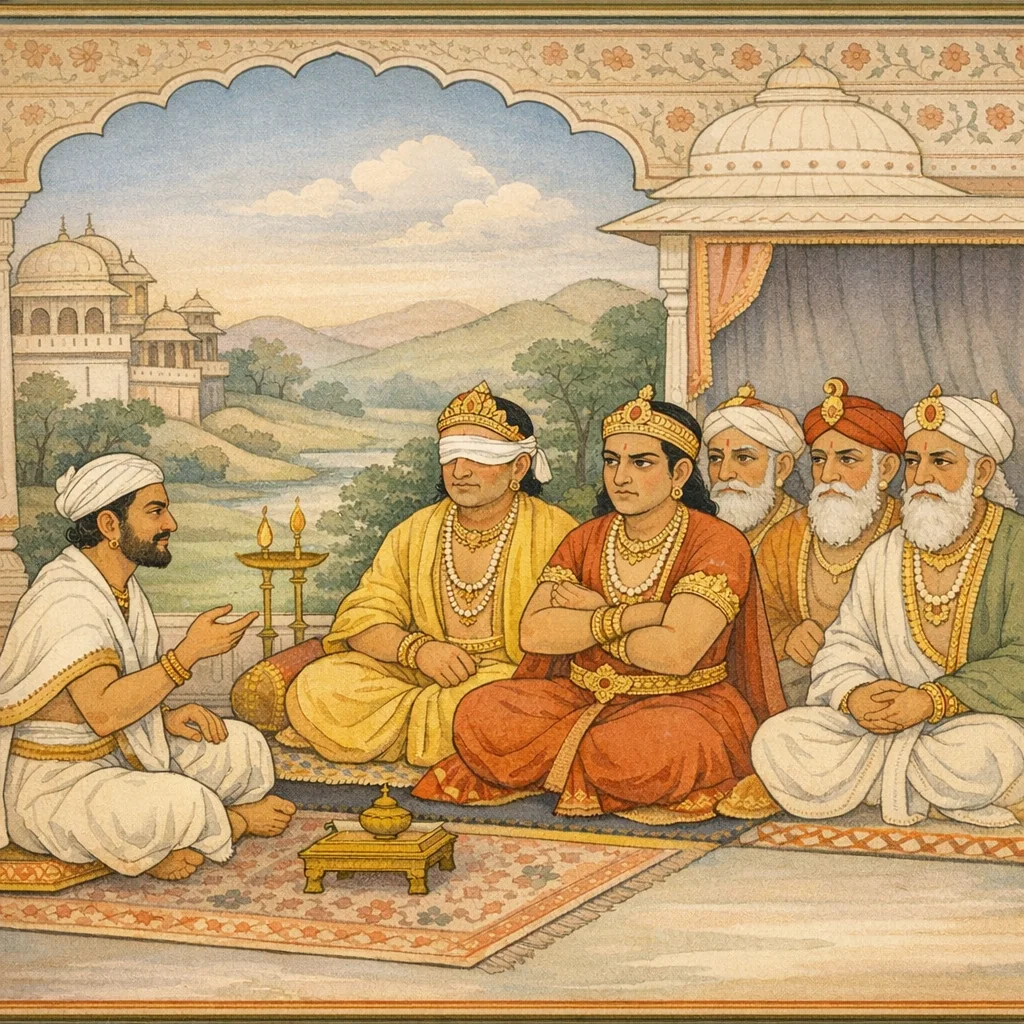
Adhyaya 47
Udyoga-parva Adhyāya 47 — Arjuna’s Deterrent Declaration (Sañjaya’s Report)
Upa-parva: Sañjaya–Dhṛtarāṣṭra Saṃvāda (Court Report of Arjuna’s Message)
Dhṛtarāṣṭra questions Sañjaya about what Arjuna (Dhanañjaya) declared in the royal assembly context. Sañjaya relays Arjuna’s message intended for Duryodhana and the Kuru leadership: if the Dhārtarāṣṭras do not relinquish the kingdom due to Yudhiṣṭhira, conflict will follow as the fruition of prior harmful actions. The report enumerates Pandava-aligned combat capacities—Bhīma, the twins Nakula and Sahadeva, the Draupadeyas, Abhimanyu, Sātyaki, Dhṛṣṭadyumna, Śikhaṇḍin, Virāṭa, Drupada, and others—presented as a structured deterrent catalogue. Arjuna’s rhetoric repeatedly forecasts that Dhārtarāṣṭra’s party will ‘regret’ war upon witnessing the operational realities of battle: arrow-storms, disarrayed forces, and the collapse of morale. The chapter then pivots to Kṛṣṇa’s exceptional stature: Sañjaya articulates the impracticality of opposing Vāsudeva, supporting this with exempla of Kṛṣṇa’s prior exploits and divine favor motifs. The discourse concludes with an appeal to heed the counsel of elders (Bhīṣma, Droṇa, Kṛpa, Vidura), framing wise listening as the last stabilizing option for the Kuru polity.
Chapter Arc: कौरव-सभा में संजय धृतराष्ट्र के प्रश्न पर अर्जुन का संदेश सुनाने उठता है—यह संदेश युद्ध के द्वार पर खड़े कुरुओं के लिए अंतिम चेतावनी-घोषणा बनकर आता है। → संजय अर्जुन के वचनों को युधिष्ठिर की अनुमति और केशव की उपस्थिति का साक्ष्य देकर और भी प्रामाणिक बनाता है। अर्जुन अपने बाहुबल का ज्ञान, पाण्डवों की विजय-क्षमता, और कौरवों के विनाश की निश्चितता का चित्र खींचता है—विशेषतः भीष्म के विरुद्ध शिखण्डी के रथारोहण का संकेत देकर। → अर्जुन का भविष्यवाणी-तुल्य प्रहार: दुर्योधन क्रोध, दर्प और अल्पबुद्धि के वश में अंततः भाई-बन्धु, सेना और ऐश्वर्य सहित नष्ट होगा; और जो असंभव को संभव मानकर पर्वत तोड़ने चले, उसका हाथ ही छिल जाता है—यह उपमा दुर्योधन के हठ का निर्णायक खंडन बनती है। → संदेश का निष्कर्ष यह कि युधिष्ठिर शत्रु-निग्रह हेतु सिद्धार्थ हैं और कृष्ण दूरदर्शी हैं; फिर भी कुरुवृद्ध—भीष्म, कृप, द्रोण (पुत्र सहित), विदुर—जो कहें वही मानकर सबका कल्याण हो, ऐसी औपचारिक ‘शान्ति’ की आकांक्षा व्यक्त की जाती है। → सभा के भीतर यह प्रश्न हवा में लटकता रह जाता है—क्या धृतराष्ट्र और दुर्योधन वृद्धों की सम्मति मानकर शान्ति स्वीकारेंगे, या मोह-हठ से विनाश की ओर बढ़ेंगे?
Shlokas
Verse 1
[दाक्षिणात्य अधिक पाठका ह “लोक मिलाकर कुल १७ ३ “लोक हैं।] नि हु मी अष्टचत्वारिशो< ध्याय: संजयका कौरवसभामें अर्जुनका संदेश सुनाना धृतराष्ट्र रवाच पृच्छामि त्वां संजय राजमध्ये किमब्रवीद् वाक्यमदीनसत्त्व: धनंजयस्तात युधां प्रणेता दुरात्मनां जीवितच्छिन्महात्मा,धृतराष्ट्रने कहा--संजय! मैं इन राजाओंके बीच तुमसे यह पूछ रहा हूँ कि अनेक युद्धोंके संचालक तथा दुरात्माओंके जीवनका नाश करनेवाले उदारह्ृदय महात्मा अर्जुनने हमारे लिये कौन-सा संदेश भेजा है?
Dhṛtarāṣṭra said: “Sañjaya, here in the midst of these kings I ask you: what message did the undaunted Dhanañjaya (Arjuna)—a great-souled leader of battles, a cutter-off of the lives of the wicked—speak for us?”
Verse 2
संजय उवाच दुर्योधनो वाचमिमां शृणोतु यदब्रवीदर्जुनो योत्स्यमान: । युधिष्ठिरस्यानुमते महात्मा धनंजय: शृण्वत: केशवस्य,संजय बोला--राजन्! युधिष्ठिरकी आज्ञासे युद्धके लिये उद्यत हुए महात्मा अर्जुनने भगवान् श्रीकृष्णके सुनते-सुनते जो बात कही है, उसे दुर्योधन सुनें
Sañjaya said: “Let Duryodhana hear these words—what the great‑souled Dhanañjaya, Arjuna, ready for war with Yudhiṣṭhira’s consent, spoke while Keśava (Krishna) listened.”
Verse 3
अन्वत्रस्तो बाहुवीर्य विदान उपद्वरे वासुदेवस्य धीर: । अवोचन्मां योत्स्यमान: किरीटी मध्ये ब्रूया धार्तराष्ट्र कुरूणाम्,अपने बाहुबलको अच्छी तरह जाननेवाले धीर-वीर किरीटथधारी अर्जुनने भावी युद्धके लिये उद्यत हो भगवान् श्रीकृष्णके समीप मुझसे इस प्रकार कहा है--“संजय! जो कालके गालमें जानेवाला, मन्दबुद्धि एवं महामूर्ख सदा मेरे साथ युद्ध करनेके लिये डींग हाँकता रहता है, उस कटुभाषी दुरात्मा सूतपुत्र कर्णको सुनाकर तथा और भी जो-जो राजालोग पाण्डवोंके साथ युद्ध करनेके लिये बुलाये गये हैं, उन सबको सुनाते हुए तुम कौरवोंकी मण्डलीमें मेरे द्वारा कही हुई सारी बातें मन्त्रियोंसहित धृतराष्ट्रपुत्र राजा दुर्योधनसे इस प्रकार कहना, जिससे वह अच्छी तरह सुन ले'---
Sañjaya said: “Near the doorway of steadfast Vāsudeva (Krishna), the wise and resolute Arjuna, the diadem‑wearer—fully confident in the strength of his own arms and ready for the coming battle—spoke to me: ‘Sañjaya, in the midst of the Kurus, deliver my message to the sons of Dhṛtarāṣṭra.’”
Verse 4
संशृण्वतस्तस्य दुर्भाषिणो वै दुरात्मन: सूतपुत्रस्य सूत । यो योद्धुमाशंसति मां सदैव मन्दप्रज्ञ: कालपक्वो5तिमूढ:,अपने बाहुबलको अच्छी तरह जाननेवाले धीर-वीर किरीटथधारी अर्जुनने भावी युद्धके लिये उद्यत हो भगवान् श्रीकृष्णके समीप मुझसे इस प्रकार कहा है--“संजय! जो कालके गालमें जानेवाला, मन्दबुद्धि एवं महामूर्ख सदा मेरे साथ युद्ध करनेके लिये डींग हाँकता रहता है, उस कटुभाषी दुरात्मा सूतपुत्र कर्णको सुनाकर तथा और भी जो-जो राजालोग पाण्डवोंके साथ युद्ध करनेके लिये बुलाये गये हैं, उन सबको सुनाते हुए तुम कौरवोंकी मण्डलीमें मेरे द्वारा कही हुई सारी बातें मन्त्रियोंसहित धृतराष्ट्रपुत्र राजा दुर्योधनसे इस प्रकार कहना, जिससे वह अच्छी तरह सुन ले'---
Sañjaya said: “O charioteer, hear as I speak of that foul‑mouthed, wicked man—Karna, the charioteer’s son—who forever boasts that he will fight me, though his understanding is dull, his time is ripe for death, and he is utterly deluded. Convey my words in the Kaurava assembly to Duryodhana, son of Dhṛtarāṣṭra, so that he hears them clearly, along with the ministers and all those kings who have been summoned to wage war against the Pāṇḍavas.”
Verse 5
ये वै राजान: पाण्डवायोधनाय समानीता: शृण्वतां चापि तेषाम् । यथा समग्रं वचन मयोक्तं सहामात्यं श्रावयेथा नृपं तत्,अपने बाहुबलको अच्छी तरह जाननेवाले धीर-वीर किरीटथधारी अर्जुनने भावी युद्धके लिये उद्यत हो भगवान् श्रीकृष्णके समीप मुझसे इस प्रकार कहा है--“संजय! जो कालके गालमें जानेवाला, मन्दबुद्धि एवं महामूर्ख सदा मेरे साथ युद्ध करनेके लिये डींग हाँकता रहता है, उस कटुभाषी दुरात्मा सूतपुत्र कर्णको सुनाकर तथा और भी जो-जो राजालोग पाण्डवोंके साथ युद्ध करनेके लिये बुलाये गये हैं, उन सबको सुनाते हुए तुम कौरवोंकी मण्डलीमें मेरे द्वारा कही हुई सारी बातें मन्त्रियोंसहित धृतराष्ट्रपुत्र राजा दुर्योधनसे इस प्रकार कहना, जिससे वह अच्छी तरह सुन ले'---
Sañjaya said: “Let those kings who have been assembled for battle against the Pāṇḍavas also hear. In the very manner in which I have spoken the entire message, you should cause that king (Duryodhana) to hear it, together with his ministers.”
Verse 6
यथा नून॑ देवराजस्य देवा: शुश्रूषन्ते वज्हस्तस्य सर्वे । तथाशृण्वन् पाण्डवा: सृंजयाश्न किरीटिना वाचमुक्तां समर्थाम्,जैसे सब देवता वज्रधारी देवराज इन्द्रकी बातें सुनना चाहते हैं, निश्चय ही उसी प्रकार समस्त सूंजय और पाण्डव अर्जुनकी मुझसे कही हुई ओजभरी बातें सुन रहे थे
Sañjaya said: “Just as all the gods eagerly attend upon and listen to the words of Indra, the thunderbolt‑bearing king of the gods, so too were the Pāṇḍavas and the Sṛñjayas listening intently to the powerful, well‑grounded speech spoken by the diadem‑wearing Arjuna.”
Verse 7
इत्यब्रवीदर्जुनो योत्स्यमानो गाण्डीवधन्वा लोहितपदझनेत्र: । न चेद् राज्यं मुज्चति धार्तराष्ट्रो युधिष्ठिरस्थाजमीढस्य राज्ञ:
Sañjaya said: “Thus spoke Arjuna, ready to fight—bearing the Gāṇḍīva bow, his eyes like red lotuses: ‘Unless Dhṛtarāṣṭra’s son relinquishes the kingdom that belongs to King Yudhiṣṭhira, descendant of Ajamiḍha, there will be war.’”
Verse 8
येषां युद्ध भीमसेनार्जुनाभ्यां तथाश्रिभ्यां वासुदेवेन चैव,तभी तो उनका भीमसेन, अर्जुन, नकुल-सहदेव, भगवान् श्रीकृष्ण, अस्त्र-शस्त्रोंसे सुसज्जित सात्यकि, धृष्टद्युम्मन, शिखण्डी तथा इन्द्रके समान तेजस्वी उन महाराज युधिष्ठिरके साथ युद्ध होनेवाला है, जो अनिष्टचिन्तन करते ही पृथ्वी तथा स्वर्गलोकको भी भस्म कर सकते हैं
Sañjaya said: “Those who would face battle against Bhīmasena and Arjuna—and against the illustrious ones as well, with Vāsudeva (Kṛṣṇa) himself—are entering a conflict with warriors of overwhelming might. The very thought of hostility from such men can scorch the earth and even the heavens; thus the war being courted is not merely a contest of arms, but a reckless turning away from prudent counsel and dharma.”
Verse 9
शैनेयेन ध्रुवमात्तायुधेन धृष्टद्युम्नेनाथ शिखण्डिना च । युधिष्ठिरेणेन्द्रकल्पेन चैव योज्पध्यानान्निर्दहेद् गां दिवं च,तभी तो उनका भीमसेन, अर्जुन, नकुल-सहदेव, भगवान् श्रीकृष्ण, अस्त्र-शस्त्रोंसे सुसज्जित सात्यकि, धृष्टद्युम्मन, शिखण्डी तथा इन्द्रके समान तेजस्वी उन महाराज युधिष्ठिरके साथ युद्ध होनेवाला है, जो अनिष्टचिन्तन करते ही पृथ्वी तथा स्वर्गलोकको भी भस्म कर सकते हैं
Sañjaya said: “Along with Śaineya (Sātyaki), whose weapons are surely in hand, with Dhṛṣṭadyumna and with Śikhaṇḍin too—and with Yudhiṣṭhira himself, radiant like Indra—there will be battle. That king, by the very force of his hostile resolve, could burn up both the earth and even heaven.”
Verse 10
तैश्वेद् योद्ध मन्यते धार्तराष्ट्र निर्वत्तोडर्थ:.सकल:पाण्डवानाम् । मा तत् कार्षी: पाण्डवस्यार्थहेतो- रुपैहि युद्ध यदि मन्यसे त्वम्,यदि दुर्योधन चाहता है कि इन सब वीरोंके साथ कौरवोंका युद्ध हो तो ठीक है, इससे पाण्डवोंका सारा मनोरथ सिद्ध हो जायगा। तुम केवल पाण्डवोंके लाभके लिये संधि कराने या आधा राज्य दिलानेकी चेष्टा न करना। उस दशामें यदि ठीक समझो तो उससे कह देना --दुर्योधन! तुम युद्धभूमिमें ही उतरो
Sanjaya said: “If the son of Dhritarashtra truly thinks he should fight with all these warriors, then the entire purpose of the Pandavas will be fulfilled. Do not, for the sake of the Pandava’s advantage, strive to bring about a settlement or to secure even half the kingdom. If you judge that war is the proper course, then go and tell him: ‘Duryodhana, descend to the battlefield itself.’”
Verse 11
यां तां वने दुःखशबय्यामवात्सीत् प्रत्राजित: पाण्डवो धर्मचारी । आप्रोतु तां दुःखतरामनर्था- मन्त्यां श्य्यां धार्तराष्ट्र: परासु:,धर्मात्मा पाण्डुनन्दन युधिष्ठिरने वनमें निर्वासित होकर जिस दुःखशय्यापर शयन किया है, दुर्योधन अपने प्राणोंका त्याग करके उससे भी अधिक दुःख-दायिनी और अनर्थकारिणी मृत्युकी अन्तिम शय्याको ग्रहण करे
Sañjaya said: “May that Dhārtarāṣṭra (Duryodhana), casting off his life, attain the final bed of death—more painful and more ruinous—than the sorrowful couch on which the righteous Pāṇḍava, driven into exile, lay in the forest.”
Verse 12
हिया ज्ञानेन तपसा दमेन शौर्येणाथो धर्मगुप्त्या धनेन । अन्यायवृत्ति: कुरुपाण्डवेया- नध्यातिष्ठेद् धार्तराष्ट्रो दुरात्मा,अन्यायपूर्ण बर्ताव करनेवाले दुरात्मा दुर्योधनको उचित है कि वह लज्जा, ज्ञान, तपस्या, इन्द्रियसंयम, शौर्य, धर्मरक्षा आदि गुणों तथा धनके द्वारा कौरव-पाण्डवोंपर अधिकार प्राप्त करे (सदगुणोंद्वारा सबके हृदयको जीते, अन्यायसे शासन करना असम्भव है)
Sañjaya said: Let the wicked Dhārtarāṣṭra (Duryodhana), whose conduct is unrighteous, seek to win authority over the Kurus and the sons of Pāṇḍu not through injustice, but by modesty and moral shame, by true knowledge, by austerity, by self-restraint, by valor, by safeguarding dharma, and by rightful wealth. Rule cannot be secured by wrongdoing; it is gained by virtues that conquer hearts.
Verse 13
मायोपध: प्रणिपातार्जवाभ्यां तपोदमाभ्यां धर्मगुप्त्या बलेन । सत्यं ब्रुवन् प्रतिपन्नो नृपो न- स्तितिक्षमाण: क्लिश्यमानो5तिवेलम्,हमारे महाराज युधिष्ठछिर नम्नता, सरलता, तप, इन्द्रिय-संयम, धर्मरक्षा और बल--इन सभी गुणोंसे सम्पन्न हैं। वे बहुत दिनोंसे अनेक प्रकारके क्लेश उठाते हुए भी सदा सत्य ही बोलते हैं तथा कौरवोंके कपटपूर्ण व्यवहारों तथा वचनोंको सहन करते रहते हैं
Sañjaya said: “Our king (Yudhiṣṭhira), grounded in humility and straightforwardness, endowed with austerity and self-restraint, protected by dharma and strengthened by inner resolve, speaks only truth even while enduring excessive hardship. Though afflicted for a long time, he continues to bear the Kauravas’ deceitful conduct and words with forbearance.”
Verse 14
यदा ज्येष्ठ: पाण्डव: संशितात्मा क्रोधं यत्तं वर्षपूगान् सुघोरम् अवस्रष्टा कुरुष्द्वृत्तचेता- स्तदा युद्ध धार्तराष्ट्रोडन्वतप्स्यत्,परंतु अपने मनको शुद्ध एवं संयत रखनेवाले ज्येष्ठ पाण्डव युधिष्ठिर जिस समय उत्तेजित हो अनेक वर्षोंसे दबे हुए अपने अत्यन्त भयंकर क्रोधको कौरवोंपर छोड़ेंगे, उस समय जो भयानक युद्ध होगा, उसे देखकर दुर्योधनको पछताना पड़ेगा
Sañjaya said: When the eldest Pāṇḍava—Yudhiṣṭhira, whose mind is purified and disciplined—at last, stirred to action, releases upon the Kauravas that most dreadful wrath held back for many years, then the war that follows will be so terrible that Duryodhana, seeing its consequences, will be forced into bitter regret.
Verse 15
कृष्णवर्त्मेंव ज्वलित: समिद्धो यथा दहेत् कक्षमन्निर्निंदाघे । एवं दग्धा धार्तराष्ट्रस्य सेनां युधिष्ठिर: क्रोधदीप्तो<न्ववेक्ष्य,जैसे ग्रीष्म-ऋतुमें प्रजज्लित अग्नि सब ओरसे धधक उठती और घास-फूस एवं जंगलोंको जलाकर भस्म कर देती है, उसी प्रकार क्रोधसे तमतमाये हुए युधिष्ठिर दुर्योधनकी सेनाको अपने दृष्टिपातमात्रसे दग्ध कर देंगे
Sañjaya said: “As, in the heat of summer, a blazing fire—its path marked by dark smoke—when fully kindled, burns up dry grass and thickets, so too will Yudhiṣṭhira, inflamed with wrath, scorch the army of Dhṛtarāṣṭra merely by casting his gaze upon it.”
Verse 16
यदा द्रष्टा भीमसेनं रथस्थं गदाहस्तं क्रोधविषं वमन्तम् । अमर्षणं पाण्डवं भीमवेगं तदा युद्ध धार्तराष्ट्रोडन्वतप्स्यत्,जिस समय दुर्योधन हाथमें गदा लिये रथपर बैठे हुए भयानक वेगवाले अमर्षशील पाण्डुनन्दन भीमसेनको क्रोधरूप विष उगलते देखेगा, उस समय युद्धके परिणामको सोचकर उसे महान् पश्चात्ताप करना पड़ेगा
Sañjaya said: When Duryodhana beholds Bhīmasena seated upon his chariot, mace in hand, as though spewing the poison of wrath—unyielding, a Pāṇḍava of terrible speed—then, in the midst of war, the son of Dhṛtarāṣṭra will be seized by remorse, reflecting on what this battle will bring.
Verse 17
सेनाग्रगं दंशितं भीमसेनं स्वालक्षणं वीरहणं परेषाम् | घ्नन्तं चमूमन्तकसंनिकाशं तदा स्मर्ता वचनस्थातिमानी,जब भीमसेन कवच धारण करके शत्रुपक्षके वीरोंका नाश करते हुए अपने पक्षके लोगोंके लिये भी अलक्षित हो सेनाके आगे-आगे तीव्र वेगसे बढ़ेंगे और यमराजके समान विपक्षी सेनाका संहार करने लगेंगे, उस समय अत्यन्त अभिमानी दुर्योधनको मेरी ये बातें याद आयेंगी
Sañjaya said: “When Bhīmasena, clad in armor, rushes at the very front of the army—marked by his own distinctive signs yet hard for his foes to recognize—slaying the enemy’s heroes, and when, like Antaka (Death) himself, he begins to destroy the opposing host, then the exceedingly proud Duryodhana will remember these words of mine.”
Verse 18
यदा द्रष्टा भीमसेनेन नागान् निपातितान् गिरिकूटप्रकाशान् । कुम्भैरिवासृग्वमतो भिन्नकुम्भां- स्तदा युद्ध धार्तराष्ट्रोडन्वतप्स्यत्,जब भीमसेन पर्वताकार प्रतीत होनेवाले बड़े-बड़े गजराजोंको गदाके आघातसे उनका कुम्भस्थल विदीर्ण करके मार गिरायेंगे और वे मानो घड़ोंसे खून उँड़ेल रहे हों, इस प्रकार मस्तकसे रक्तकी धारा बहाने लगेंगे, उस समय दुर्योधन जब यह दृश्य देखेगा, तब उसे युद्ध छेड़नेके कारण बड़ा भारी पश्चात्ताप होगा
Sañjaya said: When Duryodhana beholds the mighty elephants—huge as mountain-peaks—felled by Bhīmasena, their temples split open so that blood pours forth as if from shattered jars, then, in the very midst of war, the son of Dhṛtarāṣṭra will be seized by burning remorse for having provoked this conflict.
Verse 19
महासिंहो गाव इव प्रविश्य गदापाणिर्धारिराष्ट्रानुपेत्य । यदा भीमो भीमरूपो निहन्ता तदा युद्ध धार्तराष्ट्रोडन्वतप्स्यत्,जब भयंकर रूपधारी भीमसेन हाथमें गदा लिये तुम्हारी सेनामें घुसकर धृतराष्ट्रपुत्रोंके पास जाकर उनका उसी प्रकार संहार करने लगेंगे, जैसे महान् सिंह गौओंके झुंडमें घुसकर उन्हें दबोच लेता है, तब दुर्योधनको युद्धके लिये बड़ा पछतावा होगा
Sañjaya said: “Like a great lion entering a herd of cattle, Bhīma—mace in hand—will plunge into your host and close in upon the sons of Dhṛtarāṣṭra. When Bhīma, terrible in form and a slayer, begins to cut them down in that manner, then Duryodhana will burn with remorse in the very midst of war.”
Verse 20
महाभये वीतभय: कृतास्त्र: समागमे शत्रुबलावमर्दी । सकृद् रथेनाप्रतिमान् रथौघान् पदातिसंघान् गदयाभिनिध्नन्,जो भारी-से-भारी भय आनेपर भी निर्भय रहते हैं, जिन्होंने सम्पूर्ण अस्त्र-शस्त्रोंकी शिक्षा प्राप्त की है तथा जो संग्रामभूमिमें शत्रुसेनाको रौंद डालते हैं, वे ही शूरवीर भीमसेन जब एकमात्र रथपर आरूढ़ हो गदाके आघातसे असंख्य रथसमूहों तथा पैदल सैनिकोंको मौतके घाट उतारते और छींकोंके समान फंदोंमें बड़े-बड़े नागोंको फँसाकर मरे हुए बछड़ोंके समान उन्हें बलपूर्वक घसीटते हुए दुर्योधनकी सेनाको वैसे ही छिन्न-भिन्न करने लगेंगे, जैसे कोई फरसेसे जंगल काट रहा हो, उस समय धुृतराष्ट्रपुत्र मन-ही-मन यह सोचकर पछतायेगा कि मैंने युद्ध छेड़कर बड़ी भारी भूल की है
Sañjaya said: Even amid great peril he remains fearless; fully trained in the use of weapons, and in the clash of battle a crusher of the enemy’s strength. Mounted on a single chariot, Bhīmasena will strike down incomparable masses of chariots and dense ranks of infantry with blows of his mace—an image of overwhelming force that warns of the ruin brought by unrighteous war and the bitter regret it breeds in those who provoke it.
Verse 21
शैक्येन नागांस्तरसा विगृह्नन् यदा छेत्ता धार्तराष्ट्रस्य सैन्यम् छिन्दन् वन॑ परशुनेव शूर- स्तदा युद्ध धार्तराष्ट्रोडन्वतप्स्यत्,जो भारी-से-भारी भय आनेपर भी निर्भय रहते हैं, जिन्होंने सम्पूर्ण अस्त्र-शस्त्रोंकी शिक्षा प्राप्त की है तथा जो संग्रामभूमिमें शत्रुसेनाको रौंद डालते हैं, वे ही शूरवीर भीमसेन जब एकमात्र रथपर आरूढ़ हो गदाके आघातसे असंख्य रथसमूहों तथा पैदल सैनिकोंको मौतके घाट उतारते और छींकोंके समान फंदोंमें बड़े-बड़े नागोंको फँसाकर मरे हुए बछड़ोंके समान उन्हें बलपूर्वक घसीटते हुए दुर्योधनकी सेनाको वैसे ही छिन्न-भिन्न करने लगेंगे, जैसे कोई फरसेसे जंगल काट रहा हो, उस समय धुृतराष्ट्रपुत्र मन-ही-मन यह सोचकर पछतायेगा कि मैंने युद्ध छेड़कर बड़ी भारी भूल की है
Sañjaya said: “When that heroic ‘cutter-down’ (Bhīma), seizing mighty warriors as if they were great serpents with a noose and dragging them with irresistible force, begins to hew apart Dhṛtarāṣṭra’s army—splitting it like a woodman felling a forest with an axe—then, in the midst of battle, the son of Dhṛtarāṣṭra (Duryodhana) will burn with inward remorse, realizing that by provoking war he has committed a grievous error.”
Verse 22
तृणप्रायं ज्वलनेनेव दग्धं ग्रामं यथा धार्तराष्ट्रानू समीक्ष्य । पकक्वं सस्य॑ वैद्युतेनेव दग्धं परासिक्तं विपुलं स्वं बलौघम्,जब दुर्योधन यह देखेगा कि जैसे घास-फ़ूसके झोपड़ोंका गाँव आगसे जलकर खाक हो जाता है, उसी प्रकार धृतराष्ट्रके अन्य सभी पुत्र भीमसेनकी क्रोधाग्निसे दग्ध हो गये, मेरी विशाल वाहिनी बिजलीकी आगसे जली हुई पकी खेतीके समान नष्ट हो गयी, उसके मुख्य- मुख्य वीर मारे गये, सैनिकोंने पीठ दिखा दी, सभी भयसे पीड़ित हो रणभूमिसे भाग निकले, प्रायः समस्त योद्धा साहस अथवा धृष्टता खो बैठे तथा भीमसेनके अस्त्र-शस्त्रोंकी आगसे सब कुछ स्वाहा हो गया; उस समय उसे युद्धके लिये बड़ा पछतावा होगा
Sañjaya said: “When Duryodhana beholds the sons of Dhṛtarāṣṭra burned down by Bhīmasena’s wrath like a village of straw-huts consumed by fire, and sees his own vast host scattered and ruined like ripened grain scorched by lightning—its foremost heroes slain, soldiers turning their backs and fleeing the field in terror, courage and audacity drained away, everything reduced to ashes by the blaze of Bhīma’s weapons—then he will feel deep remorse for having chosen war.”
Verse 23
हतप्रवीरं विमुखं भयार्त॑ पराड्मुखं प्रायशोधृष्टयो धम् । शस्त्रार्चिषा भीमसेनेन दग्धं तदा युद्ध धार्तराष्ट्रोडन्वतप्स्यत्,जब दुर्योधन यह देखेगा कि जैसे घास-फ़ूसके झोपड़ोंका गाँव आगसे जलकर खाक हो जाता है, उसी प्रकार धृतराष्ट्रके अन्य सभी पुत्र भीमसेनकी क्रोधाग्निसे दग्ध हो गये, मेरी विशाल वाहिनी बिजलीकी आगसे जली हुई पकी खेतीके समान नष्ट हो गयी, उसके मुख्य- मुख्य वीर मारे गये, सैनिकोंने पीठ दिखा दी, सभी भयसे पीड़ित हो रणभूमिसे भाग निकले, प्रायः समस्त योद्धा साहस अथवा धृष्टता खो बैठे तथा भीमसेनके अस्त्र-शस्त्रोंकी आगसे सब कुछ स्वाहा हो गया; उस समय उसे युद्धके लिये बड़ा पछतावा होगा
Sañjaya said: When Duryodhana sees the Kaurava host stripped of its foremost heroes, turned away and fleeing in terror—most warriors having lost their boldness—burned as it were by the blazing radiance of Bhīmasena’s weapons, then the son of Dhṛtarāṣṭra will bitterly repent of having chosen war.
Verse 24
उपासंगानाचरेद् दक्षिणेन वराज़ानां नकुलक्रित्रयोधी । यदा रथाग्रयो रथिन: प्रणेता तदा युद्ध धार्तराष्ट्रोडन्वतप्स्यत्,रथियोंमें श्रेष्ठ और विचित्र रीतिसे युद्ध करनेवाले नकुल जब दाहिने हाथमें लिये हुए खड्गसे तुम्हारे सैनिकोंके मस्तक काट-काटकर धरतीपर उनके ढेर लगाने लगेंगे और रथी योद्धाओंको यमलोक भेजना प्रारम्भ करेंगे, उस समय धृतराष्ट्रपुत्र दुर्योधन युद्धका परिणाम सोचकर शोकसे संतप्त हो उठेगा
Sañjaya said: “Nakula, a foremost charioteer and a warrior of striking and unconventional skill, will move in close on the right flank of your kings. When that leader among chariot-fighters begins the battle, then Duryodhana, son of Dhṛtarāṣṭra, will burn with grief—forced to reckon with the consequences of war as his men are cut down and sent to Yama’s realm.”
Verse 25
सुखोचितो दुःखशब्यां वनेषु दीर्घ काल॑ नकुलो यामशेत । आशीविष: क्रुद्ध इवोद्वमन् विषं तदा युद्ध धार्तराष्ट्रोडन्वतप्स्यत्,सुख भोगनेके योग्य वीरवर नकुलने दीर्घकाल-तक वनोंमें रहकर जिस दुःख-शय्यापर शयन किया है, उसका स्मरण करके जब वह क्रोधमें भरे हुए विषैले सर्पकी भाँति विष उगलने लगेगा, उस समय धूृतराष्ट्रपुत्र दुर्योधनको युद्ध छेड़नेके कारण पछताना पड़ेगा
Sañjaya said: Nakula, once accustomed to comfort, has for a long time lain in the forests upon a bed of hardship. When, remembering that suffering, he begins to pour out his wrath like an enraged venomous serpent spewing poison, then in the war the son of Dhṛtarāṣṭra will bitterly regret having provoked the conflict.
Verse 26
त्यक्तात्मान: पार्थिवा योधनाय समादिष्टा धर्मराजेन सूत । रथै: शुभ्रे: सैन्यमभिद्रवन्तो दृष्टवा पश्चात् तप्स्यते धार्तराष्ट्र:,संजय! धर्मराज युधिष्ठिरके द्वारा युद्धके लिये आदेश पाकर उनके लिये प्राण देनेको उद्यत रहनेवाले भूमण्डलके नरेश जब तेजस्वी रथोंपर आरूढ़ होकर कौरव-सेनापर आक्रमण करेंगे, उस समय उन्हें देखकर दुर्योधनको युद्धके लिये अत्यन्त पश्चात्ताप करना पड़ेगा
Sañjaya said: “O Sūta, when the kings of the earth—men who have cast aside concern for their own lives—are commanded by Dharmarāja (Yudhiṣṭhira) to fight, and then, mounted on splendid chariots, they surge forward to assail the Kaurava host, Dhārtarāṣṭra (Duryodhana), seeing them, will afterwards burn with bitter remorse for having chosen war.”
Verse 27
शिशून् कृतास्त्रानशिशुप्रकाशान् यदा द्रष्टा कौरव: पञठ्च शूरान् | त्यक्त्वा प्राणान् कौरवानाद्रवन्त- स्तदा युद्ध धार्तराष्ट्रोडन्वतप्स्यत्,जो अवस्थामें बालक होते हुए भी अस्त्र-शस्त्रोंकी पूर्ण शिक्षा पाकर युद्धमें नवयुवकोंके समान पराक्रम प्रकाशित करते हैं, द्रौपदीके वे पाँचों शूरवीर पुत्र प्राणोंका मोह छोड़कर जब कौरव-सेनापर टूट पड़ेंगे और कुरुराज दुर्योधन जब उन्हें उस अवस्थामें देखेगा, तब उसे युद्ध छेड़नेकी भूलके कारण भारी पश्चात्ताप होगा
Sañjaya said: When the Kaurava (Duryodhana) beholds those five heroic sons of Draupadī—still youthful in years yet fully trained in weapons, displaying valor beyond their age—rushing upon the Kaurava host with life itself held cheap, then in the very midst of war the son of Dhṛtarāṣṭra will be seized by bitter remorse for having provoked this conflict.
Verse 28
यदा गतोद्वाहमकूजनाक्षं सुवर्णतारं रथमुत्तमाश्वै: । दान्तैर्युक्ते सहदेवो5थिरूढ: शिरांसि राज्ञां क्षेप्स्यते मार्गणौचै:,जब सहदेव उत्तम जातिके सुशिक्षित घोड़ोंसे जुते हुए अपनी इच्छाके अनुकूल चलनेवाले तथा पहियोंकी धुरीसे तनिक भी आवाज न करनेवाले रथपर, जो अलातचक्रकी भाँति घूमनेके कारण सोनेके गोलाकार तारके समान प्रतीत होता है, आरूढ़ हो अपने बाणसमूहोंद्वारा विपक्षी राजाओंके मस्तक काट-काटकर गिराने लगेंगे और इस प्रकार महान् भयका वातावरण छा जानेपर रथपर बैठे हुए अस्त्रवेत्ता सहदेव समरभूमिमें डटे रहकर जब सभी दिशाओंमें शत्रुओंपर आक्रमण करेंगे, उस दशामें उन्हें देखकर धृतराष्ट्रपुत्र दुर्योधनके मनमें युद्धका परिणाम सोचकर महान् पश्चात्ताप होगा
Sañjaya said: When Sahadeva mounts that chariot—drawn by excellent, well-trained, disciplined horses, moving as the driver wills, its axle making no sound, and appearing like a golden circular streak as it whirls—then, shooting his arrows aloft, he will cast down the heads of opposing kings. In that fearful hour, as the weapon-skilled Sahadeva stands firm in the battle and strikes enemies in every direction, Duryodhana, son of Dhṛtarāṣṭra, will be seized by deep remorse as he contemplates the outcome of the war.
Verse 29
महाभये सम्प्रवृत्ते रथस्थं विवर्तमानं समरे कृतास्त्रम् । सर्वा दिश: सम्पतन्तं समीक्ष्य तदा युद्ध धार्तराष्ट्रोडन्वतप्स्यत्,जब सहदेव उत्तम जातिके सुशिक्षित घोड़ोंसे जुते हुए अपनी इच्छाके अनुकूल चलनेवाले तथा पहियोंकी धुरीसे तनिक भी आवाज न करनेवाले रथपर, जो अलातचक्रकी भाँति घूमनेके कारण सोनेके गोलाकार तारके समान प्रतीत होता है, आरूढ़ हो अपने बाणसमूहोंद्वारा विपक्षी राजाओंके मस्तक काट-काटकर गिराने लगेंगे और इस प्रकार महान् भयका वातावरण छा जानेपर रथपर बैठे हुए अस्त्रवेत्ता सहदेव समरभूमिमें डटे रहकर जब सभी दिशाओंमें शत्रुओंपर आक्रमण करेंगे, उस दशामें उन्हें देखकर धृतराष्ट्रपुत्र दुर्योधनके मनमें युद्धका परिणाम सोचकर महान् पश्चात्ताप होगा
Sañjaya said: When a great terror has arisen in the battle, and Sahadeva—stationed upon his chariot, fully armed and skilled in weapons—whirls about in the fight, rushing upon the enemy in every direction, then Duryodhana, son of Dhṛtarāṣṭra, seeing him assail all quarters, will be seized by burning remorse in the midst of war, reflecting on the outcome of his unrighteous course.
Verse 30
ह्वीनिषेवो निपुण: सत्यवादी महाबल: सर्वधर्मोपपन्न: । गान्धारिमार्च्छ॑स्तुमुले क्षिप्रकारी क्षेप्ता जनान् सहदेवस्तरस्वी,लज्जाशील, युद्धकुशल, सत्यवादी, महाबली, सर्वधर्मसम्पन्न, वेगवान् तथा शीघ्रतापूर्वक बाण चलानेवाले सहदेव जब घमासान युद्धमें शकुनिपर आक्रमण करके शत्रुओंके सैनिकोंका संहार करने लगेंगे तथा जब दुर्योधन महाधनुर्धर शूरवीर अस्त्रविद्यामें निपुण तथा रथयुद्धकी कलामें कुशल द्रौपदीके पाँचों पुत्रोंकी भयंकर विषवाले विषधर सर्पोंकी भाँति आक्रमण करते देखेगा, तब उसे युद्ध छेड़नेकी भूलपर भारी पश्चात्ताप होगा
Sañjaya said: Sahadeva—modest in conduct, skilled, truthful, mighty, and endowed with every virtue—swift in action and forceful in onset, will in the thick of battle rush upon the Gandhāran (Śakuni) and, hurling his shafts, will cut down the enemy ranks. And when Duryodhana sees the five sons of Draupadī—terrible like venomous serpents—charging in the chariot-fight with expert weapon-skill, he will bitterly regret the folly of having provoked this war.
Verse 31
यदा द्रष्टा द्रौपदेयान् महेषून् शूरान् कृतास्त्रान् रथयुद्धकोविदान् | आशीविषान् घोरविषानिवायत- स्तदा युद्ध धार्तराष्ट्रोडन्वतप्स्यत्,लज्जाशील, युद्धकुशल, सत्यवादी, महाबली, सर्वधर्मसम्पन्न, वेगवान् तथा शीघ्रतापूर्वक बाण चलानेवाले सहदेव जब घमासान युद्धमें शकुनिपर आक्रमण करके शत्रुओंके सैनिकोंका संहार करने लगेंगे तथा जब दुर्योधन महाधनुर्धर शूरवीर अस्त्रविद्यामें निपुण तथा रथयुद्धकी कलामें कुशल द्रौपदीके पाँचों पुत्रोंकी भयंकर विषवाले विषधर सर्पोंकी भाँति आक्रमण करते देखेगा, तब उसे युद्ध छेड़नेकी भूलपर भारी पश्चात्ताप होगा
Sañjaya said: When Duryodhana beholds the sons of Draupadī—mighty archers, heroic, fully trained in weapons, and skilled in chariot-war—advancing like deadly, venomous serpents, then, in the midst of battle, the son of Dhṛtarāṣṭra will be seized by bitter remorse for having set this war in motion.
Verse 32
यदाभिमन्यु: परवीरघाती शरै: परान् मेघ इवाभिवर्षन् | विगाहिता कृष्णसम: कृतास्त्र- स्तदा युद्ध धार्तराष्ट्रोडन्वतप्स्यत्,अभिमन्यु साक्षात् भगवान् श्रीकृष्णके समान पराक्रमी तथा अस्त्रविद्यामें निपुण है, वह शत्रुपक्षके वीरोंका संहार करनेमें समर्थ है। जिस समय वह मेघके समान बाणोंकी बौछार करता हुआ शत्रुओंकी सेनामें प्रवेश करेगा, उस समय धृतराष्ट्रपुत्र दुर्योधन युद्धके लिये मन- ही-मन बहुत ही संतप्त होगा
Sañjaya said: When Abhimanyu—slayer of enemy heroes—pours down showers of arrows like a rain-cloud and plunges into the opposing host, equal to Kṛṣṇa in prowess and fully trained in the use of weapons, then in that battle the son of Dhṛtarāṣṭra will burn inwardly with distress. The verse underscores how true martial excellence, grounded in disciplined skill, can shake the confidence of those who rely on power without righteousness.
Verse 33
यदा द्रष्टा बालमबालवीर्य द्विषच्चमूं मृत्युमिवोत्पतन्तम् । सौभद्रमिन्द्रप्रतिमं कृतास्त्र तदा युद्ध धार्तराष्ट्रोडन्वतप्स्यत्,सुभद्राकुमार अवस्थामें यद्यपि बालक है, तथापि उसका पराक्रम युवकोंके समान है। वह इन्द्रके समान शक्तिशाली तथा अस्त्रविद्यामें पारंगत है। जिस समय वह शत्रुसेनापर विकराल कालके समान आक्रमण करेगा, उस समय उसे देखकर दुर्योधनको युद्ध छेड़नेके कारण बड़ा पश्चात्ताप होगा
Sañjaya said: When he beholds Saubhadra—though still a boy, yet possessed of strength not befitting a child—leaping upon the hostile host like Death itself, and sees him, Indra-like and fully trained in weapons, then in the midst of war the son of Dhṛtarāṣṭra will burn with remorse for having provoked this conflict.
Verse 34
प्रभद्रका: शीघ्रतरा युवानो विशारदा: सिंहसमानवीर्या: । यदा क्षेप्तारो धार्तराष्ट्रानू ससैन्यां- स्तदा युद्ध धार्तराष्ट्रोडन्वतप्स्यत्,अस्त्र-संचालनमें शीघ्रता दिखानेवाले, युद्धविशारद तथा सिंहके समान पराक्रमी प्रभद्रकदेशीय नवयुवक जब सेनासहित धृतराष्ट्रपुत्रोंकोी मार भगायेंगे, उस समय दुर्योधनको यह सोचकर बड़ा पश्चात्ताप होगा कि मैंने क्यों युद्ध छेड़ा?
Sañjaya said: “The Prabhadraka youths—swift in action, skilled in the arts of war, and lion-like in valor—when they hurl down the sons of Dhṛtarāṣṭra together with their forces and drive them back, then in the midst of battle Duryodhana will burn with remorse, thinking, ‘Why did I begin this war?’”
Verse 35
वृद्धौ विराटद्रुपदौ महारथौ पृथक् चमूभ्यामभिवर्तमानौ । यदा द्रष्टारी धार्तराष्ट्रानू ससैन्यां- स्तदा युद्ध धार्तराष्ट्रोडन्वतप्स्यत्,जिस समय वृद्ध महारथी राजा विराट और द्रुपद अपनी पृथक्-पृथक् सेनाओंके साथ आक्रमण करके सैनिकोंसहित धृतराष्ट्रपुत्रोंपर दृष्टि डालेंगे, उस समय दुर्योधनको युद्धका परिणाम सोचकर महान् पश्चात्ताप करना पड़ेगा
Sanjaya said: “When the aged great chariot-warriors, King Virata and Drupada, advancing with their separate armies, cast their gaze upon the sons of Dhritarashtra together with their troops, then in the midst of war the Dhritarashtra prince (Duryodhana) will be seized by remorse—realizing too late the consequences of choosing aggression over dharma.”
Verse 36
यदा कृतास्त्रो द्रुपद: प्रचिन्वन् शिरांसि यूनां समरे रथस्थ: । क्रुद्ध: शरैश्छेत्स्यति चापमुक्ति- स्तदा युद्ध धार्तराष्ट्रोडन्वतप्स्यत्,जब अस€्त्रविद्यामें निपुण राजा द्रुपद कुपित हो रथपर बैठकर समरभूमिमें अपने धनुषसे छोड़े हुए बाणोंद्वारा विपक्षी युवकोंके मस्तकोंको चुन-चुनकर काटने लगेंगे, उस समय दुर्योधनको इस युद्धके कारण भारी पछतावा होगा
Sañjaya said: “When Drupada—fully trained in the use of weapons—stands upon his chariot in battle and, in wrath, begins to pick out and sever the heads of young warriors with the arrows released from his bow, then in that war the son of Dhṛtarāṣṭra (Duryodhana) will be consumed by bitter remorse.”
Verse 37
यदा विराट: परवीरघाती रणान्तरे शत्रुचमूं प्रवेष्टा । मत्स्यै: सार्थमनृशंसरूपै- स्तदा युद्ध धार्तराष्ट्रोडन्वतप्स्यत्,जब शत्रु-वीरोंका संहार करनेवाले राजा विराट सौम्य स्वरूपवाले मत्स्यदेशीय योद्धाओंको साथ लेकर रणभूमिमें शत्रुसेनाके भीतर प्रवेश करेंगे, उस समय दुर्योधन युद्ध छेड़नेका परिणाम सोचकर शोकसे संतप्त हो उठेगा
Sañjaya said: When King Virāṭa—slayer of enemy heroes—enters the midst of the hostile army on the battlefield, accompanied by the Matsya warriors of gentle and non-cruel disposition, then in that war the son of Dhṛtarāṣṭra (Duryodhana) will burn with remorse, realizing the bitter consequence of having provoked the conflict.
Verse 38
ज्येष्ठं मात्स्यमनृशंसार्यरूपं विराटपुत्र॑ रथिनं पुरस्तात् । यदा द्रष्टा दंशितं पाण्डवार्थे तदा युद्ध धार्तराष्ट्रोडन्वतप्स्यत्,सौम्य तथा श्रेष्ठ स्वरूपवाले राजा विराटके ज्येष्ठ पुत्र मत्स्यदेशीय महारथी श्वेतको जब दुर्योधन पाण्डवोंके हितके लिये कवच धारण किये देखेगा, तब उसे युद्धका परिणाम सोचकर मन-ही-मन बड़ा कष्ट होगा
Sañjaya said: “In front stands the eldest prince of Matsya—Virāṭa’s son—an eminent chariot-warrior, noble in conduct and gentle in nature. When Dhṛtarāṣṭra’s son (Duryodhana) sees him armed and armored for the sake of the Pāṇḍavas, then, O gentle one, he will be inwardly tormented, foreseeing the bitter outcome of war.”
Verse 39
रणे हते कौरवाणां प्रवीरे शिखण्डिना सत्तमे शान्तनूजे । न जातु नः शत्रवो धारयेयु- रसंशयं सत्यमेतद् ब्रवीमि,कौरववंशके प्रमुख वीर शान्तनुनन्दन साधुशिरो-मणि भीष्मजी जब युद्धमें शिखण्डीके हाथसे मार दिये जायँगे, उस समय हमारे शत्रु कौरव कभी हमलोगोंका वेग नहीं सह सकेंगे, यह मैं सत्य कहता हूँ, इसमें तनिक भी संशय नहीं है
Sañjaya said: “When, in battle, the foremost hero of the Kauravas—Bhīṣma, the noble son of Śāntanu—has been slain by Śikhaṇḍin, then our enemies will never be able to withstand our onrush. Of this I have no doubt; I speak the truth.”
Verse 40
यदा शिखण्डी रथिन: प्रचिन्वन् भीष्म रथेनाभियाता वरूथी । दिव्यैहयैरवमृद्नन् रथौघां- स्तदा युद्ध धार्तराष्ट्रोडन्वतप्स्यत्,जब शिखण्डी अपने रथकी रक्षाके साधनोंसे सम्पन्न हो रथियोंको चुन-चुनकर मारता तथा दिव्य अश्वोंद्वारा रथसमूहोंको रौंदता हुआ रथारूढ़ हो भीष्मपर आक्रमण करेगा, उस समय दुर्योधनको युद्ध छिड़ जानेके कारण बड़ा पश्चात्ताप होगा
Sañjaya said: When Śikhaṇḍī—well-protected by his chariot’s defenses—advances against Bhīṣma in his chariot, selecting and striking down the foremost chariot-warriors, and with divine horses crushing the massed chariots, then Dhṛtarāṣṭra’s son (Duryodhana) will be seized by bitter remorse once the war has truly begun.
Verse 41
यदा द्रष्टा संजयानामनीके धृष्टय्युम्न॑ प्रमुखे रोचमानम् । अस्त्र॑ यस्मै गुह्मुमुवाच धीमान् द्रोणस्तदा तप्स्यति धार्तराष्ट्र:,जिसे परम बुद्धिमान आचार्य द्रोणने अस्त्रविद्याके गोपनीय रहस्यकी भी शिक्षा दी है, वह धृष्टद्युम्न जब सूंजयवंशी वीरोंकी सेनाके अग्रभागमें प्रकाशित होगा और उसे उस दशामें दुर्योधन देखेगा, तब वह अत्यन्त संतप्त हो उठेगा
Sañjaya said: When Dhṛtarāṣṭra’s son (Duryodhana) sees Dhrishtadyumna shining at the very front of the Pāṇḍava host, he will be deeply tormented—because it was to that very man that the wise teacher Droṇa once disclosed the secret inner knowledge of weaponry. The sight turns instruction into irony: what was taught in trust now stands as a threat on the battlefield, and Duryodhana’s mind burns with foreboding and regret.
Verse 42
यदा स सेनापतिरप्रमेय: परामृदनन्निषुभिर्धार्तराष्ट्रान् । द्रोणं रणे शत्रुसहो5भियाता तदा युद्ध धार्तराष्ट्रोडन्वतप्स्यत्,जब शत्रुओंका सामना करनेमें समर्थ अपरिमित शक्तिशाली सेनापति धृष्टद्युम्न अपने बाणोंद्वारा धृतराष्ट्र-पुत्रोंको कुचलता हुआ आचार्य द्रोगपर आक्रमण करेगा, उस समय युद्धका परिणाम सोचकर दुर्योधन बहुत पछतायेगा
Sañjaya said: “When that immeasurable commander—Dṛṣṭadyumna, able to face enemies in battle—crushes the sons of Dhṛtarāṣṭra with his arrows and advances to assail Droṇa in the fight, then Duryodhana will burn with remorse, brooding over what the war has brought upon him.”
Verse 43
ह्वीमान् मनीषी बलवान् मनस्वी स लक्ष्मीवान् सोमकानां प्रबर्ह: । न जातु तं॑ शत्रवो<न्ये सहेरन् येषां स स्यादग्रणीर्वष्णिसिंह:,सोमकवंशका वह प्रमुख वीर धृष्टद्युम्म लज्जाशील, बलवान, बुद्धिमान, मनस्वी तथा वीरोचित शोभासे सम्पन्न है। इसी प्रकार वृष्णिवंशमें सिंहके समान पराक्रमी वीरवर सात्यकि जिनके अगुआ हैं, उनके वेगको दूसरे शत्रु कदापि नहीं सह सकते
Sañjaya said: “This foremost hero among the Somakas—wise in counsel, mighty in strength, steadfast in spirit, and endowed with noble fortune—cannot be endured by other enemies. Indeed, when that lion among the Vṛṣṇis stands as their leader at the front, no opposing force can bear his onrush.”
Verse 44
इदं च ब्रूया मा वृणीष्वेति लोके युद्धेडद्धितीयं सचिवं रथस्थम् । शिनेर्नप्तारं प्रवृणीम सात्यकिं महाबलं॑ वीतभयं कृतास्त्रम्,तुम दुर्योधनसे यह भी कह देना कि अब संसारमें जीवित रहकर तुम राज्य भोगनेकी इच्छा न करो। हमने युद्धके लिये अद्वितीय वीर, महान् बलवान, निर्भय तथा अस्त्रविद्यामें निपुण शिनिपौत्र रथारूढ़ सात्यकिको अपना सहायक चुन लिया है
Sañjaya said: “And say this as well: ‘Do not choose to remain alive in this world merely to enjoy kingship.’ For the war we have chosen as our incomparable second-in-command, stationed on a chariot, Śini’s grandson Sātyaki—mighty in strength, free from fear, and fully trained in the use of weapons.”
Verse 45
महोरस्को दीर्घबाहु: प्रमाथी युद्धेडद्धितीय: परमास्त्रवेदी । शिनेर्नप्ता तालमात्रायुधो<यं महारथो वीतभय: कृतास्त्र:,शिनिके पौत्र महारथी सात्यकि चार हाथ लंबा धनुष धारण करते हैं। उनकी छाती चौड़ी और भुजाएँ बड़ी हैं। वे अद्वितीय वीर हैं और युद्धमें शत्रुओंको मथ डालते हैं। उन्हें उत्तम अस्त्रोंका ज्ञान है। वे निर्भय तथा अस्त्रविद्याके पारंगत विद्वान हैं
Sañjaya said: “This Sātyaki—broad-chested and long-armed—is a crushing warrior, second to none in battle. He is the grandson of Śini, a great chariot-fighter whose weapon reaches the measure of a tāla (palm-tree), fearless and fully trained in the science of arms. In this catalogue of champions, his praise signals not mere physical might but disciplined mastery and steadiness of heart amid the coming war.”
Verse 46
यदा शिनीनामधिपो मयोक्तः: शरै: परान् मेघ इव प्रवर्षन् | प्रच्छादयिष्यत्यरिहा योधमुख्यां- स्तदा युद्ध धार्तराष्ट्रोडन्वतप्स्यत्
Sañjaya said: “When the lord of the Śinis—urged on by me—rains down arrows upon the enemy like a cloud pouring forth, and covers over those foremost warriors who are hostile, then in that battle the son of Dhṛtarāṣṭra will be scorched with anguish.”
Verse 47
इस प्रकार श्रीमहाभारत उद्योगपर्वके अन्तर्गत यानसंधिपर्वमें संजयके लौटनेसे सम्बन्ध रखनेवाला सैंतालीसवाँ अध्याय पूरा हुआ,जब मेरे कहनेसे शिनिप्रवर शत्रुमर्दन सात्यकि शत्रुओंपर मेघकी भाँति बाणोंकी झड़ी लगाते हुए मुख्य-मुख्य योद्धाओंको आच्छादित कर देंगे, उस समय दुर्योधन युद्धका परिणाम सोचकर बहुत पछतायेगा ।। यदा धृतिं कुरुते योत्स्यमान: स दीर्घबाहुर्दुढ्धन्वा महात्मा | सिंहस्येव गन्धमाप्राय गाव: संचेष्टन्ते शत्रवो5स्माद् रणाग्रे सुदृढ़ धनुष धारण करनेवाले दीर्घबाहु महामना सात्यकि जब युद्धके लिये उत्सुक हो समरभूमिमें डट जाते हैं, उस समय जैसे सिंहकी गनन््ध पाकर गौएँ इधर-उधर भागने लगती हैं, उसी प्रकार शत्रु युद्धके मुहानेपर इनके पास आकर तुरंत भाग खड़े होते हैं
Sañjaya said: When the great-souled Sātyaki—long-armed and firm of bow—steadies his resolve and stands eager to fight, then at the very front of battle the enemies, like cattle catching the scent of a lion, grow restless and scatter away from him.
Verse 48
स दीर्घबाहुर्दुढ्धन्वा महात्मा भिन्द्याद् गिरीन् संहरेत् सवलोकान् । अस्त्रे कृती निपुण: क्षिप्रहस्तो दिवि स्थित: सूर्य इवाभिभाति,“विशालबाहु, दृढ़ धनुर्धर, युद्धकुशल और हाथोंकी फुर्ती दिखानेवाले अस्त्रवेत्ता सात्यकि पर्वतोंको विदीर्ण कर सकते हैं और सम्पूर्ण लोकोंका संहार करनेमें समर्थ हैं। वे आकाशकमें विद्यमान सूर्यदेवकी भाँति प्रकाशित होते हैं इति श्रीमहाभारते उद्योगपर्वणि यानसंधिपर्वणि अर्जुनवाक्यनिवेदने अष्टचत्वारिंशो5ध्याय:
Sañjaya said: “That great-souled warrior, long-armed and firm in his bow, could split even mountains and would be capable of destroying worlds along with their inhabitants. Skilled and accomplished in the use of weapons, deft and swift-handed, he shines like the sun stationed in the sky.”
Verse 49
चित्र: सूक्ष्म: सुकृतो यादवस्य अस्त्रे योगो वृष्णिसिंहस्य भूयान् । यथाविध॑ योगमाहु: प्रशस्तं सर्वैर्गुणै: सात्यकिस्तैरुपेत:,'युद्धनिपुण वीर पुरुष जैसे-जैसे अस्त्रोंकी उपलब्धिको प्रशंसाके योग्य मानते हैं, उन सबसे तथा समस्त वीरोचित गुणोंसे वृष्णिसिंह सात्यकि सम्पन्न हैं। उन यदुकुल-तिलकको बहुत-से उत्तम अस्त्रोंका ज्ञान प्राप्त है। उनका वह अस्त्रयोग विचित्र, सूक्ष्म और भलीभाँति अभ्यासमें लाया हुआ है
Sañjaya said: The martial discipline of the Vṛṣṇi-lion Sātyaki—his mastery of the Yādava weapons—is extraordinary, subtle, and well-wrought through careful practice. Whatever kind of weapon-training the skilled heroes of war deem praiseworthy, Sātyaki possesses that, together with every virtue befitting a warrior; and he has gained knowledge of many excellent weapons.
Verse 50
हिरण्मयं श्वेतहयै क्षतुर्भि- दा युक्त स्यन्दनं माधवस्य । द्रष्टा युद्धे सात्यकेर्धारराष्ट्र- स्तदा तप्स्यत्यकृतात्मा स मन्द:,“जब युद्धमें मधुवंशी सात्यकिके चार श्वेत घोड़ोंसे जुते हुए सुवर्णमय रथको पापात्मा मन्दबुद्धि दुर्योधन देखेगा, तब उसे अवश्य संताप होगा
Sañjaya said: When, in the midst of war, Duryodhana—sinful at heart, undisciplined in spirit, and dull of mind—beholds Sātyaki of the Madhu line upon his golden chariot yoked to four white horses, then he will surely be seized by burning anguish.
Verse 51
यदा रथं॑ हेममणिप्रकाशं श्वेताश्वयुक्ते वानरकेतुमुग्रम् । द्रष्टा ममाप्यास्थितं केशवेन तदा तप्स्यत्यकृतात्मा स मन्द:,“जब सुवर्ण और मणियोंसे प्रकाशित होनेवाले मेरे भयंकर रथको जिसमें चार श्वेत अश्व जुते होंगे, जिसपर वानरध्वजा फहरा रही होगी तथा साक्षात् भगवान् श्रीकृष्ण जिसपर बैठकर सारथिका कार्य सँभालते होंगे, अकृतात्मा मन्दबुद्धि दुर्योधन देखेगा, तब मन ही-मन संतप्त हो उठेगा
Sañjaya said: When that dull-witted Duryodhana—undisciplined in spirit—beholds my formidable chariot, radiant with gold and jewels, yoked with white horses, bearing the banner marked with the monkey, and occupied by Keśava Himself as the charioteer, then he will burn inwardly with remorse and anguish.
Verse 52
यदा मौर्व्यास्तलनिष्पेषमुग्रं महाशब्दं वज्ननिष्पेषतुल्यम् | विधूयमानस्य महारणे मया स गाण्डिवस्य श्रोष्यति मन्दबुद्धि:,“महान् संग्रामके समय जब मैं गाण्डीव धनुषकी डोरी खीचूँगा, उस समय मेरे हाथोंकी रगड़से वजपातके समान अत्यन्त भयंकर आवाज होगी, मन्दबुद्धि दुर्योधन जब गाण्डीवकी उस उग्र टंकारको सुनेगा तथा रणस्थलीके अग्रभागमें मेरी बाण-वर्षासे फैले हुए अन्धकारमें इधर-उधर भागती हुई गौओंकी भाँति अपनी सेनाको युद्धसे पलायन करती देखेगा, तब दुष्ट सहायकोंसे युक्त उस दुर्बुद्धि एवं मूढ़ धृतराष्ट्रपुत्रेके मनमें बड़ा संताप होगा
Sañjaya said: “When, in the great battle, I shake the Gāṇḍīva and the fierce, thunderous sound born of the rubbing and snapping of its bowstring—like the crash of a thunderbolt—resounds, that dull-witted one will hear it. In that moment, as the terror of war gathers, the very voice of Arjuna’s bow becomes a warning of dharma: arrogance and unrighteous resolve, when met by disciplined valor, turn into anguish.”
Verse 53
तदा मूढो धृतराष्ट्रस्य पुत्र- स्तप्ता युद्धे दुर्मतिर्दु:सहाय: । दृष्टवा सैन्यं बाणवर्षान्धकारे प्रभज्यन्तं गोकुलवद् रणाग्रे,“महान् संग्रामके समय जब मैं गाण्डीव धनुषकी डोरी खीचूँगा, उस समय मेरे हाथोंकी रगड़से वजपातके समान अत्यन्त भयंकर आवाज होगी, मन्दबुद्धि दुर्योधन जब गाण्डीवकी उस उग्र टंकारको सुनेगा तथा रणस्थलीके अग्रभागमें मेरी बाण-वर्षासे फैले हुए अन्धकारमें इधर-उधर भागती हुई गौओंकी भाँति अपनी सेनाको युद्धसे पलायन करती देखेगा, तब दुष्ट सहायकोंसे युक्त उस दुर्बुद्धि एवं मूढ़ धृतराष्ट्रपुत्रेके मनमें बड़ा संताप होगा
Sañjaya said: “Then the deluded son of Dhṛtarāṣṭra—wicked-minded and upheld by cruel allies—will be tormented in battle. For when he hears the fierce twang of the Gāṇḍīva and sees his army, in the darkness woven by the storm of arrows at the very front of the field, breaking and fleeing in all directions like a herd of cattle, anguish will seize his heart.”
Verse 54
बलाहकादुच्चरत: सुभीमान् विद्युत्स्फुलिड्रानिव घोररूपान् | सहस्रध्नान् द्विषतां सड़रेषु अस्थिच्छिदो मर्मभिद: सुपुड्खान्,“मेरे गाण्डीव धनुषकी प्रत्यंचासे छोड़े हुए तीखी धारवाले सुन्दर पंखोंसे युक्त भयंकर बाणसमूह मेघसे निकली हुई अत्यन्त भयानक विद्युतुकी चिनगारियोंके समान जब युद्धभूमिमें शत्रुओंपर पड़ेंगे और उनकी हड्डियोंको काटते तथा मर्मस्थानोंको विदीर्ण करते हुए सहस्र-सहस्र सैनिकोंको मौतके घाट उतारने लगेंगे, साथ ही कितने ही घोड़ों, हाथियों तथा कवचधारी योद्धाओंके प्राण लेना प्रारम्भ करेंगे, उस समय जब धृतराष्ट्रपुत्र दुर्योधन यह सब देखेगा, तब युद्ध छेड़नेकी भूलके कारण वह बहुत पछतायेगा
Sañjaya said: “From the bow Gāṇḍīva will fly forth arrows—terrible to behold—like dreadful sparks of lightning bursting from a thundercloud. Furnished with fine feathers and sharp points, they will cut through bones and pierce vital spots, and in the enemy’s ranks they will become slayers of thousands. When Duryodhana, son of Dhṛtarāṣṭra, witnesses this devastation on the battlefield, he will bitterly regret the folly of having provoked this war.”
Verse 55
यदा द्रष्टा ज्यामुखाद् बाणसंघान् गाण्डीवमुक्तानापतत: शिताग्रान् । हयान् गजान् वर्मिणश्चाददानां- स्तदा युद्ध धार्तराष्ट्रोडन्वतप्स्यत्,“मेरे गाण्डीव धनुषकी प्रत्यंचासे छोड़े हुए तीखी धारवाले सुन्दर पंखोंसे युक्त भयंकर बाणसमूह मेघसे निकली हुई अत्यन्त भयानक विद्युतुकी चिनगारियोंके समान जब युद्धभूमिमें शत्रुओंपर पड़ेंगे और उनकी हड्डियोंको काटते तथा मर्मस्थानोंको विदीर्ण करते हुए सहस्र-सहस्र सैनिकोंको मौतके घाट उतारने लगेंगे, साथ ही कितने ही घोड़ों, हाथियों तथा कवचधारी योद्धाओंके प्राण लेना प्रारम्भ करेंगे, उस समय जब धृतराष्ट्रपुत्र दुर्योधन यह सब देखेगा, तब युद्ध छेड़नेकी भूलके कारण वह बहुत पछतायेगा
Sañjaya said: “When he sees the volleys of sharp-pointed arrows, released from the bowstring of Gāṇḍīva, rushing down—taking the lives of horses, elephants, and armored warriors—then, in the midst of battle, the son of Dhṛtarāṣṭra will burn with remorse.”
Verse 56
यदा मन्द: परबाणान् विमुक्तान् ममेषुभिह्ठियमाणान् प्रतीपम् । तिर्यग्विध्याच्छिद्यमानान् पृषत्कै- स्तदा युद्ध धार्तराष्ट्रोडन्वतप्स्यत्,'युद्धमें दूसरे योद्धा जो बाण चलायेंगे, उन्हें मेरे बाण टक्कर लेकर पीछे लौटा देंगे। साथ ही मेरे दूसरे बाण शत्रुओंके शरसमूहको तिर्यगभावसे विद्ध करके टुकड़े-टुकड़े कर डालेंगे। जब मन्दबुद्धि दुर्योधन यह सब देखेगा, तब उसे युद्ध छेड़नेके कारण बड़ा पश्चात्ताप होगा
Sañjaya said: “When the dull-witted Dhārtarāṣṭra (Duryodhana) sees, in battle, the enemy’s arrows being checked and driven back by my shafts, and sees their volleys struck crosswise and cut to pieces by my missiles, then he will repent—bitterly—for having provoked this war.”
Verse 57
यदा विपाठा मद्भुजविप्रमुक्ता द्विजा: फलानीव महीरुहाग्रात् प्रचेतार उत्तमाड़ानि यूनां तदा युद्ध धार्तराष्ट्रोडन्वतप्स्यत्,“जब मेरे बाहुबलसे छूटे हुए विपाठ नामक बाण युवक योद्धाओंके मस्तकोंको उसी प्रकार काट-काटकर ढेर लगाने लगेंगे, जैसे पक्षी वृक्षोंके अग्रभागसे फल गिराकर उनके ढेर लगा देते हैं, उस समय यह सब देखकर दुर्योधनको बड़ा पश्चात्ताप होगा
Sañjaya said: “When the Vipāṭha arrows, loosed from my arms, shear off the heads of young warriors and heap them up—just as birds knock fruits from the tops of trees and pile them upon the earth—then, witnessing that slaughter in battle, Duryodhana, the son of Dhṛtarāṣṭra, will be seized by bitter remorse.”
Verse 58
यदा द्रष्टा पततः स्यन्दने भ्यो महागजेभ्यो5श्वगतान् सुयोधनान् । शरैहतान् पातितांश्वैव रड्े तदा युद्ध धार्तराष्ट्रोडन्वतप्स्यत्,“जब दुर्योधन देखेगा कि उसके रथोंसे, बड़े-बड़े गजोंसे और घोड़ोंकी पीठपरसे भी असंख्य योद्धा मेरे बाणोंद्वारा मारे जाकर समरांगणमें गिरते चले जा रहे हैं, तब उसे युद्धके लिये भारी पछतावा होगा
Sañjaya said: “When Duryodhana sees his warriors—those fighting from chariots, from great elephants, and from horseback—struck down by arrows and falling upon the battlefield, then the son of Dhṛtarāṣṭra will be seized by remorse for having chosen war.”
Verse 59
असम्प्राप्तानस्त्रपथं परस्य तदा द्रष्टा नश्यतो धार्तराष्ट्रानू । अकुर्वत: कर्म युद्धे समन््तात् तदा युद्ध धार्तराष्ट्रोडन्वतप्स्यत्,“दुर्योधनको जब यह दिखायी देगा कि उसके दूसरे भाई शत्रुओंकी बाण-वर्षके निकट न जाकर उसे दूरसे देखकर ही अदृश्य हो रहे हैं, युद्धमें कोई पराक्रम नहीं कर पा रहे हैं, तब वह लड़ाई छेड़नेके कारण मन-ही-मन बहुत पछतायेगा
Sañjaya said: “Then Duryodhana, the son of Dhṛtarāṣṭra, will behold his own men vanishing—unable to come within the enemy’s range of weapons, and accomplishing no deed of valor anywhere on the battlefield. Seeing this collapse of effort and courage, he will inwardly burn with regret for having set this war in motion.”
Verse 60
पदातिसंघान् रथसंघान् समन्ताद् ह्यात्तानन: काल इवाततेषु: । प्रणोत्स्यामि ज्वलितैर्बाणवर्ष: शत्रूंस्तदा तप्स्यति मन्दबुद्धि:,“जब मैं सायकोंकी अविच्छिन्न वर्षा करते हुए मुख फैलाये खड़े हुए कालकी भाँति अपने प्रज्वलित बाणोंकी बौछारोंसे शत्रुपक्षके झुंड-के-झुंड पैदलों तथा रथियोंके समूहोंको छिन्न-भिन्न करने लगूँगा, उस समय मन्दबुद्धि दुर्योधनको बड़ा संताप होगा
Sañjaya said: “Like Time (Death) itself, standing with gaping mouth, I shall shower blazing volleys of arrows on every side and shatter the masses of infantry and the companies of charioteers in the enemy host. When that happens, the dull-witted Duryodhana will be scorched with anguish.”
Verse 61
सर्वा दिश: सम्पतता रथेन रजोध्वस्तं गाण्डिवेन प्रकृत्तम् । यदा द्रष्टा स्वबलं सम्प्रमूढं तदा पश्चात् तप्स्यति मन्दबुद्धि:,“मन्दबुद्धि धृतराष्ट्रपुत्र जब यह देखेगा कि सम्पूर्ण दिशाओंमें दौड़नेवाले मेरे रथके द्वारा उड़ायी हुई धूलिसे आच्छादित हो उसकी सारी सेना धराशायी हो रही है और मेरे गाण्डीव धनुषसे छूटे हुए बाणोंद्वारा उसके समस्त सैनिक छिन्न-भिन्न होते चले जा रहे हैं, तब उसे बड़ा पछतावा होगा
Sañjaya said: “When the dull-witted son of Dhṛtarāṣṭra sees his own host thrown into utter confusion—blanketed by the dust raised as my chariot races through every quarter, and cut down by the arrows loosed from the Gāṇḍīva—then, only afterward, he will burn with regret.”
Verse 62
कान्दिग्भूतं छिन्नगात्र विसंज्ञं दुर्योधनो द्रक्ष्यति सर्वसैन्यम् । हताश्चवीराग्रयनरेन्द्रनागं पिपासिते श्रान्तपत्रं भयारत॑म्,“दुर्योधन अपनी आँखों यह देखेगा कि उसकी सारी सेना (भयसे भागने लगी है और उस)-को यह भी नहीं सूझता है कि किस दिशाकी ओर जाऊँ? कितने ही योद्धाओंके अंग- प्रत्यंग छिन्न-भिन्न हो गये हैं। समस्त सैनिक अचेत हो रहे हैं। हाथी, घोड़े तथा वीराग्रगण्य नरेश मार डाले गये हैं। सारे वाहन थक गये हैं और सभी योद्धा प्यास तथा भयसे पीड़ित हो रहे हैं। बहुतेरे सैनिक आर्त स्वरसे रो रहे हैं, कितने ही मारे गये और मारे जा रहे हैं। बहुतोंके केश, अस्थि तथा कपालसमूह सब ओर बिखरे पड़े हैं। मानो विधाताका यथार्थ निश्चित विधान हो, इस प्रकार यह सब कुछ होकर ही रहेगा। यह सब देखकर उस समय मन्दबुद्धि दुर्योधनके मनमें बड़ा पश्चात्ताप होगा
Sañjaya said: “Duryodhana will behold his entire host thrown into confusion—limbs severed, many senseless and fallen. He will see the foremost heroes and kingly elephants slain; the elephants themselves, parched with thirst, their leaf-fans drooping in exhaustion, will be tormented by fear. Confronted with this ruin born of unrighteous resolve, he will be forced to face the moral consequence of choosing war over dharma.”
Verse 63
आर्तस्वरं हन्यमानं हतं च विकीर्णकेशास्थिकपालसंघम् । प्रजापते: कर्म यथार्थनिश्ितं तदा दृष्टवा तप्स्यति मन्दबुद्धि:,“दुर्योधन अपनी आँखों यह देखेगा कि उसकी सारी सेना (भयसे भागने लगी है और उस)-को यह भी नहीं सूझता है कि किस दिशाकी ओर जाऊँ? कितने ही योद्धाओंके अंग- प्रत्यंग छिन्न-भिन्न हो गये हैं। समस्त सैनिक अचेत हो रहे हैं। हाथी, घोड़े तथा वीराग्रगण्य नरेश मार डाले गये हैं। सारे वाहन थक गये हैं और सभी योद्धा प्यास तथा भयसे पीड़ित हो रहे हैं। बहुतेरे सैनिक आर्त स्वरसे रो रहे हैं, कितने ही मारे गये और मारे जा रहे हैं। बहुतोंके केश, अस्थि तथा कपालसमूह सब ओर बिखरे पड़े हैं। मानो विधाताका यथार्थ निश्चित विधान हो, इस प्रकार यह सब कुछ होकर ही रहेगा। यह सब देखकर उस समय मन्दबुद्धि दुर्योधनके मनमें बड़ा पश्चात्ताप होगा
Sañjaya said: “Then the dull-witted Duryodhana will be tormented with remorse when he beholds the battlefield—men crying out in distress, some being slain and others struck down; heaps of scattered hair, bones, and skulls strewn about. Seeing it all unfold as though it were the Creator’s work, fixed in truth and certainty, he will burn inwardly with regret.”
Verse 64
यदा रथे गाण्डिवं वासुदेवं दिव्यं शडुखं पाउ्चजन्यं हयांश्न । तूणावक्षय्यौ देवदत्तं च मां च द्रष्टा युद्धे धार्तराष्ट्रोडन्वतप्स्यत्,“जब धुृतराष्ट्रपुत्र दुर्योधन रथपर मेरे गाण्डीव धनुषको, सारथि भगवान् श्रीकृष्णको, उनके दिव्य पांचजन्य शंखको, रथमें जुते हुए दिव्य घोड़ोंको, बाणोंसे भरे हुए दो अक्षय तूणीरोंको, मेरे देवदत्त नामक शंखको और मुझको भी देखेगा, उस समय युद्धका परिणाम सोचकर उसे बड़ा संताप होगा
Sañjaya said: When, in battle, the son of Dhṛtarāṣṭra beholds upon the chariot my Gāṇḍīva bow, Vāsudeva as charioteer, the divine conch Pāñcajanya, the celestial horses yoked to the car, the two inexhaustible quivers filled with arrows, my own conch named Devadatta, and me as well—then, foreseeing the outcome of the war, he will be seized by burning remorse and anguish.
Verse 65
उद्धर्तयन् दस्युसड्घान् समेतान् प्रवर्तयन् युगमन्यद् युगान्ते । यदा थक्ष्याम्यग्निवत् कौरवेयां- स्तदा तप्ता धृतराष्ट्र: सपुत्र:,“जिस समय युद्धके लिये एकत्र हुए इन डाकुओंके दलोंका संहार करके प्रलयकालके पश्चात् युगान्तर उपस्थित करता हुआ मैं अग्निके समान प्रज्वलित होकर कौरवोंको भस्म करने लगूँगा, उस समय पुत्रोंसहित महाराज धृतराष्ट्रको बड़ा संताप होगा
Sañjaya said: “When, at the end of an age, I rise up to destroy these assembled bands of marauders and to set in motion another age—when, blazing like fire, I begin to consume the Kauravas—then Dhṛtarāṣṭra, together with his sons, will be scorched by anguish.”
Verse 66
सभ्राता वै सहसैन्य: सभृत्यो भ्रष्टैश्वर्य: क्रोधवशो5ल्पचेता: । दर्पस्यान्ते निहतो वेपमान: पश्चान्मन्दस्तप्स्यति धार्तराष्ट्र:,“सदा क्रोधके वशमें रहनेवाला अल्पबुद्धि मूढ़ दुर्योधन जब भाई, भृत्यगण तथा सेनाओंसहित एऐश्वर्यसे भ्रष्ट एवं आहत होकर काँपने लगेगा, उस समय सारा घमंड चूर-चूर हो जानेपर उसे (अपने कुकृत्योंके लिये) बड़ा पश्चात्ताप होगा
Sañjaya said: Driven always by anger and of little understanding, Dhṛtarāṣṭra’s son (Duryodhana)—when struck down at last, his pride shattered, trembling after losing his sovereignty, and with his brothers, servants, and armies brought low—will then, in his folly, burn with remorse for his wrongdoing.
Verse 67
पूर्वाह्न मां कृतजप्यं कदाचिद् विप्र: प्रोवाचोदकान्ते मनोज्ञम् । कर्तव्य॑ ते दुष्करं कर्म पार्थ योद्धव्यं ते शत्रुभि: सव्यसाचिन्,“एक दिनकी बात है, मैं पूर्वाह्ककालमें संध्या-वन्दन एवं गायत्रीजप करके आचमनके पश्चात् बैठा हुआ था, उस समय एक ब्राह्मणने आकर एकान्तमें मुझसे यह मधुर वचन कहा --कुन्तीनन्दन! तुम्हें दुष्कर कर्म करना है। सव्यसाचिन! तुम्हें अपने शत्रुओंके साथ युद्ध करना होगा। बोलो, क्या चाहते हो? इन्द्र उच्चै:श्रवा घोड़ेपर बैठकर वज्र हाथमें लिये तुम्हारे आगे-आगे समरभूमिमें शत्रुओंका नाश करते हुए चलें अथवा सुग्रीव आदि अश्वोंसे जुते हुए रथपर बैठकर वसुदेवनन्दन भगवान् श्रीकृष्ण पीछेकी ओरसे तुम्हारी रक्षा करें
Sañjaya said: Once, in the forenoon, after I had finished my recitation and was seated after sipping water in the prescribed rite, a brahmin came to me in a secluded place and spoke pleasing words: “O Pārtha, a difficult duty stands before you. O archer skilled with either hand, you must fight your enemies.” Thus war is set not as personal hatred, but as a hard obligation that confronts a kṣatriya when conflict becomes unavoidable, urging him to be ready and not shrink from his appointed responsibility.
Verse 68
इन्द्रो वा ते हरिमान् वज़हस्त: पुरस्ताद् यातु समरे5रीन् विनिध्नन् । सुग्रीवयुक्तेन रथेन वा ते पश्चात् कृष्णो रक्षतु वासुदेव:,“एक दिनकी बात है, मैं पूर्वाह्ककालमें संध्या-वन्दन एवं गायत्रीजप करके आचमनके पश्चात् बैठा हुआ था, उस समय एक ब्राह्मणने आकर एकान्तमें मुझसे यह मधुर वचन कहा --कुन्तीनन्दन! तुम्हें दुष्कर कर्म करना है। सव्यसाचिन! तुम्हें अपने शत्रुओंके साथ युद्ध करना होगा। बोलो, क्या चाहते हो? इन्द्र उच्चै:श्रवा घोड़ेपर बैठकर वज्र हाथमें लिये तुम्हारे आगे-आगे समरभूमिमें शत्रुओंका नाश करते हुए चलें अथवा सुग्रीव आदि अश्वोंसे जुते हुए रथपर बैठकर वसुदेवनन्दन भगवान् श्रीकृष्ण पीछेकी ओरसे तुम्हारी रक्षा करें
Sañjaya said: “Either let Indra—mounted on his tawny steed and bearing the thunderbolt—go before you in battle, striking down your foes; or else, with a chariot yoked to swift horses, let Kṛṣṇa Vāsudeva guard you from behind.” The verse sets a choice in war: to seek the foremost shelter of divine might that destroys the enemy, or to rely on Kṛṣṇa’s protecting presence—hinting that victory is not mere force, but accord with dharma and sacred guardianship in a duty-bound conflict.
Verse 69
वव्रे चाहं वजहस्तान्महेन्द्रा- दस्मिन् युद्धे वासुदेव॑ं सहायम् । स मे लब्धो दस्युवधाय कृष्णो मन्ये चैतद् विहितं दैवतैमें,“उस समय मैंने वज्रपाणि इन्द्रको छोड़कर इस युद्धमें भगवान् श्रीकृष्णको अपना सहायक चुना था, इस प्रकार इन डाकुओंके वधके लिये मुझे श्रीकृष्ण मिल गये हैं। मालूम होता है, देवताओंने ही मेरे लिये ऐसी व्यवस्था कर रखी है
Sañjaya said: “In this war I chose Vāsudeva as my helper, setting aside even Mahendra of the thunderbolt in hand. Thus Kṛṣṇa has come to me for the slaying of these marauding men; it seems to me that the gods themselves have arranged this for my sake.”
Verse 70
अयुद्धयमानो मनसापि यस्य जयं कृष्ण: पुरुषस्याभिनन्देत् । एवं सर्वान् स व्यतीयादमित्रान् सेन्द्रान् देवान् मानुषे नास्ति चिन्ता,“भगवान् श्रीकृष्ण युद्ध न करके मनसे भी जिस पुरुषकी विजयका अभिनन्दन करेंगे, वह अपने समस्त शत्रुओंको, भले ही वे इन्द्र आदि देवता ही क्यों न हों, पराजित कर देता है, फिर मनुष्य-शत्रुके लिये तो चिन्ता ही क्या है?
Sañjaya said: Even without fighting—indeed, even by intention alone—if Śrī Kṛṣṇa approves and celebrates a man’s victory, that man can overcome all his enemies, even if they were gods led by Indra. Then what need is there to worry about merely human foes?
Verse 71
स बाहुभ्यां सागरमुत्तितीर्षे- न्महोदथिं सलिलस्याप्रमेयम् । तेजस्विनं कृष्णमत्यन्तशूरं युद्धेन यो वासुदेवं जिगीषेत्,'जो युद्धके द्वारा अत्यन्त शौर्यसम्पन्न तेजस्वी वसुदेवनन्दन भगवान् श्रीकृष्णको जीतनेकी इच्छा करता है, वह अनन्त अपार जलनिधि समुद्रको दोनों बाँहोंसे तैरकर पार करना चाहता है
Sañjaya said: Whoever seeks to conquer Vāsudeva Kṛṣṇa in battle—Kṛṣṇa, radiant and supremely valorous—would be like a man trying to swim across the ocean, that vast and immeasurable reservoir of waters, using only his two arms. The saying underscores the futility and moral blindness of opposing a divinely guided protector of dharma through mere force.
Verse 72
गिरिं य इच्छेत् तु तलेन भेत्तु शिलोच्चयं श्वेतमतिप्रमाणम् | तस्यैव पाणि: सनखो विशीरयें- न्न चापि किंचित् स गिरेस्तु कुर्यात्,“जो अत्यन्त विशाल प्रस्तरराशिपूर्ण श्वेत कैलास-पर्वतको हथेलीसे मारकर विदीर्ण करना चाहता है, उस मनुष्यका नखसहित हाथ ही छित्न-भिन्न हो जायगा। वह उस पर्वतका कुछ भी बिगाड़ नहीं कर सकता
Sanjaya said: If a man should wish to split, with the mere blow of his palm, a towering mass of rock—the white mountain of immeasurable size—then it is his own hand, nails and all, that would be shattered. The mountain would not be harmed in the least. The saying underscores the folly of attacking what is unassailable: reckless force, ungoverned by discernment, destroys the aggressor rather than the object of his hostility.
Verse 73
अग्निं समिद्धं शमयेद् भुजाभ्यां चन्द्र च सूर्य च निवारयेत । हरेद् देवानाममृतं प्रसहा युद्धेन यो वासुदेवं जिगीषेत्,'जो युद्धके द्वारा भगवान् श्रीकृष्णको जीतना चाहता है, वह प्रज्वलित अग्निको दोनों हाथोंसे बुझानेकी चेष्टा करता है, चन्द्रमा और सूर्यकी गतिको रोकना चाहता है तथा हठपूर्वक देवताओंका अमृत हर लानेका प्रयत्न करता है
Sañjaya said: He who seeks to conquer Vāsudeva (Kṛṣṇa) by war would be attempting the impossible—trying to extinguish a blazing fire with his bare arms, to halt the courses of the Moon and the Sun, and to seize by force the gods’ nectar of immortality. The point is ethical as well as narrative: hostility toward Kṛṣṇa is not merely a strategic error but a defiance of cosmic order that cannot succeed.
Verse 74
यो रुक्मिणीमेकरथेन भोजा- नुत्साद्य राज्ञ: समरे प्रसहा । उवाह भार्या यशसा ज्वलन्तीं यस्यां जज्ञे रौक्मिणेयो महात्मा,“जिन्होंने एकमात्र रथकी सहायतासे युद्धमें भोजवंशी राजाओंको बलपूर्वक पराजित करके (रूप, सौन्दर्य और) सुयशके द्वारा प्रकाशित होनेवाली उस परम सुन्दरी रुक्मिणीको पत्नीरूपसे ग्रहण किया, जिसके गर्भसे महामना प्रद्युम्मका जन्म हुआ है
Sañjaya said: He who, mounting a single chariot, forcibly crushed the Bhoja kings in battle and took as his wife Rukmiṇī—radiant with beauty and blazing with noble fame—she in whose womb the great-souled Pradyumna was born.
Verse 75
अयं गान्धारांस्तरसा सम्प्रमथ्य जित्वा पुत्रान् नग्नजित: समग्रान् । बद्धं मुमोच विनदन्तं प्रसहा सुदर्शन वै देवतानां ललामम्,“इन श्रीकृष्णने ही गान्धारदेशीय योद्धाओंको अपने वेगसे कुचलकर राजा नग्नजित्के समस्त पुत्रोंकोी पराजित किया और वहाँ कैदमें पड़कर क्रन्दन करते हुए राजा सुदर्शनको, जो देवताओंके भी आदरणीय हैं, बन्धनमुक्त किया
Sanjaya said: With irresistible speed he crushed the Gandhāran warriors, defeated all the sons of King Nagnajit, and then forcibly released King Sudarśana—who, bound and crying out in distress, was renowned as an ornament even among the gods. The episode underscores Krishna’s role as a protector who breaks unjust captivity and restores rightful order through decisive action.
Verse 76
अस्ति नून॑ कर्म कृतं पुरस्ता- दनिर्विष्ट पापकं धार्तराष्ट्रे: । उस समय गाण्डीवधारी अर्जुन युद्धके लिये उत्सुक जान पड़ते थे। उनके कमलसदृश नेत्र लाल हो गये थे। उन्होंने इस प्रकार कहा--'यदि दुर्योधन अजमीढकुलनन्दन महाराज युधिष्ठिरका राज्य नहीं छोड़ता है तो निश्चय ही धृतराष्ट्रके पुत्रोंका पूर्वजन्ममें किया हुआ कोई ऐसा पापकर्म प्रकट हुआ है, जिसका फल उन्हें भोगना है,अयं कपाटेन जघान पाण्ड्यं तथा कलिजड्लन् दन्तकूरे ममर्द | अनेन दग्धा वर्षपूगान् विनाथा वाराणसी नगरी सम्बभूव “इन्होंने पाण्ड्यनरेशको किंवाड़के पल्लेसे मार डाला, भयंकर युद्धमें कलिंगदेशीय योद्धाओंको कुचल डाला तथा इन्होंने ही काशीपुरीको इस प्रकार जलाया था कि वह बहुत वर्षोतक अनाथ पड़ी रही
Sañjaya said: Surely, O Dhṛtarāṣṭra, some deed done long ago—an unexpiated sin committed by the sons of Dhṛtarāṣṭra—has now come to the fore, and its fruit must be endured. (In the surrounding narration, Arjuna appears eager for battle, his lotus-like eyes reddened, interpreting Duryodhana’s refusal to yield Yudhiṣṭhira’s kingdom as the ripening of past wrongdoing.)
Verse 77
अयं सम युद्धे मन्यते<न्यैरजेयं तमेकलव्यं नाम निषादराजम् | वेगेनैव शैलमभिहत्य जम्भ: शेते स कृष्णेन हत: परासु:,“ये भगवान् श्रीकृष्ण उस निषादराज एकलव्यको सदा युद्धके लिये ललकारा करते थे, जो दूसरोंके लिये अजेय था; परंतु वह श्रीकृष्णके हाथसे मारा जाकर प्राणशून्य हो सदाके लिये रणशय्यामें सो रहा है, ठीक उसी तरह, जैसे जम्भ नामक दैत्य स्वयं ही वेगपूर्वक पर्वतपर आघात करके प्राणशून्य हो महानिद्रामें निमग्न हो गया था
Sañjaya said: “That Niṣāda king named Ekalavya—deemed by others to be unconquerable in battle—was repeatedly challenged to combat by the blessed Śrī Kṛṣṇa. Yet he now lies on the battlefield, lifeless, slain by Kṛṣṇa—just as the demon Jambha, rushing headlong, struck a mountain with his own force and, bereft of life, sank into the sleep of death.”
Verse 78
तथोग्रसेनस्य सुतं सुदुष्टं वृष्ण्यन्धकानां मध्यगतं सभास्थम् | अपातयदू बलदेवद्वितीयो हत्वा ददौ चोग्रसेनाय राज्यम्,“उग्रसेनका पुत्र कंस बड़ा दुष्ट था। वह जब भरी सभामें वृष्णि और अन्धकवंशी क्षत्रियोंके बीचमें बैठा हुआ था, श्रीकृष्णने बलदेवजीके साथ वहाँ जाकर उसे मार गिराया। इस प्रकार कंसका वध करके इन्होंने मथुराका राज्य उग्रसेनको दे दिया
Sañjaya said: Thus, Kṛṣṇa—accompanied by Balarāma—struck down Kaṃsa, the exceedingly wicked son of Ugrasena, while he sat in the assembly amid the Vṛṣṇis and Andhakas. Having slain him, they restored the kingdom to Ugrasena.
Verse 79
अयं सौभं योधयामास खस्थं विभीषणं मायया शाल्वराजम् | सौभद्दारि प्रत्यगृह्नाच्छतघ्नीं दोर्भ्या क एनं विषद्वेत मर्त्य:,“इन्होंने सौभ नामक विमानपर बैठे हुए तथा मायाके द्वारा अत्यन्त भयंकर रूप धारण करके आये हुए आकाशमें स्थित शाल्वराजके साथ युद्ध किया और सौभ विमानके द्वारपर लगी हुई शतघ्नीको अपने दोनों हाथोंसे पकड़ लिया था। फिर इनका वेग कौन मनुष्य सह सकता है?
Sañjaya said: He fought with Śālva, who was stationed in the sky within the Saubha aerial fortress and who, by sorcery, had assumed a most terrifying form. At the very doorway of Saubha he seized the iron missile (śataghnī) with both hands. What mortal could withstand such speed and force in him?
Verse 80
प्राग्ज्योतिषं नाम बभूव दुर्ग पुरं घोरमसुराणामसहाम् | महाबलो नरकस्तत्र भौमो जहारादित्या मणिकुण्डले शुभे
Sañjaya said: There was a formidable fortress-city named Prāgjyotiṣa—terrifying, and hard for even the gods to withstand, being a stronghold of the Asuras. There, the mighty Naraka, born of Bhūmi, seized the radiant jewel-studded earrings of Aditi.
Verse 81
“असुरोंका प्राग्ज्योतिषपुर नामसे प्रसिद्ध एक भयंकर किला था, जो शत्रुओंके लिये सर्वथा अजेय था। वहाँ भूमिपुत्र महाबली नरकासुर निवास करता था, जिसने देवमाता अदितिके सुन्दर मणिमय कुण्डल हर लिये थे ।। नतं देवा: सह शक्रेण शेकुः समागता युधि मृत्योरभीता: । दृष्टवा च तं विक्रमं केशवस्य बल॑ तथैवास्त्रमवारणीयम्,“मृत्युके भयसे रहित देवता इन्द्रके साथ उसका सामना करनेके लिये आये, परंतु नरकासुरको युद्धमें पराजित न कर सके। तब देवताओंने भगवान् श्रीकृष्णके अनिवार्य बल, पराक्रम और अस्त्रको देखकर तथा इनकी दयालु एवं दुष्टदमनकारिणी प्रकृतिको जानकर इन्हींसे पूर्वोक्त डाकू नरकासुरका वध करनेकी प्रार्थना की, तब समस्त कार्योंकी सिद्धिमें समर्थ भगवान् श्रीकृष्णने वह दुष्कर कार्य पूर्ण करना स्वीकार किया
Sañjaya said: There was a dreadful fortress of the Asuras, famed by the name Prāgjyotiṣa, utterly unconquerable to enemies. There dwelt the earth-born, mighty Narakāsura, who had stolen the beautiful jewel-studded earrings of Aditi, the mother of the gods. The gods, even when assembled with Indra and fearless of death, could not overcome him in battle. Seeing Keśava’s irresistible might, valor, and uncheckable weapons—and knowing his compassionate nature that also subdues the wicked—they begged him to slay that robber Narakāsura. Then Śrī Kṛṣṇa, capable of bringing all undertakings to success, accepted the task of accomplishing that difficult deed.
Verse 82
जानन्तोअस्य प्रकृतिं केशवस्य न्ययोजयन् दस्युवधाय कृष्णम् | स तत् कर्म प्रतिशुश्राव दुष्कर- मैश्वर्यवान् सिद्धिषु वासुदेव:,“मृत्युके भयसे रहित देवता इन्द्रके साथ उसका सामना करनेके लिये आये, परंतु नरकासुरको युद्धमें पराजित न कर सके। तब देवताओंने भगवान् श्रीकृष्णके अनिवार्य बल, पराक्रम और अस्त्रको देखकर तथा इनकी दयालु एवं दुष्टदमनकारिणी प्रकृतिको जानकर इन्हींसे पूर्वोक्त डाकू नरकासुरका वध करनेकी प्रार्थना की, तब समस्त कार्योंकी सिद्धिमें समर्थ भगवान् श्रीकृष्णने वह दुष्कर कार्य पूर्ण करना स्वीकार किया
Sañjaya said: Knowing the true nature of Keśava, the gods appointed Kṛṣṇa to destroy the marauder. Vāsudeva—endowed with sovereign power and unfailing success in accomplishing aims—heard of that arduous task and accepted it. The passage frames divine strength not as domination for its own sake, but as compassionate, necessary force employed to restrain violent wrongdoing and restore order.
Verse 83
निर्मोचने षघट् सहस््राणि हत्वा संच्छिद्य पाशान् सहसा क्षुरान्तान् मुरं हत्वा विनिहत्यौघरक्षो निर्मोचनं चापि जगाम वीर:,“फिर वीरवर श्रीकृष्णने निर्मोचन नगरकी सीमापर जाकर सहसा छ: हजार लोहमय पाश काट दिये, जो तीखी धारवाले थे। फिर मुर दैत्यका वध और राक्षस-समूहका नाश करके निर्मोचन नगरमें प्रवेश किया
Sañjaya said: Reaching the outskirts of Nirmocana, the heroic Śrī Kṛṣṇa swiftly cut apart the razor-edged iron nooses—six thousand in number. Then, having slain the demon Mura and destroyed the massed hosts of rākṣasas, he entered the city of Nirmocana. The episode underscores decisive action against violent oppression: force is employed not for conquest, but to break bonds, remove terror, and restore safety.
Verse 84
तत्रैव तेनास्य बभूव युद्ध महाबलेनातिबलस्य विष्णो: । शेते स कृष्णेन हत: परासु- वतिनेवोन्मथित: कर्णिकार:,“वहीं उस महाबली नरकासुरके साथ अत्यन्त बलशाली भगवान् श्रीकृष्णका युद्ध हुआ। श्रीकृष्णके हाथसे मारा जाकर वह प्राणोंसे हाथ धो बैठा और आँधीके उखाड़े हुए कनेरवृक्षकी भाँति सदाके लिये रणभूमिमें सो गया
Sañjaya said: Right there, Viṣṇu—of immeasurable might—joined battle with that exceedingly powerful foe. Struck down by Kṛṣṇa, he lost his life and lay upon the battlefield forever, like a karṇikāra tree torn up by a violent wind—an image underscoring how even the proudest strength collapses when it stands against righteous, divinely guided power.
Verse 85
आह्त्य कृष्णो मणिकुण्डले ते हत्वा च भौमं॑ नरकं मुरं च । श्रिया वृतो यशसा चैव विद्धवान् प्रत्याजगामाप्रतिमप्रभाव:,“इस प्रकार अनुपम प्रभावशाली दिद्वान् श्रीकृष्ण भूमिपुत्र नरकासुर तथा मुरका वध करके देवी अदितिके वे दोनों मणिमय कुण्डल वहाँसे लेकर विजयलक्ष्मी और उज्ज्वल यशसे सुशोभित हो अपनी पुरीमें लौट आये
Sañjaya said: Having recovered those jewel-studded earrings, Kṛṣṇa—after slaying Bhūma (Naraka) and also Mura—returned to his own city, unmatched in prowess, adorned with the splendor of victory and with radiant fame. The episode underscores the kingly duty of removing oppressive forces and restoring what was wrongfully taken, so that rightful order and honor are re-established.
Verse 86
अस्मै वराण्यददंस्तत्र देवा दृष्टवा भीम॑ कर्म कृतं रणे तत् । श्रमश्न ते युध्यमानस्य न स्या- दाकाशे चाप्सु च ते क्रम: स्थात्,'युद्धमें भगवान् श्रीकृष्णका वह भयंकर पराक्रम देखकर देवताओंने वहाँ इन्हें इस प्रकार वर दिये--“केशव! युद्ध करते समय आपको कभी थकावट न हो, आकाश और जलमें भी आप अप्रतिहत गतिसे विचरें और आपके अंगोंमें कोई भी अस्त्र-शस्त्र चोट न पहुँचा सके।” इस प्रकार वर पाकर श्रीकृष्ण पूर्णतः कृतकार्य हो गये हैं। इन असीम शक्तिशाली महाबली वासुदेवमें समस्त गुण-सम्पत्ति सदैव विद्यमान है
Sañjaya said: Seeing that awe-inspiring deed accomplished in battle, the gods there bestowed boons upon him: “O Keśava, may you never feel fatigue while fighting; may your movement remain unhindered even in the sky and in the waters.” The passage frames divine favor as a recognition of extraordinary valor and as a safeguard for righteous efficacy in war—strength granted not for cruelty, but for the successful fulfillment of a destined, dharma-aligned task.
Verse 87
शस्त्राणि गात्रे न च ते क्रमेर- न्रित्येव कृष्णश्ष॒ ततः कृतार्थ: | एवंरूपे वासुदेवे<प्रमेये महाबले गुणसम्पत् सदैव,'युद्धमें भगवान् श्रीकृष्णका वह भयंकर पराक्रम देखकर देवताओंने वहाँ इन्हें इस प्रकार वर दिये--“केशव! युद्ध करते समय आपको कभी थकावट न हो, आकाश और जलमें भी आप अप्रतिहत गतिसे विचरें और आपके अंगोंमें कोई भी अस्त्र-शस्त्र चोट न पहुँचा सके।” इस प्रकार वर पाकर श्रीकृष्ण पूर्णतः कृतकार्य हो गये हैं। इन असीम शक्तिशाली महाबली वासुदेवमें समस्त गुण-सम्पत्ति सदैव विद्यमान है
Sañjaya said: “No weapon could take hold upon his body; rather, it was as though Kṛṣṇa moved in a dance. Having thus received the boon, he became wholly accomplished in his purpose. In such an immeasurable, mighty Vāsudeva, every excellence and abundance of virtues is ever present.” In the narrative frame, the gods—astonished by Kṛṣṇa’s formidable prowess in battle—grant him protections: freedom from fatigue in combat, unhindered movement even through sky and water, and invulnerability to weapon-strikes. Ethically, the passage underscores that divine power is portrayed not as mere force but as a perfection of qualities, supporting the restoration of dharma in a time of war.
Verse 88
तमसहां विष्णुमनन्तवीर्य- माशंसते धार्तराष्ट्रो विजेतुम् । सदा होन॑ तर्कयते दुरात्मा तच्चाप्ययं सहते<स्मान् समीक्ष्य,“ऐसे अनन्त पराक्रमी और अजेय श्रीकृष्णको धृतराष्ट्रपुत्र दुर्योधन जीत लेनेकी आशा करता है। वह दुरात्मा सदैव इनका अनिष्ट करनेके विषयमें सोचता रहता है, परंतु हमलोगोंकी ओर देखकर उसके इस अपराधको भी ये भगवान् सहते चले जा रहे हैं
Sañjaya said: “Duryodhana, the son of Dhṛtarāṣṭra, even cherishes the hope of conquering Viṣṇu—Śrī Kṛṣṇa of limitless valor. That wicked-minded man is forever plotting harm against Him; yet the Lord, looking upon us, continues to endure even this offense.”
Verse 89
पर्यागतं मम कृष्णस्य चैव यो मन्यते कलहं सम्प्रसहा । शक्यं हर्तु पाण्डवानां ममत्वं॑ तद् वेदिता संयुगं तत्र गत्वा,“दुर्योधन मानता है कि मुझमें और श्रीकृष्णमें हठात्ू कलह करा दिया जा सकता है। पाण्डवोंका श्रीकृष्णके प्रति जो ममत्व (अपनापन) है, उसे मिटा दिया जा सकता है; परंतु कुरुक्षेत्रकी युद्धभूमिमें पहुँचनेपर उसे इन सब बातोंका ठीक-ठीक पता चल जायगा
Sañjaya said: “Whoever imagines that he can, by sheer force, suddenly stir up a quarrel between me and Kṛṣṇa—whoever thinks he can erase the Pāṇḍavas’ sense of belonging and loyal affection toward Kṛṣṇa—will learn the truth of it when he reaches the battlefield and faces the reality of war.”
Verse 90
नमस्कृत्वा शान्तनवाय राज्ञे द्रोणायाथो सहपुत्राय चैव | शारद्वतायाप्रतिद्वद्धिने च योत्स्याम्यहं राज्यमभीप्समान:,“मैं शान्तनुनन्दन महाराज भीष्मको, आचार्य द्रोणको, गुरुभाई अश्वत्थामाको और जिनका सामना कोई नहीं कर सकता, उन वीरवर कृपाचार्यको भी प्रणाम करके राज्य पानेकी इच्छा लेकर अवश्य युद्ध करूँगा
Sañjaya said: “Having bowed to King Bhīṣma, the son of Śāntanu, to Droṇa, and also to his son, and to Śāradvata Kṛpa—who is without an equal in combat—I shall indeed fight, driven by the desire to obtain the kingdom.”
Verse 91
धर्मेणाप्तं निधनं तस्य मन्ये यो योत्स्यते पाण्डवै: पापबुद्धि: । मिथ्या ग्लहे निर्जिता वै नृशंसै: संवत्सरान् वै द्वादश राजपुत्रा:,“जो पापबुद्धि मानव पाण्डवोंके साथ युद्ध करेगा, धर्मकी दृष्टिसे उसकी मृत्यु निकट आ गयी है, ऐसा मेरा विश्वास है। कारण कि इन क्रूर स्वभाववाले कौरवोंने हम सब लोगोंको कपट्यूतमें जीतकर बारह वर्षोके लिये वनमें निर्वासित कर दिया था; यद्यपि हम भी राजाके ही पुत्र थे
Sañjaya said: “I deem that, by the very law of dharma, death has already been secured for that man of sinful intent who chooses to fight against the Pāṇḍavas. For those ruthless men won the royal princes through a deceitful game of dice and drove them into exile in the forest for twelve years—though they too were sons of the king.”
Verse 92
वास: कृच्छो विहितश्चाप्यरण्ये दीर्घ कालं चैकमज्ञातवर्षम् | ते हि कस्माज्जीवतां पाण्डवानां नन्दिष्यन्ते धार्तराष्ट्रा: पदस्था:,“हम वनमें दीर्घकालतक बड़े कष्ट सहकर रहे हैं और एक वर्षतक हमें अज्ञातवास करना पड़ा है। ऐसी दशामें पाण्डवोंके जीते-जी वे कौरव अपने पदोंपर प्रतिष्ठित रहकर कैसे आनन्द भोगते रहेंगे?
Sanjaya said: “A harsh life in the forest was imposed on them, and for a long time; and then there was the single year of living in concealment. While the Pandavas are still alive, how could the sons of Dhritarashtra, remaining secure in their positions, continue to rejoice?”
Verse 93
ते चेदस्मान् युध्यमानाञ्जयेयु- देवैर्महेन्द्रप्रमुखै: सहायै: । धर्मादधर्मश्षरितो गरीयां- स्ततो ध्रुवं नास्ति कृतं च साधु,“यदि इन्द्र आदि देवताओंकी सहायता पाकर भी धृतराष्ट्रपुत्र हमें युद्धमें जीत लेंगे तो यह मानना पड़ेगा कि धर्मकी अपेक्षा पापाचारका ही महत्त्व अधिक है और संसारसे पुण्यकर्मका अस्तित्व निश्चय ही उठ गया
Sanjaya said: “If, even with the gods—Indra and the foremost among them—as allies, the sons of Dhritarashtra were to defeat us while we fight, then one would have to conclude that unrighteousness outweighs righteousness; and surely, in that case, good and meritorious action would no longer have any standing in the world.”
Verse 94
न चेदिमं पुरुष॑ कर्मबद्ध न चेदस्मान् मन्यतेडसौ विशिष्टान् । आशंसे<हं वासुदेवद्धितीयो दुर्योधनं सानुबन्ध॑ निहन्तुम्,“यदि दुर्योधन मनुष्यको कर्मोंके बन्धनसे बँधा हुआ नहीं मानता है अथवा यदि वह हमलोगोंको अपनेसे श्रेष्ठ तथा प्रबल नहीं समझता है, तो भी मैं यह आशा करता हूँ कि भगवान् श्रीकृष्णको अपना सहायक बनाकर मैं दुर्योधनको उसके सगे-सम्बन्धियों-सहित मार डालूँगा
Sanjaya said: If that man does not regard himself as bound by the consequences of his actions, and if he does not consider us to be superior to him, even then I still cherish this hope: with Vasudeva (Krishna) as my second, I shall strike down Duryodhana together with all who are bound to him—his allies and kinsmen.
Verse 95
न चेदिदं कर्म नरेन्द्र वन्ध्यं न चेद् भवेत् सुकृतं निष्फलं वा । इदं च तच्चाभिसमीक्ष्य नून॑ पराजयो धार्तराष्ट्रस्य साधु:,“राजन! यदि मनुष्यका किया हुआ यह पापकर्म निष्फल नहीं होता अथवा पुण्यकर्मोंका फल मिले बिना नहीं रहता तो मैं दुर्योधनके वर्तमान और पहलेके किये हुए पापकर्मका विचार करके निश्चयपूर्वक कह सकता हूँ कि धृतराष्ट्रप्त्रकी पराजय अनिवार्य है और इसीमें जगत्की भलाई है
Sanjaya said: “O king, if a man’s evil deed does not go barren, and if meritorious deeds do not remain without their due fruit, then—having carefully considered both this present conduct and what has been done before—I can say with certainty that defeat for Dhritarashtra’s son is inevitable; and in that defeat lies what is truly wholesome for the world.”
Verse 96
प्रत्यक्ष व: कुरवो यद् ब्रवीमि युध्यमाना धार्तराष्ट्रा न सन्ति । अन्यत्र युद्धात् कुरवो यदि स्यु- न युद्धे वै शेष इहास्ति कश्चित्,“कौरवो! मैं तुमलोगोंके समक्ष यह स्पष्टरूपसे बता देना चाहता हूँ कि धृतराष्ट्रके पुत्र यदि युद्धभूमिमें उतरे तो जीवित नहीं बचेंगे। कौरवोंके जीवनकी रक्षा तभी हो सकती है, जब वे युद्धसे दूर रहें। युद्ध छिड़ जानेपर तो उनमेंसे कोई भी यहाँ शेष नहीं रहेगा
Sanjaya said: “Kurus, I tell you this plainly to your face: if Dhritarashtra’s sons enter the battlefield and engage in combat, they will not survive. Only by staying away from war can the Kurus preserve their lives; once war truly begins, not a single one will remain here.”
Verse 97
हत्वा त्वहं धार्तराष्ट्रान् सकर्णान् राज्यं कुरूणामवजेता समग्रम् । यद् वः कार्य तत् कुरुध्वं यथास्व- मिष्टान् दारानात्मभोगान् भजध्वम्,“मैं कर्णसहित धृतराष्ट्रपत्रोंका वध करके कुरुदेशका सम्पूर्ण राज्य जीत लूँगा, अतः तुम्हारा जो-जो कर्तव्य शेष हो, उसे पूरा कर लो। अपने वैभवके अनुसार प्रियतमा पत्नियोंके साथ सुख भोग लो और अपने शरीरके लिये भी जो अभीष्ट भोग हों, उनका उपभोग कर लो
Sañjaya said: “Having slain the sons of Dhṛtarāṣṭra together with Karṇa, I shall win the entire sovereignty of the Kurus. Therefore, whatever duties still remain for you, complete them at once. According to your means, enjoy your beloved wives and the pleasures desired for your own body.”
Verse 98
अप्येवं नो ब्राह्मणा: सन्ति वृद्धा बहुश्रुता: शीलवन्तः कुलीना: । सांवत्सरा ज्योतिषि चाभियुक्ता नक्षत्रयोगेषु च निश्चयज्ञा:,“हमारे पास कितने ही ऐसे वृद्ध ब्राह्मण विद्यमान हैं, जो अनेक शास्त्रोंके विद्वान, सुशील, उत्तम कुलमें उत्पन्न, वर्षके शुभाशुभ फलोंको जाननेवाले, ज्योतिष-शास्त्रके मर्मज्ञ तथा ग्रह-नक्षत्रोंक योगफलका निश्चित-रूपसे ज्ञान रखनेवाले हैं
Sañjaya said: “Indeed, we also have among us aged Brahmins—learned in many sacred disciplines, of good conduct and noble lineage—skilled in astrology, able to judge the auspicious and inauspicious results of the year, and certain in their knowledge of the combinations of stars and planets.”
Verse 99
उच्चावचं दैवयुक्तं रहस्यं दिव्या: प्रश्ना मृगचक्रा मुहूर्ता: । क्षयं महान्तं कुरुसूंजयानां निवेदयन्ते पाण्डवानां जयं च,'वे दैवसम्बन्धी उन्नति एवं अवनतिके फलदायक रहस्य बता सकते हैं। प्रश्नोंके अलौकिक ढंगसे उत्तर देते हैं, जिससे भविष्य घटनाओंका ज्ञान हो जाता है। वे शुभाशुभ फलोंका वर्णन करनेके लिये सर्वतोभद्र आदि चक्रोंका भी अनुसंधान करते हैं और मुहूर्तशास्त्रके तो वे पण्डित ही हैं। वे सब लोग निश्चितरूपसे यह निवेदन करते हैं कि कौरवों और सूंजयवंशके लोगोंका बड़ा भारी संहार होनेवाला है और इस महायुद्धमें पाण्डवोंकी विजय होगी
Sañjaya said: “They can disclose the hidden, fate-linked secret by which one understands both rise and fall. They answer questions in a wondrous, almost superhuman manner, giving insight into events yet to come. By examining auspicious and inauspicious results through devices such as the all-round ‘bhadra’ and other astrological wheels, and being masters of the science of auspicious timings, they firmly report this: a great destruction awaits the Kurus and the Sūñjayas, and in this great war the Pāṇḍavas will be victorious.”
Verse 100
यथा हि नो मन्यतेडजातशत्रु: संसिद्धार्थों द्विषतां निग्रहाय | जनार्दनश्चाप्यपरोक्षविद्यो न संशयं पश्यति वृष्णिसिंह:,“अजातशत्रु महाराज युधिष्छिर मानते हैं, मैं अपने शत्रुओंका दमन करनेमें निश्चय सफल होऊझँगा। वृष्णिवंशके पराक्रमी वीर भगवान् श्रीकृष्णको भी सारी विद्याओंका अपरोक्ष ज्ञान है। वे भी हमारे इस मनोरथके सिद्ध होनेमें कोई संदेह नहीं देखते हैं
Sanjaya said: “As Ajātaśatru (King Yudhiṣṭhira) believes, our purpose will indeed be accomplished in the subduing of the hostile; and Janārdana (Kṛṣṇa), the lion among the Vṛṣṇis, whose knowledge is direct and immediate, also sees no doubt that this resolve will succeed.”
Verse 101
अहं तथैवं खलु भाविरूपं पश्यामि बुद्धया स्वयमप्रमत्त: । दृष्टिश्न मे न व्यथते पुराणी संयुध्यमाना धार्तराष्ट्रा न सन्ति,“मैं भी स्वयं प्रमादशून्न्य होकर अपनी बुद्धिसे भावीका ऐसा ही स्वरूप देखता हूँ। मेरी चिरंतन दृष्टि कभी तिरोहित नहीं होती। उसके अनुसार मैं यह निश्चितरूपसे कह सकता हूँ कि युद्धभूमिमें उतरनेपर धृतराष्ट्रके पुत्र जीवित नहीं रह सकते
Sañjaya said: “I too, remaining fully vigilant, perceive with my own understanding the future taking exactly this form. My ancient, unfailing vision does not falter. And by that vision I can state with certainty: once they enter the battlefield and engage in combat, Dhṛtarāṣṭra’s sons will not survive.”
Verse 102
अनालब्धं जृम्भति गाण्डिवं धनु- रनाहता कम्पति मे धरनुर्ज्या बाणाश्व मे तृणमुखाद् विसृत्य मुहुर्मुहुर्गन्तुमुशन्ति चैव,“गाण्डीव धनुष बिना स्पर्श किये ही तना जा रहा है, मेरे धनुषकी डोरी बिना खींचे ही हिलने लगी है और मेरे बाण बार-बार तरकससे निकलकर शत्रुओंकी ओर जानेके लिये उतावले हो रहे हैं
Sañjaya said: “Without being grasped, the Gāṇḍīva bow seems to draw itself; without being struck, the bowstring on my bow trembles. And my arrows, slipping out again and again from the quiver, appear eager to rush toward the enemy.”
Verse 103
खड्गः कोशाज्नि:सरति प्रसन्नो हित्वेव जीर्णामुरगस्त्वचं स्वाम् । ध्वजे वाचो रौद्ररूपा भवन्ति कदा रथो योक्ष्यते ते किरीटिनू,“चमचमाती हुई तलवार म्यानसे इस प्रकार निकल रही है, मानो सर्प अपनी पुरानी केंचुल छोड़कर चमकने लगा हो तथा मेरी ध्वजापर यह भयंकर वाणी गूँजती रहती है कि अर्जुन! तुम्हारा रथ युद्धके लिये कब जोता जायगा
Sañjaya said: “A bright sword slips out from its scabbard, gleaming—like a serpent that has cast off its worn-out skin and shines anew. And from my banner there arise fierce, dreadful cries: ‘O Kirīṭin (Arjuna), when will your chariot be yoked for battle?’”
Verse 104
गोमायुसंघाश्च नदन्ति रात्रौ रक्षांस्यथो निष्पतन्त्यन्तरिक्षात् । मृगा: शृगाला: शितिकण्ठाश्न काका गृथ्रा बकाश्नैव तरक्षवश्च,'रातमें गीदड़ोंक दल कोलाहल मचाते हैं, राक्षत आकाशसे पृथिवीपर टूटे पड़ते हैं तथा हिरण, सियार, मोर, कौआ, गीध, बगुला और चीते मेरे रथके समीप दौड़े आते हैं
Sañjaya said: “At night, packs of jackals howl loudly; and rākṣasas, as though launched from the sky, swoop down. Deer, jackals, peacocks, crows, vultures, herons, and hyenas also rush close to my chariot.”
Verse 105
सुवर्णपत्राश्न पतन्ति पश्चाद् दृष्टवा रथं श्वेतहयप्रयुक्तम् अहं होकः पार्थिवान् सर्वयोधान् शरान् वर्षन् मृत्युलोक॑ नयेयम्,'श्वेत घोड़ोंसे जुते हुए मेरे रथको देखकर सुवर्ण-पत्र नामक पक्षी पीछेसे टूटे पड़ते हैं। इससे जान पड़ता है, मैं अकेला बाणोंकी वर्षा करके समस्त राजाओं और योद्धाओंको यमलोक पहुँचा दूँगा
Sañjaya said: “When they behold my chariot yoked with white horses, the birds called Suvarṇapatra swoop down from behind. From this omen it seems that I, alone, shall shower arrows and send all the kings and warriors to the realm of Death.”
Verse 106
समाददान: पृथगस्त्रमार्गान् यथाग्निरिद्धों गहनं निदाघे । स्थूणाकर्ण पाशुपतं महास्त्र ब्राह्मंं चास्त्रं यच्च शक्रो5प्यदान्मे,'जैसे गर्मीमें प्रजज्लित हुई आग जब वनको जलाने लगती है, तब किसी भी वृक्षको बाकी नहीं छोड़ती, उसी प्रकार मैं शत्रुओंके वधके लिये सुसज्जित हो अस्त्रसंचालनकी विभिन्न रीतियोंका आश्रय ले स्थूणाकर्ण, महान् पाशुपतास्त्र, ब्रह्मास्त्र तथा जिसे इन्द्रने मुझे दिया था, उस इन्द्रास्त्रका भी प्रयोग करूँगा और वेगशाली बाणोंकी वर्षा करके इस युद्धमें किसीको भी जीवित नहीं छोडूँगा। ऐसा करनेपर ही मुझे शान्ति मिलेगी। संजय! तुम उनसे स्पष्ट कह देना कि मेरा यह दृढ़ और उत्तम निश्चय है
Sañjaya said: “Taking up the various modes of weaponry, I shall act like a blazing fire in the heat of summer that consumes a dense forest and leaves no tree standing. For the destruction of my enemies I will employ the Sthūṇākarṇa weapon, the great Pāśupata missile, the Brahmā-weapon, and also that weapon which Indra himself once granted me. With a storm of swift arrows I will leave none alive in this battle. Only by doing so will I find peace. Sañjaya, tell them plainly: this is my firm and resolute decision.”
Verse 107
वधे धृतो वेगवतः प्रमुडचन् नाहं प्रजा: किंचिदिहावशिष्ये | शान्तिं लप्स्ये परमो होष भाव: स्थिरो मम ब्रूहि गावल्गणे तान्,'जैसे गर्मीमें प्रजज्लित हुई आग जब वनको जलाने लगती है, तब किसी भी वृक्षको बाकी नहीं छोड़ती, उसी प्रकार मैं शत्रुओंके वधके लिये सुसज्जित हो अस्त्रसंचालनकी विभिन्न रीतियोंका आश्रय ले स्थूणाकर्ण, महान् पाशुपतास्त्र, ब्रह्मास्त्र तथा जिसे इन्द्रने मुझे दिया था, उस इन्द्रास्त्रका भी प्रयोग करूँगा और वेगशाली बाणोंकी वर्षा करके इस युद्धमें किसीको भी जीवित नहीं छोडूँगा। ऐसा करनेपर ही मुझे शान्ति मिलेगी। संजय! तुम उनसे स्पष्ट कह देना कि मेरा यह दृढ़ और उत्तम निश्चय है
Sanjaya said: “Resolved upon slaughter, exulting in my own speed and force, I shall leave no people here remaining. Only then will I obtain peace. This is my supreme and unwavering determination—go, O Gāvalgaṇa, and tell them so plainly.”
Verse 108
ये वैजय्या: समरे सूत लब्ध्वा देवानपीन्द्रप्रमुखान् समेतान् । तैर्मन्यते कलहं सम्प्रसहा स धार्तराष्ट्र: पश्यत मोहमस्य,'सूत! जो पाण्डव समरभूमिमें इन्द्र आदि समस्त देवताओंको भी पाकर उन्हें पराजित किये बिना नहीं रहेंगे, उन्हीं हम पाण्डवोंके साथ यह दुर्योधन हठपूर्वक युद्ध करना चाहता है, इसका मोह तो देखो
Sañjaya said: “O Sūta, those Pāṇḍavas are such that, even if they were to encounter Indra and all the gods assembled under his leadership on the battlefield, they would not rest without overcoming them. Yet Dhṛtarāṣṭra’s son, driven by obstinate pride, insists on forcing a war with those very Pāṇḍavas—behold the delusion that has seized him.”
Verse 109
वृद्धों भीष्म: शान्तनव: कृपश्च द्रोण: सपुत्रो विदुरश्ष धीमान् एते सर्वे यद् वदन्ते तदस्तु आयुष्मन्त: कुरव: सन्तु सर्वे,'फिर भी मैं चाहता हूँ कि बूढ़े पितामह शान्तनु-नन्दन भीष्म, कृपाचार्य, द्रोणाचार्य, अश्वत्थामा और बुद्धिमान् विदुर--ये सब लोग मिलकर जैसा कहें, वही हो। समस्त कौरव दीर्घायु बने रहें
Sanjaya said: “Let it be as the aged Bhishma, son of Shantanu, and Kripa, and Drona with his son, and the wise Vidura—all of them together—declare. May all the Kurus be long-lived.”
Frequently Asked Questions
The dilemma is whether the Kuru leadership will restore a lawful share of sovereignty to Yudhiṣṭhira (thereby preserving kinship order and political stability) or persist in refusal, transforming a negotiable dispute into a duty-bound confrontation.
Strategic power should be subordinated to ethical governance: ignoring competent counsel and legitimate claims converts political advantage into systemic risk, while timely conciliation can prevent irreversible collective loss.
No formal phalaśruti is presented; the chapter’s meta-layer is pragmatic and ethical, emphasizing foresight, the weight of counsel, and the karmic logic that political wrongdoing matures into avoidable catastrophe.