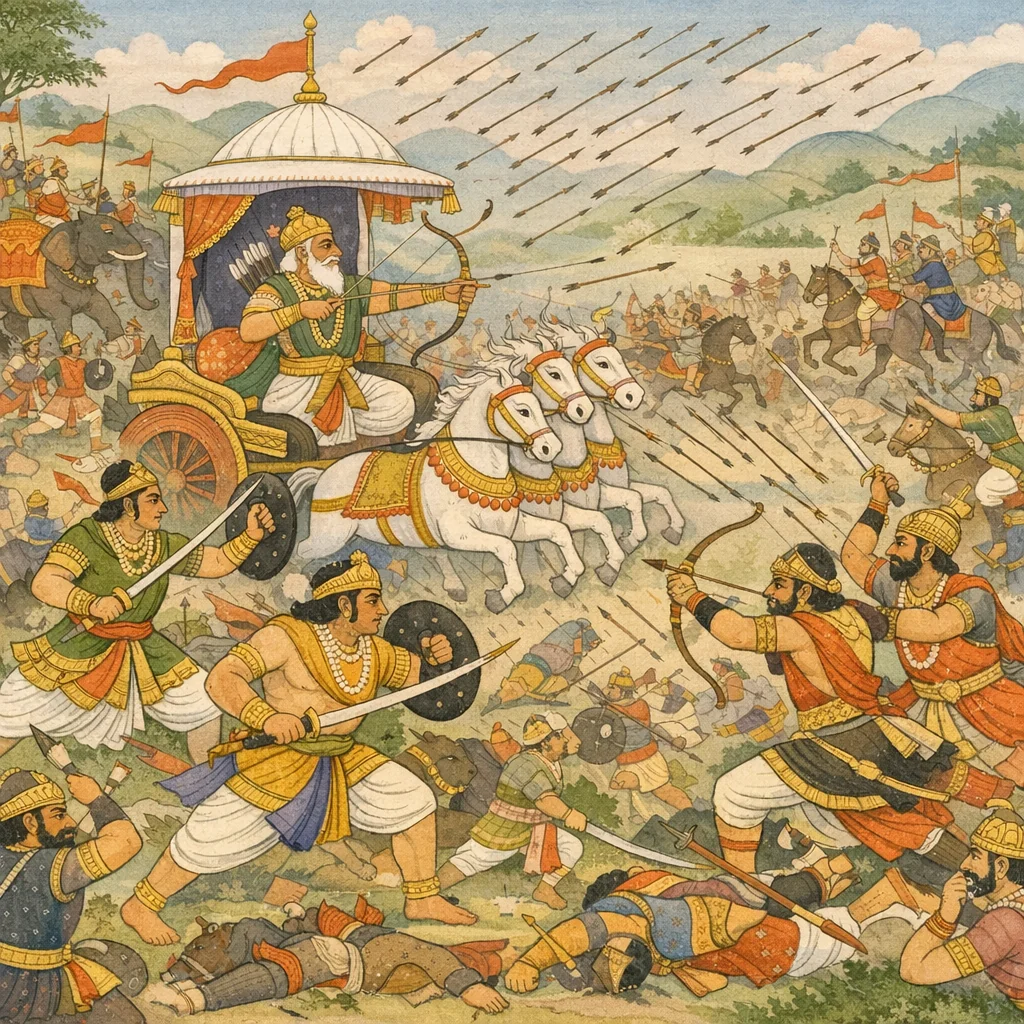
Adhyaya 32
Cakravyūha-saṃkalpaḥ, Saṃśaptaka-āhvānaṃ, Saubhadra-vikrīḍitam (Drona Parva, Adhyāya 32)
Upa-parva: Cakravyūha-vidhāna and Saubhadra-nipātana (Episode Cluster)
Saṃjaya reports a prior Kaurava setback: the forces are disordered and demoralized after being checked by Arjuna (Phalguna) and after Droṇa fails to seize Yudhiṣṭhira despite proximity. In a public, politically charged exchange, Duryodhana reproaches Droṇa—invoking expectations created by a promised boon and implying that a visible enemy should not escape if the commander truly intends capture. Droṇa responds by defending Arjuna’s near-unassailable protection under Kṛṣṇa and by asserting that no ordinary coalition can overpower a Kṛṣṇa–Arjuna pairing. He then announces a new operational plan: he will deploy an exceptionally hard-to-break vyūha and requires that Arjuna be diverted by some means. Saṃśaptaka warriors renew their challenge to draw Arjuna toward the southern direction, and a singularly intense engagement arises there. Droṇa’s array is described as radiant and formidable; Abhimanyu, acting on instruction associated with the Pandava leadership, penetrates and fractures the cakravyūha in battle. After extraordinary feats and heavy fighting, Abhimanyu becomes trapped against multiple elite opponents and falls. Dhṛtarāṣṭra, hearing of the young warrior’s death, laments the severity of kṣatra-dharma and asks Saṃjaya to narrate in full how the ratha-host was ‘played with’ and broken by Saubhadra; Saṃjaya prepares to describe the terror among Kaurava troops, likened to forest-dwellers encircled by wildfire.
Chapter Arc: द्रोण-पर्व के रण-आकाश में द्वात्रिंश अध्याय का उद्घोष होता है—कौरव और पाण्डव सेनाएँ घमासान में टकराती हैं; भीमसेन महारथियों के बीच प्रलय-सा वेग लेकर उतरते हैं, और पाण्डवों की दृष्टि एक ही लक्ष्य पर टिकती है: द्रोणाचार्य का रथ। → द्रोणाचार्य तीक्ष्ण, सीधे जाने वाले बाणों से मर्मस्थलों पर प्रहार कर युद्ध को ‘जीवितान्त’ तक ले जाने की चेष्टा करते हैं। कर्ण और अश्वत्थामा निरन्तर प्रतिघात-आघात की शृंखला बनाए रखते हैं—द्रोण के साथ मिलकर पाण्डवों की अग्रगति को रोकते हैं। चारों ओर वर्ग-से-वर्ग भिड़ते हैं—घोड़े घोड़ों से, हाथी हाथियों से, रथी रथियों से—और रणभूमि नदी-रोध टूटने जैसी उथल-पुथल में डूब जाती है। → पाण्डव-सेनापति की आज्ञा पर योद्धा ‘हंसों की तरह’ द्रोण-रथ की ओर झपटते हैं; उसी उन्मत्त धारा में धृष्टद्युम्न, भीम और सात्यकि कर्ण को निकट से घायल करते हैं, जबकि कर्ण प्रत्युत्तर में उनके धनुषों को काटकर उनकी गति को तोड़ता है। इसी बीच युद्ध का क्रूर शिखर उभरता है—‘पिता पुत्र को’ और ‘वीर वीर को’ चक्र-से-चक्र भिड़ाकर संहारते हैं; संबंध और शौर्य दोनों रक्त में घुल जाते हैं। → अध्याय का अंत किसी एक निर्णायक वध पर नहीं, बल्कि रण-यंत्र के और अधिक कस जाने पर होता है—द्रोण का रथ अभी अडिग है, कर्ण-अश्वत्थामा की प्रतिरोध-दीवार कायम है, और पाण्डवों का द्रोण-वध का संकल्प और तीव्र होकर अगले प्रहार की तैयारी में बदल जाता है। → द्रोण के रथ पर टूटती पाण्डव-धारा और कर्ण की काटती प्रत्याघात-नीति के बीच प्रश्न लटकता है—क्या पाण्डव द्रोण तक पहुँचकर उसे निर्णायक रूप से बाँध/परास्त कर पाएँगे, या यह आक्रमण उन्हीं पर उलट पड़ेगा?
Shlokas
Verse 1
द्वात्रिशोड्थध्याय: कौरव-पाण्डव-सेनाओंका घमासान युद्ध, भीमसेनका कौरव महारथियोंके साथ संग्राम, भयंकर संहार, पाण्डवोंका द्रोणाचार्यपर आक्रमण, अर्जुन और कर्णका युद्ध, कर्णके भाइयोंका वध तथा कर्ण और सात्यकिका संग्राम संजय उवाच प्रतिघातं तु सैन्यस्य नामृष्यत वृकोदर: । सो<भ्याहनद् गुरुं षष्ट्या कर्ण च दशभि: शरै:,संजय कहते हैं--महाराज! अपनी सेनाका वह विनाश भीमसेनसे नहीं सहा गया। उन्होंने गुर्देवको साठ और कर्णको दस बाणोंसे घायल कर दिया
Sañjaya said: Bhīma (Vṛkodara) could not endure the blow—indeed, the devastation—suffered by his own army. In fierce retaliation he struck the Guru (Droṇa) with sixty arrows and Karṇa with ten, wounding them on the battlefield.
Verse 2
तस्य द्रोण: शितैर्बाणैस्तीक्ष्णधारैरजिद्वागै: । जीवितान्तमभिप्रेप्सुर्मर्माण्याशु जघान ह,तब द्रोणाचार्यने सीधे जानेवाले, तीखी धारसे युक्त पैने बाणोंद्वारा शीघ्रतापूर्वक भीमसेनके मर्मस्थानोंपर आघात किया। वे भीमसेनके प्राणोंका अन्त कर देना चाहते थे
Sañjaya said: Then Droṇa, intent on bringing Bhīmasena’s life to an end, swiftly struck at his vital points with razor-sharp arrows, keen-edged and unfailing in their flight.
Verse 3
आनन्तर्यमभिप्रेप्सु: षड्विंशत्या समार्पयत् । कर्णो द्वादशभिर्बाणैरश्वृत्थामा च सप्तभि:,इस आधघात-प्रतिघातको निरन्तर जारी रखनेकी इच्छासे द्रोणाचार्यने भीमसेनको छब्बीस, कर्णने बारह और अश्व॒त्थामाने सात बाण मारे
Sañjaya said: Wishing to keep the exchange of blows unbroken, Droṇācārya struck Bhīmasena with twenty-six arrows; Karṇa with twelve; and Aśvatthāmā with seven.
Verse 4
षड्भिद्दुर्योधनो राजा तत एनमथाकिरत् । भीमसेनो<पि तानू सर्वान् प्रत्यविध्यन्महाबल:,तदनन्तर राजा दुर्योधनने उनके ऊपर छ: बाणोंद्वारा प्रहार किया। फिर महाबली भीमसेनने उन सबको अपने बाणोंद्वारा घायल कर दिया
Sañjaya said: King Duryodhana then showered him with six arrows. In response, the mighty Bhīmasena struck back, piercing all of them with his own shafts—an exchange that shows how, in the fury of battle, prowess and retaliation drive the combatants onward, often eclipsing restraint and reflection.
Verse 5
द्रोणं पडचाशतेषूणां कर्ण च दशभि: शरै: | दुर्योधन द्वादशभिद्रौणिमष्टाभिराशुगै:,उन्होंने द्रोणको पचास, कर्णको दस, दुर्योधनको बारह और अश्व॒त्थामाको आठ बाण मारे
Sañjaya said: He struck Droṇa with fifty arrows, Karṇa with ten, Duryodhana with twelve, and Droṇa’s son Aśvatthāman with eight swift shafts—an act of measured yet relentless prowess amid the moral darkness of fratricidal war.
Verse 6
आयावं तुमुलं॑ कुर्वन्नभ्यवर्तत तान् रणे । तस्मिन् संत्यजति प्राणान् मृत्युसाधारणीकृते,तत्पश्चात् भयंकर गर्जना करते हुए भीमने रणक्षेत्रमें उन सबका सामना किया। भीमसेन मृत्युके तुल्य अवस्थामें पहुँच गये थे और अपने प्राणोंका परित्याग करना चाहते थे। उसी समय अजातशत्रु युधिष्ठिरने अपने योद्धाओंको यह कहकर आगे बढ़नेकी आज्ञा दी कि “तुम सब लोग भीमसेनकी रक्षा करो।” यह सुनकर वे अमित तेजस्वी वीर भीमसेनके समीप चले
Sañjaya said: Raising a dreadful uproar, he advanced against them in the battle. At that moment, when he had been brought to a condition as good as death and seemed ready to give up his life, Yudhiṣṭhira—Ajātaśatru—ordered his warriors to move forward, saying, “All of you protect Bhīmasena.” Hearing this, the mighty heroes went near the immeasurably radiant Bhīma, upholding their duty of comradeship amid the terror of war.
Verse 7
अजातशणत्रुस्तान् योधान् भीम॑ त्रातेत्यचोदयत् । ते ययुर्भीमसेनस्य समीपममितौजस:,तत्पश्चात् भयंकर गर्जना करते हुए भीमने रणक्षेत्रमें उन सबका सामना किया। भीमसेन मृत्युके तुल्य अवस्थामें पहुँच गये थे और अपने प्राणोंका परित्याग करना चाहते थे। उसी समय अजातशत्रु युधिष्ठिरने अपने योद्धाओंको यह कहकर आगे बढ़नेकी आज्ञा दी कि “तुम सब लोग भीमसेनकी रक्षा करो।” यह सुनकर वे अमित तेजस्वी वीर भीमसेनके समीप चले
Sañjaya said: Ajātaśatru (Yudhiṣṭhira) urged those warriors, saying, “Protect Bhīma!” Hearing this command, those heroes of immeasurable prowess moved toward Bhīmasena’s side. The moment underscores a king’s dharmic duty to safeguard his foremost fighter and not abandon a comrade in peril, even amid the terror of battle.
Verse 8
युयुधानप्रभृतयो माद्रीपुत्रौ च पाण्डवौ | ते समेत्य सुसंरब्धा: सहिता: पुरुषर्षभा:,सात्यकि आदि महार॒थी तथा पाण्डुकुमार माद्रीपुत्र नकुल-सहदेव--ये सभी पुरुषश्रेष्ठ वीर परस्पर मिलकर एक साथ अत्यन्त क्रोधमें भरकर बड़े-बड़े धनुर्धरोंसे सुरक्षित हो द्रोणाचार्यकी सेनाको विदीर्ण कर डालनेकी इच्छासे उसपर टूट पड़े। वे भीम आदि सभी महारथी अत्यन्त पराक्रमी थे
Sañjaya said: Led by Yuyudhāna (Sātyaki), and joined by the two Pāṇḍava sons of Mādrī (Nakula and Sahadeva), those bull-like heroes gathered together. United and fiercely enraged, they surged forward with the resolve to tear open Droṇa’s battle-array—an image of collective valor driven by loyalty to their cause and the grim ethics of war, where righteous intent is pursued through violent means.
Verse 9
महेष्वासवरैर्गुप्ता द्रोणानीकं बिभित्सव: । समापेतुर्महावीर्या भीमप्रभूतयो रथा:,सात्यकि आदि महार॒थी तथा पाण्डुकुमार माद्रीपुत्र नकुल-सहदेव--ये सभी पुरुषश्रेष्ठ वीर परस्पर मिलकर एक साथ अत्यन्त क्रोधमें भरकर बड़े-बड़े धनुर्धरोंसे सुरक्षित हो द्रोणाचार्यकी सेनाको विदीर्ण कर डालनेकी इच्छासे उसपर टूट पड़े। वे भीम आदि सभी महारथी अत्यन्त पराक्रमी थे
Sañjaya said: Guarded by the foremost great bowmen, the battle-array of Droṇa was assailed by mighty chariot-warriors—Bhīma and the others—together with Sātyaki and the sons of Pāṇḍu, Nakula and Sahadeva, who surged as one, intent on shattering it. In fierce wrath and heroic resolve, those great fighters closed upon Droṇa’s host, seeking to break through its protected ranks.
Verse 10
तान् प्रत्यगृह्नादव्यग्रो द्रोणोडपि रथिनां वर: । महारथानतिबलान् वीरान् समरयोधिन:,उस समय रथियोंमें श्रेष्ठ आचार्य द्रोणने घबराहट छोड़कर उन अत्यन्त बलवान् समरभूमिमें युद्ध करनेवाले महारथी वीरोंको रोक दिया
Sañjaya said: Then Droṇa too—foremost among chariot-warriors—without losing composure, checked those mighty heroes, great chariot-fighters of immense strength, who were pressing on to fight in the battle.
Verse 11
बाहां मृत्युभयं कृत्वा तावकान् पाण्डवा ययु: । सादिन: सादिनो<भ्यघ्नंस्तथैव रथिनो रथान्,परंतु पाण्डववीर मौतके भयको बाहर छोड़कर आपके सैनिकोंपर चढ़ आये। घुड़सवार घुड़सवारोंको तथा रथारोही योद्धा रथियोंको मारने लगे
Sañjaya said: Casting aside the fear of death as though it were outside their very arms, the Pāṇḍavas charged upon your troops. Horsemen struck down horsemen, and chariot-warriors likewise fell upon opposing charioteers—each meeting his counterpart in the grim order of battle.
Verse 12
आसीच्छक्त्यासिसम्पातो युद्धमासीत् परश्वधै: । प्रकृष्टमसियुद्धं च बभूव कटुकोदयम्,उस युद्धमें शक्ति और खड़्गोंके घातक प्रहार हो रहे थे। फरसोंसे मार-काट हो रही थी। तलवार खीचंकर उसके द्वारा ऐसा भयंकर युद्ध हो रहा था कि उसका कटु परिणाम प्रत्यक्ष सामने आ रहा था
In that battle, deadly blows of spear and sword fell in ceaseless succession. Axes too hewed down men in slaughter. And the clash of blades grew so dreadful that its bitter outcome seemed to stand revealed before their eyes.
Verse 13
कुण्जराणां च सम्पाते युद्धमासीत् सुदारुणम् । अपतत् कुज्जरादन्यो हयादन्यस्त्ववाकृशिरा:,हाथियोंके संघर्षमें अत्यन्त दारुण संग्राम होने लगा। कोई हाथीसे गिरता था तो कोई घोड़ेसे ही औंधे सिर धराशायी हो रहा था
Sañjaya said: In the very clash and close press of the elephants, a battle of extreme ferocity arose. One warrior would fall from an elephant, while another, thrown from his horse, would crash down headlong—showing how the frenzy of war reduces even the mighty to sudden ruin.
Verse 14
नरो बाणविनिर्भिन्नो रथादन्यक्ष मारिष । तत्रान्यस्य च सम्मर्दे पतितस्य विवर्मण:
Sañjaya said: O venerable one, a warrior, pierced through by arrows, fell from his chariot—its axle broken. There, amid the crush of battle, another combatant too lay fallen, stripped of his armor. The scene reveals the war’s relentless, leveling force, undoing prowess and protection in an instant.
Verse 15
अपरांश्चापरे5मृद्नन् वारणा: पतितान् नरान्
Sañjaya said: And other elephants, in turn, were crushing other fallen men—an image of the battle’s pitiless momentum, where the helpless on the ground were trampled amid the chaos of war.
Verse 16
नरान्त्रै: केचिदपरे विषाणालग्नसंश्रयै:
Sañjaya said: Some lay with their entrails spilling out, and others clung to horns, their bodies caught and hanging there—such were the dreadful sights on that battlefield. The narration lays bare the moral cost of war: when dharma collapses into unchecked violence, the human body and dignity are reduced to horrific spectacle.
Verse 17
कार्ष्णायसतनुत्राणान् नराश्वरथकुञ्जरान्
Sañjaya said: (They beheld) men, horses, chariots, and elephants protected by iron cuirasses—an image of war’s hardening of bodies and minds, where life is preserved not by compassion but by armor and force.
Verse 18
गृध्रपत्राधिवासांसि शयनानि नराधिपा:
Sañjaya said: “O kings, their beds and resting-places were furnished with coverings made of vulture-feathers.”
Verse 19
हन्ति स्मात्र पिता पुत्र रथेनाभ्येत्य संयुगे
Sañjaya said: In the very clash of battle, the father struck down the son, driving straight at him in his chariot—an image that lays bare how war can overturn natural bonds and test the limits of duty and restraint.
Verse 20
पुत्रश्न पितरं मोहान्निर्मर्यादमवर्तत । वहाँ पिता रथके द्वारा युद्धके मैदानमें आकर पुत्रका ही वध कर डालता था और पुत्र भी मोहवश पिताके प्राण ले रहा था। इस प्रकार वहाँ मर्यादाशून्य युद्ध हो रहा था ।। १९३ || रथो भग्नो ध्वजश्शकछ्िन्नश्छत्रमुर्व्या निपातितम्
Sañjaya said: Deluded, a son turned upon his father without restraint. There, a father would come onto the battlefield in his chariot and slay his own son, and the son too—overpowered by confusion—would take his father’s life. Thus, in that place the fighting became bereft of all bounds and propriety. Chariots were shattered, banners cut down, and parasols cast upon the earth.
Verse 21
सासिर्बाहुर्निपतित: शिरश्छिन्न॑ं सकुण्डलम्
Sañjaya said: With sword in hand and arm outstretched, he fell; his head—severed—dropped as well, still adorned with earrings. The line starkly underscores the brutal finality of battle, where prowess and ornament alike are rendered meaningless before death.
Verse 22
रथिना ताडितो नागो नाराचेनापतत् क्षितौ,किसी रथीने नाराचके द्वारा गजराजपर आघात किया और वह धराशायी हो गया। किसी हाथीके वेगपूर्वक आघात करनेपर सवारसहित घोड़ा धरतीपर ढेर हो गया। इस प्रकार वहाँ मर्यादाशून्य अत्यन्त भयंकर एवं महान् युद्ध होने लगा
Sañjaya said: Struck by a chariot-warrior with a nārāca arrow, the great elephant collapsed upon the earth. Thus, as mounts and riders were felled by force and missile alike, a dreadful and vast battle arose there—one that had slipped beyond all bounds of restraint, revealing the ethical breakdown that accompanies unbridled violence in war.
Verse 23
सारोहश्चापतद् वाजी गजेनाभ्याहतो भूशम् | निर्मर्यादं महद् युद्धमवर्तत सुदारुणम्,किसी रथीने नाराचके द्वारा गजराजपर आघात किया और वह धराशायी हो गया। किसी हाथीके वेगपूर्वक आघात करनेपर सवारसहित घोड़ा धरतीपर ढेर हो गया। इस प्रकार वहाँ मर्यादाशून्य अत्यन्त भयंकर एवं महान् युद्ध होने लगा
Sañjaya said: A horse, together with its rider, was struck by an elephant and fell heavily to the ground. Thus, in that place a great and exceedingly dreadful battle began to rage—one that had slipped beyond all bounds of restraint, where the usual limits of righteous conduct in war were no longer observed.
Verse 24
हा तात हा पुत्र सखे क्वासि तिष्ठ क्व धावसि । प्रहराहर जहोन॑ स्मितक्ष्वेडितगर्जितै:
Sañjaya said: “Alas, father! Alas, my son! O friend—where are you? Stand! Where do you run? Strike, strike!” Thus they cried out again and again, with restrained yet piercing shouts, with war-cries and roars—voices that reveal both affection and the brutal urgency of battle.
Verse 25
इत्येवमुच्चरन्ति सम श्रूयन्ते विविधा गिर: । उस समय सभी सैनिक “हा तात! हा पुत्र! सखे! तुम कहाँ हो? ठहरो, कहाँ भागे जा रहे हो? मारो, लाओ, इसका वध कर डालो'--इस प्रकारकी बातें कह रहे थे। हास्य, उछल-कूद और गर्जनाके साथ उनके मुखसे नाना प्रकारकी बातें सुनायी देती थीं ।। २४ ई || नरस्याश्वस्य नागस्य समसज्जत शोणितम्
Sañjaya said: “Thus were many kinds of cries heard—men calling out in confusion and anguish, invoking ‘Father!’ ‘Son!’ ‘Friend!’ and shouting commands to strike, seize, and kill. Amid laughter, leaping about, and roaring, a tumult of voices rose from their mouths. And the blood of men, horses, and elephants mingled together on the field.”
Verse 26
चक्रेण चक्रमासाद्य वीरो वीरस्य संयुगे
Sañjaya said: In the thick of battle, the hero met the hero’s chariot-wheel with his own wheel—closing in at close quarters, as if to test strength and resolve face to face amid the chaos of war.
Verse 27
आसीतू् केशपरामर्शों मुष्टियुद्धं च दारुणम्
Sañjaya said: There ensued a grim struggle—grappling by seizing one another’s hair, and a fierce exchange of blows with clenched fists—signaling how the battle had descended into brutal hand-to-hand combat where rage eclipsed restraint.
Verse 28
तत्राच्छिद्यत शूरस्य सखड्गो बाहुरुद्यतः,उस युद्धमें एक शूरवीरकी खड्गसहित ऊपर उठी हुई भुजा काट डाली गयी। दूसरेकी भी धनुष-बाण और अंकुशसहित बाँह खण्डित हो गयी। वहाँ एक सैनिक दूसरेको पुकारता था और दूसरा युद्धसे विमुख होकर भागा जा रहा था
Sanjaya describes the chaos of the battle: there, the upraised arm of a warrior—still gripping his sword—was severed. Another fighter’s arm too was cut down, even as it held bow, arrows, and a goad. In that turmoil one soldier called out to another, while someone else, turning away from the fight, fled from the battlefield—showing how war breaks both bodies and resolve.
Verse 29
सथधनुश्चापरस्यापि सशर: साड्कुशस्तथा । आक्रोशदन्यमन्यो>त्र तथान्यो विमुखो<द्रवत्,उस युद्धमें एक शूरवीरकी खड्गसहित ऊपर उठी हुई भुजा काट डाली गयी। दूसरेकी भी धनुष-बाण और अंकुशसहित बाँह खण्डित हो गयी। वहाँ एक सैनिक दूसरेको पुकारता था और दूसरा युद्धसे विमुख होकर भागा जा रहा था
Sañjaya said: In that battle, one warrior’s arm—raised aloft with sword in hand—was hewn off. Another’s arm too was severed, along with his bow, arrows, and goad. There, one soldier cried out to another, while yet another, turning away from the fight, fled in fear—showing the chaos, suffering, and moral collapse that war unleashes.
Verse 30
अन्य: प्राप्तस्य चान्यस्य शिर: कायादपाहरत् । सशब्दमद्रवच्चान्य: शब्दादन्यो5त्रसद् भृशम्,किसी दूसरे वीरने सामने आये हुए अन्य योद्धाके मस्तकको धड़से अलग कर दिया। यह देख कोई तीसरा वीर बड़े जोरसे कोलाहल करता हुआ भागा। उसके उस आर्तनादसे एक अन्य योद्धा अत्यन्त डर गया
Sañjaya said: Another hero struck off the head of a warrior who had come up before him, tearing it from the body. Seeing this, a third fled, raising a great uproar. And at that cry of anguish, yet another fighter was seized by overwhelming fear.
Verse 31
स्वानन्यो5थ परानन्यो जघान निशितै: शरै: | गिरिशृड्रोपमश्चात्र नाराचेन निपातित:
Sañjaya said: Then, striking down his own foes and then the enemies of others with keen arrows, he fought on. And here, one who stood like a mountain-peak was felled by a nārāca arrow—showing how, in war, even the mightiest form and pride of strength can be brought down in an instant by skill and fate.
Verse 32
तथैव रथिनं नाग: क्षरन् गिरिरिवारुजन्,भरतनन्दन! दोनों ओरकी सेनाएँ अत्यन्त आहत होकर खूनसे लथपथ हो एक- दूसरीकी ओर देख रही थीं, इतनेहीमें सूर्यदेव अस्ताचलको जा पहुँचे। फिर तो वे दोनों ही धीरे-धीरे अपने-अपने शिविरकी ओर चल दीं ।। इति श्रीमहा भारते द्रोणपर्वणि संशप्तकवधपर्वणि द्वादशदिवसावहारे द्वात्रिंशोड्थ्याय: इस प्रकार श्रीमह्ाभारत द्रोणपर्वके अन्तर्गत संशप्तकवधपर्वमें बारहवें दिनके युद्धमें सेनाका युद्धसें विरत हो अपने शिविरको प्रस्थानविषयक बत्तीसवाँ अध्याय पूरा हुआ
Sanjaya said: “In the same way, the great warrior and the mighty ‘elephant’ among men raged on, shedding blood like a mountain oozing streams. O joy of the Bharatas, both armies—grievously wounded and smeared with gore—stood facing one another, staring across the field. Just then the Sun reached the western mountain. Thereafter, both sides gradually withdrew, each returning to its own camp.”
Verse 33
शूरान् प्रहरतो दृष्टवा कृतास्त्रान् रुधिरोक्षितान्
Sañjaya said: Seeing the valiant warriors striking in battle—masters of weapons and drenched in blood—(the scene revealed the grim cost of prowess and the relentless momentum of war).
Verse 34
सर्वमाविग्नमभवतन्न प्राज्ञायत किड्चन
Sañjaya said: Everything was thrown into confusion, and nothing could be clearly ascertained. In the moral fog of battle, discernment failed and certainty vanished amid the turmoil.
Verse 35
ततः: सेनापति: शीघ्रमयं काल इति ब्रुवन्
Then the commander, speaking quickly, declared, “This is Time (Death) itself,” conveying the grim moral certainty that in war the force of fate can appear embodied in a single, unstoppable moment.
Verse 36
कुर्वन्त: शासनं तस्य पाण्डवा बाहुशालिन:
Sañjaya said: The mighty-armed Pāṇḍavas carried out his command—acting in disciplined obedience amid the pressures of war, where order and duty must be upheld even in peril.
Verse 37
गृह्नीताद्रवतान्योन्यं विभीता विनिकृन्तत
Sañjaya said: In panic, the warriors seized and struck at one another as they rushed about—fear driving them into mutual slaughter amid the confusion of battle.
Verse 38
ततो द्रोण: कृप: कर्णो द्रौणी राजा जयद्रथ:ः
Sañjaya said: Then Droṇa, Kṛpa, Karṇa, Droṇa’s son (Aśvatthāmā), and King Jayadratha assembled, marking the gathering of key Kaurava champions as the battle’s momentum shifted toward a decisive and morally fraught escalation.
Verse 39
ते त्वार्यधर्मसंरब्धा दुर्निवारा दुरासदा:
Sanjaya said: But those men, stirred and bound by the code of noble duty, were not to be held back and were hard to approach—unyielding in their resolve to act as they deemed righteous amid the press of war.
Verse 40
ततो द्रोणो$तिसंक्रुद्धो विसृजज्छतश: शरान्
Sanjaya said: Then Droṇa, inflamed with intense anger, began releasing arrows in hundreds—his wrath turning into a relentless storm of weapons on the battlefield, where passion and duty collide in the harsh ethics of war.
Verse 41
चेदिपज्चालपाण्डूनामकरोत् कदनं महत् । यह देख अत्यन्त क्रोधमें भरे हुए द्रोणाचार्यने सैकड़ों बाणोंकी वर्षा करके चेदि, पांचाल तथा पाण्डव-योद्धाओंका महान् संहार आरम्भ किया ।। ४० $ ।। तस्य ज्यातलनिर्घोष: शुश्रुवे दिक्षु मारिष
Sanjaya said: O revered one, the thunderous twang of his bowstring was heard in all directions—an ominous sign that Droṇa’s furious onslaught had begun to overwhelm the Cedi, Pāñcāla, and Pāṇḍava warriors. The sound itself becomes a moral marker of war’s escalation: skill and wrath, once unleashed, spread fear far beyond the immediate battlefield.
Verse 42
एतस्मिन्नन्तरे जिष्णुर्जित्वा संशप्तकान् बहून्
Sañjaya said: Meanwhile, Jiṣṇu (Arjuna), having overcome many of the Saṁśaptakas, continued to press forward—showing how steadfast resolve and disciplined prowess can turn even a vowed and determined opposition aside in the midst of war.
Verse 43
ताञ्छरौघान् महावर्तान् शोणितोदान् महाह्ददान्
Sañjaya said: “Those torrents of arrows—whirling like mighty eddies—became like great lakes whose waters were blood.”
Verse 44
तीर्ण: संशप्तकान् हत्वा प्रत्यदृश्यत फाल्गुन: । संशप्तक योद्धा महान् सरोवरोंके समान थे, बाणोंके समूह ही उनके जल-प्रवाह थे, धनुष ही उनमें उठी हुई बड़ी-बड़ी भँवरोंके समान जान पड़ते थे तथा प्रवाहित होनेवाला रक्त ही उन सरोवरोंका जल था। अर्जुन संशप्तकोंका वध करके उन महान् सरोवरोंके पार होकर वहाँ आते दिखायी दिये थे || ४३ $ ।। तस्य कीर्तिमतो लक्ष्म सूर्यप्रतिमतेजस:
Sañjaya said: Having crossed through and slain the Saṁśaptakas, Phālguna (Arjuna) was seen again, reappearing on the field. Those mighty Saṁśaptaka warriors were like great lakes: their masses of arrows were the flowing currents, their bows seemed like vast rising whirlpools, and the blood that streamed was the water of those lakes. Arjuna, having killed the Saṁśaptakas, appeared as one who had crossed beyond those great lakes; and the glory and fortune of that renowned hero, whose splendor was like the sun, shone forth.
Verse 45
दीप्यमानमपश्याम तेजसा वानरध्वजम् | सूर्यके समान तेजस्वी एवं यशस्वी अर्जुनके चिह्नस्वरूप वानरध्वजको हमने दूरसे ही देखा, जो अपने दिव्य तेजसे उद्धासित हो रहा था ।। ४४ ई ।। संशप्तकसमुद्रं तमुच्छोष्यास्त्रगभस्तिभि:
Sañjaya said: We saw from afar Arjuna’s banner, marked with the monkey-emblem, blazing with radiance—sunlike in splendor and renowned as his sign. It shone with a divine brilliance, as though ready to dry up the very “ocean” of the Saṁśaptakas with the rays of weapons—an omen of Arjuna’s unwavering resolve and the moral force of his cause amid the chaos of war.
Verse 46
प्रददाह कुरून् सर्वानर्जुन: शस्त्रतेजसा
Sañjaya said: With the blazing potency of his weapons, Arjuna scorched all the Kurus.
Verse 47
युगान्ते सर्वभूतानि धूमकेतुरिवोत्थित: । जैसे प्रलयकालमें प्रकट हुई अग्नि सम्पूर्ण भूतोंको दग्ध कर देती है, उसी प्रकार अर्जुनने अपने अस्त्र-शस्त्रोंके तेजसे समस्त कौरव-सैनिकोंको जलाना आरम्भ किया ।। ४६ हे || तेन बाणसहस्रौघैर्गजाश्वरथयोधिन:
Sañjaya said: “As at the end of an age, when a blazing comet-like fire rises and consumes all beings, so did Arjuna begin to scorch the entire Kaurava host with the fierce radiance of his weapons. Then, with torrents of thousands of arrows, he struck down the warriors fighting from elephants, horses, and chariots.”
Verse 48
ताड्यमानाः क्षितिं जम्मुर्मुक्तकेशा: शरार्दिता: । हाथी, घोड़े तथा रथपर आरूढ़ होकर युद्ध करनेवाले बहुत-से योद्धा अर्जुनके सहस्तरों बाणसमूहोंसे आहत एवं पीड़ित हो बाल खोले हुए पृथ्वीपर गिर पड़े ।। केचिदार्तस्वनं चक्रु्विनेशुरपरे पुन:
Sañjaya said: Struck down and tormented by showers of arrows, many warriors fighting from elephants, horses, and chariots fell to the earth with their hair loosened in disarray. Some cried out in anguish, while others, again, perished—showing how Arjuna’s relentless missile-storm shattered not only bodily strength but also the will to fight in the brutal press of war.
Verse 49
तेषामुत्पतितान् कांश्चित् पतितांश्व पराड़मुखान्
Sañjaya said: Of those warriors, some were seen springing up again, while others had fallen and lay turned away in flight—an image of a battle where courage and collapse alternate, and where fear can drive even armed men to abandon their duty.
Verse 50
न जघानार्जुनो योधान् योधव्रतमनुस्मरन् । उन योद्धाओंमेंसे जो लोग रथसे कूद पड़े थे या धरतीपर गिर गये थे अथवा युद्धसे विमुख होकर भाग चले थे, उन सबको एक वीर सैनिकके लिये निश्चित नियमका निरन्तर स्मरण रखते हुए अर्जुनने नहीं मारा ।। ते विकीर्णरथाश्षित्रा: प्रायशश्न॒ पराड्मुखा:
Sañjaya said: Remembering the warrior’s code, Arjuna did not strike down those fighters who had been thrown from their chariots, who had fallen to the ground, or who had turned away from the battle and fled. Most of them, their chariots scattered and their ranks broken, were already facing away in retreat.
Verse 51
कुरव: कर्ण कर्णेति हाहेति च विचुक्रुशु: । कौरव-सैनिकोंके रथ टूट-फ़ूटकर बिखर गये। उनकी विचित्र अवस्था हो गयी। वे प्रायः: युद्धसे विमुख हो गये और “हा कर्ण, हा कर्ण” कहकर पुकारने लगे ।। ५० ई ।। तमाधिरथिराक्रन्दं विज्ञाय शरणैषिणाम्
Sañjaya said: The Kurus cried out again and again, “Karṇa! Karṇa!” and also wailed “Alas! Alas!” Their chariots were shattered and scattered, and their condition became strange and disordered. For the most part they turned away from the fight, calling out to Karṇa in desperation. Hearing that lament of men seeking refuge, the son of Adhiratha (Karṇa) understood their plight.
Verse 52
स भारतरथश्रेष्ठ: सर्वभारतहर्षण:
Sañjaya said: “That foremost of the Bharata chariot-warriors—one who brings joy and renewed confidence to all the Bharatas—…”
Verse 53
तस्य दीप्तशरौघस्य दीप्तचापधरस्य च
Sañjaya said: “Of him—whose volleys of arrows blazed like fire, and who bore a radiant bow…”
Verse 54
तथैवाधिरथिस्तस्य बाणाज्ज्वलिततेजस:
Sañjaya said: In the same manner, Adhirathi too was struck by his blazing arrow—showing that in the fury of battle, warriors answer force with force, and the contest turns on disciplined skill rather than mere rage.
Verse 55
अस्त्रमस्त्रेण संवार्य प्राणदद् विसृजज्छरान् । उसी प्रकार अधिरथकुमार कर्णने भी प्रज्वलित तेजवाले अर्जुनके बाणोंका तथा उनके प्रत्येक अस्त्रका अपने अस्त्रोंद्रारा निवारण करके बाणोंकी वर्षा करते हुए बड़े जोरसे सिंहनाद किया || ५४ $ || धृष्टद्युम्नश्व॒ भीमश्च सात्यकिश्न महारथ:
Sañjaya said: Countering weapon with weapon, he unleashed arrows as if staking his very life. In the same way, Karṇa—the son of Adhiratha—checked Arjuna’s blazing shafts and each of his missile-weapons with his own, and while pouring forth a rain of arrows, he roared aloud like a lion, proclaiming his resolve in the midst of righteous but devastating war.
Verse 56
अर्जुनास्त्र तु राधेय: संवार्य शरवृष्टिभि:
Sañjaya said: Rādheya (Karna), however, checked Arjuna’s weapon and its force by meeting it with a rain of arrows—answering skill with skill in the relentless ethics of the battlefield, where restraint and countermeasure decide survival.
Verse 57
ते निकृत्तायुधा: शूरा निर्विषा भुजगा इव
Sañjaya said: Those heroes, their weapons cut away, became like serpents whose venom has been removed—still formidable in form, yet deprived of the power by which they truly strike. The image underscores how, in war, prowess depends not only on courage but on the means and discipline that make courage effective.
Verse 58
ता भुजाग्रैर्महावेगा निसृष्टा भुजगोपमा:
Sañjaya said: Those (weapons), hurled with tremendous force from the very ends of the warriors’ arms, sped forth like serpents—swift, deadly, and unerring—intensifying the terror and moral gravity of the battle’s violence.
Verse 59
दीप्यमाना महाशक्त्यो जग्मुराधिरथिं प्रति । उनके हाथोंसे छूटी हुई वे अत्यन्त वेगशालिनी सर्पाकार महाशक्तियाँ अपनी प्रभासे प्रकाशित होती हुई कर्णकी ओर चलीं || ५८ $ || ता निकृत्य शरव्रातैस्त्रिभिस्त्रिभिरजिद्वागै:
Sañjaya said: Blazing with their own radiance, the great spear-weapons—swift as serpents in their flight—sped forth toward Ādhirathi (Karna). The scene underscores the war’s relentless escalation: even the most formidable arms, once released, move with an almost fated momentum, testing not only martial skill but also the moral endurance of those who wield violence in a dharmic crisis.
Verse 60
अर्जुनश्नापि राधेयं विद्ध्वा सप्तभिराशुगै:
Sañjaya said: Arjuna too struck Rādheya (Karna) with seven swift arrows—an act that underscores the relentless reciprocity of battlefield duty, where even the greatest warriors must answer force with force while remaining bound to their chosen allegiance and the harsh ethics of war.
Verse 61
कर्णादवरजं बाणैर्जघान निशितै: शरै: | अर्जुनने भी राधानन्दन कर्णको सात शीघ्रगामी बाणोंद्वारा बीधकर अपने पैने बाणोंसे उसके छोटे भाईको मार डाला || ६० $ || ततः शत्रुंजयं हत्वा पार्थ: षड़भिरजिह्यगै:ः
Sañjaya said: With sharp arrows, Arjuna struck down Karṇa’s younger brother. Then, having slain Śatruṃjaya, Pārtha (Arjuna) again advanced the battle by releasing six swift, unerring shafts—an episode that underscores the grim momentum of war, where prowess and strategy eclipse kinship, and death follows in rapid succession.
Verse 62
जहार सद्यो भल्लेन विपाटस्य शिरो रथात् | तत्पश्चात् सीधे जानेवाले छः सायकोंद्वारा शत्रुंजयका संहार करके एक भल्लद्वारा रथपर बैठे हुए विपाटका मस्तक तत्काल काट गिराया ।। ६१ ई || पश्यतां धार्तराष्ट्राणामेकेनैव किरीटिना
Sañjaya said: With a sharp bhalla-arrow he at once struck off Vipāṭa’s head from his chariot. Thereafter, having slain Śatruñjaya with six arrows, the crowned warrior (Arjuna) severed with a single bhalla the head of Vipāṭa as he sat upon his car—while the sons of Dhṛtarāṣṭra looked on. The passage underscores the grim swiftness of kṣatriya warfare: prowess and resolve are displayed publicly, yet the ethical weight of violence remains inescapable amid the duties of battle.
Verse 63
प्रमुखे सूतपुत्रस्य सोदर्या निहतास्त्रय: । इस प्रकार धुृतराष्ट्रपुत्रोंके देखते-देखते एकमात्र अर्जुनने युद्धके मुहानेपर सूतपुत्र कर्णके तीन भाइयोंका वध कर डाला ।। ६२ $ ।। ततो भीम: समुत्पत्य स्वरथाद् वैनतेयवत्
Sañjaya said: Right before the eyes of Karṇa, the charioteer’s son, his three full brothers were slain. Thus, as Dhṛtarāṣṭra’s sons looked on, Arjuna alone cut down Karṇa’s three brothers at the very forefront of the battle. Then Bhīma sprang up from his own chariot, swift and fierce like Vainateya (Garuḍa).
Verse 64
पुनस्तु रथमास्थाय धनुरादाय चापरम्
Sañjaya said: Then again, mounting his chariot once more and taking up another bow, he prepared to re-enter the fray—an image of renewed resolve amid the relentless demands of righteous and unrighteous warfare alike.
Verse 65
विव्याध दशभ्ि: कर्ण सूतमश्चांश्व॒ पठचभि: । फिर भी उन्होंने अपने रथपर बैठकर दूसरा धनुष हाथमें ले लिया और दस बाणोंद्वारा कर्णको तथा पाँच बाणोंसे उसके सारथि और घोड़ोंको भी घायल कर दिया ।। ६४ $ || धृष्टद्युम्नो5प्यसिवरं चर्म चादाय भास्वरम्
Sañjaya said: He pierced Karṇa with ten arrows, and with five more he struck Karṇa’s charioteer and horses as well. Even amid the relentless violence of battle, the narration highlights the calculated, targeted nature of warrior action—skill directed toward disabling the opponent’s capacity to fight rather than mere rage.
Verse 66
ततः स्वरथमास्थाय पाज्चाल्योडन्यच्च कार्मुकम्
Sañjaya said: Then the Pāñcāla warrior mounted his own chariot and took up another bow as well—signaling renewed resolve and readiness to continue the fight despite the strain and losses of battle.
Verse 67
शैनेयो<5प्यन्यदादाय धनुरिन्दुसमझुति:
Sañjaya said: Śaineya too, taking up another bow—radiant like the moon—prepared himself again for battle, showing the warrior’s resolve to continue his duty even after loss or setback.
Verse 68
भल्लाभ्यां साधुमुक्ता भ्यां छित्त्वा कर्णस्य कार्मुकम्
Sañjaya said: With two well-aimed, expertly released bhalla-arrows, he cut Karṇa’s bow—an act that momentarily checked the famed warrior’s power and signaled a decisive turn in the duel’s momentum amid the relentless ethics of battlefield skill and resolve.
Verse 69
पुन: कर्ण त्रिभि्बाणैर्बाह्वोरुरसि चार्पयत् । इसके बाद उन्होंने अच्छी तरह छोड़े हुए दो भल्लोंद्वारा कर्णके धनुषको काटकर पुनः तीन बाणोंद्वारा कर्णकी दोनों भुजाओं तथा छातीमें भी चोट पहुँचायी ।। ततो दुर्योधनो द्रोणो राजा चैव जयद्रथ:
Sañjaya said: Once again he struck Karṇa with three arrows, planting them in his arms and chest. Then, with two well-shot bhalla shafts, he cut Karṇa’s bow; and again with three arrows he wounded Karṇa’s two arms and his breast. At that moment Duryodhana, Droṇa, the king (Dhṛtarāṣṭra’s son), and Jayadratha came into prominence, as the battle’s weight shifted toward the foremost Kaurava champions.
Verse 70
पत्त्यश्चरथमातज्ञास्त्वदीया: शतशो5परे
Sañjaya said: And besides them, hundreds of other foot-soldiers and charioteers skilled in handling horses—men belonging to your side—were also present in the battle array.
Verse 71
कर्णमेवाभ्यधावन्त त्रास्यमाना: प्रहारिण: । उस समय आपकी सेनाके अन्य सैकड़ों पैदल, घुड़सवार, रथी और गजारोही योद्धा सात्यकिसे संत्रस्त होकर कर्णके ही पीछे दौड़े गये || ७० $ ।। धृष्टय्युम्नश्ष भीमश्न सौभद्रोडर्जुन एव च
Sañjaya said: Terrified by the blows, the assailants rushed only toward Karṇa. At that time, many other hundreds of warriors in your army—infantry, horsemen, chariot-fighters, and elephant-riders—alarmed by Sātyaki, fled and ran behind Karṇa. And Dṛṣṭadyumna, Bhīma, the son of Subhadrā (Abhimanyu), and Arjuna as well advanced in that same surge.
Verse 72
एवमेष महारौद्र: क्षयार्थ सर्वधन्विनाम्
Sañjaya said: “Thus this exceedingly dreadful onslaught has arisen, intended for the destruction of all the bowmen.”
Verse 73
पदातिरथनागाश्चा गजाश्वरथपत्तिभि:
Sañjaya reports that the battlefield was filled with every kind of fighting force—foot-soldiers, charioteers, and elephant-warriors—intermingled with troops of elephants, horses, chariots, and infantry. The line underscores the overwhelming scale and confusion of war, where all arms of the army converge and individual lives are swept into a vast, impersonal machinery of combat.
Verse 74
रथिनो नागप्त्त्यश्वै रथपत्ती रथद्विपै: | पैदल, रथ, हाथी और घोड़े क्रमश: हाथी, घोड़े, रथ और पैदलोंके साथ युद्ध करने लगे। रथी हाथियों, पैदलों और घोड़ोंके साथ भिड़ गये। रथी और पैदल सैनिक रथियों और हाथियोंका सामना करने लगे || ७३ $ ।। अश्लैरश्चा गजैर्नागा रथिनो रथिभि: सह
Chariot-warriors fought elephant-riders; elephant-riders fought horsemen; foot-soldiers fought chariots; and horsemen fought the infantry, each in its turn. The charioteers closed with elephants, footmen, and horses; and chariot-warriors with the men on foot faced chariots and elephants as well.
Verse 75
एवं सुकलिलं युद्धमासीत् क्रव्यादहर्षणम् । महद्विस्तैरभीतानां यमराष्ट्रविवर्धनम्
Sañjaya said: Thus the battle became a dreadful mire, delighting the flesh-eaters. Vast and sprawling, it drove even the fearless toward death, swelling the realm of Yama.
Verse 76
ततो हता नररथवाजिकुगञ्जरै- रनेकशो द्विपरथपत्तिवाजिन: । गजैर्गजा रथिभिरुदायुधा रथा हयै्हया: पत्तिगणैश्नल पत्तय:,उस समय पैदल, रथी, घुड़सवार और हाथीसवारोंके द्वारा बहुत-से हाथीसवार, रथी, पैदल और घुड़सवार मारे गये। हाथियोंने हाथियोंको, रथियोंने शस्त्र उठाये हुए रथियोंको, घुड़सवारोंने घुड़सवारोंको और पैदल योद्धाओंने पैदल योद्धाओंको मार गिराया
Sañjaya said: Then, in great numbers, foot-soldiers, chariot-warriors, horsemen, and elephant-riders were slain—each arm of the host striking down its counterpart. Elephants felled elephants; charioteers cut down charioteers with weapons raised; horsemen brought down horsemen; and companies of infantry overthrew infantry.
Verse 77
रथैर्दविपा द्विरदवरैर्महाहया हयैर्नरा वररथिभिश्न वाजिन: । निरस्तजिल्लादशनेक्षणा: क्षितौ क्षयं गता: प्रमथितवर्म भूषणा:,रथियोंने हाथियोंको, गजराजोंने बड़े-बड़े घोड़ोंको, घुड़सवारोंने पैदलोंको तथा श्रेष्ठ रथियोंने घुड़सवारोंको धराशायी कर दिया। उनकी जिह्ठा, दाँत और नेत्र--ये सब बाहर निकल आये थे। कवच और आभूषण टुकड़े टुकड़े होकर पड़े थे। ऐसी अवस्थामें वे सब योद्धा पृथ्वीपर गिरकर नष्ट हो गये थे
Sañjaya said: In that slaughter, charioteers struck down elephants; the best of elephants brought down great horses; horsemen felled foot-soldiers; and foremost chariot-warriors overthrew the cavalry. Cast upon the earth, their tongues, teeth, and eyes were forced out; their armor and ornaments were shattered. Thus those warriors fell to the ground and perished.
Verse 78
तथा परैर्बहुकरणैर्वरायुधै- हता गता: प्रतिभयदर्शना: क्षितिम् विपोथिता हयगजपादताडिता भूशाकुला रथमुखनेमिश्रि: क्षता:,शत्रुओंके पास बहुत-से साधन थे। उनके हाथमें उत्तम अस्त्र-शस्त्र थे। उनके द्वारा मारे जाकर पृथ्वीपर पड़े हुए सैनिक बड़े भयंकर दिखायी देते थे। कितने ही योद्धा हाथियों और घोड़ोंके पैरोंसे आहत होकर धरतीपर गिर पड़ते थे। कितने ही बड़े-बड़े रथोंके पहियोंसे कुचलकर क्षत-विक्षत हो अत्यन्त व्याकुल हो रहे थे
Sañjaya said: Thus, struck down by the enemy—who possessed many implements of war and excellent weapons—men fell upon the earth, dreadful to behold. Some warriors, trampled and battered by the feet of horses and elephants, collapsed onto the ground. Others, crushed beneath the rims and fronts of great chariots’ wheels, were torn and mangled, writhing in extreme agony.
Verse 79
प्रमोदने श्वापदपक्षिरक्षसां जनक्षये वर्तति तत्र दारुणे । महाबलास्ते कुपिता: परस्परं निषूदयन्त: प्रविचेरुरोजसा,वहाँ वह भयंकर जनसंहार हिंसक जन्तुओं, पक्षियों तथ राक्षसरोंको आनन्द प्रदान करनेवाला था। उसमें कुपित हुए वे महाबली शूरवीर एक-दूसरेको मारते हुए बलपूर्वक विचरण कर रहे थे
Sañjaya said: In that dreadful slaughter of men, which brought grim delight to beasts of prey, birds, and rākṣasas, those mighty warriors—enraged with one another—moved about with force, cutting each other down. The scene underscores how war, once unrestrained by dharma, becomes a feast for death and a collapse of human order.
Verse 80
ततो बले भृशलुलिते परस्परं निरीक्षमाणे रुधिरौघसम्प्लुते । दिवाकरे<स्तंगिरिमास्थिते शनै- रुभे प्रयाते शिबिराय भारत
Sañjaya said: Then, when the armies had been grievously shattered and were looking upon one another amid a flood of blood, and when the sun had slowly reached the mountain of setting, both sides withdrew to their respective camps, O Bhārata. The verse underscores the grim moral weight of battle: even as hostility persists, the day’s end imposes a pause, leaving both hosts to confront the consequences of violence before resuming their chosen course.
Verse 143
शिर: प्रध्वंसयामास वक्षस्याक्रम्प कुज्जर: । आर्य! उस युद्धमें कितने मनुष्य बाणोंसे विदीर्ण होकर रथसे नीचे गिर जाते थे। कितने ही योद्धा कवचशून्य हो धरतीपर गिर पड़ते थे और सहसा कोई हाथी उनकी छातीपर पैर रखकर उनके मस्तकको भी कुचल देता था
Sañjaya said: In that battle, many men—pierced through by arrows—fell down from their chariots. Many warriors, stripped of their armour, collapsed upon the earth; and then, in an instant, some elephant would plant its foot upon their chest and crush even their head. The scene underscores the ruthless momentum of war, where the loss of protection and composure leads swiftly from injury to annihilation, and where brute force overwhelms the already fallen.
Verse 156
विषाणैश्चावनिं गत्वा व्यभिन्दन् रथिनो बहून् । दूसरे हाथियोंने भी दूसरे बहुत-से गिरे हुए मनुष्यों-को अपने पैरोंसे रौंद डाला। अपने दाँतोंसे धरतीपर आघात करके बहुत-से रथियोंको चीर डाला
Sañjaya said: Striking down to the earth with their horns, the beasts tore through many chariot-warriors. Other elephants, trampling the fallen underfoot and gouging the ground with their tusks, crushed and split apart numerous fighters—an image of war’s unchecked ferocity where strength, once unleashed, overwhelms restraint and compassion.
Verse 173
पतितान् पोथयाज्चक्रुर्द्धिपा: स्थूलनलानिव । काले रंगके लोहमय कवच धारण करके रणभूमिमें गिरे हुए कितने ही मनुष्यों, रथों, घोड़ों और हाथियोंको बड़े-बड़े गजराजोंने मोटे नरकुलोंके समान रौंद डाला
Sañjaya said: The mighty elephants trampled those who had fallen on the battlefield—men, chariots, horses, and even other elephants—crushing them as if they were thick reeds. The scene underscores the pitiless momentum of war, where strength and panic override restraint and the fallen become helpless amid the clash of arms.
Verse 183
ह्वीमन््त: कालसम्पर्कात् सुदुःखान्यनुशेरते । बड़े-बड़े राजा कालसंयोगसे अत्यन्त दुःखदायिनी तथा गीधकी पाँखरूपी बिछौनोंसे युक्त शय्याओंपर लज्जापूर्वक सो रहे थे
Sañjaya said: Through the harsh contact of Time (fate), they lay down amid exceedingly painful conditions—great kings, humbled by circumstance, sleeping in shame upon beds made of vulture-feathers, as if even their resting place proclaimed the ruin brought by war.
Verse 206
युगार्थ छिन्नमादाय प्रदुद्राव तथा हयः । कितने ही रथ टूट गये, ध्वज कट गये, छत्र पृथ्वीपर गिरा दिये गये और जूए खण्डित हो गये। उन खण्डित हुए आधे जूओंको ही लेकर घोड़े तेजीसे भाग रहे थे
Sañjaya said: Even after the yoke had been cut and broken, the horse bolted away, dragging the shattered remnant with it. In that furious press of battle, many chariots were smashed, banners were severed, parasols were hurled down to the earth, and yokes were splintered—yet the steeds, driven by panic and momentum, fled on with only the broken halves of the yokes still clinging to them. The scene underscores how war reduces royal emblems and ordered discipline to ruin, as uncontrolled force overwhelms human intention.
Verse 213
गजेनाक्षिप्य बलिना रथ: संचूर्णित: क्षितौ | कितने ही वीरोंकी भुजाएँ तलवारसहित काट गिरायी गयीं, कितनोंके कुण्डलमण्डित मस्तक धड़से अलग कर दिये गये। कहीं किसी बलवान् हाथीने रथको उठाकर फेंक दिया और वह पृथ्वीपर गिरकर चूर-चूर हो गया
Sañjaya said: A powerful elephant hurled the chariot down, and it was smashed to pieces upon the earth. In that same slaughter, many heroes’ arms—still gripping their swords—were severed and cast down; many heads, adorned with earrings, were cut clean from their bodies. Elsewhere too, a mighty elephant lifted a chariot and flung it away, so that it fell to the ground and was shattered—an image of war’s ruthless force, where valor and ornament alike are made equal before death.
Verse 256
उपाशाम्यद् रजो भौमं भीरून् कश्मलमाविशत् । मनुष्य, घोड़े और हाथीके रक्त एक-दूसरेसे मिल रहे थे। उस रक्तप्रवाहसे वहाँकी उड़ती हुई भयंकर धूल शान्त हो गयी। उस रक्तराशिको देखकर भीरु पुरुषोंपर मोह छा जाता था
Sañjaya said: The earth-born dust began to subside, and a crippling bewilderment seized the timid. The blood of men, horses, and elephants flowed together and mingled; and by that stream of blood the dreadful dust that had been whirling there was stilled. Seeing that mass of blood, faint-hearted men were overcome by delusion—an image of war’s moral collapse, where fear and confusion eclipse discernment and duty.
Verse 263
अतीतेषुपथे काले जहार गदया शिर: । किसी वीरने अपने चक्रके द्वारा शत्रुपक्षीय वीरके चक्रका निवारण करके युद्धमें बाणप्रहारके योग्य अवसर न होनेके कारण गदासे ही उसका सिर उड़ा दिया
Sañjaya said: When the moment for striking with arrows had passed and the opening in combat was gone, he severed the warrior’s head with his mace—showing how, in the press of battle, a fighter shifts means according to circumstance, even when the act is grim and final.
Verse 273
नर्खैर्दन्तैश्न शूराणामद्वीपे द्वीपमिच्छताम् । कुछ लोगोंमें एक-दूसरेके केश पकड़कर युद्ध होने लगा। कितने ही योद्धाओं में अत्यन्त भयंकर मुक्कोंकी मार होने लगी। कितने ही शूरवीर उस निराश्रय स्थानमें आश्रय ढूँढ़ रहे थे और नखों तथा दाँतोंसे एक-दूसरेको चोट पहुँचा रहे थे
Sañjaya said: In that supportless, islandless chaos of battle, the warriors—desperate to find some “island” of safety—fell to striking one another with nails and teeth. The scene sank from ordered combat into raw, close-quarters violence, revealing how fear and confusion can strip away restraint and the customary codes of warfare.
Verse 326
अभ्यतिष्ठत् पदा भूमौ सहाश्वं सहसारथिम् | झरने बहानेवाले पर्वतकी भाँति किसी मदस्रावी गजराजने सारथि और अश्वोंसहित रथीको पैरोंसे भूमिपर दबाकर उन सबको कुचल डाला
Sañjaya said: The rut-maddened lord of elephants, like a mountain with torrents rushing down its sides, stepped upon the chariot-warrior together with his horses and charioteer, pinning them to the earth and crushing them all. In the brutal press of battle, strength unrestrained becomes sheer destruction, showing how war can reduce living beings and their roles—warrior, driver, and animal alike—to a single, indiscriminate ruin.
Verse 333
बहूनप्याविशन्मोहो भीरून् हृदयदुर्बलान् | अस्त्र-विद्यामें निपुण और खूनसे लथपथ हुए शूरवीरोंको परस्पर प्रहार करते देख बहुत-से दुर्बल हृदयवाले भीरु मनुष्योंके मनमें मोहका संचार होने लगा
Sañjaya said: Seeing warriors—skilled in the science of weapons and smeared with blood—striking one another, delusion began to spread through the minds of many timid men whose hearts were weak. The spectacle of mutual slaughter, even among the trained and valiant, unsettled those lacking inner steadiness, revealing how war erodes discernment and courage in the vulnerable.
Verse 343
सैन्येन रजसा ध्वस्तं निर्मर्यादमवर्तत । उस समय सेनाद्वारा उड़ायी हुई धूलसे व्याप्त होकर सारा जनसमूह उद्विग्न हो रहा था, किसीको कुछ नहीं सूझता था। उस युद्धमें किसी भी नियम या मर्यादाका पालन नहीं हो रहा था
Sañjaya said: The battlefield, choked and battered by the dust raised by the armies, turned into a scene without restraint. In that confusion the mass of warriors grew agitated, unable to discern anything clearly, and the fighting proceeded with no regard for rule, order, or the ethical boundaries of war.
Verse 356
नित्याभित्वरितानेव त्वरयामास पाण्डवान् | तब सेनापति धूृष्टद्युम्नने यही उपयुक्त अवसर है, ऐसा कहते हुए सदा शीघ्रता करनेवाले पाण्डवोंको और भी जल्दी करनेके लिये प्रेरित किया
Sañjaya said: Ever intent on haste, he urged the Pāṇḍavas forward. Then their commander Dhṛṣṭadyumna, declaring, “This is the fitting moment,” pressed the ever-quick Pāṇḍavas to act with still greater speed—seizing the right time in war as a matter of duty and strategy.
Verse 363
सरो हंसा इवापेतुर्घ्नन्तो द्रोणरथं प्रति । तदनन्तर अपनी भुजाओंसे सुशोभित होनेवाले पाण्डव सेनापतिकी आज्ञाका पालन करनेके लिये वहाँ द्रोणाचार्यके रथपर प्रहार करते हुए उसी प्रकार टूट पड़े, जैसे बहुत-से हंस किसी सरोवरपर सब ओरसे उड़कर आते हैं
Sañjaya said: Like swans converging upon a lake from every side, the warriors rushed in and struck at Droṇa’s chariot. Immediately thereafter, to carry out the command of the Pāṇḍava commander—whose arms were famed for their strength and splendor—they fell upon Droṇācārya’s car with repeated blows, surrounding it from all directions.
Verse 373
इत्यासीत् तुमुल: शब्दो दुर्धर्षस्य रथं प्रति । उस समय दुर्धर्ष वीर द्रोणाचार्यके रथके समीप सब ओरसे यही भयानक आवाज आने लगी कि “दौड़ो, पकड़ो और निर्भय होकर शत्रुओंको काट डालो”
Sañjaya said: Thus there arose a tumultuous roar directed toward Durdharṣa’s chariot. From every side, near Droṇācārya’s chariot, a dreadful cry kept resounding—“Charge! Seize them! And, fearless, cut down the foes!”
Verse 383
विन्दानुविन्दावावन्त्यौ शल्यश्वैतान् न्यवारयन् । तब द्रोणाचार्य, कृपाचार्य, कर्ण, अश्वत्थामा, राजा जयद्रथ, अवन्तीके राजकुमार विन्द और अनुविन्द तथा राजा शल्यने मिलकर इन आक्रमणकारियोंको रोका
Sañjaya said: Vindā and Anuvindā, the princes of Avanti, checked the advance of Śalya’s and Śveta’s forces. In that moment, Droṇācārya, Kṛpācārya, Karṇa, Aśvatthāmā, King Jayadratha, and the Avanti princes Vindā and Anuvindā, together with King Śalya, united to repel those assailants.
Verse 396
शरार्ता न जहुद्रोणं पज्चाला: पाण्डवैः सह । वे पाण्डवोंसहित पाउ्चालवीर आर्यधर्मके अनुसार विजयके लिये प्रयत्नशील थे। उन्हें रोकना या पराजित करना बहुत कठिन था। वे बाणोंसे पीड़ित होनेपर भी द्रोणाचार्यको छोड़ न सके
Sañjaya said: Though tormented by arrows, the Pāñcālas, together with the Pāṇḍavas, did not abandon Droṇa. Bound by the warrior’s code and intent on victory, they pressed on with relentless resolve—so formidable that to check or defeat them was exceedingly difficult.
Verse 413
वज्संहादसंकाशस्त्रासयन् मानवान् बहून् | आर्य! उनके धनुषकी प्रत्यंचाका गम्भीर घोष सम्पूर्ण दिशाओंमें सुनायी देता था। वह वज्रकी गर्जनाके समान घोर शब्द बहुसंख्यक मनुष्योंको भयभीत कर रहा था
Sañjaya said: “Like the crash of a thunderbolt, the deep, resonant twang of his bowstring was heard in every direction. That dreadful, thunder-like sound struck fear into multitudes of men.”
Verse 423
अभ्ययात् तत्र यत्रासौ द्रोण: पाण्डून् प्रमर्दति । इसी समय अर्जुन बहुत-से संशप्तकोंपर विजय प्राप्त करके उस स्थानपर आये, जहाँ आचार्य द्रोण पाण्डव-सैनिकोंका मर्दन कर रहे थे
Sañjaya said: At that very time Arjuna, having overcome many of the Saṁśaptakas, advanced to the place where Ācārya Droṇa was fiercely crushing the Pāṇḍava forces.
Verse 453
स पाण्डवयुगान्तार्क: कुरूनप्यभ्यतीतपत् । वे पाण्डुवंशके प्रलयकालीन सूर्य अपनी अस्त्रमयी किरणोंसे उस संशप्तकरूपी समुद्रको सोखकर कौरव-सैनिकोंको भी संतप्त करने लगे
Sañjaya said: That warrior, like the sun at the end of an age for the Pāṇḍavas, blazed forth and scorched even the Kurus. With weapon-born rays he dried up the ocean-like Saṁsaptakas and spread burning distress through the Kaurava ranks.
Verse 483
पार्थबाणहता: केचितन्निपेतुर्विगतासव: । कोई आर्तनाद करने लगे, कोई नष्ट हो गये, कोई अर्जुनके बाणोंसे मारे जाकर प्राणशून्य हो पृथ्वीपर गिर पड़े
Sañjaya said: Some warriors, struck down by Pārtha’s arrows, fell to the ground bereft of life. The battlefield resounded with cries of distress, while others were utterly destroyed—killed by Arjuna’s shafts and cast lifeless upon the earth.
Verse 513
मा भैछ्टेति प्रतिश्रुत्य ययावभिमुखो<र्जुनम् । तब अधिरथपुत्र कर्णने उन शरणार्थी सैनिकोंकी करुण पुकार सुनकर 'डरो मत” इस प्रकार उन्हें आश्वासन देकर अर्जुनका सामना करनेके लिये प्रस्थान किया
Sañjaya said: Having pledged, “Do not fear,” Karṇa, Adhiratha’s son, reassured the soldiers who sought refuge and, hearing their piteous cries, set out to face Arjuna.
Verse 523
प्रादुश्चक्रे तदाग्नेयमस्त्रमस्त्रविदां वर: । उस समय अस्त्रवेत्ताओंमें श्रेष्ठ, भरतवंशियोंके श्रेष्ठ महारथी तथा सम्पूर्ण भारतीय सेनाका हर्ष बढ़ानेवाले कर्णने आग्नेयास्त्र प्रकट किया
Sañjaya said: Then Karṇa, foremost among the knowers of weapons, manifested the fiery Agneya missile. It heightened the ardor of the Bharata host, as he sought to turn the battle’s balance through overwhelming force.
Verse 533
शरौघाञ्छरजालेन विदुधाव धनंजय: । प्रजवलित बाणसमूह तथा देदीप्यमान धनुष धारण करनेवाले कर्णके उन बाणसमूहोंको अर्जुनने अपने बाणोंके समुदायद्वारा छिन्न-भिन्न कर दिया
Sañjaya said: Dhanañjaya (Arjuna), with a net of arrows, shattered the onrushing volleys of shafts. The blazing clusters of missiles released by Karṇa—he who bore a radiant bow—were cut to pieces and scattered by Arjuna’s own concentrated flights of arrows.
Verse 553
विव्यधु: कर्णमासाद्य त्रिभिस्त्रिभिरजिद्वागै: । इसी समय धृष्टद्युम्न, भीम तथा महारथी सात्यकिने भी कर्णके पास पहुँचकर उसे तीन-तीन बाणोंसे घायल कर दिया
Sañjaya said: Reaching Karṇa, they pierced him with three arrows each—swift as victorious speech. At that very moment, Dhṛṣṭadyumna, Bhīma, and the great chariot-warrior Sātyaki also came up to Karṇa and struck him, each with three arrows.
Verse 576
रथशक्ती: समुत्क्षिप्प भृशं सिंहा इवानदन् । अपने धनुष कट जानेपर विषहीन भुजंगमोंके समान उन शूरवीरोंने रथ-शक्तियोंको ऊपर उठाकर सिंहोंके समान भयंकर गर्जना की
Sañjaya said: When their bows had been cut down, those heroic warriors—like venomless serpents deprived of their fangs—lifted up their ratha-śaktis (javelins meant for chariot-war) and roared fiercely like lions.
Verse 593
ननाद बलवान् कर्ण: पार्थाय विसृजज्छरान् । परंतु बलवान् कर्णने सीधे जानेवाले तीन-तीन बाणसमूहोंद्वारा उन शक्तियोंके टुकड़े- टुकड़े करके अर्जुनपर बाणोंकी वर्षा करते हुए सिंहनाद किया
Sañjaya said: Mighty Karṇa roared like a lion as he loosed his arrows at Pārtha (Arjuna). With great force, he shattered the oncoming weapons into fragments by means of straight-flying clusters of three arrows at a time, and then rained shafts upon Arjuna.
Verse 633
वरासिना कर्णपक्षान् जघान दश पञ्च च | तदनन्तर भीमसेनने गरुड़की भाँति अपने रथसे उछलकर उत्तम खड्गद्वारा कर्णपक्षके पंद्रह योद्धाओंको मार डाला
Sanjaya said: With his excellent weapon he struck down fifteen warriors belonging to Karna’s division. Thereafter Bhimasena, leaping from his chariot like Garuda, slew fifteen more of Karna’s fighters with a superb sword.
Verse 653
जघान चन्द्रवर्माणं बृहत्क्षत्रं च नैषधम् । धष्टद्युम्नने भी श्रेष्ठ खड़ग और चमकीली ढाल लेकर चन्द्रवर्मा तथा निषधराज बृहत्क्षतका काम तमाम कर दिया
Sañjaya said: O best of the Bhāratas, Dhṛṣṭadyumna, taking up his sword and a shining shield, struck down Candravarmā and also Bṛhatkṣatra, the king of the Niṣadhas. In the harsh code of battlefield duty, this marks the swift, decisive removal of opposing leaders amid the war’s relentless course.
Verse 666
आदाय कर्ण विव्याध त्रिसप्तत्या नदन् रणे | तदनन्तर पाञ्चालराजकुमार धृष्टद्युम्नने अपने रथपर बैठकर दूसरा धनुष ले रणक्षेत्रमें गर्जना करते हुए तिहत्तर बाणोंद्वारा कर्णको बींध डाला
Sañjaya said: Roaring in the midst of battle, he pierced Karṇa with seventy-three arrows. Thereafter the Pāñcāla prince Dhṛṣṭadyumna, mounting his own chariot and taking up a second bow, thundered across the field and likewise struck Karṇa through with seventy-three shafts—an image of relentless martial resolve, as prowess and rivalry drive the fight on while the great war keeps testing the bounds of dharma amid violence.
Verse 673
सूतपुत्र॑ चतुःषष्ट्या विद्ध्वा सिंह इवानदत् | तत्पश्चात् चन्द्रमाके समान कान्तिमान् सात्यकिने भी दूसरा धनुष हाथमें लेकर सूतपुत्र कर्णको चौंसठ बाणोंसे घायल करके सिंहके समान गर्जना की
Sañjaya said: Having pierced Karṇa, the charioteer’s son, with sixty-four arrows, Sātyaki roared like a lion. Then, radiant like the moon, he took up a second bow in his hand and pressed the battle forward with unwavering resolve, under the demands of righteous warfare.
Verse 693
निमज्जमान राधेयमुज्जहु: सात्यकार्णवात् | तत्पश्चात् दुर्योधन, द्रोणाचार्य तथा राजा जयद्रथने डूबते हुए राधानन्दन कर्णका सात्यकिरूपी समुद्रसे उद्धार किया
Sañjaya said: When Karṇa, the son of Rādhā, was sinking, they hauled him up from the ocean-like Sātyaki. Thereafter Duryodhana, Droṇācārya, and King Jayadratha also rallied—supporting the rescue and regrouping amid the battle’s moral and strategic turmoil.
Verse 716
नकुल: सहदेवश्व सात्यकिं जुगुपू रणे । उधर धृष्टद्युम्न, भीमसेन, अभिमन्यु, अर्जुन, नकुल तथा सहदेवने रणक्षेत्रमें सात्यकिका संरक्षण आरम्भ किया
Sañjaya said: In the thick of battle, Nakula and Sahadeva guarded Sātyaki. Rallying around him, Dhṛṣṭadyumna, Bhīmasena, Abhimanyu, Arjuna, and again Nakula together with Sahadeva began to protect Sātyaki on the battlefield—an act of comradeship and duty amid the chaos of war.
Verse 726
तावकानां परेषां च त्यक्त्वा प्राणानभूद् रण: । महाराज! इस प्रकार आपके तथा शत्रुपक्षके सम्पूर्ण धनुर्धरोंके विनाशके लिये उनमें परस्पर प्राणोंकी परवा न करके अत्यन्त भयंकर युद्ध होने लगा
Sañjaya said: Casting aside all concern for life—both your warriors and those of the opposing side—the battle flared up. O King, thus, with no regard for their own lives and intent on the destruction of all the bowmen on both sides, a most dreadful combat began.
Verse 753
इस प्रकार उन निर्भीक सैनिकोंका महान् शक्तिशाली विपक्षी योद्धाओंके साथ अत्यन्त घमासान युद्ध हो रहा था, जो कच्चा मांस खानेवाले पशु-पक्षियों तथा पिशाचोंके हर्षकी वृद्धि और यमराजके राष्ट्रकी समृद्धि करनेवाला था
Sañjaya said: Thus there raged a tremendous, powerfully contested battle between those fearless soldiers and the mighty warriors of the opposing side—a slaughter so fierce that it heightened the delight of flesh-eating beasts and birds and of ghoulish spirits, and swelled the dominion of Yama, the Lord of Death.
Verse 1636
बभ्रमु: समरे नागा मृद्नन्त: शतशो नरान् । कितने ही गजराज अपने दाँतोंमें लगी हुई मनुष्योंकी आँतें लिये समरभूमिमें सैकड़ों योद्धाओंको कुचलते हुए चक्कर लगा रहे थे
Sañjaya said: In the thick of battle, the great elephants wheeled about, trampling men by the hundreds. Some lordly tuskers, with human entrails caught upon their tusks, circled across the field, crushing scores of warriors.
Verse 3136
मातड़ो न्यपतद् भूमौ नदीरोध इवोष्णगे । कोई अपने ही सैनिकोंको और कोई शत्रु-योद्धाओंको अपने तीखे बाणोंसे मार रहा था। उस युद्धमें पर्वत शिखरके समान विशालकाय हाथी नाराचसे मारा जाकर वर्षाकालमें नदीके तटकी भाँति धरतीपर गिरा और ढेर हो गया
Sañjaya said: A great elephant collapsed upon the earth, like a riverbank giving way in the heat. In that fierce battle, warriors—some striking down their own side in the confusion, others felling enemy fighters—kept killing with sharp arrows. Thus the massive, mountain-peak-like elephant, pierced by nārāca shafts, fell and lay heaped on the ground like a river’s embankment in the rainy season.
Verse 5636
तेषां त्रयाणां चापानि चिच्छेद विशिखैस्त्रिभि: । तब राधानन्दन कर्णने अपने बाणोंकी वर्षद्वारा अर्जुनके बाणोंका निवारण करके अपने तीन बाणोंद्वारा धृष्टद्युम्न आदि तीनों वीरोंके धनुषोंको भी काट दिया
Sañjaya said: With three sharp arrows, Karṇa cut the bows of those three warriors. In the thick of battle, he checked Arjuna’s arrow-shower with his own volleys and then, by a precise triple shot, disabled the weapons of Dṛṣṭadyumna and the other two heroes.
Verse 7463
संयुक्ता: समदृश्यन्त पत्तयश्चापि पत्तिभि: । घोड़ोंसे घोड़े, हाथियोंसे हाथी, रथियोंसे रथी और पैदलोंसे पैदल जूझते दिखायी दे रहे थे
Sañjaya said: The foot-soldiers were seen locked in close combat with other foot-soldiers. In the same way across the field, like met like—horse with horse, elephant with elephant, chariot-warrior with chariot-warrior—revealing the grim order of battle, where each class of fighter met its counterpart in relentless, face-to-face struggle.
Frequently Asked Questions
The chapter stages a dharma-saṃkaṭa between strategic necessity (capturing or neutralizing protected leaders through specialized formations and diversion) and the ethical unease that arises when such strategy results in the isolation and death of a young, valorous combatant.
Power is portrayed as relational rather than merely numeric: Droṇa underscores that the Kṛṣṇa–Arjuna alliance alters the field of possibility, implying that prudent leadership must account for moral-psychological force multipliers (alliances, counsel, legitimacy) alongside raw strength.
No explicit phalaśruti appears in this passage; the meta-commentary functions indirectly through Dhṛtarāṣṭra’s lament on the harshness of kṣatriya codes, framing the narration as an ethical inquiry rather than mere chronicle.