Adhyaya 14
Brahmā’s Prayers to Lord Kṛṣṇa (Brahmā-stuti) and the Restoration of Vraja’s Lunch Pastime
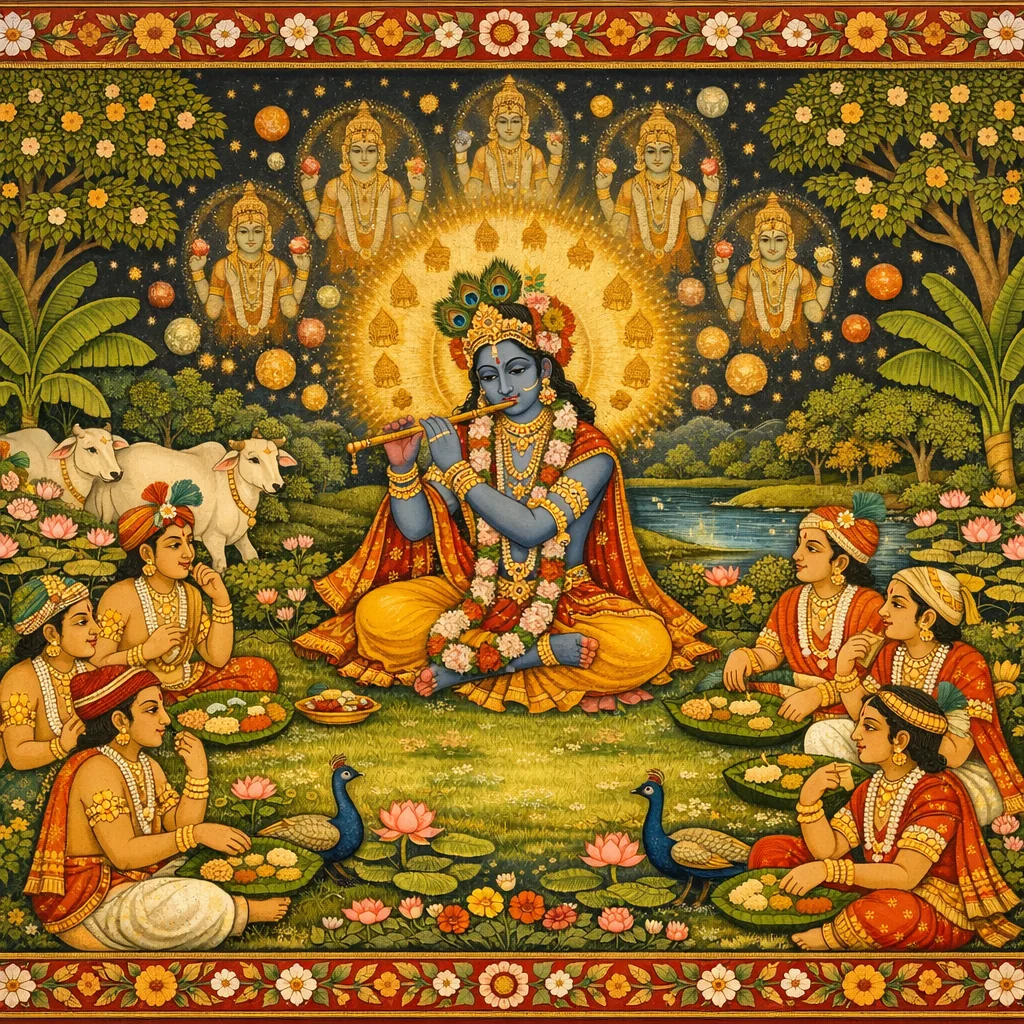
After Brahmā tests Kṛṣṇa by stealing the calves and cowherd boys, this chapter records Brahmā’s repentance and theological surrender upon witnessing Kṛṣṇa’s inconceivable expansions (the boys, the calves, Viṣṇu forms, and entire universes). Brahmā glorifies the Lord’s Vraja form—flute, peacock feather, forest garlands—affirming Him as the only worshipable Lord, the source of Nārāyaṇa and all cosmic functions. He teaches that bhakti—humble hearing and chanting—conquers the unconquerable Lord, whereas dry jñāna yields only toil. Confessing his offense and his smallness before the Lord’s limitless universes, Brahmā prays for any birth in Vraja, even as grass, to receive the dust of devotees’ feet. Granted leave, Kṛṣṇa returns the calves to the riverbank and resumes the boys’ lunch pastime as if no time had passed; the year-long separation is concealed by Yogamāyā. The chapter then turns to Parīkṣit’s inquiry into the gopīs’ extraordinary love, preparing the next clarification on the self’s dearness and on Kṛṣṇa as Paramātmā, the ultimate Self of all.
Shlokas
Verse 1
श्रीब्रह्मोवाच नौमीड्य तेऽभ्रवपुषे तडिदम्बराय गुञ्जावतंसपरिपिच्छलसन्मुखाय । वन्यस्रजे कवलवेत्रविषाणवेणु- लक्ष्मश्रिये मृदुपदे पशुपाङ्गजाय ॥ १ ॥
Lord Brahmā said: O worshipable Lord, I bow to You. Your body is dark blue like a fresh raincloud, and Your garment shines like lightning; the guñjā ornaments and peacock feather enhance the beauty of Your face. Wearing a garland of forest flowers, holding a morsel of food, and bearing a herding stick, horn and flute, O son of the cowherd king, You stand supremely beautiful with gentle steps.
Verse 2
अस्यापि देव वपुषो मदनुग्रहस्य स्वेच्छामयस्य न तु भूतमयस्य कोऽपि । नेशे महि त्ववसितुं मनसान्तरेण साक्षात्तवैव किमुतात्मसुखानुभूते: ॥ २ ॥
My Lord, neither I nor anyone else can measure the potency of Your transcendental body, which has shown mercy to me and appears by Your own will to fulfill the desires of Your pure devotees, not being made of material elements. Though my mind is withdrawn from worldly matters, I still cannot comprehend Your personal form—how then could I understand the inner bliss You experience within Yourself?
Verse 3
ज्ञाने प्रयासमुदपास्य नमन्त एव जीवन्ति सन्मुखरितां भवदीयवार्ताम् । स्थाने स्थिता: श्रुतिगतां तनुवाङ्मनोभि- र्ये प्रायशोऽजित जितोऽप्यसि तैस्त्रिलोक्याम् ॥ ३ ॥
Those who cast aside the labor of speculative knowledge and, while remaining in their own stations, humbly honor with body, words and mind the narrations of Your person and pastimes—spoken by You and by Your pure devotees—and dedicate their lives to hearing them, certainly conquer You, O Ajita, though You are otherwise unconquerable within the three worlds.
Verse 4
श्रेय:सृतिं भक्तिमुदस्य ते विभो क्लिश्यन्ति ये केवलबोधलब्धये । तेषामसौ क्लेशल एव शिष्यते नान्यद् यथा स्थूलतुषावघातिनाम् ॥ ४ ॥
O mighty Lord, devotion (bhakti) to You is the highest path to true good. Those who abandon it and struggle only for intellectual knowledge gain nothing but distress—like one who beats an empty husk and never obtains the grain.
Verse 5
पुरेह भूमन् बहवोऽपि योगिन- स्त्वदर्पितेहा निजकर्मलब्धया । विबुध्य भक्त्यैव कथोपनीतया प्रपेदिरेऽञ्जोऽच्युत ते गतिं पराम् ॥ ५ ॥
O almighty Lord, in former times many yogīs in this world attained devotional service by offering all their endeavors unto You and faithfully performing their prescribed duties. By such bhakti, perfected through hearing and chanting about You, they came to know You, O infallible Acyuta, and easily surrendered to You, attaining Your supreme abode.
Verse 6
तथापि भूमन्महिमागुणस्य ते विबोद्धुमर्हत्यमलान्तरात्मभि: । अविक्रियात् स्वानुभवादरूपतो ह्यनन्यबोध्यात्मतया न चान्यथा ॥ ६ ॥
Nevertheless, O Bhūman, the greatness of Your qualities can be understood only by those whose inner self is purified. By direct realization of the unchanging Self, You may be perceived as the formless, impersonal Brahman, for You are the Paramātmā knowable only in that singular way, and not otherwise.
Verse 7
गुणात्मनस्तेऽपि गुणान् विमातुं हितावतीर्णस्य क ईशिरेऽस्य । कालेन यैर्वा विमिता: सुकल्पै- र्भूपांशव: खे मिहिका द्युभास: ॥ ७ ॥
O Lord, in time learned philosophers or scientists may count all the atoms of the earth, the particles of snow in the sky, or even the shining motes radiating from the sun and stars. But who could ever count Your limitless transcendental qualities, O Supreme Personality who has descended to this world for the welfare of all beings?
Verse 8
तत्तेऽनुकम्पां सुसमीक्षमाणो भुञ्जान एवात्मकृतं विपाकम् । हृद्वाग्वपुर्भिर्विदधन्नमस्ते जीवेत यो मुक्तिपदे स दायभाक् ॥ ८ ॥
My dear Lord, one who earnestly awaits Your causeless mercy, patiently enduring the ripened results of his own past deeds, and who offers You respectful obeisances with heart, words, and body, is surely eligible for the state of liberation, for it has become his rightful claim.
Verse 9
पश्येश मेऽनार्यमनन्त आद्ये परात्मनि त्वय्यपि मायिमायिनि । मायां वितत्येक्षितुमात्मवैभवं ह्यहं कियानैच्छमिवार्चिरग्नौ ॥ ९ ॥
My Lord, just see my uncivilized impudence! To test Your power I tried to spread my illusory potency to cover You—the unlimited, primeval Paramātmā who bewilders even the masters of illusion. What am I compared to You? I am only a tiny spark before a great fire.
Verse 10
अत: क्षमस्वाच्युत मे रजोभुवो ह्यजानतस्त्वत्पृथगीशमानिन: । अजावलेपान्धतमोऽन्धचक्षुष एषोऽनुकम्प्यो मयि नाथवानिति ॥ १० ॥
Therefore, O infallible Lord Acyuta, please forgive my offenses. Born in the mode of passion, I foolishly imagined myself a controller apart from You. The darkness of ignorance has blinded my eyes; O Nātha, I am Your servant—show me compassion.
Verse 11
क्वाहं तमोमहदहंखचराग्निवार्भू- संवेष्टिताण्डघटसप्तवितस्तिकाय: । क्वेदृग्विधाविगणिताण्डपराणुचर्या- वाताध्वरोमविवरस्य च ते महित्वम् ॥ ११ ॥
Who am I—a tiny creature only seven spans of my own hand, confined within a potlike universe made of tamas, the mahat-tattva, false ego, ether, air, fire, water, and earth? And what is Your glory—countless universes pass through the pores of Your body like dust through the openings of a screened window.
Verse 12
उत्क्षेपणं गर्भगतस्य पादयो: किं कल्पते मातुरधोक्षजागसे । किमस्तिनास्तिव्यपदेशभूषितं तवास्ति कुक्षे: कियदप्यनन्त: ॥ १२ ॥
O Lord Adhokṣaja, does a mother take offense when the child within her womb kicks with his legs? And is there anything—called ‘real’ or ‘unreal’ by philosophers—that actually lies outside Your abdomen, O Infinite One?
Verse 13
जगत् त्रयान्तोदधिसम्प्लवोदे नारायणस्योदरनाभिनालात् । विनिर्गतोऽजस्त्विति वाङ्न वै मृषा किन्त्वीश्वर त्वन्न विनिर्गतोऽस्मि ॥ १३ ॥
My dear Lord, it is said that at dissolution the three worlds merge into the waters; then Your plenary expansion Nārāyaṇa lies upon that water, a lotus grows from His navel, and Brahmā is born upon it. These words are not false; therefore, O Īśvara, am I not born from You?
Verse 14
नारायणस्त्वं न हि सर्वदेहिना- मात्मास्यधीशाखिललोकसाक्षी । नारायणोऽङ्गं नरभूजलायना- त्तच्चापि सत्यं न तवैव माया ॥ १४ ॥
Are You not the original Nārāyaṇa, O supreme controller, since You are the Soul of every embodied being and the eternal witness of all worlds? Indeed, Lord Nārāyaṇa is Your expansion, so named because He is the source and shelter of the primeval waters (‘nara’) of the universe. He is real, not a product of Your illusory Māyā.
Verse 15
तच्चेज्जलस्थं तव सज्जगद्वपु: किं मे न दृष्टं भगवंस्तदैव । किं वा सुदृष्टं हृदि मे तदैव किं नो सपद्येव पुनर्व्यदर्शि ॥ १५ ॥
My Lord, if Your transcendental body, the shelter of the entire universe, was indeed lying upon the water, why did I not see You when I searched for You? And though I could not clearly behold You within my heart, why did You suddenly reveal Yourself?
Verse 16
अत्रैव मायाधमनावतारे ह्यस्य प्रपञ्चस्य बहि: स्फुटस्य । कृत्स्नस्य चान्तर्जठरे जनन्या मायात्वमेव प्रकटीकृतं ते ॥ १६ ॥
My Lord, in this incarnation You have shown that You are the supreme controller of Māyā. Though You appear within this universe, the entire creation rests within Your transcendental body—revealed when You showed the universe within Your abdomen to mother Yaśodā.
Verse 17
यस्य कुक्षाविदं सर्वं सात्मं भाति यथा तथा । तत्त्वय्यपीह तत् सर्वं किमिदं मायया विना ॥ १७ ॥
Just as the entire universe, including You, was revealed within Your abdomen, so it is now manifested externally here in the very same form. How could such a thing occur without the arrangement of Your inconceivable energy?
Verse 18
अद्यैव त्वदृतेऽस्य किं मम न ते मायात्वमादर्शित- मेकोऽसि प्रथमं ततो व्रजसुहृद्वत्सा: समस्ता अपि । तावन्तोऽसि चतुर्भुजास्तदखिलै: साकं मयोपासिता- स्तावन्त्येव जगन्त्यभूस्तदमितं ब्रह्माद्वयं शिष्यते ॥ १८ ॥
Have You not shown me today that You Yourself and everything within creation are manifestations of Your inconceivable potency? First You appeared alone; then You became all the calves and cowherd boys of Vraja, Your friends; next You appeared as the same number of four-armed Viṣṇu forms, worshiped by all beings, including me; then as the same number of complete universes; and finally You returned to Your limitless form as the Supreme Absolute Truth, one without a second.
Verse 19
अजानतां त्वत्पदवीमनात्म- न्यात्मात्मना भासि वितत्य मायाम् । सृष्टाविवाहं जगतो विधान इव त्वमेषोऽन्त इव त्रिनेत्र: ॥ १९ ॥
To those ignorant of Your true transcendental position, You seem to belong to the material world, manifesting Yourself by expanding Your inconceivable energy. Thus, for the universe’s creation You appear as Brahmā, for its maintenance as Viṣṇu, and for its annihilation as Trinetra, Śiva.
Verse 20
सुरेष्वृषिष्वीश तथैव नृष्वपि तिर्यक्षु याद:स्वपि तेऽजनस्य । जन्मासतां दुर्मदनिग्रहाय प्रभो विधात: सदनुग्रहाय च ॥ २० ॥
O Lord, O supreme creator and master! Though You are unborn in matter, to curb the arrogant pride of the faithless asuras and to bestow mercy upon Your saintly bhaktas, You appear in birth among the devas, the sages, human beings, animals, and even the aquatic creatures.
Verse 21
को वेत्ति भूमन् भगवन् परात्मन् योगेश्वरोतीर्भवतस्त्रिलोक्याम् । क्व वा कथं वा कति वा कदेति विस्तारयन्क्रीडसि योगमायाम् ॥ २१ ॥
O Supreme Great One—Bhagavan, Paramatma, master of all mystic power! Your lilas unfold ceaselessly within the three worlds; but who can ever gauge where, how, how many, and when You expand Your Yogamaya and perform these innumerable pastimes?
Verse 22
तस्मादिदं जगदशेषमसत्स्वरूपं स्वप्नाभमस्तधिषणं पुरुदु:खदु:खम् । त्वय्येव नित्यसुखबोधतनावनन्ते मायात उद्यदपि यत् सदिवावभाति ॥ २२ ॥
Therefore this entire universe, dreamlike and unreal by nature, still appears real, veiling one’s awareness and striking again and again with misery. It seems real because it is manifested by the power of maya that emanates from You, O Infinite One, whose transcendental forms are filled with eternal bliss and knowledge.
Verse 23
एकस्त्वमात्मा पुरुष: पुराण: सत्य: स्वयंज्योतिरनन्त आद्य: । नित्योऽक्षरोऽजस्रसुखो निरञ्जन: पूर्णाद्वयो मुक्त उपाधितोऽमृत: ॥ २३ ॥
You are the one Supreme Soul, the primeval Supreme Person, the Absolute Truth—self-effulgent, endless, and without beginning. You are eternal and infallible, perfect and complete, without rival and free from all material designations; Your bliss can never be obstructed, nor are You touched by any contamination. Indeed, You are amrita, the indestructible nectar of immortality.
Verse 24
एवंविधं त्वां सकलात्मनामपि स्वात्मानमात्मात्मतया विचक्षते । गुर्वर्कलब्धोपनिषत्सुचक्षुषा ये ते तरन्तीव भवानृताम्बुधिम् ॥ २४ ॥
Those who have gained the clear, Upanishadic vision bestowed by the sunlike spiritual master can see You in this way—as the Soul of all souls, the Paramatma within everyone’s own self. Knowing Your original personality, they cross beyond the ocean of illusory material existence.
Verse 25
आत्मानमेवात्मतयाविजानतां तेनैव जातं निखिलं प्रपञ्चितम् । ज्ञानेन भूयोऽपि च तत् प्रलीयते रज्ज्वामहेर्भोगभवाभवौ यथा ॥ २५ ॥
Just as one who mistakes a rope for a snake becomes afraid, yet abandons that fear upon realizing it is only a rope, so for those who do not know You as the Supreme Soul of all souls the vast illusory world arises; but knowledge of You makes it subside at once.
Verse 26
अज्ञानसंज्ञौ भवबन्धमोक्षौ द्वौ नाम नान्यौ स्त ऋतज्ञभावात् । अजस्रचित्यात्मनि केवले परे विचार्यमाणे तरणाविवाहनी ॥ २६ ॥
The notions of bondage in material existence and of liberation are both born of ignorance; they have no standing in true knowledge. When one rightly understands the pure soul as distinct from matter and ever conscious, bondage and liberation lose all significance, just as day and night are meaningless from the sun’s perspective.
Verse 27
त्वामात्मानं परं मत्वा परमात्मानमेव च । आत्मा पुनर्बहिर्मृग्य अहोऽज्ञजनताज्ञता ॥ २७ ॥
Behold the folly of the ignorant: they take You to be some separate display of illusion, and they take the self—which is truly You—to be something else, the material body. Thus they imagine the Supreme Soul must be sought somewhere outside Your supreme Personality.
Verse 28
अन्तर्भवेऽनन्त भवन्तमेव ह्यतत्त्यजन्तो मृगयन्ति सन्त: । असन्तमप्यन्त्यहिमन्तरेण सन्तं गुणं तं किमु यन्ति सन्त: ॥ २८ ॥
O unlimited Lord, saintly devotees seek You within their own bodies by rejecting everything separate from You. Indeed, how can a discerning person grasp the true nature of a rope lying before him until he refutes the illusion that it is a snake?
Verse 29
अथापि ते देव पदाम्बुजद्वय- प्रसादलेशानुगृहीत एव हि । जानाति तत्त्वं भगवन् महिम्नो न चान्य एकोऽपि चिरं विचिन्वन् ॥ २९ ॥
My Lord, one who is blessed by even a slight trace of mercy from Your two lotus feet can know the truth of Your greatness. But those who try to grasp the Supreme Personality by speculation cannot know You, even if they study the Vedas for many years.
Verse 30
तदस्तु मे नाथ स भूरिभागो भवेऽत्र वान्यत्र तु वा तिरश्चाम् । येनाहमेकोऽपि भवज्जनानां भूत्वा निषेवे तव पादपल्लवम् ॥ ३० ॥
O my Lord, let this be my greatest fortune: in this life or another, whether as a human or even among the animals, may I be counted among Your devotees and render loving devotional service to Your lotus feet.
Verse 31
अहोऽतिधन्या व्रजगोरमण्य: स्तन्यामृतं पीतमतीव ते मुदा । यासां विभो वत्सतरात्मजात्मना यत्तृप्तयेऽद्यापि न चालमध्वरा: ॥ ३१ ॥
O almighty Lord, how supremely blessed are the cows and the gopīs of Vraja! Joyfully You drank the nectar of their milk, becoming their calves and children. Even Vedic sacrifices performed from time immemorial until today have not satisfied You as much.
Verse 32
अहो भाग्यमहो भाग्यं नन्दगोपव्रजौकसाम् । यन्मित्रं परमानन्दं पूर्णं ब्रह्म सनातनम् ॥ ३२ ॥
How astonishing, how boundless is the good fortune of Nanda Mahārāja, the cowherd men, and all the residents of Vraja! For the Absolute Truth—the eternal, perfect Supreme Brahman, source of transcendental bliss—has become their friend.
Verse 33
एषां तु भाग्यमहिमाच्युत तावदास्ता- मेकादशैव हि वयं बत भूरिभागा: । एतद्धृषीकचषकैरसकृत् पिबाम: शर्वादयोऽङ्घ्य्रुदजमध्वमृतासवं ते ॥ ३३ ॥
O Acyuta, the glory of the Vṛndāvana residents’ good fortune is inconceivable—let that be. Yet we too, the eleven presiding deities of the senses headed by Śiva, are greatly fortunate, for through the senses of these Vraja devotees, as through cups, we repeatedly drink the nectarean, intoxicating wine—the honey flowing from Your lotus feet.
Verse 34
तद् भूरिभाग्यमिह जन्म किमप्यटव्यां यद् गोकुलेऽपि कतमाङ्घ्रिरजोऽभिषेकम् । यज्जीवितं तु निखिलं भगवान् मुकुन्द- स्त्वद्यापि यत्पदरज: श्रुतिमृग्यमेव ॥ ३४ ॥
My greatest fortune would be to take birth in any form within this forest of Gokula, so that the dust from the lotus feet of any of its residents may bathe my head like a sacred anointing. For their whole life and soul is Bhagavān Mukunda, whose foot-dust is still sought even today in the mantras of the Śruti (the Vedas).
Verse 35
एषां घोषनिवासिनामुत भवान् किं देव रातेति न- श्चेतो विश्वफलात् फलं त्वदपरं कुत्राप्ययन् मुह्यति । सद्वेषादिव पूतनापि सकुला त्वामेव देवापिता यद्धामार्थसुहृत्प्रियात्मतनयप्राणाशयास्त्वत्कृते ॥ ३५ ॥
O Lord, for the residents of the cowherd settlement of Vraja, You Yourself are the supreme fruit of all blessings; when I ponder what reward besides You could be found anywhere, my mind is bewildered. Even Pūtanā, disguised as a devotee, attained You along with her family; what, then, remains for You to give to the devotees of Vṛndāvana, who have dedicated home, wealth, friends, dear ones, body, children, life and heart solely for Your sake?
Verse 36
तावद् रागादय: स्तेनास्तावत् कारागृहं गृहम् । तावन्मोहोऽङ्घ्रिनिगडो यावत् कृष्ण न ते जना: ॥ ३६ ॥
My dear Lord Kṛṣṇa, until people become Your devotees, their material attachments and desires remain thieves, their homes remain prisons, and their affectionate feelings for family remain shackles upon their feet.
Verse 37
प्रपञ्चं निष्प्रपञ्चोऽपि विडम्बयसि भूतले । प्रपन्नजनतानन्दसन्दोहं प्रथितुं प्रभो ॥ ३७ ॥
My dear Master, although You are untouched by material existence, You descend to this earth and seem to imitate worldly life, only to expand the many varieties of ecstatic joy for Your surrendered devotees.
Verse 38
जानन्त एव जानन्तु किं बहूक्त्या न मे प्रभो । मनसो वपुषो वाचो वैभवं तव गोचर: ॥ ३८ ॥
Let those who say, “I know everything about Kṛṣṇa,” think so. Why speak at length? O Lord, Your opulences lie beyond the reach of my mind, my body, and my words; this much alone I can say.
Verse 39
अनुजानीहि मां कृष्ण सर्वं त्वं वेत्सि सर्वदृक् । त्वमेव जगतां नाथो जगदेतत्तवार्पितम् ॥ ३९ ॥
My dear Kṛṣṇa, I humbly ask permission to depart. You know and see all things; You are the Lord of all universes. And yet I offer this one universe unto You.
Verse 40
श्रीकृष्ण वृष्णिकुलपुष्करजोषदायिन् क्ष्मानिर्जरद्विजपशूदधिवृद्धिकारिन् । उद्धर्मशार्वरहर क्षितिराक्षसध्रु- गाकल्पमार्कमर्हन् भगवन्नमस्ते ॥ ४० ॥
My dear Śrī Kṛṣṇa, You bestow joy upon the lotuslike Vṛṣṇi dynasty and You expand the great oceans of the earth, the devas, the brāhmaṇas, and the sacred cows. You dispel the dense darkness of adharma and oppose the demons who have arisen upon this world. O Bhagavān, as long as the universe endures and as long as the sun shines, I offer my obeisances unto You.
Verse 41
श्रीशुक उवाच इत्यभिष्टूय भूमानं त्रि: परिक्रम्य पादयो: । नत्वाभीष्टं जगद्धाता स्वधाम प्रत्यपद्यत ॥ ४१ ॥
Śukadeva Gosvāmī said: Having thus offered his prayers, Brahmā circumambulated his worshipable Lord, the unlimited Personality of Godhead, three times and then bowed down at His lotus feet. The appointed creator of the universe then returned to his own residence.
Verse 42
ततोऽनुज्ञाप्य भगवान् स्वभुवं प्रागवस्थितान् । वत्सान् पुलिनमानिन्ये यथापूर्वसखं स्वकम् ॥ ४२ ॥
After granting His son Brahmā permission to leave, the Supreme Personality of Godhead took the calves, who were still where they had been a year earlier, and brought them to the riverbank, where He had been taking His meal and where His cowherd boyfriends remained just as before.
Verse 43
एकस्मिन्नपि यातेऽब्दे प्राणेशं चान्तरात्मन: । कृष्णमायाहता राजन् क्षणार्धं मेनिरेऽर्भका: ॥ ४३ ॥
O King, although the boys had passed an entire year apart from the Lord of their very lives, the indwelling Paramātmā, they were covered by Lord Kṛṣṇa’s illusory potency and thus considered that year merely half a moment.
Verse 44
किं किं न विस्मरन्तीह मायामोहितचेतस: । यन्मोहितं जगत् सर्वमभीक्ष्णं विस्मृतात्मकम् ॥ ४४ ॥
What indeed is not forgotten by those whose minds are bewildered by Māyā? By that power of Māyā, this entire universe remains in perpetual delusion, and in this atmosphere of forgetfulness no one can understand his own true identity.
Verse 45
ऊचुश्च सुहृद: कृष्णं स्वागतं तेऽतिरंहसा । नैकोऽप्यभोजि कवल एहीत: साधु भुज्यताम् ॥ ४५ ॥
The cowherd boys said to Lord Kṛṣṇa: “Welcome—You have returned so quickly! In Your absence we have not eaten even a single morsel. Come here and take Your meal without distraction.”
Verse 46
ततो हसन् हृषीकेशोऽभ्यवहृत्य सहार्भकै: । दर्शयंश्चर्माजगरं न्यवर्तत वनाद् व्रजम् ॥ ४६ ॥
Then Lord Hṛṣīkeśa, smiling, finished His lunch with the cowherd boys. As they returned from the forest to Vraja, Śrī Kṛṣṇa showed them the skin of the dead serpent Aghāsura.
Verse 47
बर्हप्रसूनवनधातुविचित्रिताङ्ग: प्रोद्दामवेणुदलशृङ्गरवोत्सवाढ्य: । वत्सान् गृणन्ननुगगीतपवित्रकीर्ति- र्गोपीदृगुत्सवदृशि: प्रविवेश गोष्ठम् ॥ ४७ ॥
Lord Kṛṣṇa’s transcendental body was adorned with peacock feathers and flowers and painted with forest minerals, and His bamboo flute resounded in festive joy. Calling His calves by name, while His cowherd friends sang His purifying glories, He entered Nanda’s cow pasture, and the sight of His beauty became a great festival for the eyes of all the gopīs.
Verse 48
अद्यानेन महाव्यालो यशोदानन्दसूनुना । हतोऽविता वयं चास्मादिति बाला व्रजे जगु: ॥ ४८ ॥
Reaching Vraja, the cowherd boys sang, “Today the son of Yaśodā and Nanda saved us by killing a great serpent!” Some called Him Yaśodā’s son, and others Nanda’s son.
Verse 49
श्रीराजोवाच ब्रह्मन् परोद्भवे कृष्णे इयान् प्रेमा कथं भवेत् । योऽभूतपूर्वस्तोकेषु स्वोद्भवेष्वपि कथ्यताम् ॥ ४९ ॥
King Parīkṣit said: “O brāhmaṇa, how did the gopīs develop for Kṛṣṇa—who was another’s son—such unprecedented, pure love, a love they never felt even for their own children? Please explain this.”
Verse 50
श्रीशुक उवाच सर्वेषामपि भूतानां नृप स्वात्मैव वल्लभ: । इतरेऽपत्यवित्ताद्यास्तद्वल्लभतयैव हि ॥ ५० ॥
Śrī Śukadeva Gosvāmī said: O King, for every living being the dearest is certainly one’s own self (ātman). The dearness of children, wealth, and all else is only because the self is dear.
Verse 51
तद् राजेन्द्र यथा स्नेह: स्वस्वकात्मनि देहिनाम् । न तथा ममतालम्बिपुत्रवित्तगृहादिषु ॥ ५१ ॥
Therefore, O best of kings, the embodied being’s affection rests on one’s own self and body, not equally on what is clung to as “mine”—children, wealth, home, and the like.
Verse 52
देहात्मवादिनां पुंसामपि राजन्यसत्तम । यथा देह: प्रियतमस्तथा न ह्यनु ये च तम् ॥ ५२ ॥
Indeed, even for those who take the body to be the self, O best of kings, the body is most dear; things important only by relation to the body are never as dear as the body itself.
Verse 53
देहोऽपि ममताभाक् चेत्तर्ह्यसौ नात्मवत् प्रिय: । यज्जीर्यत्यपि देहेऽस्मिन् जीविताशा बलीयसी ॥ ५३ ॥
If one comes to regard the body as “mine” rather than “me,” then the body will not be held as dear as the self. For even as this body grows old, the longing to go on living remains strong.
Verse 54
तस्मात् प्रियतम: स्वात्मा सर्वेषामपि देहिनाम् । तदर्थमेव सकलं जगदेतच्चराचरम् ॥ ५४ ॥
Therefore, for every embodied living being, one’s own self (ātman) is most dear; and it is solely for the satisfaction of this self that the entire world of moving and nonmoving beings exists.
Verse 55
कृष्णमेनमवेहि त्वमात्मानमखिलात्मनाम् । जगद्धिताय सोऽप्यत्र देहीवाभाति मायया ॥ ५५ ॥
Know Kṛṣṇa to be the original Soul of all living beings. For the welfare of the universe, by His own internal potency, He appears here as if an ordinary embodied man.
Verse 56
वस्तुतो जानतामत्र कृष्णं स्थास्नु चरिष्णु च । भगवद्रूपमखिलं नान्यद् वस्त्विह किञ्चन ॥ ५६ ॥
Those who truly know Lord Kṛṣṇa see all things, moving and unmoving, as manifestations of Bhagavān, and they acknowledge no reality apart from Kṛṣṇa.
Verse 57
सर्वेषामपि वस्तूनां भावार्थो भवति स्थित: । तस्यापि भगवान् कृष्ण: किमतद् वस्तु रूप्यताम् ॥ ५७ ॥
Even the subtle, unmanifest source of all material things has Bhagavān Kṛṣṇa as its origin. What, then, could ever be ascertained as separate from Him?
Verse 58
समाश्रिता ये पदपल्लवप्लवं महत्पदं पुण्ययशो मुरारे: । भवाम्बुधिर्वत्सपदं परं पदं पदं पदं यद् विपदां न तेषाम् ॥ ५८ ॥
For those who take shelter of the boat of Lord Murāri’s lotus feet—He whose holy fame upholds the cosmos—the ocean of saṁsāra becomes like the water in a calf’s hoofprint. Their destination is param padam, Vaikuṇṭha, where there is no misery, not the realm where danger waits at every step.
Verse 59
एतत्ते सर्वमाख्यातं यत् पृष्टोऽहमिह त्वया । तत् कौमारे हरिकृतं पौगण्डे परिकीर्तितम् ॥ ५९ ॥
Since you asked me, I have told you everything. Those pastimes of Lord Hari performed in His kaumāra age (fifth year) were later sung and celebrated in His pauganda age (sixth year).
Verse 60
एतत् सुहृद्भिश्चरितं मुरारे- रघार्दनं शाद्वलजेमनं च । व्यक्तेतरद् रूपमजोर्वभिष्टवं शृण्वन् गृणन्नेति नरोऽखिलार्थान् ॥ ६० ॥
Anyone who hears or chants these pastimes of Lord Murāri with His cowherd friends—the slaying of Aghāsura, the lunch upon the forest grass, the revelation of His transcendental forms, and Brahmā’s wondrous prayers—surely attains all spiritual aspirations.
Verse 61
एवं विहारै: कौमारै: कौमारं जहतुर्व्रजे । निलायनै: सेतुबन्धैर्मर्कटोत्प्लवनादिभि: ॥ ६१ ॥
Thus the two boys spent their childhood in Vraja in youthful games—hide-and-seek, building play bridges, leaping like monkeys, and many other pastimes.
Frequently Asked Questions
Brahmā’s test arises from cosmic pride and the reflex to measure divinity by created standards. SB 10.14 teaches that the Supreme is not an object of experimental verification; Kṛṣṇa’s acintya-śakti transcends Brahmā’s māyā. The proper epistemology is bhakti—humble submission, śravaṇa-kīrtana, and surrender—through which the Lord willingly reveals Himself.
Brahmā identifies Kṛṣṇa as Adhokṣaja and the original controller whose expansions conduct creation, maintenance, and dissolution. He states that for creation the Lord appears as Brahmā, for maintenance as Viṣṇu, and for annihilation as Śiva—indicating functional manifestations grounded in one supreme source. He further clarifies Nārāyaṇa as Kṛṣṇa’s expansion, not a māyā-produced form.
It means Bhagavān is not compelled by power, intellect, or ritual precision, but He becomes ‘won’ by loving devotion. When devotees abandon speculative arrogance and dedicate body, speech, and mind to hearing and glorifying His līlā as received through pure devotees, the Lord voluntarily submits to that love.
Brahmā recognizes Vraja-bhakti as the highest fortune: the residents’ love grants intimacy even the Vedas seek. Wanting the dust of their feet signifies longing for the mood of humble service (tṛṇād api sunīcena) and the transformative association of pure devotees, which is superior to cosmic status.
Kṛṣṇa’s Yogamāyā covered their awareness so the separation did not register as time passing. The episode illustrates that perception and memory within līlā are governed by the Lord’s internal potency, preserving the sweetness of Vraja relationships while simultaneously displaying the Lord’s supreme control.
After Brahmā glorifies Vraja’s unparalleled devotion, the narrative naturally prompts inquiry into how such love arises. Parīkṣit asks why the gopīs loved Kṛṣṇa beyond even their own children, and Śukadeva begins the philosophical bridge: all love is rooted in the self, and Kṛṣṇa is the ultimate Self (Paramātmā) of all beings—thereby explaining the superlative attraction.