Adhyaya 99
इन्द्रवृत्रयुद्धवर्णनम् (Indra–Vṛtra Conflict and the Adversaries’ Tapas-Targeting Counsel)
Upa-parva: Lomāśa-kathita Devāsura-saṅgrāma (Indra–Vṛtra episode within Āraṇyaka-parva)
Lomāśa narrates Indra’s approach toward Vṛtra, who is defended by formidable Kālakeya forces likened to weapon-raised mountains. A fierce devāsura engagement follows, marked by intense sonic imagery—clashing swords, falling heads, and the press of armored combatants. The deities lose cohesion under the Kālakeyas’ momentum and retreat in fear; observing this, Indra is overtaken by distress as Vṛtra’s presence expands. Viṣṇu, described as eternal, transfers his tejas to Indra, and other deities and purified brahmarṣis consolidate their own energies, restoring Indra’s strength. Vṛtra roars upon recognizing Indra’s renewed power, shaking directions and earth; Indra, still under fear-pressure yet compelled to act, releases the vajra to kill Vṛtra, who falls like a great mountain. Despite the apparent success, Indra’s fear persists, and he flees toward a lake, doubting both his act and its outcome. The gods then celebrate and press the advantage, striking the remaining adversaries, who retreat into the ocean. There they convene counsel aimed at large-scale disruption: concluding that the worlds are upheld by tapas, they propose expedited measures to diminish tapas by targeting tapasvins and dharma-knowers, treating their removal as a primary step toward systemic collapse.
Chapter Arc: लोमश ऋषि युधिष्ठिर को तीर्थ-यात्रा के क्रम में एक ऐसे प्रसंग में ले आते हैं जहाँ अतिथि-सत्कार भी है और छल-भोजन भी—इल्वल के यहाँ राजर्षियों का स्वागत, और रसोई में ‘भेड़’ के रूप में पकाया गया वातापि। → राजर्षि उस ‘भेड़’ को देखकर भीतर से विषण्ण हो उठते हैं—यह साधारण भोज नहीं, असुर-छल का जाल है। इल्वल की परंपरा है कि वह अतिथियों को वातापि खिलाकर फिर उसे पुकारता है, ताकि वह पेट फाड़कर बाहर निकले और अतिथि मारे जाएँ। → अगस्त्य ऋषि लोकहित के लिए उस असुर को पचा डालते हैं और इल्वल के पुकारने पर निर्णायक वाक्य कहते हैं—वातापि अब निकल नहीं सकता; वह ‘जीर्ण’ हो चुका है। इल्वल का छल उसी क्षण टूट जाता है। → कथा का प्रवाह फिर जामदग्न्य परशुराम की ओर मुड़ता है—धन की आवश्यकता, क्षत्रियों पर रोष, और अंततः पिता/पितरों के वचन से तप-तेज का पुनः तीर्थ में प्रतिष्ठित होना। लोमश यह दिखाते हैं कि तीर्थ केवल स्थान नहीं, तेज और संयम का पुनर्संस्कार है। → परशुराम के ‘तेज’ के ह्रास-प्राप्ति और पुनर्प्राप्ति का संकेत देकर लोमश आगे की तीर्थ-कथा के लिए भूमि तैयार करते हैं—युधिष्ठिर के मन में प्रश्न छोड़ते हुए कि क्रोध से उपजा पराक्रम कब धर्म बनता है और कब अधर्म।
Shlokas
Verse 1
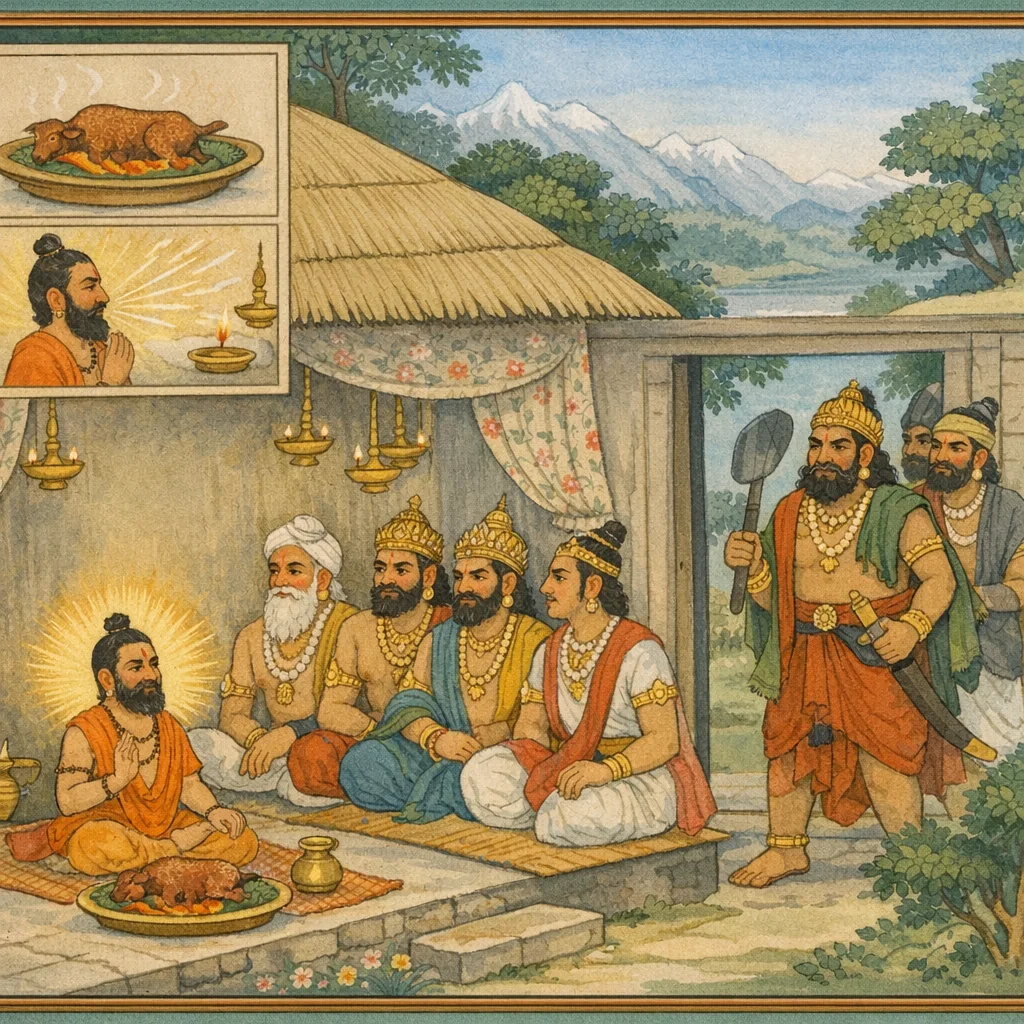
इस प्रकार श्रीमहाभारत वनपर्वके अन्तर्गत तीर्थयात्रापर्वमें लोमशती र्थयात्राके प्रस॑ंगमें अगस्त्योपाख्यानविषयक अद्ठदानबेवाँ अध्याय पूरा हुआ ॥/ ९८ ॥ हम आय न () हि २ 7 एकोनशततमो<ध्याय: अगस्त्यजीका इल्वलके यहाँ धनके लिये जाना, वातापि तथा इल्वलका वध, लोपामुद्राको पुत्रकी प्राप्ति तथा श्रीरामके द्वारा हरे हुए तेजकी परशुरामजीको तीर्थस्नानद्वारा पुनः प्राप्ति लोगमश उवाच इल्वलस्तान् विदित्वा तु महर्षिसहितान् नृपान् । उपस्थितान् सहामात्यो विषयान्ते हपूजयत्
Lomaśa said: Having learned that those kings—arrived together with great sages—had come, Ilvala, accompanied by his ministers, went to the border of his domain and received them with due honors. The scene underscores the outward forms of hospitality and royal decorum, even as the wider Agastya–Ilvala narrative warns that courtesy can sometimes mask hostile intent.
Verse 2
लोमशजी कहते हैं--राजन्! इल्वलने महर्षिसहित उन राजाओंको आता जान मन्त्रियोंके साथ अपने राज्यकी सीमापर उपस्थित होकर उन सबका पूजन किया ।। तेषां ततो<सुरश्रेष्ठस्त्वातिथ्यमकरोत् तदा । सुसंस्कृतेन कौरव्य भ्रात्रा वातापिना यदा,कुरुनन्दन! उस समय असुरश्रेष्ठ इल्वलने अपने भाई वातापिका मांस राँधकर उसके द्वारा उन सबका आतिथ्य किया
Lomaśa said: “O King! When Ilvala learned that those kings, accompanied by great sages, were approaching, he went with his ministers to the border of his realm, received them there, and honored them all. Then that foremost of Asuras offered them hospitality—O Kaurava—by having his brother Vātāpi, well-prepared (as cooked meat), served to them. Thus, under the outward form of reverence to guests, he concealed a cruel and deceitful intent.”
Verse 3
ततो राजर्षय: सर्वे विषण्णा गतचेतस: । वातापिं संस्कृतं॑ दृष्टवा मेषभूतं महासुरम्,भेड़के रूपमें महान् दैत्य वातापिको ही राँधा गया देख उन सभी राजर्षियोंका मन खिन्न हो गया और वे अचेतसे हो गये
Then all those royal seers, seeing the great demon Vātāpi prepared as cooked food in the form of a ram, became overwhelmed with grief; their minds sank, and they stood as if senseless. The scene underscores how deception and violence, even when disguised as hospitality, can shock the righteous and unsettle the moral order they strive to uphold.
Verse 4
अथाब्रवीदगस्त्यस्तान् राजर्षनृषिसत्तम: । विषादो वो न कर्तव्यो हाहं भोक्ष्ये महासुरम्,तब ऋषिश्रेष्ठ अगस्त्यने उन राजर्षियोंसे (आश्वासन देते हुए) कहा--“तुमलोगोंको चिन्ता नहीं करनी चाहिये। मैं ही इस महादैत्यको खा जाऊँगा।' ऐसा कहकर महर्षि अगस्त्य प्रधान आसनपर जा बैठे और दैत्यराज इल्वलने हँसते हुए-से उन्हें वह मांस परोस दिया
Then the sage Agastya—foremost among royal seers and best of men—addressed them: “You must not give way to despair. I myself shall consume this mighty demon.” Having spoken thus, the great rishi took the chief seat; and Ilvala, the lord of the demons, as though laughing, served him that meat—intending deceit, but meeting Agastya’s fearless resolve.
Verse 5
धुर्यासनमथासाद्य निषसाद महानृषि: । त॑ पर्यवेषद् दैत्येन्द्र इल्वल: प्रहसन्निव,तब ऋषिश्रेष्ठ अगस्त्यने उन राजर्षियोंसे (आश्वासन देते हुए) कहा--“तुमलोगोंको चिन्ता नहीं करनी चाहिये। मैं ही इस महादैत्यको खा जाऊँगा।' ऐसा कहकर महर्षि अगस्त्य प्रधान आसनपर जा बैठे और दैत्यराज इल्वलने हँसते हुए-से उन्हें वह मांस परोस दिया
Having approached the seat of honor, the great sage sat down. Then Ilvala, lord of the Dānavas, as if smiling to himself, served him (the offered meat). The scene underscores the contrast between a demon’s deceitful hospitality and a sage’s fearless composure grounded in spiritual power and protection of others.
Verse 6
अगस्त्य एव कृत्स्नं तु वातापिं बुभुजे ततः । भुक्तवत्यसुरो55ह्लानमकरोत् तस्य चेल्वल:,अगस्त्यजी ही वातापिका सारा मांस खा गये; जब वे भोजन कर चुके, तब असुर इल्वलने वातापिका नाम लेकर पुकारा
Lomaśa said: Agastya alone then consumed Vātāpi entirely. After the sage had finished eating, the asura Ilvala, seeking to mock and harm him, called out to Vātāpi by name—expecting him to burst forth again. The episode underscores how malicious deception aimed at the righteous recoils upon the deceiver, while spiritual power grounded in discipline protects the virtuous.
Verse 7
ततो वायु: प्रादुरभूदधस्तस्य महात्मन: । शब्देन महता तात गर्जन्निव यथा घन:,तात! उस समय महात्मा अगस्त्यकी गुदासे गर्जते हुए मेघकी भाँति भारी आवाजके साथ अधोवायु निकली
Then, from below that great-souled one, a gust of wind suddenly issued forth—O dear one—with a loud sound, roaring like a thundercloud. The narration underscores the extraordinary, even unsettling, physical manifestations that can accompany ascetic power and the testing of restraint, inviting reflection on dignity, self-control, and the limits of spectacle in spiritual life.
Verse 8
वातापे निष्क्रमस्वेति पुन: पुनरुवाच ह । त॑ प्रहस्याब्रवीद् राजन्नगस्त्यो मुनिसत्तम:,इल्वल बार-बार कहने लगा--'वातापे! निकलो-निकलो।” राजन्! तब मुनिश्रेष्ठ अगस्त्यने उससे हँसकर कहा--
Lomaśa said: Ilvala kept calling again and again, “Vātāpi, come out!” Then, O King, the foremost sage Agastya, smiling, replied to him—signaling that Ilvala’s deceit had failed and that the power of tapas and discernment can overturn malicious stratagems.
Verse 9
कुतो निष्क्रमितुं शक्तो मया जीर्णस्तु सो5सुर: । इल्वलस्तु विषण्णो<भूद् दृष्टवा जीर्ण महासुरम्,“अब वह कैसे निकल सकता है, मैंने (लोकहितके लिये) उस असुरको पचा लिया है।' महादैत्य वातापिको पच गया देख इल्चलको बड़ा खेद हुआ
Lomaśa said: “How could that demon possibly come out? I have digested him (for the welfare of the world).” Seeing the mighty demon Vātāpi thus digested, Ilvala was overcome with grief and dejection. The episode underscores the ethical force of a sage’s tapas used to restrain predatory violence and protect society.
Verse 10
प्राउजलिश्न सहामात्यैरिदं वचनमब्रवीत् | किमर्थमुपयाता: स्थ ब्रूत कि करवाणि व:,उसने मन्त्रियोंसहित हाथ जोड़कर उन अतिथियोंसे यह बात पूछी--“आपलोग किस प्रयोजनसे यहाँ पधारे हैं, बताइये, मैं आपलोगोंकी क्या सेवा करूँ?”
Lomaśa said: With palms joined in respectful greeting, he addressed the visitors in the presence of his ministers: “For what purpose have you come here? Tell me—what service may I render to you?” The verse highlights the ethic of hospitality: a host first honors guests, then inquires into their needs with humility and readiness to help.
Verse 11
प्रत्युवाच ततो5गस्त्य: प्रहसन्निल्चलं तदा । ईशं हासुर विद्मस्त्वां वयं सर्वे धनेश्वरम्,तब महर्षि अगस्त्यने हँ-कर इल्वलसे कहा--“असुर! हम सब लोग तुम्हें शक्तिशाली शासक एवं धनका स्वामी समझते हैं
Then Agastya replied, smiling calmly: “O Asura Ilvala, we all know you as a mighty ruler and the lord of wealth.” The sage’s composed laughter signals moral confidence—he is not intimidated by power or riches, and his words subtly expose the Asura’s pride as something a wise person can see through without fear.
Verse 12
एते च नातिधनिनो धनार्थश्च॒ महान् मम । यथाशव]त्यविहिंस्यान्यान् संविभागं प्रयच्छ न:,'ये नरेश अधिक धनवान् नहीं हैं और मुझे बहुत धनकी आवश्यकता आ पड़ी है। अतः दूसरे जीवोंको कष्ट न देते हुए अपने धनमेंसे यथाशक्ति कुछ भाग हमें दो”
Lomasha said: “These people are not excessively wealthy, yet my need for wealth has become great. Therefore, without harming other living beings, give us—according to your ability—a share from your possessions.”
Verse 13
ततो$भिवाद्य तमृषिमिल्वलो वाक्यमब्रवीत् । दित्सितं यदि वेत्सि त्वं ततो दास्यामि ते वसु,तब इल्वलने महर्षिको प्रणाम करके कहा--'मैं कितना धन देना चाहता हूँ? यह बात यदि आप जान लें तो मैं आपको धन दूँगा"
Then Ilvala, having respectfully saluted that sage, spoke these words: “If you can discern what I intend to give, then I will grant you wealth.” In the narrative context, the offer is framed as a test of insight and a challenge to the ascetic’s spiritual discernment, hinting at the ethical tension between apparent generosity and concealed motive.
Verse 14
अगस्त्य उवाच गवां दशसहस्त्राणि राज्ञामेकेकशो5सुर । तावदेव सुवर्णस्य दित्सितं ते महासुर,अगस्त्यजीने कहा--महान् असुर! तुम इनमेंसे एक-एक राजाको दस-दस हजार गौएँ तथा इतनी ही (दस-दस हजार) सुवर्णमुद्राएँ देना चाहते हो
Agastya said: “O Asura, you intend to give each king ten thousand cows, and an equal amount of gold as well, O great Asura.” The statement highlights the scale of intended generosity and frames it as a deliberate act of giving, raising ethical questions about wealth, merit, and the proper aims of donation.
Verse 15
महां ततो वै द्विगुणं रथश्वैव हिरण्मय: । मनोजवोौ वाजिनौ च दित्सितं ते महासुर,इन राजाओंकी अपेक्षा दूनी गौएँ और सुवर्ण-मुद्राएँ तुमने मेरे लिये देनेका विचार किया है। महादैत्य! इसके सिवा एक स्वर्णमय रथ, जिसमें मनके समान तीव्रगामी दो घोड़े जुते हों, तुम मुझे और देना चाहते हो
Agastya said: “Moreover, you have resolved to give me gifts twice as great as those offered by those kings—cows and gold coins. And, O mighty Asura, you also intend to give me a golden chariot, yoked with two horses swift as the mind.”
Verse 16
(लोमश उवाच इल्वलस्तु मुनि प्राह सर्वमस्ति यथा55तथ माम् | रथं तु यमवोचो मां नैनं विद्यो हिरण्मयम् ।। लोमशजी कहते हैं--राजन्! इसपर इल्वलने अगस्त्य मुनिसे कहा कि “आपने मुझसे जो कुछ कहा है, वह सब सत्य है; किंतु आपने जो मुझसे रथकी बात कही है, उस रथको हमलोग सुवर्णमय नहीं समझते हैं'। अगस्त्य उवाच न मे वागनृता काचिदुक्तपूर्वा महासुर ।) जिज्ञास्यतां रथ: सद्यो व्यक्त एष हिरण्मय: । अगस्त्यजीने कहा--महादैत्य! मेरे मुँहसे पहले कभी कोई बात झूठी नहीं निकली है, अतः शीघ्र पता लगाओ, यह रथ निश्चय ही सोनेका है ।। लोगमश उवाच जिज्ञास्यमान: स रथ: कौन्तेयासीद्धिरण्मय: । ततः प्रव्यथितो दैत्यो ददावभ्यधिकं वसु,लोमशजी कहते हैं--कुन्तीनन्दन युधिष्ठिर! पता लगानेपर वह रथ सोनेका ही निकला, तब मनमें (भाईकी मृत्युसे) व्यथित हुए उस दैत्यने महर्षिको बहुत अधिक धन दिया
Lomaśa said: Ilvala replied to the sage, “Everything you have told me is true; but about the chariot you mentioned— we do not recognize it as made of gold.” Agastya said: “Great Asura, no word spoken by me has ever been false. Examine it at once—this chariot is indeed manifestly golden.” Lomaśa said: When it was tested, that chariot, O son of Kuntī, proved to be of gold. Then the Daitya, shaken with distress, bestowed even greater wealth upon the sage.
Verse 17
विरावश्व सुरावश्व तस्मिन् युक्तौ रथे हयौ | ऊहतुः सवसूनाशु तावगस्त्याश्रमं प्रति,उस रथमें विराव और सुराव नामक दो घोड़े जुते हुए थे। वे धनसहित राजाओं तथा अगस्त्य मुनिको शीघ्र ही मानो पलक मारते ही अगस्त्याश्रमकी ओर ले भागे। उस समय इल्वल असुरने अगस्त्य मुनिके पीछे जाकर उनको मारनेकी इच्छा की, परंतु महातेजस्वी अगस्त्यमुनिने उस महादैत्य इल्वलको हुंकारसे ही भस्म कर दिया। तदनन्तर उन वायुके समान वेगवाले घोड़ोंने उन सबको मुनिके आश्रमपर पहुँचा दिया। भरतनन्दन! फिर अगस्त्यजीकी आज्ञा ले वे राजर्षिगण अपनी-अपनी राजधानीको चले गये और महर्षिने लोपामुद्राकी सभी इच्छाएँ पूर्ण कीं
Lomasha said: In that chariot were yoked two horses named Virāva and Surāva. Swiftly they bore those kings—together with their treasures—toward the hermitage of Agastya, as if in the blink of an eye. In the same episode, Ilvala the asura pursued Agastya with the intent to kill him, but the mighty sage reduced that great demon to ashes by a mere roar. Then those wind-swift horses brought them all to the sage’s āśrama. After receiving Agastya’s permission, the royal seers returned to their respective capitals, and the great ṛṣi fulfilled all of Lopāmudrā’s wishes.
Verse 18
सर्वान् राज्ञ: सहागस्त्यान् निमेषादिव भारत । (इल्वलस्त्वनुगम्यैनमगस्त्यं हन्तुमैच्छत । भस्म चक्रे महातेजा हुंकारेण महासुरम् ।। मुनेराश्रममश्चौ तौ निन्यतुर्वातरंहसौ ।) अगस्त्येनाभ्यनुज्ञाता जग्मू राजर्षयस्तदा । कृतवांश्व मुनि: सर्व लोपामुद्राचिकीर्षितम्,उस रथमें विराव और सुराव नामक दो घोड़े जुते हुए थे। वे धनसहित राजाओं तथा अगस्त्य मुनिको शीघ्र ही मानो पलक मारते ही अगस्त्याश्रमकी ओर ले भागे। उस समय इल्वल असुरने अगस्त्य मुनिके पीछे जाकर उनको मारनेकी इच्छा की, परंतु महातेजस्वी अगस्त्यमुनिने उस महादैत्य इल्वलको हुंकारसे ही भस्म कर दिया। तदनन्तर उन वायुके समान वेगवाले घोड़ोंने उन सबको मुनिके आश्रमपर पहुँचा दिया। भरतनन्दन! फिर अगस्त्यजीकी आज्ञा ले वे राजर्षिगण अपनी-अपनी राजधानीको चले गये और महर्षिने लोपामुद्राकी सभी इच्छाएँ पूर्ण कीं
Lomaśa said: “O Bhārata, in the blink of an eye they carried all the kings together with Agastya. Ilvala the asura followed after Agastya, desiring to kill him; but the great-splendoured sage reduced that mighty demon to ashes merely with a thunderous utterance. Then those two horses, swift as the wind, brought them to the hermit’s āśrama. Having received Agastya’s permission, the royal sages then departed to their own capitals; and the great seer fulfilled all that Lopāmudrā wished to have done.” Ethically, the passage underscores the protective power of tapas and spiritual authority: aggression driven by hostility is checked not by brute force but by the sage’s inner potency and restraint, after which social order is restored as the kings return to their rightful duties.
Verse 19
लोपामुद्रोवाच कृतवानसि तत् सर्व भगवन् मम काड्क्षितम् । उत्पादय सकृन्मह्ममपत्यं वीर्यवत्तरम्,लोपामुद्रा बोली--भगवन्! मेरी जो-जो अभिलाषा थी, वह सब आपने पूर्ण कर दी। अब मुझसे एक अत्यन्त शक्तिशाली पुत्र उत्पन्न कीजिये
Lopāmudrā said: “Revered one, you have fulfilled everything I longed for. Now, grant me—just once—a child of great vigor.” In the narrative, her request frames progeny not as mere desire but as a dharmic continuation of household life after austerity and restraint have been honored.
Verse 20
अगस्त्य उवाच तुष्टो*हमस्मि कल्याणि तव वृत्तेन शोभने । विचारणामपत्ये तु तव वक्ष्यामि तां शृणु,अगस्त्यजीने कहा--शोभामयी कल्याणी! तुम्हारे सद्व्यवहारसे मैं बहुत संतुष्ट हूँ। पुत्रके सम्बन्धमें तुम्हारे सामने एक विचार उपस्थित करता हूँ, सुनो
Agastya said: “Auspicious lady, radiant one, I am pleased with you because of your conduct. Now, regarding the matter of offspring, I shall place a considered proposal before you—listen to it.”
Verse 21
सहसंरं तेअस्तु पुत्राणां शतं वा दशसम्मितम् । दश वा शततुल्या: स्युरेको वापि सहस्रजित्,क्या तुम्हारे गर्भसे एक हजार या एक सौ पुत्र उत्पन्न हों, जो दसके ही समान हों? अथवा दस ही पुत्र हों, जो सौ पुत्रोंकी समानता करनेवाले हों? अथवा एक ही पुत्र हो, जो हजारोंको जीतनेवाला हो?
Agastya said: “May you have a thousand sons; or a hundred sons equal in worth to ten; or ten sons who are the equal of a hundred; or even a single son who can conquer a thousand.” In this blessing, the sage emphasizes that true strength lies not merely in numbers, but in excellence, capability, and the power to uphold one’s lineage and duties.
Verse 22
लोपामुद्रोवाच सहस्नसम्मित: पुत्र एको<प्यस्तु तपोधन । एको हि बहुभि: श्रेयान् विद्वान् साधुरसाधुभि:,लोपामुद्रा बोली--तपोधन! मुझे सहस्रोंकी समानता करनेवाला एक ही श्रेष्ठ पुत्र प्राप्त हो; क्योंकि बहुत-से दुष्ट पुत्रोंकी अपेक्षा एक ही विद्दान् एवं श्रेष्ठ पुत्र उत्तम माना गया है
Lopāmudrā said: “O ascetic rich in austerity, let me have even a single son who is equal to a thousand. For one wise and virtuous son is truly better than many sons who are unworthy.”
Verse 23
लोगश उवाच स तथेति प्रतिज्ञाय तया समभवन्मुनि: । समये समशीलिन्या श्रद्धावाउ्छुद्दधधानया,लोमशजी कहते हैं--राजन्! तब “तथास्तु” कहकर श्रद्धालु महात्मा अगस्त्यने समान शील-स्वभाववाली श्रद्धालु पत्नी लोपामुद्राके साथ यथासमय समागम किया
Lomaśa said: “O King, having pledged ‘So be it,’ the sage acted accordingly. In due season he united with his wife—one whose conduct and disposition matched his own—she being faithful and steadfast in her devoted resolve.”
Verse 24
तत आधाय गर्भ तमगमद् वनमेव स: । तस्मिन् वनगते गर्भो ववृधे सप्त शारदान्,गर्भाधान करके अगस्त्यजी फिर वनमें ही चले गये। उनके वनमें चले जानेपर वह गर्भ सात वर्षोंतक माताके पेटमें ही पलता और बढ़ता रहा
After begetting that embryo, he departed again for the forest. Once he had gone to the forest, the embryo continued to grow within the mother’s womb for seven autumns (seven years), indicating an extraordinary gestation shaped by ascetic power and destiny rather than ordinary human measure.
Verse 25
सप्तमेडब्दे गते चापि प्राच्यवत् स महाकवि: । ज्वलन्निव प्रभावेण दृढस्युर्नाम भारत,भारत! सात वर्ष बीतनेपर अपने तेज और प्रभावसे प्रज्वलित होता हुआ वह गर्भ उदरसे बाहर निकला। वही महादिद्दान् दृढस्युके नामसे विख्यात हुआ
When the seventh year had also passed, that great poet—radiant in power and splendor as though blazing—came forth from the womb in the manner of those of old. O Bhārata, he became renowned by the name Dṛḍhasyu.
Verse 26
साड्रोपनिषदान् वेदाञ्जपन्निव महातपा: । तस्य पुत्रो5$भवदृषे: स तेजस्वी महाद्विज:,महर्षिका वह महातपस्वी और तेजस्वी पुत्र जन्म-कालसे ही अंग और उपनिषदोंसहित सम्पूर्ण वेदोंका स्वाध्याय-सा करता जान पड़ा। दृढस्यु ब्राह्मणोंमें महान् माने गये
Lomaśa said: That great ascetic’s son was born as a radiant, eminent Brahmin. From the very time of his birth he appeared as though he were continuously reciting the Vedas together with their auxiliaries and the Upaniṣads—an image of innate spiritual discipline and inherited sacred learning.
Verse 27
स बाल एव तेजस्वी पितुस्तस्य निवेशने । इध्मानां भारमाजद्ठे इध्मवाहस्ततो5भवत्,पिताके घरमें रहते हुए तेजस्वी दृढस्यु बाल्य-कालसे ही इध्म (समिधा)-का भार वहन करके लाने लगे; अतः “इध्मवाह” नामसे विख्यात हो गये
Even while still a boy, he lived in his father’s household with innate brilliance and vigor. From childhood he would carry heavy loads of firewood (fuel-sticks) for the household; therefore he became well known by the name “Idhmavāha,” the bearer of fuel. The episode highlights disciplined service and humble labor as a foundation for character and later renown.
Verse 28
तथायुक्तं तु तं दृष्टवा मुमुदे स मुनिस्तदा । एवं स जनयामास भारतापत्यमुत्तमम्,अपने पुत्रको स्वाध्याय और समिधानयनके कार्यमें संलग्न देख महर्षि अगस्त्य उस समय बहुत प्रसन्न हुए। भारत! इस प्रकार अगस्त्यजीने उत्तम संतान उत्पन्न की
Seeing his son properly engaged in sacred study and in the duty of gathering fuel for the ritual fire, the sage rejoiced greatly at that time. Thus, O Bhārata, Agastya brought forth an excellent offspring—one shaped by discipline, learning, and service.
Verse 29
लेभिरे पितरश्नलास्य लोकान् राजन् यथेप्सितान् । तत ऊर्ध्वमयं ख्यातस्त्वगस्त्यस्याश्रमो भुवि,राजन्! तदनन्तर उनके पितरोंने मनोवांछित लोक प्राप्त कर लिये। उसके बादसे यह स्थान इस पृथ्वीपर अगस्त्याश्रमके नामसे विख्यात हो गया
O King, their forefathers attained the worlds they had desired. From that time onward, this very spot became renowned on earth as the hermitage of Agastya. The passage underscores the moral logic that ancestral welfare and lasting sacred renown follow from rightly performed deeds and the sanctity of a sage’s abode.
Verse 30
प्राह्नादिरेवं वातापिरगस्त्येनोपशामित: । तस्यायमाश्रमो राजन् रमणीयैर्गुणैर्युत:,वातापि प्रह्नादके गोत्रमें उत्पन्न हुआ था, जिसे अगस्त्यजीने इस प्रकार शान्त कर दिया। राजन! यह उन्हींका रमणीय गुणोंसे युक्त आश्रम है
Thus was Vātāpi—born in the lineage of Prahlāda—subdued and brought to peace by the sage Agastya. O King, this is that very hermitage of his, endowed with delightful and auspicious qualities. The passage recalls how destructive power is restrained by ascetic discipline, and it frames the āśrama as a moral landscape shaped by tapas and self-control.
Verse 31
एषा भागीरथी पुण्या देवगन्धर्वसेविता । वातेरिता पताकेव विराजति नभस्तले,इसके-समीप यह वही देव-गन्धर्वसेवित पुण्यसलिला भागीरथी है, जो आकाशमें वायुकी प्रेरणासे फहरानेवाली श्वेत पताकाके समान सुशोभित हो रही है
“Here is the holy Bhāgīrathī (Gaṅgā), frequented and honored by gods and Gandharvas. Driven by the wind, she shines in the expanse of the sky like a fluttering banner—pure, auspicious, and worthy of reverence.”
Verse 32
प्रतार्यमाणा कूटेषु यथा निम्नेषु नित्यश: । शिलातलेषु संत्रस्ता पन्नगेन्द्रवधूरिव,यह क्रमशः नीचे-नीचेके शिखरोंपर गिरती हुई सदा तीव्रगतिसे बहती है और शिलाखण्डोंके नीचे इस प्रकार समायी जाती है, मानो भयभीत सर्पिणी बिलमें घुसी जा रही हो
“As a stream, driven onward, continually rushes down from peak to lower peak and then slips beneath slabs of rock, so she—terrified—seemed to sink away under the stones like the wife of the king of serpents retreating into her burrow.”
Verse 33
दक्षिणां वै दिशं सर्वा प्लावयन्ती च मातृवत् । पूर्व शम्भोर्जटा भ्रष्टा समुद्रमहिषी प्रिया । अस्यां नद्यां सुपुण्यायां यथेष्टमवगाह[ुताम्,पहले भगवान् शंकरकी जटासे गिरकर प्रवाहित होनेवाली समुद्रकी प्रियतमा महारानी गंगा सम्पूर्ण दक्षिण दिशाको इस प्रकार आप्लावित कर रही है, मानो माता अपनी संतानको नहला रही हो। इस परम पवित्र नदीमें तुम इच्छानुसार स्नान करो
“This beloved queen Gaṅgā—dear to the Ocean and formerly fallen from Śambhu’s matted locks—floods and refreshes the whole southern quarter as a mother bathes her children. In this supremely holy river, bathe as you wish.”
Verse 34
युधिष्ठिर निबोधेदं त्रिषु लोकेषु विश्रुतम् । भृगोस्तीर्थ महाराज महर्षिगणसेवितम्
“Yudhiṣṭhira, understand this—renowned throughout the three worlds. O great king, it is the sacred ford of Bhṛgu, frequented and revered by hosts of great seers.”
Verse 35
महाराज युधिष्ठिर! इधर ध्यान दो, यह महर्षि-गणसेवित भृगुतीर्थ है, जो तीनों लोकोंमें विख्यात है ।। यत्रोपस्पृष्टवान् रामो हृतं तेजस्तदा55प्तवान् । अत्र त्वं भ्रातृभि: सार्थ कृष्णया चैव पाण्डव,जहाँ परशुरामजीने स्नान किया और उसी क्षण अपने खोये हुए तेजको पुनः प्राप्त कर लिया। पाण्डुनन्दन! तुम अपने भाइयों और द्रौपदीके साथ इसमें स्नान करके दुर्योधनद्वारा छीने हुए अपने तेजको पुनः प्राप्त कर सकते हो। जैसे दशरथनन्दन श्रीरामसे वैर करनेपर उनके द्वारा अपहृत हुए तेजको परशुरामने यहाँ स्नानके प्रभावसे पुनः पा लिया था
Lomasa said: “O great king Yudhiṣṭhira, attend here: this is Bhṛgu’s sacred ford, frequented by hosts of seers and renowned throughout the three worlds. Here Rāma (Paraśurāma) once bathed and, in that very moment, regained the splendor that had been taken from him. So too, O Pāṇḍava, you—together with your brothers and with Kṛṣṇā (Draupadī)—should bathe here and recover the radiance and royal potency that Duryodhana has wrongfully seized from you.”
Verse 36
दुर्योधनहृतं तेज: पुनरादातुमर्हसि । कृतवैरेण रामेण यथा चोपदहृतं पुनः,जहाँ परशुरामजीने स्नान किया और उसी क्षण अपने खोये हुए तेजको पुनः प्राप्त कर लिया। पाण्डुनन्दन! तुम अपने भाइयों और द्रौपदीके साथ इसमें स्नान करके दुर्योधनद्वारा छीने हुए अपने तेजको पुनः प्राप्त कर सकते हो। जैसे दशरथनन्दन श्रीरामसे वैर करनेपर उनके द्वारा अपहृत हुए तेजको परशुरामने यहाँ स्नानके प्रभावसे पुनः पा लिया था
Lomaśa said: “You should reclaim the splendor that Duryodhana has taken from you. Just as Paraśurāma—after entering into enmity with Rāma—had his radiance taken away and then regained it again (by bathing here), so too, O son of Pāṇḍu, you, together with your brothers and Draupadī, can bathe in this place and recover the lost tejas.”
Verse 37
वैशम्पायन उवाच सतत्र भ्रातृभिश्वैव कृष्णया चैव पाण्डव: । स्नात्वा देवान् पितृश्चिव तर्पपामास भारत,वैशम्पायनजी कहते हैं--जनमेजय! तब राजा युधिष्ठिरने अपने भाइयों और द्रौपदीके साथ उस तीर्थमें स्नान करके देवताओं और पितरोंका तर्पण किया
Vaiśampāyana said: O Bhārata (Janamejaya), there the Pāṇḍava, together with his brothers and with Kṛṣṇā (Draupadī), bathed at that sacred ford and then performed the rites of satisfaction (tarpana) for the gods and the ancestors. The act underscores the exiles’ continued commitment to dharma—honouring divine order and familial lineage even amid hardship.
Verse 38
तस्य तीर्थस्य रूप॑ वै दीप्ताद् दीप्ततरं बभौ । अप्रधृष्यतरश्नासीच्छात्रवाणां नरर्षभ,नरश्रेष्ठ) उस तीर्थमें स्नान कर लेनेपर राजा युधिष्ठिरका रूप अत्यन्त तेजोयुक्त हो प्रकाशमान हो गया। अब वे शत्रुओंके लिये परम दुर्धर्ष हो गये
Vaiśampāyana said: After bathing at that sacred ford, Yudhiṣṭhira’s appearance shone with a brilliance greater than before. Having purified himself there, the bull among men became even more unassailable to his enemies—suggesting that inner purity and merit gained through tīrtha-observance manifests outwardly as moral and royal radiance, strengthening one’s resolve in the face of hostility.
Verse 39
अपृच्छच्चैव राजेन्द्र लोमशं पाण्डुनन्दन: । भगवन् किमर्थ रामस्य हृतमासीद् वपु: प्रभो | कथं प्रत्याहृतं चैव एतदाचक्ष्व पृच्छत:,राजेन्द्र! उस समय पाण्डुनन्दन युधिष्ठिरने महर्षि लोमशसे पूछा--“भगवन्! परशुरामजीके तेजका अपहरण किसलिये किया गया था और प्रभो! वह इन्हें पुन: किस प्रकार प्राप्त हो गया? यह मैं जानना चाहता हूँ। आप कृपा करके इस प्रसंगका वर्णन करें!
Vaiśampāyana said: “O king, the son of Pāṇḍu (Yudhiṣṭhira) questioned the sage Lomaśa: ‘Revered sir, for what reason was Rāma’s (Paraśurāma’s) bodily splendor/energy taken away? And, O lord, how was it regained? Please explain this to me, for I ask to know this episode.’”
Verse 40
लोमश उवाच शृणु रामस्य राजेन्द्र भार्गवस्य च धीमत: । जातो दशरथस्यासीत् पुत्रो रामो महात्मन:,लोमशजीने कहा--राजेन्द्र! तुम दशरथनन्दन श्रीराम तथा परम बुद्धिमान् भृगुनन्दन परशुरामजीका चरित्र सुनो। पूर्वकालमें महात्मा राजा दशरथके यहाँ साक्षात् भगवान् विष्णु अपने ही सच्चिदानन्दमय विग्रहसे श्रीरामरूपमें अवतीर्ण हुए थे। उनके अवतारका उद्देश्य था--पापी रावणका विनाश। अयोध्यामें प्रकट हुए दशरथनन्दन श्रीरामका हम लोग प्राय: दर्शन करते रहते थे
Lomaśa said: “O king, listen to the account of Rāma, and also of the wise Bhārgava. From the great-souled Daśaratha was born his son Rāma.”
Verse 41
विष्णु: स्वेन शरीरेण रावणस्य वधाय वै | पश्यामस्तमयोध्यायां जातं दाशरथिं तत:,लोमशजीने कहा--राजेन्द्र! तुम दशरथनन्दन श्रीराम तथा परम बुद्धिमान् भृगुनन्दन परशुरामजीका चरित्र सुनो। पूर्वकालमें महात्मा राजा दशरथके यहाँ साक्षात् भगवान् विष्णु अपने ही सच्चिदानन्दमय विग्रहसे श्रीरामरूपमें अवतीर्ण हुए थे। उनके अवतारका उद्देश्य था--पापी रावणका विनाश। अयोध्यामें प्रकट हुए दशरथनन्दन श्रीरामका हम लोग प्राय: दर्शन करते रहते थे
Lomaśa said: “Viṣṇu Himself, taking on His own embodied form, was born for the very purpose of slaying Rāvaṇa. There in Ayodhyā we used to behold that son of Daśaratha—Rāma—again and again.”
Verse 42
ऋचीकनन्दनो रामो भार्गवो रेणकासुत: । तस्य दाशरथे: श्रुत्वा रामस्याक्लिष्टकर्मण:,अनायास ही महान् कर्म करनेवाले दशरथकुमार श्रीरामका भारी पराक्रम सुनकर भृगु तथा ऋचीकके वंशज रेणुकानन्दन परशुराम उन्हें देखनेके लिये उत्सुक हो क्षत्रियसंहारक दिव्य धनुष लिये अयोध्यामें आये
Lomaśa said: “Rāma, the son of Reṇukā—Bhārgava, descendant of Ṛcīka—on hearing of the extraordinary prowess of Rāma Dāśarathi, whose deeds were accomplished without strain, became eager to see him.”
Verse 43
कौतूहलान्वितो रामस्त्वयोध्यामगमत् पुनः । धनुरादाय तद् दिव्यं क्षत्रियाणां निबर्हणम्,अनायास ही महान् कर्म करनेवाले दशरथकुमार श्रीरामका भारी पराक्रम सुनकर भृगु तथा ऋचीकके वंशज रेणुकानन्दन परशुराम उन्हें देखनेके लिये उत्सुक हो क्षत्रियसंहारक दिव्य धनुष लिये अयोध्यामें आये
Lomaśa said: Filled with curiosity, Paraśurāma went again to Ayodhyā, taking up that divine bow—an instrument famed for subduing kṣatriyas—eager to see Rāma after hearing of the great prowess of Daśaratha’s son. The episode frames a moral test: true heroism is not mere force, but disciplined power restrained by dharma when confronted by an older, formidable warrior.
Verse 44
जिज्ञासमानो रामस्य वीर्य दाशरथेस्तदा । त॑ वै दशरथ: श्रुत्वा विषयान्तमुपागतम्
Wishing to learn of Rāma Dāśarathi’s prowess, he came at that time to the edge of Daśaratha’s realm; and Daśaratha, hearing of his arrival, took note of the visitor who had reached the frontier. The episode frames rightful kingship as vigilant hospitality: a ruler must be attentive to those who enter his domain, especially when their intent is to test or inquire into the strength and conduct of the royal house.
Verse 45
प्रेषयामास रामस्य राम॑ पुत्र पुरस्कृतम् । स तमभ्यागतं दृष्टवा उद्यतास्त्रमवस्थितम्
Lomaśa said: Rāma dispatched his son to the front as his emissary. Seeing him arrive and stand ready with weapon raised, (the other side) beheld a youth who came not merely with words but with the resolve and preparedness of a warrior—signaling that even a message in such times is carried under the shadow of force and vigilance.
Verse 46
प्रहसन्निव कौन्तेय रामो वचनमत्रवीत् । कृतकाल हि राजेन्द्र धनुरेतन्मया विभो
Smiling, O son of Kuntī, Rāma spoke these words: “O best of kings, O mighty one—this bow has been fashioned by me at the proper time.”
Verse 47
समारोपय यत्नेन यदि शक््नोषि पार्थिव । उनके शुभागमनका उद्देश्य था दशरथनन्दन श्रीरामके बल-पराक्रमकी परीक्षा करना। महाराज दशरथने जब सुना कि परशुरामजी हमारे राज्यकी सीमापर आ गये हैं, तब उन्होंने मुनिकी अगवानीके लिये अपने पुत्र श्रीरामको भेजा। कुन्तीनन्दन! श्रीरामचन्द्रजी धनुष- बाण हाथमें लिये आकर खड़े हैं, यह देखकर परशुरामजीने हँसते हुए कहा--'राजेन्द्र! प्रभो! भूपाल! यदि तुममें शक्ति हो तो यत्नपूर्वक इस धनुषपर प्रत्यज्चा चढ़ाओ। यह वह धनुष है जिसके द्वारा मैंने क्षत्रियोंका संहार किया है” || ४४-४६ $ ।। इत्युक्तस्त्वाह भगवंस्त्वं नाधिक्षेप्तुमहसि
Lomaśa said: “O king, if you are able, then with careful effort string this bow.” When this was said, the venerable one replied, “You ought not to speak to me in a disparaging or insulting way.”
Verse 48
उनके ऐसा कहनेपर श्रीरामचन्द्रजीने कहा--“भगवन्! आपको इस तरह आक्षेप नहीं करना चाहिये ।। नाहमप्यधमो धर्मे क्षत्रियाणां द्विजातिषु । इक्ष्वाकूणां विशेषेण बाहुवीर्यें न कत्थनम्,“मैं भी समस्त द्विजातियोंमें क्षत्रियरर्मका पालन करनेमें अधम नहीं हूँ। विशेषतः इक्ष्वाकुवंशी क्षत्रिय अपने बाहुबलकी प्रशंसा नहीं करते”
When he had spoken thus, Śrī Rāmacandra replied: “Revered sir, you should not reproach me in this manner. I am not inferior in upholding the kṣatriya’s dharma among the twice-born. And especially among the Ikṣvāku lineage, kṣatriyas do not boast of the strength of their arms.”
Verse 49
तमेवंवादिनं तत्र रामो वचनमत्रवीत् | अलं वै व्यपदेशेन धनुरायच्छ राघव,श्रीरामचन्द्रजीके ऐसा कहनेपर परशुरामजी बोले--“रघुनन्दन! बातें बनानेकी कोई आवश्यकता नहीं। यह धनुष लो और इसपर प्रत्यज्चा चढ़ाओ'
As he spoke in that manner there, Rāma addressed him: “Enough of mere claims and self-advertisement. Take up the bow, O Rāghava, and string it.” The moment underscores a dharmic preference for disciplined action and verifiable conduct over boastful speech.
Verse 50
ततो जग्राह रोषेण क्षत्रियर्षभसूदनम् । रामो दाशरअथिर्दिव्यं हस्तादू रामस्य कार्मुकम्,तब दशरथनन्दन श्रीरामजीने रोषपूर्वक परशुरामका वह वीर क्षत्रियोंका संहारक दिव्य धनुष उनके हाथसे ले लिया। भारत! उन्होंने लीलापूर्वक प्रत्यज्चा चढ़ा दी। तत्पश्चात् पराक्रमी श्रीरामचन्द्रजीने मुसकराते हुए धनुषकी टंकार फैलायी
Then, in a surge of righteous anger, Rāma, the son of Daśaratha—he who had once humbled the foremost of kṣatriyas—took from Paraśurāma’s hand the divine bow. O Bhārata, with effortless mastery he strung it, and thereafter the valiant Śrī Rāmacandra, smiling, let its resonant twang spread far and wide—an ethical warning that power must be restrained by dharma, and that pride, even in a mighty ascetic-warrior, must yield before rightful conduct.
Verse 51
धनुरारोपयामास सलील इव भारत । ज्याशब्दमकरोच्चैव स्मयमान: स वीर्यवान्,तब दशरथनन्दन श्रीरामजीने रोषपूर्वक परशुरामका वह वीर क्षत्रियोंका संहारक दिव्य धनुष उनके हाथसे ले लिया। भारत! उन्होंने लीलापूर्वक प्रत्यज्चा चढ़ा दी। तत्पश्चात् पराक्रमी श्रीरामचन्द्रजीने मुसकराते हुए धनुषकी टंकार फैलायी
Lomaśa said: “O Bhārata, that mighty hero strung the bow as effortlessly as if in play. Smiling, he then produced the resonant twang of the bowstring.” In ethical and narrative context, the verse highlights controlled power: strength is displayed without loss of composure, suggesting mastery over anger and skill governed by purpose rather than vanity.
Verse 52
तस्य शब्दस्य भूतानि वित्रसन्त्यशनेरिव । अथाब्रवीत् तदा रामो रामं॑ दाशरथिस्तदा
At the sound of that cry, living beings were struck with fear, as if by a thunderbolt. Then, at that very moment, Rāma—Daśaratha’s son—spoke to Rāma.
Verse 53
इदमारोपितं ब्रह्मन् किमन्यत् करवाणि ते । तस्य रामो ददौ दिव्यं जामदग्न्यो महात्मन: । शरमाकर्णदेशान्तमयमाकृष्यतामिति
Lomaśa said: “O Brāhmaṇa, this has been mounted (and made ready). What else shall I do for you? Then Rāma Jāmadagnya, that great-souled one, gave him a divine arrow, saying, ‘Let this be drawn back up to the region of the ear (to full draw).’”
Verse 54
बिजलीकी गड़गड़ाहटके समान उस टंकार-ध्वनिको सुनकर सब प्राणी घबरा उठे। उस समय दशरथनन्दन श्रीरामने परशुरामजीसे कहा--“ब्रह्मन! यह धनुष तो मैंने चढ़ा दिया अब और आपका कौन-सा कार्य करूँ?” तब जमदग्निनन्दन परशुरामने महात्मा श्रीरामचन्द्रजीको एक दिव्य बाण दे दिया और कहा--“इसे धनुषपर रखकर अपने कानके पासतक खींचिये” ।। लोगश उवाच एतच्छुत्वाब्रवीद् राम: प्रदीप्त इव मन्युना । श्रूयते क्षम्यते चैव दर्पपूर्णोईसि भार्गव,लोमशजी कहते हैं--राजन्! इतना सुनते ही श्रीरामचन्द्रजी मानो क्रोधसे प्रज्वलित हो उठे और बोले--'भृगुनन्दन! तुम बड़े घमण्डी हो। मैं तुम्हारी कठोर बातें सुनता हूँ फिर क्षमा कर लेता हूँ
Lomaśa said: Hearing this, Rāma spoke as if blazing with anger: “Bhārgava (descendant of Bhṛgu), you are full of pride. I have listened to your harsh words and yet I have borne them with forbearance.”
Verse 55
त्वया हाुधिगतं तेज: क्षत्रियेभ्यो विशेषत: । पितामहप्रसादेन तेन मां क्षिपसि श्रुवम्,“तुमने अपने पितामह ऋचीकके प्रभावसे क्षत्रियोंको जीतकर विशेष तेज प्राप्त किया है, निश्चय ही, इसीलिये मुझपर आक्षेप करते हो
Lośa said: “Through your grandfather’s favor you have gained extraordinary prowess—especially over the kṣatriyas. It is surely because of that acquired brilliance that you now cast reproaches at me.”
Verse 56
पश्य मां स्वेन रूपेण चक्षुस्ते वितराम्पहम् । ततो रामशरीरे वै राम: पश्यति भार्गव:,"लो! मैं तुम्हें दिव्यदृष्टि देता हूँ। उसके द्वारा मेरे यथार्थ स्वरूपका दर्शन करो।' तब भुगुवंशी परशुरामजीने श्रीरामचन्द्रजीके शरीरमें बारह आदित्य, आठ वसु, ग्यारह रुद्र, साध्य देवता, उनचास मरुद्गण, पितृगण, अग्निदेव, नक्षत्र, ग्रह, गन्धर्व, राक्षस, यक्ष, नदियाँ, तीर्थ, सनातन ब्रह्मभूत बालखिल्य ऋषि, देवर्षि, सम्पूर्ण समुद्र, पर्वत, उपनिषदोंसहित वेद, वषट्कार, यज्ञ, साम और धरनुर्वेद, इन सभीको चेतनरूप धारण किये हुए प्रत्यक्ष देखा। भरतनन्दन युधिष्ठिर! मेघोंके समूह, वर्षा और विद्युत्का भी उनके भीतर दर्शन हो रहा था
“Behold me in my own true form; I grant you divine sight.” Thereupon, within Rāma’s very body, Bhārgava Paraśurāma beheld Rāma’s cosmic reality—Adityas, Vasus, Rudras, Sādhyas, the hosts of Maruts, the Pitṛs, Agni, the constellations and planets, Gandharvas, Rākṣasas, Yakṣas, rivers and sacred fords, the eternal Brahman-natured sages such as the Bālakhilyas and the divine seers, the oceans and mountains, the Vedas with the Upaniṣads, sacrificial formulas and rites, Sāman chants and the science of archery—everything appearing as living, conscious presences within him. Even masses of clouds, rain, and lightning were seen within that vision. The episode frames divine power as subordinate to dharma: true authority is revealed not by force, but by the manifestation of the cosmic order embodied in the righteous one.
Verse 57
आदित्यान् सवसून् रुद्रान् साध्यांश्व समरुद्रणान् । पितरो हुताशनश्लैव नक्षत्राणि ग्रहास्तथा,"लो! मैं तुम्हें दिव्यदृष्टि देता हूँ। उसके द्वारा मेरे यथार्थ स्वरूपका दर्शन करो।' तब भुगुवंशी परशुरामजीने श्रीरामचन्द्रजीके शरीरमें बारह आदित्य, आठ वसु, ग्यारह रुद्र, साध्य देवता, उनचास मरुद्गण, पितृगण, अग्निदेव, नक्षत्र, ग्रह, गन्धर्व, राक्षस, यक्ष, नदियाँ, तीर्थ, सनातन ब्रह्मभूत बालखिल्य ऋषि, देवर्षि, सम्पूर्ण समुद्र, पर्वत, उपनिषदोंसहित वेद, वषट्कार, यज्ञ, साम और धरनुर्वेद, इन सभीको चेतनरूप धारण किये हुए प्रत्यक्ष देखा। भरतनन्दन युधिष्ठिर! मेघोंके समूह, वर्षा और विद्युत्का भी उनके भीतर दर्शन हो रहा था
Lomaśa said: “(Within that divine form) he beheld the Ādityas, the Vasus, the Rudras, the Sādhyas together with the hosts of Maruts; the Pitṛs and Agni as well; and also the constellations and the planets.” In narrative context, the passage underscores a vision of cosmic order: the gods, ancestral powers, and celestial regulators are seen as integrated within a single, living reality—suggesting that dharma is grounded in recognizing the unity and hierarchy of the cosmos rather than in mere outward power.
Verse 58
गन्धर्वा राक्षसा यक्षा नद्यस्तीर्थानि यानि च । ऋषयो बालखिल्याश्न ब्रह्म भूता: सनातना:,"लो! मैं तुम्हें दिव्यदृष्टि देता हूँ। उसके द्वारा मेरे यथार्थ स्वरूपका दर्शन करो।' तब भुगुवंशी परशुरामजीने श्रीरामचन्द्रजीके शरीरमें बारह आदित्य, आठ वसु, ग्यारह रुद्र, साध्य देवता, उनचास मरुद्गण, पितृगण, अग्निदेव, नक्षत्र, ग्रह, गन्धर्व, राक्षस, यक्ष, नदियाँ, तीर्थ, सनातन ब्रह्मभूत बालखिल्य ऋषि, देवर्षि, सम्पूर्ण समुद्र, पर्वत, उपनिषदोंसहित वेद, वषट्कार, यज्ञ, साम और धरनुर्वेद, इन सभीको चेतनरूप धारण किये हुए प्रत्यक्ष देखा। भरतनन्दन युधिष्ठिर! मेघोंके समूह, वर्षा और विद्युत्का भी उनके भीतर दर्शन हो रहा था
Logaśa said: “Gandharvas, Rākṣasas, and Yakṣas; the rivers and all sacred fords; and the sages—especially the Bālakhilyas—who are eternal beings established in Brahman.” In the narrative context, this line forms part of a sweeping vision in which the hero is shown the entire cosmos—divine classes, sacred geography, and primordial seers—gathered within a single, higher reality, underscoring that true power is grounded in spiritual order rather than mere force.
Verse 59
देवर्षयश्न कार्त्स्न्येन समुद्रा: पर्वतास्तथा । वेदाश्न सोपनिषदों वषट्करै: सहाध्वरै:,"लो! मैं तुम्हें दिव्यदृष्टि देता हूँ। उसके द्वारा मेरे यथार्थ स्वरूपका दर्शन करो।' तब भुगुवंशी परशुरामजीने श्रीरामचन्द्रजीके शरीरमें बारह आदित्य, आठ वसु, ग्यारह रुद्र, साध्य देवता, उनचास मरुद्गण, पितृगण, अग्निदेव, नक्षत्र, ग्रह, गन्धर्व, राक्षस, यक्ष, नदियाँ, तीर्थ, सनातन ब्रह्मभूत बालखिल्य ऋषि, देवर्षि, सम्पूर्ण समुद्र, पर्वत, उपनिषदोंसहित वेद, वषट्कार, यज्ञ, साम और धरनुर्वेद, इन सभीको चेतनरूप धारण किये हुए प्रत्यक्ष देखा। भरतनन्दन युधिष्ठिर! मेघोंके समूह, वर्षा और विद्युत्का भी उनके भीतर दर्शन हो रहा था
Lomaśa said: “And in their entirety the divine seers, the oceans, and the mountains; the Vedas together with the Upaniṣads; and the sacrificial exclamations ‘vaṣaṭ’ along with the rites of sacrifice—(all these) were beheld as present within that wondrous, all-containing form.” In the narrative context, the passage underscores a moral vision: true greatness is not mere power but the capacity to hold the whole order of the world—sages, nature, and sacred knowledge—within a single, conscious reality, inspiring reverence and restraint rather than pride.
Verse 60
चेतोमन्ति च सामानि धरनुर्वेदश्न भारत । मेघवृन्दानि वर्षाणि विद्युतश्न युधिछ्विर,"लो! मैं तुम्हें दिव्यदृष्टि देता हूँ। उसके द्वारा मेरे यथार्थ स्वरूपका दर्शन करो।' तब भुगुवंशी परशुरामजीने श्रीरामचन्द्रजीके शरीरमें बारह आदित्य, आठ वसु, ग्यारह रुद्र, साध्य देवता, उनचास मरुद्गण, पितृगण, अग्निदेव, नक्षत्र, ग्रह, गन्धर्व, राक्षस, यक्ष, नदियाँ, तीर्थ, सनातन ब्रह्मभूत बालखिल्य ऋषि, देवर्षि, सम्पूर्ण समुद्र, पर्वत, उपनिषदोंसहित वेद, वषट्कार, यज्ञ, साम और धरनुर्वेद, इन सभीको चेतनरूप धारण किये हुए प्रत्यक्ष देखा। भरतनन्दन युधिष्ठिर! मेघोंके समूह, वर्षा और विद्युत्का भी उनके भीतर दर्शन हो रहा था
“O Bhārata (descendant of Bharata), the Sāman-chants and the science of archery were seen there as conscious presences; and, O Yudhiṣṭhira, within him were also beheld clusters of clouds, rainfall, and lightning.” In the narrative flow, this verse continues the vision of a cosmic, all-containing form: sacred knowledge, ritual sound, and even the forces of weather appear not as separate phenomena but as living aspects within a single, comprehensive reality—suggesting that dharma and the order of the world are upheld by an integrated, divinely grounded cosmos.
Verse 61
ततः स भगवान् विष्णुस्तं वै बाणं मुमोच ह । शुष्काशनिसमाकीर्ण महोल्काभि श्ष भारत,तदनन्तर भगवान् विष्णुरूप श्रीरामचन्द्रजीने उस बाणको छोड़ा। भारत! उस समय सारी पृथ्वी बिना बादलकी बिजली और बड़ी-बड़ी उल्काओंसे व्याप्त-सी हो उठी। बड़े जोरकी आँधी उठी और सब ओर धूलकी वर्षा होने लगी। फिर मेघोंकी घटा घिर आयी और भूतलपर मूसलाधार वर्षा होने लगी। बार-बार भूकम्प होने लगा। मेघगर्जन तथा अन्य भयानक उत्पातसूचक शब्द गूँजने लगे
Then the Blessed Lord Viṣṇu released that arrow. O Bhārata, at that moment the earth seemed filled with cloudless lightning and great meteors—portents of overwhelming divine force. The scene signals that when a godlike power is set in motion, nature itself responds with fearful omens, underscoring the gravity of the act and its moral consequence.
Verse 62
पांसुवर्षेण महता मेघवर्षश्व भूतलम् । भूमिकम्पैश्न निर्धातिनदिश्व विपुलैरपि,तदनन्तर भगवान् विष्णुरूप श्रीरामचन्द्रजीने उस बाणको छोड़ा। भारत! उस समय सारी पृथ्वी बिना बादलकी बिजली और बड़ी-बड़ी उल्काओंसे व्याप्त-सी हो उठी। बड़े जोरकी आँधी उठी और सब ओर धूलकी वर्षा होने लगी। फिर मेघोंकी घटा घिर आयी और भूतलपर मूसलाधार वर्षा होने लगी। बार-बार भूकम्प होने लगा। मेघगर्जन तथा अन्य भयानक उत्पातसूचक शब्द गूँजने लगे
Lomaśa said: “Then the earth was overwhelmed—first by a great shower of dust, then by torrents of rain from massed clouds. Repeated earthquakes shook the ground, and mighty, ominous sounds—like thunder and other portents—resounded in every direction.”
Verse 63
सरामं विह्नलं कृत्वा तेजश्चाक्षिप्प केवलम् | आगच्छज्ज्वलितो बाणो रामबाहुप्रचोदित:,श्रीरामचन्द्रजीकी भुजाओंसे प्रेरित हुआ वह प्रज्वलित बाण परशुरामजीको व्याकुल करके केवल उनके तेजको छीनकर पुन: लौट आया
The blazing arrow, impelled by Rāma’s mighty arm, struck Paraśurāma with such force that it left him shaken and overwhelmed; yet it did not take his life—only his martial splendor and potency were withdrawn. Having accomplished this measured act, the arrow returned. The episode underscores restraint in the use of power: victory is achieved without needless destruction, and a superior force is exercised within ethical bounds.
Verse 64
स तु विद्धलतां गत्वा प्रतिलभ्य च चेतनाम् । राम: प्रत्यागतप्राण: प्राणमद् विष्णुतेजसम्,परशुरामजी एक बार मूर्च्छित होकर जब पुन: होशमें आये तब मरकर जी उठे हुए मनुष्यकी भाँति उन्होंने विष्णुतेज धारण करनेवाले भगवान् श्रीरामको नमस्कार किया। तत्पश्चात् भगवान् विष्णु श्रीरामकी आज्ञा लेकर वे पुनः महेन्द्रपर्वतपर चले गये। वहाँ भयभीत और लज्जित हो महान् तपस्यामें संलग्न होकर रहने लगे
Having fallen into a stunned, weakened state, he later regained consciousness. Then, as though a man restored to life after death, he bowed in reverence to Lord Rāma, whose life-breath was renewed and who bore the blazing divine energy of Viṣṇu. With Rāma’s permission, he departed again for Mount Mahendra, and there—afraid and ashamed—he took up severe austerities, living in disciplined penance.
Verse 65
विष्णुना सो<भ्यनुज्ञातो महेन्द्रमगमत् पुन: । भीतस्तु तत्र न्यवसद् व्रीडितस्तु महातपा:,परशुरामजी एक बार मूर्च्छित होकर जब पुन: होशमें आये तब मरकर जी उठे हुए मनुष्यकी भाँति उन्होंने विष्णुतेज धारण करनेवाले भगवान् श्रीरामको नमस्कार किया। तत्पश्चात् भगवान् विष्णु श्रीरामकी आज्ञा लेकर वे पुनः महेन्द्रपर्वतपर चले गये। वहाँ भयभीत और लज्जित हो महान् तपस्यामें संलग्न होकर रहने लगे
Having been granted permission by Viṣṇu, he went again to Mount Mahendra. There, the great ascetic remained—fearful and ashamed—dwelling in austerity. The episode underscores the ethical weight of divine restraint: even a mighty warrior-ascetic, once checked by the Lord’s will, accepts correction, withdraws from violence, and turns inward to penance and self-mastery.
Verse 66
ततः संवत्सरे5तीते हृतौजसमवस्थितम् | निर्मदं दु:खितं दृष्टवा पितरो राममनत्रुवन्,तदनन्तर एक वर्ष व्यतीत होनेपर तेजोहीन और अभिमानशून्य होकर रहनेवाले परशुरामको दुःखी देखकर उनके पितरोंने कहा
Then, when a full year had passed, the ancestors saw Rāma (Paraśurāma) living with his vigor drained away—humbled, free from pride, and sunk in sorrow. Moved by his condition, the Pitṛs addressed him, setting the stage for counsel that links inner restraint and repentance with the restoration of right conduct.
Verse 67
पितर ऊचु. न वै सम्यगिदं पुत्र विष्णुमासाद्य वै कृतम् । स हि पूज्यश्व मान्यश्न त्रिषु लोकेषु सर्वदा,पितर बोले--तुमने भगवान् विष्णुके पास जाकर जो बर्ताव किया है वह ठीक नहीं था। वे तीनों लोकोंमें सर्वदा पूजनीय और माननीय हैं
The Fathers said: “My son, what you did after approaching Viṣṇu was not proper. He is ever worthy of worship and honor in all the three worlds.”
Verse 68
गच्छ पुत्र नदीं पुण्यां वधूसरकृताह्वयाम् । तत्रोपस्पृश्य तीर्थेषु पुनर्वपुरवाप्स्यसि,बेटा! अब तुम वधूसर नामक पुण्यमयी नदीके तटपर जाओ। वहाँ तीर्थोंमें स्नान करके पूर्ववत् अपना तेजोमय शरीर पुनः प्राप्त कर लोगे
Logaśa said: “Go, my son, to the sacred river called Vadhūsara. There, after performing purificatory bathing at its holy fords, you will regain your former radiant body.” The instruction frames purification not merely as ritual, but as moral and spiritual restoration through contact with a tīrtha—an ethically charged space where one renews oneself by disciplined action.
Verse 69
दीप्तोदं नाम तत् तीर्थ यत्र ते प्रपितामह: । भृगुर्देवयुगे राम तप्तवानुत्तमं तप:,राम! वह दीप्तोदक नामक तीर्थ है, जहाँ देवयुगमें तुम्हारे प्रपितामह भृगुने उत्तम तपस्या की थी
“That sacred ford is called Dīptoda. There, in the age of the gods, your great‑grandfather Bhṛgu, O Rāma, performed supreme austerities.”
Verse 70
तत् तथा कृतवान् राम: कौन्तेय वचनात् पितु: । प्राप्तवांश्व॒ पुनस्तेजस्तीर्थेंडस्मिन् पाण्डुनन्दन,कुन्तीनन्दन युधिष्ठिर! पितरोंके कहनेसे परशुरामजीने वैसा ही किया। पाण्डुनन्दन! इस तीर्थमें नहाकर पुन: उन्होंने अपना तेज प्राप्त कर लिया
Thus did Rāma (Paraśurāma) act exactly as his forefathers instructed, O son of Kuntī. And here at this sacred ford, O joy of the Pāṇḍus, he bathed and regained his spiritual radiance and power. The passage underscores obedience to ancestral injunctions and the purificatory, restorative force attributed to tīrthas when approached with right intent.
Verse 71
एतदीदृशकं तात रामेणाक्लिष्टकर्मणा । प्राप्तमासीन्महाराज विष्णुमासाद्य वै पुरा,तात महाराज युधिष्छिर! इस प्रकार पूर्वकालमें अनायास ही महान् कर्म करनेवाले परशुराम विष्णुस्वरूप श्रीरामचन्द्रजीसे भिड़कर इस दशाको प्राप्त हुए थे
“Dear child, O great king: in former times this very kind of fate befell (him) when he confronted Rāma—whose deeds are accomplished without strain—having challenged Viṣṇu Himself.”
Verse 99
इति श्रीमहाभारते वनपर्वणि तीर्थयात्रापर्वणि लोमशतीर्थयात्रायां जामदग्न्यतेजोहानिकथने एकोनशततमो<ध्याय:
Thus ends the ninety-ninth chapter of the Vana Parva of the Śrī Mahābhārata, within the section on pilgrimage to sacred fords (Tīrtha-yātrā Parva), in the episode describing the pilgrimage narrated by Lomasha, specifically in the account concerning the diminution or loss of the spiritual splendor (tejas) associated with Jāmadagnya (Paraśurāma).
Frequently Asked Questions
The dilemma concerns action under fear: Indra must decide whether to reassert leadership and employ decisive force despite psychological destabilization and uncertainty about the efficacy and legitimacy of his own act.
The episode implies that order is sustained by both righteous force and inner capital: tejas can be collectively restored through legitimate support, while tapas functions as a foundational substrate of stability that adversarial strategy seeks to erode.
Yes: the counsel explicitly states that all worlds are upheld by tapas; therefore, the removal of tapasvins and dharma-knowers is presented as a first-order tactic for destabilizing the broader moral-cosmic framework.