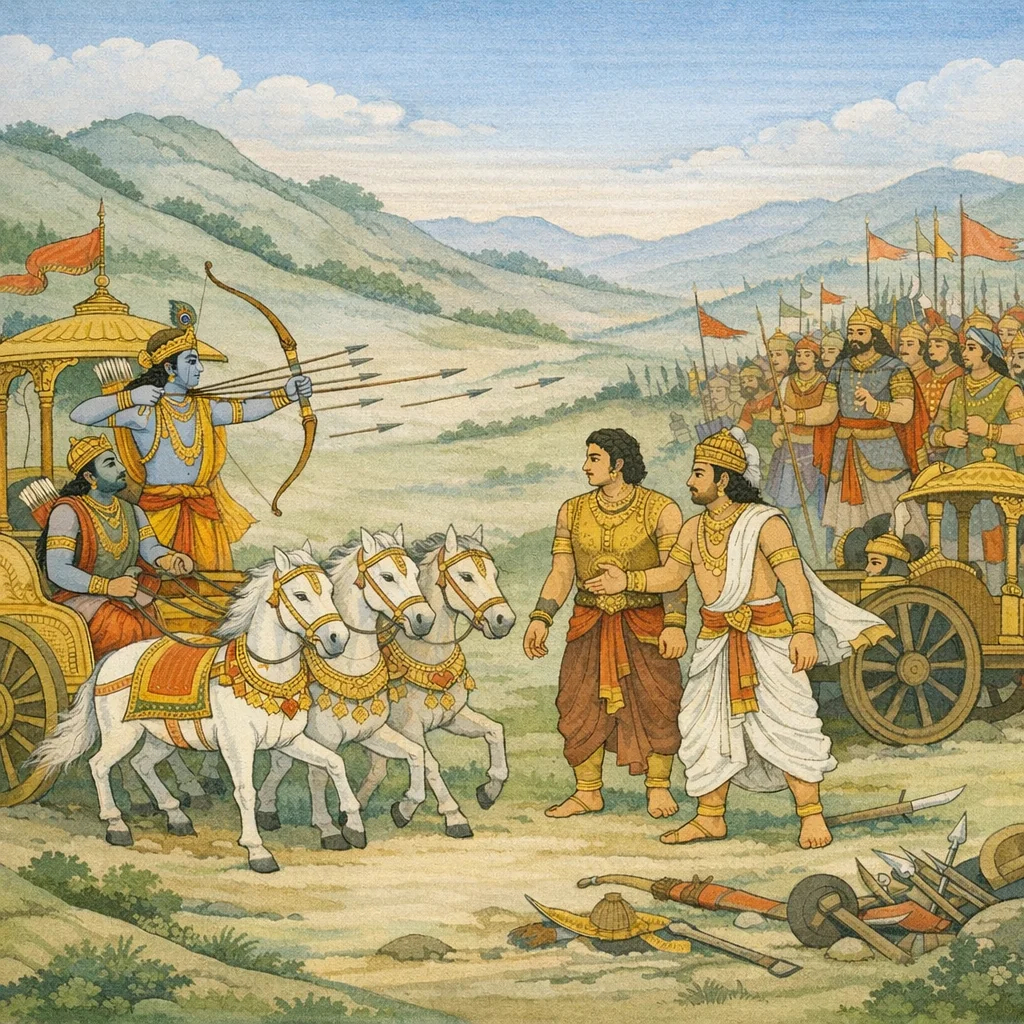
Adhyaya 147
द्रोणकर्णयोः निशि संप्रहारः — Night Engagement with Droṇa and Karṇa
Upa-parva: Rātri-yuddha (Night Battle) Episode within Droṇa-parva
Saṃjaya reports that, seeing his troops routed, Duryodhana becomes intensely agitated and confronts Karṇa and Droṇa with pointed speech, invoking earlier assurances of victory and framing their present posture as insufficient. Stung by his rebuke, the two senior warriors surge into action against the Pandava-aligned fighters (including Śaineya/Sātyaki and allied Somakas), producing heavy pressure on the Pañcāla contingent. The scene shifts into a night battle: darkness and dust obscure identification; torches (pradīpāḥ/ulkāḥ) become moving beacons that attract concentrated attacks; combatants recognize one another by shouted names and gotras. The Pandava side experiences fragmentation and flight, while Kṛṣṇa addresses Arjuna, urging coordinated resistance and reassurance of the army. Bhīma advances with allied forces to help restore the line. The chapter closes with the nocturnal melee intensifying across both sides, emphasizing tactical disorientation and the psychological volatility of night warfare.
Chapter Arc: धृतराष्ट्र, भूरिश्रवा के वध के बाद भी युद्ध की ज्वाला शांत न होने पर, संजय से पूछते हैं—उस क्षण के बाद रण कैसे फिर भड़क उठा? → भूरिश्रवा के परलोकगमन के पश्चात अर्जुन का रथ फिर जयद्रथ की ओर मुड़ता है; अर्जुन कृष्ण से घोड़ों को उसी दिशा में हाँकने को कहता है जहाँ ‘राजा जयद्रथ’ खड़ा है। उधर कौरव-पक्ष में जयद्रथ-रक्षा का संकल्प कठोर होता जाता है—कर्ण को युद्ध-काल का स्मरण कराकर अर्जुन से जयद्रथ को बचाने हेतु अपना पराक्रम दिखाने को उकसाया जाता है। कौरव महारथी रथ-समूहों से मोर्चा बाँधते हैं और रणभूमि में घेराबंदी, प्रतिघेराबंदी का जाल फैलता है। → अर्जुन समस्त योद्धाओं के देखते-देखते अपने ‘पाणिलाघव’ का प्रदर्शन करते हुए बाण-वर्षा से शत्रु-पंक्तियों को ढक देता है; कर्ण भी शरजाल में मोहित होकर कर्तव्य-विमूढ़-सा हो जाता है, उसके घोड़े और सारथी मारे जाते हैं और वह रथहीन हो पड़ता है—क्षण भर को कौरव-रक्षा की धुरी डगमगाती है। → अश्वत्थामा कर्ण को रथ पर बैठाकर पुनः अर्जुन के साथ युद्ध में उतार देता है; कौरव-सेना के श्रेष्ठ महारथी संगठित होकर मोर्चा सँभालते हैं। रण में हाथी-घोड़े गिरते हैं, ध्वज-छत्र-चामर और शिर कटकर बिखरते हैं—पर जयद्रथ तक पहुँचने का अर्जुन का वेग अभी रोका नहीं गया, केवल टाल दिया गया है। → कर्ण के पुनः रथस्थ होते ही अर्जुन के मार्ग में नई दीवार खड़ी होती है—अब जयद्रथ-रक्षा का घेरा टूटेगा या सूर्यास्त से पहले अर्जुन की प्रतिज्ञा संकट में पड़ेगी?
Shlokas
Verse 1
धृतराष्ट्रने पूछा--संजय! उस अवस्थामें कुरुवंशी भूरिश्रवाके मारे जानेपर पुनः: जिस प्रकार युद्ध हुआ, वह मुझे बताओ
Dhṛtarāṣṭra asked: “Sañjaya, after the Kuru prince Bhūriśravā was slain in that condition, tell me how the battle resumed and in what manner it unfolded.”
Verse 2
संजय उवाच भूरिश्रवसि संक्रान्ते परलोकाय भारत । वासुदेवं महाबाहुरर्जुन: समचूचुदत्,संजयने कहा--भारत! भूरिश्रवाके परलोकगामी हो जानेपर महाबाहु अर्जुनने भगवान् श्रीकृष्णको प्रेरित करते हुए कहा--
Sanjaya said: O Bharata (Dhṛtarāṣṭra), when Bhūriśravas had passed on to the other world, the mighty-armed Arjuna urged Vāsudeva (Kṛṣṇa) to act—pressing him forward in the midst of the battle’s moral strain and unfolding consequences.
Verse 3
चोदयाश्वान् भृशं कृष्ण यतो राजा जयद्रथ: । श्रूयते पुण्डरीकाक्ष त्रिषु धर्मेषु वर्तते,“श्रीकृष्ण! जिस ओर राजा जयद्रथ खड़ा है, उसी ओर अब इन घोड़ोंको शीघ्रतापूर्वक हॉकिये। कमलनयन! सुना जाता है कि वह इस समय तीन धर्मोमें विद्यमान है। निष्पाप केशव! मेरी प्रतिज्ञा आप सफल करें। महाबाहो! सूर्यदेव तीव्रणतिसे अस्ताचलकी ओर जा रहे हैं
Sañjaya said: “Urge the horses on swiftly, O Kṛṣṇa, toward the side where King Jayadratha stands. O lotus-eyed one, it is said that at this moment he is abiding within the threefold bounds of dharma.”
Verse 4
प्रतिज्ञां सफलां चापि कर्तुमहसि मेडनघ । अस्तमेति महाबाहो त्वरमाणो दिवाकर:,“श्रीकृष्ण! जिस ओर राजा जयद्रथ खड़ा है, उसी ओर अब इन घोड़ोंको शीघ्रतापूर्वक हॉकिये। कमलनयन! सुना जाता है कि वह इस समय तीन धर्मोमें विद्यमान है। निष्पाप केशव! मेरी प्रतिज्ञा आप सफल करें। महाबाहो! सूर्यदेव तीव्रणतिसे अस्ताचलकी ओर जा रहे हैं
Sanjaya said: O sinless one, you must make my vow come true. O mighty-armed one, the Sun is hastening toward its setting. (Therefore act quickly, so that the pledged deed may be accomplished before nightfall.)
Verse 5
एतद्धि पुरुषव्यात्र महदशभ्युद्यंतं मया । कार्य संरक्ष्यते चैष कुरुसेनामहारथै:,'पुरुषसिंह! मैंने यह बहुत बड़े कार्यके लिये उद्योग आरम्भ किया है। कौरव-सेनाके महारथी इस जयद्रथकी रक्षा कर रहे हैं
Sanjaya said: “O tiger among men, I have undertaken this as a great and formidable enterprise. And this man—Jayadratha—is being guarded in that very task by the great chariot-warriors of the Kuru host.”
Verse 6
तथा नाभ्येति सूर्योडस्तं यथा सत्यं भवेद् वच: । चोदयाश्वांस्तथा कृष्ण यथा हन्यां जयद्रथम्,“श्रीकृष्ण! जबतक सूर्य अस्ताचलको न चले जाय, तभीतक जैसे भी मेरी प्रतिज्ञा सच्ची हो जाय और जैसे भी मैं जयद्रथको मार सकूँ, उसी प्रकार शीघ्रतापूर्वक इन घोड़ोंको हॉकिये'
Verse 7
ततः कृष्णो महाबाहू रजतप्रतिमान् हयान् । हयज्ञश्नोदयामास जयद्रथवध्ध॑ प्रति,तब अभश्वविद्याके ज्ञाता महाबाहु श्रीकृष्णने जयद्रथको मारनेके उद्देश्स्से उसकी ओर चाँदीके समान श्वेत घोड़ोंको हाँका
Sañjaya said: Then Kṛṣṇa, the mighty-armed, urged on the horses—white like silver—driving them forward with the resolve to accomplish Jayadratha’s slaying. In the ethical frame of the battle, this is purposeful action: the charioteer’s skill and steadiness are directed toward a vowed objective, where strategy serves a pledged duty amid war’s moral pressure.
Verse 8
त॑ प्रयान््तममोधघेषुमुत्पतद्धिरिवाशुगै: । त्वरमाणा महाराज सेनामुख्या: समाद्रवन्,महाराज! जिनके बाण कभी व्यर्थ नहीं जाते, उन अर्जुनको धनुषसे छूटे हुए बाणोंके समान उड़ते हुए-से अभश्वोंद्वारा जयद्रथकी ओर जाते देख कौरव-सेनाके प्रधान-प्रधान वीर बड़े वेगसे दौड़े
Verse 9
दुर्योधनश्व कर्णश्र वृषसेनो5थ मद्रराट् । अश्वत्थामा कृपश्चैव स्वयमेव च सैन्धव:,दुर्योधन, कर्ण, वृषसेन, मद्रराज शल्य, अअश्वत्थामा, कृपाचार्य और स्वयं सिंधुराज जयद्रथ--ये सभी युद्धके लिये डट गये
Sañjaya said: Duryodhana and Karṇa, Vṛṣasena and the king of Madra (Śalya), along with Aśvatthāmā and Kṛpa, and Jayadratha of Sindhu himself—all stood firmly resolved for battle. The verse underscores the Kaurava leadership consolidating around martial duty and loyalty, even as the war’s moral weight and consequences intensify.
Verse 10
समासाद्य च बीभत्सु: सैन्धवं समुपस्थितम् । नेत्राभ्यां क्रोधदीप्ताभ्यां सम्प्रैक्षन्निर्दहज्िव,वहाँ उपस्थित हुए सिंधुराजको सामने पाकर अर्जुनने क्रोधसे उद्दीप्त नेत्रोंद्वारा उसे इस प्रकार देखा, मानो जलाकर भस्म कर देंगे
Sañjaya said: Having come face to face with the Saindhava who stood before him, Arjuna (Bībhatsu) fixed him with eyes blazing with wrath, as though he would burn him to ashes by his very gaze. The moment underscores how, in the pressure of war, righteous resolve can harden into consuming anger when a grievous wrong is confronted.
Verse 11
ततो दुर्योधनो राजा राधेयं त्वरितो<ब्रवीत् । अर्जुन प्रेक्ष्य संयातं जयद्रथवर्ध॑ प्रति,तब राजा दुर्योधनने अर्जुनको जयद्रथको मारनेके लिये उसकी ओर जाते देख तुरंत ही राधापुत्र कर्णसे कहा--
Sañjaya said: Then King Duryodhana, in haste, addressed Rādheya (Karna). Seeing Arjuna advancing toward Jayadratha’s protector, Duryodhana spoke at once—seeking to rally Karna to counter Arjuna’s determined charge in the battle where vows, loyalty, and the ethics of protection and pursuit collide.
Verse 12
अयं स वैकर्तन युद्धकालो विदर्शयस्वात्मबलं महात्मन् | यथा न वध्येत रणे<र्जुनेन जयद्रथ: कर्ण तथा कुरुष्व,'सूर्यपुत्र! यही वह युद्धका समय आया है। महात्मन्! तुम इस समय अपना बल दिखाओ। कर्ण! रणभूमिमें अर्जुनके द्वारा जैसे भी जयद्रथका वध न होने पावे, वैसा प्रयत्न करो
Verse 13
अल्पावशेषो दिवसो नृवीर विघातयस्वाद्य रिपुं शरौचै: । दिनक्षयं प्राप्य नरप्रवीर ध्रुवो हि न: कर्ण जयो भविष्यति,“नरवीर! अब दिनका थोड़ा-सा ही भाग शेष है। तुम अपने बाणसमूहोंद्वारा इस समय शत्रुको घायल करके उसके कार्यमें बाधा डालो। मनुष्यलोकके प्रमुख वीर कर्ण! दिन समाप्त होनेपर तो निश्चय ही हमारी विजय हो जायगी
Sañjaya said: “O hero among men, only a little of the day remains. Today, with volleys of arrows, strike and obstruct the enemy’s advance. O foremost of warriors, Karṇa—once the day reaches its end, our victory is surely to come.”
Verse 14
सैन्धवे रक्ष्यमाणे तु सूर्यस्यास्तमन प्रति । मिथ्याप्रतिज्ञ: कौन्तेयः प्रवेक्ष्यति हुताशनम्,'सूर्यास्त होनेतक यदि सिंधुराज सुरक्षित रहे तो प्रतिज्ञा झूठी होनेके कारण अर्जुन अग्निमें प्रवेश कर जायँगे
Sañjaya said: “If the king of Sindhu is kept protected until the sun sets, then the son of Kuntī—his vow having proved false—will enter the fire.” The line underscores the grave ethical weight of a warrior’s public pledge: in the midst of war, honor is bound to truthfulness, and failure is imagined to demand a drastic act of self-punishment rather than a mere tactical retreat.
Verse 15
अनर्जुनायां च भुवि मुहूर्तमपि मानद । जीवितुं नोत्सहेरन् वै भ्रातरो5स्य सहानुगा:,“मानद! फिर अर्जुनरहित भूतलपर उनके भाई और अनुगामी सेवक दो घड़ी भी जीवित नहीं रह सकते
Sañjaya said: “O bestower of honor, on this earth, if Arjuna were absent, his brothers—together with their followers—would not have the heart to live even for a single moment.”
Verse 16
विनष्टै: पाण्डवेयैश्न सशैलवनकाननाम् | वसुंधरामिमां कर्ण भोक्ष्यामो हतकण्टकाम्,“कर्ण! पाण्डवोंके नष्ट हो जानेपर हमलोग पर्वत, वन और काननोंसहित इस निष्कण्टक वसुधाका राज्य भोगेंगे
Sañjaya said: “When the sons of Pāṇḍu have been destroyed, O Karṇa, we shall enjoy the sovereignty of this earth—complete with its mountains, forests, and groves—now made ‘thornless,’ with all obstacles removed.”
Verse 17
दैवेनोपहत: पार्थो विपरीतश्च मानद । कार्याकार्यमजानान: प्रतिज्ञां कृतवान् रणे,“मानद! दैवके मारे हुए अर्जुनकी बुद्धि विपरीत हो गयी थी। इसीलिये कर्तव्य और अकर्तव्यका विचार न करके उन्होंने रणभूमिमें जयद्रथको मारनेकी प्रतिज्ञा कर ली ततो युगान्ताभ्रसमस्वनं मह- न्महेन्द्रचापप्रतिमं च गाण्डिवम् । चकर्ष दोर्भ्या विहसन् भृशं ययौ दहंस्त्वदीयान् यमराष्ट्रवर्धन:
Sañjaya said: O bestower of honor, Pārtha (Arjuna), struck down by fate and with his judgment turned awry, made a vow on the battlefield without discerning what ought to be done and what ought not. Then, laughing loudly, he drew with his arms the great Gāṇḍīva—resounding like the clouds at the end of an age and comparable to the bow of mighty Indra—and he advanced, burning down your warriors, increasing the realm of Yama (the lord of death).
Verse 18
नूनमात्मविनाशाय पाण्डवेन किरीटिना । प्रतिज्ञेयं कृता कर्ण जयद्रथवर्ध॑ प्रति,“कर्ण! निश्चय ही किरीटधारी पाण्डव अर्जुनने अपने ही विनाशके लिये जयद्रथ-वधकी यह प्रतिज्ञा कर डाली है
Sañjaya said: “Surely, O Karṇa, the Pāṇḍava Arjuna—the diadem-wearer—has made this vow concerning the slaying of Jayadratha as if for his own destruction.” In context, the line underscores the moral and strategic peril of a warrior’s public vow in war: once proclaimed, honor and dharma compel its fulfillment, even when the vow may invite ruin.
Verse 19
कथं जीवति दुर्धर्षे त्वयि राधेय फाल्गुन: । अनस्तंगत आदित्ये हन्यात् सैन्धवककं नृपम्,'राधानन्दन! तुम-जैसे दुर्धर्ष वीरके जीते-जी अर्जुन सिंधुराजको सूर्यास्त होनेसे पहले ही कैसे मार सकेंगे?
Sañjaya said: “O son of Rādhā (Karna), while you—the unconquerable warrior—are still alive, how could Phālguna (Arjuna) possibly slay the king of Sindhu (Jayadratha) before the sun has set?”
Verse 20
रक्षितं मद्रराजेन कृपेण च महात्मना । जयद्रथं रणमुखे कथं हन्याद् धनंजय:,“मद्रराज शल्य और महामना कृपाचार्यसे सुरक्षित हुए जयद्रथको अर्जुन युद्धके मुहानेपर कैसे मार सकेंगे?
Sañjaya said: “When Jayadratha is being protected in the very forefront of battle by the king of Madra (Śalya) and by the great-souled Kṛpa, how could Dhanañjaya (Arjuna) possibly strike him down there?”
Verse 21
द्रौणिना रक्ष्यमाणं च मया दुःशासनेन च । कथं प्राप्स्यति बीभत्सु: सैन्धवं कालचोदितः
Sañjaya said: “When Jayadratha is being guarded by Drauni (Aśvatthāman), by me, and by Duḥśāsana as well, how will the terrible Arjuna—driven on by fate and the pressure of time—ever reach the Sindhu prince?”
Verse 22
“मैं, दःशासन तथा अभश्वत्थामा जिनकी रक्षा कर रहे हैं, उन सिंधुराज जयद्रथको अर्जुन कैसे प्राप्त कर सकेंगे? जान पड़ता है कि वे कालसे प्रेरित हो रहे हैं ।। युध्यन्ते बहव: शूरा लम्बते च दिवाकर: । शड़्के जयद्रथं पार्थो नैव प्राप्स्यति मानद,“मानद! बहुत-से शूरवीर युद्ध कर रहे हैं, उधर सूर्य भी अस्ताचलपर जा रहे हैं। अतः मुझे संदेह यह होता है कि अर्जुन जयद्रथतक नहीं पहुँच पायेंगे
Sañjaya said: “Many valiant warriors are still locked in battle, and the sun is already sinking toward the horizon. Therefore I fear that Pārtha (Arjuna), despite his resolve, will not be able to reach Jayadratha in time.” In context, Sañjaya voices a grim ethical tension of the day’s war: Arjuna’s vow to punish Jayadratha before sunset is being obstructed by coordinated protection from the Kaurava side, and the approaching sunset threatens to turn a dharmic vow into a crisis of honor, consequence, and fate.
Verse 23
स त्वं कर्ण मया सार्थ शूरैश्नान्यैर्महारथै: । द्रौणिना त्वं हि सहितो मद्रेशेन कृपेण च
Sañjaya said: “O Karṇa, you—together with me and with other heroic great chariot-warriors—were indeed accompanied by Aśvatthāmā (son of Droṇa), by the king of Madra, and by Kṛpa.” In the moral atmosphere of the war, the line underscores how responsibility and consequence are shared among allied leaders: the presence of renowned commanders strengthens resolve, but also binds them collectively to the outcomes of their chosen cause.
Verse 24
एवमुक्तस्तु राधेयस्तव पुत्रेण मारिष
Sañjaya said: Thus addressed by your son, O venerable one, Rādheya (Karna) responded—signaling the next turn in the counsel and resolve that drives the war’s unfolding.
Verse 25
दुर्योधनमिदं वाक्य प्रत्युवाच कुरूत्तमम् । आर्य! आपके पुत्रके ऐसा कहनेपर राधानन्दन कर्णने कुरुश्रेष्ठ दुर्योधनसे इस प्रकार कहा-- || २४ $ || दृढलक्ष्येण वीरेण भीमसेनेन धन्विना,“मानद! सुदृढ़ लक्ष्यवाले वीर धनुर्धर भीमसेनने संग्राममें अपने बाणसमूहोंद्वारा अनेक बार मेरे शरीरको अत्यन्त क्षत-विक्षत कर दिया है। मुझे खड़ा रहना चाहिये (भागना नहीं चाहिये), यह सोचकर ही इस समय मैं रणभूमिमें ठहरा हुआ हूँ
Sanjaya said: In reply to those words, Radha’s son Karna addressed Duryodhana, the foremost of the Kurus: “O noble one, the heroic archer Bhimasena, unwavering in aim, has again and again in battle torn my body with volleys of arrows. Precisely because I have resolved, ‘I must stand my ground and not flee,’ I remain here on the battlefield even now.”
Verse 26
भृशं भिन्नतनु: संख्ये शरजालैरनेकश: । स्थातव्यमिति तिष्ठामि रणे सम्प्रति मानद,“मानद! सुदृढ़ लक्ष्यवाले वीर धनुर्धर भीमसेनने संग्राममें अपने बाणसमूहोंद्वारा अनेक बार मेरे शरीरको अत्यन्त क्षत-विक्षत कर दिया है। मुझे खड़ा रहना चाहिये (भागना नहीं चाहिये), यह सोचकर ही इस समय मैं रणभूमिमें ठहरा हुआ हूँ
Sañjaya said: “In the thick of battle my body has been grievously torn again and again by volleys of arrows. Yet, thinking, ‘I must stand my ground,’ I remain here now upon the battlefield, O bestower of honor.”
Verse 27
नाड़मिड्गति किंचिन्मे संतप्तस्य महेषुभि: । योत्स्यामि तु यथाशक्त्या त्वदर्थ जीवितं मम,“इस समय मेरा कोई भी अंग किसी प्रकारकी चेष्टा नहीं कर रहा है। मैं बड़े-बड़े बाणोंकी आगसे संतप्त हूँ, तथापि यथाशक्ति युद्ध करूँगा; क्योंकि यह मेरा जीवन तुम्हारे लिये ही है
Verse 28
यथा पाण्डवमुख्योडसौ न हनिष्यति सैन्धवम् । न हि मे युध्यमानस्य सायकानस्यत: शितान्
Sañjaya said: “In such a way will that foremost of the Pāṇḍavas not slay Saindhava. For, as I fight and discharge my keen arrows, it is not possible for me (to allow that outcome).”
Verse 29
यत्तु भक्तिमता कार्य सततं हितकाड्क्षिणा
Sañjaya said: “But whatever is to be done by one who is devoted, and who constantly seeks what is truly beneficial…”
Verse 30
सैन्धवार्थ परं यत्नं करिष्याम्यद्य संयुगे
Sañjaya said: “For the sake of the Saindhava (Jayadratha), I shall exert the utmost effort today on the battlefield.” In the moral atmosphere of the war, the line underscores a deliberate choice to concentrate one’s strength on a single decisive objective—an intention that can serve either justice or wrongdoing depending on the cause being pursued.
Verse 31
अद्य योत्स्येडर्जुनमहं पौरुष॑ स्वं व्यपाश्रित:
Sañjaya said: “Today I shall fight Arjuna, relying upon my own manly strength.”
Verse 32
अद्य युद्ध कुरुश्रेष्ठ मम पार्थस्य चोभयो:
Sañjaya said: “Today, O best of warriors, the battle is to be waged—both for my side and for Pārtha’s.”
Verse 33
कर्णकौरवयोरेवं रणे सम्भाषमाणयो:
Sanjaya said: While Karna and the Kaurava were thus conversing on the battlefield, the course of events moved forward amid the moral tension of war—where counsel, loyalty, and ambition contend even as weapons are raised.
Verse 34
चिच्छेद निशितैर्बाणै: शूराणामनिवर्तिनाम्
Sañjaya said: With razor-sharp arrows he cut down the unyielding heroes—warriors who would not turn back—bringing their fierce advance to a halt amid the relentless ethics of battle where courage and destruction stand side by side.
Verse 35
भुजान् परिघसंकाशान् हस्तिहस्तोपमान् रणे । उन्होंने तीखे बाणोंसे रणभूमिमें कभी पीठ न दिखानेवाले शूरवीरोंकी परिघके समान सुदृढ़ तथा हाथीकी सूँड़के समान मोटी भुजाओंको काट डाला ।। शिरांसि च महाबाह॒श्चिच्छेद निशितै: शरैः
Sañjaya said: In the thick of battle he severed the warriors’ arms—arms as firm as iron clubs and as massive as an elephant’s trunk—those of heroes famed for never turning their backs on the battlefield. With razor-sharp arrows he also cut off the heads of mighty-armed fighters. The scene underscores the grim ethic of kṣatriya warfare: steadfast courage is praised, yet the cost of martial duty is shown in relentless, bodily destruction.
Verse 36
शोणिताक्तान् हयारोहान् गृहीतप्रासतोमरान्
Sañjaya said: “(He beheld) the horsemen smeared with blood, holding spears and javelins in their hands.” The line underscores the grim immediacy of battle—warriors remain armed and intent even when wounded, revealing both steadfast martial resolve and the ethical cost of violence.
Verse 37
हया वारणमुख्याश्च प्रापतन्त समन्तत:
Sañjaya said: From every side, the finest horses and the foremost elephants surged forward and fell upon the fray, as the battle’s momentum tightened and the warriors’ resolve hardened into relentless assault.
Verse 38
कक्षमग्निरिवोद्धूत: प्रदहंस्तव वाहिनीम्
Sañjaya said: “Like a forest-fire suddenly fanned into a blaze, he was burning through your army, consuming it on every side.”
Verse 39
हतभूयिष्ठयोधं तत् कृत्वा तव बल॑ बली
Sañjaya said: Having thus reduced your army to a force in which most of the warriors were slain, that mighty one brought about this state of your host—an outcome heavy with the moral weight of war’s devastation.
Verse 40
बीभत्सुर्भीमसेनेन सात्वतेन च रक्षित:
Sañjaya said: Arjuna—called Bībhatsu—was being protected by Bhīmasena and by the Sātvata (Kṛṣṇa), as the battle’s peril pressed in. The line underscores the ethical ideal of comradeship in war: even the greatest warrior stands firm through loyal guardianship and shared responsibility.
Verse 41
त॑ तथावस्थितं दृष्टवा त्वदीया वीर्यसम्पदा
Sañjaya said: Seeing him standing thus—steadfast in that very posture—your warriors, relying on their own store of valor, took note of the situation and responded in accordance with the harsh ethics of the battlefield.
Verse 42
दुर्योधनश्व कर्णश्र वृषसेनो5थ मद्रराट्,दुर्योधन, कर्ण, वृषसेन, मद्रराज शल्य, अअश्व॒त्थामा, कृपाचार्य तथा स्वयं सिंधुराज जयद्रथ--इन सबने जयद्रथकी रक्षाके लिये संनद्ध होकर किरीटधारी अर्जुनको सब ओरसे घेर लिया
Sañjaya said: Duryodhana and Karṇa, Vṛṣasena, and the king of Madra—Śalya—along with Aśvatthāmā and Kṛpācārya, and Jayadratha himself, the ruler of Sindhu—having all armed themselves for Jayadratha’s protection—surrounded Arjuna, the diadem-wearing hero, from every side. The scene underscores how, in war, collective resolve and loyalty to one’s faction can harden into a defensive cordon around a single strategic figure, even as it intensifies the moral pressure on the opposing warrior to break through without losing restraint.
Verse 43
अश्वत्थामा कृपश्चैव स्वयमेव च सैन्धव: । संनद्धा: सैन्धवस्यार्थे समावृण्वन् किरीटिनम्,दुर्योधन, कर्ण, वृषसेन, मद्रराज शल्य, अअश्व॒त्थामा, कृपाचार्य तथा स्वयं सिंधुराज जयद्रथ--इन सबने जयद्रथकी रक्षाके लिये संनद्ध होकर किरीटधारी अर्जुनको सब ओरसे घेर लिया
Sañjaya said: Aśvatthāmā, Kṛpa, and Saindhava (Jayadratha) himself—armed and fully prepared for battle—closed in around the diadem-wearing Arjuna on every side, determined to protect Saindhava. The scene underscores how, in war, loyalty to one’s ally can harden into collective resolve, even when it serves a cause opposed to righteousness.
Verse 44
नृत्यन्तं रथमार्गेषु धनुज्यातलनिःस्वनै: । संग्रामकोविदं पार्थ सर्वे युद्धविशारदा:
Sañjaya said: “With the twang and snap of bowstrings resounding, he seemed to ‘dance’ along the paths of the chariots. All those warriors—seasoned and expert in battle—beheld Pārtha as one supremely skilled in the art of war.”
Verse 45
सैन्धवं पृष्ठतः कृत्वा जिघांसन्तो<च्युतार्जुनौ
Sañjaya said: Keeping the Saindhava behind them, Acyuta (Kṛṣṇa) and Arjuna pressed forward with the intent to kill—driven by the urgent demands of battle and the moral resolve to punish the one held responsible for grievous harm.
Verse 46
ते भुजैभोगिभोगाभेर्थनूंष्यानम्य सायकान्
Sanjaya said: With their arms—resembling the coiling bodies of great serpents—they bent their bows and set their arrows, preparing to strike in the fierce press of battle.
Verse 47
मुमुचु: सूर्यरश्म्याभान् शतश: फाल्गुनं प्रति । उन कौरव-सैनिकोंने सर्पके शरीरके समान प्रतीत होनेवाली अपनी भुजाओंद्वारा धनुषोंको नवाकर अर्जुनपर सूर्यकी किरणोंके समान चमकीले सैकड़ों बाण छोड़े ।। ततस्तानस्यमानांश्व किरीटी युद्धदुर्मद:
Sañjaya said: The Kaurava soldiers loosed, by the hundreds, arrows blazing like the sun’s rays, directing them against Phālguna (Arjuna). Bending their bows with arms that seemed like the coils of serpents, they showered him with radiant shafts—an image of war’s fierce momentum, where valor and skill are pressed into service by opposing loyalties.
Verse 48
द्विधा त्रिधाष्टथैकैकं छित्त्वा विव्याध तान् रथान् । तदनन्तर रणदुर्मद किरीटधारी अर्जुनने उन छोड़े गये बाणोंमेंसे प्रत्येकके दो-दो, तीन- तीन और आठ-आठ टुकड़े करके उन रथियोंको भी घायल कर दिया ।। सिंहलाड्गूलकेतुस्तु दर्शयन् वीर्यमात्मन:
Sañjaya said: Arjuna, wearing his crown and intoxicated with the fierce momentum of battle, split the arrows that had been released—each into two, three, and even eight parts—and then struck and wounded those chariot-warriors as well. Meanwhile, Siṃhalāṅgūlaketu, displaying his own prowess, continued his martial show.
Verse 49
स विद्ध्वा दशभि: पार्थ वासुदेव॑ च सप्तभि:
Sañjaya said: Having struck Pārtha (Arjuna) with ten (arrows) and Vāsudeva (Kṛṣṇa) with seven, the warrior pressed the attack—an image of the battle’s ruthless intensity, where even the charioteer who upholds dharma is not spared amid the demands of war.
Verse 50
अथैनं कौरवश्रेष्ठा: सर्व एव महारथा:
Sañjaya said: Then all those great chariot-warriors, the foremost among the Kauravas, turned their attention to him—gathering as one in the midst of battle, where loyalty to their side and the demands of war compel swift collective action.
Verse 51
महता रथवंशेन सर्वतः प्रत्यवारयन् । तत्पश्चात् कौरव-सेनाके सभी श्रेष्ठ महारथियोंने विशाल रथसमूहके द्वारा कृपाचार्यको सब ओरसे घेर लिया ।। ५० ई || विस्फारयन्तश्नापानि विसृजन्तश्न सायकान्
Sanjaya said: With a vast mass of chariots they checked him from every side. Thereafter, the foremost great chariot-warriors of the Kaurava host, forming a broad chariot-formation, surrounded Kripa, the preceptor, on all sides—twanging their bows and releasing volleys of arrows. The scene underscores how, in the press of war, even revered teachers become tactical centers to be protected or enclosed, and how collective force can override individual prowess.
Verse 52
सैन्धवं पर्यरक्षन्त शासनात् तनयस्य ते | वे आपके पुत्रकी आज्ञासे धनुष खींचते और बाण छोड़ते हुए वहाँ जयद्रथकी सब ओरसे रक्षा करने लगे ।। ततः पार्थस्य शूरस्य बाह्दोर्बलमदृश्यत
Sañjaya said: At your son’s command, they drew their bows and loosed arrows, forming a protective ring around Jayadratha on every side. Then the might of the heroic Pārtha’s arms became manifest—an ominous turning point in the battle, where loyalty to a commander’s order collides with the moral weight of shielding a key offender amid a righteous fury.
Verse 53
अस्त्रैरस्त्राणि संवार्य द्रौणे: शारद्वतस्य च
Sañjaya said: Countering weapon with weapon, they checked the assaults of Droṇa’s son and of Śāradvata as well—meeting force with disciplined force amid the chaos of battle.
Verse 54
तं॑ द्रौणि: पञचविंशत्या वृषसेनश्न सप्तभि:
Sañjaya said: Aśvatthāman (the son of Droṇa) struck him with twenty-five (arrows), and Vṛṣasena too with seven—intensifying the press of battle through concentrated missile-fire.
Verse 55
त एनमभिगर्जन्तो विध्यन्तश्न पुनः पुन:
Sañjaya said: Roaring at him with fierce cries, they kept striking him again and again—an image of the battle’s relentless cruelty, where martial ardor turns into repeated, dehumanizing assault.
Verse 56
श्लिष्ट च सर्वतश्नक्रू रथमण्डलमाशु ते
Sañjaya said: Then, swiftly and from every side, they closed in and formed a tight chariot-circle—an encircling formation meant to protect their own and to press the enemy in the midst of battle.
Verse 57
त एनमभिनर्दन्तो विधुन्वाना धनूंषि च
Sanjaya said: Roaring loudly at him, they shook and brandished their bows as well—an outward display of fierce resolve meant to intimidate the foe and rally their own spirits amid the moral strain of battle.
Verse 58
ते महास्त्राणि दिव्यानि तत्र राजन् व्यदर्शयन्
Sañjaya said: “O King, there they displayed those great, divine weapons.” The line underscores how the battlefield becomes a stage for extraordinary power—yet such power, when exhibited in war, also heightens the moral weight of its use and the consequences that follow.
Verse 59
हतभूयिष्ठयोधं तत् कृत्वा तव बल॑ बली
Sañjaya said: Having reduced your army to a state where most of its warriors were slain, that mighty one brought your forces to such ruin—an image of how sheer strength in war, when unrestrained by dharma, turns victory into devastation.
Verse 60
तं कर्ण: संयुगे राजन् प्रत्यवारयदाशुगै:
Sañjaya said: O King, in the thick of battle Karṇa checked him, swiftly turning him back with a shower of fast-flying arrows—an act that underscores the relentless, skill-driven contest of warriors where resolve is tested through restraint and force rather than words.
Verse 61
त॑ पार्थों दशभिर्बाणै: प्रत्यविध्यद् रणाजिरे
Sañjaya said: In the thick of battle, Pārtha (Arjuna) struck him in return with ten arrows, answering attack with measured counterforce amid the demands and harsh ethics of war.
Verse 62
सात्वतश्ष त्रिभिर्बाणै: कर्ण विव्याध मारिष
Sañjaya said: Then the Sātvata warrior struck Karṇa with three arrows, O venerable one—an act that underscores the relentless discipline of battle, where prowess and resolve are tested without pause amid the moral weight of fratricidal war.
Verse 63
भीमसेनस्टत्रिभिश्वैव पुनः पार्थश्च॒ सप्तभि: । माननीय नरेश! तदनन्तर सात्यकिने तीन बाणोंसे कर्णको वेध दिया, फिर भीमसेनने भी उसे तीन बाण मारे और अर्जुनने पुनः सात बाणोंसे कर्णको घायल कर दिया ।। तान् कर्ण: प्रतिविव्याध षष्ट्या षष्ट्या महारथ:
Sanjaya said: “O revered king, then Satyaki pierced Karna with three arrows; Bhimasena too struck him with three; and Arjuna again wounded Karna with seven. But Karna—the great chariot-warrior—counter-pierced those assailants with sixty arrows each.” The verse highlights the relentless reciprocity of battlefield violence: prowess answers prowess, and injury is met with measured retaliation, intensifying the moral weight of war even as each fighter acts according to his chosen allegiance and duty.
Verse 64
तद् युद्धमभवद् राजन् कर्णस्य बहुभि: सह । तब महारथी कर्णने उन तीनोंको साठ-साठ बाण मारकर बदला चुकाया। राजन! कर्णका वह युद्ध अनेक वीरोंके साथ हो रहा था ।। ६३ $ ।। तत्राद्भुतमपश्याम सूतपुत्रस्य मारिष
Sañjaya said: “O King, that battle of Karṇa took place against many warriors at once. There we beheld something wondrous in the charioteer’s son, O revered one—his prowess in the midst of overwhelming opposition.”
Verse 65
यदेक: समरे क्रुद्धस्त्रीन् रथान् पर्यवारयत् । आर्य! वहाँ हमने सूतपुत्रका अद्भुत पराक्रम देखा कि समरभूमिमें कुपित होकर उसने अकेले ही तीन-तीन महारथियोंको रोक दिया था ।। ६४ ई ।। फाल्गुनस्तु महाबाहु: कर्ण वैकर्तनं रणे
Sanjaya said: “O noble one, there we witnessed the astonishing valor of the charioteer’s son. Enraged on the battlefield, he alone held back three great chariot-warriors at a time.”
Verse 66
रुधिरोक्षितसर्वाड्ि: सूतपुत्र: प्रतापवान्,प्रतापी सूतपुत्र कर्णके सारे अंग खूनसे लथपथ हो गये, तथापि उस वीरने पचास बाणोंसे अर्जुनको भी घायल कर दिया। रणक्षेत्रमें उसकी यह फुर्ती देखकर अर्जुन सहन न कर सके
Sañjaya said: Though the valiant Karṇa, the son of a charioteer, had all his limbs drenched in blood, that fierce warrior still wounded Arjuna with fifty arrows. Seeing such swift prowess on the battlefield, Arjuna could not endure it—an image of how, in war, resolve and pride contend even as bodies fail, and how the ethic of kṣatriya combat drives both heroes to answer injury with unwavering counterstroke.
Verse 67
शरै: पञ्चाशता वीर: फाल्गुनं प्रत्यविध्यत । तस्य तल्लाघवं दृष्टवा नामृष्यत रणेडर्जुन:,प्रतापी सूतपुत्र कर्णके सारे अंग खूनसे लथपथ हो गये, तथापि उस वीरने पचास बाणोंसे अर्जुनको भी घायल कर दिया। रणक्षेत्रमें उसकी यह फुर्ती देखकर अर्जुन सहन न कर सके
Sañjaya said: With fifty arrows that hero struck Phālguna (Arjuna). Seeing his swift skill on the battlefield, the mighty Arjuna could not endure it—his spirit flared, unwilling to tolerate such prowess from his opponent.
Verse 68
ततः पार्थो धनुश्कछित्त्वा विव्याधैनं स्तनान्तरे । सायकैर्नवभिरर्वीरस्त्वरमाणो धनंजय:,तदनन्तर कुन्तीकुमार वीर धनंजयने कर्णका धनुष काटकर बड़ी उतावलीके साथ उसकी छातीमें नौ बाणोंका प्रहार किया
Sañjaya said: Then Pārtha (Arjuna), cutting down his bow, swiftly struck him in the region of the chest with nine arrows. The act underscores the relentless momentum of battle, where a warrior’s duty (kṣatriya-dharma) demands decisive action against an armed opponent, even amid personal rivalries and moral strain.
Verse 69
अथान्यद् धनुरादाय सूतपुत्र: प्रतापवान् | सायकैरष्टसाहस्नैश्छादयामास पाण्डवम्,तब प्रतापी सूतपुत्रने दूसरा धनुष हाथमें लेकर आठ हजार बाणोंसे पाण्डुपुत्र अर्जुनको ढक दिया
Sañjaya said: Then the valiant son of the charioteer took up another bow and, with eight thousand arrows, completely covered the Pāṇḍava (Arjuna). The scene underscores the relentless intensity of battle—where prowess and resolve are tested—while also hinting at the ethical tension of war: extraordinary skill is displayed in service of a destructive conflict.
Verse 70
तां बाणवृष्टिमतुलां कर्णचापसमुत्थिताम् | व्यधमत् सायकै: पार्थ: शलभानिव मारुत:,कर्णके धनुषसे प्रकट हुई उस अनुपम बाण-वर्षाको अर्जुनने बाणोंद्वारा उसी प्रकार नष्ट कर दिया, जैसे वायु टिड्डियोंके दलको उड़ा देती है
Sañjaya said: That incomparable shower of arrows released from Karṇa’s bow, Pārtha (Arjuna) shattered with his own shafts—just as the wind scatters and destroys a swarm of locusts. The scene underscores disciplined mastery in battle: force is met not with rage, but with skill, steadiness, and measured counteraction.
Verse 71
छादयामास च तदा सायकैरर्जुनो रणे । पश्यतां सर्वयोधानां दर्शयन् पाणिलाघवम्,तत्पश्चात् अर्जुनने रणभूमिमें दर्शक बने हुए समस्त योद्धाओंको अपने हाथोंकी फुर्ती दिखाते हुए उस समय कर्णको भी आच्छादित कर दिया
Sañjaya said: Then, in the midst of battle, Arjuna covered the field with his arrows—before the very eyes of all the warriors—displaying the swift mastery of his hands. By that same feat he also overwhelmed Karṇa, making clear that disciplined skill and resolve can dominate even the most formidable opponent in war.
Verse 72
वधार्थ चास्य समरे सायकं सूर्यवर्चसम् । चिक्षेप त्वरया युक्तस्त्वराकाले धनंजय:,साथ ही शीघ्रताके अवसरपर शीघ्रता करनेवाले अर्जुनने समरभूमिमें सूतपुत्रका वध करनेके लिये उसके ऊपर सूर्यके समान तेजस्वी बाण चलाया
Sañjaya said: Then, intent on his death in the midst of battle, Dhanañjaya (Arjuna)—swift to act when speed was demanded—hurled at him a sun-bright arrow. The moment underscores the grim ethic of war: once a foe is judged a legitimate target within the rules of combat, decisive action is taken without delay, even as the act remains morally weighty.
Verse 73
तमापततन्तं वेगेन द्रौणिश्चविच्छेद सायकम् । अर्धचन्द्रेण तीक्ष्णेन स च्छिन्न: प्रापतद् भुवि,उस बाणको वेगपूर्वक आते देख अभश्वत्थामाने तीखे अर्धचन्द्रसे बीचमें ही काट दिया। कटकर वह पृथ्वीपर गिर पड़ा
Sañjaya said: As that arrow rushed in with great speed, Aśvatthāman, the son of Droṇa, cut it down in mid-flight with a sharp, crescent-headed shaft. Severed, the missile fell to the earth. The scene underscores the ruthless precision of battlefield skill—where intent is met not by dialogue but by counter-force, and where prowess becomes the immediate arbiter amid the collapse of restraint in war.
Verse 74
कर्णो5पि द्विषतां हन्ता छादयामास फाल्गुनम् | सायकैर्बहुसाहस्रै: कृतप्रतिकृतेप्सया,तब शत्रुहन्ता कर्णने भी उनके किये हुए प्रहारका बदला चुकानेकी इच्छासे अनेक सहस्र बाणोंद्वारा पुन: अर्जुनको आच्छादित कर दिया
Sañjaya said: Karṇa too—slayer of foes—covered Phālguna (Arjuna) once again with many thousands of arrows, driven by the desire to repay the blows that had been dealt to him. The scene underscores the war’s cycle of retaliation, where prowess is repeatedly yoked to the urge for requital rather than restraint.
Verse 75
तौ वृषाविव नर्दन्तौ नरसिंहौ महारथौ । सायकैस्तु प्रतिच्छन्न॑ चक्रतु: खमजिद्दागै:ः,वे दोनों पुरुषसिंह महारथी दो साँड़ोंके समान हँकड़ते हुए अपने सीधे जानेवाले बाणोंद्वारा आकाशको आच्छादित करने लगे
Sañjaya said: Those two great chariot-warriors, lion-like among men, roared like two bulls and, with their swift, unfailing arrows, began to veil the very sky—signaling a duel where prowess and resolve, rather than restraint, governed the moment of battle.
Verse 76
अदृश्यौ च शरौघैस्तौ निघ्नन्तावितरेतरम् | कर्ण पार्थोडस्मि तिष्ठ त्वं कर्णो5हं तिष्ठ फाल्गुन,वे दोनों एक-दूसरेपर चोट करते हुए स्वयं बाण-समूहोंसे ढककर अदृश्य हो गये थे और एक-दूसरेको पुकारकर इस प्रकार कहते थे--'कर्ण! तू खड़ा रह, मैं अर्जुन हूँ; “अर्जुन! खड़ा रह, मैं कर्ण हूँ!
Sañjaya said: Hidden from sight as they were, each covered by torrents of arrows while striking the other, Karṇa and Arjuna challenged one another aloud: “Karṇa, stand your ground—I am Arjuna!” and “Arjuna, stand your ground—I am Karṇa!” The scene underscores the warrior code of direct confrontation and mutual recognition even amid the blinding violence of battle.
Verse 77
इत्येवं तर्जयन्तौ तौ वाक्शल्यैस्तुदतां तदा । युध्येतां समरे वीरौ चित्र लघु च सुष्ठुच,इस प्रकार एक-दूसरेको ललकारते और डाँटते हुए वे दोनों वीर वाक्यरूपी बाणोंद्वारा परस्पर चोट करते हुए समरांगणमें शीघ्रतापूर्वक और सुन्दर ढंगसे विचित्र युद्ध कर रहे थे
Sañjaya said: Thus, as the two heroes taunted and challenged one another, wounding each other with barbed words, they fought on the battlefield—swiftly, skillfully, and in a strikingly varied manner. The verse highlights how, amid war, speech itself becomes a weapon, intensifying hostility and testing restraint alongside martial prowess.
Verse 78
प्रेक्षणीयां चाभवतां सर्वयोधसमागमे । प्रशस्यमानौ समरे सिद्धचारणपन्नगै:
Sañjaya said: In that great mustering of all the warriors, the two became a sight worth beholding; and in the thick of battle they were being praised by Siddhas, Cāraṇas, and serpent-beings—witnesses who extol valor when it is joined to steadfastness amid the ordeal of war.
Verse 79
ततो दुर्योधनो राजंस्तावकानभ्यभाषत,राजन! तदनन्तर दुर्योधनने आपके सैनिकोंसे कहा--“वीरो! तुम यत्नपूर्वक राधापुत्र कर्णकी रक्षा करो। वह युद्धस्थलमें अर्जुनका वध किये बिना नहीं लौटेगा; क्योंकि उसने मुझसे यही बात कही है!
Sanjaya said: Then King Duryodhana addressed his own troops: “Heroes, protect Karna, the son of Radha, with utmost care. He will not return from the battlefield without killing Arjuna, for this is exactly what he has pledged to me.”
Verse 80
यत्नाद् रक्षत राधेयं नाहत्वा समरेअ<र्जुनम् । निवर्तिष्यति राधेय इति मामुक्तवान् वृष:,राजन! तदनन्तर दुर्योधनने आपके सैनिकोंसे कहा--“वीरो! तुम यत्नपूर्वक राधापुत्र कर्णकी रक्षा करो। वह युद्धस्थलमें अर्जुनका वध किये बिना नहीं लौटेगा; क्योंकि उसने मुझसे यही बात कही है!
Sañjaya said: “O King, ‘Protect Rādheya (Karna) with utmost effort. Rādheya will not withdraw from the battlefield without slaying Arjuna.’ Thus did Vṛṣa (Karna) speak to me.” After this, Duryodhana addressed his troops, urging them to guard Karna, for Karna’s vow-bound resolve to kill Arjuna would not allow him to turn back. The passage highlights the moral tension of war: personal vows and loyalty drive action even when they intensify collective peril and deepen the cycle of violence.
Verse 81
एतस्मिन्नन्तरे राजन् दृष्टवा कर्णस्य विक्रमम् | आकर्णममुक्तैरिषुभि: कर्णस्य चतुरो हयान्,राजन्! इसी समय कर्णका वह पराक्रम देखकर श्वेतवाहन अर्जुनने कानतक खींचकर छोड़े हुए चार बाणोंद्वारा कर्णके चारों घोड़ोंको प्रेततोक पहुँचा दिया और एक भल्ल मारकर उसके सारथिको रथकी बैठकसे नीचे गिरा दिया
Sañjaya said: “Just then, O King, seeing Karṇa’s prowess, Arjuna of the white steeds drew his bow to the ear and, with arrows released at full draw, sent Karṇa’s four horses to their end.”
Verse 82
अनयत् प्रेतलोकाय चतुर्भि: श्वेतवाहन: । सारथिं चास्य भल्लेन रथनीडादपातयत्,राजन्! इसी समय कर्णका वह पराक्रम देखकर श्वेतवाहन अर्जुनने कानतक खींचकर छोड़े हुए चार बाणोंद्वारा कर्णके चारों घोड़ोंको प्रेततोक पहुँचा दिया और एक भल्ल मारकर उसके सारथिको रथकी बैठकसे नीचे गिरा दिया
Sañjaya said: Then Śvetavāhana Arjuna, witnessing Karṇa’s prowess, dispatched Karṇa’s four horses to the world of the dead with four arrows, and with a sharp bhalla he struck down Karṇa’s charioteer from the chariot-seat, O King. The episode underscores the grim ethics of battlefield necessity: decisive, targeted force is used to disable mobility and command, turning skill into a lethal instrument within the accepted code of war.
Verse 83
छादयामास स शरैस्तव पुत्रस्य पश्यत: । संछाद्यमान: समरे हताश्चो हतसारथि:
Sañjaya said: Before your son’s very eyes, he covered that warrior with a shower of arrows. In the thick of battle, the man—overwhelmed and hemmed in by those shafts—stood dispirited, his charioteer already slain, his fighting strength broken.
Verse 84
"५५४ 407-#495 #॥ त॑ तथा विरथं दृष्टवा रथमारोप्य तं॑ तदा
Sañjaya said: Seeing him thus left without a chariot, they then lifted him up and placed him upon a chariot—an act that, amid the chaos of battle, reflects the urgent duty to preserve a warrior’s capacity to continue the fight and not abandon an ally in distress.
Verse 85
मद्रराजश्न॒ कौन्तेयमविध्यत् त्रिंशता शरै:
Sañjaya said: The king of Madra struck Kaunteya with thirty arrows—an episode that underscores the relentless escalation of battle, where prowess and resolve are tested amid the harsh ethics of warfare.
Verse 86
शारद्वतस्तु विंशत्या वासुदेवं समार्पयत् । धनंजयं द्वादशशभिराजघान शिलीमुखै:
Sañjaya said: Śāradvata (Kṛpa) then directed twenty arrows at Vāsudeva, and with twelve sharp shafts he struck Dhanañjaya (Arjuna). The report underscores the grim reciprocity of battle: even the most revered figures become targets, and prowess is measured in restraint, aim, and steadfastness amid escalating violence.
Verse 87
मद्रराज शल्यने कुन्तीकुमार अर्जुनको तीस बाणोंसे घायल कर दिया। कृपाचार्यने भगवान् श्रीकृष्णको बीस बाण मारे और अर्जुनपर बारह बाणोंका प्रहार किया ।। चतुर्भि: सिन्धुराजश्न वृषसेनश्न सप्तभि: । पृथक् पृथड्महाराज विव्यधु: कृष्णपाण्डवौ,महाराज! फिर सिन्धुराजने चार और वृषसेनने सात बाणोंद्वारा श्रीकृष्ण और अर्जुनको पृथक्-पृथक् घायल कर दिया
Sañjaya said: King Śalya of Madra struck Kuntī’s son Arjuna with thirty arrows. Kṛpācārya then pierced Lord Śrī Kṛṣṇa with twenty arrows and also shot Arjuna with twelve. After that, O King, the ruler of Sindhu with four arrows and Vṛṣasena with seven wounded Kṛṣṇa and the Pāṇḍava (Arjuna) separately. The scene underscores the relentless escalation of battle, where even the charioteer who embodies divine guidance is treated as a combatant, while Arjuna remains the focal point of concentrated hostility.
Verse 88
तथैव तानू प्रत्यविध्यत् कुन्तीपुत्रो धनंजय: । द्रोणपुत्रं चतुःषष्ट्या मद्रराजं शतेन च,इसी प्रकार कुन्तीपुत्र अर्जुनने भी उन्हें बाणोंसे बींधकर बदला चुकाया। अर्जुनने द्रोणपुत्र अश्वत्थामाको चौंसठ, मद्रराज शल्यको सौ, सिन्धुराज जयद्रथको दस, वृषसेनको तीन और कृपाचार्यको बीस बाणोंसे घायल करके सिंहनाद किया
Sañjaya said: In the same manner, Kuntī’s son Dhanañjaya (Arjuna) repaid them by piercing them with arrows. He struck Droṇa’s son (Aśvatthāman) with sixty-four shafts and the king of Madra (Śalya) with a hundred—an act of measured retaliation within the warrior code, displaying prowess while remaining within the battlefield’s accepted norms of response.
Verse 89
सैन्धवं दशभिर्बाणैर्वुषसेन त्रिभि: शरै: । शारद्वतं च विंशत्या विद्ध्वा पार्थो ननाद ह,इसी प्रकार कुन्तीपुत्र अर्जुनने भी उन्हें बाणोंसे बींधकर बदला चुकाया। अर्जुनने द्रोणपुत्र अश्वत्थामाको चौंसठ, मद्रराज शल्यको सौ, सिन्धुराज जयद्रथको दस, वृषसेनको तीन और कृपाचार्यको बीस बाणोंसे घायल करके सिंहनाद किया
Sañjaya said: Arjuna, son of Pṛthā, struck Jayadratha of Sindhu with ten arrows, Vṛṣasena with three shafts, and Kṛpa Śāradvata with twenty. Having thus repaid their assault with measured, decisive counterblows, Pārtha roared aloud like a lion—signaling both martial resolve and unwavering commitment to his duty amid the chaos of war.
Verse 90
ते प्रतिज्ञाप्रतीघातमिच्छन्त: सव्यसाचिन: । सहितास्तावकास्तूर्णमभिपेतुर्धन॑ंजयम्,यह देख सव्यसाची अर्जुनकी प्रतिज्ञाको भंग करनेकी अभिलाषासे आपके वे सभी सैनिक एक साथ संगठित हो तुरंत उनपर टूट पड़े
Sañjaya said: Wishing to thwart the vow of Savyasācin (Arjuna), all your warriors, gathered together, rushed swiftly to assail Dhanañjaya. The scene underscores how, in war, opponents often aim not only at bodily defeat but at breaking a hero’s pledged word—an attack on resolve and honor as much as on arms.
Verse 91
अथार्जुन: सर्वतो वारुणास्त्रं प्रादुश्षक्रे त्रासयन् धार्तराष्ट्रान् | त॑ प्रत्युदीयु: कुरव: पाण्डुपुत्रं रथैर्महाहैं: शरवर्षाण्यवर्षन्,तदनन्तर अर्जुनने धृतराष्ट्रके पुत्रोंको भयभीत करते हुए सब ओर वारुणास्त्र प्रकट किया। कौरव-सैनिक अपने बहुमूल्य रथोंद्वारा पाण्डुपुत्र अर्जुनकी ओर बढ़े और उनपर बाणोंकी वर्षा करने लगे
Sañjaya said: Then Arjuna, terrifying the sons of Dhṛtarāṣṭra on every side, manifested the Vāruṇa weapon. In response, the Kurus advanced against the son of Pāṇḍu with great, splendid chariots and rained volleys of arrows upon him. The episode underscores how, in the heat of war, fear and retaliation rapidly escalate—prowess is met not with reflection but with counter-force.
Verse 92
ततस्तु तस्मिंस्तुमुले समुत्थिते सुदारुणे भारत मोहनीये । नोमुहात प्राप्य स राजपुत्र: किरीटमाली व्यसृजच्छरौघान्,भारत! सबको मोहमें डालनेवाले उस अत्यन्त भयंकर तुमुल युद्धके उपस्थित होनेपर भी किरीटधारी राजकुमार अर्जुन तनिक भी मोहित नहीं हुए। वे बाणसमूहोंकी वर्षा करते ही रहे
Sanjaya said: Then, when that tumultuous battle arose—most dreadful and bewildering to the Bharatas—the diademed prince Arjuna, having come into its midst, did not lose his clarity even for a moment. O Bharata, he continued to unleash volleys of arrows without faltering.
Verse 93
राज्यप्रेप्सु: सव्यसाची कुरूणां स्मरन् क्लेशान् द्वादशवर्षवृत्तान् । गाण्डीवमुक्तैरिषुभिमहात्मा सर्वा दिशो व्यावृणोदप्रमेय:,अप्रमेय शक्तिशाली महामनस्वी सव्यसाची अर्जुन अपना राज्य प्राप्त करना चाहते थे। उन्होंने कौरवोंके दिये हुए क्लेशों और बारह वर्षोंतक भोगे हुए वनवासके कष्टोंको स्मरण करते हुए गाण्डीव धनुषसे छूटनेवाले बाणोंद्वारा सम्पूर्ण दिशाओंको आच्छादित कर दिया
Sañjaya said: Seeking to regain his rightful kingdom, Arjuna—ambidextrous in battle—remembered the hardships inflicted by the Kurus and the sufferings of the twelve-year forest exile. Stirred by that memory, the great-souled, immeasurable hero covered all directions with arrows released from the Gāṇḍīva, turning his resolve into overwhelming martial force.
Verse 94
प्रदीप्तोल्कमभवच्चान्तरिक्ष॑ मृतेषु देहेष्वपपतन् वयांसि । यत् पिड्जनलज्येन किरीटमाली क्रुद्धो रिपूनाजगवेन हन्ति,आकाशमें कितनी ही उल्काएँ प्रज्वलित हो उठीं और योद्धाओंके मृत शरीरोंपर मांसभक्षी पक्षी गिरने लगे; क्योंकि उस समय क्रोधमें भरे हुए किरीटधारी अर्जुन पीली प्रत्यंचावाले गाण्डीव धनुषके द्वारा शत्रुओंका संहार कर रहे थे
Sañjaya said: “The sky blazed with flaming meteors, and flesh-eating birds swooped down upon the bodies of the slain. For at that time the diademed Arjuna, consumed by wrath, was cutting down his enemies with the Gāṇḍīva whose bowstring was tawny-yellow—an omen-laden scene where nature itself seemed to echo the moral horror and intensity of war.”
Verse 95
ततः किरीटी महता महायशा: शरासनेनास्थ शराननीकजित् । हयप्रवेकोत्तमनागधूर्गतान् कुरुप्रवीरानिषुभिव्यपातयत्,तत्पश्चात् शत्रुसेनाकों जीतनेवाले महायशस्वी किरीटधारी अर्जुनने विशाल धनुषके द्वारा बाणोंका प्रहार करके उत्तम घोड़ों और श्रेष्ठ हाथियोंकी पीठपर बैठे हुए प्रमुख कौरव- वीरोंको मार गिराया
Sañjaya said: Then the diadem-crowned Arjuna—of great fame, a conqueror of hostile ranks—took his mighty bow in hand and, showering arrows, struck down the foremost Kuru champions who were mounted upon excellent horses and seated upon the backs of the best elephants. The scene underscores the grim ethic of battlefield duty: prowess and resolve are exercised without hesitation, even as the cost is the fall of eminent warriors.
Verse 96
गदाश्न गुर्वी: परिघानयस्मया- नसींक्ष॒ शक्ती क्ष रणे नराधिपा: । महान्ति शस्त्राणि च भीमदर्शना: प्रगृह् पार्थ सहसाभिदुद्रुवु:,उस रफणक्षेत्रमें भयंकर दिखायी देनेवाले कितने ही नरेश भारी गदाओं, लोहेके परिघों, तलवारों, शक्तियों और बड़े-बड़े अस्त्र-शस्त्रोंको हाथमें लेकर कुन्तीनन्दन अर्जुनपर सहसा टूट पड़े
Sañjaya said: On that battlefield, many kings of fearsome aspect, seizing heavy maces, iron clubs, swords, spears, and other great weapons, suddenly rushed together against Pārtha (Arjuna). The scene underscores the war’s moral pressure: a lone righteous warrior becomes the target of collective aggression, testing steadiness, restraint, and duty amid chaos.
Verse 98
तब यमराजके राज्यकी वृद्धि करनेवाले अर्जुनने प्रलयकालके मेघोंके समान गम्भीर ध्वनि करनेवाले तथा इन्द्रधनुषके समान प्रतीत होनेवाले विशाल गाण्डीव धनुषको हँसते हुए दोनों हाथोंसे खींचा और आपके सैनिकोंको दग्ध करते हुए वे बड़े वेगसे आगे बढ़े ।। स तानुदीर्णान् सरथान् सवारणान् पदातिसड्घांश्व॒ महाधनुर्धर: । विपन्नसर्वायुधजीवितान् रणे चकार वीरो यमराष्ट्रवर्धनान्
Sañjaya said: The mighty bowman Arjuna—one who swells the realm of Yama by sending warriors to death—drew his vast Gāṇḍīva with both hands, smiling, its sound deep like the clouds at the time of dissolution and its arc seeming like a rainbow. Then, scorching your troops, he surged forward with great speed, and in battle he reduced charioteers, elephant-riders, and masses of foot-soldiers to a state where their weapons and even their lives were ruined—thus increasing the dominion of Death.
Verse 145
महाधनुर्धर वीर अर्जुनने रथ, हाथी और पैदल-समूहोंसहित उन कौरव-सैनिकोंको प्रचण्ड गतिसे आगे बढ़ते देख उनके सम्पूर्ण आयुधों और जीवनको भी नष्ट करके उन्हें यमराजके राज्यकी वृद्धि करनेवाला बना दिया ।। इति श्रीमहाभारते द्रोणपर्वणि जयद्रथवधपर्वणि संकुलयुद्धे पज्चचत्वारिंशदधिकशततमो< ध्याय:,इस प्रकार श्रीमह्ाभारत द्रोणपर्वके अन्तर्गत जयद्रथवधपर्वमें संकुलयुद्धाविषयक एक सौ पैतालीसवाँ अध्याय पूरा हुआ
Sanjaya said: The heroic Arjuna, a master of the great bow, seeing those Kaurava soldiers advancing at a furious speed with chariots, elephants, and masses of infantry, shattered their weapons and took their lives as well—thus increasing the realm of Yama, the Lord of Death. The scene underscores the grim moral weight of war: prowess becomes an instrument of inevitable mortality, and victory is measured in lives consigned to death’s dominion.
Verse 236
युध्यस्व यत्नमास्थाय पर पार्थेन संयुगे | “कर्ण! तुम मेरे, अश्वत्थामाके, मद्रराज शल्यके, कृपाचार्यके तथा अन्य शूरवीर महारथियोंके साथ पूरा प्रयत्न करके रणक्षेत्रमें अर्जुनके साथ युद्ध करो”
Sañjaya said: “Fight with full resolve and exertion against Pārtha (Arjuna) in the battle.” In the surrounding narrative sense, this is a forceful exhortation to concentrate one’s strength and allies against a single, formidable opponent—revealing the escalating desperation and strategic intensity of the war, where duty to one’s side is invoked even as the moral cost of continued slaughter deepens.
Verse 283
सैन्धवं प्राप्स्ते वीर: सव्यसाची धनंजय: । 'पाण्डवोंके प्रधान वीर अर्जुन जैसे भी किसी तरह सिंधुराजको नहीं मार सकेंगे, वैसा प्रयत्न करूँगा। जबतक मैं युद्धमें तत्पर होकर पैने बाण छोड़ता रहूँगा, तबतक सव्यसाची वीर धनंजय सिंधुराजको नहीं पा सकेंगे
Sañjaya said: “The heroic Dhanañjaya Arjuna, famed as Savyasācī, will reach (and confront) the king of Sindhu. Yet I shall strive so that the foremost Pāṇḍava hero, Arjuna, may not by any means succeed in slaying the Sindhu king. So long as I remain intent on battle and keep releasing sharp arrows, so long will the valiant Savyasācī Dhanañjaya be unable to get at the Sindhu king.”
Verse 296
तत् करिष्यामि कौरव्य जयो दैवे प्रतिष्ठित: । “कुरुनन्दन! सदा मित्रका हित चाहनेवाले भक्तिमान् पुरुषको जो कार्य करना चाहिये, वह मैं करूँगा। विजयकी प्राप्ति तो दैवके अधीन है
Sañjaya said: “O descendant of the Kurus, I will do what ought to be done. Victory, however, rests upon the divine.” In context, the verse balances human duty and effort with humility before fate and providence—one must act rightly and wholeheartedly, without claiming absolute control over outcomes.
Verse 306
त्वत्प्रियार्थ महाराज जयो दैवे प्रतिष्ठित: । “महाराज! आज युद्धस्थलमें आपका प्रिय करनेके लिये मैं सिंधुराजकी रक्षाके निमित्त पूरा प्रयत्न करूँगा। विजय तो दैवके अधीन है
Sañjaya said: “O great king, for the sake of what is dear to you, I will exert myself fully to protect the king of Sindhu. Yet victory rests with fate (the divine).”
Verse 316
त्वदर्थे पुरुषव्याप्र जयो दैवे प्रतिष्ठित: । 'पुरुषसिंह! आज मैं अपने पुरुषार्थका भरोसा करके तुम्हारे हितके लिये अर्जुनके साथ युद्ध करूँगा। विजयकी प्राप्ति तो दैवके अधीन है
Sañjaya said: “For your sake, O man of strenuous effort, I will engage in battle with Arjuna, relying on my own human endeavor for your welfare. Yet the attainment of victory ultimately rests with destiny (the divine).”
Verse 326
पश्यन्तु सर्वसैन्यानि दारुणं लोमहर्षणम् | “कुरुश्रेष्ठ आज सारी सेनाएँ मेरे और अर्जुन दोनोंके भयंकर एवं रोमांचकारी युद्धको देखें!
Sañjaya said: “Let all the armies behold this dreadful, hair-raising spectacle.” The line frames the coming clash as a public moral test: the warriors are not merely fighting, but witnessing an extreme display of courage, wrath, and the consequences of adharma on the battlefield.
Verse 336
अर्जुनो निशितैर्बाणैर्जघान तव वाहिनीम् । जब रफक्षेत्रमें कर्ण और दुर्योधन इस तरह वार्तालाप कर रहे थे, उस समय अर्जुनने अपने पैने बाणोंद्वारा आपकी सेनाका संहार आरम्भ किया
Sañjaya said: While Karṇa and Duryodhana were conversing in this manner on the battlefield, Arjuna began the destruction of your army, striking it with his razor-sharp arrows. The scene underscores how, amid counsel and ambition, the inexorable momentum of war—driven by resolve and duty—moves forward without pause.
Verse 353
हस्तिहस्तान् हयग्रीवान् रथाक्षांश्ष समन्ततः । महाबाहु अर्जुने सब ओर अपने तीखे बाणोंसे शत्रुओंके मस्तक, हाथियोंके शुण्डदण्डों, घोड़ोंकी गर्दनों तथा रथके धुरोंको भी खण्डित कर दिया
Sañjaya said: On every side, the mighty-armed Arjuna, with his razor-sharp arrows, cut down the enemies’ heads, severed the trunks of elephants, struck through the necks of horses, and even shattered the yokes and axles of chariots. The scene underscores the terrifying efficiency of a warrior’s skill when yoked to a grim duty in war—power used not for cruelty, but to fulfill a chosen obligation amid the moral darkness of battle.
Verse 363
क्षुरैश्रविच्छेद बीभत्सुर्द्धिधैकैकं त्रिधेव च अर्जुनने हाथोंमें प्रास और तोमर लिये खूनसे रँँगे हुए घुड़सवारोंमेंसे प्रत्येकके अपने छुरोंद्वारा दो-दो और तीन-तीन टुकड़े कर डाले
Sañjaya said: Arjuna—terrible in battle—cut down the blood-smeared horsemen who bore spears and javelins, slicing each of them with his sharp blades into two and even into three pieces. The scene underscores the grim necessity of war as it unfolds under the demands of kṣatriya-duty, where skill and resolve become instruments of a ruthless, dharma-bound conflict.
Verse 383
अचिरेण महीं पार्थश्च॒कार रुधिरोत्तराम् । जैसे प्रचण्ड अग्नि घास-फ़ूसके जंगलको जला डालती है, उसी प्रकार अर्जुनने आपकी सेनाको दग्ध करते हुए थोड़ी ही देरमें वहाँकी भूमिको रक्तसे आप्लावित कर दिया
Sañjaya said: In a very short time, Pārtha (Arjuna) turned that ground into a field overflowing with blood. As a fierce fire consumes a thicket of dry grass and brushwood, so did Arjuna, burning through your army, quickly flood the earth there with gore—an image that underscores the terrible moral cost and dehumanizing momentum of war even when fought under the compulsion of duty.
Verse 393
आससाद दुराधर्ष: सैन्धवं सत्यविक्रम: । सत्यपराक्रमी, बलवान एवं दुर्धर्ष वीर अर्जुनने आपकी सेनाके अधिकांश योद्धाओंको मारकर सिंधुराजपर आक्रमण किया
Sañjaya said: The unconquerable Arjuna—true to his pledged valor, mighty and hard to resist—having slain the greater part of your army’s warriors, closed in upon the king of Sindhu (Jayadratha) and launched his assault. The verse underscores the ethical pressure of a vowed duty in war: Arjuna’s advance is not mere rage, but the relentless execution of a solemn commitment amid the terrible cost of battle.
Verse 403
प्रबभौ भरतश्रेष्ठ ज्वलन्निव हुताशन: । भरतश्रेष्ठ] भीमसेन और सात्यकिसे सुरक्षित अर्जुन उस समय प्रज्वलित अग्निके समान प्रकाशित हो रहे थे
Sañjaya said: O best of the Bharatas, Arjuna shone forth like a blazing fire—his radiance and resolve made him appear as a living flame amid the battle, protected by Bhīmasena and Sātyaki.
Verse 416
नामृष्यन्त महेष्वासा: पाण्डवं पुरुषर्षभा: । अर्जुनको इस प्रकार बल-पराक्रमकी सम्पत्तिसे युक्त होकर युद्धके लिये डटा हुआ देख आपकी सेनाके श्रेष्ठ पुरुष एवं महाधनुर्धर वीर सहन न कर सके
Sanjaya said: The great bowmen—bulls among men—could not endure it when they saw Arjuna, the Pandava, standing firm for battle, endowed in this manner with the wealth of strength and heroic prowess. The foremost men of your army, mighty archers and warriors, were unable to bear the sight of his resolute readiness.
Verse 446
अभीताः: पर्यवर्तन्त व्यादितास्यमिवान्तकम् । उस समय युद्धकुशल कुन्तीकुमार धनुषकी टंकार करते हुए रथके मार्गोपर नाच रहे थे और मुँह बाये हुए यमराजके समान भयंकर जान पढ़ते थे। उन्हें युद्धविशारद समस्त कौरव-महारथियोंने निर्भय हो चारों ओरसे घेर लिया
Sañjaya said: Fearless, they wheeled about and returned again and again, appearing like Death itself with gaping mouth. At that time the Kuntī-born warriors, skilled in battle, made their bows resound and moved in dancing turns along the paths of their chariots, looking as dreadful as Yama. Seeing them thus, all the Kaurava great chariot-fighters—seasoned in war—surrounded them from every side without fear, intensifying the moral tension of kṣatriya-duty where courage and ferocity are displayed even amid mutual destruction.
Verse 456
सूर्यास्तमनमिच्छन्तो लोहितायति भास्करे । वे श्रीकृष्ण और अर्जुनको मार डालनेकी इच्छासे सिंधुराज जयद्रथको पीछे करके सूर्यास्त होनेकी इच्छा और प्रतीक्षा करने लगे। उस समय सूर्य लाल-से हो चले
Sañjaya said: As the sun (Bhāskara) began to redden, they—eager for sunset—waited for it to arrive. Their intent was strategic and ruthless: placing the Sindhu king Jayadratha to the rear as a shield, they sought the opportunity to kill Śrī Kṛṣṇa and Arjuna, timing their assault with the coming dusk. The scene underscores how, in war, desire and calculation can eclipse restraint, turning even the natural course of time into a weapon.
Verse 486
शारद्वतीसुतो राजन्नर्जुनं प्रत्यवारयत् । राजन! जिनकी ध्वजामें सिंहकी पूँछका चिह्न था, उन शारद्वतीपुत्र कृपाचार्यने अपना बल-पराक्रम दिखाते हुए अर्जुनको रोका
Sañjaya said: O King, Śāradvatī’s son—Kṛpācārya—checked Arjuna’s advance. Bearing a banner marked with a lion’s tail, he displayed his strength and martial prowess, standing as a resolute defender in the midst of the righteous yet devastating conflict.
Verse 493
अतिष्ठद् रथमार्गेषु सैन्धवं प्रतिपालयन् । वे दस बाणोंसे अर्जुनको और सातसे श्रीकृष्णको घायल करके रथके मार्गोपर जयद्रथकी रक्षा करते हुए खड़े थे
Sanjaya said: Stationing himself along the paths of the chariots, the Sindhu prince stood guard over Jayadratha. Having struck Arjuna with ten arrows and Śrī Kṛṣṇa with seven, he remained posted on the chariot-routes to protect Jayadratha—an act that shows how, in war, loyalty to one’s side can harden into the single-minded duty of shielding a key ally, even at the cost of escalating violence against the righteous.
Verse 526
इषूणामक्षयत्वं च धनुषो गाण्डिवस्य च । तत्पश्चात् वहाँ शूरवीर कुन्तीकुमारकी भुजाओंका बल देखा गया। उनके गाण्डीव धनुष तथा बाणोंकी अक्षयताका परिचय मिला
Sanjaya said: “And there was the inexhaustibility of the arrows, and of the bow Gāṇḍīva as well.” In the flow of battle, this line highlights the awe inspired by Arjuna’s divinely sustained weaponry—suggesting not merely martial superiority, but the moral weight of a cause supported by higher order, where steadfast resolve and rightful purpose appear reinforced beyond ordinary limits.
Verse 536
एकैकं दशभिर्बाणै: सवनिव समार्पयत् । उन्होंने अश्वत्थामा तथा कृपाचार्यके अस्त्रोंका अपने अस्त्रोंद्वारा निवारण करके बारी- बारीसे उन सबको दस-दस बाण मारे
Sanjaya said: Having checked the missiles of Aśvatthāmā and Kṛpācārya with his own counter-weapons, he struck each of them in turn with ten arrows—measured retaliation in the midst of battle, asserting mastery without needless excess.
Verse 543
दुर्योधनस्तु विंशत्या कर्णशल्यौ त्रिभिस्त्रिभि: | अश्वत्थामाने पचीस, वृषसेनने सात, दुर्योधनने बीस तथा कर्ण और शल्यने तीन-तीन बाणोंसे अर्जुनको घायल कर दिया
Sanjaya said: Duryodhana struck Arjuna with twenty arrows; Vṛṣasena with seven; Aśvatthāman with twenty-five; and Karṇa and Śalya each with three. Thus, in the press of battle, the Kaurava champions together wounded Arjuna—an image of many assailing one, where prowess is measured not only by strength but by steadfastness under collective aggression.
Verse 556
विधुन्वतश्न चापानि सर्वतः प्रत्यवारयन् | वे अर्जुनको लक्ष्य करके बार-बार गरजते, उन्हें बारंबार बाणोंसे बींधते और धनुषको हिलाते हुए सब ओरसे उन्हें आगे बढ़नेसे रोकने लगे
Sañjaya said: Shaking their bows and pressing in from every side, they checked his advance. Keeping Arjuna as their target, they roared again and again and repeatedly pierced him with volleys of arrows—seeking, through sheer martial force, to halt his forward movement in the midst of the righteous yet devastating war.
Verse 563
सूर्यास्तमनमिच्छन्तस्त्वरमाणा महारथा: । उन महारथियोंने सूर्यास्तकी इच्छा रखते हुए बड़ी उतावलीके साथ अपने रथसमूहको परस्पर सटाकर सब ओरसे खड़ा कर दिया
Sañjaya said: Eager for sunset to arrive and pressed by urgency, the great chariot-warriors drew their chariot formations close together, standing firm on all sides. The line suggests a tactical tightening of ranks as daylight wanes—an ethical tension where the approaching end of the day (and the customary pause in fighting) shapes decisions amid relentless war.
Verse 576
सिषिचुर्मार्गणैस्ती&णैर्गिरिं मेघा इवाम्बुभि: । जैसे बादल पर्वतशिखरपर अपने जलकी बूँदोंसे आघात करते हैं, उसी प्रकार वे कौरव-महारथी धनुष हिलाते तथा अर्जुनके सामने गर्जना करते हुए उनपर तीखे बाणोंकी वर्षा करने लगे
Sañjaya said: Like clouds striking a mountain-peak with torrents of rain, the Kaurava great chariot-warriors, shaking their bows and roaring in Arjuna’s face, began to shower him with sharp arrows. The image underscores how collective force and martial pride can be turned into a single, overwhelming assault in the heat of war.
Verse 583
धनंजयस्य गात्रे तु शूरा: परिघबाहव: । राजन! परिघके समान सुदृढ़ भुजाओंवाले उन शूरवीरोंने अर्जुनके शरीरपर वहाँ बड़े- बड़े दिव्यास्त्रोंका प्रदर्शन किया
Sanjaya said: “O King, those heroic warriors, whose arms were like iron clubs in strength, unleashed and displayed mighty celestial weapons upon Dhananjaya (Arjuna)’s body there.” The verse underscores the ferocity of the battle and the ethical tension of war: even against a righteous champion, overwhelming force and divine armaments are employed, testing endurance, restraint, and the limits of martial dharma.
Verse 593
आससाद दुराधर्ष: सैन्धवं सत्यविक्रम: । तथापि सत्यपराक्रमी बलवान एवं दुर्धर्ष वीर अर्जुनने आपकी सेनाके अधिकांश योद्धाओंका संहार करके सिन्धुराजपर आक्रमण किया
Sañjaya said: The invincible Arjuna—whose valor never fails—closed in upon the king of Sindhu (Jayadratha). Even amid the press of battle, after cutting down a great portion of your army, that mighty and hard-to-overcome hero launched his assault on the Saindhava, driven by his vow and the demands of righteous duty in war.
Verse 606
मिषतो भीमसेनस्य सात्वतस्य च भारत | राजन! भरतनन्दन! उस युद्धस्थलमें कर्णने भीमसेन और सात्यकिके देखते-देखते अपने शीघ्रगामी बाणोंद्वारा अर्जुनको आगे बढ़नेसे रोक दिया
Sañjaya said: O Bhārata, O King, O joy of the Bharatas—right there on the battlefield, Karṇa, before the very eyes of Bhīmasena and Sātyaki, checked Arjuna’s advance with his swift-flying arrows. The moment underscores how prowess in war can decisively restrain even a foremost hero, while also highlighting the public, witnessed nature of martial honor and rivalry.
Verse 616
सूतपुत्र॑ महाबाहुः सर्वसैन्यस्य पश्यत: । तब महाबाहु अर्जुनने समरांगणमें सारी सेनाके देखते-देखते सूतपुत्र कर्णको दस बाणोंसे घायल कर दिया
Sañjaya said: In full view of the entire army, the mighty-armed Arjuna, on the battlefield, struck Karṇa—the son of a charioteer—with ten arrows, wounding him before all. The moment underscores how prowess and resolve are publicly tested in war, where honor and reputation are shaped under the gaze of both allies and foes.
Verse 656
सायकानां शतेनैव सर्वमर्मस्वताडयत् । उस समय महाबाहु अर्जुनने रणभूमिमें सौ बाणोंद्वारा, सूर्यपुत्र कर्णको उसके सम्पूर्ण मर्मस्थानोंमें चोट पहुँचायी
Sañjaya said: With a hundred arrows alone, Arjuna struck Karṇa—son of the Sun—hitting him at all his vital points. The narration underscores the ruthless precision of battlefield skill, where mastery of arms is used to disable an opponent decisively amid the moral weight of fratricidal war.
Verse 783
अयुध्येतां महाराज परस्परवधैषिणौ । सम्पूर्ण योद्धाओंके उस सम्मेलनमें वे दोनों दर्शनीय हो रहे थे। महाराज! समरभूमिमें सिद्ध, चारण और नागोंद्वारा प्रशंसित होते हुए कर्ण और अर्जुन एक-दूसरेके वधकी इच्छासे युद्ध कर रहे थे
Sañjaya said: “O King, those two fought, each intent on the other’s death.” In the full assembly of warriors they appeared striking to behold; and on the battlefield, praised by Siddhas, Cāraṇas, and Nāgas, Karṇa and Arjuna battled with mutual resolve to slay—an image of heroic prowess bound to the grim ethic of war where fame and duty are invoked even as destruction is sought.
Verse 836
मोहित: शरजालेन कर्तव्यं नाभ्यपद्यत | इतना ही नहीं, आपके पुत्रके देखते-देखते उन्होंने कर्णको बाणोंसे ढक दिया। घोड़ और सारथिके मारे जानेपर समरांगणमें बाणोंसे ढका हुआ कर्ण बाण-जालसे मोहित हो यह भी नहीं सोच सका कि अब क्या करना चाहिये
Sañjaya said: Bewildered by a net of arrows, he could not arrive at what ought to be done. Before your son’s very eyes, they covered Karṇa with volleys of shafts; and when his horses and charioteer were slain, Karṇa—still shrouded in arrows on the battlefield—was so deluded by that arrow-net that he could not even judge his next rightful course of action.
Verse 846
अश्वत्थामा महाराज भूयो<र्जुनमयोधयत् । महाराज! कर्णको इस प्रकार रथहीन हुआ देख अश्व॒त्थामाने उस समय उसे रथपर बैठा लिया और वह पुन: अर्जुनके साथ युद्ध करने लगा
Sanjaya said: “O King, Ashvatthama once again engaged Arjuna in battle. Seeing Karna thus deprived of his chariot, Ashvatthama at that moment took him up onto his own chariot; and Karna resumed the fight alongside him against Arjuna.” The episode highlights the battlefield ethic of not abandoning an ally in distress, even amid relentless and escalating violence.
Verse 3736
ध्वजाश्छत्राणि चापानि चामराणि शिरांसि च | बड़े-बड़े हाथी और घोड़े सब ओर धराशायी होने लगे। ध्वज, छत्र, धनुष, चँवर तथा योद्धाओंके मस्तक कट-कटकर गिरने लगे
Sañjaya said: “Standards and parasols, bows and yak-tail fans, and even warriors’ heads—these were being severed and falling down. All around, great elephants and horses were collapsing on the battlefield.”
Frequently Asked Questions
The chapter frames a dilemma between honor-driven escalation (responding to rebuke with intensified assault) and responsible command restraint, made sharper by night conditions where misidentification and disproportionate harm become more likely.
It underscores that agency under pressure—especially leadership speech and decisions—can rapidly amplify collective suffering; maintaining coordination and discernment is portrayed as a stabilizing counterforce to panic and pride.
No explicit phalaśruti is stated here; the chapter functions primarily as narrative documentation and ethical illustration within the war sequence, emphasizing consequence and context rather than offering a standalone salvific recital claim.