नन्दिकेश्वरावताराभिषेकविवाहवर्णनम् (Nandikeśvara: Incarnation, Consecration, and Marriage—Description)
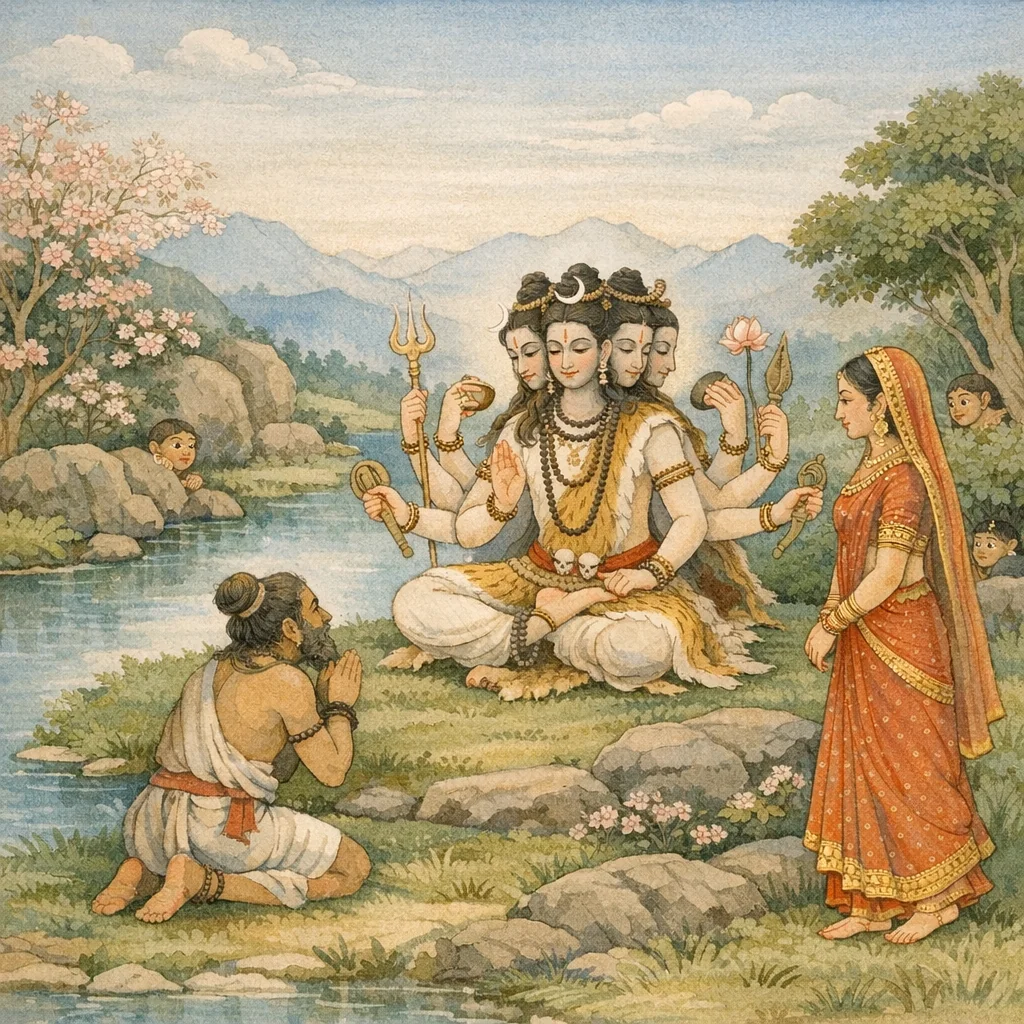
This chapter is chiefly spoken by Nandikeśvara (Nandi), who recounts his intense austerities and the divine manifestation that followed. He withdraws to a solitary sacred place, performs ugra-tapas, meditates inwardly on Tryambaka—Śiva with three eyes, ten arms, five faces, and a serene form—and sustains one-pointed Rudra-japa beside a sanctified river. Pleased, Śiva speaks directly and grants boons. Nandi prostrates and praises; Śiva compassionately touches and raises him, witnessed by the gaṇas and Devī, Himavat’s daughter. The chapter teaches that true mantra-dhyāna, steadied by tapas and bhakti, culminates not only in merit but in darśana and transformation through anugraha, establishing Nandi’s exalted status in the Śaiva sacred order.
Shlokas
Verse 1
नन्दिकेश्वर उवाच । तत्र गत्वा मुनेऽहं वै स्थित्वैकान्तस्थले सुधीः । अतपं तप उग्रं सन्मुनीनामपि दुष्करम्
Nandikeśvara said: “O sage, having gone there, I—steady in resolve—remained in a solitary, secluded place, and I performed a fierce austerity, a tapas difficult even for the noble seers.”
Verse 2
हृत्पुण्डरीकसुषिरे ध्यात्वा देवं त्रियम्बकम् । त्र्यक्षं दशभुजं शान्तं पञ्चवक्त्रं सदा शिवम्
Meditating within the hollow of the heart-lotus, one should contemplate the divine Triyambaka—the Three-eyed Lord: three-eyed, ten-armed, tranquil, five-faced, and ever-auspicious Sadāśiva.
Verse 3
रुद्रजाप्यमकार्षं वै परमध्यानमास्थितः । सरितश्चोत्तरे पुण्ये ह्येकचित्तः समाहितः
He performed the japa of Rudra’s sacred mantra and entered into the highest meditation. On the holy northern bank of the river, with his mind made one-pointed, he remained fully collected in samādhi.
Verse 4
तस्मिञ्जाप्येऽथ संप्रीतः स्थितं मां परमेश्वरः । तुष्टोऽब्रवीन्महादेवः सोमः सोमार्द्धभूषणः
As I was thus engaged in japa, the Supreme Lord—Mahādeva—pleased and satisfied, stood before me and spoke, He whose ornament is the crescent moon (Soma).
Verse 5
शिव उवाच । शैलादे वरदोहं ते तपसानेन तोषितः । साधु तप्तं त्वया धीमन् ब्रूहि यत्ते मनोगतम्
Śiva said: “O Śailāda, I am the giver of boons to you, pleased by this austerity of yours. Well has this penance been performed by you, O wise one. Speak—what is it that your heart desires?”
Verse 6
स एवमुक्तो देवेन शिरसा पादयोर्नतः । अस्तवं परमेशानं जराशोकविनाशनम्
Thus addressed by the Lord, he bowed with his head at His feet and praised Parameśāna, the Supreme Lord, the destroyer of old age and sorrow.
Verse 7
इति श्रीशिवमहापुराणे तृतीयायां शतरुद्रसंहितायां नन्दिकेश्वरावताराभिषेकविवाह वर्णनं नाम सप्तमोऽध्यायः
Thus, in the Śrī Śiva Mahāpurāṇa, in the Third Book, the Śatarudra-saṃhitā, ends the Seventh Chapter, titled “The narration of Nandikeśvara’s incarnation, consecration (abhiṣeka), and marriage.”
Verse 8
उत्थाय परमेशानः पस्पर्श परमार्तिहा । कराभ्यां संमुखाभ्यान्तु संगृह्य वृषभध्वजः
Then Parameśāna—Śiva, the supreme Lord and remover of all affliction—rose and gently touched him. Bearing the bull as His emblem, He drew him close, taking him with both hands from the front.
Verse 9
निरीक्ष्य गणपांश्चैव देवीं हिमवतः सुताम् । उवाच मां कृपादृष्ट्या समीक्ष्य जगताम्पतिः
After looking upon the hosts of Gaṇas and also upon the Goddess, Himavat’s daughter, the Lord of the worlds gazed at me with a compassionate glance and spoke.
Verse 10
वत्स नन्दिन्महाप्राज्ञ मृत्योर्भीतिः कुतस्तव । मयैव प्रेषितौ विप्रौ मत्समस्त्वं न संशयः
“Dear child Nandi, O greatly wise one—why should you fear death at all? Those two brāhmaṇas were sent by Me alone. You are equal to Me; of this there is no doubt.”
Verse 11
अमरो जरया त्यक्तोऽदुःखी गणपतिः सदा । अव्ययश्चाक्षयश्चेष्टः स पिता स सुहृज्जनः
He is deathless, untouched by old age, and forever free from sorrow. Ever the Gaṇapati, he is beloved; imperishable and undecaying. He is a fatherly protector, and the true well-wisher among beings.
Verse 12
मद्बलः पार्श्वगो नित्यं ममेष्टो भवितानिशम् । न जरा जन्म मृत्युर्वै मत्प्रसादाद्भविष्यति
Endowed with My power, he shall remain ever at My side and be dear to Me day and night. By My grace, there shall be for him no decay, no rebirth, and no death.
Verse 13
नन्दीश्वर उवाच । एवमुक्त्वा शिरोमालां कुशेशयमयीं निजाम् । समुन्मुच्य बबन्धाशु मम कण्ठे कृपानिधिः
Nandīśvara said: “Having spoken thus, the ocean of compassion (Lord Śiva) at once removed His own garland made of lotus-flowers and swiftly bound it around my neck.”
Verse 14
तयाहं मालया विप्र शुभया कण्ठसक्तया । त्र्यक्षो दशभुजश्चासं द्वितीय इव शङ्कर
O brāhmaṇa, by that auspicious garland fastened upon my neck, I became three-eyed and ten-armed—appearing like a second Śaṅkara (Śiva) Himself.
Verse 15
तत एव समादाय हस्तेन परमेश्वरः । उवाच ब्रूहि किं तेऽद्य ददामि वरमुत्तमम्
Then, right there, the Supreme Lord took him by the hand and said: “Speak—what highest boon shall I grant you today?”
Verse 16
ततो जटाश्रितं वारि गृहीत्वा हार निर्मलम् । उक्त्वा नन्दी भवेतीह विससर्ज वृषध्वजः
Then Vṛṣadhvaja (Lord Śiva), taking the pure water that rested in His matted locks, fashioned a spotless garland; and declaring, “Here, become Nandī,” He sent him forth.
Verse 17
ततः पञ्चमिता नद्यः प्रावर्तत शुभावहाः । सुतोयाश्च महावेगा दिव्य रूपा च सुन्दरी
Thereafter, five auspicious rivers began to flow, bringing welfare. They were rich in pure waters, swift in course, and—of divine form—beautiful to behold.
Verse 18
जटोदका त्रिस्रोताश्च वृषध्वनिरितीव हि । स्वर्णोदका जम्बुनदी पञ्चनद्यः प्रकीर्तिताः
They are celebrated as the five sacred rivers: Jaṭodakā, Trisrotā, Vṛṣadhvani (so indeed it is said), Svarṇodakā, and Jambūnadī.
Verse 19
एतत्पञ्चनदं नाम शिवपृष्ठतमं शुभम् । जपेश्वरसमीपे तु पवित्रं परमं मुने
This auspicious place is called Pañcanada, most sacred and dear to Lord Śiva. Near Japeśvara it is supremely purifying, O sage.
Verse 20
यः पञ्चनदमासाद्य स्नात्वा जप्त्वेश्वरेश्वरम् । पूजयेच्छिवसायुज्यं प्रयात्येव न संशयः
Whoever reaches Pañcanada, bathes there, repeats in japa the Name/Mantra of Īśvareśvara, the Lord of lords, and worships Him—such a devotee surely attains Śiva-sāyujya, union with Śiva; of this there is no doubt.
Verse 21
अथ शम्भुरुवाचोमामभिषिञ्चामि नन्दिनम् । गणेन्द्रं व्याहरिष्यामि किं वा त्वं मन्यसेऽव्यये
Then Śambhu (Lord Śiva) said: “O Umā, I shall anoint Nandin with abhiṣeka. I shall proclaim him as the lord of the Gaṇas. What do you think, O Imperishable One?”
Verse 22
उमोवाच । दातुमर्हसि देवेश नन्दिने परमेश्वर । महाप्रियतमो नाथ शैलादिस्तनयो मम
Umā said: “O Lord of the gods, O Parameśvara—please grant this boon to Nandin. O Master, he is most dear to You; and he is the son of my father, Śailādi (Himālaya).”
Verse 23
नन्दीश्वर उवाच । ततस्स शङ्करः स्वीयान्सस्मार गणपान्वरान् । स्वतन्त्रः परमेशानस्सर्वदो भक्तवत्सलः
Nandīśvara said: “Then Śaṅkara called to mind His own excellent leaders of the gaṇas. The Supreme Lord, independent and sovereign, the giver of all boons, is ever tenderly devoted to His devotees.”
Verse 24
स्मरणादेव रुद्रस्य सम्प्राप्ताश्च गणेश्वराः । असङ्ख्याता महामोदाश्शङ्कराकृतयोऽखिलाः
By the mere remembrance of Rudra, the hosts of Gaṇeśvaras at once came forth. Countless in number, all were greatly exultant—forms fashioned in the likeness of Śaṅkara.
Verse 25
ते गणेशाश्शिवं देवीं प्रणम्याहुः शुभं वचः । ते प्रणम्य करौ बद्ध्वा नतस्कन्धा महाबलाः
Those mighty Gaṇeśas bowed down to Lord Śiva and to the Devī; then, with hands joined in reverence and shoulders bent in humility, they spoke auspicious words.
Verse 26
गणेशा ऊचुः । किमर्थं च स्मृता देव ह्याज्ञापय महाप्रभो । किङ्करान्नः समायातांस्त्रिपुरार्दन कामद
The Gaṇeśas said: “O Deva, for what purpose have we been remembered? Command us, O Great Lord. Let Your attendants come to us, O Destroyer of Tripura, O Bestower of desires.”
Verse 27
किं सागराञ्शोषयामो यमं वा सह किंकरैः । हन्मो मृत्युं महामृत्युं विशेषं वृद्धपद्मजम्
“Why should we dry up the oceans, or strike down Yama with his attendants? Let us instead slay Death itself—Mahāmṛtyu—and, in particular, that aged lotus-born one (Brahmā).”
Verse 28
बद्ध्वेन्द्रं सह देवैश्च विष्णुं वा पार्षदैः सह । आनयामः सुसंकुद्धान्दैत्यान्वा दानवैः सह
“Having bound Indra along with the gods—or even Viṣṇu together with his attendants—we shall bring them here. Or else, being exceedingly enraged, we shall bring the Daityas along with the Dānavas.”
Verse 29
कस्याद्य व्यसनं घोरं करिष्यामस्तवाज्ञया । कस्य वाद्योत्सवो देव सर्वकामसमृद्धये
“By Your command, O Deva, upon whom shall we inflict a dreadful calamity today? And for whose complete fulfilment of all desires shall we arrange a festive celebration with music and instruments?”
Verse 30
नन्दीश्वर उवाच । इत्याकर्ण्य वचस्तेषां गणानां वीरवादिनाम् । उवाच तान्स प्रशंस्य गणेशान्परमेश्वरः
Nandīśvara said: Having thus heard the words of those heroic-speaking Gaṇas, the Supreme Lord, Parameśvara, praised those leaders of the Gaṇas and then addressed them.
Verse 31
शिव उवाच । नन्दीश्वरोयं पुत्रो मे सर्वेषामीश्वरेश्वरः । प्रियो गणामग्रणीस्सर्वैः क्रियतां वचनं मम
Śiva said: “This Nandīśvara is My son, the Lord of lords for all. He is dear to Me and the foremost leader of the Gaṇas. Therefore, let all of you carry out My command.”
Verse 32
सर्वे प्रीत्याभिषिञ्चध्वं मद्गणानां गतिम्पतिम् । अद्यप्रभृति युष्माकमयं नन्दीश्वरः प्रभुः
“All of you, with heartfelt joy, anoint and consecrate the Lord who is the guide and master of My gaṇas. From this day onward, this Nandīśvara shall be your sovereign lord.”
Verse 33
नन्दीश्वर उवाच । एवमुक्ताः शङ्करेण गणपास्सर्व्व एव ते । एवमस्त्विति सम्प्रोच्य सम्भारानाहरंस्ततः
Nandīśvara said: Thus addressed by Śaṅkara, all those leaders of the gaṇas assented, saying, “So be it,” and then they went forth to gather the required materials.
Verse 34
ततो देवाश्च सेन्द्राश्च नारायणमुखास्तथा । मुनयः सर्वतो लोका आजग्मुर्मुदिताननाः
Thereupon the gods—along with Indra—and those headed by Nārāyaṇa, as well as sages from all the worlds, arrived with faces radiant with joy.
Verse 35
पितामहोपि भगवन्नियोगाच्छङ्करस्य वै । चकार नंदिनस्सर्व्वमभिषेकं समाहितः
Even Pitāmaha (Brahmā), acting under the divine command of Śaṅkara, performed—fully composed in mind—the entire consecratory ablution (abhiṣeka) for Nandin.
Verse 36
ततो विष्णुस्ततश्शक्रो लोकपालास्तथैव च । ऋषयस्तुष्टुवुश्चैव पितामहपुरोगमाः
Thereupon Viṣṇu, then Śakra (Indra), and likewise the guardians of the worlds—together with the sages—praised Rudra-Śiva, with Pitāmaha (Brahmā) at their head.
Verse 37
स्तुतिमत्सु ततस्तेषु विष्णुः सर्वजगत्पतिः । शिरस्यञ्जलिमाधाय तुष्टाव च समाहितः
Then, as those hymns of praise were being offered, Viṣṇu—the Lord of the entire universe—placing his joined palms upon his head, worshipfully praised Śiva with a collected and steady mind.
Verse 38
प्राञ्जलिः प्रणतो भूत्वा जयशब्दं चकार च । ततो गणाधिपास्सर्व्वे ततो देवास्ततोऽसुराः
With palms joined, he bowed in reverence and uttered a cry of victory. Then all the chiefs of Śiva’s gaṇas did the same—after them the gods, and then even the asuras.
Verse 39
एवं स्तुतश्चाभिषिक्तो देवैस्स ब्रह्मकैस्तदा । नन्दीश्वरोहं विप्रेन्द्र नियोगात्प रमेशितुः
Thus, praised and then consecrated at that time by the gods together with Brahmā, I became Nandīśvara, O best of brāhmaṇas, by the command of the Supreme Lord, Parameśvara.
Verse 40
उद्वाहश्च कृतस्तत्र नियोगात्परमेष्ठिनः । महोत्सवयुतः प्रीत्या विष्णुब्रह्मादिभिर्मम
There, my marriage was duly solemnized at the command of Parameṣṭhin (Brahmā). With loving joy, it was celebrated as a great festival by Viṣṇu, Brahmā, and the other divine beings.
Verse 41
मरुतां च सुता देवी सुयशास्तु मनोहरा । पत्नी सा मेऽभवद्दिव्या मनोनयननन्दिनी
And the goddess Suyashā—charming and radiant, the daughter of the Maruts—became my divine wife, delighting both mind and eyes.
Verse 42
लब्धं शशिप्रभं छत्रं तया तत्र विभूषितम् । चामरैश्चामरासक्तहस्ताग्रैः स्त्रीगणैर्युतम्
There she was adorned with a parasol radiant like the moon that had been obtained for her; and she was accompanied by bands of women, their fingertips engaged in holding the fly-whisks (cāmaras) in attendance.
Verse 43
इति त्रिचत्वारिंशोवतारः
Thus ends the account of the forty-third manifestation (avatāra) of Lord Rudra (Śiva).
Verse 44
लब्धो हारश्च परमो देव्याः कण्ठगतस्तथा । वृषेन्द्रश्च शितो नागस्सिंहस्सिंहध्वजस्तथा
Then the Supreme garland was obtained and placed upon the Goddess’s neck. Likewise, the lordly bull (Vṛṣendra), the white serpent, the lion, and the lion-banner were also acquired as her divine insignia and sacred attendants.
Verse 45
रथश्च हेमहारश्च चन्द्रबिंबसमः शुभः । अन्यान्यपि च वस्तूनि लब्धानि हि मया मुने
“I obtained a chariot and a golden necklace—auspicious, radiant like the orb of the moon. And many other objects too have indeed been gained by me, O sage.”
Verse 46
एवं कृतविवाहोऽहं तया पत्न्या महामुने । पादौ ववन्दे शम्भोश्च शिवाया ब्रह्मणो हरेः
Thus, after my marriage was duly performed with that wife, O great sage, I bowed at the feet of Śambhu (Śiva) and of Śivā (the Divine Goddess), and also of Brahmā and Hari (Viṣṇu).
Verse 47
तथाविधं त्रिलोकेशस्सपत्नीकं च माम्प्रभुः । प्रोवाच परया प्रीत्या स शिवो भक्तवत्सलः
Then the Lord of the three worlds—Śiva, the tender guardian of His devotees—spoke to me, together with my wife, with supreme affection and grace.
Verse 48
ईश्वर उवाच । शृणु सत्पुत्र तातस्त्वं सुयशेयन्तव प्रिया । ददामि ते वरम्प्रीत्या यत्ते मनसि वाञ्छितम्
Īśvara, Lord Śiva, said: “Listen, O virtuous son—beloved child of Suyaśā. Out of love I grant you a boon: whatever your heart desires.”
Verse 49
सदाहन्तव नन्दीश सन्तुष्टोऽस्मि गणेश्वर । देव्या च सहितो वत्स शृणु मे परमं वचः
O Nandīśa, ever dear to Me—O lord among the Gaṇas—I am pleased. Dear child, together with the Goddess, listen to My supreme word.
Verse 50
सदेष्टश्च विशिष्टश्च परमैश्वर्य्यसंयुतः । महायोगी महेष्वासः स पिता स पितामहः
He is ever the chosen Lord, the supremely distinguished One, endowed with the highest divine sovereignty. He is the great Yogi and the mighty wielder of the bow; He is the Father, and He is the Grandfather of all.
Verse 51
अजेयस्सर्वजेता च सदा पूज्यो महाबलः । अहं यत्र भवांस्तत्र यत्र त्वं तत्र चाप्यहम्
You are unconquerable, the conqueror of all, ever worthy of worship, and possessed of great power. Wherever you are, there I am; and wherever you are, there too am I.
Verse 52
अयं च ते पिता पुत्र परमैश्वर्य्यसंयुतः । भविष्यति गणाध्यक्षो मम भक्तो महाबलः
“O son, this father of yours, endowed with supreme lordly power, will become the chief of My gaṇas—My devotee, of great strength.”
Verse 53
पितामहोऽपि ते वत्स तथास्तु नियमा इमे । मत्समीपं गमिष्यन्ति मया दत्तवरास्तथा
Even your Grandfather (Brahmā), dear child—so be it. Let these observances and restraints be established. Those who have received boons from me shall likewise come into my presence.
Verse 54
नन्दीश्वर उवाच । ततो देवी महाभागा नन्दिनं वरदाब्रवीत् । वरं ब्रूहीति माम्पुत्र सर्व्वान्कामान्यथेसितान्
Nandīśvara said: Then the most fortunate Goddess, in a boon‑granting mood, spoke to Nandin: “Speak, my son, the boon you desire; I shall grant all wishes just as you have wished them.”
Verse 55
तच्छ्रुत्वा वचनं देव्याः प्रावोचत्साञ्जलिस्तदा । भक्तिर्भवतु मे देवि पादयोस्ते सदा वरा
Hearing the Goddess’s words, he spoke with folded hands: “O Devī, may there always be for me the most excellent devotion at your feet.”
Verse 56
श्रुत्वा मम वचो देवी ह्येवमस्त्विति साब्रवीत् । सुयशां ताञ्च सुप्रीत्या नन्दिप्रियतमां शिवाम्
Hearing my words, the Goddess replied, “So be it.” Then, with great affection and delight, she gladly accepted that auspicious Lady of noble fame—Śivā, most beloved of Nandin.
Verse 57
देव्युवाच । वत्से वरं यथेष्टं हि त्रिनेत्रा जन्मवर्जिता । पुत्रपौत्रेस्तु भक्तिर्मे तथा च भर्तुरेव हि
The Goddess said: “Dear child, ask for whatever boon you desire. I, the three-eyed One, am beyond birth. Let there be devotion in me toward sons and grandsons, and likewise toward my husband alone.”
Verse 58
नन्द्युवाच । तदा ब्रह्मा च विष्णुश्च सर्व्वे देवगणाश्च वै । ताभ्यां वरान्ददुः प्रीत्या सुप्रसन्नाश्शिवाज्ञया
Nandī said: Then Brahmā and Viṣṇu, and indeed all the hosts of gods, delighted and fully appeased by Śiva’s command, joyfully granted boons to those two.
Verse 59
सान्वयं मां गृहीत्वेशस्ततस्सम्बन्धिबान्धवैः । आरुह्य वृषमीशानो गतो देव्या निजं गृहम्
Then the Lord (Īśāna), taking me together with my family and accompanied by the relatives and kinsmen, mounted His bull and went to the Goddess’s own home.
Verse 60
विष्ण्वादयः सुरास्सर्व्वे प्रशंसन्तो ह्यमी तदा । स्वधामानि ययुः प्रीत्या संस्तुवन्तः शिवं शिवम्
Then all the gods—led by Viṣṇu—praised Him; and, filled with joy, they departed to their own abodes, continually extolling Śiva, the ever-auspicious Lord.
Verse 61
इति ते कथितो वत्स स्वावतारो महामुने । सदानन्दकरः पुंसां शिवभक्तिप्रवर्द्धनः
Thus, dear child—O great sage—this self-manifest incarnation has been narrated to you: it bestows constant bliss upon people and increases devotion to Lord Śiva.
Verse 62
य इदन्नन्दिनो जन्म वरदानन्तथा मम । अभिषेकं विवाहं च शृणुयाच्छ्रावयेत्तथा
Whoever listens to—or causes others to listen to—this sacred account of Nandin’s birth, the boon granted by me, and also his consecration (abhiṣeka) and marriage, is thereby blessed.
Verse 63
पठेद्वा पाठयेद्वापि श्रद्धावान्भक्तिसंयुतः । इह सर्व्वसुखम्भुक्त्वा परत्र लभते गतिम्
Whether one recites it oneself or has it recited, one who is endowed with faith and joined to devotion enjoys every happiness in this world and, hereafter, attains the supreme path—liberation by the grace of Lord Śiva.
Frequently Asked Questions
Nandikeśvara narrates a tapas-and-mantra regimen culminating in Śiva’s direct appearance and boon-giving dialogue; the theological argument is that disciplined Rudra-japa and dhyāna, when fused with bhakti, reliably leads to darśana and anugraha.
The heart-lotus (hṛt-puṇḍarīka) frames Śiva-realization as interiorized worship; pañcavaktra signals Śiva’s comprehensive sovereignty over the fivefold cosmic functions, while tryambaka/tryakṣa encodes transcendent insight across time and guṇas—making iconography a map of metaphysics.
Śiva appears as Tryambaka—tryakṣa, śānta, and pañcavaktra (also styled Vṛṣabhadhvaja and Soma-arddha-bhūṣaṇa); Devī is referenced as Himavat’s daughter (Pārvatī), situated among gaṇas as part of the divine court witnessing Śiva’s compassionate response.