Vaiśyanātha-avatāra-kathā (The Account of Śiva’s Manifestation as Vaiśyanātha)
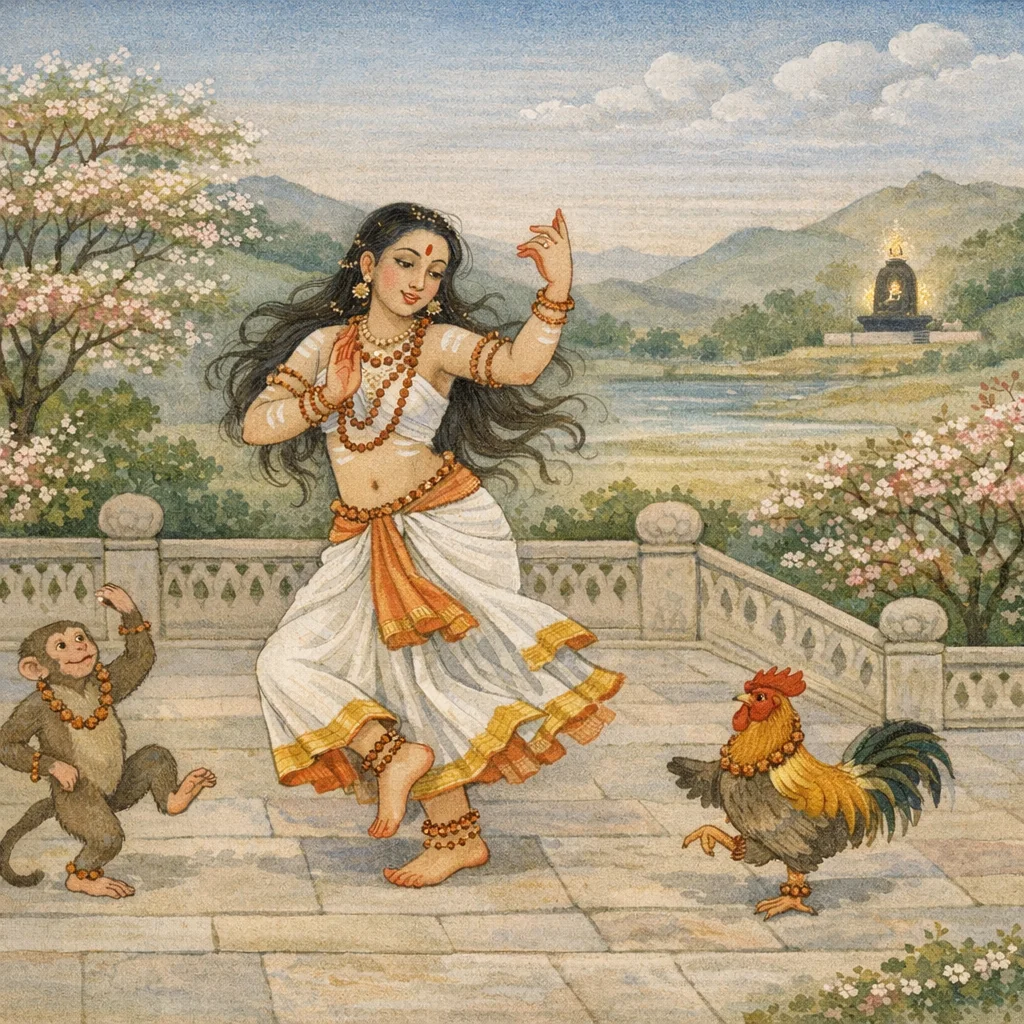
This adhyāya, spoken as Nandīśvara’s instruction (“Nandīśvara uvāca”), introduces the avatāra account of Śiva as Vaiśyanātha. Set in Nandigrāma, it presents Mahānandā, a famed courtesan of beauty, wealth, and performing skill, and uses her story to teach that devotion surpasses conventional social labels. Ever devoted to Śaṃkara, she is absorbed in śiva-nāma-japa, wears bhasma and rudrākṣa, and performs daily worship, singing Śiva’s glory and dancing in devotional ecstasy. Even a monkey and a rooster are adorned with rudrākṣa and trained to dance, symbolizing how sacred emblems and disciplined practice can sanctify the marginal and even the animal realm. These motifs prepare for the avatāra’s saving intervention and an implicit theology of grace (anugraha) mediated through bhakti, the holy Name, and Śaiva signs.
Shlokas
Verse 1
नन्दीश्वर उवाच । शृणु तात प्रवक्ष्यामि शिवस्य परमात्मनः । अवतारं परमानन्दं वैश्यनाथाह्वयं मुने
Nandīśvara said: “Listen, dear one. Now I shall describe the descent (avatāra) of Śiva—the Supreme Self—an incarnation of highest bliss, known, O sage, by the name Vaiśyanātha.”
Verse 2
नन्दिग्रामे पुरा काचिन्महानन्देति विश्रुता । बभूव वारवनिता शिवभक्ता सुसुन्दरी
Long ago, in Nandigrāma, there lived a courtesan renowned by the name Mahānandā—exceedingly beautiful and devoted to Lord Śiva.
Verse 3
महाविभवसम्पन्ना सुधनाढ्या महोज्ज्वला । नानारत्नपरिच्छिन्न शृङ्गाररसनिर्भरा
She was endowed with immense prosperity, abundantly wealthy, and exceedingly radiant—adorned with many kinds of jewels and overflowing with the beauty and charm of auspicious adornment.
Verse 4
सर्वसंगीत विद्यासु निपुणातिमनोहरा । तस्या गेयेन हृष्यन्ति राज्ञ्यो राजान एव च
She was expertly accomplished in every art of music and was exceedingly captivating. By her singing, the queens and the kings themselves were delighted.
Verse 5
समानर्च सदा साम्बं सा वेश्या शंकरं मुदा । शिवनामजपासक्ता भस्मरुद्राक्षभूषणा
That courtesan always worshipped Śaṅkara—Śiva together with Umā—with joy. Absorbed in the japa of Śiva’s Name, she adorned herself with sacred ash (tripuṇḍra-bhasma) and Rudrākṣa beads.
Verse 6
शिवं सम्पूज्य सा नित्यं सेवन्ती जगदीश्वरम् । ननर्त परया भक्त्या गायन्ती शिवसद्यशः
Having duly worshipped Śiva, she constantly attended upon the Lord of the universe. Singing of Śiva’s immediate glory, she danced with supreme devotion.
Verse 7
रुद्राक्षैर्भूषयित्वैकं मर्कटं चैव कुक्कुटम् । करतालैश्च गीतैश्च सदा नर्तयति स्म सा
Adorning a monkey and also a rooster with rudrākṣa beads, she would continually make them dance—accompanied by clapping of hands and by songs.
Verse 8
नृत्यमानौ च तौ दृष्ट्वा शिवभक्तिरता च सा । वेश्या स्म विहसत्युच्चैः प्रेम्णा सर्वसखीयुता
Seeing those two dancing, that courtesan—absorbed in devotion to Śiva—laughed aloud in love, surrounded by all her companions.
Verse 9
रुद्राक्षैः कृतकेयूरकर्णा भरणमण्डनः । मर्कटः शिक्षया तस्याः पुरो नृत्यति बालवत्
Adorned with armlets and ear-ornaments fashioned from Rudrākṣa beads, the monkey—having been trained by her—danced in front of her like a little child.
Verse 10
शिखासंबद्धरुद्राक्षः कुक्कुटः कपिना सह । नित्यं ननर्त नृत्यज्ञः पश्यतां हितमावहन्
Wearing a Rudrākṣa tied upon his topknot, the rooster—together with the monkey—danced every day with perfect skill in dance, bringing benefit and auspiciousness to all who watched.
Verse 11
एवं सा कुर्वती वेश्या कौतुकम्परमादरात् । शिवभक्तिरता नित्यं महानन्दभराऽभवत्
Thus, that courtesan, acting in this way with eager curiosity and the highest reverence, became ever devoted to Śiva-bhakti and was continually filled with great bliss.
Verse 12
शिवभक्तिं प्रकुर्वन्त्या वेश्याया मुनिसत्तम । बहुकालो व्यतीयाय तस्याः परमसौख्यतः
O best of sages, as that courtesan continued to practice devotion to Lord Śiva, a long time passed for her in supreme inner happiness.
Verse 13
एकदा च गृहे तस्या वैश्यो भूत्वा शिवस्स्वयम् । परीक्षितुं च तद्भावमाजगाम शुभो व्रती
Once, Lord Śiva Himself—assuming the form of a vaiśya (merchant)—came to her house. The auspicious Lord, steadfast in His sacred vow, arrived in order to test the sincerity and inner disposition of her devotion.
Verse 14
त्रिपुण्ड्रविलसद्भालो रुद्राक्षाभरणः कृती । शिवनामजपासक्तो जटिलः शैववेषभृत्
His forehead shines with the tripuṇḍra, the triple sacred ash-mark; he is adorned with rudrākṣa beads, disciplined and accomplished in conduct. Absorbed in the japa of Śiva’s Name, with matted locks, he wears the distinctive attire of a Śaiva devotee.
Verse 15
स बिभ्रद्भस्मनिचयं प्रकोष्ठे वरकंकणम् । महारत्नपरिस्तीर्णं राजते परकौतुकी
He, delighting in wondrous adornment, shines forth—bearing a heap of sacred ash (bhasma) and wearing upon His forearm an excellent bracelet, richly inlaid and spread with great gems.
Verse 16
तमागतं सुसंपूज्य सा वेश्या परया मुदा । स्वस्थाने सादरं वैश्यं सुन्दरी हि न्यवेशयत्
When the merchant arrived, that courtesan, filled with great joy, honored him with due hospitality and respectfully seated the handsome vaiśya in her own place.
Verse 17
तत्प्रकोष्ठे वरं वीक्ष्य कंकणं सुमनोहरम् । तस्मिञ्जातस्पृहा सा च तं प्रोवाच सुविस्मिता
Seeing on his wrist a splendid, exceedingly charming bracelet, she became desirous of it; and, in delighted astonishment, she spoke to him.
Verse 18
महानन्दोवाच । महारत्नमयश्चायं कंकणस्त्वत्करे स्थितः । मनो हरति मे सद्यो दिव्यस्त्रीभूषणोचितः
Mahānanda said: “This bracelet, made of great gems, now rests upon your hand. It instantly captivates my mind—fit indeed as a divine ornament for a celestial lady.”
Verse 19
नन्दीश्वर उवाच । इति तां नवरत्नाढ्ये सस्पृहां करभूषणे । वीक्ष्योदारमतिर्वैश्यः सस्मितं समभाषत
Nandīśvara said: Thus, seeing that she was adorned with navaratna—nine kinds of gems—and richly ornamented, the magnanimous-minded Vaiśya, filled with longing, smiled and spoke.
Verse 20
वैश्यनाथ उवाच । अस्मिन्रत्नवरे दिव्ये सस्पृहं यदि ते मनः । त्वमेवाधत्स्व सुप्रीत्या मौल्यमस्य ददासि किम्
Vaiśyanātha said: “If your mind longs for this divine and excellent jewel, then take it yourself with joyful devotion—what price could you possibly give for it?”
Verse 21
वेश्योवाच । वयं हि स्वैरचारिण्यो वेश्यास्तु न पतिव्रताः । अस्मत्कुलोचितो धर्मो व्यभिचारो न संशयः
The courtesan said: “Truly, we are women who move as we please; as courtesans we are not vowed to one husband alone. For our lineage and calling, the conduct deemed ‘proper’ is union with many—of this there is no doubt.”
Verse 22
यद्येतदखिलं चित्तं गृह्णाति करभूषणम् । दिनत्रयमहोरात्रं पत्नी तव भवाम्यहम्
“If you accept this complete offering of my heart—this ornament for your hand—then for three days and three nights I shall become your wife.”
Verse 23
वैश्य उवाच । तथास्तु यदि ते सत्यं वचनं वीरवल्लभे । ददामि रत्नवलयं त्रिरात्रं भव मे वधूः
The Vaiśya said: “So be it—if your words are true, O beloved of the hero. I will give you a jeweled bracelet; for three nights, become my bride.”
Verse 24
एतस्मिन्व्यवहारे तु प्रमाणं शशिभास्करौ । त्रिवारं सत्यमित्युक्त्वा हृदयं मे स्पृश प्रिये
In this matter, the Moon and the Sun are the proof and the witnesses. Having declared three times, “This is the truth,” touch my heart, O beloved.
Verse 25
वेश्योवाच । दिनत्रयमहोरात्रं पत्नी भूत्वा तव प्रभो । सहधर्मं चरामीति सत्यंसत्यं न संशयः
The courtesan said: “O Lord, for three days and three nights I shall become your wife and walk with you upon the shared path of dharma. This is true—true indeed; there is no doubt.”
Verse 26
नन्दीश्वर उवाच । इत्युक्त्वा हि महानन्दा त्रिवारं शशिभास्करौ । प्रमाणीकृत्य सुप्रीत्या सा तद्धृदयमस्पृशत्
Nandīśvara said: Having spoken thus, Mahānandā—after reverently affirming the Moon and the Sun as witnesses three times—joyfully touched his heart with deep affection.
Verse 27
अथ तस्यै स वैश्यस्तु प्रदत्त्वा रत्नकंकणम् । लिंगं रत्नमयं तस्य हस्ते दत्त्वेदमब्रवीत्
Then that vaiśya, having presented her a jeweled bracelet, placed a gem-made Śiva-liṅga into her hand and spoke these words.
Verse 28
वैश्यनाथ उवाच । इदं रत्नमयं लिंगं शैवं मत्प्राणदवल्ल भम् । रक्षणीयं त्वया कान्ते गोपनीयं प्रयत्नतः
Vaiśyanātha said: “Beloved, this gem-made Śaiva Liṅga is as dear to me as my very life-breath. You must protect it, and with all effort keep it concealed.”
Verse 29
नन्दीश्वर उवाच । एवमस्त्विति सा प्रोच्य लिंगमादाय रत्नजम् । नाट्यमण्डपिका मध्ये निधाय प्राविशद्गृहम्
Nandīśvara said: “So be it.” Having thus spoken, she took up the jewel-made Liṅga and, placing it in the middle of the dance-pavilion, she entered the house.
Verse 30
सा तेन संगता रात्रौ वैश्येन विटधर्मिणा । सुखं सुष्वाप पर्यंके मृदुतल्पोपशो भिते
That night she lay with him—the vaiśya who behaved in the manner of a libertine—and she slept comfortably on a couch adorned with a soft bed.
Verse 31
ततो निशीथसमये मुने वैश्यपतीच्छया । अकस्मादुत्थिता वाणी नृत्यमण्डपिकान्तरे
Then, at the hour of deepest night, O sage, by the wish of the Vaiśya’s wife, a voice suddenly arose within the inner space of the dance-pavilion.
Verse 32
महाप्रज्वलितो वह्निः सुसमीरसहायवान् । नाट्यमण्डपिकां तात तामेव सहसावृणोत्
A great, fiercely blazing fire—helped along by a strong wind—swiftly enveloped that very pavilion of the dance, O dear one.
Verse 33
मण्डपे दह्यमाने तु सहसोत्थाय संभ्रमात् । मर्कटं मोचयामास सा वेश्या तत्र बन्धनात्
But when the pavilion was burning, that courtesan—rising up at once in alarm—released the monkey there from its bondage.
Verse 34
स मर्कटो मुक्तबन्धः कुक्कुटेन सहामुना । भिया दूरं हि दुद्राव विधूयाग्निकणान्बहून्
Freed from his bonds, that monkey—together with this rooster—ran far away in fear, shaking off many sparks of fire.
Verse 35
स्तम्भेन सह निर्दग्धं तल्लिंगं शकलीकृतम् । दृष्ट्वा वेश्या स वैश्यश्च दुरंतं दुःखमापतुः
When that Liṅga, together with its pillar, was burned and shattered into pieces, on seeing it the courtesan and that merchant fell into unbearable sorrow.
Verse 36
दृष्ट्वा ह्यात्मसमं लिंगं दग्धं वैश्यपतिस्तदा । ज्ञातुन्तद्भावमन्तःस्थम्मरणाय मतिन्दधे
Seeing that the Liṅga—no different from his own very self—had been burned, the leader of the Vaiśyas resolved upon death, longing to know the inner state and true meaning of that reality abiding within.
Verse 37
निविश्येतितरां खेदाद्वैश्यस्तामाह दुःखिताम् । नानालीलो महेशानः कौतुकान्नरदेहवान्
Overcome with weary sorrow, the Vaiśya sat down and spoke to her in grief. For Maheśāna—whose līlā is manifold—had, out of sheer divine sport, assumed a human body.
Verse 38
वैश्यपतिरुवाच । शिवलिंगे तु निर्भिन्ने दग्धे महत्प्राणवल्लभे । सत्यं वच्मि न सन्देहो नाहं जीवितुमुत्सहे
Vaiśyapati said: “When the Śiva-liṅga has been split and burned—dearer to me than my very life—I speak the truth, without any doubt: I no longer wish to live.”
Verse 39
चितां कारय मे भद्रे स्वभृत्यैस्त्वं वरैर्लघु । शिवे मनस्समावेश्य प्रवेक्ष्यामि हुताशनम्
“O blessed one, have my funeral pyre prepared quickly by your able attendants. Fixing my mind wholly in Śiva, I shall enter the fire.”
Verse 40
यदि ब्रह्मेन्द्रविष्ण्वाद्या वारयेयुः समेत्य माम् । तथाप्यस्मिन् क्षणे भद्रे प्रविशामि त्यजाम्यसून्
“Even if Brahmā, Indra, Viṣṇu and the other gods were to assemble and try to restrain me, still—this very moment, O auspicious one—I shall enter into that resolve and relinquish my life-breath.”
Verse 41
नन्दीश्वर उवाच । तमेवं दृढनिर्बन्धं सा विज्ञाय सुदुःखिता । स्वभृत्यैः कारयामास चितां स्वभवनाद्बहिः
Nandīśvara said: Knowing him to be so firmly resolved, she was plunged into deep sorrow, and through her own attendants she had a funeral pyre prepared outside her residence.
Verse 42
ततस्स वैश्यश्शिव एक एव प्रदक्षिणीकृत्य समिद्धमग्निम् । विवेश पश्यत्सु नरेषु धीरः सुकौतुकी संगतिभावमिच्छुः
Then that vaiśya—steadfast and devoted to Śiva—alone circumambulated the well-kindled fire and, while men looked on, calmly entered it, eager in his heart to attain communion and closeness with Śiva.
Verse 43
दृष्ट्वा सा तद्गतिं वेश्या महानन्दातिविस्मिता । अनुतापं च युवती प्रपेदे मुनिसत्तम
Seeing the state he had attained, that courtesan—overwhelmed with great joy and astonishment—was then seized by remorse, O best of sages.
Verse 44
अथ सा दुःखिता वेश्या स्मृत्वा धर्म सुनिर्मलम् । सर्वान्बंधुजनान्वीक्ष्य बभाषे करुणं वचः
Then that sorrow-stricken courtesan, recalling the stainless purity of dharma, looked upon all her kinsfolk and spoke words filled with compassion.
Verse 45
महानन्दोवाच । रत्नकंकणमादाय मया सत्यमुदाहृतम् । दिनत्रयमहं पत्नी वैश्यस्यामुष्य संमता
Mahānanda said: “Taking the jeweled bracelet, I have spoken the truth. For three days I was accepted as the wife of that Vaiśya (merchant).”
Verse 46
कर्मणा मत्कृतेनायं मृतो वैश्यः शिवव्रती । तस्मादहं प्रवेक्ष्यामि सहानेन हुताशनम्
“Because of an action done by me, this Vaiśya—steadfast in the vow of devotion to Śiva—has died. Therefore, I shall enter the fire (the blazing flame) together with him.”
Verse 47
स्वधर्मचारिणी त्यक्तमाचार्य्यै सत्यवादिभिः । एवं कृते मम प्रीत्या सत्यं मयि न नश्यतु
Though she was devoted to her own righteous dharma, she has been abandoned by the truth-speaking teachers. If this has been done out of love for me, then may the Truth within me never perish, never become false.
Verse 48
सत्याश्रयः परो धर्म सत्येन परमा गतिः । सत्येन स्वर्ग मोक्षौ च सत्ये सर्वं प्रतिष्ठितम्
The highest Dharma is that which rests upon Truth. Through Truth one attains the supreme goal. By Truth are gained both heaven and liberation (moksha); in Truth, indeed, everything is firmly established.
Verse 49
नन्दीश्वर उवाच । इति सा दृढनिर्वन्धा वार्यमाणापि बन्धुभिः । सत्यलोकपरा नारी प्राणांस्त्यक्तुं मनो दधे
Nandīśvara said: Thus, though restrained by her relatives, that steadfast woman—intent on attaining Satyaloka—resolved in her heart to give up her life.
Verse 50
सर्वस्वं द्विजमुख्येभ्यो दत्त्वा ध्यात्वा सदाशिवम् । तमग्निं त्रिः परिक्रम्य प्रवेशाभिमुखी ह्यभूत्
Having given away all her possessions to the foremost among the twice-born, and meditating on Sadāśiva, she circumambulated that sacred fire three times and then turned herself toward entering it.
Verse 51
तां पतन्तीं समिद्धेग्नौ स्वपदार्पितमानसाम् । वारयामास विश्वात्मा प्रादुर्भूतः स वै शिवः
As she was falling into the blazing, well-kindled fire—her mind wholly offered at His feet—Śiva Himself, the indwelling Soul of the universe, manifested and restrained her.
Verse 52
सा तं विलोक्याखिलदेवदेवन्त्रिलोचनं चन्द्रकलावतंसम् । शशांकसूर्यानलकोटिभासं स्तब्धेव भीतेव तथैव तस्थौ
Seeing Him—the Lord of all the gods, the Three-eyed One, adorned with the crescent moon—radiant like countless moons, suns, and fires, she stood there just as she was, motionless as if stunned, and trembling as if afraid.
Verse 53
तां विह्वलां सुवित्रस्वां वेपमानां जडीकृताम् । समाश्वास्य गलद्बाष्पां करौ धृत्वाऽब्रवीद्वचः
Seeing her overwhelmed—terrified, trembling, and as if stunned—he gently consoled her. As tears streamed down, he held her hands and spoke these words.
Verse 54
शिव उवाच । सत्यं धर्मं च धैर्यं च भक्तिं च मयि निश्चलाम् । परीक्षितुं त्वत्सकाशं वैश्यो भूत्वाहमागतः
Śiva said: “To test your truthfulness, righteousness, steadfastness, and your unwavering devotion to Me, I have come to you after assuming the form of a vaiśya.”
Verse 55
मा ययाग्निं समुद्दीप्य दग्धन्ते नाट्यमण्डपम् । दग्धं कृत्वा रत्नलिंगं प्रविष्टोहं हुताशनम्
“Alas! By her they kindled the fire and burned down the hall of sacred dance. Having burned the jewel-like Liṅga, I too entered the blazing fire.”
Verse 56
सा त्वं सत्यमनुस्मृत्य प्रविष्टाग्निं मया सहा । अतस्ते संप्रदास्यामि भोगांस्त्रिदशदुर्लभान्
You—remembering the truth—entered the fire together with me. Therefore, I shall bestow upon you enjoyments and divine attainments that are difficult even for the thirty gods to obtain.
Verse 57
यद्यदिच्छसि सुश्रोणि तदेव हि ददामि ते । त्वद्भक्त्याहं प्रसन्नोस्मि तवादेयं न विद्यते
O fair-hipped one, whatever you desire—indeed that I grant to you. By your devotion I am fully pleased; for you there is nothing that is improper to be accepted from Me.
Verse 58
नन्दीश्वर उवाच । इति ब्रुवति गौरीशे शंकरे भक्तवत्सले । महानन्दा च सा वेश्या शंकरम्प्रत्यभाषत
Nandīśvara said: As Śaṅkara—Gaurī’s Lord, tenderly affectionate toward His devotees—was speaking thus, the courtesan Mahānandā addressed Śaṅkara in reply.
Verse 59
वेश्योवाच । न मे वाञ्छास्ति भोगेषु भूमौ स्वर्गे रसातले । तव पादाम्बुजस्पर्शादन्यत्किंचिन्न कामये
The courtesan said: “I have no desire for enjoyments—on earth, in heaven, or even in Rasātala. Apart from the touch of Your lotus-feet, I do not wish for anything at all.”
Verse 60
ये मे भृत्याश्च दास्यश्च ये चान्ये मम बान्धवाः । सर्वे त्वद्दर्शनपरास्त्वयि सन्न्यस्तवृत्तयः
“My servants and maidservants, and all my other relatives—every one of them is intent on beholding You alone; their whole way of life and inner striving has been surrendered into You.”
Verse 61
सर्वानेतान्मया सार्द्धं निनीयात्मपरम्पदम् । पुनर्जन्मभयं घोरं विमोचय नमोऽस्तु ते
Along with me, lead all of these to the supreme state of the Self—Your highest abode. Release (us) from the terrible fear of rebirth. Salutations to You.
Verse 62
नन्दीश्वर उवाच । ततस्स तस्या वचनम्प्रतिनन्द्य महेश्वरः । ताः सर्वाश्च तया सार्धं निनाय स्वम्परम्पदम्
Nandīśvara said: Then Maheśvara, having graciously approved her words, led all of them—together with her—into His own supreme abode, the highest state of liberation.
Verse 63
वैश्यनाथावतारस्ते वर्णितः परमो मया । महानन्दासुखकरो भक्तानन्दप्रदस्सदा
Thus, I have described the supreme account of the avatāra known as Vaiśyanātha. He bestows great bliss and happiness, and ever grants joy to His devotees.
Verse 64
इदं चरित्रं परमं पवित्रं सतां च सर्वप्रदमाशु दिव्यम् । शिवावतारस्य विशाम्पतेर्महानन्दामहासौख्यकरं विचित्रम्
This sacred account is supremely purifying—divine, and swiftly bestowing every blessing upon the virtuous. O lord of men, it is the wondrous narrative of Śiva’s avatāra, bringing great bliss and profound spiritual happiness.
Verse 65
इदं यः शृणुयाद्भक्त्या श्रावयेद्वा समाहितः । च्यवते न स्वधर्मात्स परत्र लभते गतिम्
Whoever listens to this with devotion—or, with a collected mind, causes it to be recited for others—does not fall away from one’s own righteous duty (svadharma); and in the hereafter, that person attains the true course and blessed state (gati).
Frequently Asked Questions
Nandīśvara introduces the Vaiśyanātha-avatāra narrative and grounds it in an exemplum: Mahānandā’s unwavering Shaiva devotion. The theological argument is that authentic bhakti—expressed through worship and nāma-japa—carries salvific force irrespective of social designation.
Rudrākṣa and bhasma operate as condensed Shaiva theology: they signify belonging to Śiva, inner purification, and remembrance. Their extension even to a trained monkey and rooster dramatizes the doctrine that sacred signs and disciplined practice can transform the field of action (karma) into offering (upacāra), sacralizing the mundane.
Śiva is highlighted as the supreme paramātman and specifically introduced under the avatāra-name Vaiśyanātha. The sampled verses do not foreground a distinct Gaurī/Umā manifestation; the emphasis is on Śiva’s grace mediated through devotion and Shaiva observances.