तुलसी-शङ्खचूडोपाख्यानम् — Viṣṇu’s Disguise and the Tulasī Episode (Prelude to Śaṅkhacūḍa’s Fall)
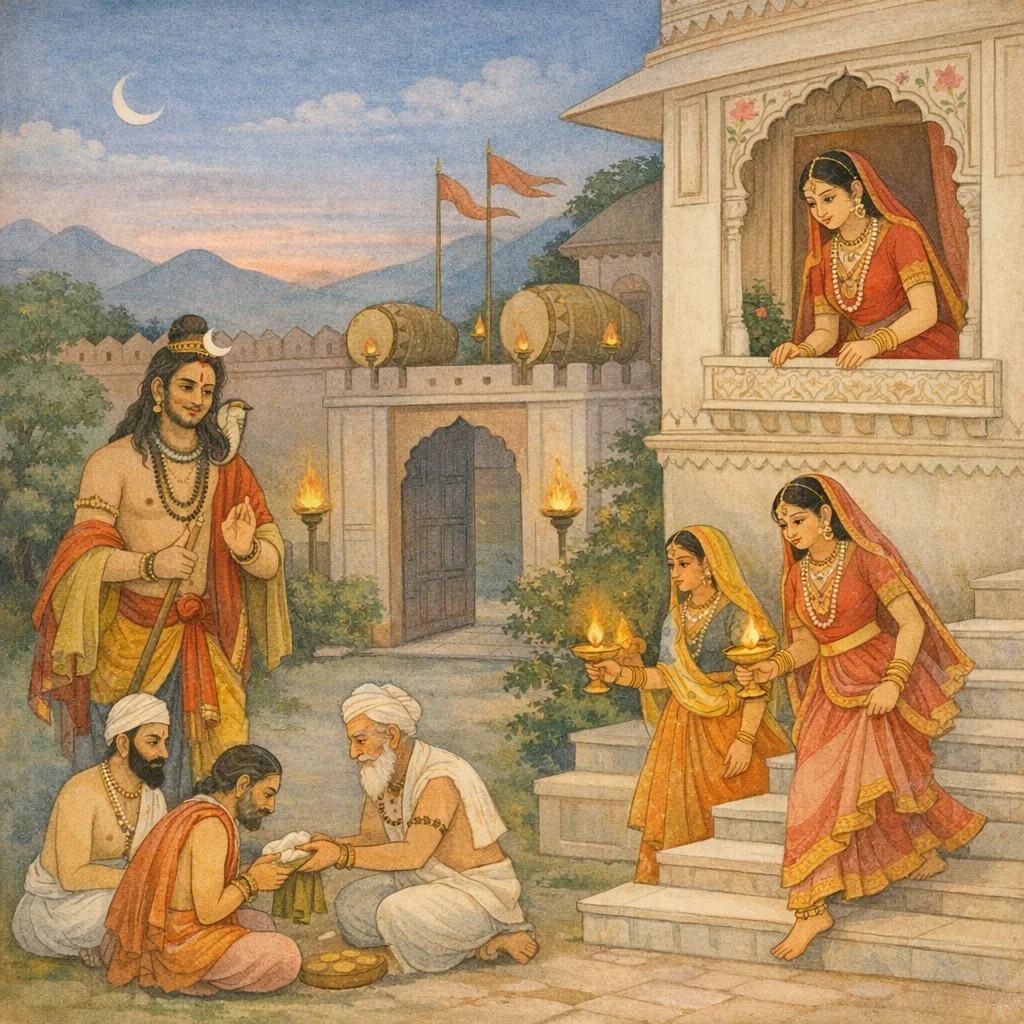
Adhyāya 41 begins with Vyāsa asking how Nārāyaṇa accomplishes vīryādhāna (impregnation) in Tulasī’s womb. Sanatkumāra explains that Viṣṇu, executing the gods’ purpose under Śiva’s command, employs māyā, assumes the form of Śaṅkhacūḍa, and approaches Tulasī’s dwelling. The chapter narrates the staged “return”: arrival at the door, the sounding of dundubhi drums, auspicious cries of victory, and Tulasī’s delighted reception with ritual hospitality—watching from the window, arranging maṅgala rites, gifting wealth to brāhmaṇas, adorning herself, and reverently washing and bowing to the feet of the apparent husband. Its central point is the use of divine disguise as a dharmic instrument in a war-context, loosening Śaṅkhacūḍa’s protections and advancing the cosmic resolution of the conflict, while highlighting the moral tension between devotion, deception, and providential necessity.
Shlokas
Verse 1
व्यास उवाच । नारायणश्च भगवान् वीर्याधानं चकार ह । तुलस्याः केन यत्नेन योनौ तद्वक्तुमर्हसि
Vyāsa said: “How, and by what particular means, did the blessed Lord Nārāyaṇa place his seed in the womb of Tulasī? Please explain that to me.”
Verse 2
सनत्कुमार उवाच । नारायणो हि देवानां कार्यकर्ता सतां गतिः । शंखचूडस्य रूपेण रेमे तद्रमया सह
Sanatkumāra said: “Nārāyaṇa indeed is the accomplisher of the gods’ purposes and the refuge of the righteous. Assuming the form of Śaṅkhacūḍa, he sported together with that Ramā (Lakṣmī).”
Verse 3
तदेव शृणु विष्णोश्च चरितं प्रमुदावहम् । शिवशासनकर्तुश्च मातुश्च जगतां हरेः
Therefore, listen to this very bliss-bestowing account of Viṣṇu—how he became the executor of Śiva’s command, and how he, as Hari the sustainer of the worlds, acted in relation to the Mother of the universe.
Verse 4
रणमध्ये व्योमवचः श्रुत्वा देवेन शंभुना । प्रेरितश्शंखचूडस्य गृहीत्वा कवचं परम्
In the midst of the battle, having heard the heavenly voice, Śambhu—the Lord—spurred on Śaṅkhacūḍa; and Śaṅkhacūḍa, thus impelled, took up the supreme armor.
Verse 5
विप्ररूपेण त्वरितं मायया निजया हरिः । जगाम शंखचूडस्य रूपेण तुलसीगृहम्
Assuming the form of a brāhmaṇa and swiftly employing his own māyā, Hari went to Tulasī’s dwelling, taking on the very likeness of Śaṅkhacūḍa.
Verse 6
दुन्दुभिं वादयामास तुलसी द्वारसन्निधौ । जयशब्दं च तत्रैव बोधयामास सुन्दरीम्
Standing near the doorway, Tulasī beat the kettle-drum; and right there she also roused the beautiful lady with the cry of “Victory!”
Verse 7
तच्छ्रुत्वा चैव सा साध्वी परमानन्दसंयुता । राजमार्गं गवाक्षेण ददर्श परमादरात्
Hearing that, the virtuous lady—filled with supreme bliss—looked out through the window with the greatest reverence and beheld the royal highway.
Verse 8
ब्राह्मणेभ्यो धनं दत्त्वा कारयामास मंगलम् । द्रुतं चकार शृंगारं ज्ञात्वाऽऽयातं निजं पतिम्
After bestowing wealth in charity upon the brāhmaṇas, she had auspicious rites performed. Then, knowing that her own husband had arrived, she swiftly adorned herself.
Verse 9
अवरुह्य रथाद्विष्णुस्तद्देव्याभवनं ययौ । शंखचूडस्वरूपः स मायावी देवकार्यकृत्
Descending from the chariot, Viṣṇu went to the dwelling of that Goddess. Assuming the form of Śaṅkhacūḍa, the wielder of māyā proceeded to accomplish the gods’ purpose.
Verse 10
दृष्ट्वा तं च पुरः प्राप्तं स्वकांतं सा मुदान्विता । तत्पादौ क्षालयामास ननाम च रुरोद च
Seeing her beloved arrive before her, she was filled with joy. She washed his feet, bowed down to him, and also wept.
Verse 11
रत्नसिंहासने रम्ये वासयामास मंगलम् । ताम्बूलं च ददौ तस्मै कर्पूरादिसुवासितम्
He seated the auspicious one upon a beautiful jeweled throne, and then offered him tāmbūla (betel-leaf), fragrant with camphor and other perfumes.
Verse 12
अद्य मे सफलं जन्म जीवनं संबभूव ह । रणे गतं च प्राणेशं पश्यंत्याश्च पुनर्गृहे
Today my birth has become fruitful; my very life has truly found its fulfillment—since I have seen my beloved lord of life, who had gone to the battlefield, return again to the home.
Verse 13
इत्युक्त्वा सकटाक्षं सा निरीक्ष्य सस्मितं मुदा । पप्रच्छ रणवृत्तांतं कांतं मधुरया गिरा
Having spoken thus, she glanced sidelong at her beloved; then, smiling with joy, she sweetly asked him about the course of the battle.
Verse 14
तुलस्युवाच । असंख्यविश्वसंहर्ता स देवप्रवरः प्रभुः । यस्याज्ञावर्त्तिनो देवा विष्णुब्रह्मादयस्सदा
Tulasi said: He is the Lord, the foremost among the gods, the destroyer of innumerable universes. By His command, the gods—Vishnu, Brahma, and the others—ever remain obedient and act accordingly.
Verse 15
त्रिदेवजनकस्सोत्र त्रिगुणात्मा च निर्गुणः । भक्तेच्छया च सगुणो हरिब्रह्मप्रवर्तकः
He is the begetter of the three gods; He is the very essence of the three guṇas, and yet He is beyond the guṇas. By the wish of His devotees He becomes possessed of attributes (saguṇa), and He empowers and sets in motion Hari (Viṣṇu) and Brahmā.
Verse 16
कुबेरस्य प्रार्थनया गुणरूपधरो हरः । कैलासवासी गणपः परब्रह्म सतां गतिः
At Kubera’s supplication, Hara assumed a form endowed with divine attributes (saguṇa). Dwelling on Kailāsa, that Lord—leader of the gaṇas— is the Supreme Brahman and the final refuge of the righteous.
Verse 17
यस्यैकपलमात्रेण कोटिब्रह्मांडसंक्षयः । विष्णुब्रह्मादयोऽतीता बहवः क्षणमात्रतः
By merely a single pala of His time, crores of cosmic eggs (universes) meet their dissolution. In but an instant, many Brahmās, Viṣṇus, and others have already passed away—surpassed by that immeasurable flow of time belonging to Him (Śiva), the supreme Lord.
Verse 18
कर्तुं सार्द्धं च तेनैव समरं त्वं गतः प्रभो । कथं बभूव संग्रामस्तेन देवसहायिना
O Lord, you went forth to wage battle together with him. How, then, did the warfare unfold, with that one who had the gods as his allies?
Verse 19
कुशली त्वमिहायातस्तं जित्वा परमेश्वरम् । कथं बभूव विजयस्तव ब्रूहि तदेव मे
“Have you come here safely, after conquering that Supreme Lord? Tell me—how did your victory come about? Explain that very thing to me.”
Verse 20
श्रुत्वेत्थं तुलसीवाक्यं स विहस्य रमापतिः । शंखचूडरूपधरस्तामुवाचामृतं वचः
Hearing Tulasi speak thus, the Lord of Ramā (Viṣṇu) smiled. Assuming the form of Śaṅkhacūḍa, he then addressed her with nectar-like words.
Verse 21
भगवानुवाच । यदाहं रणभूमौ च जगाम समरप्रियः । कोलाहलो महान् जातः प्रवृत्तोऽभून्महारणः
The Blessed Lord said: “When I—delighting in battle—went onto the battlefield, a mighty uproar arose, and the great combat began in full force.”
Verse 22
देवदानवयोर्युद्धं संबभूव जयैषिणोः । दैत्याः पराजितास्तत्र निर्जरैर्बलगर्वितैः
Then a battle arose between the Devas and the Danavas, each striving for victory. There the Daityas were defeated by the deathless gods, who were proud of their strength.
Verse 23
तदाहं समरं तत्राकार्षं देवैर्बलोत्कटैः । पराजिताश्च ते देवाश्शंकरं शरणं ययुः
Then I engaged there in battle with the gods, formidable in strength. But those gods were defeated, and they went to Śaṅkara (Śiva) for refuge.
Verse 24
रुद्रोऽपि तत्सहायार्थमाजगाम रणं प्रति । तेनाहं वै चिरं कालमयौत्संबलदर्पित
Even Rudra came to the battlefield to aid him. Therefore I—swollen with the pride of strength—did not enter into battle for a long time.
Verse 25
आवयोस्समरः कान्ते पूर्णमब्दं बभूव ह । नाशो बभूव सर्वेषामसुराणां च कामिनि
O beloved, the battle between us indeed continued for a full year; and, O dear one, it brought about the destruction of all the asuras.
Verse 26
प्रीतिं च कारयामास ब्रह्मा च स्वयमावयोः । देवानामधिकाराश्च प्रदत्ता ब्रह्मशासनात्
Brahmā himself brought about reconciliation between the two of us, and—by Brahmā’s ordinance—the rightful offices and authorities of the gods were duly restored.
Verse 27
मयागतं स्वभवनं शिवलोकं शिवो गतः । सर्वस्वास्थ्यमतीवाप दूरीभूतो ह्युपद्रवः
Having returned to my own abode—the auspicious realm of Śiva—Śiva too entered His divine state. Then perfect well-being was attained in every way, and all disturbance and adversity were driven far away.
Verse 28
सनत्कुमार उवाच । इत्युक्त्वा जगतां नाथः शयनं च चकार ह । रेमे रमापतिस्तत्र रमया स तया मुदा
Sanatkumāra said: Having spoken thus, the Lord of the worlds lay down to rest. There, the Lord of Śrī (Viṣṇu), together with Ramā (Lakṣmī), delighted—she with him, and he with her—in mutual joy.
Verse 29
सा साध्वी सुखसंभावकर्षणस्य व्यतिक्रमात् । सर्वं वितर्कयामास कस्त्वमेवेत्युवाच सा
That chaste and virtuous lady, sensing that the ease and comfort she expected had been disturbed, reflected on everything and then said, “Who, indeed, are you?”
Verse 30
तुलस्युवाच । को वा त्वं वद मामाशु भुक्ताहं मायया त्वया । दूरीकृतं यत्सतीत्वमथ त्वां वै शपाम्यहम्
Tulasī said: “Who indeed are you? Tell me at once. By your māyā I have been deceived and violated. Since my chastity has been driven away, therefore I surely curse you.”
Verse 31
सनत्कुमार उवाच । तुलसीवचनं श्रुत्वा हरिश्शापभयेन च । दधार लीलया ब्रह्मन्स्वमूर्तिं सुमनोहराम्
Sanatkumāra said: O Brahman, having heard Tulasī’s words, and also out of fear of Hari’s curse, he playfully (as līlā) assumed his own exceedingly charming form.
Verse 32
तद्दृष्ट्वा तुलसीरूपं ज्ञात्वा विष्णुं तु चिह्नतः । पातिव्रत्यपरित्यागात् क्रुद्धा सा तमुवाच ह
Seeing that deceptive form as Tulasī and recognizing Viṣṇu by the signs, she—angered that her wifely vow of fidelity (pātivratya) had been violated—spoke to him.
Verse 33
तुलस्युवाच । हे विष्णो ते दया नास्ति पाषाणसदृशं मनः । पतिधर्मस्य भंगेन मम स्वामी हतः खलु
Tulasī said: “O Viṣṇu, you have no compassion; your mind is like stone. By the breaking of a wife’s sacred dharma, my lord has indeed been slain.”
Verse 34
पाषाणसदृशस्त्वं च दयाहीनो यतः खलः । तस्मात्पाषाणरूपस्त्वं मच्छापेन भवाधुना
“You are truly stone-like, for you are a wicked one devoid of compassion. Therefore, by my curse, become stone-formed this very moment.”
Verse 35
ये वदंति दयासिन्धुं त्वां भ्रांतास्ते न संशयः । भक्तो विनापराधेन परार्थे च कथं हतः
Those who say that You—an ocean of compassion—have become deluded are themselves mistaken, without any doubt. How could a faultless devotee ever be struck down—especially while acting for another’s sake?
Verse 36
सनत्कुमार उवाच । इत्युक्त्वा तुलसी सा वै शंखचूडप्रिया सती । भृशं रुरोद शोकार्ता विललाप भृशं मुहुः
Sanatkumāra said: Having spoken thus, that virtuous Tulasī—beloved of Śaṅkhacūḍa—was overwhelmed with grief. She wept bitterly and again and again lamented aloud.
Verse 37
ततस्तां रुदतीं दृष्ट्वा स विष्णुः परमेश्वरः । सस्मार शंकरं देवं येन संमोहितं जगत्
Then, seeing her weeping, Lord Viṣṇu—the supreme ruler—remembered (invoked) Deva Śaṅkara, by whose divine power the entire world is veiled in bewilderment and set upon its destined course.
Verse 38
ततः प्रादुर्बभूवाथ शंकरो भक्तवत्सलः । हरिणा प्रणतश्चासीत्संनुतो विनयेन सः
Then Śaṅkara—ever affectionate to His devotees—manifested. Hari (Viṣṇu) bowed to Him and, in humility, offered reverent praise.
Verse 39
शोकाकुलं हरिं दृष्ट्वा विलपंतीं च तत्प्रियाम् । नयेन बोधयामास तं तां कृपणवत्सलाम्
Seeing Hari overwhelmed by grief and his beloved lamenting, He—the compassionate one, tender toward the distressed—gently counselled them both with prudent words.
Verse 40
शंकर उवाच । मा रोदीस्तुलसि त्वं हि भुंक्ते कर्मफलं जनः । सुखदुःखदो न कोप्यस्ति संसारे कर्मसागरे
Śaṅkara said: “Do not weep, O Tulasī. Truly, a person must partake of the fruit of their own deeds. In this worldly ocean of karma, there is no other independent giver of happiness or sorrow.”
Verse 41
इति श्रीशिवमहापुराणे द्वितीयायां रुद्रसंहितायां पञ्चमे युद्धखंडे शंखचूडव धोपाख्याने तुलसीशापवर्णनं नामैकचत्वारिंशोऽध्यायः
Thus, in the Śrī Śiva Mahāpurāṇa, in the Second division called the Rudra-saṃhitā, within the Fifth section—the Yuddha-khaṇḍa—during the account of the slaying of Śaṅkhacūḍa, concludes the forty-first chapter entitled “The Description of Tulasī’s Curse.”
Verse 42
तपस्त्वया कृतं भद्रे तस्यैव तपसः फलम् । तदन्यथा कथं स्याद्वै जातं त्वयि तथा च तत्
O auspicious lady, the tapas you performed has borne its own rightful fruit. How could it be otherwise? Truly, that very result has arisen in you exactly as it should.
Verse 43
इदं शरीरं त्यक्त्वा च दिव्यदेहं विधाय च । रमस्व हरिणा नित्यं रमया सदृशी भव
Abandoning this present body and assuming a divine form, rejoice eternally with Hari; become equal in splendour and blessedness to Ramā (Lakṣmī).
Verse 44
तवेयं तनुरुत्सृष्टा नदीरूपा भवेदिह । भारते पुण्यरूपा सा गण्डकीति च विश्रुता
“This very body of yours, released forth, shall here become a river in form. In Bhārata (India) she will be of the nature of merit and holiness, and will be renowned by the name Gaṇḍakī.”
Verse 45
कियत्कालं महादेवि देवपूजनसाधने । प्रधानरूपा तुलसी भविष्यति वरेण मे
For what length of time, O Mahādevī, will Tulasī, by the boon granted by me, remain the foremost means for accomplishing the worship of the Devas?
Verse 46
स्वर्गं मर्त्ये च पाताले तिष्ठ त्वं हरिसन्निधौ । भव त्वं तुलसीवृक्षो वरा पुष्पेषु सुन्दरी
“In heaven, on earth, and in the nether realms, abide—ever in the presence of Hari. Become the sacred tulasī tree, O fair one, the most excellent among flowers.”
Verse 47
वृक्षाधिष्ठातृदेवी त्वं वैकुंठे दिव्यरूपिणी । सार्द्धं रहसि हरिणा नित्यं क्रीडां करिष्यसि
You are indeed the presiding goddess of the trees. In Vaikuṇṭha, assuming a divine form, you will forever sport in secret together with Hari.
Verse 48
नद्यधिष्ठातृदेवी या भारते बहु पुण्यदा । लवणोदस्य पत्नी सा हर्यंशस्य भविष्यसि
You who are the presiding goddess of the rivers in Bhārata and who bestow abundant merit—you shall become the wife of Lavaṇoda, and you shall be born as Haryaṁśa’s daughter or within his lineage.
Verse 49
हरिर्वे शैलरूपी च गंडकी तीरसंनिधौ । संकरिष्यत्यधिष्ठानं भारते तव शापतः
Indeed, Hari (Viṣṇu) will take the form of a mountain near the bank of the Gaṇḍakī. There, in Bhārata (India), by the power of your curse, he will establish his sacred seat—an abode of worship.
Verse 50
तत्र कोट्यश्च कीटाश्च तीक्ष्णदंष्ट्रा भयंकराः । तच्छित्त्वा कुहरे चक्रं करिष्यंति तदीयकम्
There, terrifying insects in crores, with razor-sharp fangs, will cut it down; and having severed it, they will fashion a wheel (cakra) within the hollow, making it their own.
Verse 51
शालग्रामशिला सा हि तद्भेदादतिपुण्यदा । लक्ष्मीनारायणाख्यादिश्चक्रभेदाद्भविष्यति
That Śālagrāma stone indeed bestows exceedingly great merit because of its natural distinctions; and, owing to the differing marks of the discus (cakra) upon it, it is designated by names such as “Lakṣmī–Nārāyaṇa” and the like.
Verse 52
शालग्रामशिला विष्णो तुलस्यास्तव संगमः । सदा सादृश्यरूपा या बहुपुण्यविवर्द्धिनी
O Viṣṇu, the Śālagrāma stone and the sacred union with your Tulasī are ever of matching, auspicious nature, and they greatly increase manifold merit (puṇya).
Verse 53
तुलसीपत्रविच्छेदं शालग्रामे करोति यः । तस्य जन्मान्तरे भद्रे स्त्रीविच्छेदो भविष्यति
O gentle one, whoever cuts or breaks off Tulasī leaves in the worship of the Śālagrāma (Viṣṇu) will, in a future birth, meet with separation from his wife.
Verse 54
तुलसीपत्रविच्छेदं शंखं हित्वा करोति यः । भार्याहीनो भवेत्सोपि रोगी स्यात्सप्तजन्मसु
Whoever cuts or breaks tulasī leaves, casting aside the prescribed sanctity of the śaṅkha (sacred conch), becomes bereft of a wife; and he will suffer disease for seven births.
Verse 55
शालग्रामश्च तुलसी शंखं चैकत्र एव हि । यो रक्षति महाज्ञानी स भवेच्छ्रीहरिप्रियः
Truly, whoever—being a great knower—keeps together and carefully preserves the Śālagrāma stone, Tulasī, and the conch, becomes dear to Śrī Hari.
Verse 56
त्वं प्रियः शंखचूडस्य चैकमन्वन्तरावधि । शंखेन सार्द्धं त्वद्भेदः केवलं दुःखदस्तव
You are dear to Śaṅkhacūḍa, and this bond will last until the end of a single Manvantara; yet separation from you, together with the conch, will bring you nothing but sorrow.
Verse 57
सनत्कुमार उवाच । इत्युक्त्वा शंकरस्तत्र माहात्म्यमूचिवांस्तदा । शालग्रामशिलायाश्च तुलस्या बहुपुण्यदम्
Sanatkumāra said: Having spoken thus, Śaṅkara then described, in that very place, the sacred greatness—highly merit-bestowing—of the Śālagrāma stone and of Tulasī.
Verse 58
ततश्चांतर्हितो भूत्वा मोदयित्वा हरिं च ताम् । जगाम् स्वालयं शंभुः शर्मदो हि सदा सताम्
Then, becoming invisible, Śambhu—ever the giver of auspicious peace to the righteous—gladdened Hari and her as well, and departed to His own abode.
Verse 59
इति श्रुत्वा वचश्शंभोः प्रसन्ना तु तुलस्यभूत् । तद्देहं च परित्यज्य दिव्यरूपा बभूव ह
Hearing the words of Śambhu (Lord Śiva), she became wholly pleased and turned into Tulasī. Casting off her former body, she indeed assumed a radiant, divine form.
Verse 60
प्रजगाम तया सार्द्धं वैकुंठं कमलापतिः । सद्यस्तद्देहजाता च बभूव गंडकी नदी
Then Kamalāpati (Lord Viṣṇu) went together with her to Vaikuṇṭha; and at once, from that very body, the Gaṇḍakī river came into being.
Verse 61
शैलोभूदच्युतस्सोऽपि तत्तीरे पुण्यदो नृणाम् । कुर्वंति तत्र कीटाश्च छिद्रं बहुविधं मुने
O sage, even that immovable rock was dislodged there; and that riverbank became a bestower of merit for people. In that very place, worms and insects bored holes of many kinds.
Verse 62
जले पतंति यास्तत्र शिलास्तास्त्वतिपुण्यदाः । स्थलस्था पिंगला ज्ञेयाश्चोपतापाय चैव हि
The stones that fall there into the water bestow exceedingly great merit. But those that remain on dry land are known as “piṅgalā”, and indeed become a cause of affliction.
Verse 63
इत्येवं कथितं सर्वं तव प्रश्नानुसारतः । चरितं पुण्यदं शंभोः सर्वकामप्रदं नृणाम्
Thus, in accordance with your questions, everything has been narrated—the sacred account of Śambhu (Lord Śiva), which bestows merit and grants all worthy desires to human beings.
Verse 64
आख्यानमिदमाख्यातं विष्णुमाहात्म्यमिश्रितम् । भुक्तिमुक्तिप्रदं पुण्यं किं भूयः श्रोतुमिच्छसि
Thus this sacred narrative has been told—interwoven with the praise of Viṣṇu. It bestows both worldly enjoyment and liberation, and is holy and meritorious. What more do you wish to hear?
Frequently Asked Questions
Viṣṇu, under Śiva’s prompting and for the devas’ purpose, takes Śaṅkhacūḍa’s form and approaches Tulasī, leading to vīryādhāna and the strategic weakening of Śaṅkhacūḍa’s position in the wider war narrative.
The episode frames māyā as a regulated cosmic tool—subordinate to Śiva’s ordinance—used to restore dharma when direct force is constrained by boons, vows, or protective conditions.
Viṣṇu appears as devakāryakṛt (executor of divine work) and māyāvī (wielder of illusion), while Śiva is implied as śāsanakartṛ (the one whose ordinance authorizes and directs the intervention).