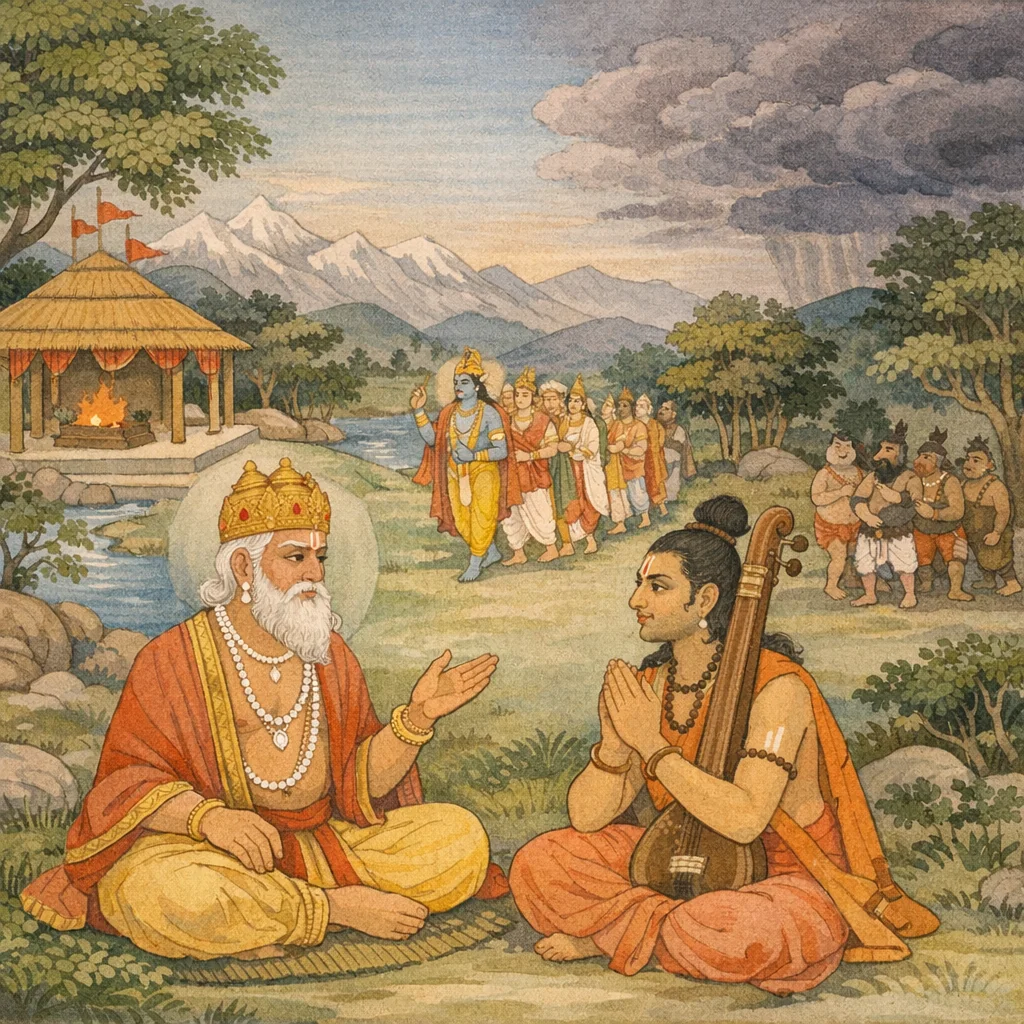
दधीच-शाप-हेतु-वर्णनम् / The Cause of Dadhīca’s Curse (Explaining Viṣṇu’s Role at Dakṣa’s Sacrifice)
Adhyāya 38 unfolds as a question-and-answer clarification of why Hari (Viṣṇu) went to Dakṣa’s sacrificial rite (yajña) even though Śiva was dishonored there. Sūta relates that Nārada, astonished after Brahmā’s earlier narration, asks the precise cause (hetu) of Hari’s participation and even of his clash with Śiva’s gaṇas. Nārada’s doubt rests on Viṣṇu’s awareness of Śambhu’s cataclysmic pralaya-power and the seeming impropriety of fighting Śiva’s attendants. Brahmā replies with a causal backstory: Viṣṇu had once been deprived of right knowledge (bhraṣṭa-jñāna) by the curse (śāpa) of the sage Dadhīca; under that impairment he, along with the gods, proceeded to Dakṣa’s yajña. Brahmā then begins the origin-story of the curse, introducing King Kṣuva as remembered in tradition and his close association with Dadhīca. A dispute arising in the context of prolonged tapas spreads into a harmful controversy across the three worlds, including an argument over who is superior among the varṇas—where Dadhīca, a Śiva-bhakta and knower of the Vedas, asserts the supremacy of the vipra (brāhmaṇa). The chapter thus frames Viṣṇu’s role at Dakṣa’s yajña not as informed opposition to Śiva, but as the consequence of a prior ethical-ritual conflict culminating in Dadhīca’s curse, setting the stage for the later verses on its terms and its teachings on dharma, pride, and devotion.
Shlokas
Verse 1
सूत उवाच । इत्याकर्ण्य वचस्तस्य विधेरमितधीमतः । पप्रच्छ नारदः प्रीत्या विस्मितस्तं द्विजोत्तमः
Sūta said: Having thus heard the words of Vidhī (Brahmā), whose wisdom is immeasurable, Nārada—the foremost of sages—rejoicing and astonished, respectfully questioned him.
Verse 2
नारद उवाच । शिवं विहाय दक्षस्य सुरैर्यज्ञं हरिर्गतः । हेतुना केन तद् ब्रूहि यत्रावज्ञाऽ भवत्ततः
Nārada said: “Setting Śiva aside, Hari (Viṣṇu) went with the gods to Dakṣa’s sacrifice. Tell me—by what reason did he go to that place where contempt for Śiva arose?”
Verse 3
जानाति किं स शंभुं नो हरिः प्रलयविक्रमम् । रणं कथं च कृतवान् तद्गणैरबुधो यथा
How could Hari (Viṣṇu) truly know Śambhu, whose prowess is like the might of pralaya that ends the cosmos? And how did he wage war against Śiva’s gaṇas, as though bereft of understanding?
Verse 4
एष मे संशयो भूयांस्तं छिंधि करुणानिधे । चरितं ब्रूहि शंभोस्तु चित्तोत्साहकरं प्रभो
A great doubt has arisen in me—cut it away, O treasure-house of compassion. O Lord, speak to me of Śambhu’s sacred deeds, which uplift and strengthen the heart.
Verse 5
ब्रह्मोवाच । द्विजवर्य शृणु प्रीत्या चरितं शशिमौलिनः । यत्पृच्छते कुर्वतश्च सर्वसंशयहारकम्
Brahmā said: “O best of the twice-born, listen with loving devotion to the sacred account of the Moon-crested Lord, Śiva. It will dispel every doubt—both about what you have asked and about what you are doing.”
Verse 6
दधीचस्य मुनेः शापाद्भ्रष्टज्ञानो हरिः पुरा । सामरो दक्षयज्ञं वै गतः क्षुवसहायकृत्
Formerly, by the curse of the sage Dadhīci, Hari (Viṣṇu) was deprived of right discernment; and, accompanied by the gods, he went to Dakṣa’s sacrifice, taking Kṣuva as his helper.
Verse 7
नारद उवाच । किमर्थं शप्तवान्विष्णुं दधीचो मुनिसत्तमः । कोपाकारः कृतस्तस्य हरिणा तत्सहायिना
Narada said: “For what reason did the foremost sage Dadhīci curse Viṣṇu? And why did Hari, together with his ally, assume an attitude of anger toward him?”
Verse 8
ब्रह्मोवाच । समुत्पन्नो महातेजा राजा क्षुव इति स्मृतः । अभून्मित्रं दधीचस्य मुनीन्द्रस्य महाप्रभोः
Brahmā said: “There arose a king of great splendour, remembered by the name Kṣuva. He became the friend of the great and mighty sage Dadhīca, foremost among seers.”
Verse 9
चिरात्तपःप्रसंगाद्वै वादः क्षुवदधीचयोः । महानर्थकरः ख्यातस्त्रिलोकेष्वभवत्पुरा
Long ago, through prolonged preoccupation with austerities, a dispute arose between Kṣuva and the sage Dadhīca. That quarrel became renowned throughout the three worlds as the cause of great harm.
Verse 10
तत्र त्रिवर्णतः श्रेष्ठो विप्र एव न संशयः । इति प्राह दधीचो हि शिवभक्तस्तु वेदवित्
In that context, among the three varṇas, the Brāhmaṇa alone is the foremost—there is no doubt. Thus indeed spoke Dadhīci, knower of the Vedas and devotee of Śiva.
Verse 11
तच्छ्रुत्वा वचनं तस्य दधीचस्य महामुने । क्षुवः प्राहेति नृपतिः श्रीमदेन विमोहितः
Hearing the words of that great sage Dadhīci, King Kṣuva—deluded by worldly splendor and pride—spoke thus.
Verse 12
क्षुव उवाच । अष्टानां लोकपालानां वपुर्धारयते नृपः । तस्मान्नृपो वरिष्ठो हि वर्णाश्रमपतिः प्रभुः
Kṣuva said: “The king embodies the powers of the eight guardians of the worlds. Therefore the king is indeed foremost—an authoritative lord who upholds and governs the order of varṇa and āśrama.”
Verse 13
सर्वदेवमयोराजा श्रुति प्राहेति तत्परा । महती देवता या सा सोहमेव ततो मुने
The Śruti proclaims that the King who embodies all the gods is devoted to that highest truth. And that great Deity—whoever She may be—is known as none other than: “I am He (Śiva),” O sage.
Verse 14
तस्माद्विप्राद्वरो राजा च्यवनेय विचार्यताम् । नावमंतव्य एवातः पूज्योऽहं सर्वथा त्वया
Therefore, O Cyavana’s son, reflect well: even a king is inferior to a brāhmaṇa. Hence I should certainly not be slighted; in every way I am to be honoured by you.
Verse 15
ब्रह्मोवाच । श्रुत्वा तथा मतं तस्य क्षुवस्य मुनिसत्तमः । श्रुतिस्मृतिविरुद्धं तं चुकोपातीव भार्गवः
Brahmā said: Hearing that opinion of Kṣuva, the foremost sage Bhārgava became exceedingly wrathful, for it stood opposed to both Śruti and Smṛti.
Verse 16
अथ क्रुद्धो महातेजा गौरवाच्चात्मनो मुने । अताडयत्क्षुवं मूर्ध्नि दधीचो वाममुष्टितः
Then, O sage, Dadhīca—ablaze with great spiritual splendour—grew wrathful; and, out of the weight of his own self-respect, he struck Kṣuva on the head with his left fist.
Verse 17
वज्रेण तं च चिच्छेद दधीचं ताडितः क्षुवः । जगर्जातीव संक्रुद्धो ब्रह्मांडाधिपतिः कुधीः
Struck in turn, Kṣuva cleft Dadhīca with the thunderbolt (vajra), cutting him down. And the lord of the cosmic sphere, his mind clouded by wrath, roared as though in furious anger.
Verse 18
पपात भूमौ निहतो तेन वज्रेण भार्गवः । शुक्रं सस्मार क्षुवकृद्भार्गवस्य कुलंधरः
Struck down by that thunderbolt, the Bhārgava fell upon the earth. Then Kulaṃdhara—who brought ruin upon the Bhārgava line—remembered and invoked Śukra.
Verse 19
शुक्रोथ संधयामास ताडितं च क्षुवेन तु । योगी दधीचस्य तदा देहमागत्य सद्रुतम्
Then Śukra promptly restored what had been struck down by Kṣuvu. At that very time, the yogin Dadhīca swiftly came there in his own body.
Verse 20
संधाय पूर्ववद्देहं दधीचस्याह भार्गवः । शिवभक्ताग्रणीर्भृत्यं जयविद्याप्रवर्तकः
Restoring Dadhīca’s body to its former state, Bhārgava spoke: “He is foremost among Śiva’s devotees, a loyal attendant, and the one who set in motion the conquering Vidyā—the knowledge that grants victory.”
Verse 21
शुक्र उवाच । दधीच तात संपूज्य शिवं सर्वेश्वरं प्रभुम् । महामृत्युंजयं मंत्रं श्रौतमग्र्यं वदामि ते
Śukra said: “O dear son Dadhīca, having duly worshipped Śiva—the Supreme Lord, the Master of all—I shall now declare to you the Mahāmṛtyuñjaya mantra, the foremost Vedic (śrauta) mantra.”
Verse 22
त्र्यम्बकं यजामहे त्रैलोक्यं पितरं प्रभुम् । त्रिमंडलस्य पितरं त्रिगुणस्य महेश्वरम्
We worship Tryambaka, the Three‑eyed Lord, the sovereign Father and Master of the three worlds; the Father of the three spheres, and Maheśvara, the Lord who governs the three guṇas.
Verse 23
त्रितत्त्वस्य त्रिवह्नेश्च त्रिधाभूतस्य सर्वतः । त्रिदिवस्य त्रिबाहोश्च त्रिधाभूतस्य सर्वतः
He is of the three principles and the three sacred fires; in every way He becomes threefold. He is of the three heavens and the three‑armed One; everywhere indeed He stands manifested in a threefold manner.
Verse 24
त्रिदेवस्य महादेवस्सुगंधि पुष्टिवर्द्धनम् । सर्वभूतेषु सर्वत्र त्रिगुणेषु कृतौ यथा
Mahādeva, the supreme Lord over the three Devas, is of sacred fragrance and the increaser of nourishment and well-being. He is present everywhere in all beings, pervading all places, and abides even within the three guṇas, as He is established in the manifested creation.
Verse 25
इन्द्रियेषु तथान्येषु देवेषु च गणेषु च । पुष्पे सुगंधिवत्सूरस्सुगंधिममरेश्वरः
In the sense-organs, and likewise in other beings—among the gods and among the gaṇas—He is present. As fragrance abides in a flower, so the radiant Lord of the immortals abides as the very fragrance, the subtle essence, within all.
Verse 26
पुष्टिश्च प्रकृतेर्यस्मात्पुरुषाद्वै द्विजोत्तम । महदादिविशेषांतविकल्पश्चापि सुव्रत
O best of the twice-born, since the evolution and nourishment of Prakṛti proceed from the Puruṣa, the whole differentiation—beginning with Mahat, the cosmic intellect, and ending in the particularized elements—also arises as a distinct sequence; O you of noble vow.
Verse 27
विष्णोः पितामहस्यापि मुनीनां च महामुने । इन्द्रियस्य च देवानां तस्माद्वै पुष्टिवर्द्धनः
O great sage, even for Viṣṇu, for the Grandfather Brahmā, for the munis, and for the gods and their faculties, He is indeed the enhancer of nourishment and strength; therefore He truly increases the well-being of all.
Verse 28
तं देवममृतं रुद्रं कर्मणा तपसापि वा । स्वाध्यायेन च योगेन ध्यानेन च प्रजापते
O Prajāpati, that divine, deathless Rudra is to be approached and realized through sacred action, through austerity, through Vedic self-study (svādhyāya), through yoga, and through meditation (dhyāna).
Verse 29
सत्येनान्येन सूक्ष्माग्रान्मृत्युपाशाद्भवः स्वयम् । वंधमोक्षकरो यस्मादुर्वारुकमिव प्रभुः
By Truth—and by subtle inner means as well—Bhava (Lord Śiva) Himself releases the embodied being from the noose of death; for that Lord bestows both bondage and liberation, like a ripe cucumber effortlessly severed from its vine.
Verse 30
मृतसंजीवनीमन्त्रो मम सर्वोत्तमः स्मृतः । एवं जपपरः प्रीत्या नियमेन शिवं स्मरन्
“The Mṛtasaṃjīvanī mantra is remembered as My most excellent mantra. Therefore, with loving reverence, devoted to its repetition and observing proper discipline, one should remember Lord Śiva.”
Verse 31
जप्त्वा हुत्वाभिमंत्र्यैव जलं पिब दिवानिशम् । शिवस्य सन्निधौ ध्यात्वा नास्ति मृत्युभयं क्वचित्
Having performed japa and the fire-offerings, and having consecrated the water with mantra, drink that water by day and by night. Meditating in the very presence of Śiva, there is nowhere any fear of death.
Verse 32
कृत्वा न्यासादिकं सर्वं संपूज्य विधिवच्छिवम् । संविधायेदं निर्व्यग्रश्शंकरं भक्तवत्सलम्
Having performed all the preliminary rites such as nyāsa, and having duly worshipped Śiva according to the prescribed method, one should then, with an undistracted mind, carry out this observance—centering it on Śaṅkara, the Lord ever affectionate to His devotees.
Verse 33
ध्यानमस्य प्रवक्ष्यामि यथा ध्यात्वा जपन्मनुम् । सिद्ध मन्त्रो भवेद्धीमान् यावच्छंभुप्रभावतः
I shall now declare the meditation for this (mantra). By meditating in this manner and then repeating the sacred formula, the wise aspirant becomes one whose mantra is perfected—by the grace and power of Śambhu (Śiva).
Verse 34
हस्तांभोजयुगस्थकुंभयुगलादुद्धृत्यतोयं शिरस्सिंचंतं करयोर्युगेन दधतं स्वांकेभकुंभौ करौ । अक्षस्रङ्मृगहस्तमंबुजगतं मूर्द्धस्थचन्द्रस्रवत्पीयूषार्द्रतनुं भजे सगिरिजं त्र्यक्षं च मृत्युंजयम्
I adore Mṛtyuñjaya, the three‑eyed Lord Śiva, together with Girijā: with lotus-like hands he lifts two water-pots and pours the water upon his own head; with another pair he holds the pots resting upon his lap; bearing a rosary and a garland and holding a deer, he is seated upon the lotus, his body moistened by the nectar that streams from the moon upon his head.
Verse 35
ब्रह्मोवाच । उपदिश्येति शुक्रः स्वं दधीचिं मुनिसत्तमम् । स्वस्थानमगमत्तात संस्मरञ् शंकरं प्रभुम्
Brahmā said: Having thus instructed his own disciple—Dadhīci, the best of sages—O dear one, Śukra returned to his own abode, all the while remembering Śaṅkara, the sovereign Lord.
Verse 36
तस्य तद्वचनं श्रुत्वा दधीचो हि महामुनिः । वनं जगाम तपसे महाप्रीत्या शिवं स्मरन्
Hearing those words, the great sage Dadhīci—remembering Lord Śiva with profound joy—went to the forest to undertake austerities (tapas).
Verse 37
तत्र गत्वा विधानेन महामृत्युंजयाभिधम् । तं मनुं प्रजपन् प्रीत्या तपस्तेपे शिवं स्मरन्
Having gone there, in the prescribed manner, he performed austerities while lovingly repeating the mantra called “Mahāmṛtyuñjaya,” and he continually remembered Lord Śiva.
Verse 38
इति श्रीशिवमहापुराणे द्वितीयायां रुद्रसंहितायां द्वितीयसतीखंडे क्षुवदधीचवादवर्णनं नामाष्टत्रिंशोऽध्यायः
Thus ends, in the Śrī Śiva Mahāpurāṇa, in the Second Book—the Rudra-saṃhitā, within the Second Satī-khaṇḍa—the thirty-eighth chapter entitled “The account of the dialogue between Kṣuva and Dadhīci.”
Verse 39
अथ शंभुः प्रसन्नात्मा तज्जपाद्भक्तवत्सलः । आविर्बभूव पुरतस्तस्य प्रीत्या महामुने
Then Śambhu, his heart delighted and ever tender toward His devotees, moved by that japa, manifested directly before him—out of love, O great sage.
Verse 40
तं दृष्ट्वा स्वप्रभुं शंभुं स मुमोद मुनीश्वरः । प्रणम्य विधिवद्भक्त्या तुष्टाव सुकृतांजलिः
Seeing Śambhu—his own Lord—the great sage rejoiced. Bowing down in due observance and devotion, with hands joined in reverence, he praised Him.
Verse 41
अथ प्रीत्या शिवस्तात प्रसन्नश्च्यावनिं मुने । वरं ब्रूहीति स प्राह सुप्रसन्नेन चेतसा
Then, out of affection, Lord Śiva became pleased. O sage, with a mind wholly serene he addressed Cyavana: “Speak—choose a boon.”
Verse 42
तच्छुत्वा शंभुवचनं दधीचो भक्तसत्तमः । सांजलिर्नतकः प्राह शंकरं भक्तवत्सलम्
Having heard Śambhu’s words, Dadhīca—foremost among devotees—bowed with joined palms and then addressed Śaṅkara, the Lord ever affectionate to His devotees.
Verse 43
दधीच उवाच । देवदेव महादेव मह्यं देहि वरत्रयम् । वज्रास्थित्वादवध्यत्वमदीनत्वं हि सर्वतः
Dadhīca said: “O God of gods, O Mahādeva, grant me three boons: may my bones become adamantine like the vajra (thunderbolt), may I be invulnerable and unassailable, and may I never, in any way, be subject to wretchedness or helplessness.”}]}
Verse 44
ब्रह्मोवाच । तदुक्तवचनं श्रुत्वा प्रसन्नः परमेश्वरः । वरत्रयं ददौ तस्मै दधीचाय तथास्त्विति
Brahmā said: Hearing those words, Parameśvara (Lord Śiva) was gracious, and to the sage Dadhīca He granted three boons, saying, “So be it.”
Verse 45
वरत्रयं शिवात्प्राप्य सानंदश्च महामुनिः । क्षुवस्थानं जगामाशु वेदमार्गे प्रतिष्ठितः
Having received the three sacred boons from Lord Śiva, the great sage—filled with joy—quickly proceeded to Kṣuva’s abode, firmly established in the Vedic path.
Verse 46
ब्रह्मोवाच । प्राप्यावध्यत्वमुग्रात्स वज्रास्थित्वमदीनताम् । अताडयच्च राजेन्द्रं पादमूलेन मूर्द्धनि
Brahmā said: Having obtained from that fierce one invulnerability, a body firm like a thunderbolt, and unshakable fearlessness, he struck that lord of kings upon the head with the sole of his foot.
Verse 47
क्षुवो दधीचं वज्रेण जघानोरस्यथो नृपः । क्रोधं कृत्वा विशेषेण विष्णुगौरवगर्वितः
O King, then Kṣuva—swollen with pride in Viṣṇu’s greatness—became especially enraged and struck the sage Dadhīca on the chest with a thunderbolt.
Verse 48
नाभून्नाशाय तद्वज्रं दधीचस्य महात्मनः । प्रभावात्परमेशस्य धातृपुत्रो विसिस्मिये
That thunderbolt, born of the great-souled Dadhīci, did not bring about destruction—such was the overpowering might of Parameśvara, Lord Śiva. Seeing this, the son of Dhātṛ, the creator-god, was struck with wonder.
Verse 49
दृष्ट्वाप्यवध्यत्वमदीनतां च वज्रस्य चात्यंतपरप्रभावम् । क्षुवो दधीचस्य मुनीश्वरस्य विसिस्मिये चेतसि धातृपुत्रः
Even after witnessing the inviolability and undaunted steadfastness of the sage-lord Dadhīci, and also the thunderbolt’s utterly overpowering might, the son of Dhātṛ became inwardly astonished at heart.
Verse 50
आराधयामास हरिं मुकुन्दमिन्द्रानुजं काननमाशु गत्वा । प्रपन्नपालश्च पराजितो हि दधीचमृत्युंजयसेवकेन
Going swiftly into the forest, he worshipped Hari—Mukunda, the younger brother of Indra. Yet that so‑called ‘protector of those who surrender’ was indeed overcome by the servant of Mṛtyuṃjaya, namely Dadhīci—showing the supremacy of Śiva’s grace over all other refuges.
Verse 51
पूजया तस्य सन्तुष्टो भगवान् मधुसूदनः । प्रददौ दर्शनं तस्मै दिव्यं वै गरुडध्वजः
Pleased by his worship, the Blessed Lord Madhusūdana—He whose banner bears Garuḍa—granted that devotee a divine vision of Himself.
Verse 52
दिव्येन दर्शनेनैव दृष्ट्वा देवं जनार्दनम् । तुष्टाव वाग्भिरिष्टाभिः प्रणम्य गरुडध्वजम्
Beholding Lord Janārdana through a divine vision, he bowed to the One whose banner bears Garuḍa and praised that Deva with cherished and fitting words.
Verse 53
सम्पूज्य चैवं त्रिदशेश्वराद्यैः स्तुतं देवमजेयमीशम् । विज्ञापयामास निरीक्ष्य भक्त्या जनार्दनाय प्रणिपत्य मूर्ध्ना
Thus, after duly worshipping that unconquerable Lord—praised by Indra and the other chiefs of the gods—he, with a gaze full of devotion, bowed his head and submitted his petition to Janārdana (Viṣṇu).
Verse 54
राजोवाच । भगवन् ब्राह्मणः कश्चिद्दधीच इति विश्रुतः । धर्मवेत्ता विनीतात्मा सखा मम पुराभवत्
The King said: “O venerable one, there was a brāhmaṇa renowned by the name Dadhīca. He knew dharma, was humble of spirit, and in former times he was my friend.”
Verse 55
अवध्यस्सर्वदा सर्वैश्शंकरस्य प्रभावतः । तमाराध्य महादेवं मृत्युंजयमनामयम्
By the power of Śaṅkara, one becomes forever invulnerable to all. Therefore worship that Mahādeva—Mṛtyuñjaya, the Conqueror of Death—who is free from every affliction.
Verse 56
सावज्ञं वामपादेन मम मूर्ध्नि सदस्यपि । ताडयामास वेगेन स दधीचो महातपाः
Even while seated in the assembly, the great ascetic Dadhīca, with contempt, swiftly struck my head with his left foot.
Verse 57
उवाच तं च गर्वेण न बिभेमीति सर्वतः । मृत्युंजयाप्त सुवरो गर्वितो ह्यतुलं हरिः
Swollen with pride, he said to him, “From any quarter I do not fear.” Having obtained the boon of victory over death, that incomparable Hari became exceedingly arrogant.
Verse 58
ब्रह्मोवाच । अथ ज्ञात्वा दधीचस्य ह्यवध्यत्वं महात्मनः । सस्मारास्य महेशस्य प्रभावमतुलं हरिः
Brahmā said: Then, having understood that the great-souled Dadhīca was indeed invulnerable, Hari (Viṣṇu) recalled the incomparable power and majesty of Maheśa (Lord Śiva).
Verse 59
एवं स्मृत्वा हरिः प्राह क्षुवं विधिसुतं द्रुतम् । विप्राणां नास्ति राजेन्द्र भयमण्वपि कुत्रचित्
Thus reflecting, Hari (Viṣṇu) swiftly spoke to Kṣuva, the son of Vidhī (Brahmā): “O best of kings, for brāhmaṇas there is not the slightest fear anywhere.”
Verse 60
विशेषाद्रुद्रभक्तानां भयं नास्ति च भूपते । दुःखं करोति विप्रस्य शापार्थं ससुरस्य मे
O king, those devoted to Rudra have, in a special way, no fear at all. Yet this brāhmaṇa is being made to suffer—so that a curse may be brought about against my father-in-law.
Verse 61
भविता तस्य शापेन दक्षयज्ञे सुरेश्वरात् । विनाशो मम राजेन्द्र पुनरुत्थानमेव च
O king, by his curse, at Dakṣa’s sacrifice there will indeed be my destruction at the hands of the Lord of the gods—and yet there will also be my restoration again.
Verse 62
तस्मात्समेत्य राजेन्द्र सर्वयज्ञो न भूयते । करोमि यत्नं राजेन्द्र दधीचविजयाय ते
Therefore, O king of kings, even after assembling all requisites, a complete sacrifice cannot be brought to fulfillment. Hence, O best of kings, I shall strive so that you may attain victory over Dadhīca.
Verse 63
श्रुत्वा वाक्यं क्षुवः प्राह तथास्त्विति हरेर्नृपः । तस्थौ तत्रैव तत्प्रीत्या तत्कामोत्सुकमानसः
Hearing those words, King Kṣuva—devoted to Hari—replied, “So be it.” Pleased at heart, he remained there itself, his mind eager and intent upon the fulfillment of that very purpose.
Frequently Asked Questions
The chapter explains Viṣṇu’s participation in Dakṣa’s yajña (where Śiva was disrespected) and the ensuing conflict context, attributing it to a prior curse by the sage Dadhīca.
It reframes divine actions through dharmic causality: even gods can be portrayed as operating under narrative constraints (śāpa) that symbolize lapses in discernment, underscoring that ritual without reverence invites disorder.
Nārada highlights Śiva’s pralayavikrama—his overwhelming, world-transforming power—implying that opposing Śiva or his gaṇas is irrational when Śiva’s supremacy is understood.