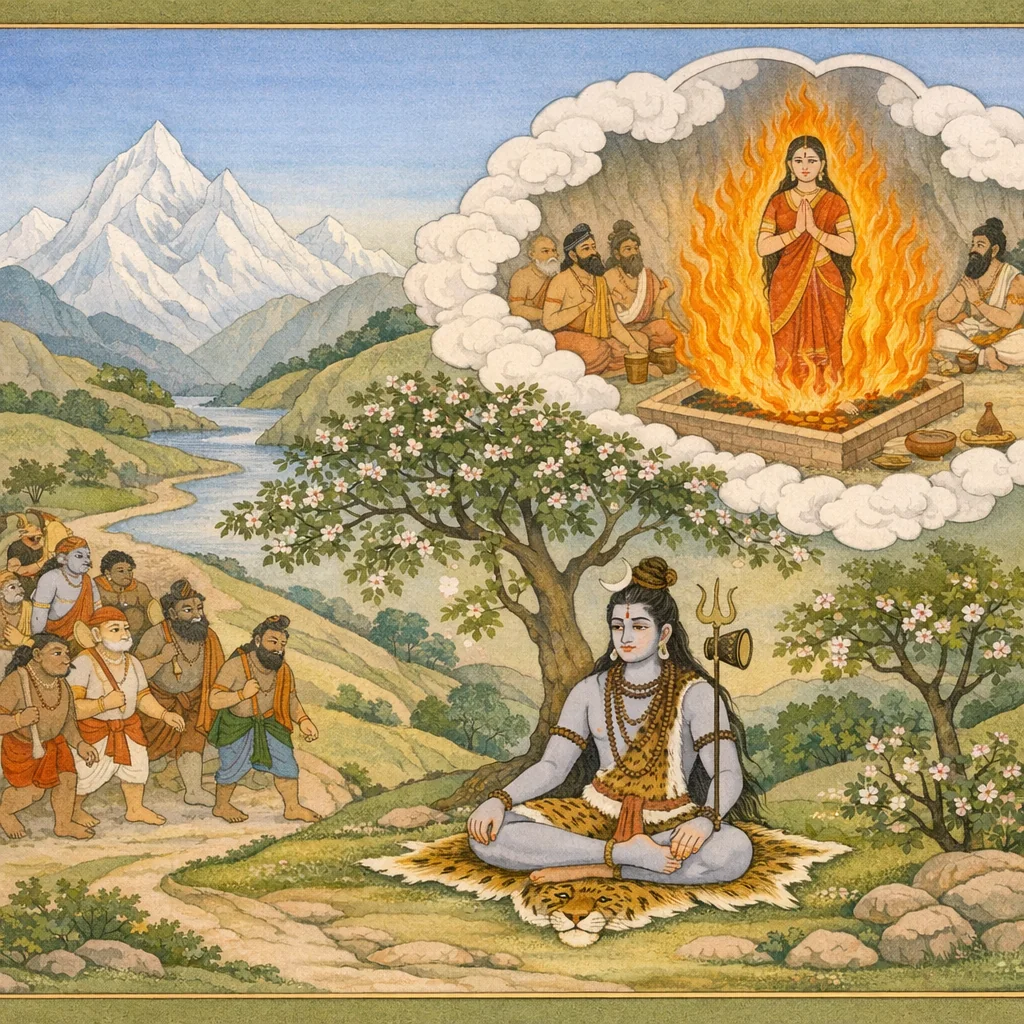
व्योमवाणी-श्रवणं, गणानां शरणागमनं, सती-दाह-वृत्तान्तः — Hearing the Heavenly Voice; The Gaṇas Seek Refuge; Account of Satī’s Self-Immolation
Adhyāya 32 continues the aftermath of the clash at Dakṣa’s sacrifice. Nārada asks Brahmā about the effects of the “vyoma-gir” (heavenly proclamation), what Dakṣa and the assembly did, and where the defeated Śiva-gaṇas went. Brahmā says the devas and attendees, shaken by the celestial voice, fall silent and remain bewildered. The heroic gaṇas who withdrew under Bhṛgu’s mantra-power regroup, and the survivors approach Śiva for refuge. Bowing, they report the whole matter: Dakṣa’s arrogance, Satī’s humiliation, the denial of Śiva’s sacrificial share, harsh speech, and the gods’ broader disrespect. They recount Satī’s fury at seeing Śiva excluded, her denunciation of her father, and her burning of her own body—an emphatic Śakti-event exposing the hollowness of pride-driven ritual. The chapter stresses taking refuge in Śiva, the grave sin of insulting the Divine, and the karmic and cosmic repercussions of an adharmic sacrifice.
Shlokas
Verse 1
नारद उवाच । श्रुत्वा व्योमगिरं दक्षः किमकार्षीत्तदाऽबुधः । अन्ये च कृतवंतः किं ततश्च किमभूद्वद
Nārada said: “After hearing the celestial voice, what did the unwise Dakṣa do at that time? And what did the others do? Tell me also what happened thereafter.”
Verse 2
पराजिताः शिवगणा भृगुमंत्रबलेन वै । किमकार्षुः कुत्र गतास्तत्त्वं वद महामते
Truly, the hosts of Śiva’s attendants were defeated by the power of Bhṛgu’s mantras. What did they do then, and where did they go? O great sage, tell me the true account.
Verse 3
ब्रह्मोवाच । श्रुत्वा व्योमगिरं सर्वे विस्मिताश्च सुरादयः । नावोचत्किंचिदपि ते तिष्ठन्तस्तु विमोहिताः
Brahmā said: Hearing the voice that arose from the sky, all the gods and others were struck with wonder. Bewildered, they stood there and could not utter even a single word.
Verse 4
पलायमाना ये वीरा भृगुमंत्रबलेन ते । अवशिष्टा श्शिवगणाश्शिवं शरणमाययुः
Those heroic ones who fled, overpowered by the force of Bhṛgu’s mantra—those remaining attendants of Śiva—went to Śiva, taking refuge in Him.
Verse 5
सर्वं निवेदयामासू रुद्रायामिततेजसे । चरित्रं च तथाभूतं सुप्रणम्यादराच्च ते
Then they respectfully bowed down and reported everything to Rudra, whose splendour is immeasurable—relating, with due reverence, the entire account exactly as it had occurred.
Verse 6
गणा ऊचुः । देवदेव महादेव पाहि नश्शरणागतान् । संशृण्वादरतो नाथ सती वार्तां च विस्तरात्
The Gaṇas said: “O God of gods, O Mahādeva, protect us who have come seeking refuge. O Lord, listen with reverent care to the account of Satī, and hear it in full detail.”
Verse 7
गर्वितेन महेशानदक्षेन सुदुरात्मना । अवमानः कृतस्सत्याऽनादरो निर्जरैस्तथा
By the arrogant Dakṣa—hostile to Lord Maheśa and utterly wicked in disposition—Satī was insulted; and the gods present there likewise treated her with disregard.
Verse 8
तुभ्यं भागमदात्रो स देवेभ्यश्च प्रदत्तवान् । दुर्वचांस्यवदत्प्रोच्चैर्दुष्टो दक्षस्सुगर्वितः
That wicked Dakṣa, swollen with pride, gave no share to You in the sacrifice, though he distributed portions to the other gods; and he spoke harsh, insulting words aloud.
Verse 9
ततो दृष्ट्वा न ते भागं यज्ञेऽकुप्यत्सती प्रभो । विनिंद्य बहुशस्तातमधाक्षीत्स्वतनुं तदा
Then, seeing that no share had been allotted to You in the sacrifice, Satī grew enraged, O Lord. Reproaching her father again and again, she then consigned her own body to the fire.
Verse 10
गणास्त्वयुतसंख्याका मृतास्तत्र विलज्जया । स्वांगान्याछिद्य शस्त्रैश्च क्रुध्याम ह्यपरे वयम्
There, gaṇas numbering in tens of thousands died of shame; and some of us, in fury, even cut our own limbs with weapons.
Verse 11
तद्यज्ञे ध्वंसितुं वेगात्सन्नद्धास्तु भयावहाः । तिरस्कृता हि भृगुणा स्वप्रभावाद्विरोधिना
To destroy that sacrifice, they rushed forth with great speed, fully armed and terrifying. For they had been insulted by Bhṛgu, whose own power made him an opposing force.
Verse 12
ते वयं शरणं प्राप्तास्तव विश्वंभर प्रभो । निर्भयान् कुरु नस्तस्माद्दयमानभवाद्भयात्
O Lord, Sustainer of the universe! We have come to You for refuge. Therefore, out of compassion, make us fearless—protect us from the fear that arises from the merciless one.
Verse 13
अपमानं विशेषेण तस्मिन् यज्ञे महाप्रभो । दक्षाद्यास्तेऽखिला दुष्टा अकुर्वन् गर्विता अति
O great lord, at that sacrifice they committed a deliberate insult; Dakṣa and the others—altogether wicked and exceedingly arrogant—perpetrated it.
Verse 14
इत्युक्तं निखिलं वृत्तं स्वेषां सत्याश्च नारद । तेषां च मूढबुद्धीनां यथेच्छसि तथा कुरु
Thus, O Nārada, Satyā has told you the entire account concerning her own people. Now, as you wish, deal accordingly with those whose understanding has become deluded.
Verse 15
ब्रह्मोवाच । इत्याकर्ण्यवचस्तस्य स्वगणानां वचः प्रभुः । सस्मार नारदं सर्वं ज्ञातुं तच्चरितं लघु
Brahmā said: Having thus heard his words, and also the words of his own attendants, the Lord (Brahmā), wishing to know the entire account quickly, summoned Nārada.
Verse 16
आगतस्त्वं द्रुतं तत्र देवर्षे दिव्यदर्शन । प्रणम्य शंकरं भक्त्या सांजलिस्तत्र तस्थिवान्
O Devarṣi of divine vision, you swiftly arrived there; and, bowing to Śaṅkara with devotion, you stood in that place with folded hands.
Verse 17
त्वां प्रशस्याथ स स्वामी सत्या वार्त्तां च पृष्टवान् । दक्षयज्ञगताया वै परं च चरितं तथा
Then the Lord, praising you, asked about Satī’s tidings—especially the supreme account of what occurred when she went to Dakṣa’s sacrifice.
Verse 18
पृष्टेन शंभुना तात त्वयाश्वेव शिवात्मना । तत्सर्वं कथितं वृतं जातं दक्षाध्वरे हि यत्
O dear one, when Śambhu asked you—who are indeed of Śiva’s very nature—you promptly recounted in full everything that happened at Dakṣa’s sacrificial rite.
Verse 19
तदाकर्ण्येश्वरो वाक्यं मुने तत्त्वन्मुखोदितम् । चुकोपातिद्रुतं रुद्रो महारौद्रपराक्रमः
O sage, on hearing those words spoken from your mouth, the Lord at once flared up in wrath; Rudra—whose prowess is supremely terrible—became swiftly enraged.
Verse 20
उत्पाट्यैकां जटां रुद्रो लोकसंहारकारकः । आस्फालयामास रुषा पर्वतस्य तदोपरि
Rudra, the divine power who brings about the dissolution of the worlds, tore out a single lock of His matted hair; and in wrath He struck and hurled it down upon the mountain there.
Verse 21
तोदनाच्च द्विधा भूता सा जटा च मुने प्रभोः । संबभूव महारावो महाप्रलयभीषणः
O sage, when it was struck, that matted lock of the Lord split into two; and there arose a mighty roar—terrifying like the dread of the great cosmic dissolution (mahāpralaya).
Verse 22
तज्जटायास्समुद्भूतो वीरभद्रो महाबलः । पूर्वभागेन देवर्षे महाभीमो गणाग्रणीः
O divine sage, from that very matted lock of his hair arose Vīrabhadra—of immense strength—terrifying in appearance, and a foremost leader of Śiva’s gaṇas, emerging from the front portion.
Verse 23
स भूमिं विश्वतो वृत्त्वात्यतिष्ठद्दशांगुलम् । प्रलयानलसंकाशः प्रोन्नतो दोस्सहस्रवान्
Encompassing the earth on every side, He stood rising ten finger-breadths above it—lofty, blazing like the fire of cosmic dissolution, and bearing a thousand arms that were impossible to withstand.
Verse 24
कोपनिश्वासतस्तत्र महारुद्रस्य चेशितुः । जातं ज्वराणां शतकं संनिपातास्त्रयोदश
From the wrathful breath of Mahārudra, the Supreme Lord, there arose a hundred fevers, and thirteen composite fevers born of combined humors.
Verse 25
महाकाली समुत्पन्ना तज्जटापरभा गतः । महाभयंकरा तात भूतकोटिभिरावृता
From His matted locks (jaṭā) Mahākālī sprang forth, taking on the radiance born of those locks. O dear one, she was exceedingly terrifying, surrounded by crores of bhūtas—Śiva’s spirit-hosts.
Verse 26
सर्वे मूर्त्तिधराः क्रूराः स्वर लोकभयंकराः । स्वतेजसा प्रज्वलंतो दहंत इव सर्वतः
All of them were embodied beings, fierce and terrifying even to the celestial realms; blazing with their own innate radiance, they seemed to burn everything on every side.
Verse 27
अथ वीरो वीरभद्रः प्रणम्य परमेश्वरम् । कृतांजलिपुटः प्राह वाक्यं वाक्यविशारदः
Then the heroic Vīrabhadra, having bowed down to Parameśvara (Lord Śiva), spoke with his hands joined in reverence—he who was skilled and discerning in speech.
Verse 28
वीरभद्र उवाच । महारुद्र महारौद्र सोमसूर्याग्निलोचन । किं कर्तव्यं मया कार्यं शीघ्रमाज्ञापय प्रभो
Vīrabhadra said: “O Mahārudra, O Mahāraudra, You whose eyes are the Moon, the Sun, and Fire—what is to be done by me? What task should I carry out? Command me swiftly, O Lord.”
Verse 29
शोषणीयाः किमीशान क्षणार्द्धेनैव सिंधवः । पेषणीयाः किमीशान क्षणार्द्धेनैव पर्वताः
O Īśāna (Lord Śiva), what is there that cannot be done? In but half a moment the oceans could be dried up; in but half a moment the mountains could be ground to powder.
Verse 30
क्षणेन भस्मसात्कुर्यां ब्रह्मांडमुत किं हर । क्षणेन भस्मसात्कुर्याम्सुरान्वा किं मुनीश्वरान्
O Hara, in a single instant I could reduce the entire cosmic egg—the universe—to ashes; what then of it? In an instant I could likewise burn to ashes the gods, or even the lordly sages.
Verse 31
व्याश्वासः सर्वलोकानां किमु चार्यो हि शंकर । कर्तव्य किमुतेशान सर्वप्राणिविहिंसनम्
If even the slightest distrust toward all beings is improper, then how much more so toward You, O Śaṅkara, the true Master! O Īśāna, what could ever be called “right” in harming any living creature?
Verse 32
इति श्रीशिवमहापुराणे द्वितीयायां रुद्रसंहितायां द्वितीये सतीखंडे वीरभद्रोत्पत्तिशिवोपदेशवर्णनं नाम द्वात्रिंशोऽध्यायः
Thus, in the Śrī Śiva Mahāpurāṇa—within the Second Rudra Saṃhitā, in the Second Satī Khaṇḍa—ends the thirty-second chapter entitled “The account of Vīrabhadra’s manifestation and the description of Śiva’s instruction.”
Verse 33
यत्र यत्कार्यमुद्दिश्य प्रेषयिष्यसि मां प्रभो । तत्कार्यं साधयाम्येव सत्वरं त्वत्प्रसादतः
O Lord, whatever task You send me for, with that very purpose in view—I shall surely accomplish that work swiftly, by the power of Your grace.
Verse 34
क्षुद्रास्तरंति लोकाब्धिं शासनाच्छंकरस्य ते । हरातोहं न किं तर्तुं महापत्सागरं क्षमः
Even the insignificant cross the ocean of saṃsāra by the command and grace of Śaṅkara. Why then should I, protected by Hara, not be able to cross this vast ocean of great calamities?
Verse 35
त्वत्प्रेषिततृणेनापि महत्कार्यं मयत्नतः । क्षणेन शक्यते कर्तुं शंकरात्र न संशयः
O Śaṅkara, even by a mere blade of grass sent by You, a great task can be accomplished effortlessly in an instant—of this there is no doubt.
Verse 36
लीलामात्रेण ते शंभो कार्यं यद्यपि सिद्ध्यति । तथाप्यहं प्रेषणीयो तवैवानुग्रहो ह्ययम्
O Śambhu, although by Your mere play (līlā) the intended work is already accomplished, still I am to be sent forth as Your emissary—indeed, this itself is Your grace upon me.
Verse 37
शक्तिरेतादृशी शंभो ममापि त्वदनुग्रहात् । विना शक्तिर्न कस्यापि शंकर त्वदनुग्रहात्
O Śambhu, even I have attained such power only through Your grace. Without Śakti, no one has any capability at all, O Śaṅkara—everything functions only by Your grace.
Verse 38
त्वदाज्ञया विना कोपि तृणादीनपि वस्तुतः । नैव चालयितुं शक्तस्सत्यमेतन्न संशयः
Without Your command, no one is truly capable of moving even a blade of grass. This is the truth—of this there is no doubt.
Verse 39
शंभो नियम्यास्सर्वेपि देवाद्यास्ते महेश्वर । तथैवाहं नियम्यस्ते नियंतुस्सर्वदेहिनाम्
O Śambhu, O Maheśvara—truly all the gods and all other beings are held in check and governed by You. In the same way, I too am ruled by You, for You are the supreme Controller of all embodied beings.
Verse 40
प्रणतोस्मि महादेव भूयोपि प्रणतोस्म्यहम् । प्रेषय स्वेष्ट सिद्ध्यर्थं मामद्य हर सत्वरम्
O Mahādeva, I bow to You; again and again I bow. For the fulfillment of my dearest desire, send me today—O Hara—swiftly to my destined end.
Verse 41
स्पंदोपि जायते शंभो सख्यांगानां मुहुर्मुहुः । भविष्यत्यद्य विजयो मामतः प्रेषय प्रभो
O Śambhu, again and again a tremor rises in the limbs of my companions. Surely victory will be ours today; therefore, O Lord, send me forth from here.
Verse 42
हर्षोत्साहविशेषोपि जायते मम कश्चन । शंभो त्वत्पादकमले संसक्तश्च मनो मम
O Śambhu, a distinct joy and fervour arises within me, and my mind has become wholly attached to the lotus of Your feet.
Verse 43
भविष्यति प्रतिपदं शुभसंतानसंततिः
Day after day, an auspicious succession of progeny shall arise.
Verse 44
तस्यैव विजयो नित्यं तस्यैव शुभमन्वहम् । यस्य शंभौ दृढा भक्तिस्त्वयि शोभनसंश्रये
For him alone there is constant victory; for him alone there is auspiciousness day after day—he whose devotion to Śambhu is firm, O you who are the beautiful refuge.
Verse 45
ब्रह्मोवाच । इत्युक्तं तद्वचः श्रुत्वा संतुष्टो मंगलापतिः । वीरभद्र जयेति त्वं प्रोक्ताशीः प्राह तं पुनः
Brahmā said: Hearing those words, Maṅgalāpati (Lord Śiva), well pleased, addressed him again and bestowed a blessing: “O Vīrabhadra, be victorious!”
Verse 46
महेश्वर उवाच । शृणु मद्वचनं तात वीरभद्र सुचेतसा । करणीयं प्रयत्नेन तद्द्रुतं मे प्रतोषकम्
Maheshvara said: “Listen to my words, dear one—O Vīrabhadra—with a clear and steady mind. What must be done, do with earnest effort; do it swiftly, for it will bring satisfaction to Me.”
Verse 47
यागं कर्तुं समुद्युक्तो दक्षो विधिसुतः खलः । मद्विरोधी विशेषेण महागर्वोऽबुधोऽधुना
That wicked Dakṣa, the son of Brahmā, has now set himself to perform a sacrifice. In particular he is hostile to me; at present he is swollen with great pride and blinded by ignorance.
Verse 48
तन्मखं भस्मसात्कृत्वा सयागपरिवारकम् । पुनरायाहि मत्स्थानं सत्वरं गणसत्तम
Having reduced that sacrifice to ashes—together with its entire ritual retinue—return at once again to My abode, O best among the Gaṇas.
Verse 49
सुरा भवंतु गंधर्वा यक्षा वान्ये च केचन । तानप्यद्यैव सहसा भस्मसात्कुरु सत्वरम्
Whether they be Devas, Gandharvas, Yakṣas, or any others whatsoever—reduce them too, this very day, suddenly and without delay, to ashes.
Verse 50
तत्रास्तु विष्णुर्ब्रह्मा वा शचीशो वा यमोपि वा । अपि चाद्यैव तान्सर्वान्पातयस्व प्रयत्नतः
“Let it be there—whether it is Viṣṇu, or Brahmā, or Indra (the lord of Śacī), or even Yama. Even today, by all means and with full effort, cast all of them down.”
Verse 51
सुरा भवंतु गंधर्वा यक्षा वान्ये च केचन । तानप्यद्यैव सहसा भस्मसात्कुरु सत्वरम्
Whether they be Devas, Gandharvas, Yakṣas, or any others whatsoever—reduce them too, this very day, suddenly and without delay, to ashes.
Verse 52
दधीचिकृतमुल्लंघ्य शपथं मयि तत्र ये । तिष्ठंति ते प्रयत्नेन ज्वालनीयास्त्वया ध्रुवम्
Those who, there, transgress the vow made by Dadhīci and persist in hostility toward Me—by your deliberate effort they must surely be scorched (punished) without fail.
Verse 53
प्रमथाश्चागमिष्यंति यदि विष्ण्वादयो भ्रमात् । नानाकर्षणमंत्रेण ज्वालयानीय सत्वरम्
If the Pramathas come—or if even Viṣṇu and others, through delusion, approach—then one should swiftly set (the protective fire) ablaze by means of the various attraction-compelling mantras.
Verse 54
ये तत्रोल्लंघ्य शपथं मदीयं गर्विताः स्थिताः । ते हि मद्द्रोहिणोऽतस्तान् ज्वालयानलमालया
Those who, there, have proudly stood after transgressing my solemn vow—since they are traitors to me—therefore burn them with a garland of fire.
Verse 55
सपत्नीकान्ससारांश्च दक्षयागस्थलस्थितान् । प्रज्वाल्य भस्मसात्कृत्वा पुनरायाहि सत्वरम्
“Set ablaze all those present at Daksha’s sacrificial arena—together with their wives and their entire retinues—reduce them to ashes, and then return here at once.”
Verse 56
तत्र त्वयि गते देवा विश्वाद्य अपि सादरम् । स्तोष्यंति त्वां तदाप्याशु ज्वालया ज्वालयैव तान्
When you have gone there, the gods—the Viśvadevas and the rest—will respectfully praise you. Even then, quickly burn them with your flame; yes, burn them at once.
Verse 57
देवानपि कृतद्रोहान् ज्वालामालासमाकुलः । ज्वालय ज्वलनैश्शीघ्रं माध्यायाध्यायपालकम्
Even the gods who have committed treachery—being encircled by garlands of flames—burn them at once with blazing fires, O protector and preserver of the sacred recitations and their proper order.
Verse 58
दक्षादीन्सकलांस्तत्र सपत्नीकान्सबांधवान् । प्रज्वाल्य वीर दक्षं नु सलीलं सलिलं पिब
O hero, having kindled the fire of destruction there, burn Dakṣa and all the others—together with their wives and kinsmen; then, playfully, drink the water as if to cool yourself.
Verse 59
ब्रह्मोवाच । इत्युक्तो रोषताम्राक्षो वेदमर्यादपालकः । विरराम महावीरं कालारिस्सकलेश्वरः
Brahmā said: Thus addressed, the great hero—his eyes reddened with wrath—yet the guardian of the Vedic order, the Lord of all, the foe of Kāla (Death), withdrew and desisted.
Frequently Asked Questions
The immediate aftermath of Dakṣa’s sacrifice: the devas’ bewilderment after a heavenly proclamation, the defeated gaṇas retreating and taking refuge in Śiva, and the gaṇas recounting Satī’s self-immolation due to Dakṣa’s insult and Śiva’s denied share.
It frames the Dakṣa-yajña not merely as a quarrel but as a doctrinal demonstration that sacrifice without reverence to Rudra is spiritually defective; Satī’s act functions as a śakti-driven correction of cosmic order and a condemnation of ego-based ritualism.
Bhṛgu’s mantra-bala (ritual/mantric power) is contrasted with Śiva’s role as ultimate refuge; the ‘vyoma-vāṇī’ underscores supra-human divine governance, while Satī’s śakti is shown as transformative power capable of overturning sacrificial authority.