Dāruvana-parīkṣā: Śaṅkara’s Test and the Linga’s Ritual-Theological Grounding
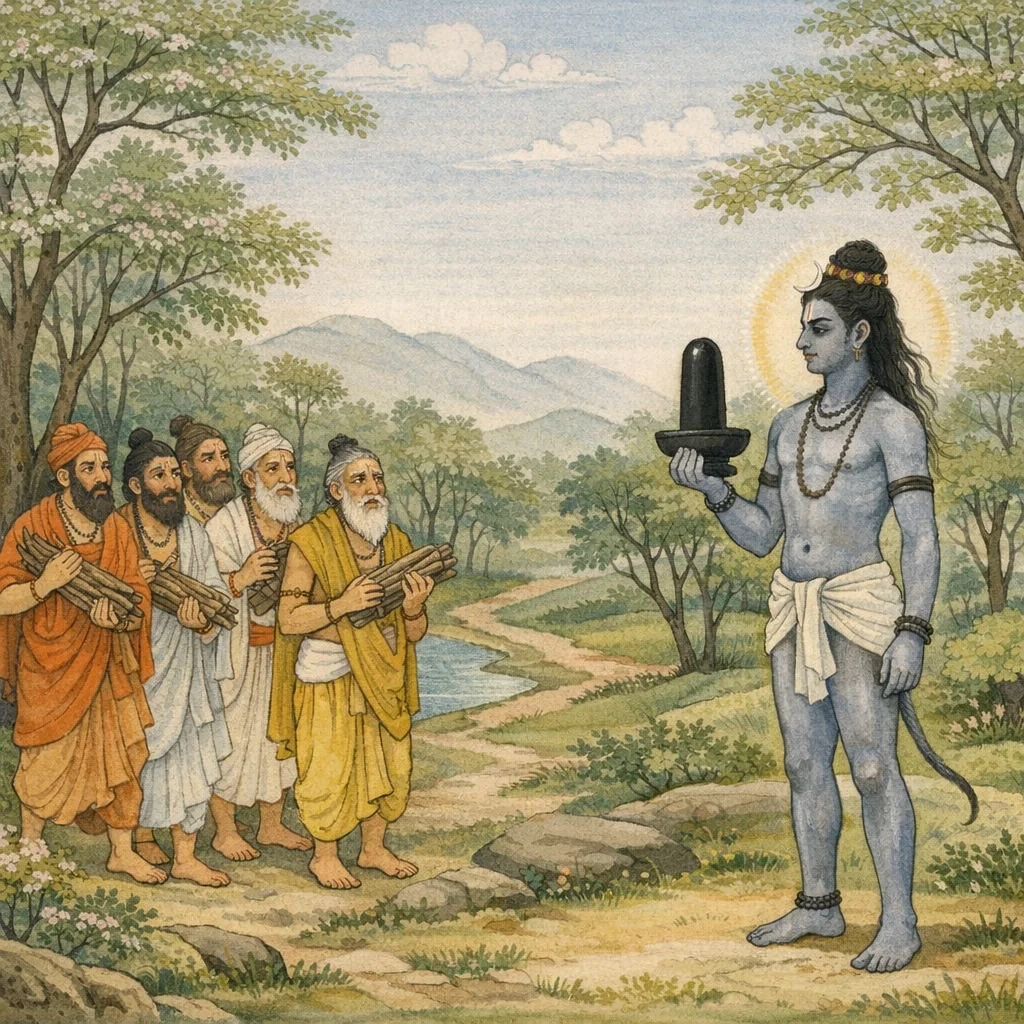
Adhyāya 12 begins with the ṛṣis addressing Sūta as an authoritative transmitter by Vyāsa’s grace and asking the cause of two linked matters: why the liṅga is worshipped in the world as the true principle already taught, and why Pārvatī, Śiva’s beloved, is famed in “bāṇa-rūpa” (a pointed, arrow-like emblematic form). Sūta replies by placing the explanation within a kalpa-bheda account received from Vyāsa and introduces the Dāruvana forest episode as the frame. A forest of Śiva-devoted ascetics is described—performing tri-kāla pūjā, chanting hymns, and abiding in constant dhyāna—who go out to gather samidh. In their absence, Śaṅkara appears directly as Nīla-Lohita, deliberately assuming a disturbing, virūpa, digambara guise, smeared with bhūti, holding a liṅga in his hand and performing provocative acts explicitly “for testing” (parīkṣārtha). Through this narrative provocation, the chapter grounds the Purāṇic theology of symbol: the liṅga is not a mere object but a doctrinal sign of Śiva-tattva, rightly recognized through inner discernment (bhāva) no less than outer rite (kriyā).
Shlokas
Verse 1
ऋषय ऊचुः । सूत जानासि सकलं वस्तु व्यासप्रसादतः । तवाज्ञातं न विद्येत तस्मात्पृच्छामहे वयम्
The sages said: “O Sūta, by the grace of Vyāsa you know the entirety of this subject. Nothing remains unknown to you; therefore we ask you to explain it.”
Verse 2
लिंगं च पूज्यते लोके तत्त्वया कथितं च यत् । तत्तथैव न चान्यद्वा कारणं विद्यते त्विह
In this world the Liṅga is worshipped, and the true principle behind it has been declared. It is exactly so—here there is no other cause or explanation apart from that truth.
Verse 3
बाणरूपा श्रुता लोके पार्वती शिववल्लभा । एतत्किं कारणं सूत कथय त्वं यथाश्रुतम्
In the world it is heard that Goddess Pārvatī, beloved of Lord Śiva, assumed the form of an arrow. O Sūta, what is the reason for this? Tell it exactly as you have heard.
Verse 4
सूत उवाच । कल्पभेदकथा चैव श्रुता व्यासान्मया द्विजाः । तामेव कथयाम्यद्य श्रूयतामृषिसत्तमाः
Sūta said: “O twice-born sages, I have indeed heard from Vyāsa the account of the distinctions among the kalpas. That very account I shall narrate today—listen, O best of seers.”
Verse 5
पुरा दारुवने जातं यद्वृत्तं तु द्विजन्मनाम् । तदेव श्रूयतां सम्यक् कथयामि कथाश्रुतम्
Formerly, in the Dāru forest, an incident occurred involving the twice-born sages. Listen carefully to that very account; I shall narrate it properly, just as it has been heard in the sacred tradition.
Verse 6
दारुनामवनं श्रेष्ठं तत्रासन्नृषिसत्तमाः । शिवभक्तास्सदा नित्यं शिवध्यानपरायणाः
Dārunāmavana was an excellent and foremost forest. There dwelt the best of sages—devotees of Lord Śiva—ever constant, always absorbed in meditation upon Śiva.
Verse 7
त्रिकालं शिवपूजां च कुर्वंति स्म निरन्तरम् । नानाविधैः स्तवैर्दिव्यैस्तुष्टुवुस्ते मुनीश्वराः
Those lordly sages continually performed the worship of Lord Śiva at the three sacred times of the day, and with many kinds of divine hymns they praised Him again and again.
Verse 8
ते कदाचिद्वने यातास्समिधाहरणाय च । सर्वे द्विजर्षभाश्शैवाश्शिवध्यानपरायणाः
Once, they went into the forest to gather sacred fuel-sticks (samidh) for the rites. All those bull-like best of brāhmaṇas were devoted Śaivas, wholly intent on meditation upon Lord Śiva.
Verse 9
एतस्मिन्नंतरे साक्षाच्छंकरो नील लोहितः । विरूपं च समास्थाय परीक्षार्थं समागतः
Just then, Śaṅkara Himself—dark-hued and ruddy—arrived in person. Assuming a strange and uncomely guise, He came there in order to test them.
Verse 10
दिगम्बरोऽतितेजस्वी भूतिभूषणभूषितः । स चेष्टामकरोद्दुष्टां हस्ते लिंगं विधारयन्
Sky-clad (Digambara) and exceedingly radiant, adorned with the ornament of sacred ash (bhūti), he—holding the Liṅga in his hand—performed a wicked, disruptive act.
Verse 11
मनसा च प्रियं तेषां कर्तुं वै वनवासिनाम् । जगाम तद्वनं प्रीत्या भक्तप्रीतो हरः स्वयम्
Wishing in his heart to do what would delight the forest-dwellers, Hara (Lord Śiva) himself—moved by love for his devotees—joyfully went to that forest.
Verse 12
तं दृष्ट्वा ऋषिपत्न्यस्ताः परं त्रासमुपागताः । विह्वला विस्मिताश्चान्यास्समाजग्मुस्तथा पुनः
Seeing him, the wives of the sages were seized by intense fear; some were shaken and bewildered, while others—astonished—gathered together again.
Verse 13
अलिलिंगुस्तथा चान्याः करं धृत्या तथापराः । परस्परं तु संघर्षात्संमग्नास्ताः स्त्रियस्तदा
Some women embraced one another closely, while others held each other by the hand. In that moment, through their mutual jostling and pressing together, those women became completely absorbed in the commotion.
Verse 14
एतस्मिन्नेव समये ऋषिवर्याः समागमन् । विरुद्धं तं च ते दृष्ट्वा दुःखिताः क्रोधमूर्च्छिताः
At that very moment, the foremost sages arrived there. Seeing that conflict had arisen, they became sorrowful and were overcome by a surge of anger.
Verse 15
तदा दुःखमनुप्राप्ताः कोयं कोयं तथाऽबुवन् । समस्ता ऋषयस्ते वै शिवमायाविमोहिताः
Then those sages were overtaken by sorrow and repeatedly exclaimed, “Who is this? Who is this?”—for all of them had been deluded by Lord Śiva’s māyā.
Verse 16
यदा च नोक्तवान्किंचित्सोवधूतो दिगम्बरः । ऊचुस्तं पुरुषं भीमं तदा ते परमर्षयः
When that sky-clad avadhūta spoke nothing at all, then those supreme sages addressed that formidable man.
Verse 17
त्वया विरुद्धं क्रियते वेदमार्ग विलोपि यत् । ततस्त्वदीयं तल्लिंगं पततां पृथिवीतले
Because, in opposition to you, an act has been done that destroys the path of the Vedas—therefore let that Liṅga belonging to you fall down upon the surface of the earth.
Verse 18
सूत उवाच । इत्युक्ते तु तदा तैश्च लिंगं च पतितं क्षणात् । अवधूतस्य तस्याशु शिवस्याद्भुतरूपिणः
Sūta said: When those words were spoken by them, in that very moment the Liṅga fell down at once—belonging to that wondrous-formed Lord Śiva, the Avadhūta, the utterly detached One.
Verse 19
तल्लिंगं चाग्निवत्सर्वं यद्ददाह पुरा स्थितम् । यत्रयत्र च तद्याति तत्रतत्र दहेत्पुनः
That Liṅga, blazing like fire, once burned all that stood before it; and wherever it moved, there too—again and again—it scorched all that was there.
Verse 20
पाताले च गतं तश्च स्वर्गे चापि तथैव च । भूमौ सर्वत्र तद्यातं न कुत्रापि स्थिरं हि तत्
It goes even to the netherworlds of Pātāla, and likewise to heaven; on earth too it moves everywhere. Indeed, it is not steady anywhere at all.
Verse 21
लोकाश्च व्याकुला जाता ऋषयस्तेतिदुःखिताः । न शर्म लेभिरे केचिद्देवाश्च ऋषयस्तथा
The worlds became distressed and agitated, and the sages were overwhelmed with sorrow. No one found peace—neither the gods nor the sages, in the same way.
Verse 22
न ज्ञातस्तु शिवो यैस्तु ते सर्वे च सुरर्षयः । दुःखिता मिलिताश्शीघ्रं ब्रह्माणं शरणं ययुः
Those divine sages who had not recognized Lord Śiva became distressed. Gathering together at once, they swiftly went to Brahmā and sought refuge in him.
Verse 23
तत्र गत्वा च ते सर्वे नत्वा स्तुत्वा विधिं द्विजाः । तत्सर्वमवदन्वृत्तं ब्रह्मणे सृष्टिकारिणे
Having gone there, all those twice-born sages bowed to and praised Vidhi (Brahmā). Then they related to Brahmā, the creator of the world, everything that had occurred.
Verse 24
ब्रह्मा तद्वचनं श्रुत्वा शिवमायाविमोहितान् । ज्ञात्वा ताञ्च्छंकरं नत्वा प्रोवाच ऋषिसत्तमान्
Having heard those words, Brahmā understood that the sages had been deluded by Śiva’s māyā. Then, bowing to Śaṅkara, he addressed those foremost of ṛṣis.
Verse 25
ब्रह्मोवाच । ज्ञातारश्च भवन्तो वै कुर्वते गर्हितं द्विजाः । अज्ञातारो यदा कुर्युः किं पुनः कथ्यते पुनः
Brahmā said: “Even you twice-born sages—though you know dharma—at times commit censurable acts. If even the ignorant do such things, what more need be said?”
Verse 26
विरुद्ध्यैवं शिवं देवं कुशलं कस्समीहते । मध्याह्नसमये यो वै नातिथिं च परामृशेत्
Who, having thus acted in opposition to Lord Śiva, the Divine, can truly hope for well-being? Indeed, one who at midday does not duly honour and receive a guest incurs blame.
Verse 27
तस्यैव सुकृतं नीत्वा स्वीयं च दुष्कृतं पुनः । संस्थाप्य चातिथिर्याति किं पुनः शिवमेव वा
The guest carries away that person’s merit and leaves behind his own demerit in its place, then departs—how much more so if the guest is none other than Lord Śiva Himself?
Verse 28
यावल्लिंगं स्थिरं नैव जगतां त्रितये शुभम् । जायते न तदा क्वापि सत्यमेतद्वदाम्यहम्
So long as the Liṅga is not firmly established, auspiciousness for the three worlds does not arise anywhere. This is the truth—I declare it.
Verse 29
भवद्भिश्च तथा कार्यं यथा स्वास्थ्यं भवेदिह । शिवलिंगस्य ऋषयो मनसा संविचार्य्यताम्
You too should act so that health and well-being are preserved here. O sages, reflect carefully in your minds upon the Śiva-liṅga.
Verse 30
सूत उवाच । इत्युक्तास्ते प्रणम्योचुर्ब्रह्माणमृषयश्च वै । किमस्माभिर्विधे कार्यं तत्कार्यं त्वं समादिश
Sūta said: Thus addressed, those sages bowed down and said to Brahmā: “O Vidhe, what is to be done by us? Command us that very duty which is to be accomplished.”
Verse 31
इत्युक्तश्च मुनीशैस्तैस्सर्वलोकपितामहः । मुनीशांस्तांस्तदा ब्रह्मा स्वयं प्रोवाच वै तदा
Thus addressed by those great sages, Brahmā—the grandsire of all the worlds—then indeed spoke personally to those very sages.
Verse 32
ब्रह्मोवाच । आराध्य गिरिजां देवीं प्रार्थयन्तु सुराश्शिवम् । योनिरूपा भवेच्चेद्वै तदा तत्स्थिरतां व्रजेत्
Brahmā said: “Let the gods worship Girijā Devī and pray to Lord Śiva. If She indeed becomes manifest in the form of the yoni—the sacred source-form—then that divine manifestation will attain steadiness and remain firmly established.”
Verse 33
तद्विधिम्प्रवदाम्यद्य सर्वे शृणुत सत्तमाः । तामेव कुरुत प्रेम्णा प्रसन्ना सा भविष्यति
Today I shall declare that sacred procedure—listen, all you best of the good. Perform that very observance with loving devotion (bhakti); she will surely become gracious and pleased.
Verse 34
कुम्भमेकं च संस्थाप्य कृत्वाष्टदलमुत्तमम् । दूर्वायवांकुरैस्तीर्थोदकमापूरयेत्ततः
Having set up a single ritual pot (kumbha) and arranged an excellent eight-petalled lotus design, one should then fill it with sacred water from a tīrtha, together with dūrvā grass and fresh barley sprouts.
Verse 35
वेदमंत्रैस्ततस्तं वै कुंभं चैवाभिमंत्रयेत् । श्रुत्युक्तविधिना तस्य पूजां कृत्वा शिवं स्मरन्
Thereafter, one should consecrate that kumbha by reciting Vedic mantras. Then, following the procedure taught in the Śruti, one should perform its worship while inwardly remembering Lord Śiva.
Verse 36
तल्लिंगं तज्जलेनाभिषेचयेत्परमर्षयः । शतरुद्रियमंत्रैस्तु प्रोक्षितं शांतिमाप्नुयात्
O great sages, one should bathe that Śiva-liṅga with that very water. When it is duly sprinkled and sanctified with the Śatarudrīya mantras, one attains peace—inner pacification and auspicious calm—through the grace of Lord Śiva.
Verse 37
गिरिजां योनिरूपां च बाणं स्थाप्य शुभं पुनः । तत्र लिंगं च तत्स्थाप्यं पुनश्चैवाभिमंत्रयेत्
Again, one should auspiciously place the yoni-form pedestal of Girijā (Pārvatī) and set the bāṇa, the Liṅga-stone, upon it. Then, establishing the Liṅga there, one should once more consecrate it by reciting the appropriate mantras.
Verse 38
सुगन्धैश्चन्दनैश्चैव पुष्पधूपादिभिस्तथा । नैवेद्यादिकपूजाभिस्तोषयेत्परमेश्वरम्
With fragrant substances and sandal paste, likewise with flowers, incense, and such offerings, and with worship that includes naivedya (food-offerings) and the like—one should gladden Parameśvara, Lord Śiva.
Verse 39
प्रणिपातैः स्तवैः पुण्यैर्वाद्यैर्गानैस्तथा पुनः । ततः स्वस्त्ययनं कृत्वा जयेति व्याहरेत्तथा
With prostrations, with sacred hymns, and again with instrumental music and devotional singing, one should then perform the rite of auspicious benediction; thereafter one should proclaim, “Victory!”
Verse 40
प्रसन्नो भव देवेश जगदाह्लादकारक । कर्ता पालयिता त्वञ्च संहर्ता त्वं निरक्षरः
Be gracious, O Lord of the gods, the One who brings joy to the whole world. You alone are the Creator, the Sustainer, and the Dissolver; you are the imperishable, beyond all decay and limitation.
Verse 41
जगदादिर्जगद्योनिर्जगदन्तर्गतोपि च । शान्तो भव महेशान सर्वांल्लोकांश्च पालय
O Maheśāna, You are the beginning of the universe, the very womb from which the universe arises, and yet You abide within it. Be appeased; in Your calmness, protect all the worlds.
Verse 42
एवं कृते विधौ स्वास्थ्यं भविष्यति न संशय । विकारो न त्रिलोकेस्मिन्भविष्यति सुखं सदा
When this prescribed rite is performed in this manner, health will surely arise—there is no doubt. In these three worlds there will be no affliction; happiness will prevail always.
Verse 43
सूत उवाच । इत्युक्तास्ते द्विजा देवाः प्रणिपत्य पितामहम् । शिवं तं शरणं प्राप्तस्सर्वलोकसुखेप्सया
Sūta said: Thus instructed, those divine brāhmaṇas bowed down to Pitāmaha (Brahmā) and then took refuge in that Lord Śiva, desiring the welfare and happiness of all the worlds.
Verse 44
पूजितः परया भक्त्या प्रार्थितः शंकरस्तदा । सुप्रसन्नस्ततो भूत्वा तानुवाच महेश्वरः
Thus worshipped with supreme devotion and earnestly entreated, Śaṅkara became exceedingly gracious; then Mahēśvara spoke to them.
Verse 45
महेश्वर उवाच । हे देवा ऋषयः सर्वे मद्वचः शृणुतादरात् । योनिरूपेण मल्लिंगं धृतं चेत्स्यात्तदा सुखम्
Mahēśvara said: “O gods and all sages, listen attentively to my words. If my Liṅga is installed and held in the form of the Yoni, then there arises well-being and auspicious ease.”
Verse 46
पार्वतीं च विना नान्या लिंगं धारयितुं क्षमा । तया धृतं च मल्लिंगं द्रुतं शान्तिं गमिष्यति
Apart from Pārvatī, no other is capable of bearing the Liṅga. And when my Liṅga is borne by her, it will swiftly attain pacification and peace.
Verse 47
सूत उवाच । तच्छ्रुत्वा ऋषिभिर्देवैस्सुप्रसन्नैर्मुनीश्वराः । गृहीत्वा चैव ब्रह्माणं गिरिजा प्रार्थिता तदा
Sūta said: Hearing this, the great sages—together with the gods—were exceedingly pleased. Then Girijā (Pārvatī), taking Brahmā with her, offered her supplication at that time.
Verse 48
प्रसन्नां गिरिजां कृत्वा वृषभध्वजमेव च । पूर्वोक्तं च विधिं कृत्वा स्थापितं लिंगमुत्तमम्
Having pleased Girijā (Pārvatī) and also Vṛṣabhadhvaja (Lord Śiva, whose banner bears the bull), and having performed the previously prescribed rite, he established the excellent, supremely auspicious Liṅga.
Verse 49
मंत्रोक्तेन विधानेन देवाश्च ऋषयस्तथा । चक्रुः प्रसन्नां गिरिजां शिवं च धर्महेतवे
Following the rite as prescribed in the mantras, the gods and the sages likewise performed the worship, pleasing Girijā (Pārvatī) and Śiva, so that dharma might be established and upheld.
Verse 50
समानर्चुर्विशेषेण सर्वे देवर्षयः शिवम् । ब्रह्मा विष्णुः परे चैव त्रैलोक्यं सचराचरम्
Then all the divine sages worshipped Lord Śiva with special reverence; and Brahmā, Viṣṇu, and the other gods as well—indeed the entire three worlds, moving and unmoving—honoured Him together.
Verse 51
सुप्रसन्नः शिवो जातः शिवा च जगदम्बिका । धृतं तया च तल्लिंगं तेन रूपेण वै तदा
Then Lord Śiva became exceedingly gracious, and Śivā—the Mother of the universe—was likewise filled with auspicious joy. At that time she held that very Liṅga, abiding in that same form.
Verse 52
लोकानां स्थापिते लिंगे कल्याणं चाभवत्तदा । प्रसिद्धं चैव तल्लिंगं त्रिलोक्यामभवद्द्विजाः
When that Liṅga was established for the welfare of the worlds, auspiciousness arose at that very time. And that very Liṅga became renowned throughout the three worlds, O twice-born sages.
Verse 53
हाटकेशमिति ख्यातं तच्छिवाशिवमित्यपि । पूजनात्तस्य लोकानां सुखं भवति सर्वथा
It is renowned as Hāṭakeśa, and it is also called Śivāśiva. By worshipping that Lord—manifest as the Liṅga—happiness comes to people in every way, without exception.
Verse 54
इह सर्वसमृद्धिः स्यान्नानासुखवहाधिका । परत्र परमा मुक्तिर्नात्र कार्या विचारणा
Here, in this very life, one attains complete prosperity, bringing manifold and superior joys; and hereafter, one attains the supreme liberation. Of this there is no need for any further deliberation.
Frequently Asked Questions
The chapter frames a kalpa-bheda account centered on the Dāruvana episode: Śaṅkara manifests as Nīla-Lohita in a deliberately transgressive guise to test Śiva-devoted sages, thereby grounding the public practice of liṅga worship in a narrative of doctrinal clarification and ritual discernment.
The liṅga functions as a semiotic bridge between nirguṇa transcendence and saguna accessibility: it is carried/held by Śiva to force interpretation beyond social appearance. Digambara/virūpa imagery and bhūti ornamentation operate as markers of renunciation and liminality, teaching that correct worship depends on recognizing Śiva-tattva beneath destabilizing forms.
Śiva appears explicitly as Nīla-Lohita (a Rudra form) assuming a virūpa, digambara presentation for parīkṣā; Pārvatī is referenced as Śiva-vallabhā with an attributed “bāṇa-rūpa,” introduced as a topic whose causal explanation is to be unfolded through the Dāruvana narrative framework.