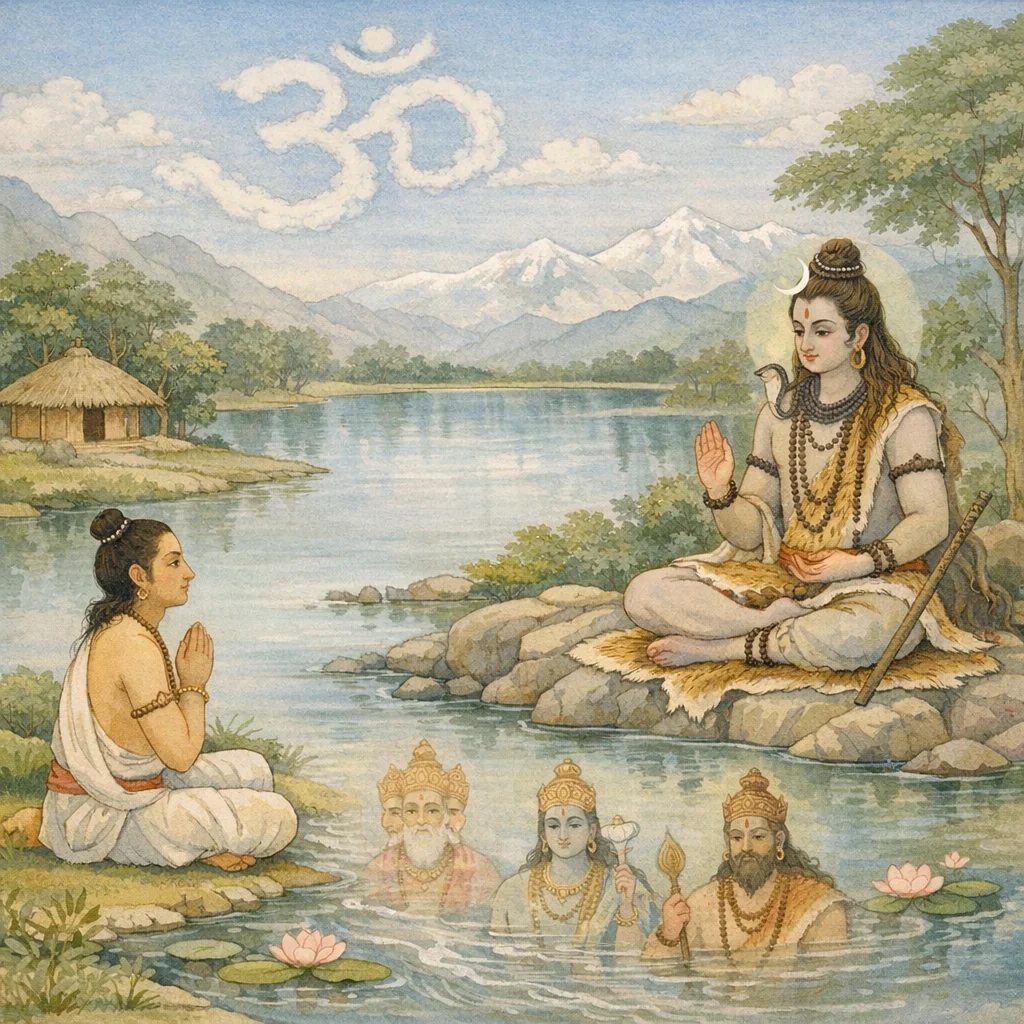
प्रणवार्थपद्धतिवर्णनम् (Methodical Explanation of the Meaning of Praṇava/Om)
Framed as Īśvara’s instruction, this chapter offers a technical-theological account of how Śiva is designated through an ordered set of divine names and how those names map onto ontology. It opens by listing key appellations—Śiva, Maheśvara, Rudra, Viṣṇu, Pitāmaha—and interprets them as primary pointers to the omniscient Paramātman, the “physician of saṃsāra.” The text introduces a nitya nāmāṣṭaka (eternal octad of names) and explains differentiation through upādhis (conditioning adjuncts): names and ranks arise by assuming adjuncts, and when adjuncts cease each resolves into its proper, unconditioned reality. It contrasts the enduring ‘pada’ (stable ontic ground/word-seat) with the impermanent ‘padinaḥ’ who occupy shifting states, stressing liberation as release from the revolutions of conditioned predicates. Finally, it aligns this semantic-ritual analysis with a tattva scheme (prakṛti beyond the 23 tattvas and puruṣa as the 25th), presenting the meaning of praṇava/Om as a disciplined path for reading cosmic categories back into Śiva’s unity.
Shlokas
Verse 1
ईश्वर उवाच । शिवो महेश्वरश्चैव रुद्रो विष्णुः पितामहः । संसारवैद्यस्सर्वज्ञः परमात्मेति मुख्यतः
Īśvara said: “He is called Śiva, Maheśvara, and Rudra; and He is also spoken of as Viṣṇu and Pitāmaha (Brahmā). Above all, He is chiefly known as the All-knowing Physician who cures worldly existence, and as the Supreme Self (Paramātman).”
Verse 2
नामाष्टकमिदं नित्यं शिवस्य प्रतिपादकम् । आद्यन्तपञ्चकन्तत्र शान्त्यतीताद्यनुक्रमात्
This ever-effective octad of Names proclaims Lord Śiva. In it, the first and the last five names are set forth in due sequence, beginning with “Śānti” and “Atīta.”
Verse 3
संज्ञा सहाशिवादीनां पञ्चोपाधिपरिग्रहात् । उपाधिविनिवृत्तौ तु यथास्वं विनि वर्तते
The very designations—such as “Śiva” and the rest—arise only because of the assumption of the five limiting adjuncts (upādhis). But when those adjuncts withdraw, each reality returns to its own intrinsic state.
Verse 4
पदमेव हितं नित्यमनित्याः पदिनः स्मृताः । पदानां परिवृत्ति स्यान्मुच्यंते पदिनो यतः
Only the supreme Abode (Padam) is eternally beneficial; those who tread the paths (padinaḥ)—the embodied beings—are declared impermanent. Since the paths continually shift and turn, the path-travellers are bound and released again and again.
Verse 5
परिवृत्त्यन्तरे त्वेवं भूयस्तस्याप्युपाधिना । आत्मान्तराभिधानं स्यात्पादाद्यं नामपंचकम्
Again, in another turn of cyclic manifestation, by that same limiting adjunct (upādhi), there comes to be the designation of a “different self”; thus arises the set of five names beginning with “pāda” (foot), and so on.
Verse 6
अन्यत्तु त्रितयं नाम्नामुपादानादिभेदतः । त्रिविधोपाधिरचनाच्छिव एव तु वर्तते
But the other triad of names—distinguished by differences such as material cause and the like—arises from the construction of three kinds of limiting adjuncts (upādhis); in truth, it is Shiva alone who abides within them as the underlying reality.
Verse 7
अनादिमलसंश्लेषप्रागभावात्स्वभावतः । अत्यन्तपरिशुद्धात्मेत्यतोऽयं शिव उच्यते
Because, by His very nature, from the beginningless past there is absolute non-existence of any contact with impurity, His essence is utterly stainless; therefore He is called “Śiva.”
Verse 8
अथवाऽशेषकल्याणगुणैकघन ईश्वरः । शिव इत्युच्यते सद्भिश्शिवतत्त्वार्थवेदिभिः
Or again: that Lord (Īśvara) who is a single, solid plenitude of all auspicious virtues is called “Śiva” by the wise—those good souls who truly know the meaning of Śiva-tattva.
Verse 9
त्रयोविंशतितत्वेभ्यः पराप्रकृतिरुच्यते । प्रकृतेस्तु परम्प्राहुः पुरुषम्पञ्चविंशकम्
Beyond the twenty-three principles (tattvas) is spoken of the Higher Prakṛti (Parā-Prakṛti), the subtle causal Nature. And beyond Prakṛti, they declare the twenty-fifth principle to be Puruṣa, the conscious self.
Verse 10
यद्वेदादौ स्वरम्प्राहुर्वाच्यवाचकभावतः । वेदैकवेद्यं याथात्म्याद्वेदान्ते च प्रतिष्ठितम्
That Reality which, at the very beginning of the Veda, is declared to be the sacred sound—both as the signifier and the signified; which, in its true nature, is knowable only through the Veda; and which stands firmly established in the Vedānta—this indeed is the Supreme Lord, Śiva.
Verse 11
स एव प्रकृतौ लीनो भोक्ता यः प्रकृतेर्यतः । तस्य प्रकृतिलीनस्य यः परस्स महेश्वरः
That very experiencer (the individual soul), having arisen from Prakṛti, becomes merged in Prakṛti. But He who is beyond that soul merged in Prakṛti—He is Mahādeva, Maheśvara, the Great Lord.
Verse 12
तदधीनप्रवृत्तित्त्वात्प्रकृतेः पुरुषस्य च । अथवा त्रिगुणन्तत्त्वं मायेयमिदमव्ययम्
Because both Prakṛti (material nature) and Puruṣa (the individual conscious principle) function only under That (the Supreme Lord’s) governance, this principle is called Māyā. Or again, it is the imperishable reality constituted of the three guṇas.
Verse 13
मायान्तु प्रकृतिम्विद्यान्मायिनन्तु महेश्वरम् । मायाविमोचकोऽनन्तोमहेश्वरसमन्वयात्
Know Māyā to be Prakṛti, and know the wielder of Māyā to be Maheśvara. Through union with Maheśvara, the Infinite One becomes the liberator who frees (the soul) from Māyā.
Verse 14
रु द्दुःखं दुःखहेतुर्वा तद्द्रावयति यः प्रभुः । रुद्र इत्युच्यते तस्माच्छिवः परमकारणम्
“Ru” denotes sorrow (or even the cause of sorrow). The Lord who makes that sorrow melt away is therefore called Rudra. Hence, Śiva is the supreme cause, the ultimate source of all.
Verse 15
शिवतत्त्वादिभूम्यन्तं शरीरादि घटादि च । व्याप्याधितिष्ठति शिवस्तमाद्विष्णुरुदाहृतः
From the principle of Śiva (Śiva-tattva) down to the very earth, and likewise within bodies, pots, and all formed things, Śiva pervades all and yet abides as the Inner Ruler. Therefore He is also spoken of as “Viṣṇu”—the All‑pervading One.
Verse 16
जगतः पितृभूतानां शिवो मूर्त्यात्मनामपि । पितृभावेन सर्वेषां पितामह उदीरितः
Śiva is the Father of the world and even of those beings who are embodied. Therefore, by His very nature as the universal Father, He is proclaimed to be the Pitāmaha—the Great Sire of all.
Verse 17
निदानज्ञो यथा वैद्यो रोगस्य निवर्तकः । उपायैर्भेषजैस्तद्वल्लयभोगाधिकारकः
Just as a physician who knows the true diagnosis removes a disease by proper methods and medicines, so too the competent spiritual preceptor, through appropriate means, makes one fit to attain the Lord’s state—laya (absorption) and bhoga (divine enjoyment).
Verse 18
संसारस्येश्वरो नित्यं स्थूलस्य विनिवर्तकः । संसार वैद्य इत्युक्तस्सर्वतत्त्वार्थवेदिभिः
He is eternally the Lord of saṃsāra, the One who turns the soul back from gross outwardness. Therefore, those who know the meaning of all tattvas call Him the “physician of saṃsāra.”
Verse 19
दशार्द्धज्ञानसिद्ध्यर्थमिन्द्रियेषु च सत्स्वपि । त्रिकालभाविनो भावान्स्थूलान्सूक्ष्मानशेषतः
Even while the senses continue to function, for the attainment of the perfected knowledge called the “tenfold and eightfold,” one should comprehensively discern all states of existence—gross and subtle—that arise across the three times (past, present, and future).
Verse 20
अणवो नैव जानन्ति मायार्णवमलावृताः । असत्स्वपि च सर्वेषु सिद्धसर्वार्थवेदिषु
The atomic souls (aṇu), veiled by the ocean of Māyā and by impurity (mala), do not truly know Reality; and even with regard to all that is unreal, they still imagine it to be real—though the siddhas, perfected knowers of all meanings, declare otherwise.
Verse 21
यद्यथावस्थितं वस्तु तत्तथैव सदाशिवः । अयत्नेनैव जानाति तस्मात्सर्वज्ञ उच्यते
Whatever a thing truly is, exactly as it stands, Sadāśiva knows it precisely so—effortlessly; therefore He is called the Omniscient.
Verse 22
सर्वात्मा परमैरेभिर्गुणैर्नित्यसमन्वयात् । स्वस्मात्परात्मविरहात्परमात्मा शिवस्स्वयम्
He is the Self of all, for the supreme qualities ever abide in Him. And since there is no higher Self apart from Him, Śiva Himself is the Supreme Self (Paramātman).
Verse 23
इति स्तुत्वा महादेवं प्रणवात्मानमव्ययम् । दत्त्वा पराङ्मुखाद्यञ्च पश्चादीशानमस्तके
Having thus praised Mahādeva—imperishable, whose very essence is the Pranava (Oṁ)—he then placed the act of worship/obeisance beginning from the western-facing aspect, and thereafter established it upon the head as Īśāna (the lordly, upward/northern aspect).
Verse 24
पुनरर्च्य देवेशम्प्रणवेन समाहितः । हस्तेन बद्धाञ्जलिना पूजापुष्पम्प्रगृह्य च
Worshipping again the Lord of the gods with the Pranava (Oṁ), his mind well-collected, he joined his hands in reverence and, taking up the flowers of worship, proceeded to offer them.
Verse 25
उन्मनान्तं शिवं नीत्वा वामनासापुटाध्वना । देवोमुद्वास्य च ततो दक्षनासापुटाध्वना
Leading the mind into the state of unmanā and establishing it in Śiva through the channel of the left nostril, the yogin should then gently bring it out, afterwards, through the channel of the right nostril.
Verse 26
शिव एवाहमस्मीति तदैक्यमनुभूय च । सर्वावरणदेवांश्च पुनरुद्वासयेद्धृदि
Realizing the oneness expressed as, “Śiva alone am I,” and directly experiencing that unity, one should then again install within the heart all the deities of the sacred enclosure (āvaraṇa) of worship.
Verse 27
विद्यापूजां गुरोःपूजां कृत्वा पश्चाद्यथाक्रमम् । शंखार्घपात्रमंत्रांश्च हृदये विन्यसेत्क्रमात्
Having first worshipped sacred knowledge and then worshipped the Guru in due order, one should thereafter—step by step—by nyāsa place within the heart the mantras of the conch and of the arghya-vessel, in their proper sequence.
Verse 28
निर्माल्यञ्च समर्प्याऽथ चण्डेशायेशगोचरे । पुनश्च संयतप्राण ऋष्यादिकमथोच्चरेत्
Then one should offer the nirmālya, the sacred remnants, to Caṇḍeśa who abides within the sphere of Lord Īśa. Thereafter, with breath restrained and the senses disciplined, one should again recite the preliminaries such as the ṛṣi and the rest.
Verse 29
कैलासप्रस्तरो नाम मण्डलम्परिभाषितम् । अर्चयेन्नित्यमेवैतत्पक्षे वा मासिमासि वा
A sacred maṇḍala is prescribed, known as the “Kailāsa-prastara.” One should worship it regularly—either every day, or at least once each fortnight, or month after month.
Verse 30
षण्मासे वत्सरे वापि चातुर्मास्यादिपर्वणि । अवश्यञ्च समभ्यर्चेन्नित्यं मल्लिङ्गमास्तिकः
Whether at the completion of six months, or after a year, or on sacred observances such as the Cāturmāsya and other festival-days, the faithful devotee should certainly worship My Liṅga—and indeed should revere it daily.
Verse 31
तस्मिन्क्रमे महादेवि विशेषः कोऽपि कथ्यते । उपदेशदिने लिंगम्पूजितं गुरुणा सह
O Mahādevī, in that prescribed procedure a special point is taught: on the day of initiation, the Liṅga should be worshipped together with the Guru.
Verse 32
गृह्णीयादर्चयिष्यामि शिवमाप्राणसंक्षयम् । एवन्त्रिवारमुच्चार्य्य शपथं गुरुसन्निधौ
In the Guru’s very presence, having uttered this vow three times, one should take it up: “I shall worship Lord Śiva until the exhaustion of my life-breath—until my last breath.”
Verse 33
ततस्समर्चयेन्नित्यम्पूर्वोक्तविधिना प्रिये । अर्घं समर्पयेल्लिंगमूर्द्धन्यर्घ्योदकेन च
Then, O beloved, one should worship daily according to the method described earlier; and one should offer arghya to the Liṅga—presenting the arghya-water upon its top.
Verse 34
प्रणवेन समभ्यर्च्य धूपदीपौ समर्पयेत् । ऐशान्यां चण्डमाराध्य निर्माल्यञ्च निवेदयेत्
Having duly worshipped with the Praṇava (Oṁ), one should offer incense and a lamp. Then, in the Īśāna (north‑eastern) direction, having propitiated Caṇḍa, one should also present the sacred remnants (nirmālya) as an offering.
Verse 35
प्रक्षाल्य ल्लिंगम्वेदीञ्च वस्त्रपूतैर्जलैस्ततः । निःक्षिप्य पुष्पं शिरसि लिंगस्य प्रणवेन तु
Then, having washed the Śiva-liṅga and its pedestal with water purified by straining through cloth, one should place a flower upon the head (top) of the liṅga, accompanied by the Praṇava (Oṁ).
Verse 36
आधारशक्तिमारभ्य शुद्धविद्यासनावधि । विभाव्य सर्वं मनसा स्थापयेत्परमेश्वरम्
Beginning with Ādhāra-Śakti and proceeding up to the Seat of Śuddha-vidyā, having mentally contemplated the entire hierarchy of principles, one should establish the Supreme Lord, Parameśvara, within one’s awareness in meditation.
Verse 37
पञ्चगव्यादिभिर्द्रव्यैर्यथाविभवसम्भृतैः । केवलैर्वा जलैश्शुद्धैस्सुरभि द्रव्यवासितैः
According to one’s means, one should perform the rite of purification with substances such as pañcagavya—the five products of the cow—and other proper materials; or else with pure water alone, made fragrant with auspicious aromatic substances.
Verse 38
पावमानेन रुद्रेण नीलेन त्वरितेन च । ऋग्भिश्च सामभिर्वापि ब्रह्मभिश्चैव पञ्चभिः
With the purifying Rudra called Pāvamāna, with Nīla and with Tvarita; and also with the Ṛg and Sāma hymns, together with the five Brahma-mantras—by these sacred utterances the rite of Śiva is to be performed, for they sanctify the worshipper and lead the bound soul toward the Lord.
Verse 39
स्नापयेद्देवदेवेशं प्रणवेन शिवेन च । विशेषार्घ्योदकेनापि प्रणवेनाभिषेचयेत्
One should bathe the Lord of lords, the God of gods, with the sacred Praṇava (Oṁ) and with the mantra of Śiva. Even with specially sanctified arghya-water, one should perform His abhiṣeka again, invoking the Praṇava.
Verse 40
विशोध्य वाससा पुष्पं लिंगमूर्द्धनि विन्यसेत् । पीठे लिंगं समारोप्य सूर्याद्यर्चां समाचरेत्
Having purified the offering with a clean cloth, one should place the flower upon the crown of the Śiva-liṅga. Then, installing the liṅga properly upon its pīṭha (pedestal), one should duly perform worship in due order, beginning with Sūrya and the other attendant deities, so that all adoration culminates in Lord Śiva, the supreme Pati.
Verse 41
आधारशक्त्यनन्तौ द्वौ पीठाधस्तात्समर्चयेत् । सिंहासनन्तदूर्ध्वन्तु समभ्यर्च्य यथाक्रमम्
One should duly worship the two—Ādhāra-Śakti and Ananta—beneath the pedestal. Then, in proper order, one should worship the lion-throne (siṃhāsana) above Ananta.
Verse 42
अथोर्ध्वच्छदनम्पीठपादे स्कन्दं समर्चयेत् । लिंगे मूर्तिं समाकल्प्य मान्त्वया सह पूजयेत्
Then, at the foot of the pedestal—beneath the upper canopy—one should duly worship Skanda. Having envisioned and established his form upon the Liṅga, one should worship him there together with the attendant divine energies (Śakti).
Verse 43
सम्यग् भक्त्या विधानेन यतिर्मद्ध्यानतत्परः । एवम्मया ते कथितमतिगुह्यमिदम्प्रिये
With proper devotion and according to the prescribed rites, the renunciate (yati) becomes wholly intent on meditation upon Me. Thus have I spoken to you, O beloved, this most secret teaching.
Verse 44
गोपनीयं प्रयत्नेन न देयं यस्य कस्य चित् । मम भक्ताय दातव्यं यतये वीतरागिणे
“This teaching must be guarded with great care and should not be given to just anyone. It is to be bestowed only upon my devotee—upon a renunciate (yati), free from attachment.”
Verse 45
गुरुभक्ताय शान्ताय मदर्थे योगभागिने । ममाज्ञामतिलंघ्यैतद्यो ददाति विमूढधीः
To one devoted to the Guru, tranquil by nature, and a rightful sharer in Yoga for My sake—whoever, with deluded intellect, gives this (teaching/secret) by transgressing My command…
Verse 46
स नारकी मम द्रोही भविष्यति न संशयः । मद्भक्तदानाद्देवेशि मत्प्रियश्च भवेद्ध्रुवम् । इह भुक्त्वाखिलान्भोगान्मत्सान्निध्यमवाप्नुयात्
Without doubt, the one who betrays me becomes hell-bound. But, O Goddess of the gods, by giving and rendering support to my devotee, one certainly becomes dear to me; having enjoyed all blessings here, such a person finally attains my very presence.
Verse 47
व्यास उवाच । एतच्छुत्वा महादेवी महादेवेन भाषितम् । स्तुत्वा तु विविधैः स्तोत्रैर्देवम्वेदार्थगर्वितैः
Vyāsa said: Hearing these words spoken by Mahādeva, the Great Goddess (Mahādevī) praised that Lord with many kinds of hymns—hymns enriched with the purport of the Vedas.
Verse 48
श्रीमत्पादाब्जयोः पत्युः प्रणवं परमेश्वरी । अतिप्रहृष्टहृदया मुमोद मुनिसत्तमाः
Parameśvarī (Pārvatī), with an exceedingly delighted heart, received the sacred Praṇava (Oṁ) from her Lord—the Master whose lotus-feet are glorious; and the foremost sages rejoiced.
Verse 49
अतिगुह्यमिदम्विप्राः प्रणवार्थप्रकाशकम् । शिवज्ञानपरं ह्येतद्भवतामार्तिनाशनम्
O brāhmaṇas, this teaching is exceedingly secret; it illumines the true meaning of the Praṇava (Oṁ). It is wholly devoted to the knowledge of Śiva, and it destroys your afflictions and suffering.
Verse 50
सूत उवाच । इत्युक्त्वा मुनिशार्दूलः पराशर्य्यो महातपाः । पूजितः परया भक्त्या मुनिभिर्वेदवादिभिः
Sūta said: Having thus spoken, that tiger among sages—Parāśara’s son, the great ascetic—was honored with supreme devotion by the sages, the exponents of the Vedas.
Verse 51
कैलासाद्रिमनुसृत्य ययौ तस्मात्तपोवनात् । तेऽपि प्रहृष्टहृदयास्सत्रान्ते परमेश्वरम्
Leaving that forest of austerities, he proceeded toward Mount Kailāsa. And they too, their hearts filled with joy, went at the close of the sacrificial session to the Supreme Lord, Parameśvara (Śiva).
Verse 52
सम्पूज्य परया भक्त्या सोमं सोमार्द्धशेखरम् । यमादियोगनिरताश्शिवध्यानपराभवन्
After worshipping Soma with supreme devotion—as the Moon that adorns Śiva’s crest—they became absorbed in the disciplines of yoga beginning with yama, and their minds turned wholly toward meditation on Śiva.
Verse 53
गुहाय कथितं ह्येतद्देव्या तेनापि नन्दिने । सनत्कुमारमुनये प्रोवाच भगवान् हि सः
This sacred teaching was told by the Goddess to Guha; and he, in turn, related it to Nandin. Nandin, the venerable one, then expounded it to the sage Sanatkumāra.
Verse 54
तस्माल्लब्धं मद्गुरुणा व्यासेनामिततेजसा । तस्माल्लब्धमिदम्पुण्यम्मयापि मुनिपुंगवाः
Therefore, this sacred teaching was obtained from my guru, the sage Vyāsa of immeasurable splendor; and therefore, O best of sages, this meritorious lore has been obtained by me as well.
Verse 55
मया वश्श्रावितं ह्येतद्गुह्याद्गुह्यतरम्परम् । ज्ञात्वा शिवप्रियान्भक्त्या भवतो गिरिशप्रियम्
I have indeed caused you to hear this supreme teaching—more secret than what is called secret. Knowing you to be devoted and dear to Śiva, I have spoken it with bhakti, for you too are beloved of Girīśa (Śiva), the Lord of the mountains.
Verse 56
भवद्भिरपि दातव्यमेतद्गुह्यं शिवप्रियम् । यतिभ्यश्शान्तचित्तेभ्यो भक्तेभ्यश्शिवपादयोः
You too should impart this secret teaching—so dear to Śiva—to renunciants of tranquil mind and to devotees who cling in devotion to the feet of Lord Śiva.
Verse 57
एतदुक्त्वा महाभागस्सूतः पौराणिकोत्तमः । तीर्थयात्राप्रसंगेन चचार पृथिवीमिमाम्
Having spoken thus, the greatly fortunate Sūta—the foremost among the narrators of the Purāṇas—then journeyed across this earth on the occasion of pilgrimage to the sacred tīrthas.
Verse 58
एतद्रहस्यम्परमं लब्ध्वा सूतान्मुनीश्वराः । काश्यामेव समासीना मुक्ताश्शिवपदं ययुः
Having received this supreme secret from Sūta, the great sages remained in Kāśī; liberated from bondage, they attained the state of Śiva—His highest abode.
Frequently Asked Questions
Rather than a narrative episode, the chapter advances a theological-analytic argument: Śiva’s multiple divine names (including functions associated with Viṣṇu and Brahmā) are explained as designations arising from upādhis, while Śiva as paramātman remains the primary, non-conditioned referent.
The rahasya lies in treating praṇava and naming as ontological instruments: mantra-meaning is a method (paddhati) for tracing conditioned identity back to the unconditioned ‘pada’—the stable ground—by recognizing and dissolving upādhis that generate apparent multiplicity.
The emphasis is on Śiva’s conceptual manifestations through names—Śiva (as utterly pure and auspicious), Maheśvara (as sovereign Lord), and Rudra (as transformative power)—with the chapter focusing on semantic-metaphysical identity rather than a distinct iconographic form of Śiva or a specific manifestation of Gaurī.