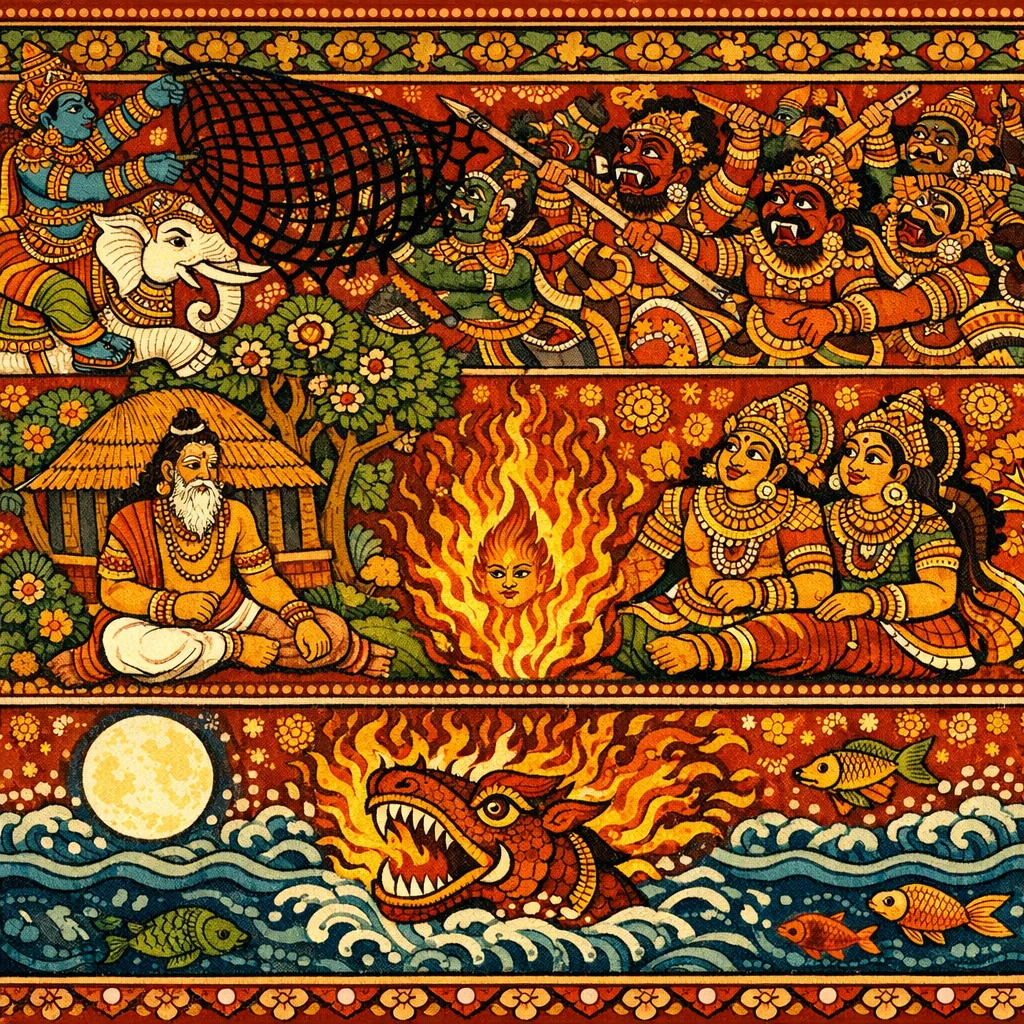
Adhyaya 175: War of Devas and Asuras; Birth of Aurva Fire; Countering Tamasī Māyā through Soma
सुरासुरयुद्धम्, और्वानलोत्पत्तिः, माया-प्रशमनम्
Speaker: Lord Matsya (narrator), Indra (Śakra, Vajrin, Puruhūta), Varuṇa, Brahmarṣi Ūrva, Brahmā, Aurva (fire-being), Hiraṇyakaśipu
Matsya recounts a catastrophic Deva–Asura war: the gods are ensnared by arrow-nets and trapped in Dānava māyā. Indra breaks through with the vajra and casts a tāmasa astra-net, plunging the Daityas into blinding darkness so the gods can strike back. The Asuras answer with a stupefying dark māyā and the scorching heat of Aurva-fire; the gods withdraw to the Moon’s cooling realm and appeal to Indra. At Indra’s urging, Varuṇa tells Aurva’s ancient origin: sages question Ūrva’s childless brahmacarya; Ūrva upholds ascetic dharma and, by mind-power and churning fire from his thigh, creates a son. Aurva is born ravenous to consume the world, but Brahmā persuades restraint and assigns him to the ocean’s Vaḍavā-mouth, reserving the waters-consuming role for pralaya. Hiraṇyakaśipu submits to Ūrva/Aurva and receives a fiery māyā weapon (later said to be curse-limited); Varuṇa seeks Soma’s alliance to destroy that māyā.
Key Concepts
Shlokas in Adhyaya 175
Verse 1
*मत्स्य उवाच ताभ्यां बलाभ्यां संजज्ञे तुमुलो विग्रहस्तदा सुराणामसुराणां च परस्परजयैषिणाम् //
Matsya said: Then, from those two mighty forces, a fierce conflict arose—between the Devas and the Asuras—each desiring victory over the other.
Verse 2
दानवा दैवतैः सार्धं नानाप्रहरणोद्यताः समीयुर्युध्यमाना वै पर्वता इव पर्वतैः //
The Dānavas, brandishing many kinds of weapons, closed in together with the gods, clashing in battle—like mountains colliding with mountains.
Verse 3
तत्सुरासुरसंयुक्तं युद्धमत्यद्भुतं बभौ धर्माधर्मसमायुक्तं दर्पेण विनयेन च //
That battle, joined between the Devas and the Asuras, appeared utterly wondrous—charged with both dharma and adharma, and driven alike by pride and by disciplined restraint.
Verse 4
ततो रथैर्विप्रयुक्तैर् वारणैश्च प्रचोदितैः उत्पतद्भिश्च गगनम् असिहस्तैः समन्ततः //
Then, with chariots careening out of control, and with elephants driven hard, the sky on every side was filled with warriors springing up, swords in hand.
Verse 5
क्षिप्यमाणैश्च मुसलैः संपतद्भिश्च सायकैः चापैर्विस्फार्यमाणैश्च पात्यमानैश्च मुद्गरैः //
With clubs being hurled, with arrows flying in volleys, with bows being twanged and drawn back, and with heavy maces being brought crashing down—(the battle raged on).
Verse 6
तद्युद्धमभवद्घोरं देवदानवसंकुलम् जगतस्त्रासजननं युगसंवर्तकोपमम् //
That battle became dreadful—crowded with Devas and Dānavas—striking terror into the worlds, and resembling the fury of the cosmic dissolution at the end of an age.
Verse 7
हस्तमुक्तैश्च परिघैर् विप्रयुक्तैश्च पर्वतैः दानवाः समरे जघ्नुर् देवानिन्द्रपुरोगमान् //
In the battle, the Dānavas struck down the gods led by Indra, hurling iron clubs cast from their hands and even mountains torn up and flung away.
Verse 8
ते वध्यमाना बलिभिर् दानवैर्जितकाशिभिः विषण्णवदना देवा जग्मुरार्तिं परां मृधे //
Being struck down by the mighty Dānavas—whose splendor had been eclipsed— the gods, their faces cast in gloom, fell into extreme distress amid the battle.
Verse 9
ते ऽस्त्रशूलप्रमथिताः परिघैर्भिन्नमस्तकाः भिन्नोरस्का दितिसुतैर् वेमू रक्तं व्रणैर्बहु //
Smitten by weapons and tridents, their heads shattered by iron clubs, their chests split open by the sons of Diti, they vomited forth much blood from countless wounds.
Verse 10
वेष्टिताः शरजालैश्च निर्यत्नाश्चासुरैः कृताः प्रविष्टा दानवीं मायां न शेकुस्ते विचेष्टितुम् //
Enmeshed in nets of arrows and rendered powerless by the asuras, they entered the Dānava’s illusory snare and could no longer make any effort to move or act.
Verse 11
अस्तं गतमिवाभाति निष्प्राणसदृशाकृति बलं सुराणामसुरैर् निष्प्रयत्नायुधं कृतम् //
The might of the gods appeared as though it had set—its form like something lifeless—having been rendered weaponless and powerless by the Asuras, as if without any effort.
Verse 12
दैत्यचापच्युतान् घोरांश् छित्त्वा वज्रेण ताञ्छरान् शक्रो दैत्यबलं घोरं विवेश बहुलोचनः //
Having hewn down with his thunderbolt those dreadful arrows discharged from the Daityas’ bows, Śakra (Indra), the many‑eyed one, pressed into the fearsome army of the Daityas.
Verse 13
स दैत्यप्रमुखान्हत्वा तद्दानवबलं महत् तामसेनास्त्रजालेन तमोभूतमथाकरोत् //
Having slain the foremost leaders of the Daityas, he then rendered that vast host of the Dānavas powerless—enveloping it in darkness by means of a net of tāmasa weapons.
Verse 14
ते ऽन्योन्यं नावबुध्यन्त देवानां वाहनानि च घोरेण तमसाविष्टाः पुरुहूतस्य तेजसा //
Enveloped in dreadful darkness, they could not recognize one another—nor even the mounts of the gods—overwhelmed by the blazing splendor of Puruhūta (Indra).
Verse 15
मायापाशैर्विमुक्तास्तु यत्नवन्तः सुरोत्तमाः वपूंषि दैत्यसिंहानां तमोभूतान्यपातयन् //
Freed from the snare of illusion, the foremost of the gods, resolute in their exertion, struck down the bodies of those lion-like Daityas, now become enveloped in darkness.
Verse 16
अपध्वस्ता विसंज्ञाश्च तमसा नीलवर्चसा पेतुस्ते दानवगणाश् छिन्नपक्षा इवाद्रयः //
Struck down and senseless, shrouded by a dark, blue-tinged gloom, those hosts of Dānavas fell—like mountains whose wings have been cut off.
Verse 17
तद्घनीभूतदैत्येन्द्रम् अन्धकार इवार्णवे दानवं देवकदनं तमोभूतमिवाभवत् //
That Danava—an afflicter of the gods—became like darkness upon the ocean: the Daitya-lord, densely massed, appeared as though transformed into sheer gloom.
Verse 18
तदासृजन्महामायां मयस्तां तामसीं दहन् युगान्तोद्योतजननीं सृष्टामौर्वेण वह्निना //
Then Maya produced that great delusive power—dark and stupefying—and, burning it with the Aurva-fire, he destroyed the very source that kindles the terrible blaze at the end of an age.
Verse 19
सा ददाह ततः सर्वान् माया मयविकल्पिता दैत्याश्चादित्यवपुषः सद्य उत्तस्थुराहवे //
Then that illusory power—conjured through magic and manifold deception—burned them all; and the Daityas, assuming the very forms of the Ādityas, instantly rose up again for battle.
Verse 20
मायामौर्वीं समासाद्य दह्यमाना दिवौकसः भेजिरे चन्द्रविषयं शीतांशुसलिलप्रदम् //
When the celestial beings, scorched by the burning heat, took refuge in the illusory (protective) power called Maurvī, they then resorted to the region of the Moon, which bestows the cooling waters of the moonbeam.
Verse 21
ते दह्यमाना ह्यौर्वेण वह्निना नष्टचेतसः शशंसुर्वज्रिणं देवाः संतप्ताः शरणैषिणः //
Scorched by the Aurva fire and driven out of their senses, the gods—burning with anguish and seeking refuge—appealed to Vajrin (Indra), the wielder of the thunderbolt.
Verse 22
संतते मायया सैन्ये हन्यमाने च दानवैः चोदितो देवराजेन वरुणो वाक्यमब्रवीत् //
When the army had been thrown into confusion by illusion and was being cut down by the Dānavas, Varuṇa—urged on by the king of the gods—spoke these words.
Verse 23
पुरा ब्रह्मर्षिजः शक्र तपस्तेपे सुदारुणम् ऊर्वः सपूर्वतेजस्वी सदृशो ब्रह्मणो गुणैः //
In former times, O Śakra, the Brahmarṣi Ūrva performed exceedingly fierce austerities—radiant with primeval splendor and comparable to Brahmā in his qualities.
Verse 24
तं तपन्तमिवादित्यं तपसा जगदव्ययम् उपतस्थुर्मुनिगणा दिव्या देवर्षिभिः सह //
The divine companies of sages, together with the god-sages (devarṣis), attended upon Him—who blazed like the Sun and who, through austerity, sustains the imperishable world.
Verse 25
हिरण्यकशिपुश्चैव दानवो दानवेश्वरः ऋषिं विज्ञापयामासुः पुरा परमतेजसम् //
Long ago, Hiranyakashipu—an Asura, the lord of the Daityas—approached and addressed a sage of supreme spiritual radiance.
Verse 26
ऊचुर्ब्रह्मर्षयस्तं तु वचनं धर्मसंहितम् ऋषिवंशेषु भगवंश् छिन्नमूलमिदं पदम् //
The brahmarṣis said: “O Blessed One, this statement is a compendium of dharma; yet, within the lineages of sages, this teaching appears cut off from its root (its original source).”
Verse 27
एकस्त्वमनपत्यश्च गोत्रजो ऽन्यो न वर्तते कौमारं व्रतमास्थाय क्लेशमेवानुवर्तसे //
You are alone and without offspring; no other kinsman of your lineage remains. Yet, having undertaken the vow of lifelong celibacy, you are only pursuing hardship.
Verse 28
बहूनि विप्र गोत्राणि मुनीनां भावितात्मनाम् एकदेहानि तिष्ठन्ति विविक्तानि विना प्रजाः //
O brāhmaṇa, many gotras (lineages) of self-disciplined sages continue as single-bodied (solitary) lines—dwelling in seclusion, without offspring.
Verse 29
एवमुच्छिन्नमूलैश्च पुत्रैर्नो नास्ति कारणम् भवांस्तु तपसा श्रेष्ठो प्रजापातसमद्युतिः //
With our sons thus cutting off the very root (of the family line), there is no longer any cause for hope. But you—by your austerity—are the foremost, radiant like Prajāpati himself.
Verse 30
तत्र वर्तस्व वंशाय वर्धयात्मानम् आत्मना त्वया धर्मो ऽर्जितस्तेन द्वितीयां कुरु वै तनुम् //
Therefore, abide there for the sake of the lineage; strengthen yourself by your own self-discipline. Since you have earned dharma, by that merit indeed make for yourself a second embodiment (a renewed life/continuation).
Verse 31
स एवमुक्तो मुनिभिर् मुनिर् मर्मसु ताडितः जगर्हे तानृषिगणान् वचनं चेदमब्रवीत् //
Thus addressed by the sages, the sage—struck at his vital points (i.e., deeply wounded in honor)—rebuked that assembly of seers and spoke these words:
Verse 32
यथायं विहितो धरो मुनीनां शाश्वतः पुरा आर्षं वै सेवतः कर्म वन्यमूलफलाशिनः //
Thus is this eternal dharma of the sages, ordained from ancient times: they follow the ṛṣi-way of conduct, living on forest roots and fruits.
Verse 33
ब्रह्मयोनौ प्रसूतस्य ब्राह्मणस्यात्मदर्शिनः ब्रह्मचर्यं सुचरितं ब्रह्माणमपि चालयेत् //
For a Brahmin—born from the source of Brahman, and a seer of the Self—well-practised brahmacarya (celibate student-discipline) is so potent that it can even shake Brahmā himself.
Verse 34
जनानां वृत्तयस्तिस्रो ये गृहाश्रमवासिनः अस्माकं तु वरं वृत्तिर् वनाश्रमनिवासिनाम् //
For people who live in the householder stage, there are three recognized modes of livelihood; but for us, the superior livelihood is that of those who dwell in the forest-hermitage (the vānaprastha life).
Verse 35
अब्भक्षा वायुभक्षाश्च दन्तोलूखलिनस्तथा अश्मकुट्टा ह्यशनकाः पञ्चातपसहाश्च ये //
Those who subsist only on water, those who subsist only on air, those who pound (their food) with their teeth as with a mortar, those who crush (grains) with stone, those who remain without eating, and those who endure the ‘five fires’—all such ascetics are (here) being described.
Verse 36
एते तपसि तिष्ठन्ति व्रतैरपि सुदुष्करैः ब्रह्मचर्यं पुरस्कृत्य प्रार्थयन्ति परां गतिम् //
These remain steadfast in austerity, undertaking even extremely difficult vows; placing brahmacarya (continence and sacred discipline) in the forefront, they pray for the highest state of liberation.
Verse 37
ब्रह्यचर्याद्ब्राह्मणस्य ब्राह्मणत्वं विधीयते एवमाहुः परे लोके ब्रह्मचर्यविदो जनाः //
It is through brahmacarya (disciplined celibate studentship) that a brāhmaṇa’s true brāhmaṇa-status is established; thus declare, in the other world as well, those people who know the meaning of brahmacarya.
Verse 38
ब्रह्मचर्ये स्थितं सत्यं ब्रह्मचर्ये स्थितं तपः ये स्थिता ब्रह्मचर्ये तु ब्राह्मणा दिवि संस्थिताः //
Truth is established in brahmacarya (celibate discipline); austerity too is established in brahmacarya. Those brāhmaṇas who remain steadfast in brahmacarya become firmly established in heaven.
Verse 39
नास्ति योगं विना सिद्धिर् न वा सिद्धिं विना यशः नास्ति लोके यशोमूलं ब्रह्मचर्यात्परं तपः //
Without yoga there is no attainment (siddhi), and without attainment there is no true renown. In this world, there is no deeper root of lasting fame than brahmacarya—there is no austerity higher than it.
Verse 40
यो निगृह्येन्द्रियग्रामं भूतग्रामं च पञ्चकम् ब्रह्मचर्यं समाधत्ते किमतः परमं तपः //
What austerity could be higher than this: that one restrains the host of senses and the fivefold aggregate of elemental nature, and firmly establishes oneself in brahmacarya (disciplined continence and sacred conduct)?
Verse 41
अयोगे केशधरणम् असंकल्पव्रतक्रियां अब्रह्मचर्ये चर्या च त्रयं स्याद् दम्भसंज्ञकम् //
Keeping matted hair without true discipline, performing vows and rites without a sincere resolve, and maintaining an outward show of religious conduct while lacking brahmacarya—these three are called ‘dambha’ (hypocritical piety).
Verse 42
क्व दाराः क्व च संयोगः क्व च भावविपर्ययः नन्वियं ब्रह्मणा सृष्टा मनसा मानसी प्रजा //
Where are ‘wives’ (as objects of possession), and where is union? Where is the reversal of feelings (passion turning into sorrow)? Surely this is a mind-born progeny—created by Brahmā through the mind alone.
Verse 43
यद्यस्ति तपसो वीर्यं युष्माकं विदितात्मनाम् सृजध्वं मानसान्पुत्रान् प्राजापत्येन कर्मणा //
If the power of austerity truly abides in you—who are knowers of the Self—then bring forth sons born of the mind, by the Prajāpati-ordained act of creation.
Verse 44
मनसा निर्मिता योनिर् आधातव्या तपस्विभिः न दारयोगो बीजं वा व्रतमुक्तं तपस्विनाम् //
For ascetics, the ‘womb’ is to be established as mind-created; for tapasvins, the observance is declared to be free from (worldly) vows—there is to be neither union with a wife nor the sowing of seed.
Verse 45
यदिदं लुप्तधर्मार्थं युष्माभिरिह निर्भयैः व्याहृतं सद्भिरत्यर्थम् असद्भिरिव मे मतम् //
This statement—whose intent regarding dharma has been obscured—has been spoken here by you fearlessly; yet, though uttered by the good, it seems to me excessively so, almost as if it were spoken by the ungood.
Verse 46
वपुर्दीप्तान्तरात्मानम् एतत्कृत्वा मनोमयम् दारयोगं विना स्रक्ष्ये पुत्रम् आत्मतनूरुहम् //
Having fashioned this radiant-bodied being—whose inner self shines—by the power of the mind alone, I shall, without union with a wife, bring forth a son, a sprout of my own body.
Verse 47
एवमात्मानमात्मा मे द्वितीयं जनयिष्यति वन्येनानेन विधिना दिधक्षन्तमिव प्रजाः //
Thus my own Self will generate a second self (as it were); and by this wild/primeval procedure it will produce beings, as though it were about to burn the creatures.
Verse 48
ऊर्वस्तु तपसाविष्टो निवेश्योरुं हुताशने ममन्थैकेन दर्भेण सुतस्य प्रभवारणिम् //
But Ūrva, absorbed in ascetic power, placed his thigh into the sacred fire and, with a single blade of darbha grass, churned it as a generating fire-stick—so that a son might come forth.
Verse 49
तस्योरुं सहसा भित्त्वा ज्वालामाली ह्यनिन्धनः जगतो दहनाकाङ्क्षी पुत्रो ऽग्निः समपद्यत //
Splitting his thigh all at once, there arose Fire as his son—wreathed in flames, needing no fuel—desiring to burn the worlds.
Verse 50
ऊर्वस्योरुं विनिर्भिद्य और्वो नामान्तको ऽनलः दिधक्षन्निव लोकांस्त्रीञ् जज्ञे परमकोपनः //
Rending open Urva’s thigh, there was born the blazing fire named Aurva—death-dealing in nature—furious beyond measure, as though intent on burning the three worlds.
Verse 51
उत्पन्नमात्रश्चोवाच पितरं क्षीणया गिरा क्षुधा मे बाधते तात जगद्भक्ष्ये त्यजस्व माम् //
As soon as he was born, he spoke to his father in a faint voice: “Dear father, hunger torments me. I will devour the world—leave me (cast me away)!”
Verse 52
त्रिदिवारोहिभिर्ज्वालैर् जृम्भमाणो दिशो दश निर्दहन्सर्वभूतानि ववृधे सो ऽन्तको ऽनलः //
With flames rising up to the heavens, yawning wide across all ten directions, burning every living being, that fire—Antaka, the bringer of the end—grew ever more intense.
Verse 53
एतस्मिन्नन्तरे ब्रह्मा मुनिमूर्वं सभाजयन् उवाच वार्यतां पुत्रो जगतश्च दयां कुरु //
Just then, Brahmā—honouring the sage Ūrva—said: “Restrain your son, and show compassion toward the world.”
Verse 54
अस्यापत्यस्य ते विप्र करिष्ये स्थानमुत्तमम् तथ्यमेतद्वचः पुत्र शृणु त्वं वदतां वर //
O Brahmin, I shall grant this offspring of yours the highest station. This word of mine is true, dear son—listen, O best among speakers.
Verse 55
*ऊर्व उवाच धन्यो ऽस्म्यनुगृहीतो ऽस्मि यन्मे ऽद्य भगवाञ्छिशोः मतिमेतां ददातीह परमानुग्रहाय वै //
Ūrva said: “Blessed am I; I have been shown grace—since today the Lord, out of supreme compassion, bestows upon me (though I am but a child) this understanding here, as the highest favor indeed.”
Verse 56
प्रभातकाले सम्प्राप्ते काङ्क्षितव्ये समागमे भगवंस्तर्पितः पुत्रः कैर्हव्यैः प्राप्स्यते सुखम् //
When the morning hour has arrived—at the longed-for occasion of reunion—a son, having offered tarpaṇa to the Lord, attains happiness through the rite of offerings to the Pitṛs (kairhavyas).
Verse 57
कुत्र चास्य निवासः स्याद् भोजनं वा किमात्मकम् विधास्यतीह भगवान् वीर्यतुल्यं महौजसः //
“And where is his dwelling to be, and what kind of food is he to have? How will the Blessed Lord—mighty, of great splendor, and matching him in power—make these arrangements here?”
Verse 58
*ब्रह्मोवाच वडवामुखे ऽस्य वसतिः समुद्रे वै भविष्यति मम योनिर्जलं विप्र तस्य पीतवतः सुखम् //
Brahmā said: “In the mouth of the Vaḍavā (the submarine fire), its dwelling shall indeed be in the ocean. O brāhmaṇa, water is my very womb; and for the one who drinks of it, there is ease and well-being.”
Verse 59
यत्राहमास नियतं पिबन्वारिमयं हविः तद्धविस्तव पुत्रस्य विसृजाम्यालयं च तत् //
Where I stayed, regularly consuming the oblation made of water—this very offering I now bestow upon your son, and I also relinquish that abode.
Verse 60
ततो युगान्ते भूतानाम् एष चाहं च पुत्रक सहितौ विचरिष्यावो निष्पुत्राणामृणापहः //
Then, at the end of the age, when beings reach their final time, this one and I—together with my son—shall roam about, removing the burden of debt for those who are without offspring.
Verse 61
एषो ऽग्निर् अन्तकाले तु सलिलाशी मया कृतः दहनः सर्वभूतानां सदेवासुररक्षसाम् //
At the time of the final dissolution, this fire—made by me—becomes a consumer even of the waters, burning all beings, including the gods, the Asuras, and the Rakṣasas.
Verse 62
एवमस्त्विति तं सो ऽग्निः संवृतज्वालमण्डलः प्रविवेशार्णवमुखं प्रक्षिप्य पितरि प्रभाम् //
“So be it,” said he; and that Fire—its circle of flames drawn in—entered the mouth of the ocean, having cast its radiance into the Father (Pitṛ).
Verse 63
प्रतियातस्ततो ब्रह्मा ये च सर्वे महर्षयः और्वस्याग्नेः प्रभां ज्ञात्वा स्वां स्वां गतिमुपाश्रिताः //
Then Brahmā, along with all the great sages, departed. Having recognized the blazing radiance of Aurva’s fire, each returned to his own destined abode and course.
Verse 64
हिरण्यकशिपुर्दृष्ट्वा तदा तन्महदद्भुतम् उच्चैः प्रणतसर्वाङ्गो वाक्यमेतदुवाच ह //
Then Hiraṇyakaśipu, seeing that great marvel, bowed down with all his limbs and spoke these words aloud.
Verse 65
भगवन्नद्भुतमिदं संवृत्तं लोकसाक्षिकम् तपसा ते मुनिश्रेष्ठ परितुष्टः पितामहः //
O Blessed One, this wondrous event has occurred with the world itself as witness. O best of sages, by your austerity the Grandfather (Brahmā) has been fully pleased.
Verse 66
अहं तु तव पुत्रस्य तव चैव महाव्रत भृत्य इत्यवगन्तव्यः साध्यो यदिह कर्मणा //
But I am to be understood as a servant—of your son and of you as well, O great-vowed one—and I shall carry out, here and now, whatever is to be accomplished by action.
Verse 67
तन्मां पश्य समापन्नं तवैवाराधने रतम् यदि सीदेन्मुनिश्रेष्ठ तवैव स्यात्पराजयः //
So look upon me—one who has come to you for refuge, devoted solely to your worship. If I were to fall into ruin, O best of sages, that would indeed be your defeat.
Verse 68
*और्व उवाच धन्यो ऽस्म्यनुगृहीतो ऽस्मि यस्य ते ऽहं गुरुः स्थितः नास्ति मे तपसानेन भयमद्येह सुव्रत //
Aurva said: “Blessed am I; I am truly favored, since I stand here as your guru. By this austerity of mine, O man of good vows, there is no fear for me here today.”
Verse 69
तामेव मायां गृह्णीष्व मम पुत्रेण निर्मिताम् निरिन्धनामग्निमयीं दुर्धर्षां पावकैरपि //
Take up that very māyā—fashioned by my son—fiery in nature, needing no fuel, and so unassailable that even other fires cannot overcome it.
Verse 70
एषा ते स्वस्य वंशस्य वशगारिविनिग्रहे संरक्षत्यात्मपक्षं च विपक्षं च प्रधक्ष्यति //
She will, for you, safeguard your own lineage by subduing enemies who come under control; she will protect your own side and will utterly consume the opposing side.
Verse 71
एवमस्त्विति तां गृह्य प्रणम्य मुनिपुंगवम् जगाम त्रिदिवं हृष्टः कृतार्थो दानवेश्वरः //
Saying, “So be it,” and accepting her, the lord of the Dānavas bowed to that foremost of sages, then departed joyfully for Tridiva (heaven), his purpose fulfilled.
Verse 72
एषा दुर्विषहा माया देवैरपि दुरासदा और्वेण निर्मिता पूर्वं पावकेनोर्वसूनुना //
This māyā is unbearable—indeed, even the gods cannot withstand or overcome it. Formerly it was fashioned by Aurva, the son of Urvasū, through (the agency of) Pāvaka, the Fire.
Verse 73
तस्मिंस्तु व्युत्थिते दैत्ये निर्वीर्यैषा न संशयः शापो ह्यस्याः पुरा दत्तः सृष्टा येनैव तेजसा //
But when that Daitya rose up, she became powerless—of this there is no doubt; for a curse had formerly been laid upon her by the very one whose spiritual brilliance (tejas) had brought her into being.
Verse 74
यद्येषा प्रतिहन्तव्या कर्तव्यो भगवान्सुखी दीयतां मे सखा शक्र तोययोनिर्निशाकरः //
“If this (obstacle/offence) must indeed be countered, and if the Blessed One is to be made content, then, O Śakra, grant me my friend—the moon, the lord of the night, Soma who is born of the waters.”
Verse 75
तेनाहं सह संगम्य यादोभिश्च समावृतः मायामेतां हनिष्यामि त्वत्प्रसादान्न संशयः //
Therefore, joining forces with him—and surrounded by the aquatic beings—I shall destroy this illusion (māyā). By your grace, there is no doubt of it.
Frequently Asked Questions
The chapter teaches that uncontrolled power—whether martial (weapons), psychic (māyā), or ascetic (tapas)—must be governed by dharma to preserve cosmic order. Ūrva’s defense of brahmacarya shows tapas as a legitimate creative force (mind-born progeny) that can rival cosmic agencies, yet even such power (Aurva fire) requires Brahmā’s regulation and a proper ‘station’ (Vaḍavā-mouth in the ocean). Strategically, it also frames māyā as counterable through appropriate opposites: darkness-illusion is met by tāmasa weapons and then cooled/neutralized through Soma and watery, lunar refuge.
Dharma dominates: brahmacarya-dharma, ascetic codes, and the ethical critique of hypocrisy (dambha). Creation theology appears through mānasī prajā (mind-born creation) and the emergence of Aurva fire. Genealogy is present in the lineage concern raised by sages and the role of Hiraṇyakaśipu as Daitya-lord interacting with Ūrva/Aurva. Vastu/temple architecture is not a focus in this adhyāya; instead, it is a cosmological ‘placement’ doctrine—assigning Aurva fire a fixed cosmic location (the ocean’s Vaḍavā-mouth).