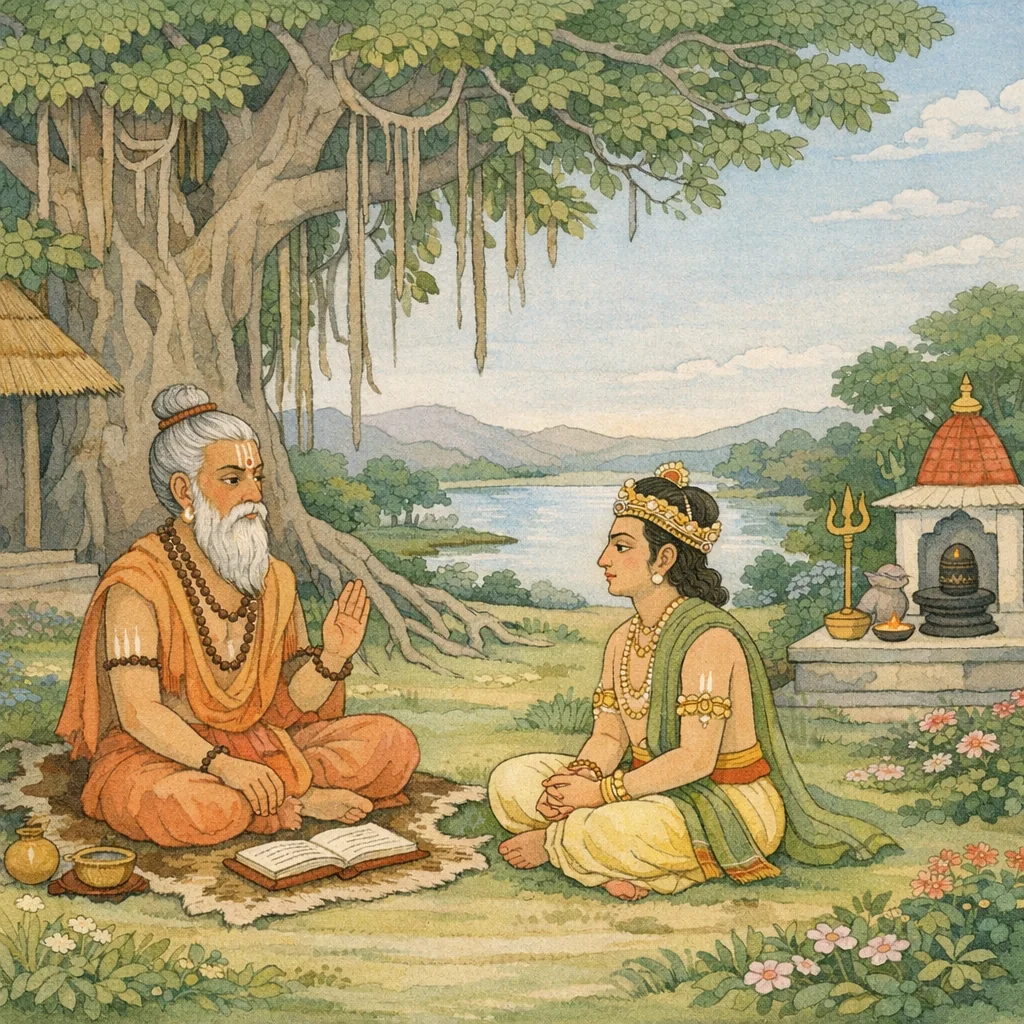
Adhyaya 82
Pulastya’s Tīrtha Enumeration: Sarasvatī, Naimiṣa, Gayā, and Associated Phalaśruti (Chapter 82)
Upa-parva: Tīrtha-yātrā (Pilgrimage Catalogue) — Pulastya’s Instruction
Chapter 82.0 is a sustained tīrtha-māhātmya sequence delivered by Pulastya. The chapter proceeds as an itinerary: beginning with “dharmatīrtha” and “kārāpatanam,” it moves through the Saugaṃdhika forest and the highly meritorious Sarasvatī (including ritual bathing at waters said to emerge from anthills/valmīka). It then lists multiple named tīrthas and confluences, repeatedly prescribing abhiṣeka (ritual bathing), tarpaṇa and worship of pitṛs and devas, and short austerities (notably trirātra upavāsa). The phalaśruti idiom dominates: visits are equated with major Vedic sacrifices (agniṣṭoma, vājapeya, aśvamedha, rājasūya), promise purification “up to the seventh generation,” removal of sins, attainment of specific divine or heavenly “lokas,” and special boons (e.g., jātismaratva—memory of past births). The catalogue includes prominent sacred nodes such as Naimiṣa (entry itself purifies), Gaṅgādvāra/Haridvāra motifs, Gayā with akṣayavaṭa and pitṛ rites, and Śālagrāma as Nārāyaṇa’s abiding place. The chapter thus functions as a ritual-ethical map, embedding exile travel within a theology of place and disciplined action.
Chapter Arc: भीष्म के प्रश्न पर महर्षि पुलस्त्य का वचन खुलता है—पितृभक्ति से युक्त भीष्म को देखकर ऋषि का हृदय द्रवित होता है और वे तीर्थ-यात्रा का माहात्म्य सुनाने का संकल्प करते हैं। → पुलस्त्य एक-एक कर तीर्थों की शृंखला खोलते जाते हैं—स्थाणु (शिव) के भद्रवट-तीर्थ से लेकर वरदान-तीर्थ, श्रीकुण्ड, विमल तीर्थ आदि—और प्रत्येक स्थान के स्नान, नमस्कार, स्मरण से मिलने वाले महायज्ञ-सम फल (सहस्र गोदान, अग्निष्टोम-अतिरात्र, अश्वमेध) का विधान बताते हैं; कथा का भार ‘कहाँ जाएँ, कैसे जाएँ, किस भाव से जाएँ’ की बढ़ती हुई पवित्रता में चढ़ता है। → योगेश्वर शिव स्वयं योग का आश्रय लेकर शुद्धात्मा ऋषियों के क्रोध/मन्यु के विनाश हेतु प्रकट-प्रभाव दिखाते हैं—यह संकेत देता है कि तीर्थ केवल भू-स्थान नहीं, देव-चेतना का स्पर्श है; इसी बिंदु पर तीर्थ-माहात्म्य साधारण पुण्य से उठकर ‘अंतःकरण-शुद्धि’ की चरम प्रतिज्ञा बन जाता है। → अध्याय का निष्कर्ष तीर्थ-स्मरण की सार्वभौमिकता में उतरता है—प्रातः-सायं हाथ जोड़कर तीनों पुष्करों का स्मरण करने वाला मानो समस्त तीर्थों में स्नान कर लेता है; बाह्य यात्रा का फल अंततः अंतर्मन की श्रद्धा, संयम और स्मृति में प्रतिष्ठित होता है। → पुलस्त्य का तीर्थ-मानचित्र आगे भी विस्तृत होने का संकेत देता है—अगले प्रसंगों में और तीर्थों/विधानों का क्रम जारी रहने की प्रतीति रहती है।
Shlokas
Verse 1
अऑड हटर () है द्रयशीतितमो< ध्याय: भीष्मजीके पूछनेपर पुलस्त्यजीका उन्हें विभिन्न तीर्थोकी यात्राका माहात्म्य बताना घुलस्त्य उवाच अनेन तव धर्मज्ञ प्रश्रयेण दमेन च । सत्येन च महाभाग तुष्टोडस्मि तव सुव्रत,पुलस्त्यजीने कहा--धर्मज्ञ! उत्तम व्रतका पालन करनेवाले महाभाग! तुम्हारे इस विनय, इन्द्रियसंयम और सत्यपालनसे मैं बहुत संतुष्ट हूँ
Pulastya said: “O knower of dharma, O fortunate one steadfast in excellent vows—by this humility of yours, by your self-restraint, and by your truthfulness, I am greatly pleased with you.”
Verse 2
यस्येदृशस्ते धर्मोड्यं पितृभक्त्याश्रितोडनघ । तेन पश्यसि मां पुत्र प्रीतिश्च॒ परमा त्वयि,निष्पाप वत्स! तुम्हारेद्वारा पितृभक्तिके आश्रित जो ऐसे उत्तम धर्मका पालन हो रहा है, इसीके प्रभावसे तुम मेरा दर्शन कर रहे हो और तुमपर मेरा बहुत प्रेम हो गया है
O blameless son, because you are today upholding such noble dharma grounded in devotion to your father, you are able to behold me. And, sinless child, through this very virtue my affection for you has become supreme.
Verse 3
अमोघदर्शी भीष्माहं ब्रूहि कि करवाणि ते । यद् वक्ष्यसि कुरुश्रेष्ठ तस्य दातास्मि तेडनघ,निष्पाप कुरुश्रेष्ठ भीष्म! मेरा दर्शन अमोघ है। बोलो, मैं तुम्हारे किस मनोरथकी पूर्ति करूँ? तुम जो माँगोगे, वही दूँगा
“I am Bhīṣma, whose vision never fails. Tell me—what shall I do for you? O best of the Kurus, whatever you ask, that I will grant you, O blameless one.”
Verse 4
भीष्म उवाच प्रीते त्वयि महाभाग सर्वलोकाभिपूजिते । कृतमेतावता मन्ये यदहं दृष्टवान् प्रभुम्,भीष्मजीने कहा--महाभाग! आप सम्पूर्ण लोकों-द्वारा पूजित हैं। आपके प्रसन्न हो जानेपर मुझे क्या नहीं मिला? आप-जैसे शक्तिशाली महर्षिका मुझे दर्शन हुआ, इतनेहीसे मैं अपनेको कृतकृत्य मानता हूँ
Bhishma said: “O noble one, revered and worshipped by all the worlds—now that you are pleased, I feel I have gained everything. Indeed, I consider my purpose fulfilled simply because I have obtained the vision of the Lord.”
Verse 5
यदि त्वहमनुग्राह्मुस्तव धर्मभूृतां वर । संदेहं ते प्रवक्ष्यामि तन्मे त्वं छेत्तुमहसि,धर्मात्माओंमें श्रेष्ठ महर्ष! यदि मैं आपकी कृपाका पात्र हूँ तो मैं आपके सामने अपना संशय रखता हूँ। आप उसका निवारण करें
If I am worthy of your favor, O best among the upholders of dharma, I shall state to you my doubt. You ought to dispel it for me, O righteous sage—so that the path of duty may be seen without confusion.
Verse 6
अस्ति मे हृदये कश्रित् तीर्थभ्यो धर्मसंशय: । तमहं श्रोतुमिच्छामि तद् भवान् वक्तुमरहति,मेरे मनमें तीर्थोंसे होनेवाले धर्मके विषयमें कुछ संशय हो गया है, मैं उसीका समाधान सुनना चाहता हूँ; आप बतानेकी कृपा करें
Bhīṣma said: “A doubt has arisen in my heart concerning dharma as it is gained through sacred pilgrimage places (tīrthas). I wish to hear its resolution; please be so kind as to explain it.”
Verse 7
प्रदक्षिणां यः पृथिवीं करोत्यमरसंनिभ । कि फल तस्य विप्रर्षे तन्मे ब्रूहि सुनिश्चितम्,देवतुल्य ब्रह्मर्ष! जो (तीर्थोंके उद्देश्यसे) सारी पृथ्वीकी परिक्रमा करता है, उसे क्या फल मिलता है? यह निश्चित करके मुझे बताइये
Bhīṣma asked the sage—radiant like an immortal: “O brahmarṣi, equal to the gods! What fruit is gained by one who, for the sake of visiting the tīrthas, makes a full pradakṣiṇā of the entire earth? Tell me this with certainty.”
Verse 8
घुलस्त्य उवाच हन्त ते कथयिष्यामि यदृषीणां परायणम् | तदेकाग्रमना: पुत्र शृणु तीर्थेषु यत् फलम्,पुलस्त्यजीने कहा--वत्स! तीर्थयात्रा ऋषियोंके लिये बहुत बड़ा आश्रय है। मैं इसके विषयमें तुम्हें बताऊँगा। तीर्थोंके सेवनसे जो फल होता है, उसे एकाग्र होकर सुनो
Pulastya said: “Very well—I shall tell you what the seers hold as their sure refuge. My son, listen with a single-pointed mind to the fruit that comes from resorting to the tīrthas.”
Verse 9
यस्य हस्तौ च पादौ च मनश्लैव सुसंयतम् | विद्या तपश्च कीर्तिश्व॒ स तीर्थफलमश्चुते,जिसके हाथ, पैर और मन अपने काबूमें हों तथा जो विद्या, तप और कीर्तिसे सम्पन्न हो, वही तीर्थसेवनका फल पाता है
He alone gains the fruit of the tīrtha whose hands and feet are restrained from wrongdoing and whose mind is well-controlled—one endowed with learning, austerity, and good repute.
Verse 10
प्रतिग्रहादपावृत्त: संतुष्टो येन केनचित् | अहंकारनिवृत्तश्न स तीर्थफलमश्षुते,जो प्रतिग्रहसे दूर रहे तथा जो कुछ अपने पास हो, उसीसे संतुष्ट रहे और जिसमें अहंकारका अभाव हो, वही तीर्थका फल पाता है
He who turns away from accepting gifts, who is content with whatever he has, and in whom ego is absent—such a one truly attains the fruit of the tīrtha.
Verse 11
अकल्कको निरारम्भो लघ्वाहारो जितेन्द्रिय: । विमुक्त: सर्वपापेभ्य स तीर्थफलमश्षुते,जो दम्भ आदि दोषोंसे दूर, कर्तृत्वके अहंकारसे शून्य, अल्पाहारी और जितेन्द्रिय हो, वह सब पापोंसे विमुक्त हो तीर्थके वास्तविक फलका भागी होता है
One who is unblemished, who undertakes no self-serving enterprises, who eats lightly, and who has mastered the senses—being freed from all sins—truly partakes of the real fruit of the tīrtha.
Verse 12
अक्रोधनश्न राजेन्द्र सत्यशीलो दृढव्रत: । आत्मोपमश्च भूतेषु स तीर्थफलमश्ञुते,राजन! जिसमें क्रोध न हो, जो सत्यवादी और दृढ़तापूर्वक व्रतका पालन करनेवाला हो तथा जो सब प्राणियोंके प्रति आत्मभाव रखता हो, वही तीर्थके फलका भागी होता है
Ghūlastya said: “O best of kings, the true fruit of pilgrimage is gained by one who is free from anger, devoted to truth, steadfast in vowed discipline, and who regards all beings as equal to oneself. Such a person alone becomes the rightful recipient of a tīrtha’s merit.”
Verse 13
ऋषिभि: क्रतव:ः प्रोक्ता देवेष्विह यथाक्रमम् | फलं चैव यथातथ्यं प्रेत्य चेह च सर्वश:,ऋषियोंने देवताओंके उद्देश्यसे यथायोग्य यज्ञ बताये हैं और उन यज्ञोंका यथावत् फल भी बताया है, जो इहलोक और परलोकमें भी सर्वथा प्राप्त होता है
Ghūlastya said: “The seers have set forth the sacrificial rites in due order, directing them toward the gods. They have also declared the true results of those rites—fruits that are obtained unfailingly, both here in this world and after death in the next.”
Verse 14
न ते शक््या दरिद्रेण यज्ञा: प्राप्तुं महीपते । बहूपकरणा यज्ञा नानासम्भारविस्तरा:,परंतु भूपाल! दरिद्र मनुष्य उन यज्ञोंका अनुष्ठान नहीं कर सकते; क्योंकि उनमें बहुत- सी सामग्रियोंकी आवश्यकता होती है। नाना प्रकारके साथनोंका संग्रह होनेसे उनमें विस्तार बहुत बढ़ जाता है
O king, a poor man cannot realistically undertake those sacrificial rites. Such yajñas demand many implements and extensive provisions; because they require the gathering of varied materials, their scale becomes very great.
Verse 15
प्राप्यन्ते पार्थिवैरेते समृद्धैर्वा नरैः क्वचित् । नार्थन्यूनैर्नावगणैरेकात्मभिरसा धनै:,अतः राजालोग अथवा कहीं-कहीं कुछ समृद्धिशाली मनुष्य ही यज्ञोंका अनुष्ठान कर सकते हैं। जिनके पास धनकी कमी और सहायकोंका अभाव है, जो अकेले और साधनशून्य हैं, उनके द्वारा यज्ञोंका अनुष्ठान नहीं हो सकता
Such rites (like sacrifices) are attainable only for kings, or at times for certain prosperous men. But those who are short of wealth, lacking attendants and resources—solitary and without means—cannot carry out sacrificial performances.
Verse 16
यो दरिद्रैरपि विधि: शक: प्राप्तुं नरेश्वर । तुल्यो यज्ञफलै: पुण्यैस्तं निबोध युधां वर,योद्धाओंमें श्रेष्ठ नरेश्वर! जो सत्कर्म दरिद्रलोग भी कर सकें और जो अपने पुण्योद्वारा यज्ञोंके समान फलप्रद हो सके, उसे बताता हूँ, सुनो
O king, best of warriors, I shall tell you of a righteous practice that even the poor can perform—one whose merit yields results equal to those of sacrificial rites. Listen and understand it well.
Verse 17
ऋषीणां परम॑ गुहय॒मिदं भरतसत्तम । तीर्थाभिगमन पुण्यं यज्जैरपि विशिष्यते,भरतश्रेष्ठ! यह ऋषियोंका परम गोपनीय रहस्य है। तीर्थयात्रा बड़ा पवित्र सत्कर्म है। वह यज्ञोंसे भी बढ़कर है
O best of the Bharatas, this is the sages’ most secret teaching: the merit gained by going on pilgrimage to the sacred fords (tīrthas) is a supremely purifying act—one said to surpass even sacrificial rites.
Verse 18
अनुपोष्य त्रिरात्राणि तीर्थान्यनभिगम्य च । अदत्त्वा काज्चनं गाश्व दरिद्रो नाम जायते,मनुष्य इसीलिये दरिद्र होता है कि वह (तीर्थोमें) तीन राततक उपवास नहीं करता, तीर्थोंकी यात्रा नहीं करता और सुवर्णदान और गोदान नहीं करता
Ghūlastya said: “A person is known as ‘poor’ because he does not undertake a three-night fast, does not visit the sacred fords (tīrthas), and does not give gifts—such as gold, cows, and horses.”
Verse 19
अग्निष्टोमादिभिय्यजैरिष्टवा विपुलदक्षिणै: । न तत् फलमवाप्रोति तीर्थाभिगमनेन यत्,मनुष्य तीर्थयात्रासे जिस फलको पाता है, उसे प्रचुर दक्षिणावाले अग्निष्टोम आदि यज्ञोंद्वारा यजन करके भी नहीं पा सकता
Ghūlastya said: “Even after performing Agniṣṭoma and other sacrifices, lavishly endowed with abundant priestly fees, one does not obtain that fruit which is gained by going to the sacred fords (tīrthas).”
Verse 20
नृलोके देवदेवस्य तीर्थ त्रैलोक्यविश्रुतम् । पुष्करं नाम विख्यातं महाभाग: समाविशेत्,मनुष्यलोकमें देवाधिदेव ब्रह्माजीका त्रिलोक-विख्यात तीर्थ है, जो “पुष्कर' नामसे प्रसिद्ध है। उसमें कोई बड़भागी मनुष्य ही प्रवेश कर पाता है
In the human realm there is a sacred ford of the God of gods, renowned throughout the three worlds. It is celebrated by the name Puṣkara; only a truly fortunate person is able to enter and partake of it.
Verse 21
दशकोटिसहस््राणि तीर्थानां वै महामते । सांनिध्य॑ पुष्करे येषां त्रिसंध्यं कुरुनन्दन
O wise one, there are tens of millions of sacred fords (tīrthas). Yet at Puṣkara—O delight of the Kurus—the sanctifying presence of many is gathered; one who performs the rites at the three sandhyās (dawn, noon, and dusk) there gains the concentrated merit of many pilgrimage-sites.
Verse 22
महामते कुरुनन्दन! पुष्करमें तीनों समय दस सहस्र कोटि (दस अरब) तीर्थोका निवास रहता है ।। आदित्या वसवो रुद्रा: साध्याक्ष समरुद्गणा: । गन्धर्वाप्सरसश्लैव नित्यं संनिहिता विभो
O son of Kuru, great-souled one! At Puṣkara, in all the three times, there abides a host of tīrthas—ten thousand koṭis (ten billion). There the Ādityas, the Vasus, the Rudras, the Sādhyas with the companies of Maruts, and also the Gandharvas and Apsarases, are ever present, O mighty lord.
Verse 23
विभो! वहाँ आदित्य, वसु, रुद्र, साध्य, मरुद्गण, गन्धर्व और अप्सराओंकी भी नित्य संनिधि रहती है ।। यत्र देवास्तपस्तप्त्वा दैत्या ब्रह्मर्षपस्तथा । दिव्ययोगा महाराज पुण्येन महतान्विता:,महाराज! वहाँ तप करके देवता, दैत्य और ब्रह्मर्षि महान् पुण्यसे सम्पन्न दिव्य योगसे युक्त होते हैं
O mighty one, in that place the Ādityas, the Vasus, the Rudras, the Sādhyas, the hosts of Maruts, and also the Gandharvas and Apsarases are ever present. There, O great king, gods, Daityas, and Brahmarishis, having performed austerities (tapas), become endowed with great merit and attain a divine discipline of yoga.
Verse 24
मनसाप्यभिकामस्य पुष्कराणि मनस्विन: । पूयन्ते सर्वपापानि नाकपृष्ठे च पूज्यते
Even one who merely longs for Puṣkara in the mind—if he is steadfast in purpose—has all his sins washed away; and he is honored in heaven.
Verse 25
जो मनस्वी पुरुष मनसे भी पुष्कर तीर्थमें जानेकी इच्छा करता है, उसके स्वर्गके प्रतिबन्धक सारे पाप मिट जाते हैं और वह स्वर्गलोकमें पूजित होता है ।। तस्मिंस्तीर्थे महाराज नित्यमेव पितामह: । उवास परमप्रीतो भगवान् कमलासन:,महाराज! उस तीर्थमें कमलासन भगवान् ब्रह्माजी नित्य ही बड़ी प्रसन्नताके साथ निवास करते हैं
Ghūlastya said: “O king, even the resolute man who merely forms in his mind the wish to go to the sacred ford of Puṣkara has all sins that obstruct heaven wiped away; he becomes honored in the heavenly world. In that holy place, O great king, the Grandfather—Lord Brahmā, the lotus-seated—dwells continually, abiding in supreme delight.”
Verse 26
८ छ ४ #-*7 5 ३५ ० थी... हक / ऋण ् ८5 कक क्््््खिि ज्ज्ज़ “" न्न्न्ा - ९८१ को या /६, हि जत् हे 89 छत _ *-फ्र की नमन श- प्् . 4 ई८ पुष्करेषु महाभाग देवा: सर्षिगणा: पुरा | सिद्धि समभिसम्प्राप्ता: पुण्येन महतान्विता:,महाभाग! पुष्करमें पहले देवता तथा ऋषि महान् पुण्यसे सम्पन्न हो सिद्धि प्राप्त कर चुके हैं
O noble one, in the sacred region of Puṣkara, the gods—together with the companies of ṛṣis—long ago attained siddhi, being endowed with great merit.
Verse 27
तत्राभिषेकं यः कुर्यात् पितृदेवार्चने रत: । अश्वमेधाद् दशगुणं फल प्राहुरमनीषिण:
Whoever performs the consecratory rite there, devoted to the worship of the Pitṛs (ancestors) and the gods—so declare the wise—wins a fruit tenfold greater than that of the Aśvamedha sacrifice.
Verse 28
जो वहाँ स्नान करता तथा देवताओं और पितरोंकी पूजामें संलग्न रहता है, उस पुरुषको अश्वमेधसे दस गुना फल प्राप्त होता है; ऐसा मनीषीगण कहते हैं ।। अप्येक॑ भोजयेद् विप्रं पुष्करारण्यमाश्रित: । तेनासौ कर्मणा भीष्म प्रेत्य चेह च मोदते,भीष्म! पुष्करमें जाकर कम-से-कम एक ब्राह्मणको अवश्य भोजन कराये। उस पुण्यकर्मसे मनुष्य इहलोक और परलोकमें भी आनन्दका भागी होता है
Whoever bathes there and remains intent on the worship of the gods and the Pitṛs (ancestors) gains, the sages say, a fruit tenfold that of the Aśvamedha. Even if, while dwelling in the sacred forest of Puṣkara, one feeds but a single brāhmaṇa, that deed—O Bhīṣma—brings him joy both in this world and after death.
Verse 29
शाकैर्मूलै: फलैर्वापि येन वर्तयते स्वयम् । तद् वै दद्याद् ब्राह्मणाय श्रद्धावाननसूयक:,मनुष्य साग, फल तथा मूल जिसके द्वारा स्वयं प्राणयात्राका निर्वाह करता है, वही श्रद्धाभावसे दूसरोंके दोष न देखते हुए ब्राह्मणको दान करे
Whatever a man sustains his own life with—be it leafy greens, roots, or fruits—let him, with faith and without fault-finding, give that very food as alms to a brāhmaṇa.
Verse 30
तेनैव प्राप्तुयात् प्राज्ञो हपयमेधफलं नर: । ब्राह्मणा: क्षत्रिया वैश्या: शूद्रा वा राजसत्तम
By that very means a wise man may attain the fruit of the Aśvamedha sacrifice. O best of kings, whether one is a brāhmaṇa, kṣatriya, vaiśya, or even a śūdra—this result is attainable.
Verse 31
कार्तिकीं तु विशेषण योडभिगच्छति पुष्करम्
Ghūlastya said: “But whoever, with special observance, goes to Puṣkara in the month of Kārtika…”
Verse 32
सायं प्रातः स्मरेद् यस्तु पुष्कराणि कृताञज्जलि:
Ghūlastya said: “Whoever, with hands joined in reverence, remembers the sacred Puṣkaras in the evening and again at dawn…”
Verse 33
जन्मप्रभृति यत् पापं स्त्रिया वा पुरुषेण वा
Ghūlastya said: “Whatever sin has been committed from birth onward—whether by a woman or by a man—…”
Verse 34
यथा सुराणां सर्वेषामादिस्तु मधुसूदन:
“Just as Madhusūdana is the primal source of all the gods…”
Verse 35
तथैव पुष्कर राजंस्तीर्थानामादिरुच्यते । राजन! जैसे भगवान् मधुसूदन (विष्णु) सब देवताओंके आदि हैं, वैसे ही पुष्कर सब तीर्थोंका आदि कहा जाता है || ३४ $ || उष्ट्वा द्वादश वर्षाणि पुष्करे नियत: शुचि:
Ghūlastya said: “In the same way, O king, Puṣkara is proclaimed the first among sacred fords. Just as the Blessed Madhusūdana (Viṣṇu) is the origin and foremost among all the gods, so Puṣkara is declared the foremost among all pilgrimage places. Having dwelt at Puṣkara for twelve years—self-restrained and purified—… (the narration continues).”
Verse 36
यस्तु वर्षशतं पूर्णमग्निहोत्रमुपासते,जो पूरे सौ वर्षोतक अग्निहोत्र करता है और जो कार्तिककी एक ही पूर्णिमाको पुष्करमें वास करता है, दोनोंका फल बराबर है
Ghūlastya said: “He who duly maintains the Agnihotra for a full hundred years, and he who resides at Puṣkara for just a single full-moon day in the month of Kārttika—these two attain an equal fruit.”
Verse 37
कार्तिकीं वा वसेदेकां पुष्करे सममेव तत्,जो पूरे सौ वर्षोतक अग्निहोत्र करता है और जो कार्तिककी एक ही पूर्णिमाको पुष्करमें वास करता है, दोनोंका फल बराबर है
Ghūlastya said: “If one dwells at Puṣkara for a single Kārtikī full-moon observance, its merit equals that of performing the Agnihotra sacrifice unceasingly for a hundred years.”
Verse 38
त्रीणि शृद्भाणि शुभ्राणि त्रीणि प्रद्रवणानि च । पुष्कराण्यादिसिद्धानि न विद्यस्तत्र कारणम्,तीन शुभ्र पर्वतशिखर, तीन सोते और तीन पुष्कर--ये आदिसिद्ध तीर्थ हैं। ये कब किस कारणसे तीर्थ माने गये? इसका हमें पता नहीं है
“There are three gleaming mountain-peaks, three flowing springs, and three Pushkara lakes—sacred tīrthas held to be established from primeval time. Yet we do not know what cause or historical reason first made them revered as tīrthas.”
Verse 39
दुष्करं पुष्करे गन्तुं दुष्करं पुष्करे तप: । दुष्करं पुष्करे दानं वस्तुं चैव सुदुष्करम्,पुष्करमें जाना अत्यन्त दुर्लभ है, पुष्करमें तप अत्यन्त दुर्लभ है, पुष्करमें दान देनेका सुयोग तो और भी दुर्लभ है और उसमें निवासका सौभाग्य तो अत्यन्त ही दुष्कर है
Ghūlastya said: “Hard it is to reach Puṣkara; hard it is to practice austerity (tapas) at Puṣkara. Hard it is to give gifts (dāna) at Puṣkara, and harder still—indeed exceedingly hard—is the good fortune of dwelling there.”
Verse 40
उष्य द्वादशरात्र तु नियतो नियताशनः । प्रदक्षिणमुपावृत्य जम्बूमार्ग समाविशेत्,वहाँ इन्द्रियसंयम और नियमित आहार करते हुए बारह रात रहकर तीर्थकी परिक्रमा करनेके पश्चात् जम्बूमार्गको जाय
There, with the senses restrained and food taken in due measure, having stayed for twelve nights and then completed the sacred circumambulation (pradakṣiṇā) in the proper rightward manner, one should enter the route called Jambūmārga.
Verse 41
जम्बूमार्ग समाविश्य देवर्षिपितृसेवितम् । अश्वमेधमवाप्रोति सर्वकामसमन्वित:,जम्बूमार्ग देवताओं, ऋषियों तथा पितरोंसे सेवित तीर्थ है। उसमें जाकर मनुष्य समस्त मनोवांछित भोगोंसे सम्पन्न हो अश्वमेधयज्ञका फल पाता है
Entering the sacred ford called Jambūmārga—revered and frequented by the gods, the seers (ṛṣis), and the ancestral Fathers (pitṛs)—a person becomes endowed with all desired enjoyments and attains merit equal to that of an Aśvamedha sacrifice.
Verse 42
तत्रोष्य रजनी: पज्च पूतात्मा जायते नर: । न दुर्गतिमवाप्रोति सिद्ध) प्राप्नोति चोत्तमाम्,वहाँ पाँच रात निवास करनेसे मनुष्यका अन्तःकरण पवित्र हो जाता है। उसे कभी दुर्गति नहीं प्राप्त होती, वह उत्तम सिद्धि पा लेता है
Having stayed there for five nights, a person’s inner self becomes purified. He does not fall into an evil destiny; rather, he attains the highest spiritual accomplishment.
Verse 43
जम्बूमार्गादुपावृत्य गच्छेत् तन्दुलिकाश्रमम् | न दुर्गतिमवाप्रोति ब्रह्मलोक॑ च गच्छति,जम्बूमार्गसे लौटकर मनुष्य तन्दुलिकाश्रमको जाय। इससे वह दुर्गतिमें नहीं पड़ता और अन्तमें ब्रह्मलोकको चला जाता है
Having turned back from the Jambū-path, one should proceed to the hermitage of Tandulikā. By doing so, a person does not fall into an evil destiny; and in the end, he attains Brahmaloka.
Verse 44
आगर््त्यं सर आसाद्य पितृदेवार्चने रत: । त्रिरात्रोपोषितो राजन्नग्निष्टोमफलं लभेत्,राजन्! जो अगस्त्यसरोवर जाकर देवताओं और पितरोंके पूजनमें तत्पर हो तीन रात उपवास करता है, वह अग्निष्टोमयज्ञका फल पाता है
O King, one who reaches the lake of Agastya and, devoted to worship of the gods and the ancestral spirits, observes a fast for three nights, attains the merit equivalent to the Agniṣṭoma sacrifice.
Verse 45
शाकतवृत्ति: फलैर्वापि कौमारं विन्दते परम् । कण्वाश्रमं ततो गच्छेच्छीजुष्टं लोकपूजितम्,जो शाकाहार या फलाहार करके वहाँ रहता है, वह परम उत्तम कुमारलोक (कार्तिकेयके लोक)-में जाता है। वहाँसे लोकपूजित कण्वके आश्रममें जाय, जो भगवती लक्ष्मीके द्वारा सेवित है
One who lives there on herbs or on fruits attains the supreme Kumaraloka (the realm of Kumāra/Kārttikeya). From there, one should then go to Kaṇva’s hermitage, revered by the world and attended by the goddess Lakṣmī.
Verse 46
धर्मारण्यं हि तत् पुण्यमाद्यं च भरतर्षभ | यत्र प्रविष्टमात्रो वै सर्वपापै: प्रमुच्यते
That sacred forest is indeed the “Forest of Dharma”—primeval and holy, O bull among the Bharatas. The very moment one enters it, one is released from all sins.
Verse 47
भरतश्रेष्ठ। वह धर्मारण्य कहलाता है, उसे परम पवित्र एवं आदितीर्थ माना गया है। उसमें प्रवेश करनेमात्रसे मनुष्य सब पापोंसे छुटकारा पा जाता है ।। अर्चयित्वा पितृन् देवान् नियतो नियताशन: । सर्वकामसमृद्धस्य यज्ञस्य फलमश्लुते,जो वहाँ नियमपूर्वक मिताहारी होकर देवता और पितरोंकी पूजा करता है, वह सम्पूर्ण कामनाओंसे सम्पन्न यज्ञका फल पाता है
O best of the Bharatas, that place is known as Dharmāraṇya. It is held to be supremely pure and a primordial sacred ford. By merely entering it, a person is freed from all sins. And one who, disciplined and restrained in food, worships the gods and the ancestors there, attains the fruit of a sacrifice made complete—abounding in the fulfillment of all rightful aims.
Verse 48
प्रदक्षिणं तत: कृत्वा ययातिपतन व्रजेत् । हयमेधस्य यज्ञस्य फल प्राप्रोति तत्र वै,तदनन्तर उस तीर्थकी परिक्रमा करके वहाँसे ययातिपतन नामक तीर्थमें जाय। वहाँ जानेसे यात्रीको अवश्य ही अश्वमेधयज्ञका फल मिलता है
After making a respectful circumambulation, one should proceed to the sacred ford called Yayātipatana. A pilgrim who goes there is said, indeed, to obtain the merit equal to that of performing the Aśvamedha sacrifice.
Verse 49
महाकाल ततो गच्छेन्नियतो नियताशन: । कोटितीर्थमुपस्पृश्य हयमेधफलं लभेत्,वहाँसे महाकालतीर्थको जाय। वहाँ नियम-पूर्वक रहकर नियमित भोजन करे। वहाँ कोटितीर्थमें आचमन (एवं स्नान) करनेसे अश्वमेधयज्ञका फल प्राप्त होता है
Then one should proceed to the sacred ford called Mahākāla. Living there with disciplined observances and regulated food, and performing ācamana (ritual sipping for purity) and bathing at Koṭitīrtha, one is said to obtain merit equal to that of an Aśvamedha sacrifice.
Verse 50
ततो गच्छेत धर्मज्ञ: स्थाणोस्तीर्थमुमापते: । नाम्ना भद्रवर्ट नाम त्रिषु लोकेषु विश्रुतम्,वहाँसे धर्मज्ञ पुरुष उमावललभ भगवान् स्थाणु (शिव)-के उस तीर्थमें जाय, जो तीनों लोकोंमें “भद्रवट” के नामसे प्रसिद्ध है
Then the man who knows dharma should proceed to the sacred ford of Sthāṇu—Lord Umāpati (Śiva). That tīrtha, called Bhadravaṭa, is renowned throughout the three worlds.
Verse 52
नर्मदां तु समासाद्य नदी त्रैलोक्यविश्रुताम्
Having reached the Narmadā River—renowned throughout the three worlds—
Verse 53
तर्पयित्वा पितृन् देवानग्निष्टोमफलं लभेत् | वहाँसे त्रिभुवनविख्यात नर्मदा नदीके तटपर जाकर देवताओं और पितरोंका तर्पण करनेसे अग्निष्टोम-यज्ञका फल प्राप्त होता है ।। ५२ $ ।। दक्षिणं सिन्धुमासाद्य ब्रह्मचारी जितेन्द्रिय:
Ghūlastya said: “Having offered tarpana (libations) to the Pitṛs and to the gods, one attains the merit equivalent to the Agniṣṭoma sacrifice.”
Verse 54
चर्मण्वतीं समासाद्य नियतो नियताशन: । रन्तिदेवा भ्यनुज्ञातमग्निष्टोमफलं लभेत्,इन्द्रियसंयम या शौच-संतोष आदिके पालनपूर्वक नियमित आहारका सेवन करते हुए चर्मण्वती (चंबल) नदीमें स्नान आदि करनेसे राजा रन्तिदेवद्वारा अनुमोदित अग्निष्टोमयज्ञका फल प्राप्त होता है
Having reached the Carmaṇvatī (Chambal) River, a disciplined person who eats in a regulated manner attains the merit of the Agniṣṭoma sacrifice—approved by King Rantideva—through bathing and observances there.
Verse 55
ततो गच्छेत धर्मज्ञ हिमवत्सुतमर्बुदम् । पृथिव्यां यत्र वै छिद्रं पूर्वमासीद् युधिष्ठिर,धर्मज्ञ युधिष्ठिर-! वहाँसे आगे हिमालयपुत्र अर्बुद (आबू)-की यात्रा करे, जहाँ पहले पृथ्वीमें विवर था
Then, O dharma-knowing Yudhiṣṭhira, one should proceed to Arbuda, the son of Himavat. It is the place where, in former times, there was a cleft in the earth.
Verse 56
तत्राश्रमो वसिष्ठस्य त्रिषु लोकेषु विश्रुत: । तत्रोष्य रजनीमेकां गोसहस्रफलं लभेत्,वहाँ महर्षि वसिष्ठका त्रिलोकविख्यात आश्रम है, जिसमें एक रात रहनेसे सहस्र गोदानका फल मिलता है
“There stands the hermitage of the sage Vasiṣṭha, renowned throughout the three worlds. Whoever spends even a single night there is said to gain the merit equal to gifting a thousand cows.”
Verse 57
पिड़तीर्थमुपस्पृश्य ब्रह्म॒चारी जितेन्द्रिय: । कपिलानां नरश्रेष्ठ शतस्य फलमश्चुते,नरश्रेष्ठ! पिंगतीर्थमें स्नान एवं आचमन करके ब्रह्मचारी एवं जितेन्द्रिय मनुष्य सौ कपिलाओंके-दानका फल प्राप्त कर लेता है
Ghūlastya said: “O best of men, one who bathes and performs ācamana at the sacred Piṅga-tīrtha—living as a celibate student and keeping the senses under control—obtains the merit equal to gifting a hundred tawny cows.”
Verse 58
ततो गच्छेत राजेन्द्र प्रभासं तीर्थमुत्तमम् । तत्र संनिहितों नित्यं स््वयमेव हुताशन:
Then, O best of kings, you should proceed to Prabhāsa, the most excellent sacred ford. There the Fire-god Agni is ever present in person—abiding there continually—so that a seeker may approach that holy place with reverence and disciplined conduct.
Verse 59
तस्मिंस्तीर्थे नर: स्नात्वा शुचि: प्रयतमानस:
Having bathed at that sacred ford, a man becomes purified—outwardly clean and inwardly disciplined in mind—fit to pursue righteous aims with focused intention.
Verse 60
ततो गत्वा सरस्वत्या: सागरस्य च संगमे,तदनन्तर सरस्वती और समुद्रके संगममें जाकर स्नान करनेसे मनुष्य सहस्र गोदानका फल और स्वर्गलोक पाता है। भरतश्रेष्ठ! वह पुण्यात्मा पुरुष अपने तेजसे सदा अग्निकी भाँति प्रकाशित होता है
Then, going to the confluence of the Sarasvatī and the ocean and bathing there, a person gains the merit equal to a thousand gifts of cows and attains heaven. O best of the Bharatas, that virtuous man, by his own spiritual radiance, shines continually like fire.
Verse 61
गोसहस्रफलं तस्य स्वर्गलोकं च विन्दति । प्रभया दीप्यते नित्यमग्निवद् भरतर्षभ,तदनन्तर सरस्वती और समुद्रके संगममें जाकर स्नान करनेसे मनुष्य सहस्र गोदानका फल और स्वर्गलोक पाता है। भरतश्रेष्ठ! वह पुण्यात्मा पुरुष अपने तेजसे सदा अग्निकी भाँति प्रकाशित होता है
He finds the fruit of a thousand gifts of cows and also the heavenly world. O bull of the Bharatas, by his radiance he shines always, like fire.
Verse 62
तीर्थे सलिलराजस्य स्नात्वा प्रयतमानस: । त्रिरात्रमुषित: स्नातस्तर्पयेत् पितृदेवता:,मनुष्य शुद्धचित्त हो जलोंके स्वामी वरुणके तीर्थ (समुद्र)-में स्नान करके वहाँ तीन रात रहे और प्रतिदिन नहाकर देवताओं तथा पितरोंका तर्पण करे
Having bathed at the sacred ford of Varuṇa, lord of the waters, with a disciplined and purified mind, one should stay there for three nights; bathing each day, one should offer libations (tarpana) in satisfaction to the gods and to the ancestors.
Verse 63
प्रभासते यथा सोम: सो<श्चमेधं च विन्दति । वरदान ततो गच्छेत् तीर्थ भरतसत्तम,ऐसा करनेवाला यात्री चन्द्रमाके समान प्रकाशित होता है। साथ ही उसे अश्वमेधयज्ञका फल मिलता है। भरतश्रेष्ठ! वहाँसे वरदानतीर्थमें जाय
One who performs this observance shines with radiance like the Moon, and he also gains the merit equivalent to an Aśvamedha sacrifice. O best of the Bharatas, from there he should proceed to the sacred ford called Varadāna—thus the speaker directs the pilgrim onward, presenting tīrtha-journeying as an ethical discipline that purifies conduct and yields exalted spiritual reward.
Verse 64
विष्णोर्दुर्वाससा यत्र वरो दत्तो युधिष्िर । वरदाने नर: स्नात्वा गोसहस्रफलं लभेत्
Ghūlastya said: “O Yudhiṣṭhira, at that place where Viṣṇu granted a boon through Durvāsas, a man who bathes at the boon-bestowing ford, Varadāna, gains the merit equal to gifting a thousand cows.”
Verse 65
युधिष्ठि!! यह वह स्थान है, जहाँ मुनिवर दुर्वासाने श्रीकृष्णको वरदान दिया था। वरदानतीर्थमें स्नान करनेसे मानव सहस्र गोदानका फल पाता है ।। ततो द्वारवतीं गच्छेन्नियतो नियताशन: । पिण्डारके नर: स्नात्वा लभेद् बहु सुवर्णकम्,वहाँसे तीर्थयात्रीको द्वारका जाना चाहिये। वह नियमसे रहे और नियमित भोजन करे। पिण्डारकतीर्थमें स्नान करनेसे मनुष्यको अधिकाधिक सुवर्णकी प्राप्ति होती है
“Yudhiṣṭhira, this is the very place where the great sage Durvāsā granted a boon to Śrī Kṛṣṇa. By bathing at the sacred ford called Varadāna-tīrtha, a person gains the merit equal to gifting a thousand cows. From here, the pilgrim should proceed to Dvāravatī, living with discipline and taking measured food. Bathing at the Piṇḍāraka-tīrtha brings abundant gain of gold.”
Verse 66
तस्मिंस्तीर्थे महाभाग पद्मलक्षणलक्षिता: | उद्यापि मुद्रा दृश्यन्ते तदद्भुतमरिंदम,महाभाग! उस तीर्थमें आज भी कमलके चिह्ढोंसे चिह्नित सुवर्णमुद्राएँ देखी जाती हैं। शत्रुदमन! यह एक अद्भुत बात है
O noble one, in that sacred ford even today coins of gold are seen, stamped with the emblem of the lotus. O subduer of foes, this is truly a wondrous thing.
Verse 67
त्रिशूलाड्कानि पद्मानि दृश्यन्ते कुरुनन्दन । महादेवस्य सांनिध्यं तत्र वै पुरुषर्षभ,पुरुषरत्न कुरुनन्दन! जहाँ त्रिशूलसे अंकित कमल दृष्टिगोचर होते हैं। वहीं महादेवजीका निवास है
“O delight of the Kurus, lotus-flowers marked with the sign of the trident are seen there. Know for certain, O best of men, that where such trident-emblazoned lotuses appear, there is the presence and abiding of Mahādeva (Śiva).”
Verse 68
सागरस्य च सिन्धोशक्ष् संगमं प्राप्प भारत । तीर्थे सलिलराजस्य स्नात्वा प्रयतमानस:,भारत! सतर और सिंधु नदीके संगममें जाकर वरुणतीर्थमें स्नान करके शुद्धचित्त हो देवताओं, ऋषियों तथा पितरोंका तर्पण करे। भरतकुलतिलक! ऐसा करनेसे मनुष्य दिव्य दीप्तिसे देदीप्यमान वरुणलोकको प्राप्त होता है
Ghūlastya said: “O Bhārata, go to the confluence of the ocean and the Sindhu. Having bathed at the sacred ford of the Lord of Waters (Varuṇa) with a disciplined and purified mind, one should continually offer libations (tarpana) to the gods, the seers, and the ancestors. O ornament of Bharata’s line, by doing so a person attains Varuṇa’s world, radiant with divine splendor.”
Verse 69
तर्पयित्वा पितृन् देवानृषींश्व भरतर्षभ । प्राप्रोति वारुणं लोक॑ दीप्यमानं स्वतेजसा,भारत! सतर और सिंधु नदीके संगममें जाकर वरुणतीर्थमें स्नान करके शुद्धचित्त हो देवताओं, ऋषियों तथा पितरोंका तर्पण करे। भरतकुलतिलक! ऐसा करनेसे मनुष्य दिव्य दीप्तिसे देदीप्यमान वरुणलोकको प्राप्त होता है
Ghūlastya said: “O bull among the Bharatas, after offering libations (tarpana) to the Pitṛs, the gods, and the seers, a person attains Varuṇa’s radiant world, shining by its own splendor. The teaching emphasizes purity of mind through sacred bathing and gratitude toward divine and ancestral lineages, presenting ritual duty as a path to auspicious posthumous destiny.”
Verse 70
शड्कुकर्णेश्वरं देवमर्चयित्वा युधिष्ठिर । अश्वमेधाद् दशगुणं प्रवदन्ति मनीषिण:,युधिष्ठिर! वहाँ शंकुकर्णेश्वर शिवकी पूजा करनेसे मनीषी पुरुष अश्वमेधसे दस गुने पुण्यफलकी प्राप्ति बताते हैं
Ghūlastya said: “O Yudhiṣṭhira, by worshipping the divine Lord Śaṅkukarṇeśvara, the wise declare that one attains merit tenfold greater than that gained from an Aśvamedha sacrifice.”
Verse 71
प्रदक्षिणमुपावृत्य गच्छेत भरतर्षभ । तीर्थ कुरुवरश्रेष्ठ त्रिषु लोकेषु विश्वुतम्,भरतवंशावतंस कुरुश्रेष्ठी] उनकी परिक्रमा करके त्रिभुवन-विख्यात “दमी” नामक तीर्थमें जाय, जो सब पापोंका नाश करनेवाला है। वहाँ ब्रह्मा आदि देवता भगवान् महेश्वरकी उपासना करते हैं
Having circumambulated it in pradakṣiṇā and then turning back, O bull among the Bharatas, one should proceed to that sacred ford—renowned among the three worlds.
Verse 72
दमीति नाम्ना विख्यातं सर्वपापप्रणाशनम् । तत्र ब्रह्मादयो देवा उपासन्ते महेश्वरम्,भरतवंशावतंस कुरुश्रेष्ठी] उनकी परिक्रमा करके त्रिभुवन-विख्यात “दमी” नामक तीर्थमें जाय, जो सब पापोंका नाश करनेवाला है। वहाँ ब्रह्मा आदि देवता भगवान् महेश्वरकी उपासना करते हैं
“Proceed to the sacred ford renowned as ‘Damī,’ celebrated for destroying all sins. There, Brahmā and the other gods worship Maheśvara (Śiva).”
Verse 73
तत्र स्नात्वा च पीत्वा च रुद्रं देवगणैर्वृतम् जन्मप्रभूति यत् पापं तत् स्नातस्य प्रणश्यति
There, by bathing and drinking the sacred water, one beholds Rudra surrounded by the hosts of gods. Whatever sin has accrued from one’s very birth is destroyed for the person who bathes there.
Verse 74
वहाँ स्नान, जलपान और देवताओंसे घिरे हुए रुद्रदेवका दर्शन-पूजन करनेसे स्नानकर्ता पुरुषके जन्मसे लेकर वर्तमान समयतकके सारे पाप नष्ट हो जाते हैं ।। दमी चात्र नरश्रेष्ठ सर्वदेवैरभिष्टृत: । तत्र स्नात्वा नरव्यात्र हयमेधमवाप्तुयात्,नरश्रेष्ठ) भगवान् दमीका सभी देवता स्तवन करते हैं। पुरुषसिंह! वहाँ स्नान करनेसे अश्वमेधयज्ञके फलकी प्राप्ति होती है
There, by bathing and drinking the water, and by beholding and worshipping Lord Rudra who is surrounded by the gods, all the sins of the bather—from birth up to the present moment—are destroyed. And here, O best of men, the blessed Damī is praised by all the gods. O tiger among men, by bathing there one attains the merit equal to that of an Aśvamedha sacrifice.
Verse 75
गत्वा यत्र महाप्राज्ञ विष्णुना प्रभविष्णुना । पुरा शौचं कृतं राजन हत्वा दैतेयदानवान्,महाप्राज्ञ नरेश! सर्वशक्तिमान् भगवान् विष्णुने पहले दैत्यों-दानवोंका वध करके इसी तीर्थमें जाकर (लोकसंग्रहके लिये) शुद्धि की थी
O highly wise king, this is the very sacred place to which the mighty Lord Viṣṇu—supremely powerful—once came. After slaying the Daiteyas and Dānavas, he performed ritual purification here for the sake of maintaining cosmic order and setting an ethical example for the world.
Verse 76
ततो गच्छेत धर्मज्ञ वसोर्धारामभिष्टृताम् । गमनादेव तस्यां हि हयमेधफलं लभेत्,धर्मज्ञ! वहाँसे वसुधारातीर्थमें जाय, जो सबके द्वारा प्रशंसित है। वहाँ जानेमात्रसे अश्वमेधयज्ञका फल मिलता है
Then, O knower of dharma, one should proceed to the sacred ford called Vasudhārā, praised by all. For merely by going there, O righteous one, a person obtains the merit that is said to arise from performing the Aśvamedha sacrifice.
Verse 77
स्नात्वा कुरुवरश्रेष्ठ प्रयतात्मा समाहित: । तर्प्य देवान् पितृश्चैव विष्णुलोके महीयते,कुरुश्रेष्ठ! वहाँ स्नान करके शुद्ध और समाहितचित्त होकर देवताओं और पितरोंका तर्पण करनेसे मनुष्य विष्णुलोकमें प्रतिष्ठित होता है
Ghūlastya said: “O best of the Kurus, after bathing and becoming purified—self-restrained and with a collected mind—one who offers the proper libations (tarpana) to the gods and to the ancestors is honored and firmly established in Viṣṇu’s world (Viṣṇuloka).”
Verse 78
तीर्थ चात्र सर: पुण्यं वसूनां भरतर्षभ । तत्र स्नात्वा च पीत्वा च वसूनां सम्मतो भवेत्,भरतश्रेष्ठ! उस तीर्थमें वसुओंका पवित्र सरोवर है। उसमें स्नान और जलपान करनेसे मनुष्य वसु देवताओंका प्रिय होता है। नरश्रेष्ठ! वहीं सिन्धूत्तम नामसे प्रसिद्ध तीर्थ है, जो सब पापोंका नाश करनेवाला है। उसमें स्नान करनेसे प्रचुर स्वर्णराशिकी प्राप्ति होती है
Here, O bull among the Bharatas, there is a sacred bathing-place—a holy lake belonging to the Vasus. By bathing in it and drinking its water, a person becomes esteemed and dear to the Vasu deities.
Verse 79
सिन्धूत्तममिति ख्यातं सर्वपापप्रणाशनम् । तत्र स्नात्वा नरश्रेष्ठ लभेद् बहु सुवर्णकम्,भरतश्रेष्ठ! उस तीर्थमें वसुओंका पवित्र सरोवर है। उसमें स्नान और जलपान करनेसे मनुष्य वसु देवताओंका प्रिय होता है। नरश्रेष्ठ! वहीं सिन्धूत्तम नामसे प्रसिद्ध तीर्थ है, जो सब पापोंका नाश करनेवाला है। उसमें स्नान करनेसे प्रचुर स्वर्णराशिकी प्राप्ति होती है
There is a sacred ford renowned as “Sindhūttama”, a destroyer of all sins. O best of men, by bathing there one gains abundant gold.
Verse 80
भद्रतुड्गं समासाद्य शुचि: शीलसमन्वित: । ब्रद्मलोकमवाप्रोति गति च परमां व्रजेत्,भद्रतुंगतीर्थमें जाकर पवित्र एवं सुशील पुरुष ब्रह्मलोकमें जाता और वहाँ उत्तम गति पाता है
Having reached the sacred ford called Bhadratuṅga, a man who is pure and endowed with good conduct attains Brahmaloka and goes to the highest state.
Verse 81
कुमारिकाणां शक्रस्य तीर्थ सिद्धनिषेवितम् । तत्र स्नात्वा नर: क्षिप्रं स्वर्गलोकमवाप्लनुयात्,शक्रकुमारिकातीर्थ सिद्ध पुरुषोंद्वारा सेवित है। वहाँ स्नान करके मनुष्य शीघ्र ही स्वर्गलोक प्राप्त कर लेता है
This is the sacred ford of Śakra known as “the Maidens” (Kumārikās), frequented by perfected sages. A man who bathes here swiftly attains the heavenly world.
Verse 82
रेणुकायाश्न तत्रैव तीर्थ सिद्धनिषेवितम् । तत्र स्नात्वा भवेद् विप्रो निर्मलश्चन्द्रमा यथा,वहीं सिद्धसेवित रेणुकातीर्थ है, जिसमें स्नान करके ब्राह्मण चन्द्रमाके समान निर्मल होता है इति श्रीमहाभारते वनपर्वणि तीर्थयात्रापर्वणि पुलस्त्यती र्थयात्रायां दयशीतितमो<्ध्याय:
There, too, is the sacred ford of Reṇukā, frequented by perfected sages. By bathing in it, a brāhmaṇa becomes pure—spotless like the moon.
Verse 83
अथ पउज्चनदं गत्वा नियतो नियताशन: । पज्चयज्ञानवाप्रोति क्रमशो येडनुकीर्तिता:,तदनन्तर शौच-संतोष आदि नियमोंका पालन और नियमित भोजन करते हुए पंचनदतीर्थमें जाकर मनुष्य पंचमहायज्ञोंका फल पाता है जो कि शास्त्रोंमें क्रमश: बतलाये गये हैं
Then, going to the sacred ford of Pañcanada, disciplined in conduct and restrained in diet, a person attains the merit of the five great sacrifices—those that the scriptures enumerate in due order. The passage underscores that purity, contentment, and other observances, together with measured living, make pilgrimage ethically fruitful rather than merely physical travel.
Verse 84
ततो गच्छेत राजेन्द्र भीमाया: स्थानमुत्तमम् । तत्र स्नात्वा तु योन्यां वै नरो भरतसत्तम,राजेन्द्र! वहाँसे भीमाके उत्तम स्थानकी यात्रा करे! भरतश्रेष्ठ! वहाँ योनितीर्थमें स्नान करके मनुष्य देवीका पुत्र होता है। उसकी अंगकान्ति तपाये हुए सुवर्णकुण्डलके समान होती है। राजन! उस तीर्थके सेवनसे मनुष्यको सहस्र गोदानका फल मिलता है
Then, O king of kings, one should proceed to the excellent sacred place of Bhīmā. There, O best of the Bharatas, by bathing in the Yoni-tīrtha a man is said to become a ‘son of the Goddess’—his body taking on a radiant splendor like well-heated gold ornaments. O king, by resorting to that holy ford one attains the merit equal to a thousand gifts of cows.
Verse 85
देव्या: पुत्रो भवेद् राज॑स्तप्तकुण्डलविग्रह: । गवां शतसहस्रस्य फल प्राप्रोति मानव:,राजेन्द्र! वहाँसे भीमाके उत्तम स्थानकी यात्रा करे! भरतश्रेष्ठ! वहाँ योनितीर्थमें स्नान करके मनुष्य देवीका पुत्र होता है। उसकी अंगकान्ति तपाये हुए सुवर्णकुण्डलके समान होती है। राजन! उस तीर्थके सेवनसे मनुष्यको सहस्र गोदानका फल मिलता है
Ghūlastya said: “O king, by bathing at this sacred spot a man becomes, as it were, the son of the Goddess. His bodily radiance becomes like that of heated gold ornaments. O lord of kings, by resorting to this tīrtha a person attains the religious merit equal to the gift of a hundred thousand cows.”
Verse 86
श्रीकुण्डं तु समासाद्य त्रिषु लोकेषु विश्रुतम् । पितामहं नमस्कृत्य गोसहस्रफलं लभेत्
Having reached the sacred Śrīkuṇḍa—renowned throughout the three worlds—one should bow in reverence to Pitāmaha; by that act of devotion and humility, one gains the merit equal to the fruit of gifting a thousand cows.
Verse 87
त्रिभुवनविख्यात श्रीकुण्डमें जाकर ब्रह्माजीको नमस्कार करनेसे सहस्नर गोदानका फल प्राप्त होता है ।। ततो गच्छेत धर्मज्ञ विमल॑ तीर्थमुत्तमम् अद्यापि यत्र दृश्यन्ते मत्स्या: सौवर्णराजता:,धर्मज्ञ! वहाँसे परम उत्तम विमलतीर्थकी यात्रा करे, जहाँ आज भी सोने और चाँदीके रंगकी मछलियाँ दिखायी देती हैं
Ghūlastya said: “One who goes to the renowned Śrīkuṇḍa and bows to Brahmā gains the merit equal to a thousand gifts of cows. Then, O knower of dharma, one should proceed to the supremely pure and excellent sacred ford called Vimala, where even today fish of golden and silvery hue are seen. From there, O righteous one, let him undertake the pilgrimage to that most excellent Vimala-tīrtha, marked by these wondrous signs.”
Verse 88
तत्र स्नात्वा नर: क्षिप्रं वासवं लोकमाप्नुयात् । सर्वपापविशुद्धात्मा गच्छेत परमां गतिम्,उसमें स्नान करनेसे मनुष्य शीघ्र ही इन्द्रलोकको प्राप्त होता है और सब पापोंसे शुद्ध हो परमगति प्राप्त कर लेता है
Having bathed there, a person swiftly attains the world of Vāsava (Indra). Purified in spirit from all sins, he proceeds to the highest destination.
Verse 89
वितस्तां च समासाद्य संतर्प्य पितृदेवता: । नर: फलमवाप्रोति वाजपेयस्य भारत,भारत! वितस्तातीर्थ (झेलम)-में जाकर वहाँ देवताओं और पितरोंका तर्पण करनेसे मनुष्यको वाजपेययज्ञका फल प्राप्त होता है
O Bhārata! By reaching the river Vitastā and there offering the prescribed libations (tarpaṇa) to the gods and the ancestors, a person attains merit equal to that of performing the Vājapeya sacrifice.
Verse 90
काश्मीरेष्वेव नागस्य भवन तक्षकस्य च । वितस्ताख्यमिति ख्यातं सर्वपापप्रमोचनम्,काश्मीरमें ही नागराज तक्षकका वितस्ता नामसे प्रसिद्ध भवन है, जो सब पापोंका नाश करनेवाला है
In Kashmir itself lies the dwelling of the Nāga Takṣaka. It is renowned by the name Vitastā, a place said to release one from all sins.
Verse 91
तत्र स्नात्वा नरो नूनं वाजपेयमवाप्नुयात् । सर्वपापविशुद्धात्मा गच्छेच्च परमां गतिम्,वहाँ स्नान करनेसे मनुष्य निश्चय ही वाजपेययज्ञका फल प्राप्त करता है और सब पापोंसे शुद्ध हो उत्तम गतिका भागी होता है
Having bathed there, a person surely attains the merit of the Vājapeya sacrifice; purified in spirit from all sins, he goes on to the highest state.
Verse 92
ततो गच्छेत वडवां त्रिषु लोकेषु विश्रुताम् पश्चिमायां तु संध्यायामुपस्पृश्य यथाविधि,वहाँसे त्रिभुवनविख्यात वडवातीर्थको जाय। वहाँ पश्चिम संध्याके समय विधिपूर्वक स्नान और आचमन करके अग्निदेवको यथाशक्ति चरु निवेदन करे। वहाँ पितरोंके लिये दिया हुआ दान अक्षय होता है; ऐसा मनीषी पुरुष कहते हैं
Then one should proceed to the Vaḍavā tīrtha, renowned in the three worlds. At the western twilight, having bathed and performed ācamana according to rule, one should offer a caru oblation to Agni to the best of one’s ability. The wise declare that gifts given there for the sake of the Pitṛs become imperishable.
Verse 93
चरुं सप्तार्चिषे राजन् यथाशक्ति निवेदयेत् । पितृणामक्षयं दानं प्रवदन्ति मनीषिण:,वहाँसे त्रिभुवनविख्यात वडवातीर्थको जाय। वहाँ पश्चिम संध्याके समय विधिपूर्वक स्नान और आचमन करके अग्निदेवको यथाशक्ति चरु निवेदन करे। वहाँ पितरोंके लिये दिया हुआ दान अक्षय होता है; ऐसा मनीषी पुरुष कहते हैं
“O King, according to one’s means, one should offer a cooked oblation (caru) into the fire of the Seven-flamed Agni. The wise declare that a gift made for the ancestors (pitṛs) becomes imperishable (akṣaya), yielding enduring merit.”
Verse 94
ऋषय: पितरो देवा गन्धर्वाप्सरसां गणा: । गुहाका: किन्नरा यक्षा: सिद्धा विद्याधरा नरा:
Ghūlastya said: “Sages, ancestral spirits, gods, hosts of Gandharvas and Apsarases, Guhyakas, Kinnaras, Yakṣas, Siddhas, Vidyādharas, and human beings—(all these orders of beings are present/concerned).”
Verse 95
राक्षसा दितिजा रुद्रा ब्रह्मा च मनुजाधिप । नियत: परमां दीक्षामास्थायाब्दसहस््रिकीम्
“O lord of men, even the Rākṣasas, the Diti-born Daityas, the Rudras, and Brahmā himself—having restrained themselves—undertake the highest consecrated vow for a thousand years.”
Verse 96
विष्णो: प्रसादन कुर्वश्चरुं च श्रपयंस्तथा । सप्तभि: सप्तभिश्वैव ऋग्भिस्तुष्टाव केशवम्
Seeking the favor of Viṣṇu, he prepared the ritual offering (caru) and cooked it as prescribed; and with sets of seven Ṛgvedic hymns he praised Keśava, intent on winning the Lord’s grace through disciplined worship.
Verse 97
राजन! वहाँ देवता, ऋषि, पितर, गन्धर्व, अप्सरा, गुह्क, किन्नर, यक्ष, सिद्ध, विद्याधर, मनुष्य, राक्षस, दैत्य, रुद्र और ब्रह्मा--इन सबने नियमपूर्वक सहस्र वर्षोंके लिये उत्तम दीक्षा ग्रहण करके भगवान् विष्णुकी प्रसन्नताके लिये चरु अर्पण किया। ऋग्वेदके सात-सात मन्त्रोंद्वारा सबने चरुकी सात-सात आहुतियाँ दीं और भगवान् केशवको प्रसन्न किया ।। ९४ -7९%६ || ददावष्टगुणैश्वर्य तेषां तुष्टस्तु केशव: । यथाभिलषितानन्यान् कामान् दत्त्वा महीपते,उनपर प्रसन्न होकर भगवानने उन्हें अष्टगुण-ऐश्वर्य अर्थात् अणिमा आदि आठ सिद्धियाँ प्रदान कीं। महाराज! तत्पश्चात् उनकी इच्छाके अनुसार अन्यान्य वर देकर भगवान् केशव वहाँसे उसी प्रकार अन्तर्धान हो गये, जैसे मेघोंकी घटामें बिजली तिरोहित हो जाती है। भारत! इसीलिये वह तीर्थ तीनों लोकोंमें सप्तचरुके नामसे विख्यात है। वहाँ अग्निके लिये दिया हुआ चरु एक लाख गोदान, सौ राजसूययज्ञ और सहस्र अश्वमेधयज्ञसे भी अधिक कल्याणकारी है। राजेन्द्र! वहाँसे लौटकर रुद्रपद नामक तीर्थमें जाय। वहाँ महादेवजीकी पूजा करके तीर्थयात्री पुरुष अश्वमेधका फल पाता है
Ghūlastya said: “O king, in that place the gods, seers, ancestors, Gandharvas, Apsarases, Guhyakas, Kinnaras, Yakṣas, Siddhas, Vidyādharas, humans, Rākṣasas, Daityas, Rudras, and Brahmā—all of them—undertook an excellent consecrated discipline for a thousand years, and, to please Lord Viṣṇu, offered the sacred rice-porridge (caru). Using sets of seven Ṛgvedic mantras, each offered seven oblations of that caru and thus delighted Keśava. Pleased, Keśava granted them the eightfold lordly powers—beginning with aṇimā—and then, O ruler, bestowed other desired boons as well. Having granted what they wished, the Lord vanished from that place, like lightning disappearing within a mass of clouds. Therefore that sacred ford is famed in the three worlds as ‘Saptacaru’. An offering of caru there into Agni is said to bring greater spiritual welfare than a hundred Rājasūyas, a thousand Aśvamedhas, or even a hundred thousand gifts of cows. From there one should go to the tīrtha called Rudrapada; worshipping Mahādeva there, a pilgrim attains the fruit of an Aśvamedha.”
Verse 98
तत्रैवान्तर्दथे देवो विद्युदभ्रेषु वै यथा । नाम्ना सप्तचरुं तेन ख्यातं लोकेषु भारत,उनपर प्रसन्न होकर भगवानने उन्हें अष्टगुण-ऐश्वर्य अर्थात् अणिमा आदि आठ सिद्धियाँ प्रदान कीं। महाराज! तत्पश्चात् उनकी इच्छाके अनुसार अन्यान्य वर देकर भगवान् केशव वहाँसे उसी प्रकार अन्तर्धान हो गये, जैसे मेघोंकी घटामें बिजली तिरोहित हो जाती है। भारत! इसीलिये वह तीर्थ तीनों लोकोंमें सप्तचरुके नामसे विख्यात है। वहाँ अग्निके लिये दिया हुआ चरु एक लाख गोदान, सौ राजसूययज्ञ और सहस्र अश्वमेधयज्ञसे भी अधिक कल्याणकारी है। राजेन्द्र! वहाँसे लौटकर रुद्रपद नामक तीर्थमें जाय। वहाँ महादेवजीकी पूजा करके तीर्थयात्री पुरुष अश्वमेधका फल पाता है
Right there, the divine Lord vanished from sight, just as lightning disappears within a mass of clouds. O Bhārata, because of that event the sacred ford became renowned in the worlds by the name Saptacaru. It teaches that an offering made with faith at a holy place, and the grace that follows, can surpass even the merit of grand public sacrifices.
Verse 99
गवां शतसहस्रेण राजसूयशतेन च । अश्वमेधसहस्रेण श्रेयान् सप्तार्चिषे चरु:,उनपर प्रसन्न होकर भगवानने उन्हें अष्टगुण-ऐश्वर्य अर्थात् अणिमा आदि आठ सिद्धियाँ प्रदान कीं। महाराज! तत्पश्चात् उनकी इच्छाके अनुसार अन्यान्य वर देकर भगवान् केशव वहाँसे उसी प्रकार अन्तर्धान हो गये, जैसे मेघोंकी घटामें बिजली तिरोहित हो जाती है। भारत! इसीलिये वह तीर्थ तीनों लोकोंमें सप्तचरुके नामसे विख्यात है। वहाँ अग्निके लिये दिया हुआ चरु एक लाख गोदान, सौ राजसूययज्ञ और सहस्र अश्वमेधयज्ञसे भी अधिक कल्याणकारी है। राजेन्द्र! वहाँसे लौटकर रुद्रपद नामक तीर्थमें जाय। वहाँ महादेवजीकी पूजा करके तीर्थयात्री पुरुष अश्वमेधका फल पाता है
Ghūlastya said: “A sacrificial offering (caru) made here for the Seven-flamed Fire is more beneficial than the gift of a hundred thousand cows, than a hundred Rājasūya sacrifices, and than a thousand Aśvamedha sacrifices.” The passage praises the surpassing merit of sincere, proper worship at the right tīrtha, and it directs the pilgrim onward to Rudrapada to worship Mahādeva and gain the fruit of an Aśvamedha.
Verse 100
ततो निवृत्तो राजेन्द्र रुद्रे पदमथाविशेत् । अर्चयित्वा महादेवमश्वमेधफलं लभेत्,उनपर प्रसन्न होकर भगवानने उन्हें अष्टगुण-ऐश्वर्य अर्थात् अणिमा आदि आठ सिद्धियाँ प्रदान कीं। महाराज! तत्पश्चात् उनकी इच्छाके अनुसार अन्यान्य वर देकर भगवान् केशव वहाँसे उसी प्रकार अन्तर्धान हो गये, जैसे मेघोंकी घटामें बिजली तिरोहित हो जाती है। भारत! इसीलिये वह तीर्थ तीनों लोकोंमें सप्तचरुके नामसे विख्यात है। वहाँ अग्निके लिये दिया हुआ चरु एक लाख गोदान, सौ राजसूययज्ञ और सहस्र अश्वमेधयज्ञसे भी अधिक कल्याणकारी है। राजेन्द्र! वहाँसे लौटकर रुद्रपद नामक तीर्थमें जाय। वहाँ महादेवजीकी पूजा करके तीर्थयात्री पुरुष अश्वमेधका फल पाता है
Then, O best of kings, having returned from there, one should proceed to the sacred ford called Rudrapada. Having worshipped Mahādeva (Śiva) at that place, the pilgrim attains merit equal to an Aśvamedha sacrifice.
Verse 101
मणिमन्तं समासाद्य ब्रह्मचारी समाहित: । एकरात्रोषितो राजन्नग्निष्टोमफलं लभेत्,राजन! एकाग्रचित्त हो ब्रह्मचर्य-पालनपूर्वक मणिमान् तीर्थमें जाय और वहाँ एक रात निवास करे। इससे अग्निष्टोमयज्ञका फल प्राप्त होता है
O King, if a disciplined brahmacārin, with a collected and focused mind, goes to the sacred place called Maṇimant and stays there for a single night, he attains merit equal to the Agniṣṭoma sacrifice.
Verse 102
अथ गच्छेत राजेन्द्र देविकां लोकविश्रुताम् । प्रसूतिर्यत्र विप्राणां श्रूयते भरतर्षभ,भरतवंशशिरोमणे! राजेन्द्र! वहाँसे लोकविख्यात देविकातीर्थकी यात्रा करे, जहाँ ब्राह्मणोंकी उत्पत्ति सुनी जाती है
Then, O best of kings, you should proceed to the world-renowned sacred ford called Devikā—O bull among the Bharatas—for it is said that there one hears of the origin of the Brāhmaṇas.
Verse 103
त्रिशूलपाणे: स्थान च त्रिषु लोकेषु विश्रुतम् । देविकायां नर: स्नात्वा समभ्यर्च्य महेश्वरम्,वहाँ त्रिशूलपाणि भगवान् शिवका स्थान है, जिसकी तीनों लोकोंमें प्रसिद्धि है। देविकामें स्नान करके भगवान् महेश्वरका पूजन और उन्हें यथाशक्ति चरु निवेदन करके सम्पूर्ण कामनाओंसे समृद्ध यज्ञके फलकी प्राप्ति होती है
There stands the abode of Triśūlapāṇi (Śiva), renowned throughout the three worlds. Whoever bathes in the sacred waters of the Devikā and then duly worships Maheśvara gains the merit of a sacrifice—his aims fulfilled and his righteous rites made fruitful.
Verse 104
यथाशक्ति चरूं तत्र निवेद्य भरतर्षभ । सर्वकामसमृद्धस्य यज्ञस्य लभते फलम्,वहाँ त्रिशूलपाणि भगवान् शिवका स्थान है, जिसकी तीनों लोकोंमें प्रसिद्धि है। देविकामें स्नान करके भगवान् महेश्वरका पूजन और उन्हें यथाशक्ति चरु निवेदन करके सम्पूर्ण कामनाओंसे समृद्ध यज्ञके फलकी प्राप्ति होती है
O bull among the Bharatas, whoever offers there the sacrificial oblation (caru) according to his means attains the fruit of a sacrifice that is complete—abounding in the fulfillment of all desires.
Verse 105
कामाख्य॑ तत्र रुद्रस्य तीर्थ देवनिषेवितम् । तत्र स्नात्वा नरः क्षिप्रं सिद्धि प्राप्रोति भारत,वहाँ भगवान् शंकरका देवसेवित कामतीर्थ है। भारत! उसमें स्नान करके मनुष्य शीघ्र मनोवाजञ्छित सिद्धि प्राप्त कर लेता है
There is there a sacred ford named Kāmākhyā, belonging to Rudra (Śiva) and frequented by the gods. O Bhārata, by bathing in that tīrtha a man quickly attains success—the fulfillment of his desired aim.
Verse 106
यजनं याजनं चैव तथैव ब्रह्म बालुकाम् । पुष्पाम्भश्न उपस्पृश्य न शोचेन्मरणं गत:,वहाँ यजन, याजन तथा वेदोंका स्वाध्याय करके अथवा वहाँकी बालू, पुष्प एवं जलका स्पर्श करके मृत्युको प्राप्त हुआ पुरुष शोकसे पार हो जाता है
In that sacred place, one who performs sacrifices and officiates at sacrifices, and likewise studies the Veda; or even one who bathes and ritually touches the sand, flowers, and water there—if such a man meets death, he does not fall into grief.
Verse 107
अर्धयोजनविस्तारा पञचयोजनमायता | एतावती वेदिका तु पुण्या देवर्षिसेविता,वहाँ पाँच योजन लंबी और आधा योजन चौड़ी पवित्र वेदिका है, जिसका देवता तथा ऋषि-मुनि भी सेवन करते हैं
There is a sacred altar-platform (vedikā), five yojanas in length and half a yojana in breadth—so holy that even the gods and divine seers resort to it.
Verse 108
ततो गच्छेत धर्मज्ञ दीर्घसत्रं यथाक्रमम् । तत्र ब्रह्मादयो देवा: सिद्धाश्ष परमर्षय:
Then, O knower of dharma, one should proceed in due order to the long sacrificial session called Dīrghasatra. There are Brahmā and the other gods, together with the Siddhas and the supreme seers.
Verse 109
धर्मज्ञ! वहाँसे क्रमश: “दीर्घसत्र” नामक तीर्थमें जाय। वहाँ ब्रह्मा आदि देवता, सिद्ध और महर्षि रहते हैं ।। दीर्घसत्रमुपासन्ते दीक्षिता नियतव्रता:,वे नियमपूर्वक व्रतका पालन करते हुए दीक्षा लेकर दीर्घसत्रकी उपासना करते हैं
O knower of dharma, from there proceed in due order to the sacred ford called Dīrghasatra. There dwell Brahmā and the other gods, along with Siddhas and great seers. Consecrated ascetics of disciplined vows worship at Dīrghasatra; having undertaken initiation, they observe their vows according to rule and devote themselves to that holy rite.
Verse 110
गमनादेव राजेन्द्र दीर्घसत्रमरिंदम । राजसूयाश्चदमेधाभ्यां फलं प्राप्नोति भारत,शत्रुओंका दमन करनेवाले भरतवंशी राजेन्द्र! वहाँकी यात्रा करने मात्रसे मनुष्य राजसूय और अश्वमेध यज्ञोंक समान फल पाता है
Ghūlastya said: “O king, crusher of foes—O descendant of Bharata—by merely undertaking the journey to that sacred place, a person attains the same merit as that gained from the Rājasūya and the Aśvamedha sacrifices.”
Verse 111
ततो विनशनं गच्छेन्नियतो नियताशन: । गच्छत्यन्तर्हिता यत्र मेरुपूछले सरस्वती
Then, disciplined and eating in measured restraint, one should proceed to Vinaśana—the place where the river Sarasvatī disappears from sight as it flows on in the region called Merupūchala.
Verse 112
तदनन्तर शौच-संतोषादि नियमोंका पालन और नियमित आहार ग्रहण करते हुए विनशनतीर्थमें जाय, जहाँ मेरुपृष्ठपर रहनेवाली सरस्वती अदृश्य भावसे बहती है ।। चमसे<5थ शिवोद्धेदे नागोद्धेदे च दृश्यते । स्नात्वा तु चमसोद्धेदे अग्निष्टोमफलं लभेत्,वहाँ चमसोद्धेद, शिवोद्धेद और नागोद्धेदतीर्थमें सरस्वतीका दर्शन होता है। चमसोद्धेदमें स्नान करनेसे अग्निष्टोमयज्ञका फल प्राप्त होता है
Thereafter, observing disciplines such as purity and contentment and taking regulated food, one should go to the sacred ford called Vinaśanā, where Sarasvatī—dwelling on the back of Meru—flows in an unseen manner. At the holy spots named Camasoddheda, Śivoddheda, and Nāgoddheda, the Sarasvatī becomes visible. By bathing at Camasoddheda, one gains the merit equivalent to the Agniṣṭoma sacrifice.
Verse 113
शिवोद्धेदे नर: स्नात्वा गोसहस्रफलं लभेत् । नागोद्धेदे नर: स्नात्वा नागलोकमवाप्नुयात्,शिवोद्धेदमें स्नान करके मनुष्य सहख्र गोदानका फल पाता है। नागोद्धेदतीर्थमें स्नान करनेसे उसे नागलोककी प्राप्ति होती है
Ghūlastya said: “By bathing at the tīrtha called Śivoddheda, a man gains merit equal to the gift of a thousand cows. By bathing at the tīrtha called Nāgoddheda, he attains the realm of the Nāgas.”
Verse 114
शशयानं च राजेन्द्र तीर्थमासाद्य दुर्लभम् । शशरूपप्रतिच्छन्ना: पुष्करा यत्र भारत,राजेन्द्र! शशयान नामक तीर्थ अत्यन्त दुर्लभ है। उसमें जाकर स्नान करे। महाराज भारत! वहाँ सरस्वती नदीमें प्रतिवर्ष कार्तिकी पूर्णिमाको शश (खरगोश)-के रूपमें छिपे हुए पुष्करतीर्थ देखे जाते हैं। भरतश्रेष्ठ! नरव्याप्र! वहाँ स्नान करके मनुष्य सदा चन्द्रमाके समान प्रकाशित होता है। भरतकुलतिलक! उसे सहस्न गोदानका फल भी मिलता है
Ghūlastya said: “O king, there is a rare and hard-to-reach sacred ford called Śaśayāna. O Bhārata, there the Puṣkara-tīrthas are said to be concealed in the form of a hare. By bathing there, a man shines ever like the Moon and gains merit equal to the gift of a thousand cows.”
Verse 115
सरस्वत्यां महाराज अनुसंवत्सरं च ते । दृश्यन्ते भरतश्रेष्ठ वृत्तां वै कार्तिकीं सदा,राजेन्द्र! शशयान नामक तीर्थ अत्यन्त दुर्लभ है। उसमें जाकर स्नान करे। महाराज भारत! वहाँ सरस्वती नदीमें प्रतिवर्ष कार्तिकी पूर्णिमाको शश (खरगोश)-के रूपमें छिपे हुए पुष्करतीर्थ देखे जाते हैं। भरतश्रेष्ठ! नरव्याप्र! वहाँ स्नान करके मनुष्य सदा चन्द्रमाके समान प्रकाशित होता है। भरतकुलतिलक! उसे सहस्न गोदानका फल भी मिलता है
Ghūlastya said: “O king, O best of the Bharatas, in the Sarasvatī there is a sacred ford that is seen year after year, especially at the Kārtikī full-moon. O lord of kings, the tīrtha called Śaśayāna is exceedingly rare; one should go there and bathe. O great Bhārata, on every Kārtikī full-moon the hidden Puṣkara-tīrtha is beheld there in the form of a hare. O tiger among men, by bathing there a man shines with lunar radiance; O ornament of the Bharata line, he also gains the merit equal to the gift of a thousand cows.”
Verse 116
तत्र स्नात्वा नरव्याप्र द्योतते शशिवत् सदा । गोसहस्रफलं चैव प्राप्तुयाद् भरतर्षभ,राजेन्द्र! शशयान नामक तीर्थ अत्यन्त दुर्लभ है। उसमें जाकर स्नान करे। महाराज भारत! वहाँ सरस्वती नदीमें प्रतिवर्ष कार्तिकी पूर्णिमाको शश (खरगोश)-के रूपमें छिपे हुए पुष्करतीर्थ देखे जाते हैं। भरतश्रेष्ठ! नरव्याप्र! वहाँ स्नान करके मनुष्य सदा चन्द्रमाके समान प्रकाशित होता है। भरतकुलतिलक! उसे सहस्न गोदानका फल भी मिलता है
“O tiger among men! Having bathed there, a man ever shines like the moon. And, O bull among the Bharatas, O king, he also obtains the merit equal to gifting a thousand cows.”
Verse 117
कुमारकोटिमासाद्य नियत: कुरुनन्दन । तत्राभिषेकं कुर्वीत पितृदेवार्चने रत:,कुरुनन्दन! वहाँसे कुमारकोटितीर्थमें जाकर वहाँ नियमपूर्वक स्नान करे और देवता तथा पितरोंके पूजनमें तत्पर रहे
“O joy of the Kurus, having reached the sacred ford called Kumārakoṭi, one should bathe there with disciplined observance, and remain devoted to the worship and offerings due to the gods and the ancestors.”
Verse 118
गवामयुतमाप्रोति कुलं चैव समुद्धरेत् । ततो गच्छेत धर्मज्ञ रुद्रकोटिं समाहित:,ऐसा करनेसे मनुष्य दस हजार गोदानका फल पाता है और अपने कुलका उद्धार कर देता है। धर्मज्ञ! वहाँसे एकाग्रचित्त हो रुद्रकोटितीर्थमें जाय। महाराज! रुद्रकोटि वह स्थान है, जहाँ पूर्वकालमें एक करोड़ मुनि बड़े हर्षमें भरकर भगवान् रुद्रके दर्शनकी अभिलाषासे आये थे। भारत! “भगवान् वृषभध्वजका दर्शन पहले मैं करूँगा, मैं करूँगा" ऐसा संकल्प करके वे महर्षि वहाँके लिये प्रस्थित हुए थे
Ghūlastya said: “By doing this, a man gains merit equal to the gift of ten thousand cows, and he also uplifts and redeems his lineage. Then, O knower of dharma, with a concentrated mind he should proceed to Rudrakoṭi. O king, Rudrakoṭi is the place where, in ancient times, a crore of sages—filled with great joy and longing for the sight of Lord Rudra—came. O descendant of Bharata, those great seers set out for that spot, each resolved, ‘I shall be the first to behold the Bull-bannered Lord—yes, I shall!’”
Verse 119
पुरा यत्र महाराज मुनिकोटि: समागता । हर्षेण महताविष्टा रुद्रदर्शनकाड्क्षया,ऐसा करनेसे मनुष्य दस हजार गोदानका फल पाता है और अपने कुलका उद्धार कर देता है। धर्मज्ञ! वहाँसे एकाग्रचित्त हो रुद्रकोटितीर्थमें जाय। महाराज! रुद्रकोटि वह स्थान है, जहाँ पूर्वकालमें एक करोड़ मुनि बड़े हर्षमें भरकर भगवान् रुद्रके दर्शनकी अभिलाषासे आये थे। भारत! “भगवान् वृषभध्वजका दर्शन पहले मैं करूँगा, मैं करूँगा" ऐसा संकल्प करके वे महर्षि वहाँके लिये प्रस्थित हुए थे
Ghūlastya said: “O great king, in ancient times there is a place where a crore of sages assembled, filled with great joy, longing for the vision of Rudra. With single-minded devotion they came there, resolved—each thinking, ‘May I be the first to behold the Bull-bannered Lord.’”
Verse 120
अहं पूर्वमहं पूर्व द्रक्ष्यामि वृषभध्वजम् । एवं सम्प्रस्थिता राजन्नषय: किल भारत,ऐसा करनेसे मनुष्य दस हजार गोदानका फल पाता है और अपने कुलका उद्धार कर देता है। धर्मज्ञ! वहाँसे एकाग्रचित्त हो रुद्रकोटितीर्थमें जाय। महाराज! रुद्रकोटि वह स्थान है, जहाँ पूर्वकालमें एक करोड़ मुनि बड़े हर्षमें भरकर भगवान् रुद्रके दर्शनकी अभिलाषासे आये थे। भारत! “भगवान् वृषभध्वजका दर्शन पहले मैं करूँगा, मैं करूँगा" ऐसा संकल्प करके वे महर्षि वहाँके लिये प्रस्थित हुए थे
“I shall be the first—yes, I shall be the first—to behold Vṛṣabhadhvaja (Śiva).” With this resolve, O King—so it is told, O Bhārata—the sages set out together.
Verse 121
ततो योगेश्वरेणापि योगमास्थाय भूपते । तेषां मन्युप्रणाशार्थमृषीणां भावितात्मनाम्,राजन! तब योगेश्वर भगवान् शिवने भी योगका आश्रय ले, उन शुद्धात्मा महर्षियोंके शोककी शान्तिके लिये करोड़ों शिवलिंगोंकी सृष्टि कर दी, जो उन सभी ऋषियोंके आगे उपस्थित थे; इससे उन सबने अलग-अलग भगवान्का दर्शन किया। राजन! उन शुद्धचेता मुनियोंकी उत्तम भक्तिसे संतुष्ट हो महादेवजीने उन्हें वर दिया
Then, O king, even the Lord of Yoga entered into yogic concentration. To dispel the anger and grief of those self-disciplined sages, he manifested innumerable Śiva-liṅgas, appearing before them all, so that each sage could have a distinct vision of the Lord. Pleased by the pure-minded ascetics’ excellent devotion, Mahādeva granted them a boon.
Verse 122
सृष्टा कोटीति रुद्राणामृषीणामग्रत: स्थिता । मया पूर्वतरं दृष्ट इति ते मेनिरे पृथक्,राजन! तब योगेश्वर भगवान् शिवने भी योगका आश्रय ले, उन शुद्धात्मा महर्षियोंके शोककी शान्तिके लिये करोड़ों शिवलिंगोंकी सृष्टि कर दी, जो उन सभी ऋषियोंके आगे उपस्थित थे; इससे उन सबने अलग-अलग भगवान्का दर्शन किया। राजन! उन शुद्धचेता मुनियोंकी उत्तम भक्तिसे संतुष्ट हो महादेवजीने उन्हें वर दिया
Ghūlastya said: “A crore of Rudra-forms were manifested, standing before the sages. Each of them thought, ‘I have seen Him first,’ and so, O king, they held their own separate conviction. Then the Lord Śiva, master of Yoga, resorting to yogic power, created countless Śiva-liṅgas to soothe the grief of those pure-souled great seers; these appeared before all the sages. Thus each of them obtained a distinct vision of the Lord. O king, pleased by the excellent devotion of those pure-minded ascetics, Mahādeva granted them a boon.”
Verse 123
तेषां तुष्टो महादेवो मुनीनां भावितात्मनाम् | भक््त्या परमया राजन वर तेषां प्रदिष्टवान्,राजन! तब योगेश्वर भगवान् शिवने भी योगका आश्रय ले, उन शुद्धात्मा महर्षियोंके शोककी शान्तिके लिये करोड़ों शिवलिंगोंकी सृष्टि कर दी, जो उन सभी ऋषियोंके आगे उपस्थित थे; इससे उन सबने अलग-अलग भगवान्का दर्शन किया। राजन! उन शुद्धचेता मुनियोंकी उत्तम भक्तिसे संतुष्ट हो महादेवजीने उन्हें वर दिया
O King, Mahādeva (Śiva), pleased with those sages whose selves were purified and disciplined, granted them a boon, being satisfied by their supreme devotion. In the course of the tale, Śiva—the lord of yoga—soothed the sages’ grief by manifesting himself in countless forms, so that each might receive a direct vision; thus it is shown that sincere bhakti and inner purification draw down divine grace and consolation.
Verse 124
अद्य प्रभृति युष्माकं धर्मवृद्धिर्भविष्यति | तत्र स्नात्वा नरव्याप्र रुद्रकोट्यां नर: शुचि:
“From today onward, your growth in dharma will surely increase. O tiger among men, by bathing there at Rudrakoṭī, a person becomes purified.”
Verse 125
ततो गच्छेत राजेन्द्र संगमं लोकविश्रुतम्
Then, O best of kings, one should proceed to that confluence renowned throughout the world—an auspicious meeting-place of waters, celebrated in sacred tradition.
Verse 126
सरस्वत्या महापुण्यं केशवं समुपासते । यत्र ब्रह्मादयो देवा ऋषयश्न॒ तपोधना:
Ghūlastya said: “On the banks of the Sarasvatī, in that supremely meritorious region, they worship Keśava. It is a place where Brahmā and the other gods, and the ascetic seers rich in austerity, are present.”
Verse 127
राजेन्द्र! तदनन्तर परम पुण्यमय लोकविख्यात सरस्वतीसंगमतीर्थमें जाय, जहाँ ब्रह्मा आदि देवता और तपस्याके धनी महर्षि भगवान् केशवकी उपासना करते हैं ।। अभिगच्छन्ति राजेन्द्र चैत्रशुक्लचतुर्दशीम् । तत्र स्नात्वा नरव्याप्र विन्देद् बहुसुवर्णकम् । सर्वपापविशुद्धात्मा ब्रह्मलोक॑ च गच्छति,राजेन्द्र! वहाँ लोग चैत्र शुक्ल चतुर्दशीको विशेषरूपसे जाते हैं। पुरुषसिंह! वहाँ स्नान करनेसे प्रचुर सुवर्णराशिकी प्राप्ति होती है और सब पापोंसे शुद्धचित्त होकर मनुष्य ब्रह्मलोकको जाता है
O lord of kings, thereafter go to the supremely meritorious and world-renowned sacred ford at the confluence of the Sarasvatī. There Brahmā and the other gods, along with great sages rich in austerity, worship the Blessed Keśava. O king, people go there especially on the fourteenth day of the bright fortnight of Caitra. O tiger among men, by bathing there one gains abundant gold; and with the inner self purified of all sins, a person attains the world of Brahmā.
Verse 128
ऋषीणां यत्र सत्राणि समाप्तानि नराधिप । तत्रावसानमासाद्य गोसहस्रफलं लभेत्,नरेश्वर! जहाँ ऋषियोंके सत्र समाप्त हुए हैं, वहाँ अवसानतीर्थमें जाकर मनुष्य सहस्र गोदानका फल पाता है
Ghūlastya said: “O king, at the place where the sages’ sacrificial sessions have been brought to completion, one who goes and reaches the sacred ford called Avasāna gains the merit equal to gifting a thousand cows.”
Verse 306
न वै योनौ प्रजायते स्नातास्तीर्थे महात्मन: । उसीसे विद्वान् पुरुष अश्वमेधयज्ञका फल पाता है। नृपश्रेष्ठ! ब्राह्मण, क्षत्रिय, वैश्य अथवा शूद्र जो कोई भी महात्मा ब्रह्माजीके तीर्थमें स्नान कर लेते हैं, वे फिर किसी योनिमें जन्म नहीं लेते हैं
Ghūlastya said: “Those great-souled persons who have bathed at this sacred ford are not born again into any womb. By that act itself, a learned man attains the merit of an Aśvamedha sacrifice. O best of kings, whether one is a brāhmaṇa, kṣatriya, vaiśya, or śūdra—whoever bathes at Brahmā’s tīrtha is freed from further embodied birth.”
Verse 316
प्राप्रुयात् स नरो लोकान् ब्रह्मण: सदने$क्षयान् | विशेषतः कार्तिकमासकी पूर्णिमाको जो पुष्करतीर्थमें स्नानके लिये जाता है, वह मनुष्य ब्रह्मधाममें अक्षय लोकोंको प्राप्त होता है
Such a person attains the imperishable worlds in Brahmā’s abode. In particular, one who goes to bathe at the sacred ford of Puṣkara on the full-moon day of the month of Kārtika reaches Brahmā’s realm and gains unfailing, enduring heavenly worlds.
Verse 333
पुष्करे स्नातमात्रस्य सर्वमेव प्रणश्यति । स्त्री अथवा पुरुषने जन्मसे लेकर वर्तमान अवस्थातक जितने भी पाप किये हैं, पुष्करतीर्थमें स्नान करनेमात्रसे वे सब पाप नष्ट हो जाते हैं
Ghūlastya said: “For one who has merely bathed at Puṣkara, everything sinful is destroyed. Whether a woman or a man, whatever sins have been committed from birth up to the present condition are wiped away simply by bathing in the sacred ford of Puṣkara.”
Verse 353
क्रतून् सर्वानिवाप्नोति ब्रह्मलोक॑ स गच्छति । पुष्करमें पवित्रतापूर्वक संयम-नियमके साथ बारह वर्षोतक निवास करके मानव सम्पूर्ण यज्ञोंका फल पाता और ब्रह्मलोकको जाता है
Ghūlastya said: “By dwelling at Puṣkara for twelve years with purity and disciplined restraint—observing self-control and religious observances—a person gains the merit of all sacrifices and, upon death, attains the world of Brahmā.”
Verse 513
समृद्धमसपत्नं च श्रिया युक्त नरोत्तम: । वहाँ भगवान् शिवका निकटसे दर्शन करके नरश्रेष्ठ यात्री एक हजार गोदानका फल पाता है और महादेवजीके प्रसादसे वह गणोंका आधिपत्य प्राप्त कर लेता है, जो आधिपत्य भारी समृद्धि और लक्ष्मीसे सम्पन्न तथा शत्रुजनित बाधासे रहित होता है
There, by beholding Bhagavān Śiva at close hand, the foremost of travelers gains merit equal to the fruit of gifting a thousand cows; and by the grace of Mahādeva he attains lordship among the Gaṇas—an authority endowed with great prosperity and Lakṣmī, free from obstacles born of enemies.
Verse 531
तत्राभिगम्य चेशानं गोसहस्रफलं लभेत् | महादेवप्रसादाच्च गाणपत्यं च विन्दति
By going there and approaching Īśāna (Śiva), one gains merit equal to the fruit of gifting a thousand cows; and by the grace of Mahādeva one also attains the status of being among the Gaṇas.
Verse 533
अग्निष्टोममवाप्रोति विमान चाधिरोहति । इन्द्रियोंको काबूमें रखकर ब्रह्मचर्यका पालन करते हुए दक्षिण समुद्रकी यात्रा करनेसे मनुष्य अग्निष्टोमयज्ञका फल और विमानपर बैठनेका सौभाग्य पाता है
One who masters the senses and keeps the discipline of brahmacarya, journeying in pilgrimage to the Southern Ocean, attains the merit of the Agniṣṭoma sacrifice and the blessed fortune of ascending a celestial vimāna.
Verse 583
देवतानां मुखं वीर ज्वलनो5निलसारथि: । राजेन्द्र! तदनन्तर उत्तम प्रभासतीर्थमें जाय। वीर! उस तीर्थमें देवताओंके मुखस्वरूप भगवान् अग्निदेव, जिनके सारथि वायु हैं, सदा निवास करते हैं
Ghūlastya said: “O hero, Agni—the blazing Fire-god whose charioteer is Vāyu—is the very ‘mouth’ of the gods, for through him their offerings are received. O king among rulers, after this you should proceed to the excellent tīrtha of Prabhāsa. O valiant one, in that sacred ford dwells forever the venerable Agni, who embodies the gods’ mouth.”
Verse 596
अग्निष्टोमातिरात्राभ्यां फलं प्राप्रोति मानव: । उस तीर्थमें स्नान करके शुद्ध एवं संयत चित्त हो मानव अतिरात्र और अमग्निष्टोम यज्ञोंका फल पाता है
Ghūlastya said: “A person attains the merit of the Agniṣṭoma and Atirātra sacrifices. By bathing at that tīrtha with purity and a restrained mind, one gains the same spiritual reward as those great Vedic rites.”
Verse 1243
अश्वमेधमवाप्रोति कुलं चैव समुद्धरेत् । महर्षियो! आजसे तुम्हारे धर्मकी उत्तरोत्तर वृद्धि होती रहेगी। नरश्रेष्ठ) उस रुद्रकोटिमें स्नान करके शुद्ध हुआ मनुष्य अश्वमेधयज्ञका फल पाता और अपने कुलका उद्धार कर देता है
Ghūlastya said: “By bathing at this Rudrakoṭi and becoming purified, a person attains the merit of the Aśvamedha sacrifice and brings deliverance to his lineage. O great seers—Ajasa—may the growth of dharma for you increase ever more. O best of men, one who is cleansed by bathing here gains the fruit of the Aśvamedha and uplifts his family.”
Verse 3236
उपस्पृष्टं भवेत् तेन सर्वतीर्थेषु भारत । भारत! जो सायंकाल और प्रातःकाल हाथ जोड़कर तीनों पुष्करोंका स्मरण करता है, उसने मानो सब तीर्थोंमें स्नान एवं आचमन कर लिया
Ghūlastya said: “O Bhārata, by that act one is deemed to have performed the purifying rite of sipping water (ācamana) and bathing at all sacred fords. For the person who, at dusk and again at dawn, joins his hands in reverence and remembers the three Puṣkaras is regarded as having completed the merit of visiting every tīrtha.”
Frequently Asked Questions
Rather than a single dramatic choice, the chapter addresses the ethical problem of how a ruler in adversity should pursue purification and steadiness: it frames disciplined pilgrimage, restraint, and pitṛ-deva duties as a legitimate dharmic response to crisis and exile.
Place-based ritual is presented as meaningful only when joined to niyama—self-regulation, faith, and correct intention—so that sacred geography becomes an instrument for moral rehabilitation, lineage responsibility, and reorientation toward higher aims.
Yes. The chapter repeatedly states outcomes such as yajña-equivalent merit, purification from sins, elevation to specific lokas, and cleansing “to the seventh generation.” This functions as a persuasive hermeneutic device that authorizes the itinerary and encodes a theology of sacred places within the epic’s ethical framework.