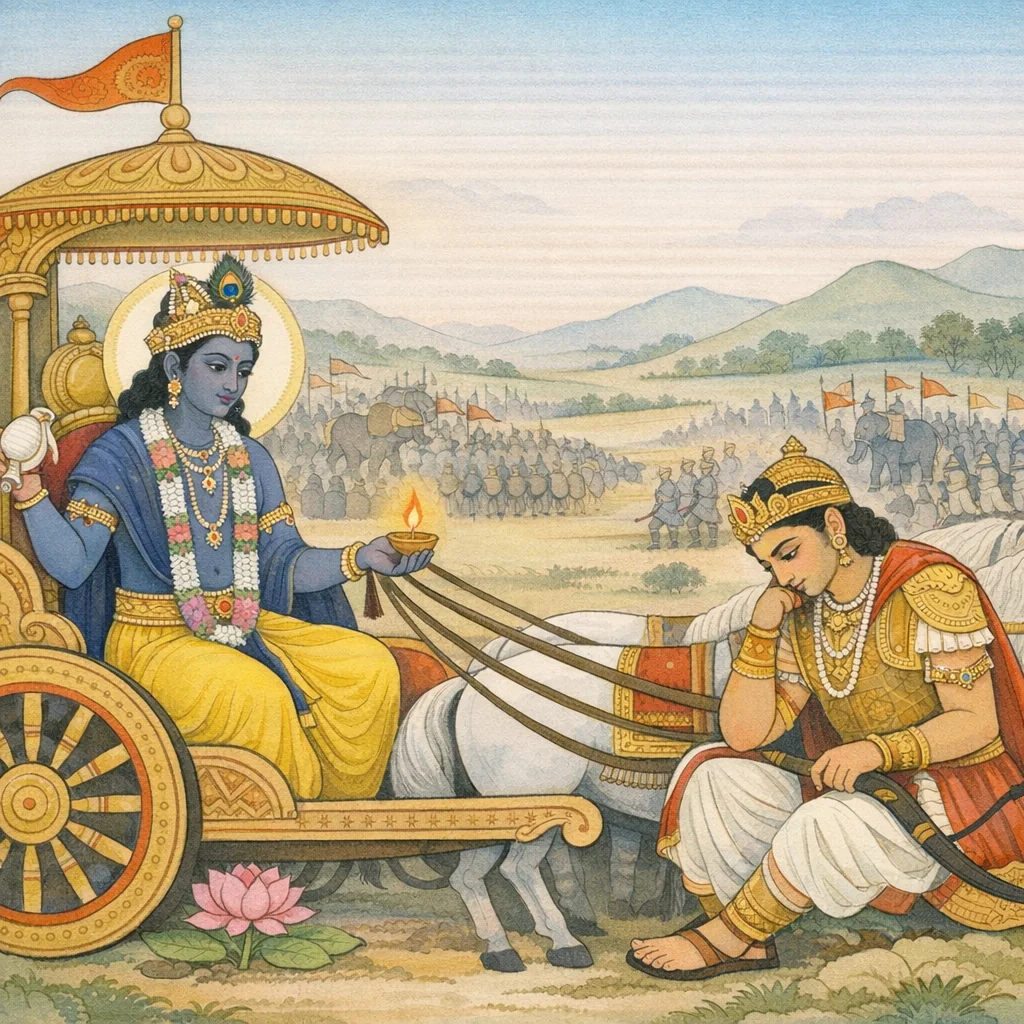
Chapter 2: Sankhya Yoga
सांख्ययोग
The Yoga of Knowledge
Chapter 2 marks the decisive turn from crisis to instruction. Arjuna’s resolve collapses under compassion, grief, and moral confusion on the field of action, and he formally adopts the posture of a disciple, requesting a clear criterion of what is truly beneficial (śreyas). Krishna first diagnoses the paralysis as ignoble dejection and reframes the ethical problem through metaphysical inquiry: the Self (ātman) is unborn, imperishable, and distinct from the changing body, so grief rooted in bodily identification is philosophically mistaken. This ontological clarification becomes the basis for steadiness (titikṣā) amid opposites and for duty performed without inner disintegration. Krishna then pivots to the practical soteriological path: disciplined action (karma-yoga) guided by buddhi, renouncing attachment to outcomes, and cultivating equanimity. The chapter culminates in a sustained portrait of the sthitaprajña—one established in wisdom—whose sense-control, inner satisfaction, and freedom from craving constitute peace and liberation-oriented stability.
Speakers
Key Concepts
Philosophical Constructs
Shlokas in Chapter 2
Verse 1
संजय उवाच । तं तथा कृपयाविष्टमश्रुपूर्णाकुलेक्षणम् विषीदन्तमिदं वाक्यमुवाच मधुसूदनः ॥ २.१ ॥
Sanjaya said: To him who was thus seized by compassion, with eyes troubled and filled with tears, and who was sinking into despondency, Madhusudana spoke these words.
Verse 2
श्रीभगवानुवाच । कुतस्त्वा कश्मलमिदं विषमे समुपस्थितम् अनार्यजुष्टमस्वर्ग्यमकीर्तिकरमर्जुन ॥ २.२ ॥
The Blessed Lord said: Whence has this dejection come upon you at this critical hour, O Arjuna? It is not befitting of the noble; it leads neither to heaven nor to honor, but to disgrace.
Verse 3
क्लैब्यं मा स्म गमः पार्थ नैतत्त्वय्युपपद्यते । क्षुद्रं हृदयदौर्बल्यं त्यक्त्वोत्तिष्ठ परन्तप ॥ २....
Do not yield to unmanliness, O Partha; it does not befit you. Casting off this petty weakness of heart, arise, O scorcher of foes.
Verse 4
अर्जुन उवाच । कथं भीष्ममहं संख्ये द्रोणं च मधुसूदन इषुभिः प्रतियोत्स्यामि पूजार्हावरिसूदन ॥ २.४ ॥
Arjuna said: O Madhusudana, O slayer of foes, how shall I, in battle, fight with arrows against Bhishma and Drona, who are worthy of reverence?
Verse 5
गुरूनहत्वा हि महानुभावान् श्रेयो भोक्तुं भैक्ष्यमपीह लोके । हत्वार्थकामांस्तु गुरूनिहैव भुञ्जीय भोगान् रुधिरप्रदिग्धान् ॥ २.५ ॥
It is indeed better for me, in this world, to live on alms than to slay these venerable, great-souled teachers. For, having slain the gurus—though they seek wealth and pleasure—here itself I would partake of enjoyments stained with blood.
Verse 6
न चैतद्विद्मः कतरन्नो गरीयो यद्वा जयेम यदि वा नो जयेयुः । यानेव हत्वा न जिजीविषामस् तेऽवस्थिताः प्रमुखे धार्तराष्ट्राः ॥ २.६ ॥
Nor do we know which is better for us—whether we should conquer, or whether they should conquer us. Those very sons of Dhritarashtra stand before us in battle; having slain them, we would not wish to live.
Verse 7
कार्पण्यदोषोपहतस्वभावः पृच्छामि त्वां धर्मसम्मूढचेताः । यच्छ्रेयः स्यान्निश्चितं ब्रूहि तन्मे शिष्यस्तेऽहं शाधि मां त्वां प्रपन्नम् ॥ २.७ ॥
My very nature is overpowered by the fault of faint-heartedness; my mind is bewildered regarding dharma. I ask You: tell me decisively what is truly good for me. I am Your disciple; instruct me, who has taken refuge in You.
Verse 8
न हि प्रपश्यामि ममापनुद्याद्यच्छोकमुच्छोषणमिन्द्रियाणाम् । अवाप्य भूमावसपत्नमृद्धं राज्यं सुराणामपि चाधिपत्यम् ॥ २.८ ॥
For I do not see what could dispel this sorrow of mine that withers the senses—even if I were to obtain on earth a prosperous, unrivaled kingdom, or even lordship over the gods.
Verse 9
सञ्जय उवाच । एवमुक्त्वा हृषीकेशं गुडाकेशः परन्तपः । न योत्स्य इति गोविन्दमुक्त्वा तूष्णीं बभूव ह ॥ २.९ ॥
Sanjaya said: Having spoken thus to Hrishikesha, Gudakesha, the scorcher of foes, said to Govinda, “I will not fight,” and then fell silent.
Verse 10
तमुवाच हृषीकेशः प्रहसन्निव भारत । सेनयोरुभयोर्मध्ये विषीदन्तमिदं वचः ॥ २.१० ॥
Hrishikesha, as though smiling, spoke these words to Arjuna, who was grieving, in the midst of the two armies, O Bharata.
Verse 11
श्रीभगवानुवाच । अशोच्यानन्वशोचस्त्वं प्रज्ञावादांश्च भाषसे । गतासूनगतासूंश्च नानुशोचन्ति पण्डिताः ॥ २.११ ॥
The Blessed Lord said: You grieve for those who are not to be grieved for, yet you speak words of wisdom; the wise grieve neither for the departed nor for those who yet live.
Verse 12
न त्वेवाहं जातु नासं न त्वं नेमे जनाधिपाः । न चैव न भविष्यामः सर्वे वयमतः परम् ॥ २.१२ ॥
Never indeed was there a time when I did not exist, nor you, nor these rulers of men; and never shall we all cease to exist hereafter.
Verse 13
देहिनोऽस्मिन्यथा देहे कौमारं यौवनं जरा । तथा देहान्तरप्राप्तिर्धीरस्तत्र न मुह्यति ॥ २.१३ ॥
As the embodied Self in this body passes through childhood, youth, and old age, so does it attain another body; the steadfast are not deluded therein.
Verse 14
मात्रास्पर्शास्तु कौन्तेय शीतोष्णसुखदुःखदाः । आगमापायिनोऽनित्यास्तांस्तितिक्षस्व भारत ॥ २.१४ ॥
Sense-contacts, O son of Kunti, give rise to cold and heat, pleasure and pain; they come and go and are impermanent—endure them, O Bharata.
Verse 15
यं हि न व्यथयन्त्येते पुरुषं पुरुषर्षभ । समदुःखसुखं धीरं सोऽमृतत्वाय कल्पते ॥ २.१५ ॥
O best among men, that steadfast one whom these (sense-contacts) do not agitate, who remains equal in sorrow and joy—he becomes fit for immortality (liberation).
Verse 16
नासतो विद्यते भावो नाभावो विद्यते सतः । उभयोरपि दृष्टोऽन्तस्त्वनयोस्तत्त्वदर्शिभिः ॥ २.१६ ॥
Of the unreal there is no being; of the real there is no non-being. The final truth of both has been seen by the seers of Reality.
Verse 17
अविनाशि तु तद्विद्धि येन सर्वमिदं ततम् । विनाशमव्ययस्यास्य न कश्चित्कर्तुमर्हति ॥ २.१७ ॥
Know That to be imperishable by which all this is pervaded. No one can bring about the destruction of this immutable principle.
Verse 18
अन्तवन्त इमे देहा नित्यस्योक्ताः शरीरिणः । अनाशिनोऽप्रमेयस्य तस्माद्युध्यस्व भारत ॥ २.१८ ॥
These bodies are said to be perishable, belonging to the eternal embodied Self, which is indestructible and immeasurable. Therefore, fight, O descendant of Bharata.
Verse 19
य एनं वेत्ति हन्तारं यश्चैनं मन्यते हतम् । उभौ तौ न विजानीतो नायं हन्ति न हन्यते ॥ २.१९ ॥
He who thinks this Self a slayer, and he who thinks it slain—both do not know. It neither slays nor is slain.
Verse 20
न जायते म्रियते वा कदाचि- न्नायं भूत्वा भविता वा न भूयः । अजो नित्यः शाश्वतोऽयं पुराणो न हन्यते हन्यमाने शरीरे ॥ २.२० ॥
The Self is never born, nor does it ever die; having once been, it does not again come into non-being. Unborn, eternal, everlasting, primeval—It is not slain when the body is slain.
Verse 21
वेदाविनाशिनं नित्यं य एनमजमव्ययम् । कथं स पुरुषः पार्थ कं घातयति हन्ति कम् ॥ २.२१ ॥
One who knows It as indestructible, eternal, unborn, and immutable—how can that person, O Pārtha, cause anyone to be slain, or slay anyone?
Verse 22
वासांसि जीर्णानि यथा विहाय नवानि गृह्णाति नरोऽपराणि । तथा शरीराणि विहाय जीर्णा- न्यन्यानि संयाति नवानि देही ॥ २.२२ ॥
As a person casts off worn-out garments and takes up others that are new, so the embodied Self casts off worn-out bodies and enters into others that are new.
Verse 23
नैनं छिन्दन्ति शस्त्राणि नैनं दहति पावकः । न चैनं क्लेदयन्त्यापो न शोषयति मारुतः ॥ २.२३ ॥
Weapons do not cut It; fire does not burn It. Water does not wet It, and wind does not dry It.
Verse 24
अच्छेद्योऽयमदाह्योऽयमक्लेद्योऽशोष्य एव च । नित्यः सर्वगतः स्थाणुरचलोऽयं सनातनः ॥ २.२४ ॥
This Self cannot be cut, cannot be burned, cannot be wetted, and cannot be dried. It is eternal, all-pervading, steadfast, immovable, and beginningless—ever ancient.
Verse 25
अव्यक्तोऽयमचिन्त्योऽयमविकार्योऽयमुच्यते । तस्मादेवं विदित्वैनं नानुशोचितुमर्हसि ॥ २.२५ ॥
This Self is said to be unmanifest, inconceivable, and unchangeable. Therefore, knowing It thus, you ought not to grieve.
Verse 26
अथ चैनं नित्यजातं नित्यं वा मन्यसे मृतम् । तथापि त्वं महाबाहो नैवं शोचितुमर्हसि ॥ २.२६ ॥
Even if you think this self is ever born and ever dies, even then, O mighty-armed, you should not grieve in this way.
Verse 27
जातस्य हि ध्रुवो मृत्युर्ध्रुवं जन्म मृतस्य च । तस्मादपरिहार्येऽर्थे न त्वं शोचितुमर्हसि ॥ २.२७ ॥
For one who is born, death is certain; and for one who has died, birth is certain. Therefore, in an unavoidable matter, you should not grieve.
Verse 28
अव्यक्तादीनि भूतानि व्यक्तमध्यानि भारत । अव्यक्तनिधनान्येव तत्र का परिदेवना ॥ २.२८ ॥
Beings are unmanifest in the beginning, manifest in the middle, O Bharata, and unmanifest again in the end. What is there to lament?
Verse 29
आश्चर्यवत्पश्यति कश्चिदेनमाश्चर्यवद्वदति तथैव चान्यः । आश्चर्यवच्चैनमन्यः शृणोति श्रुत्वाप्येनं वेद न चैव कश्चित् ॥ २.२९ ॥
One beholds It as a wonder; another speaks of It as a wonder; another hears of It as a wonder. Yet even after hearing, none truly knows It.
Verse 30
देही नित्यमवध्योऽयं देहे सर्वस्य भारत । तस्मात्सर्वाणि भूतानि न त्वं शोचितुमर्हसि ॥ २.३० ॥
O Bhārata, the embodied Self within the bodies of all beings is ever indestructible; therefore you ought not to grieve for any being.
Verse 31
स्वधर्ममपि चावेक्ष्य न विकम्पितुमर्हसि । धर्म्याद्धि युद्धाच्छ्रेयोऽन्यत्क्षत्रियस्य न विद्यते ॥ २.३१ ॥
Moreover, considering your own svadharma, you should not waver; for a kṣatriya there is nothing higher than a righteous battle.
Verse 32
यदृच्छया चोपपन्नं स्वर्गद्वारमपावृतम् । सुखिनः क्षत्रियाः पार्थ लभन्ते युद्धमीदृशम् ॥ २.३२ ॥
O Pārtha, blessed are the kṣatriyas who obtain such a battle that comes unsought, as an opened gate to heaven.
Verse 33
अथ चेत्त्वमिमं धर्म्यं संग्रामं न करिष्यसि । ततः स्वधर्मं कीर्तिं च हित्वा पापमवाप्स्यसि ॥ २.३३ ॥
But if you do not undertake this righteous war, then, abandoning your svadharma and your honor, you will incur sin.
Verse 34
अकीर्तिं चापि भूतानि कथयिष्यन्ति तेऽव्ययाम् । सम्भावितस्य चाकीर्तिर्मरणादतिरिच्यते ॥ २.३४ ॥
People too will speak of your imperishable disgrace; and for one held in honor, dishonor is worse than death.
Verse 35
भयाद्रणादुपरतं मंस्यन्ते त्वां महारथाः । येषां च त्वं बहुमतो भूत्वा यास्यसि लाघवम् ॥ २.३५ ॥
The great chariot-warriors will think that you have withdrawn from the battle out of fear; and you—once held in high esteem by them—will fall into dishonour.
Verse 36
अवाच्यवादांश्च बहून्वदिष्यन्ति तवाहिताः । निन्दन्तस्तव सामर्थ्यं ततो दुःखतरं नु किम् ॥ २.३६ ॥
Your foes will speak many unworthy words, reviling your prowess; what indeed could be more painful than that?
Verse 37
हतो वा प्राप्स्यसि स्वर्गं जित्वा वा भोक्ष्यसे महीम् । तस्मादुत्तिष्ठ कौन्तेय युद्धाय कृतनिश्चयः ॥
If you are slain, you will attain heaven; if you conquer, you will enjoy the earth. Therefore arise, O son of Kuntī, with firm resolve for battle.
Verse 38
सुखदुःखे समे कृत्वा लाभालाभौ जयाजयौ । ततो युद्धाय युज्यस्व नैवं पापमवाप्स्यसि ॥ २.३८ ॥
Holding pleasure and pain, gain and loss, victory and defeat as equal, engage in battle; thus you shall not incur sin.
Verse 39
एषा तेऽभिहिता सांख्ये बुद्धिर्योगे त्विमां शृणु । बुद्ध्या युक्तो यया पार्थ कर्मबन्धं प्रहास्यसि ॥
This understanding has been declared to you in Sāṅkhya; now hear it in Yoga. Endowed with this discernment, O Pārtha, you shall cast off the bondage of action.
Verse 40
नेहाभिक्रमनाशोऽस्ति प्रत्यवायो न विद्यते । स्वल्पमप्यस्य धर्मस्य त्रायते महतो भयात् ॥ २.४० ॥
On this path there is no loss of effort, nor does any contrary result arise; even a little of this dharma protects one from great fear.
Verse 41
व्यवसायात्मिका बुद्धिरेकेह कुरुनन्दन । बहुशाखा ह्यनन्ताश्च बुद्धयोऽव्यवसायिनाम् ॥ २.४१ ॥
Here, O joy of the Kurus, the intellect is single-pointed and steadfast; but the intellects of the irresolute are many-branched and endless.
Verse 42
यामिमां पुष्पितां वाचं प्रवदन्त्यविपश्चितः । वेदवादरताः पार्थ नान्यदस्तीति वादिनः ॥ २.४२ ॥
The unwise, delighting in Vedic words, utter flowery speech, O Pārtha, declaring, ‘There is nothing else.’
Verse 43
कामात्मानः स्वर्गपरा जन्मकर्मफलप्रदाम् । क्रियाविशेषबहुलां भोगैश्वर्यगतिं प्रति ॥ २.४३ ॥
With desire as their very self, taking heaven as the highest end, they speak words that promise rebirth as the fruit of actions—abounding in special rites—leading toward enjoyment and lordship.
Verse 44
भोगैश्वर्यप्रसक्तानां तयापहृतचेतसाम् । व्यवसायात्मिका बुद्धिः समाधौ न विधीयते ॥ २.४४ ॥
For those attached to enjoyment and power, whose minds are carried away by that (flowery speech), the steadfast, single-pointed intellect is not established in samādhi.
Verse 45
त्रैगुण्यविषया वेदा निस्त्रैगुण्यो भवार्जुन । निर्द्वन्द्वो नित्यसत्त्वस्थो निर्योगक्षेम आत्मवान् ॥
The Vedas move within the domain of the three guṇas; O Arjuna, become free from the three guṇas—free from the pairs of opposites, ever established in sattva (purity), unconcerned with acquisition and preservation, and self-possessed.
Verse 46
यावानर्थ उदपाने सर्वतः संप्लुतोदके । तावान्सर्वेषु वेदेषु ब्राह्मणस्य विजानतः ॥ २.४६ ॥
For the brāhmaṇa who truly knows, all the Vedas are as useful as a small well is when water is flooding everywhere.
Verse 47
कर्मण्येवाधिकारस्ते मा फलेषु कदाचन । मा कर्मफलहेतुर्भूर्मा ते सङ्गोऽस्त्वकर्मणि ॥ २.४७ ॥
Your entitlement is to action alone, never at any time to its fruits. Do not become one who acts for the sake of results; nor let your attachment be to inaction.
Verse 48
योगस्थः कुरु कर्माणि सङ्गं त्यक्त्वा धनंजय । सिद्ध्यसिद्ध्योः समो भूत्वा समत्वं योग उच्यते ॥ २.४८ ॥
Established in yoga, perform actions, O Dhanañjaya, abandoning attachment; becoming equal in success and failure—this equanimity is called yoga.
Verse 49
दूरेण ह्यवरं कर्म बुद्धियोगाद्धनंजय । बुद्धौ शरणमन्विच्छ कृपणाः फलहेतवः ॥ २.४९ ॥
Action is far inferior to buddhi-yoga, O Dhanañjaya. Seek refuge in buddhi; pitiable are those who act with results as their motive.
Verse 50
बुद्धियुक्तो जहातीह उभे सुकृतदुष्कृते । तस्माद्योगाय युज्यस्व योगः कर्मसु कौशलम् ॥ २.५० ॥
Endowed with buddhi (steady discernment), one casts off here both merit and demerit; therefore yoke yourself to yoga—yoga is skillfulness in action.
Verse 51
कर्मजं बुद्धियुक्ता हि फलं त्यक्त्वा मनीषिणः । जन्मबन्धविनिर्मुक्ताः पदं गच्छन्त्यनामयम् ॥ २.५१ ॥
For the wise, united with buddhi, renouncing the fruit born of action, become freed from the bondage of birth and attain the sorrowless, stainless state.
Verse 52
यदा ते मोहकलिलं बुद्धिर्व्यतितरिष्यति । तदा गन्तासि निर्वेदं श्रोतव्यस्य श्रुतस्य च ॥ २.५२ ॥
When your buddhi crosses beyond the mire of delusion, then you will attain dispassion toward what is yet to be heard and what has been heard.
Verse 53
श्रुतिविप्रतिपन्ना ते यदा स्थास्यति निश्चला । समाधावचला बुद्धिस्तदा योगमवाप्स्यसि ॥ २.५३ ॥
When your buddhi, bewildered by the diversity of teachings you have heard, stands firm and unmoving in samādhi, then you will attain yoga.
Verse 54
अर्जुन उवाच । स्थितप्रज्ञस्य का भाषा समाधिस्थस्य केशव स्थितधीः किं प्रभाषेत किमासीत व्रजेत किम् ॥
Arjuna said: O Keśava, what is the mark of one of steady wisdom, established in samādhi? How does one of steady intellect speak—how does he sit, and how does he move?
Verse 55
श्रीभगवानुवाच । प्रजहाति यदा कामान्सर्वान्पार्थ मनोगतान् । आत्मन्येवात्मना तुष्टः स्थितप्रज्ञस्तदोच्यते ॥ २.५५ ॥
The Blessed Lord said: O Pārtha, when a person wholly abandons all desires that arise in the mind, and is content in the Self by the Self alone—then he is called one of steady wisdom (sthita-prajña).
Verse 56
दुःखेष्वनुद्विग्नमनाः सुखेषु विगतस्पृहः । वीतरागभयक्रोधः स्थितधीर्मुनिरुच्यते ॥ २.५६ ॥
He whose mind is not shaken in sorrow, who is free from craving in pleasure, and who is devoid of attachment, fear, and anger—such a sage is called one of steady understanding (sthita-dhī).
Verse 57
यः सर्वत्रानभिस्नेहस्तत्तत्प्राप्य शुभाशुभम् । नाभिनन्दति न द्वेष्टि तस्य प्रज्ञा प्रतिष्ठिता ॥ २.५७ ॥
He who is unattached everywhere, and on obtaining what is auspicious or inauspicious neither rejoices nor hates—his wisdom is firmly established.
Verse 58
यदा संहरते चायं कूर्मोऽङ्गानीव सर्वशः । इन्द्रियाणीन्द्रियार्थेभ्यस्तस्य प्रज्ञा प्रतिष्ठिता ॥ २.५८ ॥
When, like a tortoise drawing in its limbs on all sides, he withdraws the senses from their objects—then his wisdom is firmly established.
Verse 59
विषया विनिवर्तन्ते निराहारस्य देहिनः । रसवर्जं रसोऽप्यस्य परं दृष्ट्वा निवर्तते ॥ २.५९ ॥
The sense-objects fall away for the embodied one who abstains from them, yet the taste (subtle longing) remains; even that taste ceases upon beholding the Supreme.
Verse 60
यततो ह्यपि कौन्तेय पुरुषस्य विपश्चितः । इन्द्रियाणि प्रमाथीनि हरन्ति प्रसभं मनः ॥ २.६० ॥
O son of Kuntī, even of the striving wise person, the turbulent senses forcibly carry away the mind.
Verse 61
तानि सर्वाणि संयम्य युक्त आसीत मत्परः । वशे हि यस्येन्द्रियाणि तस्य प्रज्ञा प्रतिष्ठिता ॥ २.६१ ॥
Having restrained them all, one should sit steadfast in yoga, devoted to Me; for he whose senses are under control—his wisdom is firmly established.
Verse 62
ध्यायतो विषयान्पुंसः सङ्गस्तेषूपजायते । सङ्गात्संजायते कामः कामात्क्रोधोऽभिजायते ॥ २.६२ ॥
In a person who dwells upon sense-objects, attachment to them arises; from attachment arises desire, and from desire anger is born.
Verse 63
क्रोधाद्भवति संमोहः संमोहात्स्मृतिविभ्रमः । स्मृतिभ्रंशाद्बुद्धिनाशो बुद्धिनाशात्प्रणश्यति ॥ २.६३ ॥
From anger arises delusion; from delusion, confusion of memory; from confusion of memory, the ruin of discernment; and from the ruin of discernment, one perishes.
Verse 64
रागद्वेषवियुक्तैस्तु विषयानिन्द्रियैश्चरन् । आत्मवश्यैर्विधेयात्मा प्रसादमधिगच्छति ॥ २.६४ ॥
But moving among sense-objects with senses under one’s control, free from attachment and aversion, the disciplined one attains serenity of mind.
Verse 65
प्रसादे सर्वदुःखानां हानिरस्योपजायते । प्रसन्नचेतसो ह्याशु बुद्धिः पर्यवतिष्ठते ॥ २.६५ ॥
In prasāda (serene clarity), the destruction of all sorrows arises for him; for one whose mind is tranquil, the intellect soon becomes firmly established.
Verse 66
नास्ति बुद्धिरयुक्तस्य न चायुक्तस्य भावना । न चाभावयतः शान्तिरशान्तस्य कुतः सुखम् ॥ २.६६ ॥
For the unyoked (unsteady) there is no wisdom; for the unyoked there is no bhāvanā (inner contemplation). For one who does not contemplate there is no peace; and for the unpeaceful, whence happiness?
Verse 67
इन्द्रियाणां हि चरतां यन्मनोऽनु विधीयते । तदस्य हरति प्रज्ञां वायुर्नावमिवाम्भसि ॥ २.६७ ॥
When the mind follows the wandering senses, it carries away his wisdom—just as the wind carries away a boat upon the waters.
Verse 68
तस्माद्यस्य महाबाहो निगृहीतानि सर्वशः । इन्द्रियाणीन्द्रियार्थेभ्यस्तस्य प्रज्ञा प्रतिष्ठिता ॥ २.६८ ॥
Therefore, O mighty-armed, he whose senses are restrained in every way from their objects—his wisdom stands firmly established.
Verse 69
या निशा सर्वभूतानां तस्यां जागर्ति संयमी । यस्यां जाग्रति भूतानि सा निशा पश्यतो मुनेः ॥ २.६९ ॥
That which is night to all beings, in that the self-controlled one is awake; and that in which beings are awake, that is night to the seeing sage.
Verse 70
आपूर्यमाणमचलप्रतिष्ठं समुद्रमापः प्रविशन्ति यद्वत् । तद्वत्कामा यं प्रविशन्ति सर्वे स शान्तिमाप्नोति न कामकामी ॥ २.७० ॥
As waters enter the ocean—ever being filled, yet steadfast and unmoved—so all desires enter the one who remains established; he attains peace, not the one who longs for desires.
Verse 71
विहाय कामान्यः सर्वान् पुमांश्चरति निःस्पृहः । निर्ममो निरहंकारः स शान्तिमधिगच्छति ॥ २.७१ ॥
Abandoning all desires, moving about free from craving, without possessiveness (‘mine-ness’) and without ego-sense—he attains peace.
Verse 72
एषा ब्राह्मी स्थितिः पार्थ नैनां प्राप्य विमुह्यति । स्थित्वास्यामन्तकालेऽपि ब्रह्मनिर्वाणमृच्छति ॥ २.७२ ॥
This is the Brahmic state, O Pārtha; having attained it, one is not deluded. Established in it even at the time of death, one reaches Brahman-nirvāṇa.
Frequently Asked Questions
It diagnoses crisis as attachment-driven confusion (moha) and prescribes steadiness through discernment, forbearance amid opposites, and outcome-independent action—an actionable model for mental clarity under pressure.
The chapter asserts the imperishability of the Self (ātman) and the perishability of the body, reframing fear and grief as errors of identification and establishing a basis for ethical action without inner collapse.
By shifting the dilemma from emotion-centered hesitation to dharma guided by wisdom: act according to rightful responsibility while relinquishing possessiveness over results, thereby avoiding both avoidance and despair.
Use it as a leadership and resilience framework: clarify your role-based duty, focus on controllable effort, detach from outcome fixation, practice sense-discipline, and cultivate equanimity to reduce stress and improve decision quality.