
Bhagavad Gita — Sankhya Yoga, Shloka 29
Sankhya Yoga
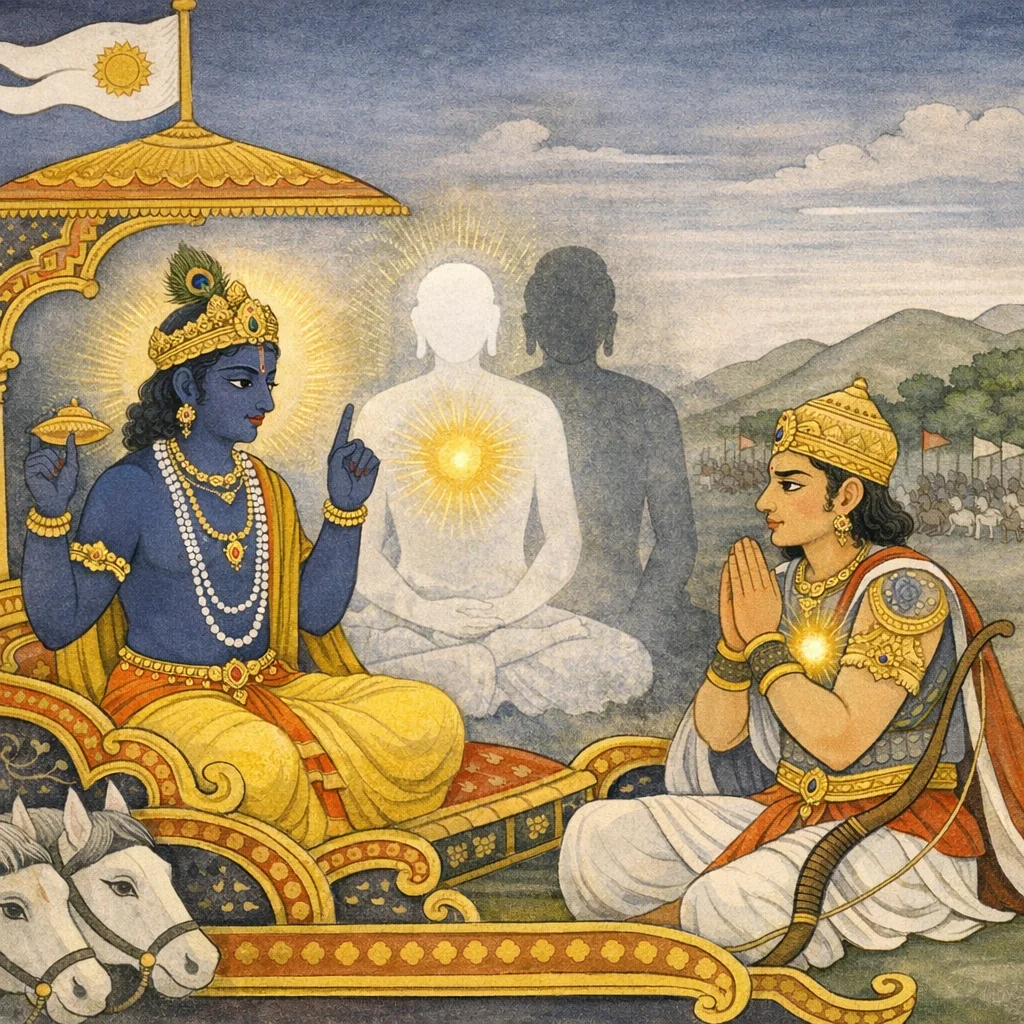
आश्चर्यवत्पश्यति कश्चिदेनमाश्चर्यवद्वदति तथैव चान्यः । आश्चर्यवच्चैनमन्यः शृणोति श्रुत्वाप्येनं वेद न चैव कश्चित् ॥ २.२९ ॥
āścaryavat paśyati kaścid enam āścaryavad vadati tathaiva cānyaḥ | āścaryavac cainam anyaḥ śṛṇoti śrutvāpy enaṁ veda na caiva kaścit || 2.29 ||

One beholds It as a wonder; another speaks of It as a wonder; another hears of It as a wonder. Yet even after hearing, none truly knows It.
One sees It as a wonder; another speaks of It as a wonder; another hears of It as a wonder; yet even after hearing, none truly understands It.
Someone regards this as marvelous; another describes it as marvelous; another hears it as marvelous; and even after hearing, no one at all truly knows it.
The verse is stable across editions; interpretive differences concern whether it critiques mere intellectualization (hearing without realization) or emphasizes the self’s exceptional ontological status.
FAQs
It distinguishes information from transformation: people may discuss profound ideas, yet integrating them requires sustained attention and lived insight.
The self is presented as extraordinary and not easily objectified; thus ordinary epistemic habits (seeing, speaking, hearing) do not guarantee genuine knowledge.
Krishna underscores why Arjuna’s confusion is understandable: the topic is subtle and commonly misunderstood.
It encourages humility in philosophical or spiritual study and emphasizes practice and reflection alongside learning.