
Bhagavad Gita — Sankhya Yoga, Shloka 61
Sankhya Yoga
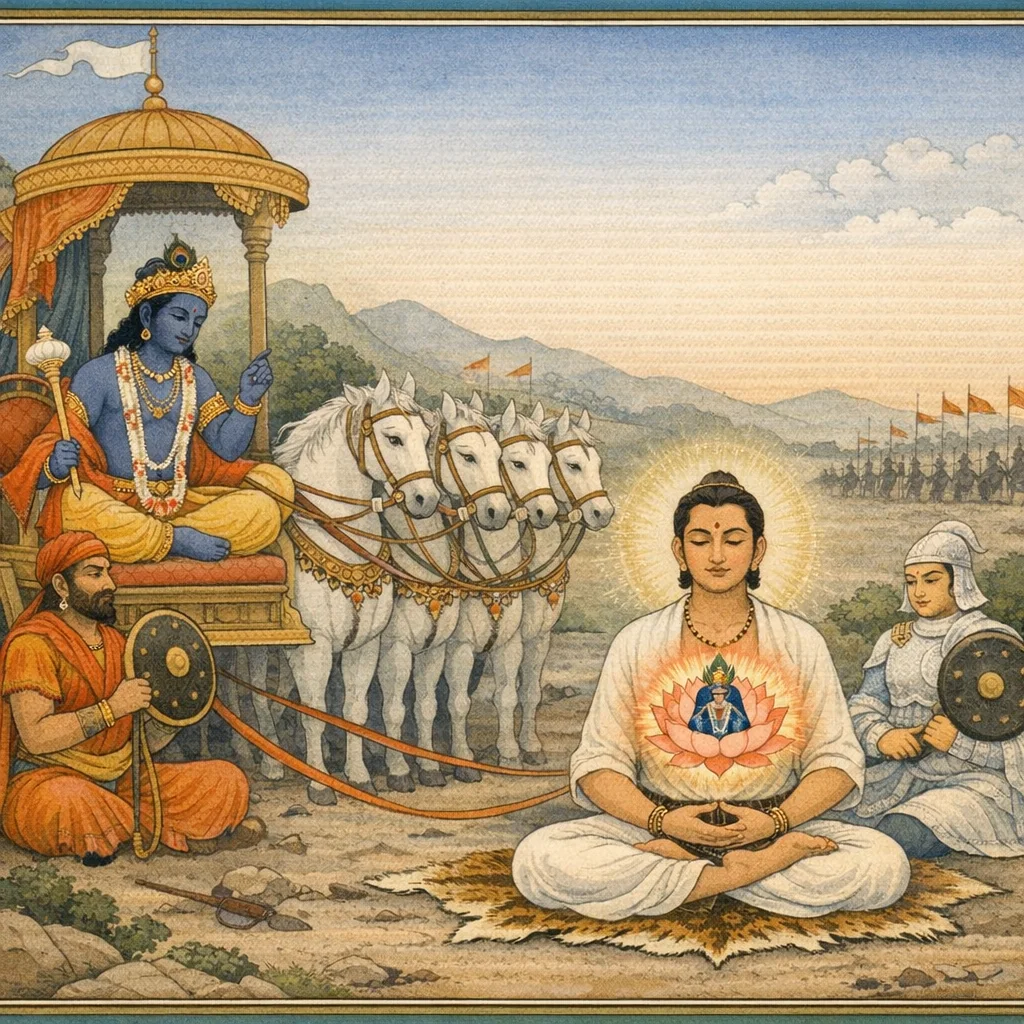
तानि सर्वाणि संयम्य युक्त आसीत मत्परः । वशे हि यस्येन्द्रियाणि तस्य प्रज्ञा प्रतिष्ठिता ॥ २.६१ ॥
tāni sarvāṇi saṃyamya yukta āsīta mat-paraḥ | vaśe hi yasyendriyāṇi tasya prajñā pratiṣṭhitā || 2.61 ||

Having restrained them all, one should sit steadfast in yoga, devoted to Me; for he whose senses are under control—his wisdom is firmly established.
उन सब (इन्द्रियों) को संयम में रखकर, मुझमें परायण होकर युक्त बैठना चाहिए; क्योंकि जिसके वश में इन्द्रियाँ हैं, उसकी प्रज्ञा प्रतिष्ठित है।
Having restrained them all, one should sit disciplined, with Me as the supreme aim; for the one whose senses are under control—his wisdom is firmly established.
‘Mat-paraḥ’ is interpreted theistically as devotion to Krishna; in broader philosophical terms, it can indicate orientation to the highest principle/goal taught by Krishna. ‘Āsīta’ (‘should sit’) may imply meditative composure as a method of stabilization.
FAQs
It proposes a two-part strategy: inhibit impulsive sensory engagement and anchor motivation in a stable, higher goal to reduce distraction.
The ‘highest aim’ functions as an ultimate reference point (Self/Supreme) that stabilizes cognition and desire.
It answers the prior warning (2.60) by prescribing disciplined restraint and a unifying orientation.
Combining attention training with a clear life-purpose (ethical or spiritual) can strengthen self-regulation and reduce compulsive behaviors.