
Bhagavad Gita — Sankhya Yoga, Shloka 26
Sankhya Yoga
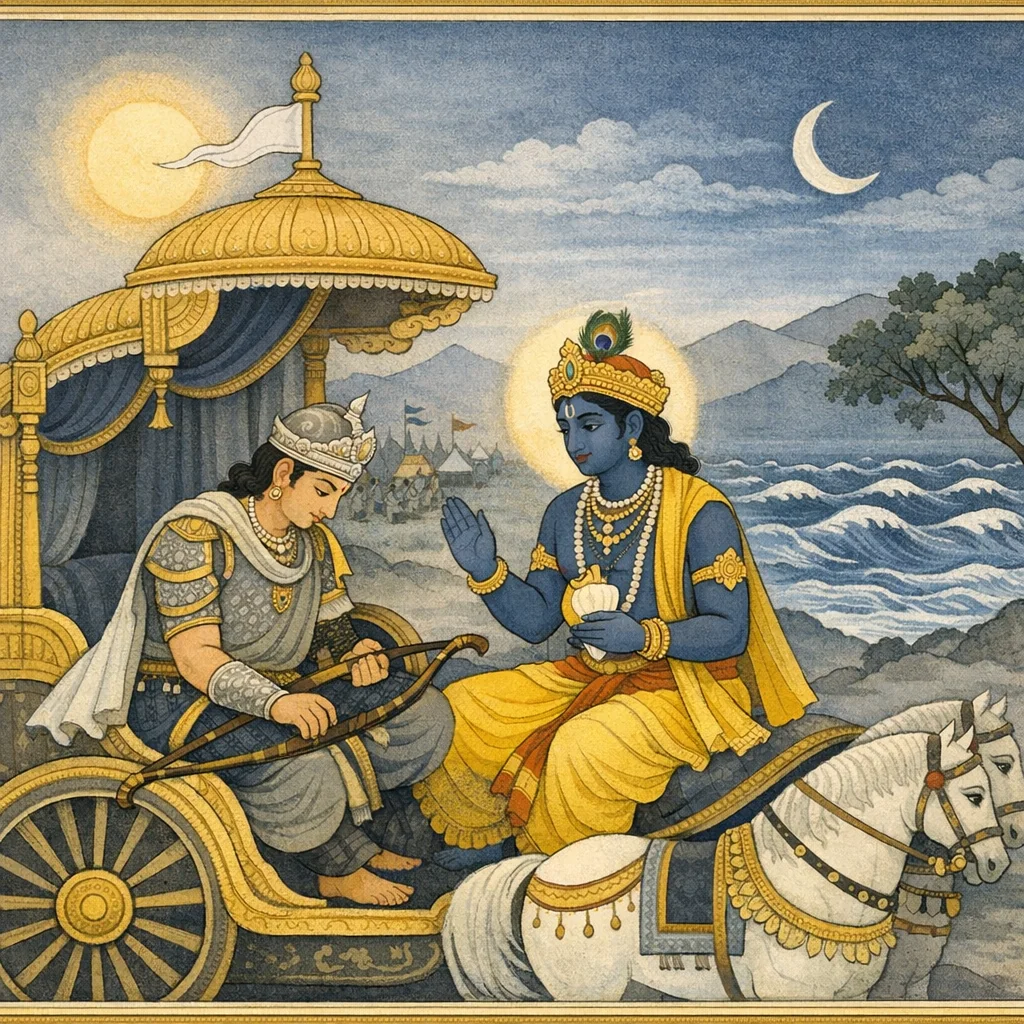
अथ चैनं नित्यजातं नित्यं वा मन्यसे मृतम् । तथापि त्वं महाबाहो नैवं शोचितुमर्हसि ॥ २.२६ ॥
atha cainaṁ nityajātaṁ nityaṁ vā manyase mṛtam | tathāpi tvaṁ mahābāho naivaṁ śocitum arhasi || 2.26 ||

Even if you think this self is ever born and ever dies, even then, O mighty-armed, you should not grieve in this way.
Even if you think this self is perpetually born and perpetually dies, even then, O mighty-armed, you should not grieve thus.
But if you suppose this (self/person) to be always born or always dead, even then, O strong-armed one, you are not fit to mourn in this manner.
This verse is often read as a concessive argument: even granting a more materialist or cyclic-birth interpretation, grief is still philosophically unwarranted because change is inevitable.
FAQs
It reduces catastrophic thinking by emphasizing that if change is constant, intense fixation on preventing it becomes psychologically counterproductive.
Krishna temporarily brackets the doctrine of an unchanging self and argues that even under an alternative view (continuous birth/death), grief lacks a stable target.
This continues a layered persuasion strategy: multiple philosophical standpoints are used to address Arjuna’s paralysis.
When facing unavoidable transitions (aging, career shifts), one can adopt a stance of acceptance rather than self-reproach or prolonged mourning.