
Bhagavad Gita — Sankhya Yoga, Shloka 51
Sankhya Yoga
कर्मजं बुद्धियुक्ता हि फलं त्यक्त्वा मनीषिणः । जन्मबन्धविनिर्मुक्ताः पदं गच्छन्त्यनामयम् ॥ २.५१ ॥
karma-jaṃ buddhi-yuktā hi phalaṃ tyaktvā manīṣiṇaḥ | janma-bandha-vinirmuktāḥ padaṃ gacchanty anāmayam || 2.51 ||

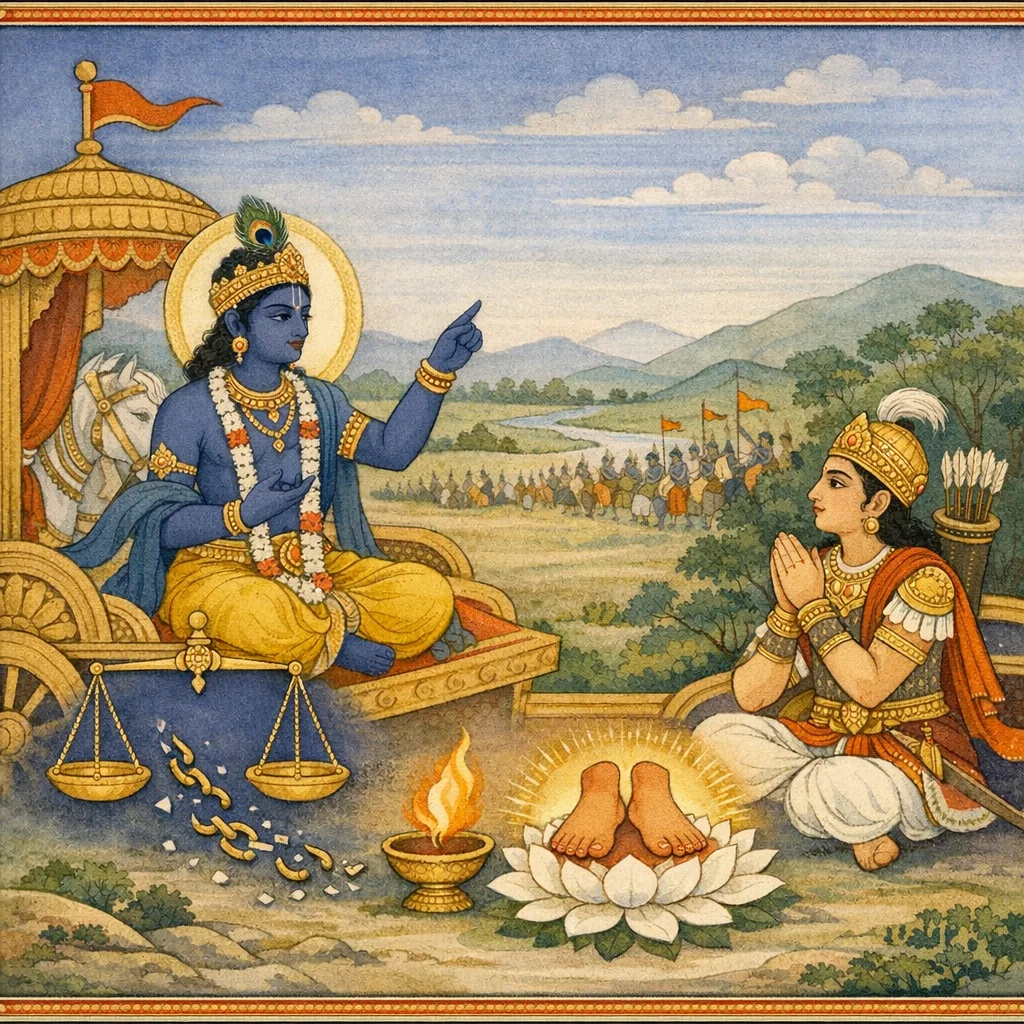
For the wise, united with buddhi, renouncing the fruit born of action, become freed from the bondage of birth and attain the sorrowless, stainless state.
The wise, united with buddhi, renouncing the fruit born of action, become freed from the bondage of birth and attain the sorrowless state.
For the discerning, joined to understanding, having abandoned the result produced by action, are released from the bondage of birth and go to the untroubled state.
“Anāmayam” literally ‘without disease/affliction’ is often rendered ‘sorrowless’ or ‘free from suffering.’ The verse links niṣkāma orientation with soteriology (release from repeated birth), a common pan-Indian religious framework.
FAQs
Letting go of result-ownership reduces chronic dissatisfaction and self-blame, supporting a more stable well-being that is not hostage to external validation.
Within the Gita’s framework, release from birth-bondage follows from dissolving the clinging that generates karmic continuity; renunciation of fruits is one mechanism for weakening that continuity.
It states the promised outcome of the discipline introduced in 2.47–2.50: action guided by buddhi and free from fruit-attachment tends toward liberation.
Even outside rebirth doctrines, the verse can be applied as freedom from repetitive compulsions: act ethically without reinforcing cycles of craving and aversion.