
Bhagavad Gita — Sankhya Yoga, Shloka 33
Sankhya Yoga
अथ चेत्त्वमिमं धर्म्यं संग्रामं न करिष्यसि । ततः स्वधर्मं कीर्तिं च हित्वा पापमवाप्स्यसि ॥ २.३३ ॥
atha cet tvam imaṁ dharmyaṁ saṅgrāmaṁ na kariṣyasi | tataḥ svadharmaṁ kīrtiṁ ca hitvā pāpam avāpsyasi || 2.33 ||

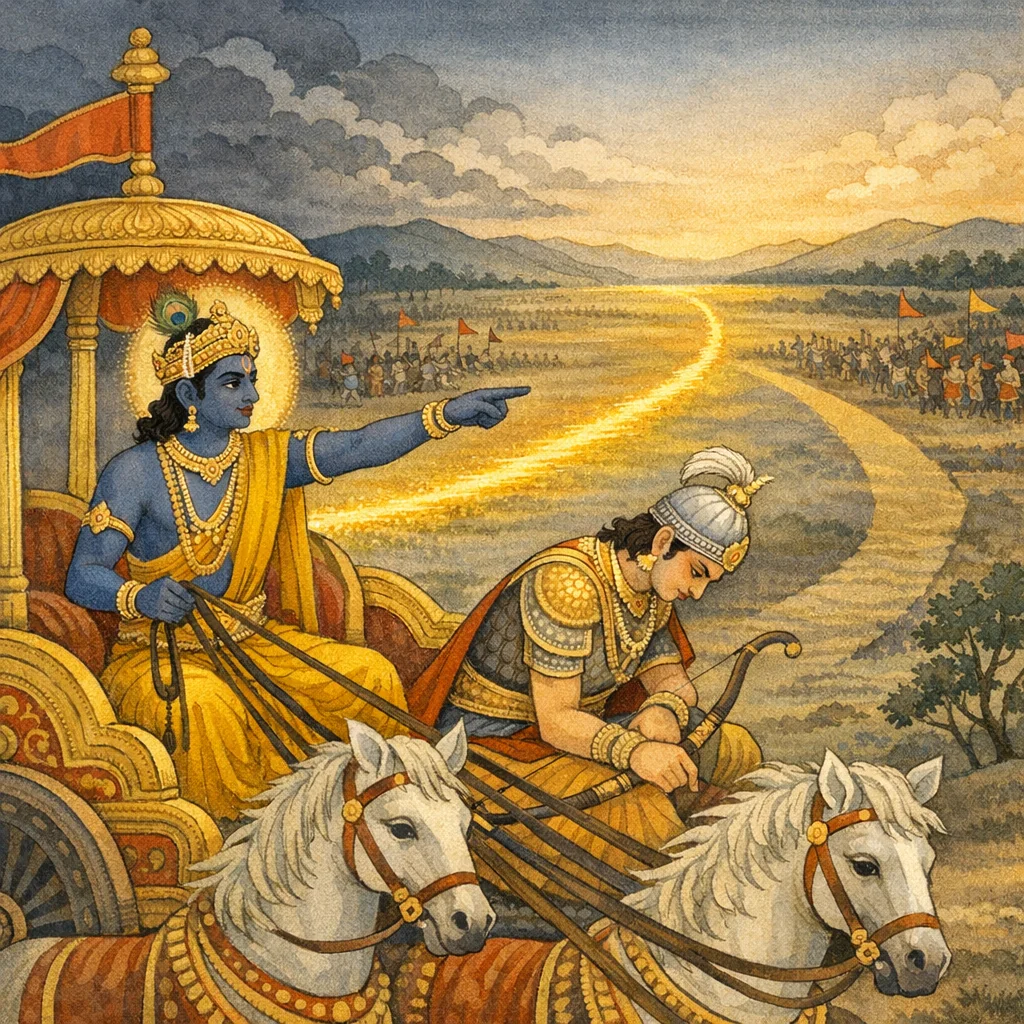
But if you do not undertake this righteous war, then, abandoning your svadharma and your honor, you will incur sin.
But if you do not undertake this righteous struggle, then, abandoning your duty and honor, you will incur demerit.
If, however, you will not perform this duty-aligned contest, then, having forsaken your own duty and reputation, you will obtain wrongdoing (pāpa).
Some translations soften pāpa as “fault” or “moral failing,” emphasizing social-ethical breach; others retain “sin” within the text’s karmic-moral vocabulary.
FAQs
It highlights the cost of avoidance: refusing a difficult responsibility can generate guilt, loss of self-respect, and moral dissonance.
The verse presupposes karmic moral causality (pāpa/puṇya) rather than arguing for it; the focus remains ethical.
Krishna intensifies the practical argument: Arjuna’s withdrawal would be seen as abandoning a socially recognized duty in the epic setting.
It can be read as guidance to meet core obligations (family, professional, civic) when they are ethically justified, rather than retreating due to fear or discomfort.