
Bhagavad Gita — Sankhya Yoga, Shloka 54
Sankhya Yoga
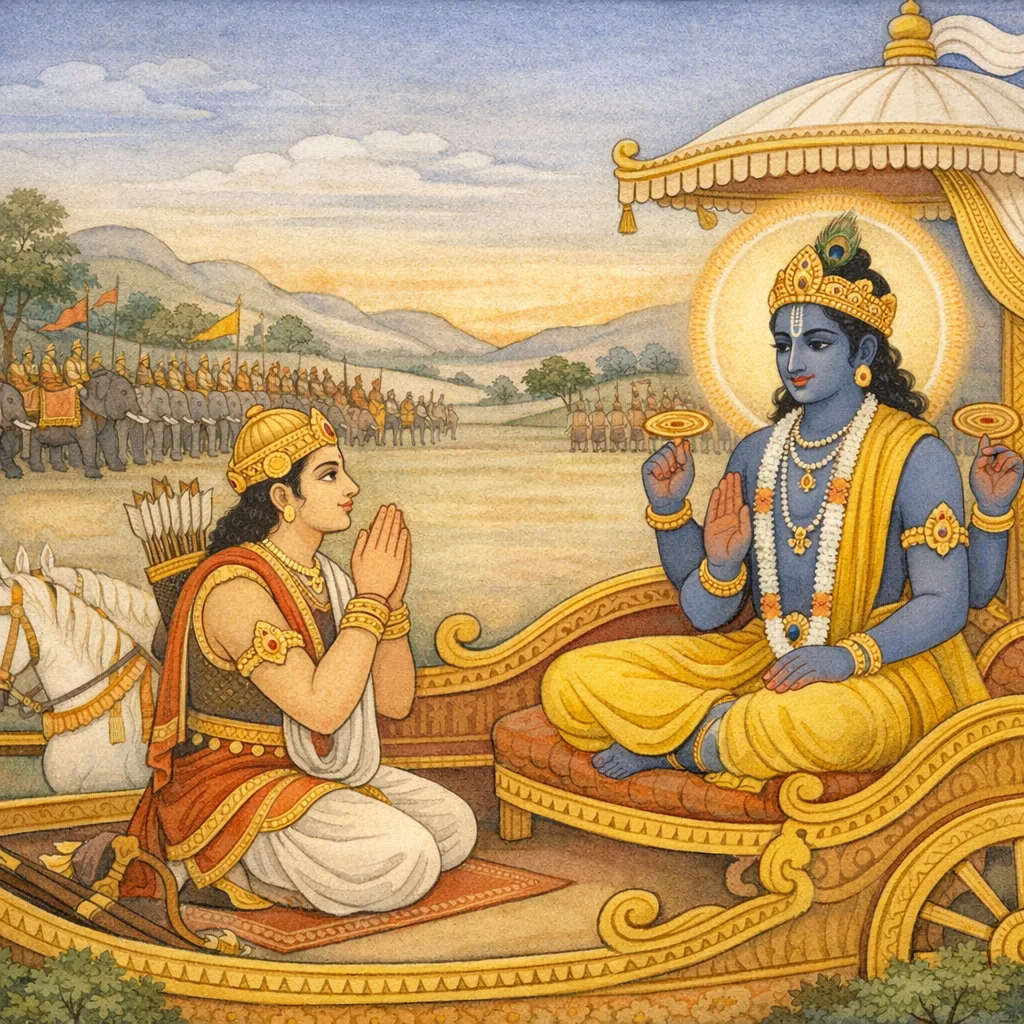
अर्जुन उवाच । स्थितप्रज्ञस्य का भाषा समाधिस्थस्य केशव स्थितधीः किं प्रभाषेत किमासीत व्रजेत किम् ॥
arjuna uvāca | sthita-prajñasya kā bhāṣā samādhi-sthasya keśava | sthita-dhīḥ kiṃ prabhāṣeta kim āsīta vrajeta kim ||

Arjuna said: O Keśava, what is the mark of one of steady wisdom, established in samādhi? How does one of steady intellect speak—how does he sit, and how does he move?
Arjuna said: O Keśava, what is the description of one of steady wisdom, established in samādhi? How does one of steady intellect speak, sit, and move?
Arjuna said: What is the manner of speech of one whose insight is steady, who is established in concentration, O Keśava? How would one of steady understanding speak; how would he sit; how would he move about?
This is a transition to the ‘sthita-prajña’ section (2.55ff.). “Bhāṣā” can mean ‘speech’ or ‘characteristic description/idiom.’ The verse frames a phenomenology of realized or stabilized insight: observable comportment rather than abstract doctrine.
FAQs
Arjuna asks for behavioral markers of inner stability—how regulated attention and emotion might manifest in speech patterns, habits, and everyday movement.
The question presumes that realization is not merely theoretical: stable knowledge of self/reality should transform the modes of engagement with the world.
After Krishna outlines buddhi-yoga and equanimity, Arjuna seeks a concrete profile of the person who has attained that steadiness, setting up the next teaching segment.
It invites inquiry into practical indicators of maturity—measured speech, consistent ethics, and non-reactive behavior—rather than relying solely on self-identification or ideology.