
Bhagavad Gita — Sankhya Yoga, Shloka 9
Sankhya Yoga
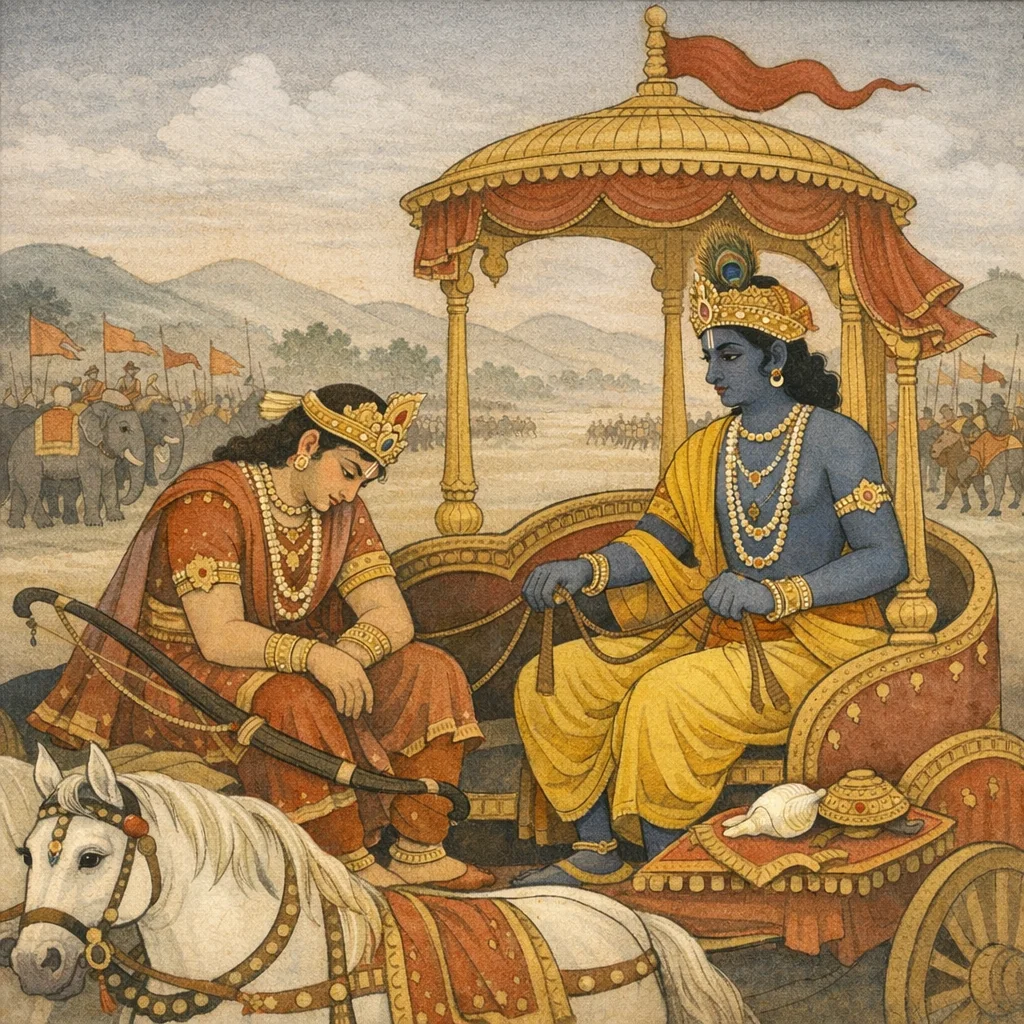
सञ्जय उवाच । एवमुक्त्वा हृषीकेशं गुडाकेशः परन्तपः । न योत्स्य इति गोविन्दमुक्त्वा तूष्णीं बभूव ह ॥ २.९ ॥
sañjaya uvāca | evam uktvā hṛṣīkeśaṃ guḍākeśaḥ parantapaḥ | na yotsya iti govindam uktvā tūṣṇīṃ babhūva ha || 2.9 ||

Sanjaya said: Having spoken thus to Hrishikesha, Gudakesha, the scorcher of foes, said to Govinda, “I will not fight,” and then fell silent.
Sanjaya narrates that having spoken thus to Hrishikesha, Arjuna said to Govinda, “I will not fight,” and became silent.
Sanjaya reports: ‘Having said this to Hṛṣīkeśa, Guḍākeśa, the scorcher of foes, told Govinda “I will not engage,” and fell silent.’
The verse is narrative framing and uses epithets (Hṛṣīkeśa, Govinda, Guḍākeśa) that carry theological and poetic resonance. Academic translations typically preserve the epithets or gloss them minimally to avoid importing later sectarian readings.
FAQs
Silence follows a firm verbal refusal, suggesting emotional shutdown after cognitive overload—often preceding receptivity to guidance.
As a framing verse, it does not argue metaphysics directly, but it marks the moment where human agency falters and the teaching on deeper agency and self-knowledge is about to begin.
It closes Arjuna’s initial lament and cues Krishna’s response; Sanjaya’s narration maintains the epic’s layered storytelling.
It can be read as the moment someone recognizes they cannot proceed under current assumptions, creating space for reframing and learning.