
Bhagavad Gita — Sankhya Yoga, Shloka 63
Sankhya Yoga
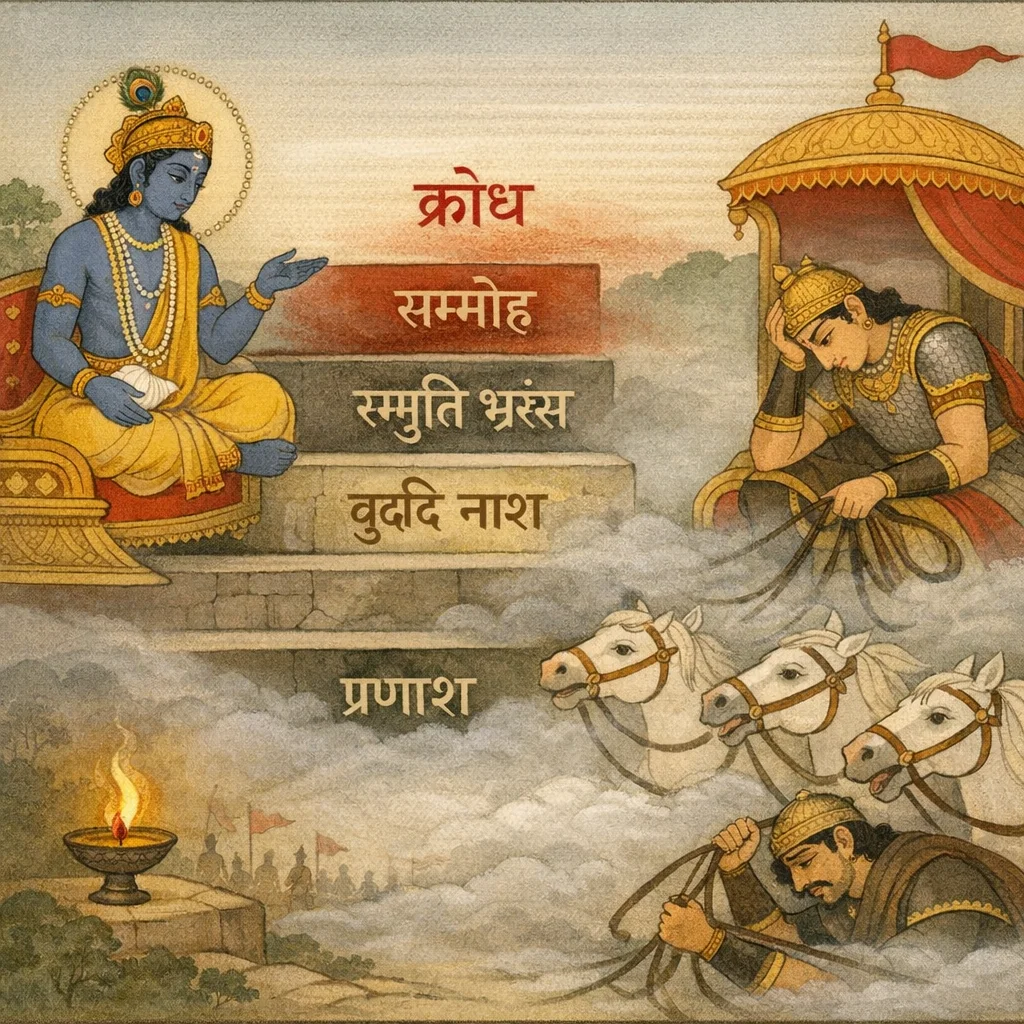
क्रोधाद्भवति संमोहः संमोहात्स्मृतिविभ्रमः । स्मृतिभ्रंशाद्बुद्धिनाशो बुद्धिनाशात्प्रणश्यति ॥ २.६३ ॥
krodhād bhavati saṃmohaḥ saṃmohāt smṛti-vibhramaḥ | smṛti-bhraṃśād buddhi-nāśo buddhi-nāśāt praṇaśyati || 2.63 ||

From anger arises delusion; from delusion, confusion of memory; from confusion of memory, the ruin of discernment; and from the ruin of discernment, one perishes.
क्रोध से सम्मोह (मूढ़ता) उत्पन्न होता है; सम्मोह से स्मृति में भ्रम होता है; स्मृति-भ्रंश से बुद्धि का नाश होता है और बुद्धि-नाश से मनुष्य का पतन हो जाता है।
From anger arises delusion; from delusion, confusion of memory; from loss of memory, destruction of discernment; from destruction of discernment, one comes to ruin.
‘Smṛti’ can mean moral recollection, learned teachings, or mindful remembrance. ‘Praṇaśyati’ is often interpreted as ethical/spiritual downfall—loss of self-governance—rather than physical destruction.
FAQs
It presents anger as a trigger for impaired judgment: emotional flooding can distort recall, undermine decision-making, and lead to self-defeating actions.
Discernment (buddhi) is central to liberation-oriented life; when it fails, one re-enters patterns of bondage through misidentification and reactive action.
It completes the cautionary sequence (2.62–2.63), emphasizing why equanimity and restraint are not optional but structurally necessary.
Anger-management, stress-reduction, and reflective practices help preserve ‘executive function’ (buddhi) under pressure.