
Bhagavad Gita — Sankhya Yoga, Shloka 69
Sankhya Yoga
या निशा सर्वभूतानां तस्यां जागर्ति संयमी । यस्यां जाग्रति भूतानि सा निशा पश्यतो मुनेः ॥ २.६९ ॥
yā niśā sarvabhūtānāṁ tasyāṁ jāgarti saṁyamī | yasyāṁ jāgrati bhūtāni sā niśā paśyato muneḥ || 2.69 ||

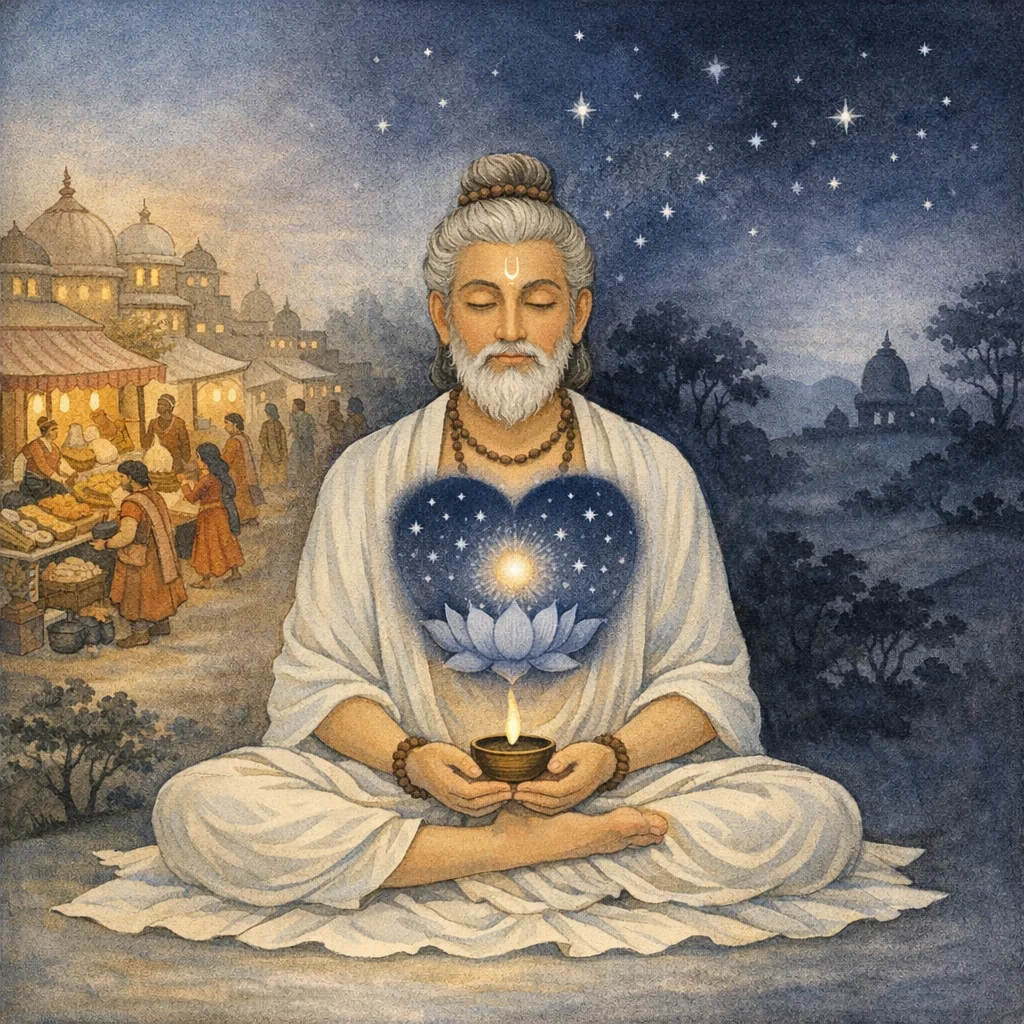
That which is night to all beings, in that the self-controlled one is awake; and that in which beings are awake, that is night to the seeing sage.
That which is night to all beings, in that the self-controlled one is awake; that in which beings are awake, that is night to the seeing sage.
What is ‘night’ for all creatures—there the disciplined one is awake; where creatures are awake—that is ‘night’ for the sage who sees.
‘Night/awake’ is metaphorical: ordinary priorities (sense-life) are ‘wakefulness’ for many, while contemplative insight is ‘wakefulness’ for the sage; the verse contrasts orientations, not literal sleep.
FAQs
It highlights that attention and value-salience differ by training: what most find compelling may lose its pull for a disciplined practitioner, and vice versa.
The ‘seeing sage’ is oriented toward the enduring (ātman/brahman framework in later verses), while ordinary beings remain oriented toward changing phenomena.
It elaborates traits of the sthitaprajña (steady in wisdom), emphasizing a radically different inner orientation.
It can describe divergent life-choices: investing in contemplation, ethics, and long-term meaning may appear ‘invisible’ to mainstream incentives focused on consumption and status.