
Bhagavad Gita — Sankhya Yoga, Shloka 48
Sankhya Yoga
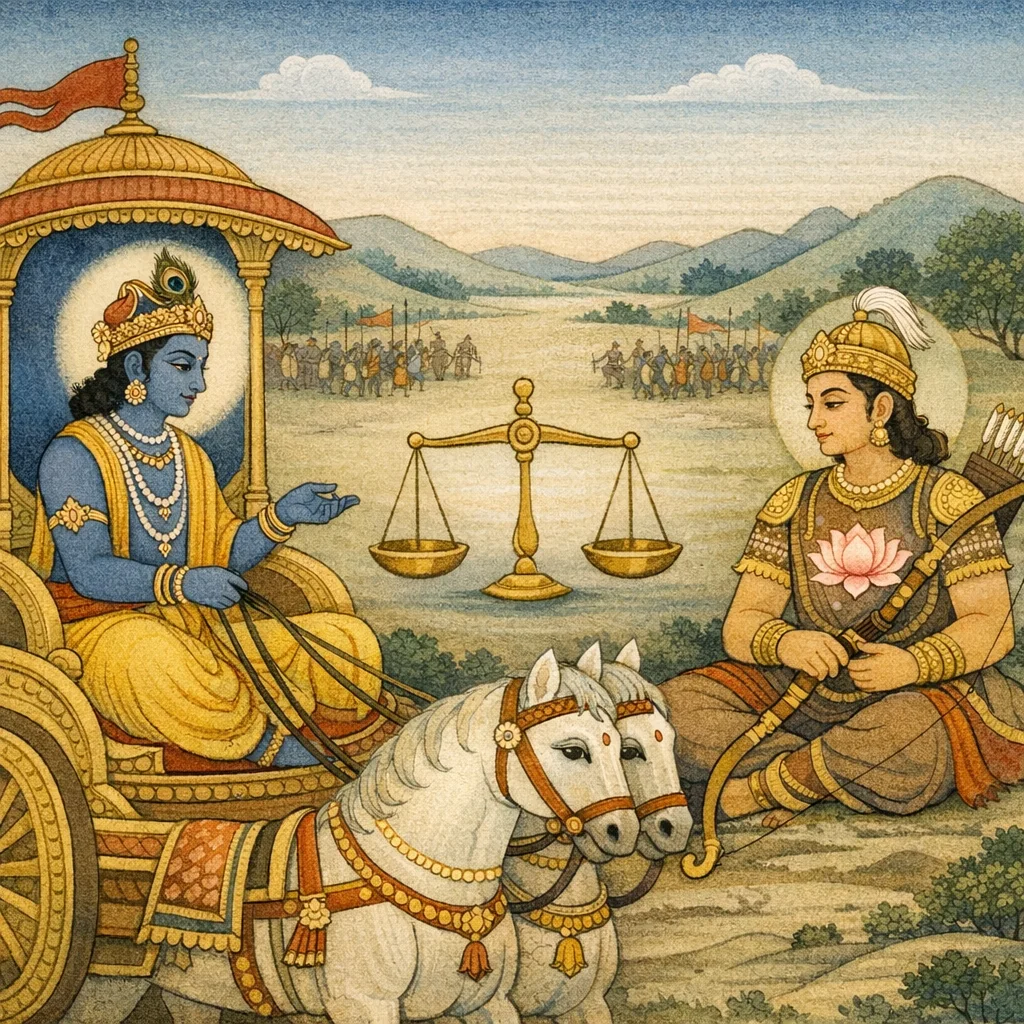
योगस्थः कुरु कर्माणि सङ्गं त्यक्त्वा धनंजय । सिद्ध्यसिद्ध्योः समो भूत्वा समत्वं योग उच्यते ॥ २.४८ ॥
yoga-sthaḥ kuru karmāṇi saṅgaṃ tyaktvā dhanañjaya | siddhy-asiddhyoḥ samo bhūtvā samatvaṃ yoga ucyate || 2.48 ||

Established in yoga, perform actions, O Dhanañjaya, abandoning attachment; becoming equal in success and failure—this equanimity is called yoga.
Established in yoga, perform actions, O Dhanañjaya, abandoning attachment; be equal in success and failure—such equanimity is called yoga.
Standing in yoga, do actions, abandoning attachment, O Dhanañjaya; having become equal toward success and non-success—equanimity is said to be yoga.
“Yoga-sthaḥ” is often interpreted as ‘grounded in disciplined integration’ (not merely a meditative posture). “Samatva” (evenness) is presented as a defining mark of yoga in action, linking ethical practice with contemplative stability.
FAQs
Equanimity here is an affective skill: maintaining composure and ethical intention despite fluctuating feedback, which supports consistent performance and reduced burnout.
By loosening attachment, the agent’s sense of self is less entangled with transient outcomes, aligning action with a more stable ground of awareness emphasized in Sāṃkhya-Yoga discourse.
It operationalizes 2.47: not only avoid fruit-fixation, but cultivate a stable inner stance while acting in demanding circumstances.
Practice outcome-neutral professionalism: evaluate results, learn, and adjust—without letting success inflate identity or failure collapse motivation.