
Bhagavad Gita — Sankhya Yoga, Shloka 28
Sankhya Yoga
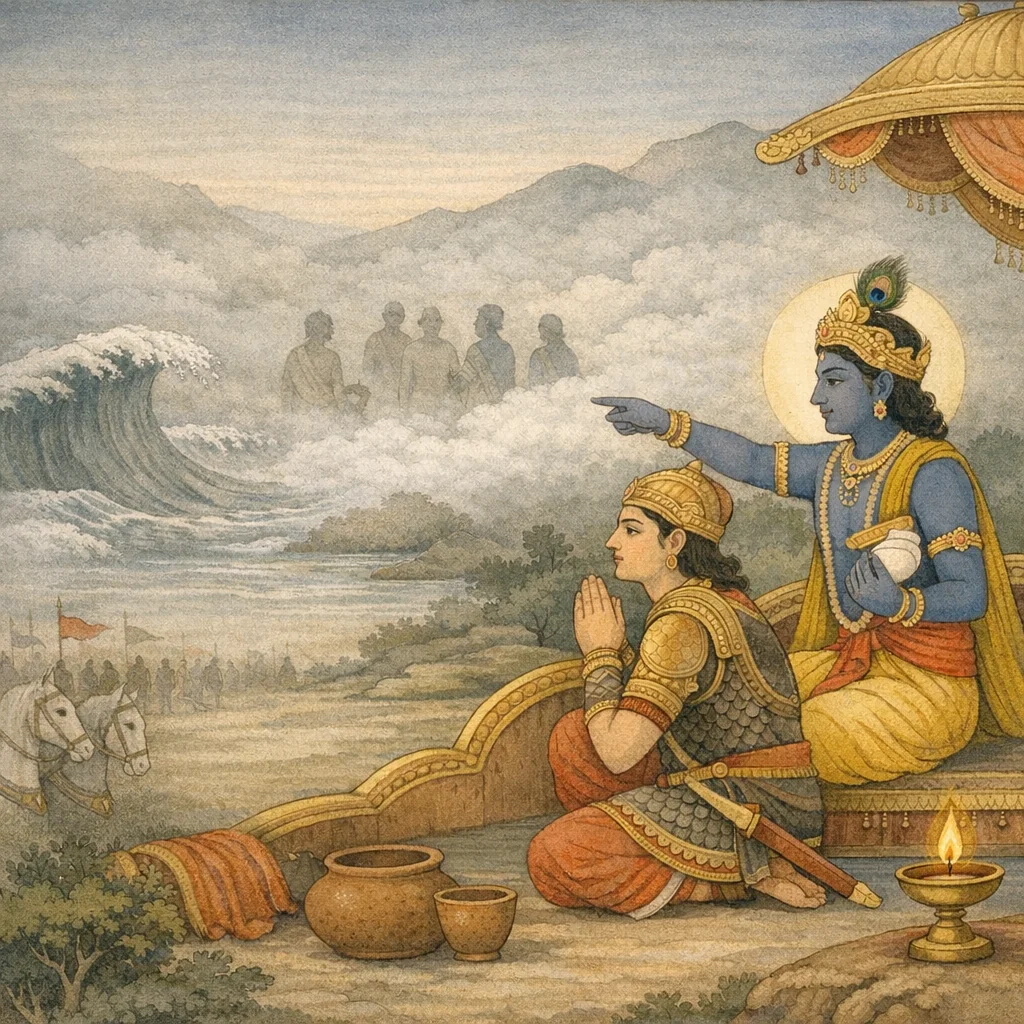
अव्यक्तादीनि भूतानि व्यक्तमध्यानि भारत । अव्यक्तनिधनान्येव तत्र का परिदेवना ॥ २.२८ ॥
avyaktādīni bhūtāni vyaktamadhyāni bhārata | avyaktanidhanāny eva tatra kā paridevanā || 2.28 ||

Beings are unmanifest in the beginning, manifest in the middle, O Bharata, and unmanifest again in the end. What is there to lament?
Beings are unmanifest in the beginning, manifest in the middle, and unmanifest again in the end; what is there to lament?
Entities have the unmanifest as their beginning, the manifest as their middle, and the unmanifest as their end; in that case, what ground is there for lamentation?
This verse is frequently linked to Sāṅkhya-like cosmology: manifestation is a temporary phase within a broader unmanifest condition; some commentators align “unmanifest” with prakṛti, others with epistemic non-appearance.
FAQs
It invites a wider time-horizon: when events are seen as phases of appearance and disappearance, emotional reactions can become less absolute.
The verse portrays embodied beings as transient expressions within a larger unmanifest ground, suggesting that manifestation is not ultimate.
It supports Krishna’s broader aim: to loosen Arjuna’s attachment to the visible, present form as the whole of reality.
Applied to life changes, it can foster resilience by treating successes and losses as temporary phases rather than final definitions.