
Bhagavad Gita — Sankhya Yoga, Shloka 42
Sankhya Yoga
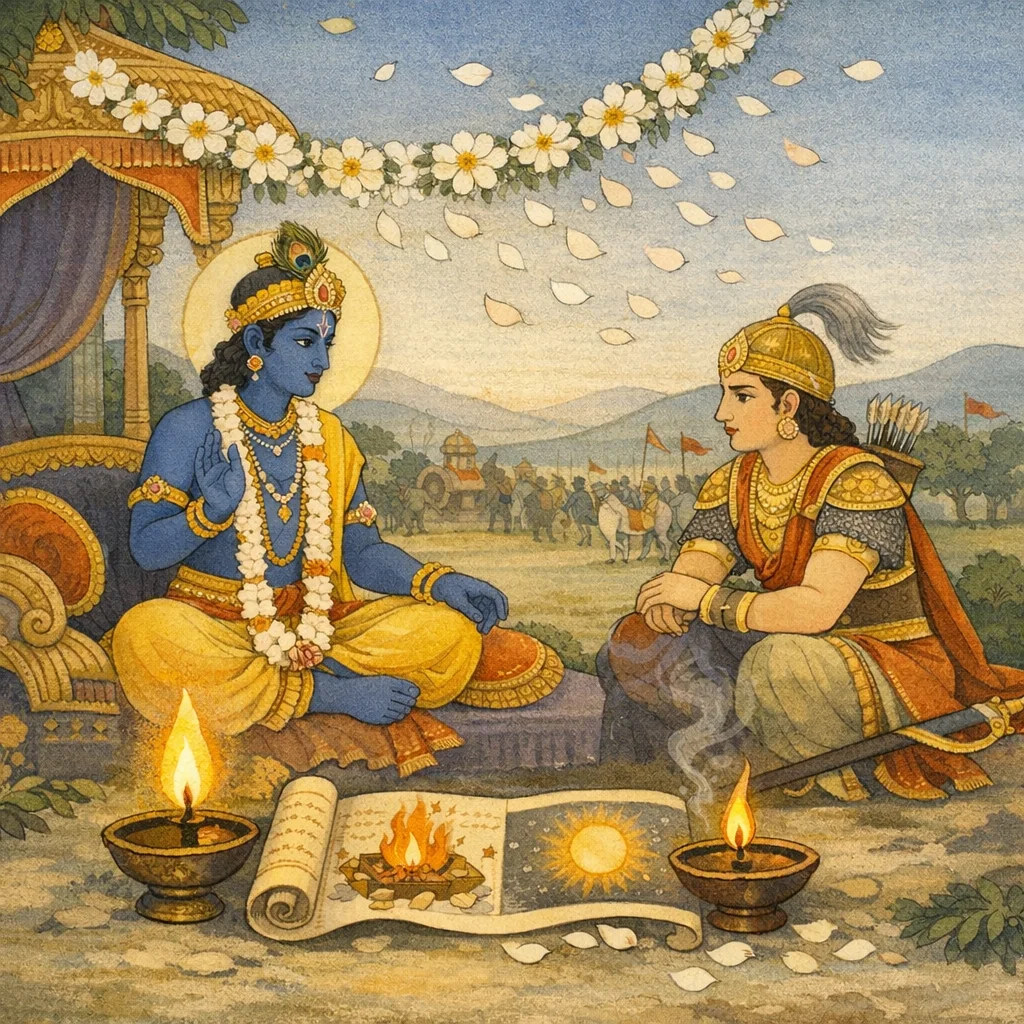
यामिमां पुष्पितां वाचं प्रवदन्त्यविपश्चितः । वेदवादरताः पार्थ नान्यदस्तीति वादिनः ॥ २.४२ ॥
yām imāṁ puṣpitāṁ vācaṁ pravadanty avipaścitaḥ | veda-vāda-ratāḥ pārtha nānyad astīti vādinaḥ || 2.42 ||

The unwise, delighting in Vedic words, utter flowery speech, O Pārtha, declaring, ‘There is nothing else.’
The unwise, delighting in the letter of the Vedas, utter flowery words, O Pārtha, saying: ‘There is nothing else.’
Those without discernment, devoted to Vedic formulations, proclaim this flowery speech, Pārtha, asserting ‘there is nothing else.’
puṣpitā vāc is “ornate/flowery speech,” often referring to promise-laden ritual discourse. The critique targets exclusivist fixation on ritual reward as the whole of religion, not the Vedas as such; later verses specify desire-driven motives.
FAQs
It points to how persuasive promises (status, pleasure, reward) can capture attention and narrow one’s horizon, reducing deeper reflection.
It suggests that ultimate reality or liberation is not exhausted by ritual reward frameworks; discernment is required to seek what transcends finite outcomes.
Krishna contrasts buddhi-yoga with a purely reward-oriented religiosity, preparing the ground for a teaching focused on intention and inner freedom.
It can be read as a critique of any system that equates spirituality with incentives alone, encouraging inquiry beyond performative or transactional religiosity.